AFP

Thermal drones seek survivors after deadly Italy glacier collapse

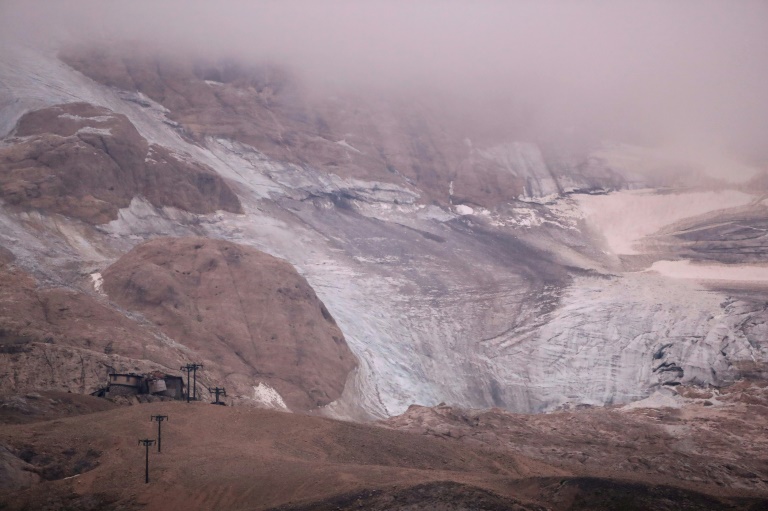
Rescuers used thermal drones Monday to search for possible survivors trapped under ice after an avalanche set off by the collapse of the largest glacier in the Italian Alps killed at least six people and injured eight others.

Authorities said they did not know how many climbers were hit when the glacier gave way Sunday on Marmolada, the highest mountain in the Italian Dolomites.

“We found bodies torn apart, in a shapeless tide of ice and debris stretching over 1,000 metres (3,280 feet),” Gino Comelli from the Alpine Rescue Service told the Corriere della Sera daily Monday.

The disaster struck one day after a record-high temperature of 10 degrees Celsius (50 degrees Fahrenheit) was recorded at the glacier’s summit.

Emergency services spokeswoman Michela Canova told AFP an “avalanche of snow, ice and rock” hit an access path at a time when there were several roped parties, “some of whom were swept away”.

The total number of climbers involved was “not yet known”, she said.

Helicopters and sniffer dogs were called off as night fell and amid fears the glacier may still be unstable.

But rescuers used drones equipped with thermal cameras to continue the search overnight and early Monday, Canazei mayor Giovanni Bernard told AFP.

“It is difficult for the rescuers in a dangerous situation”, he said.

Images of the avalanche filmed from a refuge close by show snow and rock hurtling down the mountain’s slopes.

“It’s a miracle we’re alive,” Stefano Dal Moro, an engineer who was hiking with his Israeli partner told Corriere della Sera.

“There was a dull noise, then that sea of ice came down. It’s useless to run, you can only pray that it doesn’t come your way.

“We crouched down and hugged each other tightly as the ice passed”.

Bodies dug out of the ice and rock were taken to the village of Canazei.

Italian Prime Minister Mario Draghi was expected to visit Canazei later Monday.

Massimo Frezzotti, a science professor at Roma Tre University, told AFP the collapse was caused by unusually warm weather linked to global warming, with precipitation down 40 to 50 percent during a dry winter.

“The current conditions of the glacier correspond to mid-August, not early July,” he said.

The Trento public prosecutor’s office has opened an investigation to determine the causes of the tragedy.

Ukraine retreats from key city in major Russian gain

The Ukrainian army retreated from the strategic city of Lysychansk over the weekend, as Russia claimed a major victory by seizing control of the entire eastern Lugansk region.

The Ukrainian withdrawal followed weeks of fierce fighting and marked a decisive breakthrough for Moscow’s forces more than four months after their invasion and after turning their focus away from the capital Kyiv.

Leaders from dozens of countries and international organisations will meet Monday in Switzerland to map out a “Marshall Plan” to rebuild Ukraine — aimed to begin even as Russia’s war efforts continue to rage.

A major flashpoint in the conflict, Lysychansk had been the final holdout in the Lugansk area of the eastern Donbas region and Moscow’s capture of it frees up Russian forces to advance on Kramatorsk and Sloviansk in neighbouring Donetsk. 

“The continuation of the defence of the city would lead to fatal consequences” in the face of Russia’s superiority in numbers and equipment, the Ukrainian army said in a statement announcing its retreat Sunday evening. 

“In order to preserve the lives of Ukrainian defenders, a decision was made to withdraw.

“Unfortunately, steel will and patriotism are not enough for success — material and technical resources are needed.”

The fall of Lysychansk comes after Russian forces seized its twin city of Severodonetsk last week after bouts of intense fighting. 

In an address late Sunday, Zelensky vowed Kyiv would fight on and ensure the military had “the most modern weapons”.

“Ukraine will reach the level when the fire superiority of the occupiers will be levelled.”

The latest country to provide aid was Australia, whose Prime Minister Anthony Albanese on Sunday pledged further military support — including armoured vehicles and drones during a meeting with Zelensky in Kyiv. 

– ‘Shooting from all sides’ –

On Sunday, Moscow accused Kyiv of firing three cluster missiles at the Russian city of Belgorod near the Ukrainian border, which came a day after neighbouring Belarus said it had intercepted Ukrainian missiles.

In what would represent an escalation of the conflict, Russia said its anti-aircraft defences shot down three Tochka-U cluster missiles launched by “Ukrainian nationalists” against Belgorod.

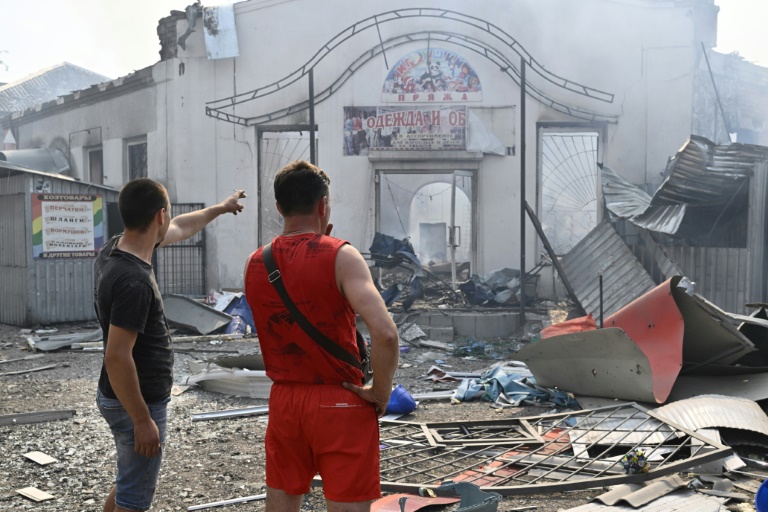
Eleven residential buildings and 39 houses had been damaged, Belgorod governor Vyacheslav Gladkov said. 

Moscow has previously accused Kyiv of conducting strikes on Russian soil, particularly in the Belgorod region.

On Saturday, Belarusian leader Alexander Lukashenko accused Kyiv of provocation and said his army intercepted missiles fired at his country by Ukrainian forces “around three days ago”.

Belarus, a Russian ally, supported the February 24 invasion and has been accused by Kyiv of launching its own attacks on Ukrainian territory.

Lukashenko denied any involvement in a recent cross-border incident, and said Belarus does “not intend to fight in Ukraine”.

About 75 kilometres (45 miles) west of Lysychansk, the city Sloviansk saw heavy Russian shelling which left six people dead — among them a nine-year-old girl, Zelensky said Sunday evening. 

About 20 others were wounded as “the Russian army once again brutally shelled” the city, as well as Kramatorsk and Kharkiv.

A strike on the town of Dobropillia — just southwest of Sloviansk — killed two people and wounded three, including two children, Donetsk authorities said.

The city of Siversk, 30 kilometres west of Lysychansk, also saw overnight shelling, residents and an official told AFP.

“It was intense, and it was shooting from all sides,” said a woman sheltering in a cellar.

Zelensky’s address Sunday evening was defiant — he pointed to Ukrainian troops progressing in the Kharkiv and Kherson regions, and vowed “there will be a day when we will say the same about Donbas”.

“We will rebuild the walls, we will win back the land, and people must be protected above all else,” Zelensky said. 

“Ukraine does not give anything up.”

By Monday, the overall death toll of children “as a result of armed aggression” from Russia stood at 345, Ukraine’s parliament said. 

Its army warned in an early morning report that “the enemy is regrouping troops to resume the offensive”. 

– ‘Democracy over autocracy’ –

Four months into the war, Ukraine has seen devastating destruction across about 10 regions. 

On Monday, leaders from dozens of countries and international organisations will meet in the Swiss city of Lugano, where they aim to hash out a roadmap for Ukraine’s reconstruction — expected to cost hundreds of billions of dollars.

Ukraine will also face demands for broad reforms, especially in cracking down on corruption after Brussels recently granted Kyiv candidate status in its push to join the 27-member European Union.

British Foreign Secretary Liz Truss is due to pledge both immediate humanitarian assistance as well as access to British financial and economic expertise, the foreign office said.

She will tell delegates that Ukraine’s recovery “will be a symbol of the power of democracy over autocracy”, it added.

But for residents in Bucha — a Ukrainian town synonymous with war crimes blamed on Moscow’s forces after their retreat in April — fear remains even as talk begins of reconstruction. 

“We’re going to bed without knowing if we’ll wake up tomorrow,” said Vera Semeniouk, 65. 

“Everyone has come back, is starting to repair houses, many are putting in new windows. It would be terrible if it started again and we had to leave everything again.”

Protests in US after release of video of police killing Black man

Several hundred protesters marched Sunday in Akron, Ohio after the release of body camera footage that showed police fatally shooting a Black man with several dozen rounds of bullets.

As anger rose over the latest police killing of a Black man in the United States, and authorities appealed for calm, a crowd marched to City Hall carrying banners with slogans such as “Justice for Jayland.”

The slogan refers to Jayland Walker, 25, who was killed Monday after officers tried to stop his car over a traffic violation, police said.

Sunday marked the fourth straight day of protests in the city of 190,000 people. Demonstrations during the day were peaceful but for a tense moment in which some protesters got close to a line of police and shouted at them.

Derrick Johnson, president of the NAACP, denounced the shooting as “murder… point blank” as the civil rights group led a daytime rally. 

“This Black man was killed… for a possible traffic violation. This doesn’t happen to white people in America,” he said in a statement, also slamming the police department’s response. 

Protests continued into the evening, with a hundred-strong crowd still in the streets in front of the justice center, an AFP reporter said.

Despite calls from some protesters for calm, tensions mounted as the night wore on. 

Some protesters set dumpsters alight and broke windows of the snowplows and other heavy equipment authorities had moved near the police department as a barrier in anticipation of unrest.

Police in riot gear deployed and fired tear gas at the crowd to push it back from the justice center. 

After initially providing few details of the shooting, Akron authorities released two videos Sunday: a compilation of body-camera footage, body-cam still frames and voiceover, and another of the complete body-cam footage of the entire chase and shooting.

The voiceover explained that Walker did not stop and drove off. Police engaged in a car chase and said a shot had been fired from Walker’s vehicle.

After being chased for several minutes, Walker got out of his car while it was still moving and fled on foot. Officers tried to subdue him with their tasers, but he kept running.

Several officers finally chased Walker to a parking lot. The body-cam footage is too blurry to see clearly what happens, but an initial police statement released after the shooting says Walker behaved in a way that caused officers to believe he posed a “deadly threat.”

– ‘Over 60 wounds’ to body –

All of the officers at the scene opened fire on Walker, shooting multiple times in rapid succession.

He was pronounced dead at the scene.

The incident was the latest death of an African-American citizen at the hands of police, events that have sparked mass protests over racism and police brutality.

“Many will wish to air their grievances in public, and I fully support our residents’ right to peacefully assemble,” Akron mayor Dan Horrigan told a press conference, saying he was “heartbroken” over the events.

“But I hope the community can agree that violence and destruction are not the answer.”

He also said an independent investigation was being conducted.

Bobby DiCello, a lawyer for the Walker family, told The New York Times: “I’ve been a trial lawyer for 22 years and I’ve never seen anything remotely close to what that video is going to show.”

Police chief Steve Mylett said he didn’t know the exact number of bullets fired at Walker, but the medical examiner’s report “indicates over 60 wounds to Mr. Walker’s body.”

He added that the eight officers involved in Walker’s death have been placed on paid administrative leave until the investigation is complete.

Authorities canceled a festival planned for the July 4th Independence Day holiday weekend.

Basketball star LeBron James, an Akron native, said in a tweet Sunday he was praying for his city.

Large Hadron Collider revs up to unprecedented energy level

Ten years after it discovered the Higgs boson, the Large Hadron Collider is about to start smashing protons together at unprecedented energy levels in its quest to reveal more secrets about how the universe works.

The world’s largest and most powerful particle collider started back up in April after a three-year break for upgrades in preparation for its third run. 

From Tuesday it will run around the clock for nearly four years at a record energy of 13.6 trillion electronvolts, the European Organisation for Nuclear Research (CERN) announced at a press briefing last week. 

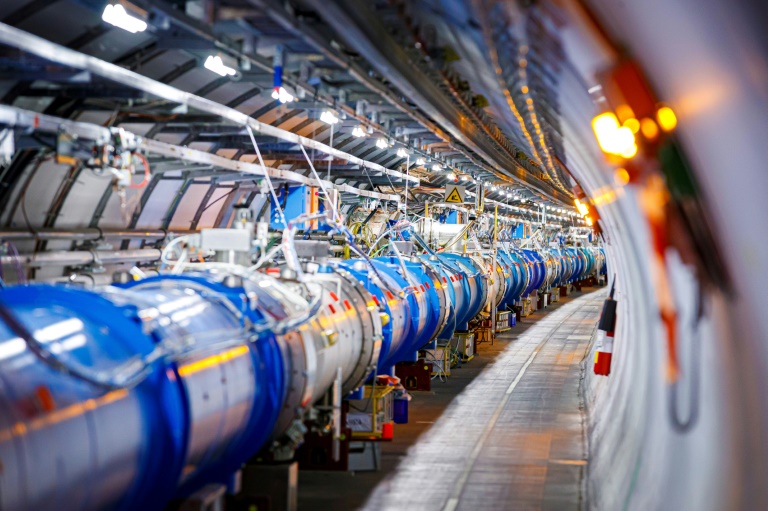
It will send two beams of protons — particles in the nucleus of an atom — in opposite directions at nearly the speed of light around a 27-kilometre (17-mile) ring buried 100 metres under the Swiss-French border.

The resulting collisions will be recorded and analysed by thousands of scientists as part of a raft of experiments, including ATLAS, CMS, ALICE and LHCb, which will use the enhanced power to probe dark matter, dark energy and other fundamental mysteries.

– 1.6 billion collisions a second –

“We aim to be delivering 1.6 billion proton-proton collisions per second” for the ATLAS and CMS experiments, CERN’s head of accelerators and technology Mike Lamont said.

This time around the proton beams will be narrowed to less than 10 microns — a human hair is around 70 microns thick — to increase the collision rate, he added.

The new energy rate will allow them to further investigate the Higgs boson, which the Large Hadron Collider first observed on July 4, 2012.

The discovery revolutionised physics in part because the boson fit within the Standard Model — the mainstream theory of all the fundamental particles that make up matter and the forces that govern them.

However several recent findings have raised questions about the Standard Model, and the newly upgraded collider will look at the Higgs boson in more depth.

“The Higgs boson is related to some of the most profound open questions in fundamental physics today,” said CERN director-general Fabiola Gianotti, who first announced the boson’s discovery a decade ago.

Compared to the collider’s first run that discovered the boson, this time around there will be 20 times more collisions.

“This is a significant increase, paving the way for new discoveries,” Lamont said.

Joachim Mnich, CERN’s head of research and computing, said there was still much more to learn about the boson.

“Is the Higgs boson really a fundamental particle or is it a composite?” he asked.

“Is it the only Higgs-like particle that exists — or are there others?”

– ‘New physics season’ – 

Past experiments have determined the mass of the Higgs boson, as well as more than 60 composite particles predicted by the Standard Model, such as the tetraquark.

But Gian Giudice, head of CERN’s theoretical physics department, said observing particles is only part of the job.

“Particle physics does not simply want to understand the how — our goal is to understand the why,” he said.

Among the Large Hadron Collider’s nine experiments is ALICE, which probes the matter that existed in the first 10 microseconds after the Big Bang, and LHCf, which uses the collisions to simulate cosmic rays.

After this run, the collider will come back in 2029 as the High-Luminosity LHC, increasing the number of detectable events by a factor of 10.

Beyond that, the scientists are planning a Future Circular Collider — a 100-kilometre ring that aims to reach energies of a whopping 100 trillion electronvolts.

But for now, physicists are keenly awaiting results from the Large Hadron Collider’s third run.

“A new physics season is starting,” CERN said.

Thousands evacuate from 'dangerous' Sydney floods

Rapidly rising rivers swamped swathes of rain-lashed Sydney on Monday, forcing thousands to flee “dangerous” floods as the city’s largest dam spilled torrents of water.

On the third day of torrential east coast rains, emergency workers said they had rescued more than 80 people since the previous evening.

Many people had been trapped in their cars trying to cross flood-swept roads or were unable to leave homes surrounded by rising waters.

Australia has been at the sharp end of climate change, with droughts, deadly bushfires, bleaching events on the Great Barrier Reef and floods becoming more common and intense as global weather patterns change.

Higher temperatures mean the atmosphere holds more moisture, unleashing more rain.

About 32,000 people were ordered to evacuate or be ready to flee across New South Wales, the emergency services department said, with the army sending 100 troops to help operations in the storm-battered state.

“The ground is saturated, the rivers are fast flowing, the dams are overflowing,” said State Emergency Services commissioner Carlene York.

“It is particularly dangerous out there,” she said at a news conference.

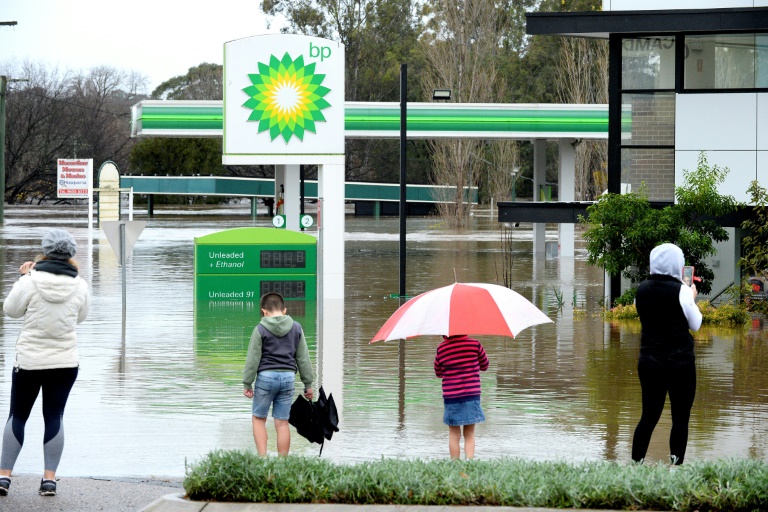
Mud-brown river waters transformed a large stretch of land into a lake in the southwestern Sydney suburb of Camden. 

Roads disappeared into the waters and mobile homes stood in knee-high water, at least one toppled on its side, television images showed.

Large volumes of water gushed from the Warragamba Dam, which has been spilling excess water since Sunday.

The huge concrete dam lies on the western outskirts of Sydney and provides most of the city’s drinking water.

Heavy rains in New South Wales may persist for at least another 24 hours, forecasters said.

– ‘Becoming more common’ –

The wild weather whipped up drama off the Sydney coast, as rescuers battled to help the 150-metre Portland Bay cargo ship with 21 crew which lost power in heavy seas.

The Hong Kong-registered bulk carrier is double-anchored, a police spokesman said. 

A plan to airlift crew members off the boat with two helicopters had been delayed because of safety concerns, he said. 

Two tugboats were headed to the ship to take it further offshore.

Australia’s east coast has suffered repeated flooding in the past 18 months.

More than 20 people died only in March this year as floodwaters lapped at rooftops and torrents swept cars off roads.

The current weather system over Sydney is being fed by warm, wet air from near the equator, said Kimberley Reid, an atmospheric scientist at Monash University. 

Rainfall in eastern Australia is highly variable, making it hard to pin this event to climate change, she said.

“However, our research of the March 2021 Sydney floods found that similar events over Sydney were likely to occur 80 percent more often by the end of the 21st century.”

Australia must prepare for more regular flooding events, New South Wales Premier Dominic Perrottet told a news conference.

“There is no doubt these events are becoming more common,” he said.

“Governments need to adjust and make sure that we respond to the changing environment we find ourselves in.”

Chinese developer Shimao misses $1 bn bond payment

Chinese developer Shimao Group said it has failed to make payment on a $1 billion bond that matured Sunday, one of the biggest such defaults so far this year in the country’s troubled property sector.

China’s real estate sector has been struggling since authorities began a crackdown on excessive debt and rampant consumer speculation in 2020, with giants such as Evergrande and Sunac scrambling to make payments and renegotiate with creditors.

The crisis has sparked fears that the industry’s struggles could spread to the wider economy, and the latest jolt came Sunday when Shimao said it had not paid the principal and interest on a $1 billion offshore note.

In a filing to the Hong Kong Stock Exchange, where it is listed, Shimao said it has experienced a noticeable decline in contracted sales due to “significant changes to the macro environment of the property sector in China since the second half of 2021 and the impact of Covid-19”.

The firm added that it had attempted to negotiate refinancing and waivers but was unable to make some payments because of “challenging” market conditions.

It said it has not received notice from creditors for accelerated repayment, and that lenders have indicated they will not take enforcement action at this point.

Shimao develops residential, hotel, office and commercial properties in China, with projects in major cities such as Beijing and Shanghai.

It was China’s 14th biggest developer by contracted sales last year, according to Bloomberg News.

China’s developers have been struggling as homebuyers tightened their purse strings owing to an uncertain economic outlook.

One company in the eastern city of Nanjing said it would accept truckloads of watermelons as downpayment from local farmers, according to Chinese media.

“The contagion has spread from Evergrande to Sunac and now Shimao,” said Bloomberg Intelligence analyst Kristy Hung.

“That raises our concerns that the extent of the debt crisis is beyond any market watcher’s imagination.”

Rescuers resume search after Italian glacier collapse kills six

Rescuers were to resume the search for survivors on Monday after an avalanche set off by the collapse of the largest glacier in the Italian Alps killed at least six people and injured eight others.

Authorities said they did not know “the total number of climbers” hit when the glacier collapsed Sunday on Marmolada, the highest mountain in the Italian Dolomites.

The disaster struck one day after a record-high temperature of 10 degrees Celsius (50 degrees Fahrenheit) was recorded at the glacier’s summit. 

“An avalanche of snow, ice and rock hit an access path at a time when there were several roped parties, some of whom were swept away,” emergency services spokeswoman Michela Canova told AFP.

Six people had been confirmed dead and eight were injured, she added while “the total number of climbers involved is not yet known”.

Two of the injured were taken to hospital in Belluno, another in a more serious condition was taken to Treviso and five to Trento.

She did not specify the nationalities of the victims, but Italian media reported that foreign nationals were among them.

The Alpine rescue corps has activated a toll-free number for people to report friends or relatives who had not returned from an excursion to the glacier.

Several helicopters were scrambled to take part in the initial rescue operation but the search for survivors had to be suspended at nightfall and would resume early Monday.

Rescuers in the nearby Veneto region of northeast Italy said they had deployed all their Alpine teams, including sniffer dogs.

Italian Prime Minister Mario Draghi expressed his “sincerest condolences” to the victims and their families on Twitter.

Massimo Frezzotti, a science professor at Roma Tre University, told AFP the collapse was caused by unusually warm weather linked to global warming, with precipitation down 40-50 percent during a dry winter.

“The current conditions of the glacier correspond to mid-August, not early July,” he said.

– Further collapses feared –

Images filmed from a refuge close to the incident show snow and rock hurtling down the mountain’s slopes and causing a thunderous noise.

Other footage shot by tourists on their mobile phones showed the greyish avalanche sweep away everything in its path.

The mountain rescue team released images showing rescuers and helicopters at the scene to take victims from the valley to the village of Canazei.

Their task was made harder because the bodies were trapped under a layer of ice and rock.

A team of psychologists was on hand to support the relatives of the victims. The Trento public prosecutor’s office has opened an investigation to determine the causes of the tragedy.

Experts quoted by the Corriere della Sera daily said they feared further collapses of ice.

Glacier specialist Renato Colucci told the Italian agency AGI that the phenomenon was “bound to repeat itself”, because “for weeks the temperatures at altitude in the Alps have been well beyond normal values”.

The recent warm temperatures had produced a large quantity of water from the melting glacier that accumulated at the bottom of the block of ice and caused it to collapse, he added.

The Marmolada glacier is the largest in the Dolomites mountain range, which is part of the Italian Alps and situated on the northern face of Marmolada. 

The glacier, nicknamed “the queen of the Dolomites”, feeds the Avisio river and overlooks Lake Fedaia in the autonomous Italian province of Trento.

According to a March report by the UN Intergovernmental Panel on Climate Change (IPCC), melting ice and snow is one of 10 major threats caused by global warming, disrupting ecosystems and infrastructure.

The IPCC has said glaciers in Scandinavia, central Europe and the Caucasus could lose between 60 and 80 percent of their mass by the end of the century.

The traditional way of life of people such as the Sami in Finland’s Lapland, who raise reindeer, has already been affected.

Thawing permafrost is also hampering economic activity in Canada and Russia.

Ukraine retreats from key city in major Russian gain

The Ukrainian army retreated from the strategic city of Lysychansk over the weekend, as Russia claimed a major victory by seizing control of the entire eastern Lugansk region.

The Ukrainian withdrawal followed weeks of fierce fighting and marked a decisive breakthrough for Moscow’s forces more than four months after their invasion and after turning their focus away from the capital Kyiv.

Leaders from dozens of countries and international organisations will meet Monday in Switzerland to map out a “Marshall Plan” to rebuild Ukraine — aimed to begin even as Russia’s war efforts continue to rage.

A major flashpoint in the conflict, Lysychansk had been the final holdout in the Lugansk area of the eastern Donbas region and Moscow’s capture of it frees up Russian forces to advance on Kramatorsk and Sloviansk in neighbouring Donetsk. 

“The continuation of the defence of the city would lead to fatal consequences” in the face of Russia’s superiority in numbers and equipment, the Ukrainian army said in a statement announcing its retreat Sunday evening. 

“In order to preserve the lives of Ukrainian defenders, a decision was made to withdraw.

“Unfortunately, steel will and patriotism are not enough for success — material and technical resources are needed.”

The fall of Lysychansk comes after Russian forces seized its twin city of Severodonetsk last week after bouts of intense fighting. 

In an address late Sunday, Zelensky vowed Kyiv would fight on and ensure the military had “the most modern weapons”.

“It requires many negotiations, but we will ensure such a supply. Ukraine will reach the level when the fire superiority of the occupiers will be levelled.”

The latest country to provide aid was Australia, whose Prime Minister Anthony Albanese on Sunday pledged further military support — including armoured vehicles and drones during a meeting with Zelensky in Kyiv. 

– ‘Shooting from all sides’ –

On Sunday, Moscow accused Kyiv of firing three cluster missiles at the Russian city of Belgorod near the Ukrainian border, which came a day after neighbouring Belarus said it had intercepted Ukrainian missiles.

In what would represent an escalation of the conflict, Russia said its anti-aircraft defences shot down three Tochka-U cluster missiles launched by “Ukrainian nationalists” against Belgorod.

Eleven residential buildings and 39 houses had been damaged, Belgorod governor Vyacheslav Gladkov said. 

Russia has previously accused Kyiv of conducting strikes on Russian soil, particularly in the Belgorod region.

On Saturday, Belarusian leader Alexander Lukashenko accused Kyiv of provocation and said his army intercepted missiles fired at his country by Ukrainian forces “around three days ago”.

Belarus, a Russian ally, supported the February 24 invasion and has been accused by Kyiv of launching its own attacks on Ukrainian territory.

Lukashenko denied any involvement in a recent cross-border incident.

“We do not intend to fight in Ukraine,” he said, according to state news agency Belta on Saturday.

About 75 kilometres (45 miles) west of Lysychansk, the city Sloviansk saw heavy Russian shelling which left six people dead — among them a nine-year-old girl, Zelensky said Sunday evening. 

About 20 others were wounded as “the Russian army once again brutally shelled” the city, as well as Kramatorsk and Kharkiv.

A strike on the town of Dobropillia — just southwest of Sloviansk — killed two people and wounded three, including two children, Donetsk authorities said.

The city of Siversk, 30 kilometres west of Lysychansk, also saw overnight shelling, residents and an official told AFP.

“It was intense, and it was shooting from all sides,” said a woman sheltering in a cellar.

Russian forces “have now gathered their largest firepower in Donbas, and they can use tens of thousands of artillery shells every day on one section of the front,” Zelensky said. 

But Ukrainian troops had progressed in Kharkiv and Kherson regions, he added, vowing that “there will be a day when we will say the same about Donbas.”

“We will rebuild the walls, we will win back the land, and people must be protected above all else,” Zelensky said. “Ukraine does not give anything up.”

A Ukrainian official said Sunday that Kyiv’s forces had seen another success in Melitopol where they had “put out of action” a Russian military base, while the army said the air force had destroyed around 20 Russian units and two ammunition depots.

“The town of Melitopol is covered in smoke,” said the city’s exiled mayor Ivan Fedorov.

– ‘Democracy over autocracy’ –

Four months into the war, Ukraine has seen devastating destruction across about 10 regions. 

On Monday, leaders from dozens of countries and international organisations will meet in the Swiss city of Lugano, where they aim to hash out a roadmap for Ukraine’s reconstruction — expected to cost hundreds of billions of dollars.

Ukraine will also face demands for broad reforms, especially in cracking down on corruption after Brussels recently granted Kyiv candidate status in its push to join the 27-member bloc.

British Foreign Secretary Liz Truss is due to pledge both immediate humanitarian assistance as well as access to British financial and economic expertise, the foreign office said.

She will tell delegates that Ukraine’s recovery “will be a symbol of the power of democracy over autocracy”, it added.

US drought exposes murky mob past of Las Vegas

Mobsters who end up sleeping with the fishes are usually never seen again.

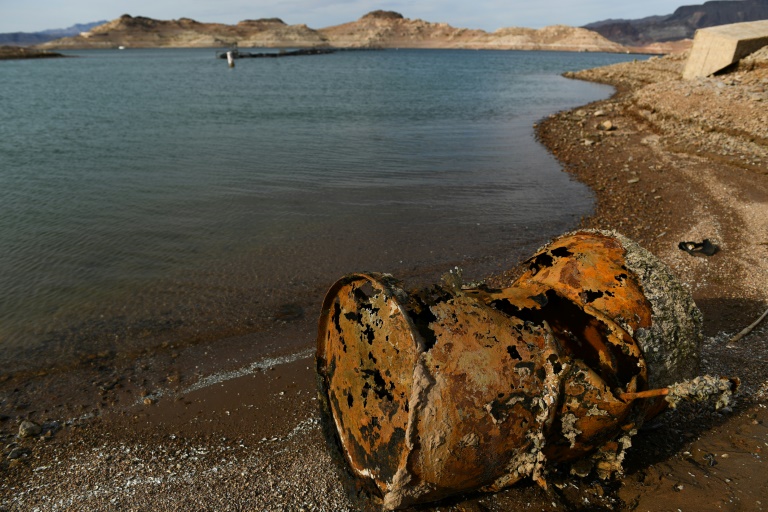
But climate change has a way of messing even with the mafia, and a watery grave outside Las Vegas is starting to cough up Sin City’s darkest secrets.

Lake Mead, which can be reached from the Las Vegas Strip by a short ride in the trunk of a car with your hands and feet bound, is drying up in a grueling decades-long drought.

Its receding waters are leaving behind the usual flotsam and jetsam of a lake heavily trafficked by weekend boaters.

But also bodies.

One particular find caught the attention of mob-watchers: the skeletal remains of a man who had been shot in the head, stuffed in a barrel and tossed in the lake four decades ago.

“The mob had a propensity to put people in barrels, whether they’re burying them in a lake, or dumping them out in the field,” said Geoff Schumacher of The Mob Museum in Las Vegas.

“That’s number one. Number two, the person was shot in the head, typical mob hit style.

“And third, we know that this happened in the late ’70s, early ’80s (when) the mob was very prominent in Las Vegas.”

– Oasis –

An improbable oasis of hotels, casinos and vice sprouted in the baking Nevada desert in the 20th century.

Las Vegas had been founded in 1905, but it wasn’t until work began on the nearby Hoover Dam in the 1930s that its population swelled.

The influx of construction workers — mostly single men — created a market for entertainment, which was filled by sex workers, showgirls and legalized gambling.

And where there is flesh, casinos and booze, organized crime is lurking in the background.

“The mob played a pretty big role in the development of Las Vegas from the 1940s through the 1980s,” said Schumacher.

“There was a lot of behind-the-scenes activity where the mob was controlling the management of the casinos, but also building and expanding the casinos, using in many cases, Teamsters union money.”

The city grew rich in the post-World War II boom that fueled the American dream, becoming the global capital of gambling.

And for every $100 that a hapless tourist lost at the blackjack table in a fug of free booze, a mafia boss in Chicago or New York wanted his cut.

The skimming, which doubtless cost the city millions of dollars in lost taxes, was a double-edged sword.

“They also sort of created this mystique about Las Vegas,” said Schumacher. 

“People wanted to come to Las Vegas, on the idea that ‘oh, maybe when I sit down at the bar, there’s going to be a mob guy sitting next to me.'”

– ‘Cold-blooded killers’ –

But it wasn’t all glamour. 

“The reality was that these guys were cold-blooded killers; they were thieves. If you were to cross the mob in some way… there definitely were consequences.”

Las Vegas police are still investigating the body found in the barrel at Lake Mead earlier this year, and in response to AFP inquiries would only say there is an ongoing probe.

But Schumacher has his theories about the identity of the dead man.

One suggestion is that he was Jay Vandermark, who worked at the Stardust Hotel, an operation run by Frank “Lefty” Rosenthal on behalf of the Chicago Mob.

Rosenthal — who was played by Robert De Niro in the movie “Casino” — was funneling cash back to his bosses, until the scheme drew the attention of local authorities.

Vandermark disappeared shortly thereafter.

A more likely candidate for the body in the barrel, however, is a man named Harry Pappas who was also connected to the Chicago Mob.

“One of the extra perks for visitors to Las Vegas, if you were a high roller… was they would take you out on the boat at Lake Mead,” Schumacher said.

“The Stardust had a boat out there and Harry Pappas was in charge of that whole operation.

“Right before he disappeared, he told his wife he was going to lunch with someone who was interested in buying his boat. We’ve never seen Harry Pappas again.”

Lake Mead is a massive reservoir on the Colorado River created by the Hoover Dam. It is now just a quarter full — the result of a drought and warming temperatures fueled by man-made climate change — and shows no sign of stabilising.

As its shoreline retreats, revealing more of the lake bed, it may yield more mob secrets, said Schumacher.

“I don’t know if we find another body in a barrel, but I have to believe that there could very well be a second murder victim out there.”

Covid-19 misinformation bolsters anti-vaccine movement

More parents are questioning the necessity of routine vaccinations for young children. Adults are skipping shots as well, even for vaccines with a long safety record.

The trend comes amid a wave of misinformation and disinformation about Covid-19 and the vaccines that helped to stem pandemic deaths. Politicization of the Covid-19 shots has bolstered the anti-vaccine movement, contributing to the decline in routine immunizations for measles, polio and other dangerous diseases.

“They ask if these are truly necessary, or if we can give them at later times,” said Jason Terk, a Texas pediatrician and spokesperson for the American Academy of Pediatrics. 

“This is not the majority of parents, but we are seeing a higher number.”

The anti-vaccine movement has mushroomed as its messages on social media are amplified by conservative political figures as well as foreign influence operations, whose vaccine disinformation efforts pre-date the pandemic.

With routine immunization rates falling, concerns are growing about a resurgence of diseases which had largely been eradicated in many parts of the world.

In the United States, the percentage of kindergarten children with recommended immunizations fell a percentage point to 94 percent in the 2020-21 school year, representing some 35,000 children unvaccinated. 

“I refer to it as the parallel contagion,” Terk said. “This seems to have at its origin hesitancy in Covid-19 vaccinations and increasing distrust of vaccines and the bodies we’ve relied on to keep us healthy and well.”

Dramatic changes were seen in some states, especially during the height of the pandemic: researchers found a 47 percent drop in immunization rates in Texas among five-month-olds and a 58 percent decline for 16-month-olds between 2019 and 2020.

The researchers, writing in the scientific journal Vaccine, said the declines resulted from shelter-in-place restrictions and vaccine exemptions, but also to “an aggressive anti-vaccine movement in Texas.”

Washington state reported a 13 percent decline in childhood immunization rates in 2021 compared with pre-pandemic levels and Michigan’s vaccination rate for toddlers fell last year to 69.9 percent, the lowest in a decade.

– Adults too –

Adult and adolescent inoculation rates have also dropped for vaccines protecting against diseases such as influenza, hepatitis, measles, tetanus and shingles, according to health consultancy Avalere, which analyzes insurer claims.

This has led to an estimated 37 million missed vaccination doses from January 2020 to July 2021 for adults and children ages seven and older, Avalere found.

Declines early in the pandemic can be attributed to shelter-in-place orders and social distancing, but “there is a risk of a bleed-over” of Covid vaccine misinformation, which affects other vaccines which have a longstanding safety record, noted Avalere managing director Jason Hall.

Social media have helped create a coalition that includes true anti-vaccine believers, libertarians and conservative political figures. These segments have been amplified by disinformation actors from Russia and elsewhere, said David Broniatowski, a George Washington University professor and associate director of the school’s Institute for Data, Democracy and Politics.

“People have been opposing vaccines for as long as there have been vaccines, but they’ve gotten more sophisticated over the past 10 years and a lot of that has been because of the ability to organize on social media across boundaries,” said Broniatowski, who researches vaccine disinformation.

He noted that while anti-vaccine activists, libertarians and foreign agents are not necessarily coordinating, “they have found common cause” in opposing vaccine mandates.

“One of the main changes we’ve seen is a pivot away from focusing on vaccines per se as a health issue to a civil rights and a political issue,” he added.

Conspiracy theories have surged during the pandemic, according to a 2021 YouGov poll, which found 28 percent of Americans and significant numbers in other countries say the truth about the harmful effects of vaccines is being “deliberately hidden.”

– Foreign actors –

Broniatowski said that foreign disinformation agents “use vaccines as a wedge issue that can mobilize a segment of the population.” 

A 2018 paper co-authored by Broniatowski in the American Journal of Public Health found anti-vaccine Twitter activity was amplified by Russian trolls from 2014 to 2017 as part of an effort to promote discord and undermine confidence in the health system.

Research from the Center for European Policy Analysis showed both China and Russia have promoted Covid-19 vaccine misinformation, in part to show that Western governments are incompetent and can’t be trusted.

“There’s been a concerted effort on the part of these actors to diminish the standing of science because it serves their political purposes,” Broniatowski said.

The problem is growing globally as well. A United Nations report last year found 23 million children worldwide missed out on routine immunizations in 2020. In the Americas region, the percentage of fully inoculated children fell to 82 percent from 91 percent in 2016 due to factors including funding shortfalls, vaccine misinformation and instability.

This is likely to create more health risks down the road from diseases which have been mostly contained.

“We had certain thresholds of protection to keep these diseases from being relevant from a public health point of view,” Terk said.

“The more people pushing back, the more likely we’ll have pockets of vulnerability.”

Close Bitnami banner
Bitnami