AFP

Central African Republic dives into crypto with the Sango

Undeterred by the turmoil hitting crypto, the Central African Republic (CAR) — one of the poorest and most troubled countries in the world — has unveiled plans to launch its own digital currency.

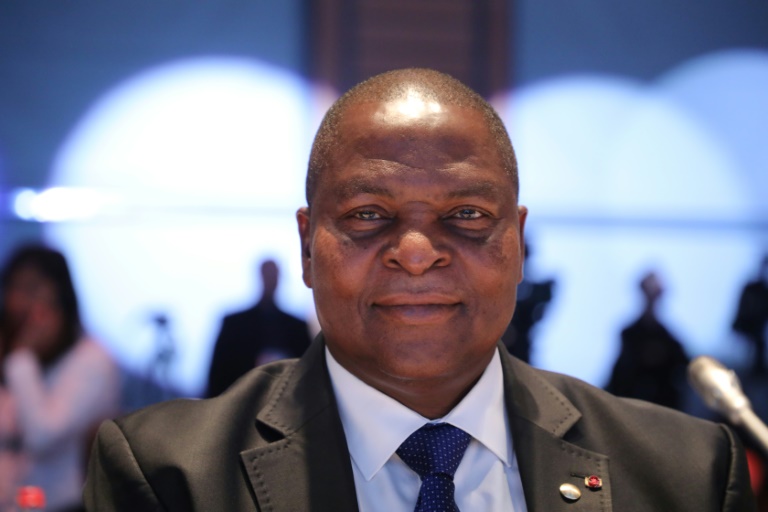
President Faustin Archange Touadera, in an “online event” on Sunday, announced CAR would create the Sango Coin and a zero-taxation “crypto-hub”, the first in Africa.

The currency is named after Sango, which with French is one of the two official languages in the landlocked country, rated the world’s second poorest nation under the UN’s Human Development Index.

Through a platform called Crypto Island, the Sango will become “the catalyst for tokenising (CAR’s) vast natural resources,” Touadera declared, providing no timeline or other details.

He hailed Sango and Crypto Island as “a new digital system fed by blockchain,” the internet-based ledger that underpins crypto currencies.

“Sango Coin will give the whole world direct access to our resources,” attracting investors and “getting the engines of the economy going,” he enthused.

On April 27, Touadera’s office abruptly announced that the CAR had adopted Bitcoin as legal tender alongside the CFA franc, a currency the country shares with five other central African economies.

It became the first country in Africa to embrace Bitcoin as a national currency, and the second in the world after El Salvador last September.

The April announcement sparked bemusement among analysts, given the entrenched poverty and lack of infrastructure in the CAR, where only one person in seven has access to mains electricity. 

They also voiced concern about the impact of crypto volatility on savings.

Virtual currencies have gone into a tailspin as investors look to safer havens at a time of inflation and uncertainty sparked by the Ukraine war.

Bitcoin has lost nearly 60 percent of its value over the past six months.

– ‘Digital gold’ –

Touadera on Sunday said 57 percent of Africa’s population does not have access to a bank.

“The solution,” he said, was “the smartphone, the alternative to the traditional bank, cash and financial red tape”.

On Twitter, he said, “gold served as the engine of our civilisation for ages! In this new age, digital gold will serve the same for the future.”

The CAR’s rush to crypto has been seen by some critics in the context of its closer ties with Russia.

Touadera has been accused of using Russian paramilitaries to buttress his regime and offering CAR’s natural resources in exchange. 

The country has a treasure chest of minerals, ranging from copper and gold to diamonds and uranium.

The CAR, a former French colony, plunged into a civil war along sectarian lines in 2013 after the then-president, Francois Bozize, was ousted.

Touadera was first elected in 2016 after an interim period and re-elected in disputed circumstances in 2020.

Violence diminished in 2018 but rebel forces remain active.

European equities recover as optimism creeps back in

Europe’s stocks recovered somewhat Monday as investors tentatively regained some optimism following the heavy losses in the financial markets last week on fears that rising interest rates could spark recession.

London stocks won 1.1 percent at midday, while Frankfurt and Paris gained 0.5 percent and 1.0 percent respectively in afternoon deals.

Tokyo and Shanghai also advanced but Hong Kong nudged lower. The dollar traded mixed while oil prices were subdued.

– ‘Sliver of optimism’ –

“A sliver of optimism has broken through on global markets at the start of the week,” said Susannah Streeter, senior investment and markets analyst at Hargreaves Lansdown.

Europe’s investors on Friday absorbed news of record-high eurozone inflation that reinforced expectations of a European Central Bank interest rate hike in July.

Markets have suffered sharp losses in recent weeks on fears that global rate hikes — aimed at fighting soaring inflation — could send economies into a downturn.

“Overall caution is still the name of the game as investors nurse wounds from a bruising first half of the year,” Streeter said.

Wall Street meanwhile remains shut for the Independence Day holiday on Monday.

City Index analyst Fawad Razaqzada cautioned that global markets might yet have further to fall.

– ‘Pinch of salt’ –

“Nothing has changed fundamentally to suggest the markets have bottomed out,” Razaqzada told AFP.

“It is a quiet day with the US out and economic calendar light. So anything we see today should be taken with a pinch of salt.”

Back in Asia, data showing a flare-up of fresh Covid-19 cases in China revived concerns about the government’s policy of locking down towns and cities to eradicate the disease, despite the economic cost.

The jump in new Covid cases weighed on sentiment among investors who fear a return to the painful lockdowns in major cities including Shanghai, which hammered the world’s number-two economy.

In a sign of the struggle officials will have in controlling rising prices, data showed Friday that eurozone inflation hit a record 8.6 percent in June. 

The European Central Bank is due to lift rates this month for the first time in more than a decade.

– Key figures at around 1100 GMT –

London – FTSE 100: UP 1.1 percent at 7,247.24 points

Frankfurt – DAX: UP 0.5 percent at 12,870.48

Paris – CAC 40: UP 1.0 percent at 5,991.47

EURO STOXX 50: UP 0.7 percent at 3,472.61

Tokyo – Nikkei 225: UP 0.8 percent at 26,153.81 (close)

Hong Kong – Hang Seng Index: DOWN 0.1 percent at 21,830.35 (close)

Shanghai – Composite: UP 0.5 percent at 3,405.43 (close)

New York – Dow: UP 1.1 percent at 31,097.26 (close)

Euro/dollar: UP at $1.0454 from $1.0414 Friday

Pound/dollar: UP at $1.2130 from $1.2095

Euro/pound: UP at 86.20 pence from 86.10 pence

Dollar/yen: UP at 135.43 yen from 135.21 yen

Brent North Sea crude: UP 0.4 percent at $112.04 per barrel

West Texas Intermediate: FLAT at $108.44 per barrel

Russia holds key Ukraine city in setback for Kyiv

Russian troops were on Monday holding the strategic Ukrainian city of Lysychansk after Kyiv’s forces retreated, in a major boost for Russia’s campaign to seize the entire Donbas region of eastern Ukraine.

With the war now well into its fifth month after Russia’s invasion of Ukraine on February 24, governments and organisations gathered for a conference in Switzerland to launch a plan to rebuild the country even as the conflict shows no sign of abating.

The loss of Lysychansk over the weekend prompted Ukrainian President Volodymyr Zelensky to step up calls for an increased supply of weapons from the West so Kyiv can keep up the resistance and regain lost territories.

After giving up on its initial war aim of capturing Kyiv following tough Ukrainian resistance, Russia has focused its efforts on securing control of the Donetsk and Lugansk areas which make up the Donbas region.

Russian Defence Minister Sergei Shoigu told President Vladimir Putin at the weekend that Moscow’s forces were now in full control of the Lugansk region. 

Moscow’s capture of Lysychansk — one week after the Ukrainian army also retreated from the neighbouring city of Severodonetsk — frees up Russian forces to advance on Kramatorsk and Sloviansk in Donetsk.

“The continuation of the defence of the city (Lysychansk) would lead to fatal consequences” in the face of Russia’s superiority in numbers and equipment, the Ukrainian army said on Sunday, announcing its retreat. 

“In order to preserve the lives of Ukrainian defenders, a decision was made to withdraw.”

– ‘Most modern weapons’ –

Lugansk region governor Sergiy Gayday said on Telegram that there was still fighting in the town of Bilogorivka outside Lysychansk.

“We keep defending a small part of the Lugansk region so that our army could build protective redoubts,” he added.

In an address late Sunday, Zelensky vowed Kyiv would fight on and ensure the military had “the most modern weapons”.

“Ukraine will reach the level when the fire superiority of the occupiers will be levelled.”

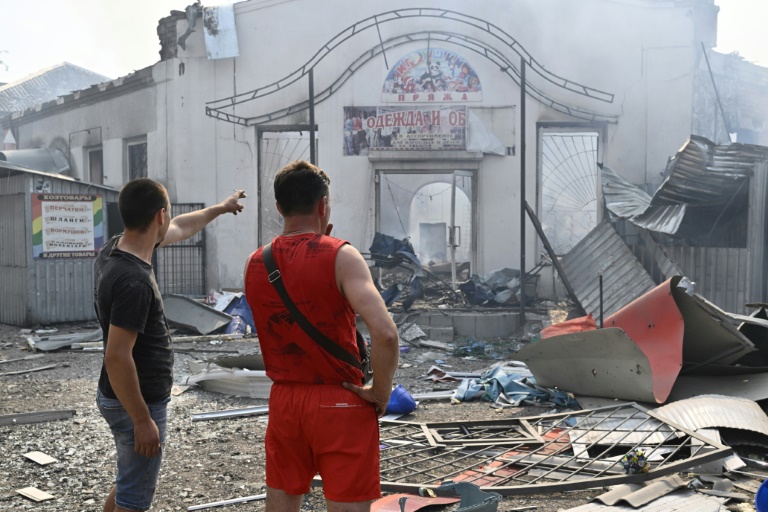
In Sloviansk, about 75 kilometres (45 miles) west of Lysychansk, there were few people on the streets on Monday, the day after Russian strikes that left at least six dead, among them a nine-year-old girl, and 19 injured. 

In the large downtown market largely ravaged by a fire caused by a Russian strike, a few vendors offered basic goods while others cleared charred debris. 

Vendors and residents who spoke to AFP, some still in shock, expressed concern for the days and weeks to come, as sounds of shelling were heard again.

– ‘Win back the land’ –

The city of Siversk, 30 kilometres west of Lysychansk, also saw overnight shelling, residents and an official told AFP.

But Zelensky’s address Sunday evening was defiant, pointing to Ukrainian troops progressing in the Kharkiv and Kherson regions, and vowed “there will be a day when we will say the same about Donbas”.

“We will rebuild the walls, we will win back the land, and people must be protected above all else,” Zelensky said. 

“Ukraine does not give anything up.”

On Monday, leaders from dozens of countries and international organisations were meeting in the Swiss city of Lugano, where they aim to hash out a roadmap for Ukraine’s reconstruction — expected to cost hundreds of billions of dollars.

Lugano is not a pledging conference but will instead attempt to lay out the principles and priorities for a rebuilding process aimed to begin even as the war rages.

– ‘Democracy over autocracy’ –

Ukraine will also face demands for broad reforms, especially in cracking down on corruption after Brussels recently granted Kyiv candidate status in its push to join the 27-member European Union.

Zelensky will address the conference by video, but the event is also being attended by Ukrainian Prime Minister Denys Shmyhal in a rare trip outside the country. 

British Foreign Secretary Liz Truss is due to pledge both immediate humanitarian assistance as well as access to British financial and economic expertise, the foreign office said.

She will tell delegates that Ukraine’s recovery “will be a symbol of the power of democracy over autocracy”, it added.

But for residents in Bucha — a Ukrainian town synonymous with war crimes blamed on Moscow’s forces after their retreat in April — fear remains even as talk begins of reconstruction. 

“We’re going to bed without knowing if we’ll wake up tomorrow,” said Vera Semeniouk, 65. 

“Everyone has come back, is starting to repair houses, many are putting in new windows. It would be terrible if it started again and we had to leave everything again.”

Trial of Chinese-Canadian tycoon who disappeared in 2017 begins in China

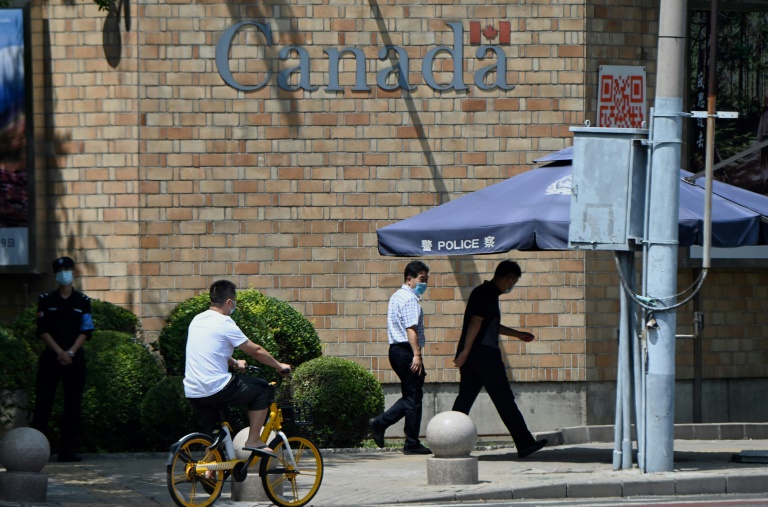
Canadian-Chinese tycoon Xiao Jianhua is standing trial on Monday, Ottawa’s embassy in Beijing said in a statement, after the businessman disappeared from a Hong Kong hotel five years ago.

Xiao vanished from Hong Kong’s Four Seasons hotel in January 2017, with local media reporting that he was snatched by mainland Chinese agents — fuelling fear at the time over Beijing’s tightening influence in the financial hub.

The tycoon, one of China’s richest people at the time of his disappearance, reportedly had close connections to the upper echelons of the ruling Communist Party.

Nothing more had been known about Xiao, who is a Canadian citizen, since his disappearance, until the embassy confirmed Monday that he was facing trial.

“Global Affairs Canada is aware that a trial in the case of Canadian citizen, Mr. Xiao Jianhua, will take place on July 4, 2022,”  the Canadian embassy told AFP, without specifying the location of the trial or charges against him.

“Canadian consular officials are monitoring this case closely, providing consular services to his family and continue to press for consular access.”

Hong Kong police said at the time that he had crossed the border into mainland China. 

His company Tomorrow Group also later said that he was in the mainland.

But Chinese authorities have been silent about the case, reportedly linked to an anti-corruption drive championed by President Xi Jinping since he came to power.

Xiao’s alleged abduction came at a time when mainland Chinese agents were not permitted to operate in Hong Kong, and it sparked fear in the city about residents being forcibly disappeared.

These fears were at the heart of massive pro-democracy protests that shook Hong Kong in 2019, prompted by a government bill that would have allowed extraditions to mainland China’s opaque, Communist Party-controlled judicial system.

Xiao’s disappearance also followed the alleged kidnapping into mainland custody of five people working for a bookstore which published salacious titles about China’s leaders.

The booksellers later appeared on mainland Chinese TV admitting to a variety of crimes.

In response to the protests, China imposed a national security law on Hong Kong in 2020.

That law allowed its security agencies to operate in the city and toppled the legal firewall between mainland and Hong Kong courts.

– Rags to riches –

Xiao rose from a poor family to become one of China’s richest men, founding the Beijing-based Tomorrow Group.

He was head of the official student union at the prestigious Peking University in 1989 when the Chinese government used troops and tanks to crush peaceful demonstrations.

Xiao had tried and failed to defuse the protests, with his company later denying a report in The New York Times that he had been rewarded by the government for his role.

After university, Xiao began selling computers and in the years that followed built an empire with diverse interests, including in banking and insurance.

According to the Hurun Report, which ranks China’s wealthiest people, Xiao was worth almost $6 billion in 2017.

He had reportedly denied allegations that he fled to Hong Kong in 2014 to escape the corruption crackdown in China.

Xiao is said to have acted as a broker for the Chinese leadership, including for President Xi’s family. 

“After five years of quietly waiting, our family is still, based on my brother’s strict instructions, putting faith in the Chinese government and Chinese law,” Xiao’s elder brother Xinhua told The Wall Street Journal last month.

“It’s very complicated and full of drama,” he said of the case, according to the WSJ.

The years after his disappearance have also been marked by plummeting relations between China and Canada, sparked by the arrest in Vancouver of Meng Wanzhou — the chief financial officer of telecoms giant Huawei — at the request of the United States.

Following Meng’s arrest, Beijing detained two Canadians in China and targeted Canadian agricultural exports.

All three were released in September 2021 after Meng reached a deal with US prosecutors on the fraud charges, ending her extradition fight.

Since then there have been hopes of a thaw in diplomatic relations, with Beijing lifting a ban on Canadian canola imports earlier this year.

'Slim' chance of finding survivors after Italy glacier collapse

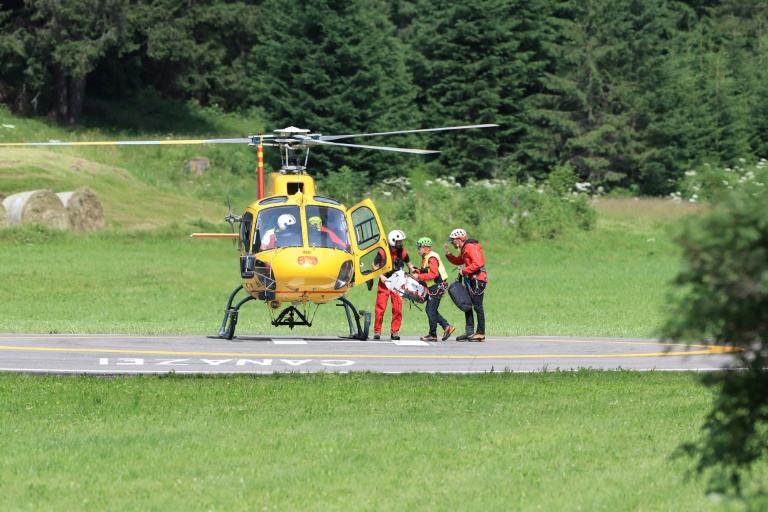
Rescuers warned Monday that hope of finding survivors was diminishing after an avalanche set off by the collapse of an Italian glacier during a heat wave killed at least six people.

Authorities said they did not know how many climbers were hit when the glacier gave way Sunday on Marmolada, the highest mountain in the Italian Dolomites.

Ice and rock thundered down the slope at 300 kilometres an hour (185 miles per hour), according to Trento province chief Maurizio Fugatti.

On Monday, rescuers armed with thermal drones searched for body heat from potential survivors trapped in ice, though hope was rapidly dwindling. 

Chances of finding survivors “are slim to nothing”, the region’s Alpine Rescue Service head Giorgio Gajer told AGI news agency.

The six bodies recovered so far were found “torn apart,” rescuer Gino Comelli said.

The disaster struck one day after a record-high temperature of 10 degrees Celsius (50 degrees Fahrenheit) was recorded at the summit of the glacier, the largest in the Italian Alps.

The glacier had been weakened by decades of global warming, experts said.

Alpine Rescue spokeswoman Michela Canova told AFP an “avalanche of snow, ice and rock” hit an access path at a time when there were several roped parties, “some of whom were swept away”.

A spokesman for the Trento province said people were still being reported missing.

Trento’s chief prosecutor Sandro Raimondi was cited by Corriere della Sera as saying he feared the number of dead “could double if not triple”, based on the number of cars in the carpark.

But Canova urged caution, saying the total number of climbers involved was “not yet known”. Eight people were recovered with injuries.

– ‘Sea of ice’ –

Bodies dug out of the ice and rock were taken to the village of Canazei, where Italian Prime Minister Mario Draghi was expected later Monday.

Helicopters and sniffer dogs were called off as night fell and amid fears the glacier may still be unstable.

“It is difficult for the rescuers in a dangerous situation,” Canazei mayor Giovanni Bernard told AFP.

Images of the avalanche filmed from a refuge close by show snow and rock hurtling down the mountain’s slopes.

“It’s a miracle we’re alive,” Stefano Dal Moro, an engineer who was hiking with his Israeli partner told Corriere della Sera.

“There was a dull noise, then that sea of ice came down. It’s useless to run, you can only pray that it doesn’t come your way.

“We crouched down and hugged each other tightly as the ice passed”.

– Heat ‘beyond normal’ –

Massimo Frezzotti, a science professor at Roma Tre University, told AFP the collapse was caused by unusually warm weather linked to global warming, with precipitation down 40 to 50 percent during a dry winter.

“The current conditions of the glacier correspond to mid-August, not early July,” he said.

Glacier specialist Renato Colucci told AGI that the phenomenon was “bound to repeat itself”, because “for weeks the temperatures at altitude in the Alps have been well beyond normal values”.

The recent warm temperatures had produced a large quantity of water from the melting glacier that accumulated at the bottom of the block of ice and caused it to collapse, he added.

The Trento public prosecutor’s office has opened an investigation to determine the causes of the tragedy.

According to a March report by the UN Intergovernmental Panel on Climate Change (IPCC), melting ice and snow is one of 10 major threats caused by global warming, disrupting ecosystems and infrastructure.

The IPCC has said glaciers in Scandinavia, central Europe and the Caucasus could lose between 60 and 80 percent of their mass by the end of the century.

Turkish inflation hits two-decade high of 78.6%

Inflation in Turkey in June soared to an annual rate of 78.6 percent — the highest in 24 years, according to official data released Monday — as President Recep Tayyip Erdogan’s unconventional economic policies continued to take their toll.

But independent estimates published by Turkish economists showed prices rising at more than double that figure.

The inflation rate reported by Turkey’s state statistics agency was the highest since the emerging market suffered a currency meltdown during a global financial crisis in 1998.

Inflation had stood at 73.5 percent in May and at 15.0 percent at the start of last year.

Economy Minister Nureddin Nebati on Friday vowed that consumer prices will start dropping in December.

“I promise to you and to the president, we will see a drop in inflation starting in December,” he was quoted as saying by Turkish media.

According to the official data, the surge in inflation in June was driven by a jump of 123.4 percent in the cost of transportation and a 94-percent increase in non-alcoholic drinks.

Turkey’s latest problems began when Erdogan forced the central bank to go through with a series of interest rate cuts last year that he said were part of his “new economic model”.

The policy rate went down despite rising consumer prices.

But the Turkish leader rejects conventional economics and affirms that high interest rates cause prices to rise.

Economists believe his approach has exacerbated the pain felt world-wide from the jump in food and energy prices caused by Russia’s invasion of Ukraine. 

– Questions over data –

However, more and more economists are starting to question Turkey’s official data.

A monthly report release Monday by Turkey’s ENAG group of independent economists showed consumer prices rising by 175 percent in June.

ENAG said prices had risen by 71.4 percent since the start of the year alone.

The Istanbul chamber of commerce said inflation in Turkey’s largest city has reached an annual rate of 94 percent.

“No one actually believes official Turkish data anymore,” said BlueBay Asset Management economist Timothy Ash.

“There is no expectation of anything like a credible policy response.”

Turkey’s official data are turning into a hot political issue ahead of next year’s general election — widely viewed as the toughest of Erdogan’s two-decade rule.

Opposition leader Kemal Kilicdaroglu accused the state statistics agency of “lying”.

“Stop committing crimes for the benefit of President Erdogan,” Kilicdaroglu told the agency on Twitter.

A survey published by the Metropol polling agency on Friday showed 69 percent of respondents believed the unofficial ENAG figure and just 24 percent the one reported by the government.

– ‘Cost-of-living problem’ –

Erodgan has doubled down on his economic approach and hinted that he may want the benchmark interest rate to move even lower in the months to come.

He has also tried to reverse the accompanying drop in his public approval by announcing a rapid series of wage hikes to large parts of the population.

He has bumped up the minimum wage earned by roughly 40 percent of the working Turks from 2,826 liras in late December to 5,500 liras ($325) this month.

The wage is used as the benchmark for a wide range of social benefits across the economy.

Economists warn that substantially raising the pay of so many people is an inflationary measure that should be accompanied by interest hikes or other means of limiting spending.

But Erdogan rejects the very idea that Turkey is suffering from inflation.

“We do not have an inflation problem. We have a cost-of-living problem,” Erdogan said last month.

Turkish inflation hits two-decade high of 78.6%

Inflation in Turkey in June soared to an annual rate of 78.6 percent — the highest in 24 years, according to official data released Monday — as President Recep Tayyip Erdogan’s unconventional economic policies continued to take their toll.

But unofficial estimates published by Turkish economists showed prices rising at more than double that figure.

The inflation rate reported by Turkey’s state statistics agency was the highest since January 1998.

Inflation had stood at 73.5 percent in May and at 15.0 percent at the start of last year.

Economy Minister Nureddin Nebati on Friday vowed that consumer prices will start dropping in December.

“I promise to you and to the president, we will see a drop in inflation starting in December,” he was quoted as saying by Turkish media.

According to the official data, the surge in inflation in June was driven by a jump of 123.4 percent in the cost of transportation and a 94-percent increase in non-alcoholic drinks.

Turkey’s crisis started when Erdogan forced the central bank to go through with a series of interest rate cuts last year that he said were part of his “new economic model”.

The policy rate went down despite rising consumer prices.

But the Turkish leader rejects conventional economics and affirms that high interest rates cause prices to rise.

Economists believe his approach has exacerbated the pain felt world-wide from the jump in food and energy prices caused by Russia’s invasion of Ukraine. 

– Questions over data –

However, more and more economists are starting to question Turkey’s official data.

A monthly report release Monday by Turkey’s ENAG group of independent economists showed consumer prices rising by 175 percent in June.

ENAG said prices had risen by 71.4 percent since the start of the year alone.

The Istanbul chamber of commerce said inflation in Turkey’s largest city has reached an annual rate of 94 percent.

“No one actually believes official Turkish data anymore,” said BlueBay Asset Management economist Timothy Ash.

“There is no expectation of anything like a credible policy response.”

Turkey on Friday substantially raised the minimum wage for the second time in a year to cushion the blow on households ahead of next year’s general election.

The hike of the net monthly take-home pay to 5,500 liras ($330) means the nominal minimum wage has nearly doubled since the end of last year.

It stood at 2,826 liras in late December and 4,253 liras in January.

Economists warn that substantially raising the pay of a large swathe of the population is an inflationary measure that should be accompanied by interest hikes or other means of limiting spending.

Official data show that more than 40 percent of Turks earned the minimum wage at the start of the year.

Thousands evacuate from 'dangerous' Sydney floods

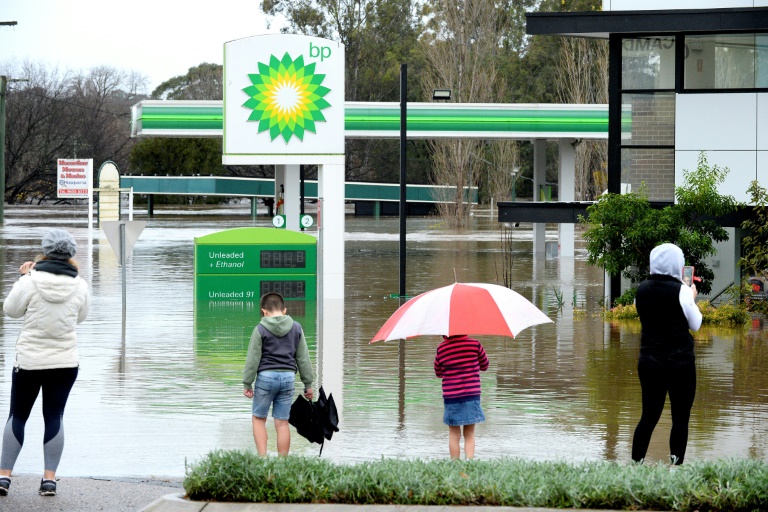
Rapidly rising rivers swamped swathes of rain-lashed Sydney on Monday, forcing thousands to flee “dangerous” floods as the city’s largest dam spilled torrents of water.

On the third day of torrential east coast rains, emergency workers said they had rescued more than 140 people since the stormy weather began. 

But evacuated residents in one area of western Sydney were now being allowed to return home, officials said, as weather conditions in New South Wales were forecast to ease over the next 24 hours.

Many of those rescued had been trapped in their cars trying to cross flood-swept roads or were unable to leave homes surrounded by rising waters.

Australia has been at the sharp end of climate change, with droughts, deadly bushfires, bleaching events on the Great Barrier Reef and floods becoming more common and intense as global weather patterns change.

Higher temperatures mean the atmosphere holds more moisture, unleashing more rain.

About 32,000 people were under orders to evacuate or be ready to flee across New South Wales, the state’s emergency services said.

The army sent 100 troops to help operations in the storm-battered state.

“The ground is saturated, the rivers are fast flowing, the dams are overflowing,” said State Emergency Services commissioner Carlene York.

“It is particularly dangerous out there.”

Mud-brown river waters transformed a large stretch of land into a lake in the southwestern Sydney suburb of Camden. 

Roads disappeared into the waters and mobile homes stood in knee-high water, at least one toppled on its side, television images showed.

Large volumes of water gushed from the Warragamba Dam, which has been spilling excess water since Sunday.

The huge concrete dam lies on the western outskirts of Sydney and provides most of the city’s drinking water.

– ‘Becoming more common’ –

The wild weather whipped up drama off the Sydney coast, as the 150-metre Portland Bay cargo ship with 21 crew lost power in heavy seas.

The Hong Kong-registered bulk carrier initially dropped two anchors to hold its position off the coastal cliffs, officials said. 

Plans for a helicopter rescue were dropped because of the conditions.

But later in the day, three tugboats managed to start towing the vessel and its crew to deeper water to undertake repairs, the state port authority said.

Australia’s east coast has suffered repeated flooding in the past 18 months.

More than 20 people died only in March this year as floodwaters lapped at rooftops and torrents swept cars off roads.

The current weather system over Sydney is being fed by warm, wet air from near the equator, said Kimberley Reid, an atmospheric scientist at Monash University. 

Rainfall in eastern Australia is highly variable, making it hard to pin this event to climate change, she said.

“However, our research of the March 2021 Sydney floods found that similar events over Sydney were likely to occur 80 percent more often by the end of the 21st century.”

Australia must prepare for more regular flooding events, New South Wales Premier Dominic Perrottet told a news conference.

“There is no doubt these events are becoming more common,” he said.

“Governments need to adjust and make sure that we respond to the changing environment we find ourselves in.”

Stocks fluctuate as traders fret over recession

Markets swung Monday as traders fret over a possible recession caused by central bank interest rate hikes aimed at fighting soaring inflation.

Data showing a flare-up of fresh Covid-19 cases in China revived concerns about the government’s policy of locking down towns and cities to eradicate the disease, despite the economic cost.

After the S&P 500’s worst January-June since 1970, Wall Street got the second half off to a healthy start Friday as a below-forecast reading on US manufacturing provided hope banks will not go on an extended period of monetary tightening.

That followed a drop in confidence among consumers — a key driver of the world’s top economy.

However, National Australia Bank’s Rodrigo Catril said the Federal Reserve and other global financial chiefs might not ease back on their rate hikes too soon as inflation remains stuck around multi-decade highs.

“While the data is suggesting a US economic slowdown is coming, we are not yet seeing signs of an ease in inflationary pressures, an important distinction given the Fed will continue with its aggressive tightening approach until it sees evidence of the latter,” he said in a commentary.

In a sign of the struggle officials will have in controlling rising prices, figures showed eurozone inflation hit a record 8.6 percent in June. The European Central Bank is due to lift rates this month for the first time in more than a decade.

Still, while surging prices remain a huge problem, Chris Weston, at Pepperstone Group, said the psychology is “shifting radically from inflation concerns to one now where we’re firmly focused on growth”.

While New York provided a strong lead, Asia struggled.

Hong Kong dropped as investors returned from a long weekend to play catch-up with Friday’s losses, while Seoul, Taipei, Bangok and Jakarta were also down.

However, Tokyo, Shanghai, Mumbai, Sydney, Singapore, Taipei and Wellington rose.

London, Paris and Frankfurt rose in early trade, though US futures were in the red.

A rise in new Covid cases in China over the weekend weighed on sentiment among investors who fear a return to the painful lockdowns in major cities including Shanghai, which hammered the world’s number two economy.

The country saw more than 700 new infections Saturday and Sunday, having held below 50 a day for the previous two weeks.

Macau saw its first two Covid deaths at the weekend and authorities said they would consider a city-wide lockdown to fight the disease. The comments sent Hong Kong-listed shares in Macau casinos plunging.

Oil prices wobbled with concerns about recession weighing on sentiment as traders bet on a drop in demand, while the head of Asia at crude trading giant Vitol said he saw signs consumers were beginning to feel the pressure of high commodity costs.

“There’s very clear evidence out there of economic stress being caused by the high prices, what some people refer to as demand destruction,” said Mike Muller. It is “not just oil, but also liquefied natural gas”. 

– Key figures at around 0810 GMT –

Tokyo – Nikkei 225: UP 0.8 percent at 26,153.81 (close)

Hong Kong – Hang Seng Index: DOWN 0.1 percent at 21,830.35 (close)

Shanghai – Composite: UP 0.5 percent at 3,405.43 (close)

London – FTSE 100: UP 0.9 percent at 7,231.42

Dollar/yen: UP at 135.37 yen from 135.28 yen Friday

Pound/dollar: DOWN at $1.2116 from $1.2098

Euro/dollar: DOWN at $1.0424 from $1.0433 

Euro/pound: DOWN at 86.03 pence from 86.21 pence

West Texas Intermediate: DOWN 0.1 percent at $108.36 per barrel

Brent North Sea crude: DOWN 0.1 percent at $111.51 per barrel

New York – Dow: UP 1.1 percent at 31,097.26 (close)

— Bloomberg News contributed to this story —

Trial of Chinese-Canadian tycoon who disappeared in 2017 begins in China

Canadian-Chinese tycoon Xiao Jianhua is standing trial on Monday, Ottawa’s embassy in Beijing said in a statement, after the businessman disappeared from a Hong Kong hotel in 2017.

“Global Affairs Canada is aware that a trial in the case of Canadian citizen, Mr. Xiao Jianhua, will take place on July 4, 2022,”  the embassy told AFP, without specifying the location of the trial or charges against him.

“Canadian consular officials are monitoring this case closely, providing consular services to his family and continue to press for consular access.”

Xiao, who is a Canadian citizen, disappeared from Hong Kong’s Four Seasons hotel in January 2017, with local media reporting that he was snatched by mainland Chinese agents.

One of China’s richest people at the time of his alleged abduction, Xiao reportedly had close connections to the upper echelons of the ruling Communist Party.

Hong Kong police said at the time that he had crossed the border into mainland China. His company Tomorrow Group also later said that he was in the mainland.

But Chinese authorities have been silent about the case, which is reportedly linked to an anti-corruption drive championed by President Xi Jinping since he came into power.

Xiao’s alleged abduction came at a time when mainland Chinese agents were not permitted to operate in Hong Kong, and it sparked fear in the city about residents being forcibly disappeared.

These fears were at the heart of massive pro-democracy protests that shook Hong Kong in 2019, prompted by a government bill that would have allowed extraditions to mainland China’s opaque, Communist Party-controlled judicial system.

Xiao’s disappearance also followed the alleged kidnapping into mainland custody of five people working for a bookstore which published salacious titles about China’s leaders.

The booksellers later appeared on TV in mainland China admitting to a variety of crimes.

In response to the protests, China imposed a national security law on Hong Kong in 2020.

That law allowed its security agencies to operate in the city and toppled the legal firewall between mainland and Hong Kong courts.

– Rags to riches –

Xiao rose from a poor family to become one of China’s richest men, founding the Beijing-based Tomorrow Group.

He was head of the official student union at the prestigious Peking University in 1989 when the Chinese government used troops and tanks to crush peaceful demonstrations.

Xiao had tried and failed to defuse the protests, with his company later denying a report in The New York Times that he had been rewarded by the government for his role.

After university, Xiao began selling computers and in the years that followed built an empire with diverse interests, including in banking and insurance.

According to the Hurun Report, which ranks China’s wealthiest people, Xiao was worth almost $6 billion in 2017.

He had reportedly denied allegations that he fled to Hong Kong in 2014 to escape the corruption crackdown in China.

Xiao is said to have acted as a broker for the Chinese leadership, including for President Xi’s family. 

“After five years of quietly waiting, our family is still, based on my brother’s strict instructions, putting faith in the Chinese government and Chinese law,” Xiao’s elder brother Xinhua told The Wall Street Journal last month.

“It’s very complicated and full of drama,” he said of the case, according to the WSJ.

Close Bitnami banner
Bitnami