AFP

Indonesian zoo breeds dozens of endangered baby Komodo dragons

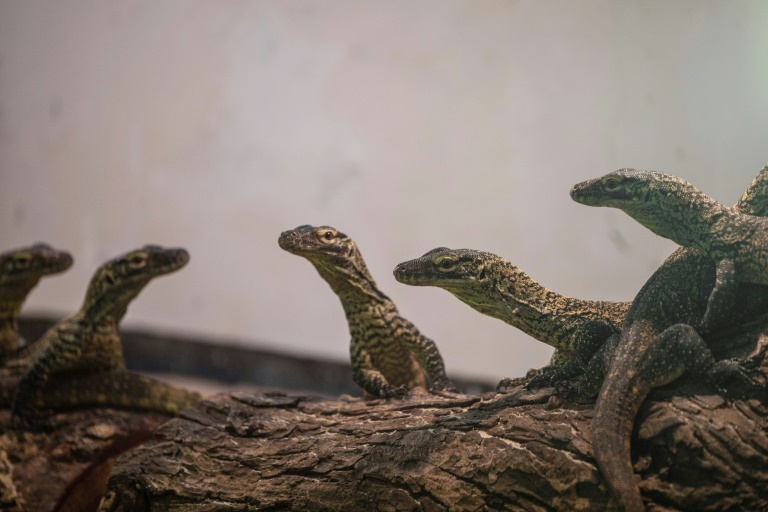
An Indonesian zoo has welcomed dozens of new baby Komodo dragons hatched in captivity in recent months as part of a breeding programme, its director said Tuesday, offering hope for efforts to conserve the endangered species.

The world’s largest living lizards are found only in Indonesia’s World Heritage-listed Komodo National Park and neighbouring Flores, and just 3,458 adult and baby species are left in the wild according to estimates.

The fearsome reptiles, which can grow to three metres (10 feet) in length and weigh up to 90 kilograms (200 pounds), are threatened by human activity and climate change destroying their habitat.

But a breeding programme in Indonesia’s second-largest city of Surabaya is trying to change that, successfully breeding 29 dragons in incubators between February and March.

“We have habitats that mirror the Komodo’s natural habitat, including its humidity and temperature,” zoo director Chairul Anwar told AFP. 

The newborns were hatched from two female Komodo dragons after their eggs were placed in incubators to prevent them from being eaten by their mothers or other Komodo dragons.

Female Komodos can fertilise an egg without the need for a male dragon.

The zoo started the programme in the 1990s as part of the effort to conserve the species in a city located more than 700 kilometres (434 miles) away from the dragon’s natural habitat. 

After the spate of births this year, Surabaya Zoo now houses 134 Komodo dragons, the largest population group outside of its habitat in the cluster of islands east of Bali, Anwar said. 

In a report last year, the International Union for the Conservation of Nature warned the endangered species’ habitat was expected to shrink by 30 percent in the next 45 years due to rising sea levels.

Anwar said the dragons will not be released back into the wild on Komodo or Flores until conditions improve.

“Komodo Island is still working to rejuvenate the forests,” which feed the dragon’s declining natural prey such as deer, he said.

Bankrupt Sri Lanka opens oil market to foreign firms

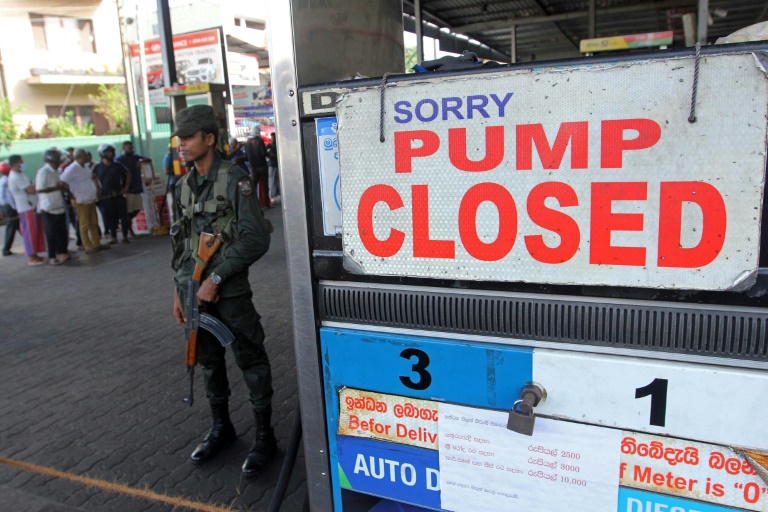
Cash-strapped Sri Lanka announced Tuesday it was opening its oil market to foreign competition, a day after chronic fuel shortages forced a nationwide halt to petrol and diesel sales.

The South Asian island country is suffering an unprecedented economic crisis because it cannot afford to import essentials, including enough oil and gas to meet energy needs. 

Lengthy blackouts are now a feature of daily life, while motorists have been forced to wait in daylong queues for scarce supplies of petrol. 

A rationing system has been in effect but on Monday night the government banned fuel sales for two weeks to conserve Sri Lanka’s limited stockpiles for emergencies. 

Ministers said the crisis had made it an appropriate time to allow market entry from firms in oil-producing nations “to enable them to import and sell fuel using their funds”, a cabinet statement said Tuesday. 

Sri Lanka’s oil industry was nationalised in 1961, though a third of the market was granted to a local unit of India’s state-owned oil and gas company in 2003. 

Despite the sales ban, long queues of vehicles were seen outside pumping stations on Monday with motorists hoping to top up whenever supplies resumed.

The government has dispatched ministers to Russia and Qatar to source discounted oil, while President Gotabaya Rajapaksa this week met with Moscow’s envoy in Sri Lanka to discuss fuel and other imports.

Sri Lanka defaulted on its $51 billion foreign debt in April and is currently in bailout talks with the International Monetary Fund.

Life in the abyss, a spectacular and fragile struggle for survival

Cloaked in darkness and mystery, the creatures of the deep oceans exist in a world of unlikely profusion, surviving on scant food and under pressure that would crush human lungs.

This extremely hostile environment, which will come under the spotlight at a major United Nations oceans summit in Lisbon this week, has caused its inhabitants to develop a prodigious array of alien characteristics and idiosyncratic survival techniques.

A vast assortment of animals populate the sunless depths, from the colossal squid, which wrapped its tentacles around the imaginations of sailors and storytellers, to beings with huge cloudy eyes, or whose bodies are as transparent as glass. 

And the angler fish, with its devilish looks illuminated by a built-in headlamp, showing that the deep dark is alive with lights.

– ‘Incredible’ creatures – 

Until the middle of the 19th century, scientists believed that life was impossible beyond a few hundred metres.

“They imagined that there was nothing, because of the absence of light, the pressure, the cold, and the lack of food,” Nadine Le Bris, a professor at Sorbonne University, told AFP. 

Between 200 and 1,000 metres (650 to 3,300 feet), the light fades until it vanishes completely, and with it plants; at 2,000 metres the pressure is 200 times that of the atmosphere.  

From the abyssal plains to the cavernous trenches plunging deeper than Everest is high, aquatic existence continues in spectacular diversity. 

“When people think of the deep sea they often think of the seafloor,” said Karen Osborn of the Smithsonian’s Natural History Museum. 

“But all that water in between is full of incredible animals. There is a ton of life.”

These open water inhabitants face a formidable challenge: they have nowhere to hide. 

“There’s no seaweed to hide in, no caves or mud to dig into,” said Osborn. 

“There are predators coming at them from below, from above, from all around.” 

– Masters of disguise – 

One tactic is to become invisible. 

Some creatures are red, making them difficult to distinguish in an environment where red light no longer filters through. 

Others render themselves transparent. 

Take the transparent gossamer worm, which ranges in size from a few millimetres to around a metre long and shimmies through the water by fluttering its frilly limbs. 

“They look like a fern frond,” said Osborn.

“They’re beautiful animals and they shoot yellow bioluminescent light out of the tips of their arms. What could be better than that.”

Bioluminescence is particularly common among fish, squid, and types of jellyfish, according to the US National Oceanic and Atmospheric Administration, which says around 80 percent of animals living between 200 and 1,000 metres produce their own light.    

This chemical process might be helpful for defence, reproduction or to find food — but no one knows for sure why so many creatures have evolved it, says NOAA. 

– “Sea snow” –

With no plants around and animals scattered in the vastness doing their utmost to disappear, creatures in the ocean depths often have a hard time finding a live meal.  

“If you happen to get lucky and hit a patch of your food, bingo! But you may not see another one for three weeks,” said Osborn.  

Another option is to feast on the dead.  

Organic particles from the surface waters — disintegrated bodies of animals and plants, mingling with fecal matter — drift down in what is known as “marine snow”. 

This cadaverous confetti forms part of a process that sequesters carbon dioxide in the ocean depths.

It is also a lifeline for many deep sea animals, including the blood red vampire squid which, contrary to its reputation, peacefully hoovers up marine snow.

When giants like dead whales sink to the seabed, they are swiftly reduced to bone by scavengers. 

– Final frontier –

With most of the oceans still unexplored, it is often said that we know more about the surface of Mars than we do about the seafloor on our own planet. 

But unlike outer space, scientists keep finding life even under the most hostile of conditions. 

Like the searing hydrothermal vents at the cracks between oceanic plates that spew chemical compounds such as hydrogen sulphide. 

Microorganisms use this to create organic matter via “chemosynthesis”, like plants use the sun for photosynthesis, which in turn feeds “exuberant” ecosystems, said Pierre-Marie Sarradin, head of the Deep Ecosystems department at the French research agency Ifremer. 

These hydrothermal springs were totally unknown until the 1970s. 

Scientists have so far identified some 250,000 marine species, though there could still be at least a million to be discovered.

Could there be an elusive sea monster lurking in the depths? Despite measuring more than 10 metres in length the colossal squid has only very rarely been seen.

“I don’t think we’re going to find a megalodon,” said Osborn, referring to the giant ancestor of the shark.

Humans may not have explored much of the deep seas, but they have left their mark, via global heating, overfishing and pollution. 

Oceans are acidifying as they absorb more and more CO2, there is a growing prevalence of “dead zones” without oxygen, while microplastics have been found in crustaceans at a depth of nearly 11 kilometres in the Mariana Trench. 

Food reaches the bottom in smaller quantities. 

Nadine Le Bris said species that “already live at the limits in terms of oxygen or temperature”, are already “disturbed”.

'Unimaginable': Austria prepares to reopen coal power station

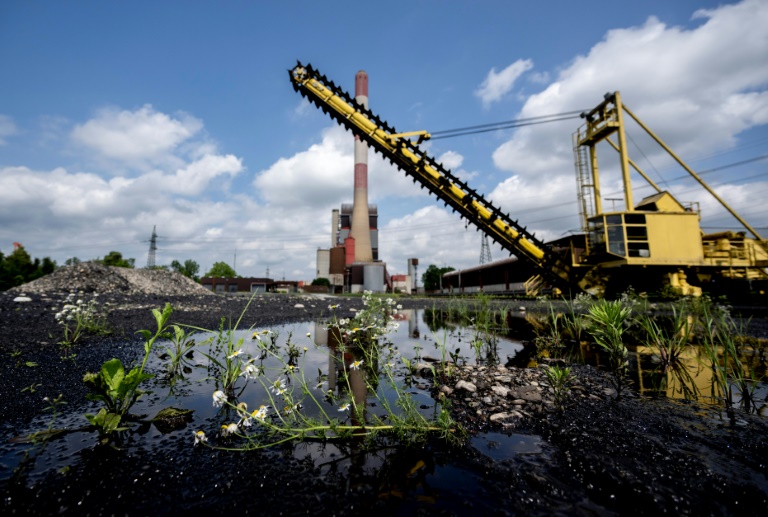
At the Mellach coal power plant in southern Austria, spider webs have taken over the conveyor belts, and plants and flowers have sprung up around the vast lot that once stored coal.

The plant, Austria’s last coal-fuelled power station, was closed in the spring of 2020, but now the government — nervous that Russia may cut its crucial gas deliveries further — has decided to get the site ready again in case it’s needed.

“I never would have imagined that we would restart the factory,” Peter Probst, a 55-year-old welder, told AFP during a visit of the plant.

“It’s really sad to be so dependent on gas,” he added.

Europe had been trying to move away from coal in the fight against climate change.

But as Russia has cut gas deliveries in the wake of sanctions the West has imposed on it for the war in Ukraine, European countries are turning back to coal.

Today, the Mellach plant’s white and red chimney stands out amid fields of corn and pumpkins, the city of Graz in the distance.

Inside, the walls are black, and coal dust clings to the doors and railings.

Some 450,000 tonnes of coal were stored at the plant before its closure as Austria’s conservative-Greens coalition aimed to have all electricity come from renewable resources by 2030.

Site manager Christof Kurzmann-Friedl says the plant operated by supplier Verbund can be ready again in “about four months” — just in time to help tackle any gas shortages in winter.

– ‘Emergency measure’ –

Chancellor Karl Nehammer insisted on Monday that the plant would only go online if necessary, while Austria holds on to its goals to reduce emissions.

“It’s really an emergency measure,” the conservative told foreign correspondents at a briefing.

“It’s really something that shows how extraordinary our times are… We must prepare for any eventuality.”

The 230 megawatt power plant would take over from the nearby gas-fired plant, also operated by Verbund, which currently supplies heating to Graz’s 300,000 inhabitants, according to Kurzmann-Friedl.

He warned, however, that the site must still be readied, hooking up all the equipment again, in addition to hiring qualified personnel and above all finding enough coal. 

Before, the coal mainly came from mines in Poland’s Silesia region, which the Polish government is aiming to shut.

Because coal prices have risen by as much as three times since 2020, the power produced by the plant will also be more expensive, Kurzmann-Friedl said.

Criticism has already flared with the opposition Social Democrats slamming the decision to reactivate the coal plant as “an act of desperation by the Greens”.

“Will the next step be the reactivation of Zwentendorf?” the opposition asked, referring to the country’s only nuclear power plant.

The Alpine nation of nine million people has been fiercely anti-nuclear with an unprecedented vote in 1978 against nuclear energy that prevented the plant from ever opening.

Asian markets bounce as China eases quarantine measures

Most Asian markets reversed early losses Tuesday and oil continued its recent rally after China slashed the quarantine time for visitors, fuelling hope for a boost to the embattled economy.

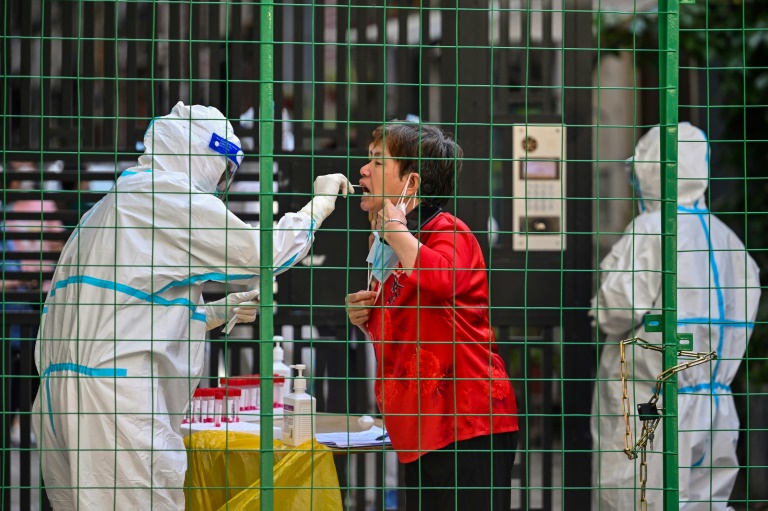
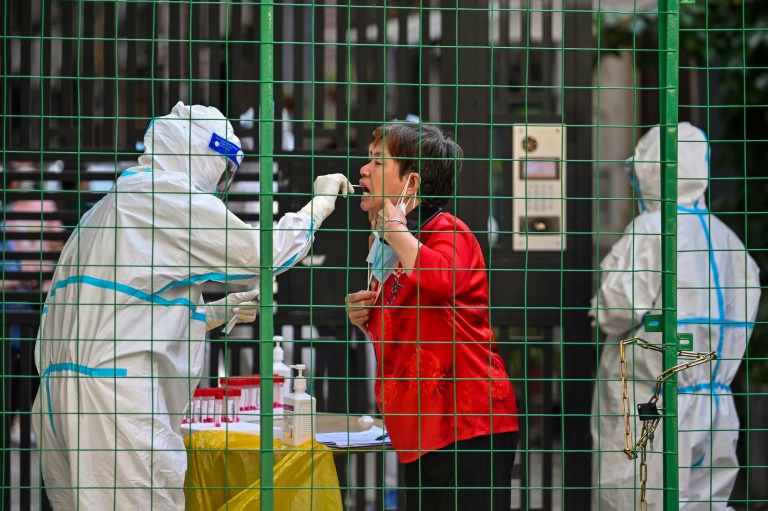
The news came as Beijing and Shanghai appeared to have contained a Covid outbreak that had forced officials to impose lockdowns which compounded global supply chain snarls.

Authorities said inbound travellers would now only have to quarantine for 10 days, instead of the three weeks that had been in place during the pandemic.

The news provided a much-needed boost to shares, which had mostly been down on renewed concerns about central bank interest rate hikes and soaring inflation.

On Monday the central People’s Bank of China pledged to provide support to the world’s number two economy.

The gains extended a rally enjoyed last week on bets that a possible recession next year could allow finance chiefs to ease up on their monetary tightening campaign.

“This relaxation sends the signal that the economy comes first,” Li Changmin, at Snowball Wealth, said. “It is a sign of the importance of the economy at this point.”

After spending the morning in the red, Hong Kong, Shanghai, Tokyo, Seoul and Wellington turned higher, while there were also gains in Sydney, Manila and Bangkok. Mumbai, Taipei and Jakarta slipped while Singapore was flat.

London, Paris and Frankfurt were all up as traders digest comments from European Central Bank boss Christine Lagarde, who said it would go “as far as necessary” to bring inflation back down to its two percent goal.

However, Huang Yanzhong of the New York-based Council on Foreign Relations warned: “It’s not surprising that China has managed to return to so-called zero, after all the huge effort it’s made.

“But that doesn’t mean it can claim a thorough and durable victory because it didn’t eradicate the virus,” he said. “Unless they thoroughly fence off Beijing and Shanghai, the virus could sneak in anytime.”

– Inflation fears –

Still, while the inflation and rate situation remains a worry, compounded by the war in Ukraine, some commentators remain relatively upbeat as the second half of the year approaches.

Market strategist Louis Navellier said in a note: “While it’s sobering that the first half of the year is the worst since 1970, history also says that when the first half of the year is down at least 15 percent the second half of the year is up every single time with an average return of 24 percent.”

And Ben Laidler, a global markets strategist at eToro, added that a lot of the expected economic weakness had been largely factored in by dealers.

“Much is already discounted by markets, which may be in ‘bad news is good news’ mode, as a slowdown cools inflation and interest rate fears,” he said.

“A ‘less bad’ gradual easing of inflation risks is possible, as is a slowdown — not recession — driving a ‘U-shaped’ rebound. The focus for investors is on cheap and defensive assets while managing rising risks.”

Oil prices surged more than one percent to build on a rally that has seen Brent and WTI pile on more than eight percent since Wednesday. Both main contracts had fallen heavily earlier in the month on recession worries.

The gains have come on the back of a pick-up in demand from China, while supply fears have been raised by political crises in producers Libya and Ecuador.

“The rhetoric around declaring victory in Shanghai over Omicron seems to be prompting Asian traders to continue buying,” said OANDA’s Jeffrey Halley.

Meanwhile, Moody’s ratings agency confirmed Russia had defaulted on foreign debt for the first time in a century after bondholders did not receive $100 million in interest payments.

The missed payments follow a series of Western sanctions that have increasingly isolated Moscow following its invasion of Ukraine.

Russia lost the last avenue to service its foreign-currency loans after the United States removed an exemption last month that allowed US investors to receive Moscow’s payments.

– Key figures at around 0810 GMT –

Tokyo – Nikkei 225: UP 0.7 percent at 27,049.47 (close)

Hong Kong – Hang Seng Index: UP 0.9 percent at 22,418.97 (close)

Shanghai – Composite: UP 0.9 percent at 3,409.21 (close)

London – FTSE 100: UP 0.8 percent at 7,316.77

West Texas Intermediate: UP 1.2 percent at $110.90 per barrel

Brent North Sea crude: UP 1.2 percent at $116.43 per barrel

Dollar/yen: UP at 135.77 yen from 135.48 yen on Monday

Euro/dollar: DOWN at $1.0577 from $1.0583

Pound/dollar: DOWN at $1.2266 from $1.2268

Euro/pound: DOWN at 86.23 pence from 86.24 pence

New York – Dow: DOWN 0.2 percent at 31,438.26 (close)

Asian markets bounce as China eases quarantine measures

Most Asian markets reversed early losses Tuesday and oil continued its recent rally after China slashed the quarantine time for visitors, fuelling hope for a boost to the embattled economy.

The news came as Beijing and Shanghai appeared to have contained a Covid outbreak that had forced officials to impose lockdowns which compounded global supply chain snarls.

Authorities said inbound travellers would now only have to quarantine for 10 days, instead of the three weeks that had been in place during the pandemic.

The news provided a much-needed boost to shares, which had mostly been down on renewed concerns about central bank interest rate hikes and soaring inflation.

On Monday the central People’s Bank of China pledged to provide support to the world’s number two economy.

The gains extended a rally enjoyed last week on bets that a possible recession next year could allow finance chiefs to ease up on their monetary tightening campaign.

“This relaxation sends the signal that the economy comes first,” Li Changmin, at Snowball Wealth, said. “It is a sign of the importance of the economy at this point.”

After spending the morning in the red, Hong Kong, Shanghai, Tokyo, Seoul and Wellington turned higher, while there were also gains in Sydney, Manila and Bangkok. Mumbai, Taipei and Jakarta slipped while Singapore was flat.

London, Paris and Frankfurt were all up as traders digest comments from European Central Bank boss Christine Lagarde, who said it would go “as far as necessary” to bring inflation back down to its two percent goal.

However, Huang Yanzhong of the New York-based Council on Foreign Relations warned: “It’s not surprising that China has managed to return to so-called zero, after all the huge effort it’s made.

“But that doesn’t mean it can claim a thorough and durable victory because it didn’t eradicate the virus,” he said. “Unless they thoroughly fence off Beijing and Shanghai, the virus could sneak in anytime.”

– Inflation fears –

Still, while the inflation and rate situation remains a worry, compounded by the war in Ukraine, some commentators remain relatively upbeat as the second half of the year approaches.

Market strategist Louis Navellier said in a note: “While it’s sobering that the first half of the year is the worst since 1970, history also says that when the first half of the year is down at least 15 percent the second half of the year is up every single time with an average return of 24 percent.”

And Ben Laidler, a global markets strategist at eToro, added that a lot of the expected economic weakness had been largely factored in by dealers.

“Much is already discounted by markets, which may be in ‘bad news is good news’ mode, as a slowdown cools inflation and interest rate fears,” he said.

“A ‘less bad’ gradual easing of inflation risks is possible, as is a slowdown — not recession — driving a ‘U-shaped’ rebound. The focus for investors is on cheap and defensive assets while managing rising risks.”

Oil prices surged more than one percent to build on a rally that has seen Brent and WTI pile on more than eight percent since Wednesday. Both main contracts had fallen heavily earlier in the month on recession worries.

The gains have come on the back of a pick-up in demand from China, while supply fears have been raised by political crises in producers Libya and Ecuador.

“The rhetoric around declaring victory in Shanghai over Omicron seems to be prompting Asian traders to continue buying,” said OANDA’s Jeffrey Halley.

Meanwhile, Moody’s ratings agency confirmed Russia had defaulted on foreign debt for the first time in a century after bondholders did not receive $100 million in interest payments.

The missed payments follow a series of Western sanctions that have increasingly isolated Moscow following its invasion of Ukraine.

Russia lost the last avenue to service its foreign-currency loans after the United States removed an exemption last month that allowed US investors to receive Moscow’s payments.

– Key figures at around 0810 GMT –

Tokyo – Nikkei 225: UP 0.7 percent at 27,049.47 (close)

Hong Kong – Hang Seng Index: UP 0.9 percent at 22,418.97 (close)

Shanghai – Composite: UP 0.9 percent at 3,409.21 (close)

London – FTSE 100: UP 0.8 percent at 7,316.77

West Texas Intermediate: UP 1.2 percent at $110.90 per barrel

Brent North Sea crude: UP 1.2 percent at $116.43 per barrel

Dollar/yen: UP at 135.77 yen from 135.48 yen on Monday

Euro/dollar: DOWN at $1.0577 from $1.0583

Pound/dollar: DOWN at $1.2266 from $1.2268

Euro/pound: DOWN at 86.23 pence from 86.24 pence

New York – Dow: DOWN 0.2 percent at 31,438.26 (close)

46 migrants found dead in trailer truck in Texas

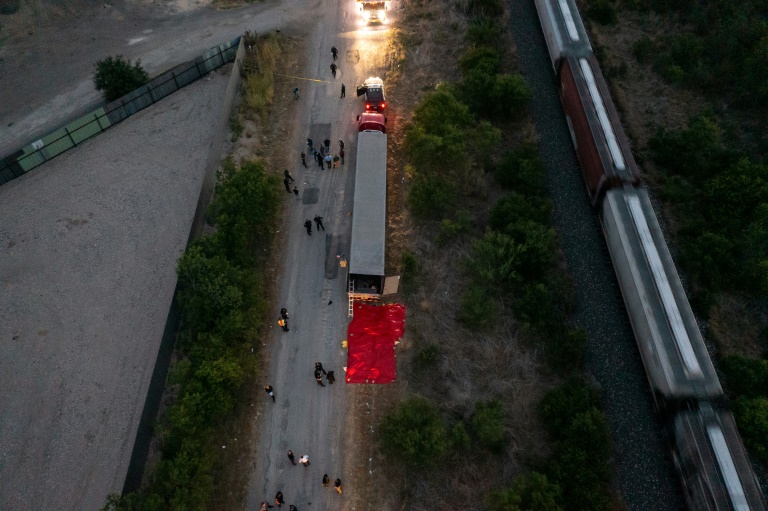
At least 46 migrants were found dead Monday in and around a large trailer truck that was abandoned on the roadside on the outskirts of the Texas city of San Antonio.

The grim discovery was one of the worst disasters involving migrants in the United States in recent years — and came five years after a similar deadly incident in the same central Texas city, a few hours from the Mexican border.

“At this time we have processed approximately 46 bodies that have been triaged and tagged and declared deceased,” San Antonio Fire Chief Charles Hood told reporters.

He said that 16 people had been transported to hospital alive and conscious — 12 adults and four children.

There were no initial details on the age or nationalities of the deceased.

“The patients that we saw were hot to the touch, they were suffering from heat stroke, heat exhaustion, no signs of water in the vehicle, it was a refrigerated tractor-trailer but there was no visible working A/C unit on that rig,” Hood said.

Officials said three people were in custody over the incident.

“Tonight we are dealing with a horrific human tragedy,” San Antonio Mayor Ron Nirenberg told a press conference.

“So I would urge you all to think compassionately and pray for the deceased, the ailing, the families,” he said.

“And we hope that those responsible for putting these people in such inhumane conditions are prosecuted to the fullest extent of the law.” 

San Antonio, which lies about 250 kilometers (150 miles) from the border, is a major transit route for people smugglers.

It has also been gripped by a record-breaking recent heat wave, and temperatures in the area hit 103 degrees Fahrenheit (39.5 degrees Celsius) on Monday. 

The vehicle was found on a road near Highway I-35, a major US artery that stretches all the way to the border with Mexico.

A large-scale emergency operation was underway at the scene involving police, firefighters and ambulances.

According to San Antonio police chief William McManus, authorities were first alerted by an emergency call at about 5:50 pm local time (2250 GMT).

“A worker who works in one of the buildings up here behind me heard a cry for help,” he told reporters. “(He) came out to investigate, found a trailer with the doors partially open, opened them up to take a look, and found a number of deceased individuals inside.”

He said the probe had been turned over to the federal Department of Homeland Security (DHS).

In a statement, the DHS said it had initiated an investigation after receiving the call from San Antonio police “regarding an alleged human smuggling event”.

Dozens of emergency responders who had worked at the scene underwent a stress debriefing following the operation.

“We’re not supposed to open up a truck and see stacks of bodies in there, none of us come to work imagining that,” Hood said.

– ‘A better life’ –

Texas Governor Greg Abbott, a Republican who advocates a tough line on immigration, hit out at President Joe Biden over the disaster — blaming the Democrat’s “deadly open border policies.”

“These deaths are on Biden,” Abbott tweeted. “They show the deadly consequences of his refusal to enforce the law.”

Beto O’Rourke, the Democratic party’s candidate to run against Abbott in November, called for “urgent action” following the incident.

“Dismantle human smuggling rings and replace them with expanded avenues for legal migration that reflect our values and meet our country’s needs,” he said.

Mexico’s foreign minister, Marcelo Ebrard, called the incident a “tragedy” and said the Mexican consul was headed to the site. 

Ebrard said the nationalities of the victims were not yet known, but that two Guatemalans were among the survivors.

San Antonio was the site of a similar migrant tragedy in 2017, when 10 people suffocated to death in a sweltering trailer with broken air conditioning and clogged ventilation holes as they traveled into the United States.

Dozens more had been hospitalized with heat stroke and dehydration — with the truck believed to have been holding as many as 200 people, most of whom fled when it stopped in a parking lot. The truck driver later pleaded guilty to charges related to the deaths.

After news broke of Monday’s discovery, the archbishop of San Antonio, Gustavo Garcia-Siller tweeted “Lord have mercy on them. They hoped for a better life.”

“Once again, the lack of courage to deal with immigration reform is killing and destroying lives.”

US CVS pharmacies limit morning-after pill purchases to avoid shortage

The US drugstore chain CVS said on Monday that it had temporarily limited purchases of the morning-after pill to three boxes per transaction, in order to avoid a shortage following a recent US Supreme Court verdict that revoked the constitutional right to abortion.

In a statement, the company said it had “ample supply” of Plan B and Aftera, two products intended to be taken by women to prevent pregnancy after unprotected sex or if a birth control method fails.

The drugs — commonly known as morning-after pills — are distinct from abortion drugs, which terminate pregnancies.

The move comes after the US Supreme Court overturned on Friday the landmark 1973 “Roe v Wade” decision that enshrined a woman’s right to an abortion, saying that individual US states can now permit or restrict the procedure themselves.

“To ensure equitable access and consistent supply on store shelves, we’ve implemented a temporary purchase limit of three (boxes) on these products,” the CVS statement said. 

Walgreens, another major US drugstore chain, said it had no plans “at this time” to place restrictions on sales of morning-after pills.

“Walgreens is still able to meet demand in-store,” a spokeswoman said. “At this time, we are working to restock online inventory for ship-to-home.”

According to the Wall Street Journal, the Walmart supermarket chain was also limiting sales of morning-after pills to four or six for orders to be delivered by the end of the month but not for those to be shipped beginning in early July.

The company did not immediately respond to a request from AFP.   

US CVS pharmacies limit morning-after pill purchases to avoid shortage

The US drugstore chain CVS said on Monday that it had temporarily limited purchases of the morning-after pill to three boxes per transaction, in order to avoid a shortage following a recent US Supreme Court verdict that revoked the constitutional right to abortion.

In a statement, the company said it had “ample supply” of Plan B and Aftera, two products intended to be taken by women to prevent pregnancy after unprotected sex or if a birth control method fails.

The drugs — commonly known as morning-after pills — are distinct from abortion drugs, which terminate pregnancies.

The move comes after the US Supreme Court overturned on Friday the landmark 1973 “Roe v Wade” decision that enshrined a woman’s right to an abortion, saying that individual US states can now permit or restrict the procedure themselves.

“To ensure equitable access and consistent supply on store shelves, we’ve implemented a temporary purchase limit of three (boxes) on these products,” the CVS statement said. 

Walgreens, another major US drugstore chain, said it had no plans “at this time” to place restrictions on sales of morning-after pills.

“Walgreens is still able to meet demand in-store,” a spokeswoman said. “At this time, we are working to restock online inventory for ship-to-home.”

According to the Wall Street Journal, the Walmart supermarket chain was also limiting sales of morning-after pills to four or six for orders to be delivered by the end of the month but not for those to be shipped beginning in early July.

The company did not immediately respond to a request from AFP.   

GlobalWafers announces plans for massive US plant

Taiwan’s GlobalWafers on Monday unveiled plans to establish a massive plant in northern Texas to produce a component vital to making semiconductors with an investment of up to $5 billion.

However, the plan to produce silicon wafers, which would reinforce fragile supplies of computer chips, is contingent largely on legislation pending in the US Congress.

“With the global chips shortage and ongoing geopolitical concerns, GlobalWafers is taking this opportunity to address the United States semiconductor supply chain resiliency,” GW Chairperson and CEO Doris Hsu said in a statement.

“Instead of importing wafers from Asia, GlobalWafers USA (GWA) will produce and supply wafers locally.”

The material is used to produce chips needed for everything from cars to smartphones, and the global shortage in recent months has been a factor in driving up US prices.

Construction of the new facility — the first of its kind in more than two decades — is due to begin this year in Sherman, Texas, with the first production coming off the line as early as 2025, creating as many as 1,500 jobs, the statement said.

However, GW President Mark England said the impasse in Congress over the $52 billion “CHIPS Act” designed to boost the US industry could hinder the plans.

“The size and possibly the actuality of the Texas investment” are at stake, he said in an email to AFP.

Democrats and Republicans are wrangling over the differing versions passed by the Senate and House of Representatives and have not agreed on the final form of the legislation that would provide subsidies to manufacturers.

England said in a statement that the legislation would help “level the global incentive playing field,” and would be instrumental in ensuring semiconductor investments and supply.

US and state officials cheered the announcement but Commerce Secretary Gina Raimondo urged quick passage of the CHIPS Act.

“We are at a make-or-break moment to expand domestic semiconductor production,” she said. “Moving quickly to pass this bill will demonstrate America’s commitment to robust domestic semiconductor capacity and provide more companies throughout the supply chain the confidence they need to move forward with investments here.”

The 300-millimeter silicon wafers are the starting material for all advanced semiconductor fabrication sites (or fabs), including recently announced US expansions by GlobalFoundries, Intel, Samsung, Texas Instruments and TSMC, but most are imported from Asia.

On Monday, Intel said that it was postponing a ceremony to celebrate the start of construction of two semiconductor plants in Ohio, at a cost of $20 billion, due to a lack of concrete progress in Congress.

Construction work continues at the site, an Intel spokesman told AFP, but a groundbreaking ceremony scheduled for July 22 had been postponed. 

Close Bitnami banner
Bitnami