AFP

Oil prices rebound on mixed day for global stocks

Oil prices bounced and Wall Street stocks declined Monday, reversing the most recent trends as markets eye the end of a bruising second quarter.

After positive sessions for several leading European and Asian bourses, Wall Street stocks were in the red most of the day, and finished modestly lower.

The broad-based S&P 500, which has fallen about 14 percent since the end of the first quarter, shed 0.3 percent on Monday.

Wall Street last week enjoyed a rare positive performance amid talk that weakening economic data may have set the stage for central banks to tighten less aggressively than they have been suggesting.

But the first session of the week also revealed angst over the current macroeconomic backdrop.

Economists are increasingly pessimistic about the potential for US policymakers to engineer a “soft landing” as central banks tighten monetary policy, reversing a after a long period of rock-bottom borrowing rates due to surging inflation.

The yield on the 10-year US Treasury note, a proxy for interest rate expectations, climbed to around 3.20 percent.

Beth Ann Bovino, chief economist for S&P Global Ratings, said she remained relatively hopeful about the 2022 outlook but that 2023 “is the bigger worry.” 

Earlier, Asia continued a rally on Monday while London and Frankfurt closed higher and Paris retreated.

Hong Kong led gainers, climbing more than two percent thanks to a strong performance in Chinese tech firms. 

Indications that China’s crackdown on the sector could be coming to an end added to the upbeat mood in the city.

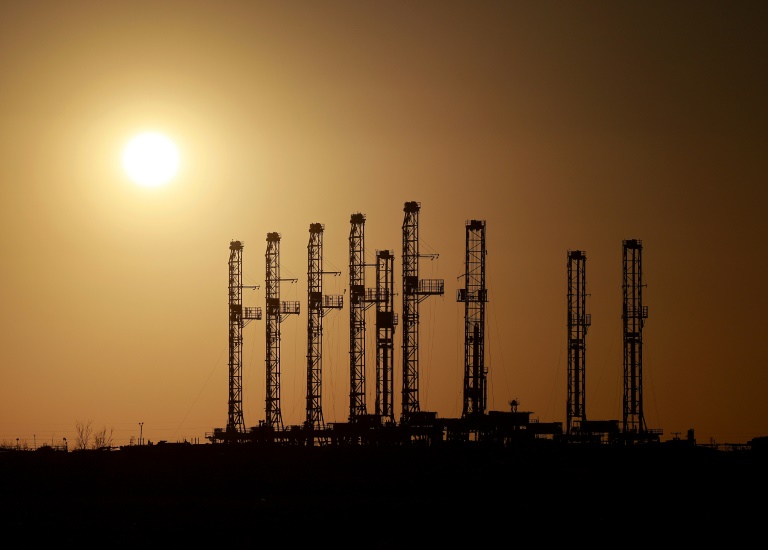
Oil prices rose after sharp falls last week, with analysts pointing to limited crude supply as a continued worried in spite of the uncertain oil demand outlook. 

“The world is increasingly vulnerable to disruptions in energy output given critically low inventories and spare capacity,” said commodities analysts at TD Securities.

“We think that oil prices are on a runaway train, and expect that the state of the world’s energy supply is so constrained that even in a recession, oil prices could remain elevated.” 

– Key figures at around 2040 GMT –

New York – Dow: DOWN 0.2 percent at 31,438.26 (close)

New York – S&P 500: DOWN 0.3 percent at 3,900.11 (close)

New York – Nasdaq: DOWN 0.7 percent at 11,523.83 (close)

London – FTSE 100: UP 0.7 percent at 7,258.32 (close) 

Frankfurt – DAX: UP 0.5 percent at 13,186.07 (close)

Paris – CAC 40: DOWN 0.4 percent at 6,047.31 (close)

EURO STOXX 50: UP 0.2 percent at 3,538.88 (close)

Tokyo – Nikkei 225: UP 1.4 percent at 26,871.27 (close)

Hong Kong – Hang Seng Index: UP 2.4 percent at 22,229.52 (close)

Shanghai – Composite: UP 0.9 percent at 3,379.19 (close)

Euro/dollar: UP at $1.0583 from $1.0553 Friday

Pound/dollar: FLAT at $1.2268

Euro/pound: UP at 86.24 pence from 86.02 pence

Dollar/yen: UP at 135.48 yen from 135.23 yen

Brent North Sea crude: UP 1.7 percent at $115.09 per barrel

West Texas Intermediate: UP 1.8 percent at $109.57 per barrel

burs-jmb
US abortion ruling roils midterm election campaign

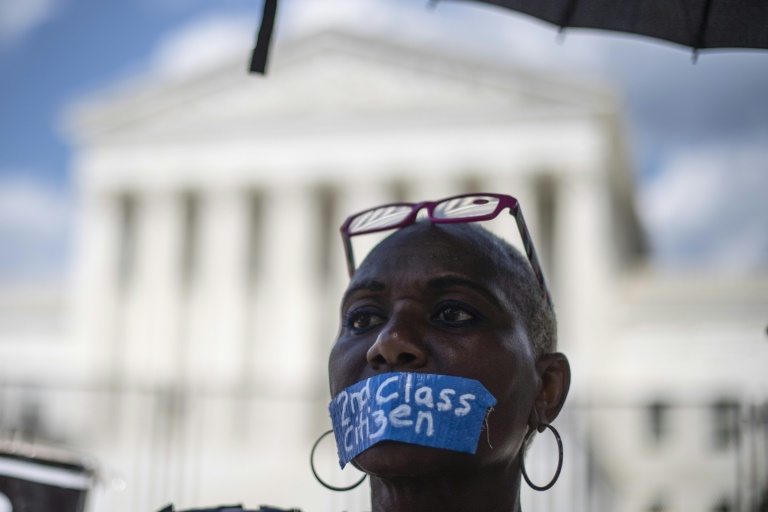
The US Supreme Court’s ruling ending the nationwide right to abortion was one of the most seismic domestic political shifts in a generation — upending the crucial midterm elections that will decide who controls Congress next year.

Republicans are celebrating the culmination of almost 50 years of activism around the argument that Roe v. Wade — the 1973 landmark ruling guaranteeing federal protection of abortion rights — was wrongly decided. 

Democrats, too, have been galvanized by the scrapping of half a century of reproductive rights, and by fears Republicans will go further and introduce a federal abortion ban if they retake Congress — threatening legal access nationwide.

Democratic President Joe Biden and House Speaker Nancy Pelosi set out what they see as the stakes on Friday, with both saying abortion would be “on the ballot” in November.

The issue has traditionally animated conservatives more than liberals but the Supreme Court may permanently have altered the political topography, analysts say.

“By striking down Roe, this is likely to create a new constituency of pro-choice voters who are activated to turn out and donate in ways that they would not normally in a midterm election,” Shana Gadarian, a professor of political science at Syracuse University, told AFP.

“The Roe decision not only has a major effect on the midterm elections, but it paved the way for greater implications on human rights as a whole,” Democratic political strategist Amani Wells-Onyioha added.

“The conservative right has made it clear that it intends on coming for contraception, the LGBT+ community, and African Americans next.”

– Mixed messaging –

A new NPR/PBS NewsHour/Marist poll out Monday showed a whopping 78 percent of Democrats believe the court’s decision made them more likely to vote in November — 24 points higher than Republicans.

Democrats are leveraging this and several recent similar polls to make the case that the position adopted by Republicans across the country is far outside of the mainstream.

The party sees it as galvanizing for its liberal base but also, according to Democratic pollster Carly Cooperman, a mobilizing issue for the moderate suburban women the party is trying to peel away from the Republicans in battleground House districts.

“Republicans will do everything possible to turn the conversation back to inflation, the economy, and high gas prices,” Cooperman told AFP.

“At a time when Democrats have consistently shown less enthusiasm for the midterms compared to Republicans, the question will be how much the court’s ruling will narrow this gap.”

Gerard Filitti, senior counsel at the New York-based Lawfare Project think tank, argues that Democrats may be able to reframe the midterms as a battle over fundamental rights rather than the cost of living.

“Concern over civil rights may well trump concerns over the economy, and the Republicans are no longer assured a clear path to victory in the November midterms,” he said.

The Republicans’ messaging has been mixed, with many members of Congress and state governors rushing to celebrate a historic victory while others prefer to keep the focus on the cost of living and economic uncertainty.

– ‘Win for life’ –

Republican leader and former president Donald Trump called the decision “the biggest win for life in a generation” while Adam Laxalt, the Republican Senate nominee in Nevada, said the issue “won’t distract voters from unaffordable prices, rising crime or the border crisis.”

The decision set off a frenzy of activity on both sides, with at least eight states imposing immediate bans and a similar number expected to follow suit within weeks.

Dozens of arrests were reported during a weekend of nationwide protest — although incidents of violence and vandalism were isolated.

Mississippi, Utah and Louisiana have been hit with lawsuits seeking to block their bans. The plaintiff in Mississippi, abortion provider Planned Parenthood, said it will spend $150 million on the midterm elections, alongside NARAL Pro-Choice America and Emily’s List. 

In Congress, Senate Minority Leader Mitch McConnell has suggested that a federal ban would be “possible,” although he has also acknowledged that no position on the issue has ever achieved the upper chamber’s 60-vote threshold.

“It will be important to see how Republican candidates campaign after this Supreme Court decision,” Lyle Solomon, a California-based principal attorney at Oak View Law Group, told AFP.

“If they campaign on abortion restrictions and focus a lot on the Supreme Court decision being a victory, it may backfire on them. On the other hand, Democrats will be looking to take full advantage of the Supreme Court decision and rally voters around the message of abortion rights and access to safe abortion.”

US to work with Taiwan, Vietnam against illegal fishing

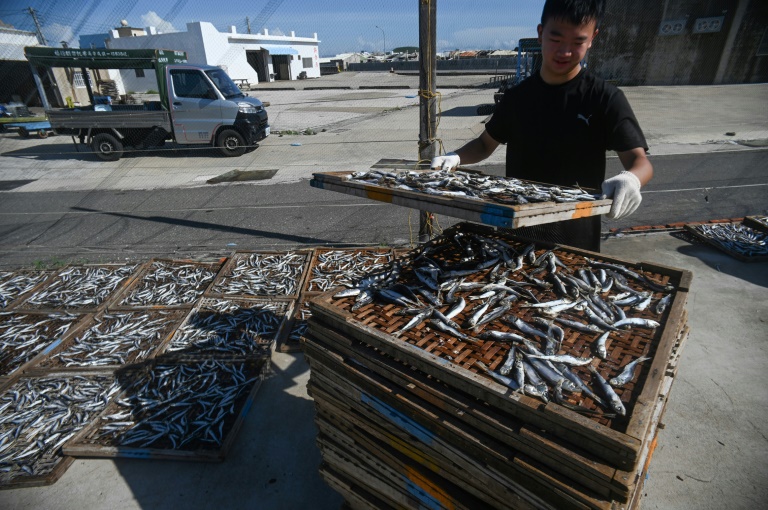
The United States said Monday it would step up cooperation with Vietnam and Taiwan among others to combat illegal fishing, a problem that environmentalists and Western nations increasingly attribute to China.

As a major UN conference opened in Portugal on restoring the planet’s ailing oceans, US President Joe Biden signed a memorandum that aimed to step up coordination and enforcement within the US government against illegal fishing and the use of forced labor.

The White House said the United States also plans new engagement with Ecuador, Panama, Senegal, Taiwan and Vietnam on fighting illegal, unreported and unregulated fishing, dubbed “IUU” in environmental jargon.

An administration official said, without further detail, that the cooperation would include “capacity building” as part of a strategic plan.

The United States identified the five “not because they are the primary offenders of IUU fishing but because they have expressed a willingness to work with the United States to combat IUU fishing in their countries,” she told reporters on customary condition of anonymity.

US officials generally avoid describing Taiwan as a country as the United States only recognizes Beijing, which considers the pro-Western self-governing democracy to be part of its territory.

Vietnam also has intense maritime disputes with Beijing, which claims large stretches of the South China Sea and has sought to enforce its own fishing rules.

Another official said that, while the new US effort does not target any country, China “is a leading contributor to IUU fishing worldwide and has impeded progress on the development of measures to combat IUU fishing and overfishing in international organizations.”

A recent report by the Environmental Justice Foundation said that China by far has the world’s largest fleet capable of fishing in distant waters and that there have been frequent complaints of abuse.

The British advocacy group said that crew members from Indonesia and Ghana in interviews recounted Chinese captains imposing excessive hours without pay, meting out threats or actual violence and providing low-quality food that led to diarrhea and other maladies.

As Ukraine fallout worsens, G7 seeks to woo fence-sitters

Five emerging powers have become the object of the G7 industrialised powers’ charm offensive, as the club of rich nations seeks broader support in their backing for Kyiv.

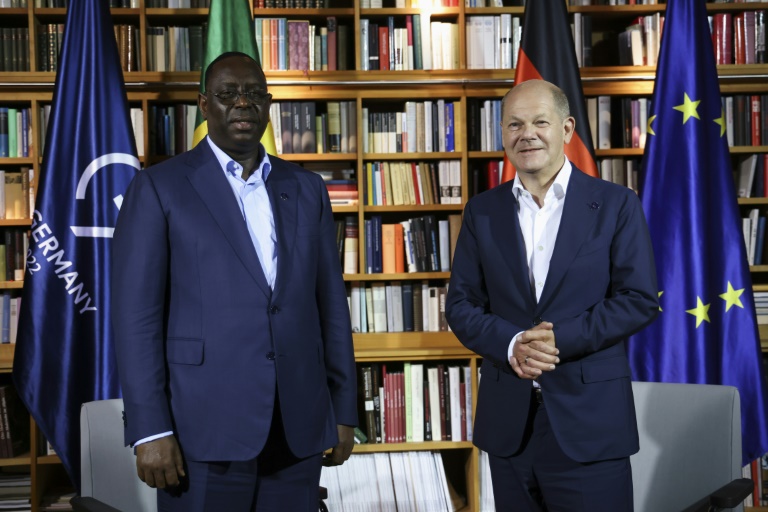
German Chancellor Olaf Scholz, who is hosting the G7 summit of advanced economies in the Bavarian Alps, said the invitation to Argentina, India, Indonesia, Senegal and South Africa signalled that the community of democracies is not limited to the West or to countries in the northern hemisphere.

“The democracies of the future are to be found in Asia and Africa,” said the German leader.

On the eve of the guest nations joining the summit, the G7 rolled out a $600-billion global infrastructure programme for the developing world.

But belying the invitation and the altruistic programme are fears that a blowback over the West’s support for Ukraine is building around the globe.

Western allies are battling to counter the rhetoric fanned by Moscow that it is the sanctions against Russia rather than Vladimir Putin’s invasion of Ukraine that are causing the multitude of crises rocking the world.

“Russia is responsible for this dramatic crisis, not international sanctions,” German Foreign Minister Annalena Baerbock insisted at a recent international food security conference.

“We know about indirect negative sanctions effects and we acknowledge them. However, they are much smaller than the brutal actions of Russia, which uses hunger as a weapon,” she said.

– Sceptical –

Three of the five guest countries — India, Senegal and South Africa — failed to condemn Russia over its assault of Ukraine, although Argentina and Indonesia did.

All five have been hit hard by the economic fallout from the war.

Thorsten Brenner, director of the Global Public Policy Institute, noted that “a crucial task” facing the G7 “is convincing many non-Western countries who are sceptical of sanctions that the West is mindful of their concern about rising energy prices when designing sanctions”.

The emerging powers have underlined the hunger crisis threatening their countries as Russia’s blockade of Ukrainian grain exports sends wheat prices soaring.

But other essentials such as sunflower oil and fertilisers essential for planting were also becoming scarcer, as both Ukraine and Russia are large producers.

And a scramble for energy by Western powers seeking to wean themselves off Russian energy has further pushed up power prices — once again hitting the poorest hardest.

Statements by Senegal President Macky Sall following his recent visit to Moscow for talks with Putin over the food crisis alarmed Western officials.

Sall had said he was “reassured” by Putin and had instead called on Ukraine to demine waters around its Odessa port to allow grain exports out.

At the same time, Western allies are seeking to ensure that the developing giants refrain from taking action that could worsen the crisis.

India’s decision to halt wheat exports and Indonesia’s move to stop palm oil exports have sparked shockwaves in the commodities markets. 

Argentina has also lowered its quota of wheat exports. 

South Africa meanwhile is suffering from the soaring oil prices.

A G7 official said Monday’s talks had shown that there was work to be done to convince the emerging giants about their action.

– ‘Don’t torpedo’ –

Putin too is jostling to broaden his backing, trying to hammer home his message that Western sanctions were to blame.

During a summit of Brazil, China, India and South Africa, calling on them to cooperate in the face of “selfish actions” from the West.

Amid fears of a growing gulf between the West and the rest, European leaders were tempering their tone. 

While calls had been made earlier for G20 host nation Indonesia to exclude Putin from this November’s summit, European leaders now appear to have distanced themselves from that stance.

A Kremlin advisor said Monday that Putin planned to attend the summit, having received the official invitation. Jakarta has also invited Ukraine’s President Volodymyr Zelensky.

Scholz said the group of major developed and developing economies would continue to play a “big role” and cooperation was key.

Germany would therefore “not torpedo” the G20’s work, Scholz told ZDF public television.

EU chief Ursula von der Leyen said on Sunday that she did not rule out sitting at the same table with Putin at the G20. 

“It is also important to tell him to his face what we think of him,” she said. 

“And we must carefully consider whether we want to paralyse the whole G20,” she said, warning that the bloc, which makes up 80 percent of total world economic output, is “too important a platform” to undermine.

US Capitol assault probe schedules surprise extra hearing

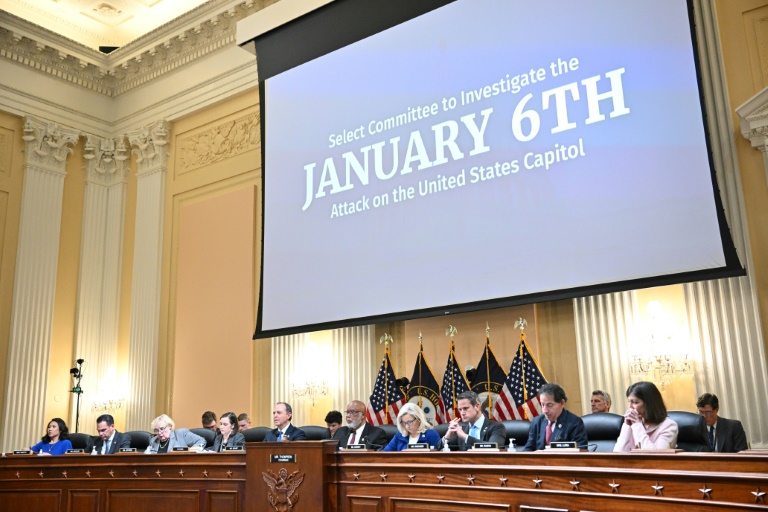
Lawmakers investigating last year’s deadly attack on the US Capitol and the alleged plot led by Donald Trump that culminated in the bloodshed said Monday they will hold an extra hearing this week.

The House select committee had announced a break of at least two weeks from its series of televised hearings, but said it would meet again on Tuesday to “present recently obtained evidence and receive witness testimony.”

The panel did not announce what new evidence it planned to reveal, or who was due to testify.

But investigators said last week they have a trove of evidence to sift through that came in as the hearings were underway, including hundreds of leads from a tip hotline and hours of footage of Trump and his family filmed for a documentary.

The committee originally planned to hold seven hearings on the initial findings from its year-long probe into the January 6 insurrection by a pro-Trump mob bent on stopping the certification of Joe Biden’s victory.

The committee initially said that last Thursday’s hearing on Trump’s push to co-opt the US Justice Department into his scheme to stay in office would be the last until the second week in July at the earliest.

Two July hearings are expected to focus on the far right groups that led the violence at the Capitol and Trump’s actions inside the White House on January 6, 2021. 

The panel hasn’t ruled out further hearings stretching deep into the summer.

Trump denies all wrongdoing and accuses the bipartisan committee and its Republican witnesses of being part of a Democratic “witch hunt” against him, while continuing to spread the very claims of widespread election fraud that led his supporters to storm the US Capitol.

Blocked Russian payments: what impact for Moscow and creditors?

Russia acknowledged Monday that two interest payments on its debt didn’t make it to creditors, an event which could be considered a default, even if Moscow disputes such an interpretation. 

What happens next?

Why the default risk?

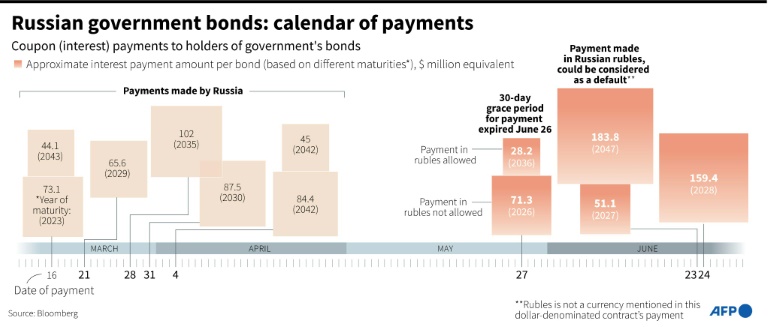
Russia was due to pay $100 million in interest on its debt on May 27 and the one-month grace period on the payment expired on Sunday.

The Russian finance ministry has said it paid the money on May 20. But it acknowledged on Monday that the money didn’t reach creditors as the banking intermediaries blocked the transfers due to Western sanctions imposed on Moscow over the war in Ukraine.

The United States has since the end of May blocked Moscow from paying its dollar debts.

How to know if Russia is really in default?

Traditionally, it is the big credit ratings agencies (Fitch, Moody’s, S&P Global Ratings) which make such a determination.

However, with the Western sanctions in place, “they are now prohibited from rating Russian government bonds,” said Eric Dor, director of economic studies at the IESEG business school.

“We could well have a default without an official declaration by an authorised institution,” he added.

It will now likely fall to the Credit Derivatives Determinations Committee (CDDC), a committee of creditors, to make the official determination whether Russia missed the payments and whether this constitutes a default.

The Committee has already acknowledged earlier this month that Russia did not make $1.9 million in penalty interest payments concerning a different payment due.

It plans to meet on Wednesday afternoon to discuss the missed May 27 payment.

It is also the Committee which decides whether or not to trigger payment of credit default swaps (CDS), financial products designed to serve as insurance for creditors against default.

Moscow argues that the fact that creditors didn’t receive their money was not of the result of its failure to make the payment, but the actions of third parties, thus there is no default on its part.

What consequences of a default?

Russia’s last default on its foreign debt was in 1918, when Bolshevik leader Vladimir Lenin repudiated Tsarist-era debts.

In case a default is declared “Russia won’t be able to borrow in foreign currencies,” said Slim Souissi, a researcher at the Institute of Business Administration at the University of Caen.

“In the short term, it will have trouble raising funds on international markets” and this could last for years, said Souissi, who previously worked as a financial analyst at Fitch. 

Liam Peach, Emerging Europe Economist at Capital Economics, downplayed the impact of a default determination, as Western sanctions are already blocking Russia’s access to international capital markets.

Normally, a default can have serious consequences.

Argentina’s decision to freeze payment on $100 billion in debt in 2001 triggered a deep economic, political and social crisis.

But with sanctions again blocking Russian access to many markets, Peach said default would be a “largely symbolic event” unlikely to have an additional macroeconomic impact.

Russia’s situation is also different in terms of the sums involved.

“There are around $2 billion in payments due from now until the end of the year, and that isn’t going to destabilise” the international financial system, said Dor.

Mexico’s 1982 default sparked debt crises in several developing countries as creditors demanded higher interest rates.

Peach said only about half of Russian foreign currency bonds are held by foreigners, which reduces the possibility of a wider impact.

Recovering the debt could prove to be thorny to litigate, according to legal experts questioned by AFP. The terms of Russian bonds are notoriously vague, including even on such basic elements as the legal jurisdiction to resolve disputes.

How did Russia try to avoid default?

To get around the ban on dollar payments, Moscow made the equivalent ruble sums available to creditors at the National Settlement Depository (NSD), a Russian financial institution.

According to Souissi, if the bond’s terms didn’t forsee payment in rubles this would constitute a default.

Moscow said the arrangement allowed Western creditors to recover their money, and they are free to request conversion into the foreign currency of their choice. 

But getting the money out of Russia isn’t straightforward and “investors weren’t keen on opening accounts at the NSD”, said Dor.

bur-boc-jvi-dga/rl/cdw

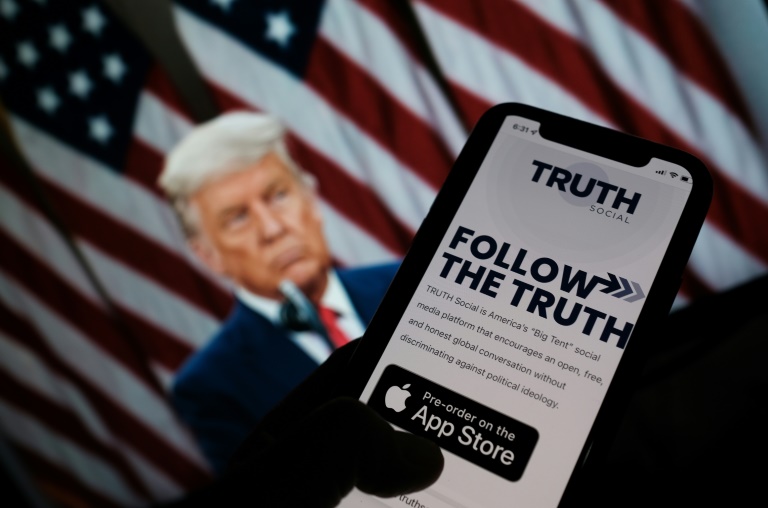
Investment vehicle probed over merger with Trump media company

The investment vehicle seeking to merge with Donald Trump’s social media venture disclosed Monday that it received federal subpoenas, delaying and potentially derailing the transaction. 

Digital World Acquisition said that it and its board members received grand jury subpoenas on issues that include due diligence on the Trump venture and communications with potential merger partners other than the Trump venture, according to a Securities and Exchange filing.

The subpoenas from the Southern District of New York are connected to a Justice Department probe that “could materially delay, materially impede, or prevent the consummation of the Business Combination,” the filing said.

First launched in September on Wall Street, DWAC was established as a special purpose acquisition company (SPAC), sometimes called a “blank check” company set up with the sole purpose of merging with another entity that is announced after the entity goes public.

In late October, DWAC announced the plan to combine with Trump’s venture to establish “a rival to the liberal media consortium.”

The deal, which would provide Trump’s venture $1.3 billion in capital and a stock market listing, has been under SEC investigation for months on similar questions raised by the DOJ subpoenas.

The SEC probe has focused on whether talks were held between Trump’s team and DWAC figures prior to the public offering, according to a New York Times report. SPACs are not supposed to have a target lined up before selling shares.

Shares of DWAC slumped 9.4 percent to $25..22 in afternoon trading. 

US Supreme Court backs praying football coach

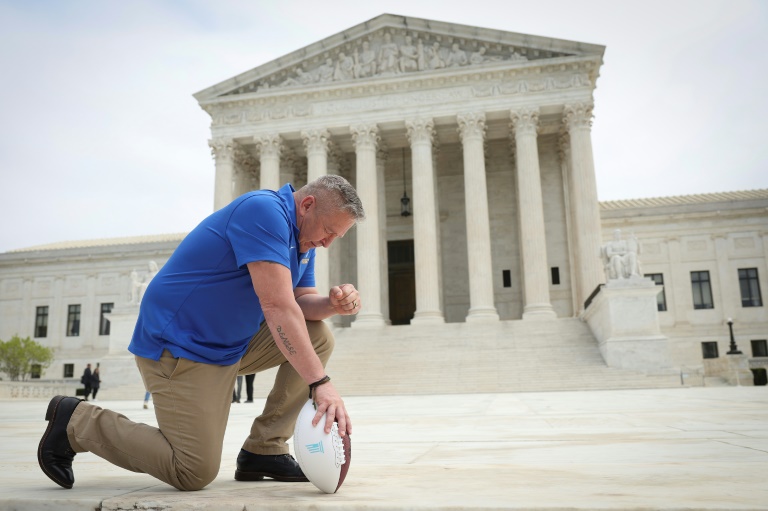
The US Supreme Court opened the door to the expansion of religion in public schools Monday when conservative justices backed a Christian high school football coach who lost his job after leading his team in post-game prayers on the field.

The court voted 6-3 along conservative-liberal lines that Joe Kennedy, a coach for Bremerton High School in Washington state, was protected by the US constitution’s guarantee of religious freedom when in 2015 he ignored supervisors’ warnings and continued to pray after the games.

The high-profile case pitted backers of the principles of free exercise of religion with those focused on the constitution’s insistence on separation of church and state — that is, that public schools should not impose specific religious practices on students.

But the two sides of the court split starkly on the basic facts of the case, in an echo of other recent landmark decisions on  gun rights and abortion that have marked the powerful ascension of the court’s conservative majority.

Kennedy, a former marine, began post-game prayers at the field’s 50-yard-line in 2008.

The school told him to halt the custom in 2015 after players began joining in, arguing that he was violating its ban on staff encouraging students to pray. 

He continued to pray on his own, but after attracting extensive media attention, he resumed group prayers, joined by members of the public, leading to his suspension. 

When his contract expired, it was not renewed.

Kennedy sued the school district on grounds of religious freedom, and the six conservative justices backed him, saying he had a right to pray on his own after the game.

“Joseph Kennedy lost his job as a high school football coach because he knelt at midfield after games to offer a quiet prayer of thanks,” Justice Neil Gorsuch wrote in the majority opinion.

Gorsuch said that he “offered his prayers quietly while his students were otherwise occupied,” he wrote.

– Repeated offenses –

The three progressive justices rejected that characterization, saying Kennedy’s prayers were not simply private and quiet, and that he chose to defy the school district policy against both encouraging and discouraging religious activities by students.

“Kennedy consistently invited others to join his prayers and for years led student athletes in prayer at the same time and location. The Court ignores this history,” they said.

They also noted that, after being told he could not lead the group prayers during school activities, Kennedy hired a lawyer and declared in multiple media appearances that he would resume group prayers at games.

He did so three more times, inviting members of the public and state politicians to pray with him.

“The last three games proved that Kennedy did not intend to pray silently, but to thrust the district into incorporating a religious ceremony into its events,” they wrote.

That violated the constitution’s “establishment clause,” they argued, which forbids authorities from involvement in establishing religious practices.

It was the third judgment in recent weeks that saw the court’s conservative majority — all Christians — endorse the involvement of government in religious activities.

In one earlier case, they ruled that a state cannot deny church-backed schools public funding.

In the other, Boston was told it cannot forbid a religious flag from being flown over the city hall if other private group flags can be flown.

One dead as rare tornado tears through Dutch city

A tornado ripped through a southwestern Dutch city on Monday, killing one person and injuring nine others in the first fatal twister to hit the country for three decades.

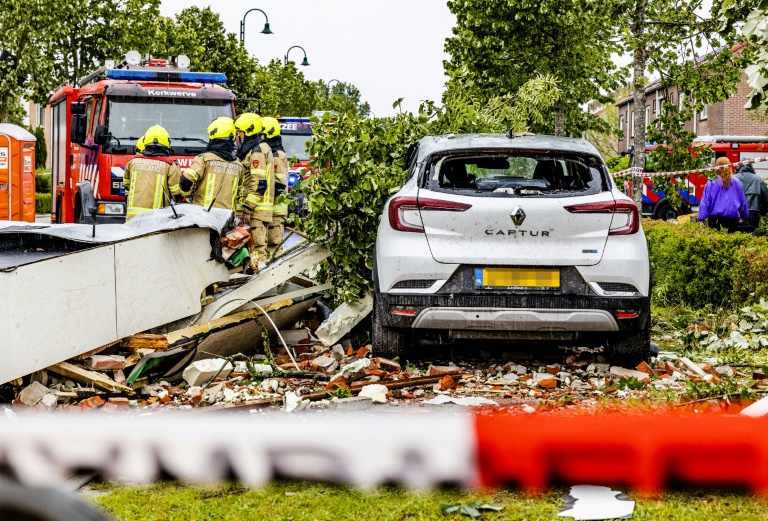
The whirlwind left a trail of destruction through the seaside city of Zierikzee, ripping the roofs off homes and toppling trees onto cars, an AFP journalist at the scene said.

Images on social media showed debris rotating in the air in the fierce winds and a huge funnel descending from stormy clouds as the tornado hit the city in the scenic province of Zeeland.

“The damage is considerable in several streets in Zierikzee. In addition to flying roof tiles and fallen trees, roofs have been blown off four houses,” the Zeeland safety authority said.

“Unfortunately, there was one fatality in the tornado,” it said, adding that one injured person was taken to hospital and eight others were treated on site by paramedics.

It said there had been a “huge deployment” of emergency services.

A local newspaper, the Provinciale Zeeuwse Courant, described the scene as a “war zone” and said the victim of the tornado was a tourist who was hit on the head by a roof tile in the city’s harbour area.

“It got completely dark. Outside you could see everything flying, everything in the air,” Zierikzee resident Freek Kouwenberg, 72, told AFP. 

“I’ve never experienced anything like it.”

“The whirlwind kept getting bigger. It reminded me of American films, with those storm chasers,” resident Maurice van den Nouweland was quoted as saying by the Dutch national news agency ANP.

– ‘Rare in our country’ –

The tornado hit at the start of the tourism season in Zierikzee, which sits on one of the bridge-connected islands that comprise Zeeland province, whose attractions include a historic fishing harbour and the 15th century “Fat Tower”.

Its path could be traced through one neighbourhood, where the twister tore a huge piece of black roofing off the top of a block of four terraced houses and dumped it in a residential street, an AFP journalist said.

A mechanical digger was lifting debris from the road near to where a car lay partly crushed by a tree. Firefighters had sealed off the road with tape while they carried out searches.

Footage on social media showed debris swirling through the air while powerful winds whipped through the town. Other images showed the tornado itself spiralling towards the ground as people stopped their cars or left their restaurant tables to watch.

Local authorities were arranging shelter for the inhabitants of dozens of rental homes left temporarily uninhabitable by the whirlwind, and residents were also being offered counselling.

The Netherlands’ flat landscape sitting just above sea level makes it vulnerable to extreme weather, although the Dutch meteorological agency KNMI said it only experiences a few tornadoes a year.

The last fatal one to hit the country was in 1992, the KNMI said, while the deadliest recorded hit the southern villages of Chaam and Tricht on June 25, 1967, killing seven people. There were also deadly twisters in 1972 and 1981.

“Heavy whirlwinds, also called a tornado, are rare in our country,” the KNMI said on its website after Monday’s twister.

“The area in which they occur is usually no larger than a narrow track of two to several tens of kilometres (miles) in length and a few hundred metres (feet) in width.”

Sri Lanka suspends fuel sales as economic crisis worsens

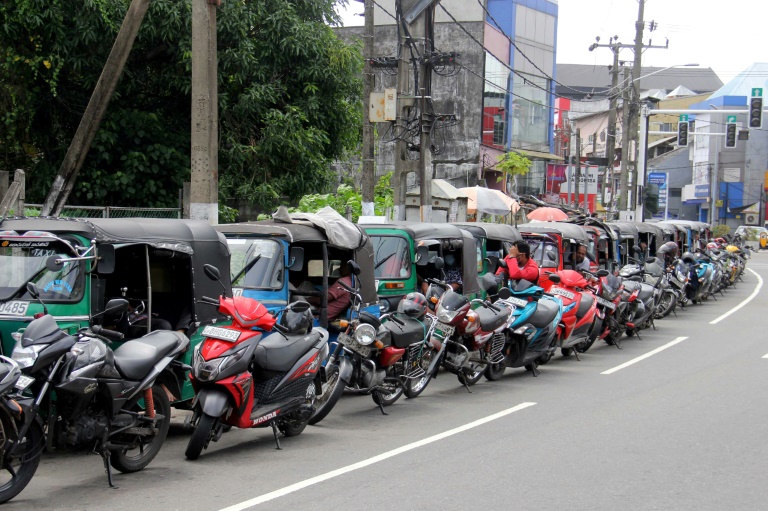
Cash-strapped Sri Lanka announced a two-week halt to all fuel sales except for essential services starting Monday and called for a partial shutdown as its unprecedented economic crisis deepened.

The South Asian nation is facing its worst economic meltdown since gaining independence from Britain in 1948, and has been unable to finance even the imports of essentials since late last year.

As fuel reserves hit rock bottom with supplies barely enough for just one more day, government spokesman Bandula Gunawardana said the sales ban was to save petrol and diesel for emergencies.

He urged the private sector to let employees work from home as public transport ground to a halt.

“From midnight today, no fuel will be sold except for essential services like the health sector, because we want to conserve the little reserves we have,” Gunawardana said in a pre-recorded statement.

He apologised to consumers for the shortages: “We regret the inconvenience caused to the people.”

-Electricity shock-

The sudden fuel ban came as the loss-making state-run electricity monopoly asked for a massive price increase for its poorest customers.

The Ceylon Electricity Board (CEB) lost 65 billion rupees ($185 million) in the first quarter and sought a nearly tenfold price hike for the heavily-subsided smallest power consumers, the Public Utilities Commission of Sri Lanka (PUCSL) said.

Currently, anyone using less than 30 kilowatts a month pays a flat 54.27 rupees ($0.15), which the CEB sought to raise to 507.65 rupees ($1.44).

“A majority of the domestic consumers will not be able to afford this type of steep increase,” PUCSL chairman Janaka Ratnayake told reporters in Colombo. 

“Hence we proposed a direct subsidy from the Treasury to keep the increase to less than half of what they have asked.”

As part of measures to ease the forex crisis that led to the energy crunch, the CEB will be allowed to charge users who earn foreign currency, such as exporters, in dollars.

The move is aimed at helping the electricity utility collect dollars to finance imports of oil and spare parts it desperately needs, but is unable to secure because of the country’s forex crisis.

The country is also facing record high inflation and lengthy power blackouts, all of which have contributed to months of protests — sometimes violent — calling on President Gotabaya Rajapaksa to step down. 

Last week, all government schools were shut down and state institutions operated with skeleton staff to reduce commuting and preserve oil.

The state sector shutdown was meant to end this week, but it is now being extended till July 10, when Gunawardana promised to restore fuel supplies.

– Broken promise –

On Sunday, the government promised it will implement a token system to ration distribution of limited fuel stocks, but it failed to take off.

There have been long queues outside the few pumping stations which still had supplies. 

Sri Lanka is seeking cheap oil from Russia and Qatar.

Earlier this month, the United Nations launched an emergency response to the island’s unprecedented economic crisis, feeding thousands of pregnant women who were facing food shortages.

Four out of five people in Sri Lanka have started skipping meals as they cannot afford to eat, the UN has said, warning of a looming “dire humanitarian crisis” with millions in need of aid.

Sri Lanka defaulted on its $51 billion foreign debt in April, and is in talks with the International Monetary Fund for a bailout.

Close Bitnami banner
Bitnami