AFP

Passenger jet catches fire while landing at Miami airport

Officials arrived in Miami Wednesday to investigate a passenger jet that caught fire as it touched down at the US city’s international airport, forcing more than 100 people to flee the burning and mangled aircraft.

Three people were hospitalized after the crash of Red Air Flight 203 late Tuesday, according to Miami-Dade fire officials, but no deaths or serious injuries have been reported among those on board.

Dramatic video footage showed people being evacuated from the McDonnell Douglas MD-82 aircraft, lying askew on the runway with its nose crumpled as thick black smoke billows from its body.

The National Transportation Safety Board (NTSB), the US government agency in charge of probing civil aviation accidents, said the airplane’s left main landing gear collapsed during landing. 

The plane then “departed the runway” before coming to rest on a grassy area, it said, with a fire breaking out on its right side.

Red Air, a Dominican budget carrier which only launched in November last year, said the plane was arriving from Santo Domingo when it met with “technical difficulties.”

Investigators were able to recover the cockpit voice recorder and flight data recorder from the plane. They will additionally examine runway markings and the physical environment.

Red Air and the NTSB said there were 130 passengers and 10 crew on board.

Passenger jet catches fire while landing at Miami airport

Officials arrived in Miami Wednesday to investigate a passenger jet that caught fire as it touched down at the US city’s international airport, forcing more than 100 people to flee the burning and mangled aircraft.

Three people were hospitalized after the crash of Red Air Flight 203 late Tuesday, according to Miami-Dade fire officials, but no deaths or serious injuries have been reported among those on board.

Dramatic video footage showed people being evacuated from the McDonnell Douglas MD-82 aircraft, lying askew on the runway with its nose crumpled as thick black smoke billows from its body.

The National Transportation Safety Board (NTSB), the US government agency in charge of probing civil aviation accidents, said the airplane’s left main landing gear collapsed during landing. 

The plane then “departed the runway” before coming to rest on a grassy area, it said, with a fire breaking out on its right side.

Red Air, a Dominican budget carrier which only launched in November last year, said the plane was arriving from Santo Domingo when it met with “technical difficulties.”

Investigators were able to recover the cockpit voice recorder and flight data recorder from the plane. They will additionally examine runway markings and the physical environment.

Red Air and the NTSB said there were 130 passengers and 10 crew on board.

US Capitol assault hearings take break as new evidence floods in

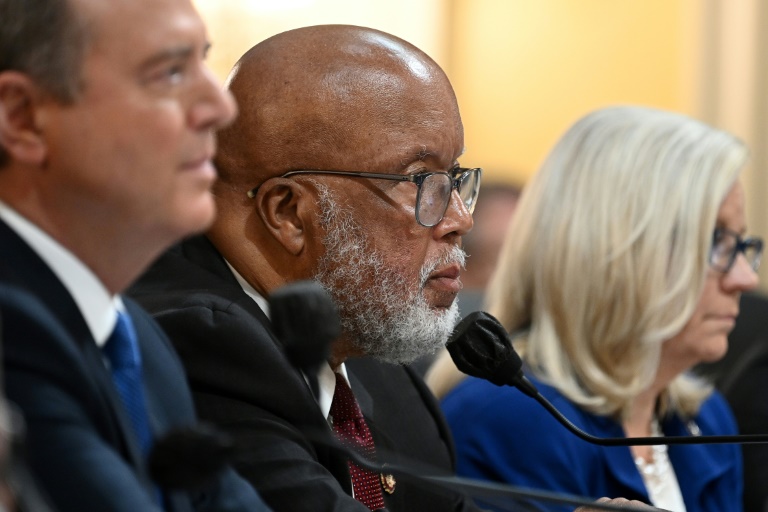
The congressional panel investigating last year’s attack on the US Capitol announced a break from its blockbuster series of televised hearings Wednesday after receiving a glut of new video footage of Donald Trump and his family from a documentary filmmaker. 

Chairman Bennie Thompson told reporters Thursday’s hearing on Trump’s alleged attempts to corrupt the Justice Department would be the last until two further hearings “later in July.”

Thompson did not elaborate on the timetable but said further hearings after the two in July were “always a possibility.”

“The timeline of the hearings is driven, and continues to be driven, by the investigation. The select committee continues to receive relevant new evidence that we think is very important to the investigation,” an aide to the panel said.

“It’s important that our members (and) investigators take the time needed to assess that information and figure out how we’re going to use that information as we continue to make our presentation to the American people.”

The new evidence includes documents from the National Archive and multiple new leads given to a tip-line since the televised hearings began earlier in June.

The most prized haul though will be hours of footage from documentary filmmaker Alex Holder, who was granted extensive access to Trump and his inner circle — including for interviews — before and after January 6. 

Holder began filming on the campaign trail in September 2020, according to Politico, and had substantial access to Trump, Trump’s grown-up children and his vice president Mike Pence for months.

Congress goes on a two-week recess for the July 4 holiday starting next week.

When lawmakers return in the second week of July, they are expected to dedicate at least some of the remaining hearings to the radicalization of extremists who stormed the Capitol, as well as the culture of political violence on the far right.

– Threats of violence –

In a sign of heightened political tensions around the hearings, The New York Times reported an uptick in violent threats against members of the panel, adding that they would likely receive a security detail.

Adam Kinzinger, one of two Republicans on the nine-member committee, revealed a letter addressed to his wife over the weekend that threatened to execute the couple and their five-month-old baby. 

“There is violence in the future, I’m going to tell you,” Kinzinger told ABC on Sunday. “And until we get a grip on telling people the truth, we can’t expect any differently.”

Committee vice-chair Liz Cheney halted large, public events long ago due in part to concerns over her safety as she fends off a primary challenge to her Wyoming seat in Congress.

Federal agents issued subpoenas over the insurrection Wednesday, raiding the homes of two people involved in the plot to overturn the election, The Washington Post reported.

One Trump supporter had allegedly tried to impersonate an official elector — the people picked by the winning party in each state to choose the president under America’s arcane “electoral college” voting system. 

The other raid target worked on Trump’s drive to invalidate the election in Arizona and New Mexico. Other participants in Trump’s alleged plot received subpoenas.

The action came after officials in Arizona and Georgia appeared Tuesday before the select committee’s fourth public hearing this month to outline Trump’s efforts to cling to power, which involved bullying local officials and poll workers, publishing their personal details and defaming them.

Recession fears send oil prices plunging, equities diverge

Wall Street stocks climbed Wednesday as the US Fed chief stressed the need to combat decades-high inflation, but elsewhere equities and oil prices tumbled on mounting recession fears as central banks hike interest rates.

Wall Street was moderately higher in late morning trading, while European and Asian markets closed in the red, a day after healthy gains.

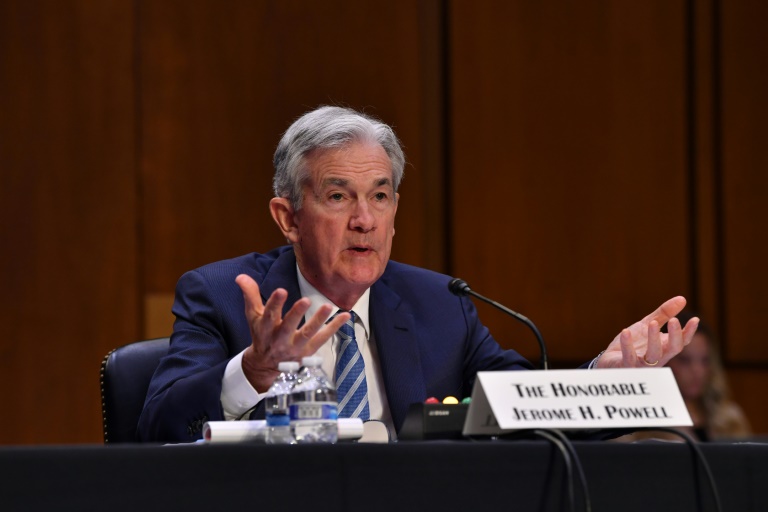
Federal Reserve boss Jerome Powell began two days of testimony to US lawmakers on Wednesday, warning that the US economy faced an “uncertain” global environment and could face further inflation “surprises”.

His testimony to Congress this week will be pored over for an idea about officials’ plans for fighting runaway prices, which are being fanned by supply chain snarls, China’s Covid lockdowns and the war in Ukraine.

Powell once again stressed that the Fed was committed to bringing down inflation — which has reached a 40-year high — with higher interest rates.

But the world’s largest economy “is very strong and well positioned to handle tighter monetary policy”, he said.

Most observers expect the Fed to aggressively hike US interest rates several more times this year, having recently carried out the sharpest lift in almost 30 years.

Powell said rapid interest rate increases were meant to cool demand and bring inflation down, but he acknowledged the risk that the hikes could trigger a US recession.

“It’s not our intended outcome at all, but it’s certainly a possibility,” Powell said in testimony to the Senate Banking Committee.

“The ‘R’ word is likely to come up a lot today and the Chairman will have a tough time dodging it, especially with mid-terms in five months,” said OANDA market analyst Craig Erlam, referring to recession.

“Naturally, he’ll do his best to remain apolitical but I’m not sure investors will be able to ignore so much recession chat,” he added.

Expectations of more rate hikes have been handing support to the dollar, which pushed the yen briefly to a fresh 24-year low Wednesday, before sliding against major rivals.

The Bank of Japan is holding back from lifting interest rates, in sharp contrast to other major central banks.

Oil prices were feeling the heat from recessionary fears, with both main contracts tanking more than six percent at one point.

“Concerns about a global slowdown appear to be outweighing any concern over supply issues derived from Russia’s invasion of Ukraine, and the prospect that Chinese demand could return,” said market analyst Michael Hewson at CMC Markets.

Crude and gas prices have soared in recent months after major economies lifted pandemic lockdowns and following the invasion of Ukraine by major energy producer Russia.

Surging energy costs are fuelling global inflation, with official data Wednesday showing the British annual rate hitting a fresh 40-year high above nine percent.

In the United States, President Joe Biden asked Congress on Wednesday to suspend the federal gas tax for three months as skyrocketing prices cause widespread anger among Americans just months before crucial mid-term elections.

A senior administration official noted that US gas prices — averaging near $5 per gallon — had jumped almost $2 since Russian President Vladimir Putin began building up forces on the Ukrainian border earlier this year.

– Key figures at around 1530 GMT –

Brent North Sea crude: DOWN 3.7 percent at $110.39 per barrel

West Texas Intermediate: DOWN 110.39 percent at $104.86 per barrel

New York – Dow: UP 0.3 percent at 30,623.29 points

EURO STOXX 50: DOWN 0.8 percent at 3,467.26

London – FTSE 100: DOWN 0.9 percent at 7,089.22 (close)

Frankfurt – DAX: DOWN 1.1 percent at 13,144.28 (close)

Paris – CAC 40: DOWN 0.8 percent at 5,916.63 (close)

Tokyo – Nikkei 225: DOWN 0.4 at 26,149.55 (close)

Hong Kong – Hang Seng Index: DOWN 2.6 percent at 21,008.34 (close)

Shanghai – Composite: DOWN 1.2 percent at 3,267.20 (close)

Euro/dollar: UP at $1.0594 from $1.0535 late Tuesday

Pound/dollar: UP at $1.2304 from $1.2273

Euro/pound: UP at 86.10 pence from 85.80 pence

Dollar/yen: DOWN at 135.89 yen from 136.64 yen

burs-rl/jj

US Fed chair admits recession a 'possibility' after rate hikes

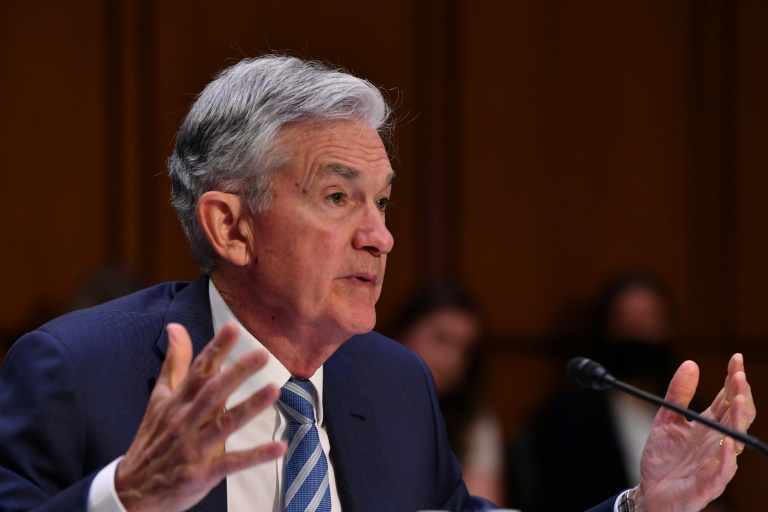
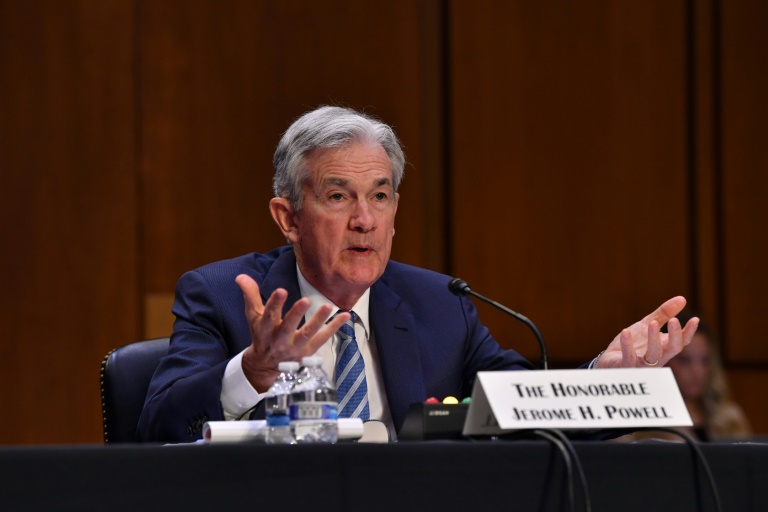
The US economy remains strong but a series of aggressive rate hikes meant to cool soaring inflation could eventually trigger a recession, Federal Reserve Chair Jerome Powell cautioned Wednesday.

Powell, whose testimony before senators was closely watched by investors and analysts, also said the world’s largest economy faces an “uncertain” global environment and could see further inflation “surprises.”

The Fed chair again stressed that policymakers understand the hardships caused by rising prices and are committed to bringing down inflation, which has reached a 40-year high.

Last week, the US central bank announced the sharpest interest rate increase in nearly 30 years and promised additional similar moves to combat the price surge, with gas and food costs skyrocketing and millions of Americans struggling to get by.

But when peppered with questions about the prospect of a recession, Powell acknowledged the risk.

“It’s not our intended outcome at all, but it’s certainly a possibility,” he told the Senate Banking Committee.

“And frankly, the events of the last few months around the world have made it more difficult for us to achieve what we want, which is two percent inflation and still a strong labor market.”

In his opening remarks, Powell insisted the US economy “is very strong and well positioned to handle tighter monetary policy.”

“Inflation has obviously surprised to the upside over the past year, and further surprises could be in store,” the Fed chief said in his semi-annual appearance before Congress.

Policymakers “will need to be nimble” given that the economy “often evolves in unexpected ways,” he said.

The Fed is facing intense criticism that it was too slow to react to the changing economy, which benefited from a flood of federal government stimulus.

Last week’s super-sized 0.75-percentage-point increase in the benchmark lending rate was the third since March, taking the policy rate up a total of 1.5 points. Powell at the time said a similar increase was likely in July.

The ideal scenario would be for those moves to cool the economy enough to douse inflation pressures, without choking off growth — the hoped-for “soft landing.”

“I think it’s going to be very challenging,” Powell said, insisting there are “pathways” to avoid recession, and that he does not view the risk of a downturn as “particularly elevated.”

Financial markets seemed cheered by his relatively upbeat comments, which echo those of other Fed officials in recent days who have pushed back against rising pessimism. 

But Wall Street stocks lost steam late in the trading session, and the Dow finished the day down 0.2 percent.

– ‘Essential’ to curb inflation –

In addition to easing the financial strain on less-wealthy American families, the Fed chief said tamping down inflation was “essential” to maintain a healthy labor market.

The US economy recovered quickly from the Covid-19 pandemic, helped by robust consumer spending, and has continued to create jobs at a strong pace, pushing unemployment down to near a 50-year low.

But the buoyant demand for homes, cars and other goods clashed with transportation and supply chain snarls in parts of the world where Covid-19 has remained a challenge.

That fueled inflation, which got dramatically worse after Russia invaded Ukraine in late February and Western nations imposed stiff sanctions on Moscow, sending food and fuel prices up at a blistering rate.

But Powell noted that inflation is a global issue, not unique to the United States.

Many major central banks have joined the Fed in beginning to tighten monetary policy — with the notable exception of the Bank of Japan.

Powell said many factors driving inflation are beyond the Fed’s control, but he pointed to signs that rising rates are having an impact, as business investment slows and “activity in the housing sector looks to be softening, in part reflecting higher mortgage rates.”

Average home loan rates jumped to 5.23 percent in May for a 30-year, fixed-rate mortgage, from 4.98 percent in April, according to Freddie Mac, while the median price for homes topped $400,000 for the first time.

“The tightening in financial conditions that we have seen in recent months should continue to temper growth and help bring demand into better balance with supply,” Powell said.

US Fed chair admits recession a 'possibility' after rate hikes

The US economy remains strong but a series of aggressive rate hikes meant to cool soaring inflation could eventually trigger a recession, Federal Reserve Chair Jerome Powell cautioned Wednesday.

Powell, whose testimony before senators was closely watched by investors and analysts, also said the world’s largest economy faces an “uncertain” global environment and could see further inflation “surprises.”

The Fed chair again stressed that policymakers understand the hardships caused by rising prices and are committed to bringing down inflation, which has reached a 40-year high.

Last week, the US central bank announced the sharpest interest rate increase in nearly 30 years and promised additional similar moves to combat the price surge, with gas and food costs skyrocketing and millions of Americans struggling to get by.

But when peppered with questions about the prospect of a recession, Powell acknowledged the risk.

“It’s not our intended outcome at all, but it’s certainly a possibility,” he told the Senate Banking Committee.

“And frankly, the events of the last few months around the world have made it more difficult for us to achieve what we want, which is two percent inflation and still a strong labor market.”

In his opening remarks, Powell insisted the US economy “is very strong and well positioned to handle tighter monetary policy.”

“Inflation has obviously surprised to the upside over the past year, and further surprises could be in store,” the Fed chief said in his semi-annual appearance before Congress.

Policymakers “will need to be nimble” given that the economy “often evolves in unexpected ways,” he said.

The Fed is facing intense criticism that it was too slow to react to the changing economy, which benefited from a flood of federal government stimulus.

Last week’s super-sized 0.75-percentage-point increase in the benchmark lending rate was the third since March, taking the policy rate up a total of 1.5 points. Powell at the time said a similar increase was likely in July.

The ideal scenario would be for those moves to cool the economy enough to douse inflation pressures, without choking off growth — the hoped-for “soft landing.”

“I think it’s going to be very challenging,” Powell said, insisting there are “pathways” to avoid recession, and that he does not view the risk of a downturn as “particularly elevated.”

Financial markets seemed cheered by his relatively upbeat comments, which echo those of other Fed officials in recent days who have pushed back against rising pessimism. 

But Wall Street stocks lost steam late in the trading session, and the Dow finished the day down 0.2 percent.

– ‘Essential’ to curb inflation –

In addition to easing the financial strain on less-wealthy American families, the Fed chief said tamping down inflation was “essential” to maintain a healthy labor market.

The US economy recovered quickly from the Covid-19 pandemic, helped by robust consumer spending, and has continued to create jobs at a strong pace, pushing unemployment down to near a 50-year low.

But the buoyant demand for homes, cars and other goods clashed with transportation and supply chain snarls in parts of the world where Covid-19 has remained a challenge.

That fueled inflation, which got dramatically worse after Russia invaded Ukraine in late February and Western nations imposed stiff sanctions on Moscow, sending food and fuel prices up at a blistering rate.

But Powell noted that inflation is a global issue, not unique to the United States.

Many major central banks have joined the Fed in beginning to tighten monetary policy — with the notable exception of the Bank of Japan.

Powell said many factors driving inflation are beyond the Fed’s control, but he pointed to signs that rising rates are having an impact, as business investment slows and “activity in the housing sector looks to be softening, in part reflecting higher mortgage rates.”

Average home loan rates jumped to 5.23 percent in May for a 30-year, fixed-rate mortgage, from 4.98 percent in April, according to Freddie Mac, while the median price for homes topped $400,000 for the first time.

“The tightening in financial conditions that we have seen in recent months should continue to temper growth and help bring demand into better balance with supply,” Powell said.

US Fed chair admits recession a 'possibility' after rate hikes

The US economy remains strong but a series of aggressive rate hikes meant to cool soaring inflation could eventually trigger a recession, Federal Reserve Chair Jerome Powell cautioned Wednesday.

Powell, whose testimony before senators was closely watched by investors and analysts, also said the world’s largest economy faces an “uncertain” global environment and could see further inflation “surprises.”

The Fed chair again stressed that policymakers understand the hardships caused by rising prices and are committed to bringing down inflation, which has reached a 40-year high.

Last week, the US central bank announced the sharpest interest rate increase in nearly 30 years and promised additional similar moves to combat the price surge, with gas and food costs skyrocketing and millions of Americans struggling to get by.

But when peppered with questions about the prospect of a recession, Powell acknowledged the risk.

“It’s not our intended outcome at all, but it’s certainly a possibility,” he told the Senate Banking Committee.

“And frankly, the events of the last few months around the world have made it more difficult for us to achieve what we want, which is two percent inflation and still a strong labor market.”

In his opening remarks, Powell insisted the US economy “is very strong and well positioned to handle tighter monetary policy.”

“Inflation has obviously surprised to the upside over the past year, and further surprises could be in store,” the Fed chief said in his semi-annual appearance before Congress.

Policymakers “will need to be nimble” given that the economy “often evolves in unexpected ways,” he said.

The Fed is facing intense criticism that it was too slow to react to the changing economy, which benefited from a flood of federal government stimulus.

Last week’s super-sized 0.75-percentage-point increase in the benchmark lending rate was the third since March, taking the policy rate up a total of 1.5 points. Powell at the time said a similar increase was likely in July.

The ideal scenario would be for those moves to cool the economy enough to douse inflation pressures, without choking off growth — the hoped-for “soft landing.”

“I think it’s going to be very challenging,” Powell said, insisting there are “pathways” to avoid recession, and that he does not view the risk of a downturn as “particularly elevated.”

Financial markets seemed cheered by his relatively upbeat comments, which echo those of other Fed officials in recent days who have pushed back against rising pessimism. 

But Wall Street stocks lost steam late in the trading session, and the Dow finished the day down 0.2 percent.

– ‘Essential’ to curb inflation –

In addition to easing the financial strain on less-wealthy American families, the Fed chief said tamping down inflation was “essential” to maintain a healthy labor market.

The US economy recovered quickly from the Covid-19 pandemic, helped by robust consumer spending, and has continued to create jobs at a strong pace, pushing unemployment down to near a 50-year low.

But the buoyant demand for homes, cars and other goods clashed with transportation and supply chain snarls in parts of the world where Covid-19 has remained a challenge.

That fueled inflation, which got dramatically worse after Russia invaded Ukraine in late February and Western nations imposed stiff sanctions on Moscow, sending food and fuel prices up at a blistering rate.

But Powell noted that inflation is a global issue, not unique to the United States.

Many major central banks have joined the Fed in beginning to tighten monetary policy — with the notable exception of the Bank of Japan.

Powell said many factors driving inflation are beyond the Fed’s control, but he pointed to signs that rising rates are having an impact, as business investment slows and “activity in the housing sector looks to be softening, in part reflecting higher mortgage rates.”

Average home loan rates jumped to 5.23 percent in May for a 30-year, fixed-rate mortgage, from 4.98 percent in April, according to Freddie Mac, while the median price for homes topped $400,000 for the first time.

“The tightening in financial conditions that we have seen in recent months should continue to temper growth and help bring demand into better balance with supply,” Powell said.

At least 1,000 killed in Afghan quake, with fear toll will rise

A powerful earthquake jolted a remote border region of Afghanistan overnight killing at least 1,000 people and injuring 1,500 more, officials said Wednesday, with the toll expected to rise as desperate rescuers dig through collapsed dwellings.

The 5.9-magnitude quake struck hardest in the rugged east, where people already lead hardscrabble lives in the grip of a humanitarian crisis made worse since the Taliban takeover in August.

“People are digging grave after grave,” said Mohammad Amin Huzaifa, head of the Information and Culture Department in hard-hit Paktika, adding that at least 1,000 people had died in that province alone.

He said more than 1,500 people were injured, many critically.

“People are still trapped under the rubble,” he told journalists.

United Nations Secretary-General Antonio Guterres said the global agency has “fully mobilized” to help, with UN officials confirming the deployment of health teams and supplies of medicine, food, trauma kits and emergency shelter to the quake zone.

The death toll climbed steadily Wednesday as news of casualties filtered in from hard-to-reach areas in the mountains, and the country’s supreme leader, Hibatullah Akhundzada, warned it would likely rise further.

The earthquake struck areas that were already suffering the effects of heavy rain, causing rockfalls and mudslides that hampered rescue efforts.

“It was a horrible situation,” said Arup Khan, 22, recovering at a hospital in Paktika’s provincial capital Sharan.

“There were cries everywhere. The children and my family were under the mud.”

– ‘Dire situation’ –

Sharan Hospital director Mohammad Yahya Wiar said they were doing their best to treat everyone.

“Our country is poor and lacks resources,” he told AFP. “This is a humanitarian crisis. It is like a tsunami.”

Photographs and video posted on social media showed scores of badly damaged houses in remote areas. The UN humanitarian coordinator for Afghanistan, Ramiz Alakbarov, told reporters nearly 2,000 homes are likely destroyed.

Footage released by the Taliban showed local residents of one village digging a long trench to bury the dead, who by Islamic tradition should be laid to rest facing Mecca.

The disaster poses a huge challenge for the Taliban, who have largely isolated the country as a result of their hardline Islamist policies — particularly the subjugation of women and girls.

Even before the Taliban takeover, Afghanistan’s emergency response teams were stretched to deal with the natural disasters that frequently strike the country.

But with only a handful of airworthy planes and helicopters left since they returned to power, any immediate response to the latest catastrophe is further limited.

“The government is working within its capabilities,” tweeted Anas Haqqani, a senior Taliban official.

“We hope that the International Community & aid agencies will also help our people in this dire situation.”

– Offers of help –

The United States, whose troops helped topple the initial Taliban regime and remained in Afghanistan for two decades until Washington pulled them out last year, was “deeply saddened” by the earthquake, the White House said.

“President Biden is monitoring developments and has directed USAID (US Agency for International Development) and other federal government partners to assess US response options to help those most affected,” National Security Advisor Jake Sullivan said in a statement.

The United Nations and European Union were quick to offer assistance.

“Inter-agency assessment teams have already been deployed to a number of affected areas,” the UN Office for the Coordination of Humanitarian Affairs (UNOCHA) in Afghanistan said on Twitter.

In sending his condolences, UN chief Guterres noted how the tragedy is afflicting a nation mired in multiple crises.

“My heart goes out to the people of Afghanistan who are already reeling from the impact of years of conflict, economic hardship and hunger,” he said in a statement.

Tomas Niklasson, EU special envoy for Afghanistan, tweeted: “The EU is monitoring the situation and stands ready to coordinate and provide EU emergency assistance to people and communities affected.”

Neighbour Pakistan, where officials said one person was killed in the quake, said it would send emergency aid — including tents — across the border.

Afghanistan is frequently hit by earthquakes, especially in the Hindu Kush mountain range, which lies near the junction of the Eurasian and Indian tectonic plates.

Scores of people were killed in January when two quakes struck the western province of Badghis.

In 2015, more than 380 people were killed in Pakistan and Afghanistan when a 7.5-magnitude earthquake ripped across the two countries.

Afghanistan’s deadliest recent earthquake killed 5,000 in May 1998 in the northeastern provinces of Takhar and Badakhshan.

From the Vatican, Pope Francis offered prayers for victims of the latest quake.

“I express my closeness with the injured and those who were affected,” the 85-year-old pontiff said concluding his weekly audience.

Wednesday’s quake occurred at around 1:30 am at a depth of 10 kilometres (six miles), some 47 kilometers southwest of Khost, according to the United States Geological Survey.

It was felt as far away as Lahore in Pakistan, 480 kilometres from the epicentre.

Rupert Murdoch and Jerry Hall to divorce: New York Times

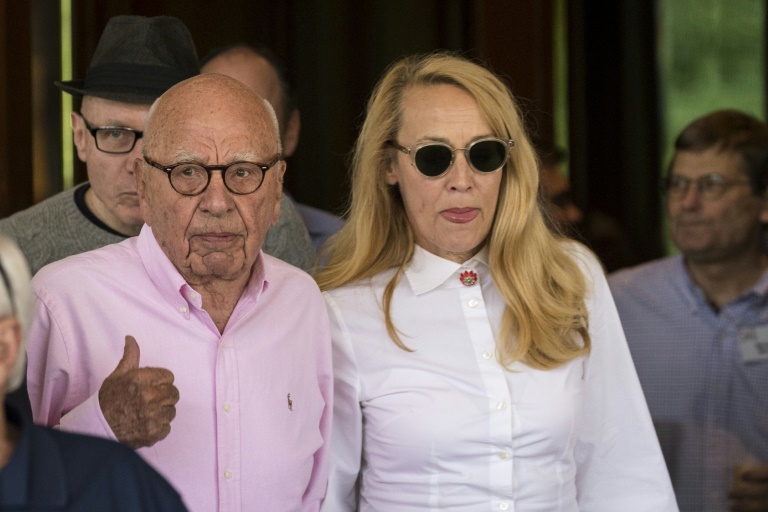
Media tycoon Rupert Murdoch and model Jerry Hall are getting divorced, the New York Times reported Wednesday, citing two people with knowledge of the matter.

It will be the fourth divorce for the 91-year-old Murdoch, who married Hall, 65, in London in March 2016.

The Australian Murdoch is worth more than $17 billion, according to Forbes.

The New York Times reported that the separation is unlikely to alter the ownership structure of businesses he holds stakes in, which include parent companies of Fox News and The Wall Street Journal. 

His powerful global media empire also includes the New York Post, The Times of London and British tabloid The Sun.

Bryce Tom, a spokesman for Murdoch, said he had no comment to make when contacted by AFP.

A representative for Hall did not immediately respond to a request for a statement.

Murdoch’s first wife was Patricia Booker, an Australian flight attendant, whom he divorced in the late 1960s.

He and his second wife, Anna, a newspaper reporter, were together more than 30 years before divorcing in 1999.

Murdoch then married entrepreneur Wendi Deng. They divorced in 2013.

Hall, who is also an actress, was the longtime partner of The Rolling Stones lead singer Mick Jagger, with whom she has four children.

Biden seeks fuel tax suspension to help fight inflation pain

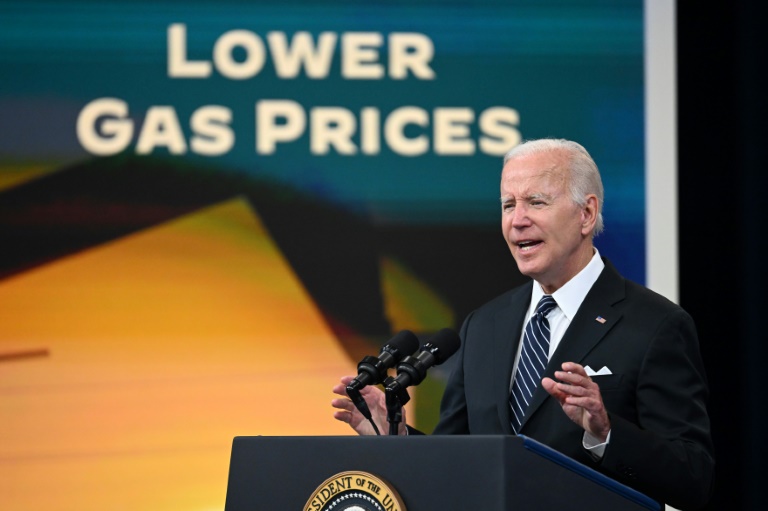
Joe Biden pitched a temporary fuel tax break Wednesday to help American drivers face the highest inflation in four decades, but critics called it window dressing by an unpopular US president ahead of difficult midterm elections.

Biden asked Congress to suspend the federal gas tax for three months as price increases — in large part spurred by fallout from President Vladimir Putin’s invasion of Ukraine and subsequent Western sanctions on Russia — drive general inflation.

But so far, lawmakers seem unlikely to give his plan the green light.

In a televised address, Biden called for lifting the federal tax on gasoline of 18 cents a gallon until September. He also asked state governments to suspend their own taxes for the same period.

Noting that gas prices — now averaging near $5 per gallon — had gone up almost $2 a gallon since the start of the Ukraine invasion, Biden said he was doing what he could.

“I fully understand that the gas tax holiday alone is not going to solve the problem but it will provide families some immediate relief,” he said.

– Skepticism –

A handful of states including New York and Connecticut have already suspended fuel taxes or delayed planned tax increases. 

But some 46 states have yet to act, including Democratic-governed California, where gasoline is the most taxed and the most expensive in the country, at well over $6 a gallon.

Federal tax revenues on gas and diesel help pay for the Highway Trust Fund, which is used to maintain roads and support public transport, but Biden says Congress can ensure the estimated $10 billion gap that would be caused by a three-month tax break is made up from other sources.

Whether Congress — where Democrats hold only a narrow majority over Republicans — will pass tax relief is a big question. Even Biden’s backers are lukewarm.

“I’ve not been a proponent,” Steny Hoyer, a senior Democratic leader in Congress, told Politico. “I just don’t know that it gives much relief.”

Jason Furman, a former top economic adviser to president Barack Obama — who himself once dismissed so-called gas tax holidays as a “gimmick” — also said the move would not help regular people. 

“It would be very unlikely that gas prices would fall by more than a dime because of this change. And oil company profits would go up by billions of dollars,” he told NPR.

– Biden’s populist mission –

Biden urged retailers at filling stations to apply any tax cuts immediately and he pushed refiners to expand their crude processing capacity in the hopes that the combined measures could cut gas prices by as much as a dollar a gallon.

He has previously tried other measures, including releasing a million barrels of oil a day from the Strategic Petroleum Reserve, negotiating the release of an additional 60 million barrels from international partners, and expanding access to biofuels.

Nothing so far has had an appreciable effect.

With Democrats fearing a severe defeat in November midterm elections — thereby leaving Biden weakened for the rest of his first term in office — the president has turned to an increasingly populist message, portraying himself as fighting for the middle class against profiteering Big Oil.

The White House recently called out groups including ExxonMobil and Chevron, denouncing their profit margins as “well above normal” and calling it their patriotic duty to increase output.

In his remarks, Biden repeatedly underlined that the blame for high prices lay with Russia and the oil industry, not the White House.

“This is a time of war, global peril, Ukraine — these are not normal times,” he said, addressing the oil companies. “Bring down the price.”

Responding to criticism growing within the Republican Party, he also defended his leadership of the strong Western response to Russia, including the highly disruptive sanctions on Russian energy exports.

“We could have turned a blind eye to Putin’s murderous ways and the price of gas wouldn’t have spiked,” he said. “I believe that would have been wrong.”

Energy Secretary Jennifer Granholm is due to meet with refiners Thursday to urge them to contribute to these measures, including increasing their output.

Republican National Committee chairwoman Ronna McDaniel quickly dismissed the president’s speech, saying: “No one is buying Biden’s gimmicks, yet Americans are paying the price for his anti-US energy agenda.”

Close Bitnami banner
Bitnami