AFP

Russia to 'intensify' fighting, Zelensky warns as EU decision looms

Ukrainian President Volodymyr Zelensky warned Russia was likely to intensify its “hostile activity” this week, as Kyiv awaits a historic decision from the European Union on its bid for candidate status.

Nearly three months after Russia launched a bloody invasion of his country, Zelensky said there had been “few such fateful decisions for Ukraine” as the one it expects from the EU this week.

“Only a positive decision is in the interests of the whole of Europe,” he said in his evening address Sunday.

“Obviously, we expect Russia to intensify hostile activity this week … We are preparing. We are ready,” he continued. 

Moscow’s forces have been pummelling eastern Ukraine for weeks as they try to seize the Donbas region, after being repelled from other parts of the country following their February invasion.

On Friday, Brussels backed Kyiv’s bid for EU candidate status after the heads of the bloc’s biggest members — France, Germany and Italy — paid a visit to the Ukrainian capital.

Ukraine could join the list of countries vying for membership as early as this week, when member state leaders meet at a Brussels summit. 

But officials and leaders in the bloc caution that, even with candidacy status, membership could take years.

NATO’s chief Jens Stoltenberg meanwhile warned that the war could grind on “for years” and urged Western countries to be ready to offer long-term military, political and economic aid.

“We must not weaken in our support of Ukraine, even if the costs are high — not only in terms of military support but also because of rising energy and food prices,” Stoltenberg told German daily newspaper Bild.

Ukraine has repeatedly urged Western countries to step up their deliveries of arms, despite warnings from nuclear-armed Russia that it could trigger wider conflict.

– Energy crisis –

Zelensky made a rare trip outside Kyiv Saturday to the hold-out Black Sea city of Mykolaiv, where he visited troops nearby and in the neighbouring Odessa region for the first time since the invasion.

“We will not give away the south to anyone, we will return everything that’s ours and the sea will be Ukrainian and safe,” he said in a video posted on Telegram as he made his way back to Kyiv.

Russia’s defence ministry said Sunday it launched missile strikes during the past 24 hours, with one attack on a top-level Ukrainian military meeting near the city of Dnipro killing “more than 50 generals and officers”.

It said it also targeted a building housing Western-provided weapons in Mykolaiv, destroying Ukrainian artillery and armoured vehicles.

There was no independent verification of the claims.

Mykolaiv is a key target for Russia as it lies on the route to the strategic port of Odessa.

With Russia maintaining a blockade of Odessa that has trapped grain supplies and threatens a global food crisis, residents have turned their attention to rallying the home front effort.

“Every day, including the weekend, I come to make camouflage netting for the army,” said Natalia Pinchenkova, 49, standing by a large Union flag, a show of thanks to Britain for its support for Ukraine.

The Ukraine war is fuelling not only a global food crisis but an energy crisis too. 

Hit by punishing sanctions, Moscow has turned up the pressure on European economies by sharply reducing gas supplies, which has in turn sent energy prices soaring. 

Germany on Sunday announced emergency measures including increased use of coal to ensure it meets its energy needs after a drop in the supply of Russian gas.

Austria announced it will reopen a mothballed coal power station to combat shortages, and Italian company Eni joined a huge Qatari project to expand production from the world’s biggest natural gas field.

– Attack repelled –

The worst of the fighting is in the industrial Donbas region, with battles raging in villages outside the city of Severodonetsk, under unrelenting Russian fire for weeks.

Regional governor Sergiy Gaiday said the Russians had targeted the settlement of Toshkivka, south of Severodonetsk.

“But our artillery worked, and we can say the attempt to break through was not successful, even though they tried very powerfully to break our defence,” he wrote on Telegram.

Lysychansk, across a river from Severodonetsk, is also under heavy bombardment, with some residents sheltering in basements in dire conditions, with limited supplies of food and water. 

Natalia Khalaimova, 54, urged Russia and Ukraine to negotiate an end to the war. 

“Every war in any country ends — but the sooner, the better,” she told AFP. “So many civilians are killed. Most of them were not involved in the war at all.”

burs-sr/

Beverly Hills 9021…oh: Planning row pits new against old in ritzy US zip code

It’s a dispute that plays out in towns the world over: a new property owner wants to alter a much-loved landmark against the wishes of locals. It’s his money. It’s their community.

So far, so familiar.

But this is Beverly Hills, where the perfectly manicured mansions of celebrities and socialites populate one of the world’s most desirable zip codes. Oh, and the property in question is worth $40 million.

“It is extremely beautiful,” said preservationist Alison Martino, who grew up four blocks away from the North Roxbury Drive house bought in 2020 by Eric Baker, the co-founder of internet-based ticket empire StubHub.

“It’s on a double lot, which makes it very stately and it’s pushed back from the street. It almost looks like a park. It’s the most beloved house in Beverly Hills.”

To the visitor, the whole city looks a little like a park; lavish homes nestle on tree-lined streets that are peopled chiefly by Lululemon joggers and the occasional member of household staff.

– Elvis, Sinatra, Madonna – 

The enclave of Beverly Hills began life a little over a century ago, and soon established itself as byword for luxury; an oasis for the well-heeled who made their money in the newly burgeoning film industry, but found nearby Hollywood a bit tawdry.

Over the years, it has been home to a Who’s Who of entertainment, counting Douglas Fairbanks, Mary Pickford, Elvis Presley, Frank Sinatra, Madonna and Jennifer Aniston as residents.

Today, minibuses ferrying star-spotting tourists whizz through the neighborhood, with guides pointing out the present and former homes of the famous.

Roxbury Drive is a particularly rich vein, with lots once owned by Lucille Ball, Peter Faulk, Jack Benny, Jimmy Stewart, and Rosemary Clooney.

“When Lucille Ball moved to Beverly Hills, she wanted that house, but it wasn’t for sale, so she bought the house across the street so she could look at it,” said Martino.

– $39.1 million –

The object of Ball’s desire is a Regency Revival home constructed 80 years ago by Beverly Hills master builder Carleton Burgess.

The 9,000-square-foot spread sits among fabulous lawns and boasts its own full-size tennis court, a pavillion and a swimming pool.

Previous owners annually festooned the house with Christmas decorations, Martino says, welcoming the neighbors over to see.

But in 2020, Baker slapped down $39.1 million for it — almost double its previous sale price — adding a glistening centerpiece to a property portfolio that reportedly already included two swanky Beverly Hills spots.

Now, he appears set on making changes to his North Roxbury Drive pad — despite what the neighbors think.

Last year he applied for a “certificate of ineligibility,” a pass that would allow major work on the house without the need to get a green light from the city’s cultural heritage commission.

His exact plans for the property are not known, and his Los Angeles-based lawyer did not respond to AFP requests for comment, but locals fear he wants to take a wrecking ball to the place.

“They want to tear it down so they can build a bigger, more modern house with the latest architecture,” wrote one commentor on Martino’s Vintage Los Angeles Facebook page.

“The thought of this impeccably well-maintained historical building and grounds being demolished sickens me.”

Others mutter darkly about not wanting something that “looks like an embassy compound” with a building that goes right up to the street.

“Even with all the money in the world, you don’t get to do whatever you want,” said life-long Beverly Hills resident Rebecca Pynoos. “Our cultural heritage shouldn’t be sold to the highest bidder.”

– 2am meeting –

Feelings are running so high that a recent planning meeting went on until 2am.

After seven hours of back-and-forth, much of which hinged on whether or not the house was sufficiently well-known to merit preservation, councillors voted to bring the matter back for further consideration on June 21.

The discussion on Tuesday night looks set to be lengthy — councillors have been presented with a 727-page document that includes a missive from actor Diane Keaton.

“I am pleading with you… This charming and historic home needs to be preserved for us and future generations,” she writes.

For campaigner Jill Tavelman Collins, the argument over the North Roxbury Drive house is emblematic of a larger issue in Beverly Hills.

“We’ve lost Lucille Ball’s house, we’ve lost Jimmy Stewart’s house… there’s so little left on Roxbury that is from that time and I think it’s pulling at everyone’s heartstrings,” she said.

“I think it’s like the straw that broke the camel’s back.”

Russia to 'intensify' fighting, Zelensky warns as EU decision looms

Ukrainian President Volodymyr Zelensky warned that Russia was likely to intensify its “hostile activity” this week, as Kyiv awaits a historic decision from the European Union on its membership application.

Nearly three months after Russia launched a bloody invasion of his country, Zelensky said there had been “few such fateful decisions for Ukraine” as the one it expects from the EU this week.

“Only a positive decision is in the interests of the whole of Europe,” he said in his evening address Sunday.

“Obviously, we expect Russia to intensify hostile activity this week … We are preparing. We are ready,” he continued. 

Moscow’s forces have been pummelling eastern Ukraine for weeks as they try to seize the Donbas region, after being repelled from other parts of the country following their February invasion.

On Friday, Brussels backed Kyiv’s bid for EU candidate status after the heads of the bloc’s biggest members — France, Germany and Italy — paid a visit to the Ukrainian capital.

Ukraine could join the list of countries vying for membership as early as this week, when member state leaders meet at a Brussels summit. 

NATO’s chief Jens Stoltenberg meanwhile warned that the war could grind on “for years” and urged Western countries to be ready to offer long-term military, political and economic aid.

“We must not weaken in our support of Ukraine, even if the costs are high — not only in terms of military support but also because of rising energy and food prices,” Stoltenberg told German daily newspaper Bild.

Ukraine has repeatedly urged Western countries to step up their deliveries of arms, despite warnings from nuclear-armed Russia that it could trigger wider conflict.

– Residents rally –

Zelensky made a rare trip outside Kyiv Saturday to the hold-out Black Sea city of Mykolaiv, where he visited troops nearby and in the neighbouring Odessa region for the first time since the invasion.

“We will not give away the south to anyone, we will return everything that’s ours and the sea will be Ukrainian and safe,” he said in a video posted on Telegram as he made his way back to Kyiv.

Russia’s defence ministry said Sunday it launched missile strikes during the past 24 hours, with one attack on a top-level Ukrainian military meeting near the city of Dnipro killing “more than 50 generals and officers”.

It said it also targeted a building housing Western-provided weapons in Mykolaiv, destroying Ukrainian artillery and armoured vehicles.

There was no independent verification of the claims.

Mykolaiv is a key target for Russia as it lies on the route to the strategic port of Odessa.

With Russia maintaining a blockade of Odessa that has trapped grain supplies and threatens a global food crisis, residents have turned their attention to rallying the home front effort.

“Every day, including the weekend, I come to make camouflage netting for the army,” said Natalia Pinchenkova, 49, standing by a large Union flag, a show of thanks to Britain for its support for Ukraine.

– ‘So many killed’ –

The Ukraine war is fuelling not only a global food crisis but an energy crisis too. 

Hit by punishing sanctions, Moscow has turned up the pressure on European economies by sharply reducing gas supplies, which has in turn sent energy prices soaring. 

Germany on Sunday announced emergency measures including increased use of coal to ensure it meets its energy needs after a drop in the supply of Russian gas.

Austria announced it will reopen a mothballed coal power station to combat shortages, and Italian company Eni joined a huge Qatari project to expand production from the world’s biggest natural gas field.

The worst of the fighting is in the industrial Donbas region, with battles raging in villages outside the city of Severodonetsk, under unrelenting Russian fire for weeks.

Ukraine’s armed forces said Sunday they had pushed back Russian attacks on villages near Severodonetsk.

Lysychansk, which sits across a river from Severodonetsk, is also under heavy bombardment. 

Some residents have taken shelter in basements in dire conditions, with limited supplies of food and water. 

Natalia Khalaimova, 54, urged Russia and Ukraine to negotiate an end to the war. 

“Every war in any country ends — but the sooner, the better,” she told AFP. “So many civilians are killed. Most of them were not involved in the war at all.”

burs-sr/dhc

Strong quake hits eastern Taiwan: USGS

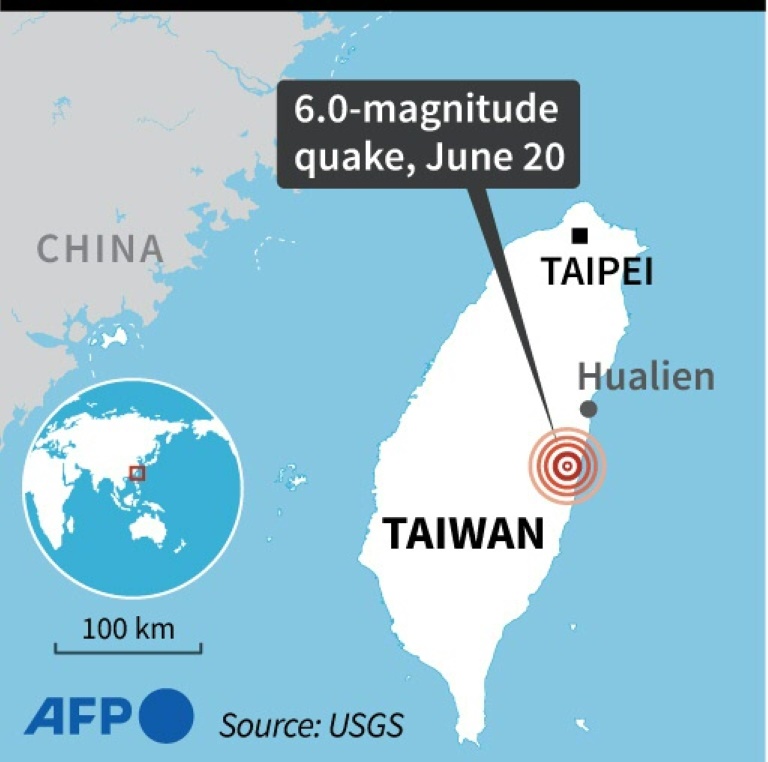
A 6.0-magnitude earthquake struck Monday in Taiwan’s east, 38 kilometres south of Hualien city, the US Geological Survey said.

There were no immediate reports of damage or injuries. 

The quake had an estimated depth of 10 kilometres, according to USGS, and struck at 09:05 local time (0105 GMT). 

A clip of a tranquil lakeside scene suddenly beginning to violently judder as the ground moved was posted on Facebook by a national park in Hualien. 

“This is a really big earthquake!… Hope everyone stays safe!”, the caption read, adding the clip had been taken from one of its camera feeds in the park.

An AFP reporter in Taipei felt shaking, and local media said the quake was felt across the island. 

The Taipei Metro stopped briefly when it hit, according to one passenger, before continuing at reduced speed for several stops.

A second smaller tremor hit about half an hour later, according to Taiwan’s Central Weather Bureau.

“In this area (where the quake hit today) there were only two earthquakes above 6.0 magnitude since 1990 and one close to 6.0 magnitude,” Chen Kuo-chang, head of Taiwan’s Central Weather Bureau’s Seismological Center, said at a press conference. 

“The most shallow one was today’s and we think it may be linked to fault activities,” he added. 

He said that the weather bureau was not ruling out more aftershocks above 5.0 magnitude in the next two days.

Taiwan is regularly hit by earthquakes as the island lies near the junction of two tectonic plates.

The island does not issue tsunami warnings unless a quake is more than magnitude 7.0.

Some earthquakes of 6.0 or more can prove deadly, although much depends on where the quake strikes and at what depth.

But the USGS gave a “green” ranking to the threat posed by the latest quake, predicting a low likelihood of either casualties or damage.

Chen said the most earthquakes over 6.0 magnitude were recorded in 1999, when there were 13. 

That year Taiwan was devastated by its deadliest ever quake — a 7.6-magnitude one in September that killed over 2,400 people. 

Asian markets, oil prices extend losses on recession worries

Asian markets fell again Monday and oil prices extended losses on growing fears that central bank moves to rein in soaring inflation will induce a recession.

The losses come after a sell-off last week fuelled by the Federal Reserve’s sharp interest rate hike last week — the biggest in nearly 30 years — and a warning of more to come, while increases in Britain and Switzerland added to the gloom.

And while the S&P 500 and Nasdaq saw gains on Friday, there is a sense that indexes still have some way down to go before they find a bottom, with economic data suggesting economies are beginning to feel the pinch.

Cleveland Fed chief Loretta Mester added to the worry, saying that the risk of a recession in the United States was increasing and it would take several years to bring inflation down from four decade highs to the bank’s two percent target.

She told CBS’s “Face The Nation” on Sunday that while she was not predicting a contraction, the Fed’s decision not to act sooner to fight rising prices was hurting the economy.

In early trade, Asian traders were struggling, with Tokyo, Hong Kong, Shanghai, Sydney, Singapore, Seoul, Taipei, Jakarta and Wellington all in the red.

Analysts warned there was likely to be more pain ahead for traders as the Ukraine war drags on and uncertainty continues to reign.

“Central banks’ hawkish rhetoric and concerns over a global economic slowdown/recession (are) not helping sentiment and at this stage it is hard to see a turn in fortunes until we see evidence of a material ease in inflationary pressures,” said National Australia Bank’s Rodrigo Catril.

And Stephen Innes of SPI Asset Management added: “Most of these major central banks are praying for some relief from inflation and hoping the data falls in line, but unless there is a detent in the Ukraine -Russia war, escalation will continue to drive energy price fears so it could be a tough road ahead.”

Still, oil prices fell further Monday after suffering a hefty drop Friday caused by demand worries caused by a possible recession.

However, US Energy Secretary Jennifer Granholm said prices could continue to surge if the European Union cuts off imports of the commodity from Russia in response to the Ukraine war.

She said Joe Biden had called on global suppliers to ramp up output to help temper the price rises, with the president to discuss the issue at an upcoming visit to Saudi Arabia next month.

– Key figures at around 0245 GMT –

Tokyo – Nikkei 225: DOWN 1.7 percent at 25,534.68 (close)

Hong Kong – Hang Seng Index: DOWN 0.4 percent at 21,001.43

Shanghai – Composite: DOWN 0.3 percent at 3,308.08

Dollar/yen: DOWN at 134.85 yen from 134.99 yen late Friday

Pound/dollar: DOWN at $1.2219 from $1.2221

Euro/dollar: UP at $1.0509 from $1.0493

Euro/pound: UP at 86.00 pence from 85.83 pence

West Texas Intermediate: DOWN 0.5 percent at $108.98

Brent North Sea crude: DOWN 0.5 percent at $112.56 a barrel

New York – Dow: DOWN 0.1 percent at 29,888.78 (close)

London – FTSE 100: DOWN 0.4 percent at 7,016.25 (close) 

— Bloomberg News contributed to this story —

China's mass testing mantra is building a waste mountain

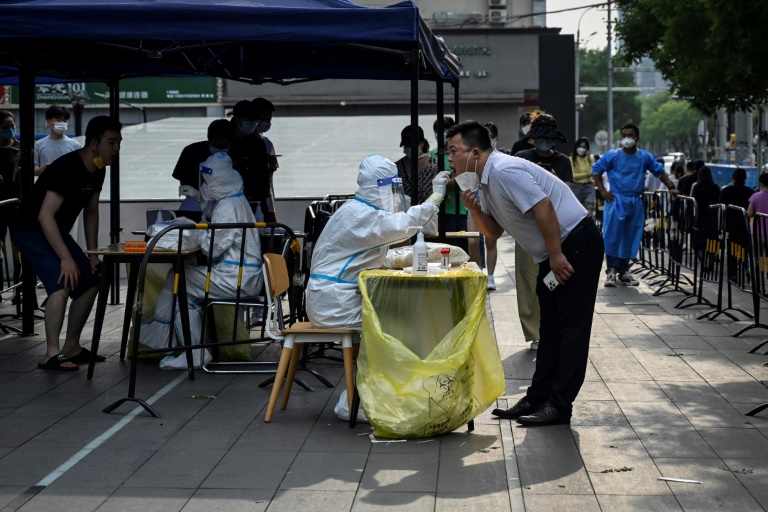
Hazmat-suited workers poke plastic swabs down millions of throats in China each day, leaving bins bursting with medical waste that has become the environmental and economic levy of a zero-Covid strategy.

China is the last major economy wedded to stamping out infections no matter the cost.

Near-daily testing is the most commonly used weapon in an anti-virus arsenal that includes snap lockdowns and forced quarantines when just a few cases are detected.

From Beijing to Shanghai, Shenzhen to Tianjin, cities are now home to an archipelago of temporary testing kiosks, while authorities order hundreds of millions of people to get swabbed every two or three days.

Mass testing appears set to stay as Chinese authorities insist zero-Covid has allowed the world’s most populous nation to avoid a public health catastrophe.

But experts say the approach — a source of political legitimacy for the ruling Communist Party — creates a sea of hazardous waste and a mounting economic burden for local governments who must plough tens of billions of dollars into funding the system.

“The sheer amount of medical waste that is being generated on a routine basis (is) at a scale that is practically unseen in human history,” said Yifei Li, an environmental studies expert at New York University Shanghai.

“The problems are already becoming astronomical, and they will continue to grow even bigger,” he told AFP.

Beijing has positioned itself as an environmental leader, cracking down on air and water pollution while setting the goal of making its economy carbon-neutral by 2060, a target experts say is untenable given the current trajectory of investments in coal.

Blanket-testing is now posing a new trash challenge.

Each positive case — typically a few dozen a day nationwide — unspools a trail of used test kits, face masks and personal protective gear.

If not disposed of properly, biomedical waste can contaminate soil and waterways, posing threats to the environment and human health.

– Burning questions –

Cities and provinces home to a total of around 600 million people have announced some form of routine testing in recent weeks, according to an AFP analysis of government notices and Chinese media reports.

Different regions have imposed different restrictions, and some areas have suspended the policy in step with falling cases. 

Nationwide data on the waste footprint has not been disclosed. But Shanghai officials said last month the city produced 68,500 tonnes of medical waste during its recent Covid lockdown, with daily output up to six times higher than normal.

Under Chinese regulations, local authorities are tasked with separating, disinfecting, transporting and storing Covid waste before finally disposing of it — usually by incineration.

But disposal systems in the poorer rural parts of the country have long been overburdened.

“I’m not sure that… the countryside really has the capacity to deal with a significant increase in the amount of medical waste,” said Yanzhong Huang, a senior fellow for global health at the Council on Foreign Relations.

The spike in waste may prompt some local governments to process it improperly or simply “dump it on the ground” in temporary landfills, said Benjamin Steuer, of the Hong Kong University of Science and Technology.

In a statement to AFP, China’s health ministry said it had made “specific demands for medical waste management” as part of national Covid protocols. 

– Waste of money? –

Beijing has urged provincial capitals and cities with at least 10 million people to set up a test site within 15 minutes’ walk of every resident.

Top leaders also expect local governments to foot the bill for testing at a time when many are struggling to balance the books.

Expanding the model to the whole of the country could cost between 0.9 and 2.3 percent of China’s gross domestic product, Nomura analysts said last month.

“The economics of that is tricky,” said Li of NYU Shanghai. “You don’t want to invest in permanent infrastructure to process what is perceived as a short-term surge of medical waste.”

Jin Dong-yan, a professor at Hong Kong University’s School of Biomedical Sciences, said “very ineffective and costly” routine testing would force governments to back away from other much-needed healthcare investments.

Authorities are also likely to miss positive cases as the Omicron variant spreads rapidly and is harder to detect than other strains, he told AFP.

“This will not work,” he said. “It will just wash down millions of dollars into the sea.”

Abortion: how things stand in US as court prepares to rule

The Supreme Court is expected to deliver an opinion by the end of June that could roll back 50 years of abortion rights in the United States.

This is the state of affairs in the country ahead of the much-anticipated ruling by the nation’s highest court:

– Roe v. Wade –

In the absence of any federal laws, it is the 1973 ruling in the landmark Supreme Court case known as Roe v. Wade that guarantees a woman’s right to an abortion in the United States.

A 1992 court decision, in Planned Parenthood v. Casey, protects access to abortion until “viability,” when the fetus can survive outside the womb, typically between 22 and 24 weeks of pregnancy.

States are also not allowed to enact any laws that would impose an “undue burden” on a woman seeking an abortion.

This legal framework could be upended soon.

According to a draft opinion leaked in May, the conservative majority on the nine-member court is prepared to overturn Roe v. Wade.

“We hold that Roe and Casey must be overruled,” the author of the opinion, Justice Samuel Alito, wrote. “It is time to heed the Constitution and return the issue of abortion to the people’s elected representatives.”

Anticipating a reversal, lawmakers in 13 Republican-ruled states have already adopted so-called “trigger” laws that would ban abortion if the Supreme Court overturns Roe v. Wade.

– Patchwork –

Conservative states have long tested the limits of the “undue burden” standard to impose laws restricting abortion, forcing many clinics to close their doors.

The states of West Virginia and Mississippi, for example, each have only one abortion clinic, while there are more than 150 in California.

Some states force minors to have parental consent before undergoing an abortion or to listen to the heartbeat of the embryo.

Since September 1, Texas, following a long legal battle, has banned abortions after six weeks, before many women even know they are pregnant.

Money is another factor.

Nearly a dozen states ban private medical insurance plans from reimbursing abortions.

But 15 other states dip into public funds to help low-income women pay for the procedure.

– Poverty and minorities –


There were more than 930,000 abortions in the United States in 2020, according to the latest statistics from the Guttmacher Institute, which has noted a recent increase after 30 years of steady decline.

This amounts to 14.4 abortions for every 1,000 women of procreative age, about the same as in most developed countries.

Nearly 50 percent of the women seeking abortions live below the poverty line and Black and Hispanic women are overrepresented as a proportion of the population — 29 percent and 25 percent respectively.

According to the US Centers for Disease Control and Prevention, 92.2 percent of abortions in the United States take place in the first trimester.

– Divided opinion – 

More than 60 percent of Americans believe abortion should remain legal in all or most cases, a figure that has remained relatively stable for the past few years, according to a survey by the Pew Research Center.

But there are enormous differences based on political persuasion: 80 percent of Democrats believe abortion should remain legal in all or most cases while just 35 percent of Republicans do.

And the divide is widening. Those figures were 72 percent and 39 percent, respectively, in 2016.

Religious conviction also plays a large role. Seventy-seven percent of white evangelicals believe abortion should be illegal in most cases.

– A conservative offensive –

During the 2016 presidential campaign, Republican Donald Trump managed to attract many voters on the religious right with his promise to name justices to the Supreme Court who shared their values and would notably be prepared to strike down Roe v. Wade.

During his four years in the White House, Trump nominated three justices to the court, giving conservatives a solid 6-3 majority.

Their arrival spurred Republican state lawmakers to pass increasingly restrictive abortion laws, several of which eventually made their way to the nation’s highest court.

'Jurassic' is again top draw in N.American theaters

“Jurassic World Dominion” again stomped to the top on North American movie screens this weekend, while new release “Lightyear” didn’t quite make it to infinity, or beyond.

Universal’s latest dinosaur frightfest — the sixth in the “Jurassic Park” franchise — took in an estimated $58.7 million for the Friday-through-Sunday period, industry watcher Exhibitor Relations reported. It stars Chris Pratt, Bryce Dallas Howard, Laura Dern and Jeff Goldblum.

“Lightyear,” Pixar and Disney’s latest computer-animated offering from the “Toy Story” empire, earned $51 million. David A. Gross of Franchise Entertainment Research called that “a soft opening for a spinoff of one of the most successful animation series of all time.”

Chris Evans voices title character Buzz Lightyear, who battles evil Emperor Zurg while trying to find his way home from a hostile planet. “Lightyear”, which features a same-sex kiss, has been denied release in more than a dozen mainly Muslim countries, a source close to Disney told AFP this week. 

Still soaring in third place was Paramount’s “Top Gun: Maverick,” with a $44 million take that Variety called “mammoth” for a film in its fourth week. 

With total earnings of $466 million domestically and $419 million overseas, the action adventure sequel to the original 1986 film has become the biggest hit of Tom Cruise’s not-too-shabby career.

Fourth spot went to Disney’s “Doctor Strange in the Multiverse of Madness,” at $4.2 million. Domestic earnings for the Benedict Cumberbatch sci-fi film are now just north of $400 million.

And in fifth place was “The Bob’s Burgers Movie” from 20th Century. Based on the popular TV series, it took in $1.1 million.

Rounding out the top 10 were:

“The Bad Guys” ($980,000)

“Everything Everywhere All at Once” ($960,000)

“Downtown Abbey: A New Era” ($830,000)

“Sonic the Hedgehog 2” ($228,000)

“Brian and Charles” ($198,000)

Phillips and Pereira: killed trying to save the Amazon

Four years after they first went on an expedition deep into the jungle of Brazil’s Javari Valley, Dom Phillips and Bruno Pereira teamed up again, each working on a big new project to save the Amazon. It cost them their lives.

The British journalist and Brazilian Indigenous expert, both at a crossroads in life, had gravitated back to the far-flung region they visited together in 2018, home to an Indigenous reservation bigger than Austria.

On their 2018 trip, Pereira, then head of Brazilian Indigenous agency FUNAI’s program for isolated tribes, invited Phillips, then on assignment for The Guardian, to cover a grueling 17-day expedition into the thick of the rainforest.

The goal was to survey the lands occupied by an uncontacted tribe, to try to avoid conflicts with other ethnicities.

In his article, Phillips wrote admiringly of Pereira squatting by a campfire in flip-flops, eating a monkey’s brain for breakfast as he discussed policy.

A bromance had clearly been born.

Four years later, the duo was back in the Javari Valley, in northwestern Brazil near the Peruvian and Colombian borders.

Phillips, 57, had set aside newspaper reporting to write a book on the world’s biggest rainforest.

Pereira, 41, had taken leave from FUNAI and set up a program to help Indigenous people detect and report invasions of their land by illegal loggers, miners and poachers.

On June 2, they set off by boat from Atalaia do Norte, a sleepy town at the juncture of the Itaquai and Javari rivers, so Pereira could show Phillips his project.

They planned to return on June 5. They never arrived.

Police say as the pair motored back to town that Sunday in a small boat, illegal fishermen sped up and shot them, then buried them in the forest.

– Indigenous app –

Pereira, who took leave from FUNAI after clashing with the program-cutting leadership appointed when far-right President Jair Bolsonaro took office in 2019, found a new home at an Indigenous-rights group, UNIVAJA.

There, he trained Indigenous volunteers to patrol the Javari Valley, entering incursions into a specially created app.

The reservation has seen a surge of land invasions, threatening it at a time when numerous studies have found that native people’s stewardship of their lands is key to protecting the Amazon, a vital resource in the race to curb climate change.

The project earned Pereira death threats.

“With the app, they had the whole crime scene mapped out, and they were preparing a report to show the authorities,” said Brazilian-American journalist Monica Yanakiew of Al Jazeera English, who accompanied Pereira on a similar trip in December.

“Everybody says you can’t patrol an area that large without a whole army, but if you have 10 Indigenous patrollers who know the lay of the land and an app, you can figure out what’s going on,” she told AFP.

It was this blend of masterful organizing and intimate knowledge of the terrain that made Pereira “one of the great Indigenous experts,” said a long-time friend, veteran Brazilian reporter Rubens Valente.

“He had a very rare gift. He was someone you just knew would go on to big things — environment minister or something. His death is a tremendous loss.”

– ‘How to Save the Amazon’ –

Phillips, one of the most respected foreign correspondents covering Brazil, had put that job on hold last year when he won a prestigious Alicia Patterson fellowship for his book project.

A deeply researched dive into the Amazon and the people who live here, the book was meant to be a highly readable look at practical ways to protect the rainforest.

His working title was “How to Save the Amazon.”

“He was so excited,” said Jenny Barchfield, a friend who met Phillips when they were both foreign correspondents in Rio de Janeiro in the 2010s.

She remembered him as friendly, kind, voraciously curious and “magnetic,” with bright blue eyes and an impish grin.

“He talked about how exciting it was to be able to think beyond the next story to this long project that had really important ramifications,” she said.

“The topic he was writing on literally could not be more important for everybody and everything on Earth.”

Friends say Phillips was well into writing the book. They are exploring ways to finish it and get it published.

“I’m sure Dom would want you to take some positives out of the tragedy,” said another friend, Scottish former foreign correspondent Andrew Downie.

“If there is a positive point to be taken out of this, it might be that people are looking at the Amazon now.”

New US Capitol riot hearings promise fresh drama

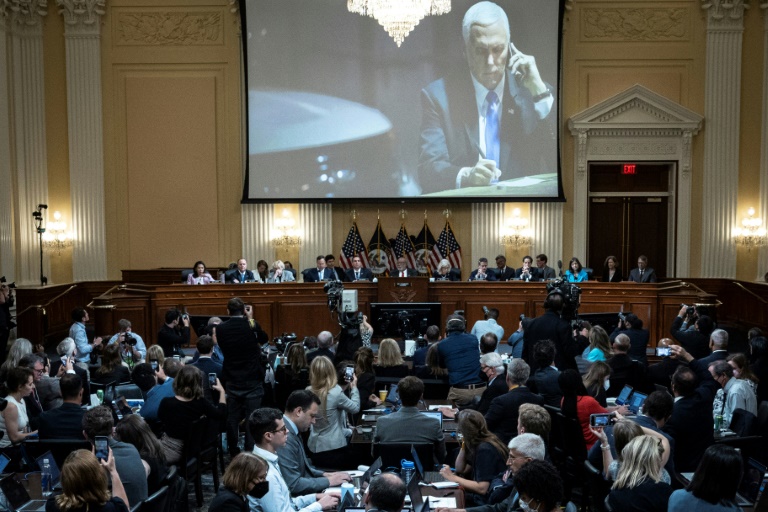
A new round of hearings this week by the congressional committee probing the January 6, 2021 US Capitol riot promises further drama, with one member saying former vice president Mike Pence might be subpoenaed. 

As the House select panel works to focus attention on what it says was an illegal scheme backed by Donald Trump to overturn the results of the 2020 elections, a new poll shows most Americans believe the former president should face charges.

In three earlier hearings, a series of Trump advisers were shown saying they had warned him of the illegality of attempting to overturn Democrat Joe Biden’s victory by persuading Pence to block a normally pro forma process.

One committee member, Adam Schiff, told CNN on Sunday that subpoenaing Pence was “certainly a possibility,” adding, “We’re not excluding anyone or anything at this point.”

Pence faced intense pressure from Trump to break with history and refuse on January 6 to formally certify Biden’s victory.

But even after Trump supporters violently stormed the building, with some chanting “Hang Mike Pence,” he refused to leave the complex and returned to the Senate chamber late at night to carry out the certification.

– ‘A hero’ –

The committee would be keenly interested to hear from Pence exactly what pressure Trump placed on him in their private contacts. If Pence is ultimately deposed, however, it could be weeks or months away.

While the conservative Pence was never a favorite of Democrats, “on that day he was a hero for resisting all the pressure campaigns,” Jamie Raskin, a committee member, told NBC’s “Meet the Press.”

“In a time of absolutely scandalous betrayal of people’s oaths of office and crimes being committed all over the place, somebody who does their job and sticks to the law will stand out as a hero.”

The pressure campaign, Schiff said, “put the vice president’s life in danger.”

The committee, in hearings Tuesday and Thursday, will also explore “how a similar pressure campaign directed against state and local elections officials put their lives in danger.”

Trump, in a taped call, famously called Georgia secretary of state Brad Raffensperger, a Republican, and asked him to “find” enough votes to overturn Biden’s victory in that key Southern state.

Raffensperger, who refused to do so, is to be among the committee’s witnesses this week.

– Divided public –

Raffensperger is among several election officials who have received anonymous death threats for refusing to alter vote outcomes in Trump’s favor.

Adam Kinzinger — one of two Republicans on the House committee, and one of 10 who voted last year to impeach Trump because of the insurrection — said Sunday he had received a menacing message only days ago.

“It threatens to execute me, as well as my wife and 5-month-old child,” he told ABC’s “This Week.” 

Trump remains as divisive a political figure as ever, inspiring furious loyalty among followers and equally passionate disdain from his critics.

The public’s division came through starkly in a new ABC News/Ipsos poll about the committee’s work.

The poll, taken June 17 and 18, found that 58 percent of Americans believed Trump should be charged with a crime for his role in the January 6 events, up from 52 percent in April.

It also found that 60 percent of respondents believed the committee was conducting a fair and impartial inquiry, up substantially from 40 percent in April.

But while nearly all Democrats said Trump bore considerable responsibility for the January 6 riot, only a quarter of Republicans agreed. 

And significantly, only nine percent of Americans said they were following the hearings very closely.

Close Bitnami banner
Bitnami