AFP

US urges Russia to open Ukrainian ports for grain exports

US Agriculture Secretary Tom Vilsack called on Russia Thursday to rapidly open Ukraine’s ports to permit the export of millions of tonnes of stockpiled grain.

“They should be acting immediately to open up those ports and they should end this war,” Vilsack told reporters at the United Nations.

“This is serious thing, we shouldn’t be using food as a weapon,” he said.

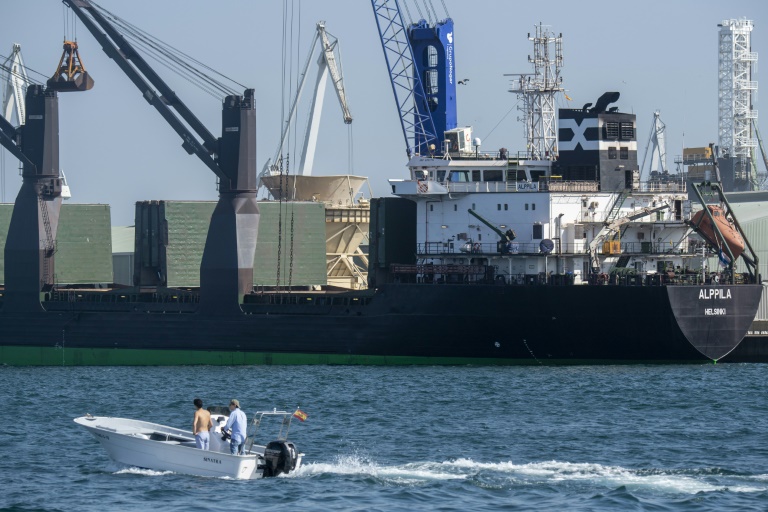
The United Nations has been deep in talks between Moscow, Kyiv and Ankara for weeks on how to open up the Black Sea, where the Russian navy has created a blockade around Ukraine, to commercial cargo ships to carry the grain to global markets.

Such an agreement would also permit Russian fertilizer, now blocked by sanctions, to return to the global market.

With grain prices soaring internationally and key importers in the Middle East and Africa facing supply shortfalls, Moscow has demanded that economic sanctions on it be lifted in exchange for allowing the exports.

Vilsack said US and European sanctions do not apply to grains and fertilizers.

Addressing the ongoing talks on the issue, Vilsack said he hoped that Russia would “take this thing seriously and that they’re not just doing this to create an image.”

He urged Moscow “to make sure that they are negotiating in good faith about the reopening of the ports and they do so quickly. Because the need is immediate.”

Vilsack said a US proposal to build silos in Poland to receive Ukrainian grain was to reduce the possibility of spoilage before the grain can transported to markets.

On Wednesday, Turkish Foreign Minister Mevlut Cavusoglu said Ankara is ready to host a four-way meeting with the United Nations, Russia and Ukraine to organize the export of grain through the Black Sea. 

Under the plan, safe corridors for grain exports from Ukraine could be established without de-mining in the Black Sea, he said.

“If Russia answers positively, there will be a four-partite meeting in Istanbul,” Cavusoglu said.

There was no immediate comment from Moscow.

Bolsonaro blamed as evidence mounts of Amazon murders

Nature defenders, colleagues and family of British journalist Dom Phillips and Indigenous expert Bruno Pereira expressed anger Thursday as evidence mounted they were murdered in the Amazon, laying the blame at the door of Brazil’s government.

Guardian contributor Phillips, 57, and Pereira, 41, went missing on June 5 in a remote part of the rainforest that is rife with illegal mining, fishing and logging, as well as drug trafficking.

Ten days later, on Wednesday, a suspect named Amarildo da Costa de Oliveira took police to a place where he said he had helped bury bodies near the city of Atalaia do Norte, where the pair had been headed.

Human remains unearthed from the site were to be brought to Brazilia Thursday to be officially identified by experts. Results are likely expected by next week.

Late Wednesday, the federal police chief of Brazil’s northern Amazonas state said there was “a 99-percent probability” the remains “corresponded” to the missing men.

They had apparently been shot.

Phillips, a long-time contributor to The Guardian and other leading international newspapers, was working on a book on sustainable development in the Amazon, with Pereira as his guide, when they went missing.

Pereira, an expert at Brazil’s indigenous affairs agency FUNAI, had received multiple threats from loggers and miners trying to invade isolated Indigenous land.

– ‘Heartbroken’ –

Phillips’ family said in a statement they were “heartbroken” by the discovery of two bodies Wednesday, which they took as confirmation that the pair were murdered.

Greenpeace Brazil said the deaths were “a direct result of the agenda of President Jair Bolsonaro for the Amazon, which opens the way for predatory activities and crimes to be reproduced in broad daylight.”

The Javari Valley where the men went missing — an area near the borders with Peru and Colombia — is home to about 20 isolated Indigenous groups where drug traffickers, loggers, miners and illegal fishermen operate. 

“In the last three years, our country has increasingly become a land where the only valid law is that of ‘anything goes,” said Greenpeace of the Bolsonaro term.

“It has become a land of invasion and land grabbing; of mining and illegal logging; of territorial conflicts, and where it’s worth killing to ensure that none of these criminal activities are prevented from happening. All this is fueled by the actions and omissions of the Brazilian government.” 

Bolsonaro has pushed to develop the Amazon, the world’s largest tropical rainforest, since he took office in 2019.

On Wednesday, he drew fresh criticism for saying Phillips was “disliked” for his reporting on the region and should have been more careful.

“The level of violence applied to Bruno and Dom makes clear how the Amazon is at the mercy of the law of the most powerful, under which brutality is the rule,” said WWF Brazil.

“The State abandoned the Amazon due to a meaningless project of destruction of the forest and extermination of its peoples.”

– ‘Political crime’ –

The Univaja Indigenous peoples grouping, which had taken part in the search, denounced the suspected killings as a “political crime,” while the Brazilian Association of Investigative Journalism said “the president and his allies have become protagonists of attacks on the press” uncovering environmental crimes.

Jonathan Watts, a colleague of Phillips at The Guardian, told AFP in London the “monstrous” crime should not deter journalists and others from exposing the truth.

“People dead for defending Indigenous lands and the environment. Brazil cannot be that,” said ex-president Luiz Inacio Lula da Silva, who will face Bolsonaro in October elections.

Investigations continue into the motive for the crime as well as the role played by Oliveira and fellow suspect Oseney da Costa de Oliveira. 

Brazilian media report there may be three more people involved. Police have not confirmed the information, but have not ruled out more arrests.

WTO talks go deep into overtime

Talks at the World Trade Organization went deep into overtime on Thursday with key holdout India talking up the prospects for a landmark deal spanning food security, fishing and combating Covid-19.

With ministers struggling to conclude agreements on each separate issue, countries were going round the clock making trade-offs which, they hope, could see several measures go through in a grand bargain.

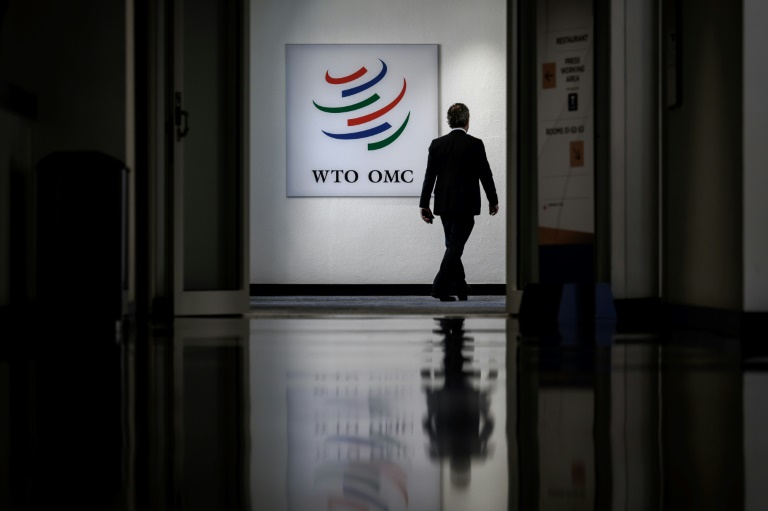
Ministers from the global trade body’s 164 members have been negotiating face-to-face since Sunday at the WTO’s headquarters in Geneva, in their first such conference since the December 2017 flop in Buenos Aires.

They added a fifth day of talks to try to break the deadlock — and prove the organisation can play a role in tackling big global challenges.

Some delegations have accused India of being intransigent on every topic under discussion at the WTO — where decisions can only pass with the agreement of all 164 members.

But Commerce and Industry Minister Piyush Goyal sounded upbeat as the talks ploughed on into the evening.

“India is convinced that this will turn out to be one of the most successful ministerials that the WTO has seen in a long time,” he told reporters.

“We are very confident that the progress made… and the positivity with which everybody is engaged truly is a matter of celebration for the world.

“I’m sure that that spirit will help us cross the hump.

“We have taken some solid decisions… subject to a few issues being sorted out.”

– EU targets ‘positive outcomes’ –

EU trade commissioner Valdis Dombrovskis later told AFP negotiations were ongoing and “quite complicated” because there were “major issues to handle”.

“We are in a complicated geopolitical situation and also the views across different work streams are quite divergent,” he said.

“We need to address those divergences but I would say we’re working towards positive outcomes and hopefully we’ll be able to reach such positive outcomes.”

Ministers have been trying to secure deals on curbing harmful fishing subsidies; temporarily waiving Covid-19 vaccine patents; food security; agriculture; e-commerce; the WTO’s response to pandemics; and reform of the organisation itself.

Countries hit a brick wall late Wednesday trying to secure each separate deal on its own merits, so they spent the night horse-trading to try to keep them all afloat in some format.

Giant trays of sandwiches kept delegates going after they finished all the fruit juice in the building.

“They’re looking at a broad package: what can be achieved, trade-offs in different areas,” a Geneva trade official told reporters.

“We’re into the real bargaining.”

– Fisheries exemption –

WTO chief Ngozi Okonjo-Iweala, who took over in March 2021, has hinged her leadership on breathing new life into the sclerotic organisation.

The former foreign and finance minister of Nigeria is hoping to pull off a coup by finalising a long-sought deal on curbing harmful fishing subsidies.

Negotiations towards banning subsidies that encourage overfishing and threaten the sustainability of the planet’s fish stocks have been going on at the WTO for more than two decades.

Several sources close to the discussions said the draft agreement on the conference’s flagship issue has been heavily watered down.

India has been pushing for a 25-year exemption — far longer than many countries are comfortable with.

“India has always been a reluctant trading partner,” said Harsh V Pant, an international relations professor at King’s College London university’s India Institute.

“India has been notorious when it comes to signing free trade agreements,” he told AFP.

– E-commerce wrangle –

On waiving Covid-19 vaccine patents, a source said the deal needed yet more time.

Ministers have also been arguing over whether to extend the moratorium on imposing customs duties on electronic transactions, in place since 1998.

But India and South Africa say it has a negative impact, with Pakistan, Indonesia and Sri Lanka also sceptical.

WTO deputy director-general Anabel Gonzalez said there were “intense negotiations” going on in a packed room discussing e-commerce.

“It’s difficult, but I am hopeful,” she said.

The United States told an earlier meeting that the moratorium had supported the growth of digital commerce, which had provided an “economic lifeline” during the Covid-19 pandemic, according to a Geneva trade official.

rjm-burs/vog/imm

Is recession the only way out of US inflation scourge?

A massive interest rate hike by the US Federal Reserve and promises of more to come are fueling warnings that the only offramp from the searing price hikes engulfing American families is a full-blown recession.

The Fed remains hopeful it can slow activity and demand, cooling the blistering pace of inflation, without derailing the world’s largest economy. But skepticism is growing about the chances of success.

The central bank hiked the benchmark borrowing rate on Wednesday by three-quarters of a point, the biggest increase in nearly 30 years, and indicated a similar move is possible in July. 

The super-sized rate increase came as the Fed faces intense pressure to curb soaring gas, food and housing prices that have left millions of Americans struggling to make ends meet and sent President Joe Biden’s approval ratings plunging. 

The central bank has raised the key rate 1.5 points since March, as the Russian invasion of Ukraine and ongoing Covid-related supply chain issues combine to send prices up at the fastest pace in more than four decades.

Fed Chair Jerome Powell said recession is not the goal, but bringing down inflation “expeditiously” is “essential” since that is vital to a healthy economy.

But Kathy Bostjancic, chief US economist at Oxford Economics, warned that “it becomes very difficult to thread that needle.” 

The Fed will need a Goldilocks scenario where “a number of things fall into place and at the right time,” she told AFP.

The healthy US labor market and strong consumer demand, helped by a beefy stockpile of savings, are working in the Fed’s favor and could support activity even as the economy cools.

In the wake of the Fed decision, mortgage rates rocketed to their highest level in 13 years, with the average for a 30-year, fixed rate home loan reaching 5.78 percent.

Drivers still face gas prices at the pump of more than $5 a gallon, although for the first time in days, the national average fell on Wednesday, down from Tuesday’s record.

“My colleagues and I are acutely aware that high inflation imposes significant hardship, especially on those least able to meet the higher costs of essentials like food, housing and transportation,” Powell told reporters after the rate hike was announced.

– Higher unemployment –

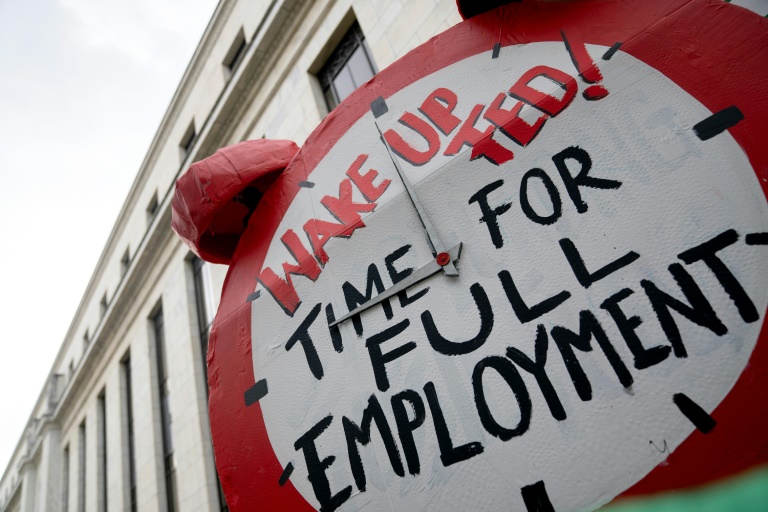
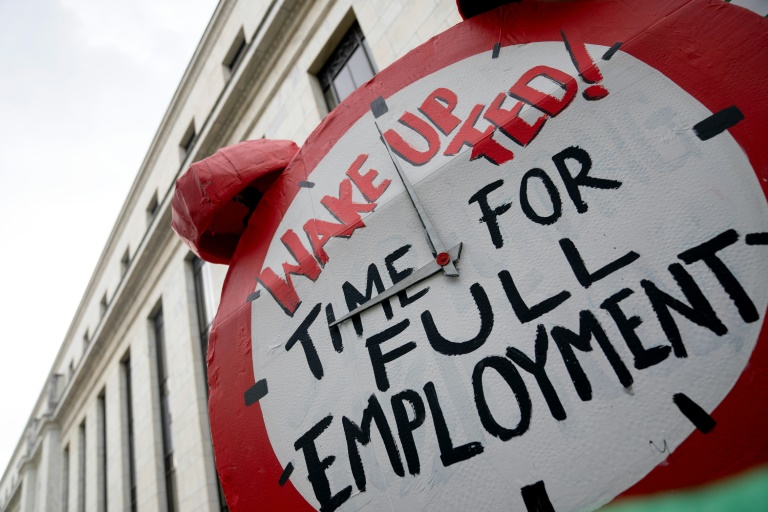
With the shift towards prioritizing the aggressive tightening of lending conditions — which policymakers see rising to 3.8 percent next year — the best the Fed might be able to hope for now is a “softish” landing, which would include higher joblessness.

The economy has continued to create jobs: the unemployment rate in May was 3.6 percent, just a tick above its pre-pandemic level, and there are nearly two job openings for every unemployment person, compared to 1.3 pre-Covid.

The Fed chief said “a 4.1 percent unemployment rate with inflation of well on its way to two percent, I think that would be a successful outcome.”

But he stressed that “events of the last few months have raised the degree of difficulty” in achieving the soft landing, and it likely will “depend on factors that we don’t control.”

But a half-point increase in the jobless rate can signal the start of a recession.

Diane Swonk of Grant Thornton, a long-time Fed watcher, called the central bank’s outlook “fanciful.”

– Rising risks –

Steve Englander of Standard Chartered Bank and a former Fed economist does not expect a recession — usually defined as two quarters of negative growth — and said unemployment may not have to increase by that much to achieve the Fed’s goals.

But the central bank will have to shrink demand, and “it’ll be painful, even if it’s not a technical recession.”

“The risk of a recession is rising and it’s rising sharply,” he told AFP.

But it is a risk the Fed is willing to take since it has made fighting inflation the priority.

Bostjancic said a softish landing is still possible, but without tough action to contain prices, the US could face stagflation — lower or negative growth with high inflation — last seen in the 1970s and 80s.

“The Fed is worried that if they don’t take care of inflation, now, it’s going to linger and be a problem many years into the future,” she said.

hsto

Is recession the only way out of US inflation scourge?

A massive interest rate hike by the US Federal Reserve and promises of more to come are fueling warnings that the only offramp from the searing price hikes engulfing American families is a full-blown recession.

The Fed remains hopeful it can slow activity and demand, cooling the blistering pace of inflation, without derailing the world’s largest economy. But skepticism is growing about the chances of success.

The central bank hiked the benchmark borrowing rate on Wednesday by three-quarters of a point, the biggest increase in nearly 30 years, and indicated a similar move is possible in July. 

The super-sized rate increase came as the Fed faces intense pressure to curb soaring gas, food and housing prices that have left millions of Americans struggling to make ends meet and sent President Joe Biden’s approval ratings plunging. 

The central bank has raised the key rate 1.5 points since March, as the Russian invasion of Ukraine and ongoing Covid-related supply chain issues combine to send prices up at the fastest pace in more than four decades.

Fed Chair Jerome Powell said recession is not the goal, but bringing down inflation “expeditiously” is “essential” since that is vital to a healthy economy.

But Kathy Bostjancic, chief US economist at Oxford Economics, warned that “it becomes very difficult to thread that needle.” 

The Fed will need a Goldilocks scenario where “a number of things fall into place and at the right time,” she told AFP.

The healthy US labor market and strong consumer demand, helped by a beefy stockpile of savings, are working in the Fed’s favor and could support activity even as the economy cools.

In the wake of the Fed decision, mortgage rates rocketed to their highest level in 13 years, with the average for a 30-year, fixed rate home loan reaching 5.78 percent.

Drivers still face gas prices at the pump of more than $5 a gallon, although for the first time in days, the national average fell on Wednesday, down from Tuesday’s record.

“My colleagues and I are acutely aware that high inflation imposes significant hardship, especially on those least able to meet the higher costs of essentials like food, housing and transportation,” Powell told reporters after the rate hike was announced.

– Higher unemployment –

With the shift towards prioritizing the aggressive tightening of lending conditions — which policymakers see rising to 3.8 percent next year — the best the Fed might be able to hope for now is a “softish” landing, which would include higher joblessness.

The economy has continued to create jobs: the unemployment rate in May was 3.6 percent, just a tick above its pre-pandemic level, and there are nearly two job openings for every unemployment person, compared to 1.3 pre-Covid.

The Fed chief said “a 4.1 percent unemployment rate with inflation of well on its way to two percent, I think that would be a successful outcome.”

But he stressed that “events of the last few months have raised the degree of difficulty” in achieving the soft landing, and it likely will “depend on factors that we don’t control.”

But a half-point increase in the jobless rate can signal the start of a recession.

Diane Swonk of Grant Thornton, a long-time Fed watcher, called the central bank’s outlook “fanciful.”

– Rising risks –

Steve Englander of Standard Chartered Bank and a former Fed economist does not expect a recession — usually defined as two quarters of negative growth — and said unemployment may not have to increase by that much to achieve the Fed’s goals.

But the central bank will have to shrink demand, and “it’ll be painful, even if it’s not a technical recession.”

“The risk of a recession is rising and it’s rising sharply,” he told AFP.

But it is a risk the Fed is willing to take since it has made fighting inflation the priority.

Bostjancic said a softish landing is still possible, but without tough action to contain prices, the US could face stagflation — lower or negative growth with high inflation — last seen in the 1970s and 80s.

“The Fed is worried that if they don’t take care of inflation, now, it’s going to linger and be a problem many years into the future,” she said.

hsto

US judge seeks clarity on supermarket shooter's death penalty prospects

A US judge on Thursday asked the Biden administration to decide quickly if it will seek execution for the teenager who shot dead 10 African Americans at a supermarket in May, warning that doing so would cost taxpayers more money.

Earlier this week, authorities announced federal hate crimes against Payton Gendron, 18, saying he was motivated by racist hate when, on May 14, he took a semi-automatic assault weapon to a grocery store in a largely Black neighborhood of Buffalo, New York, and opened fire.

In his first appearance on Thursday in a Buffalo federal court, Gendron said he was unemployed, only had $16 in his bank account and asked for legal assistance.

Judge Kenneth Schroeder agreed to grant Gendron a public defender, but urged prosecutors to make up their minds quickly about whether to pursue the death penalty for the suspect, saying such proceedings would cost additional taxpayer funds.

“The possibility of a death penalty obviously has a greater burden in the defense of the defendant,” Schroeder said.

Prosecutors said a decision on the sentence sought for Gendron will be made after a thorough evaluation of the case.

Democratic President Joe Biden ran for office on a promise to work to abolish the federal death penalty, and his top prosecutor issued a moratorium on federal executions pending a review of the process.

Gendron also faces charges of domestic terrorism and ten counts of first degree murder from the state of New York, which abolished capital punishment in 2004.

Dozens rescued by helicopter in Yellowstone floods

Dozens of people have been plucked to safety by National Guard helicopter crews this week as floods devastate Yellowstone National Park in the United States.

Over three days Montana National Guard units scrambled to reach 87 people cut off by raging rivers that have swept through the park and its surroundings following torrential rain and rapid snowmelt.

“At the request of local officials, the Montana National Guard continues to assist with search and rescue operations due to significant flooding in South Central Montana,” the National Guard said in a release Wednesday.

They have flown more than 41 hours of search and rescue operations, and also staffed road checkpoints to help with travelers’ safety, the release said. 

Thousands of visitors have been forced to leave Yellowstone, the oldest national park in the United States, where roads and bridges have been swept away by raging rivers.

Park managers said this week they expect sections of the park — which chiefly lies in Wyoming, but also extends into Montana and Idaho — will remain closed for the rest of the year because of the extensive damage caused by flooding.

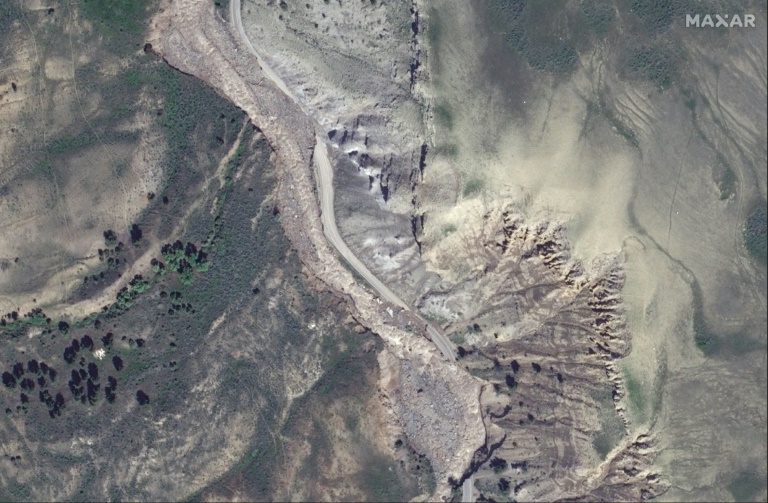
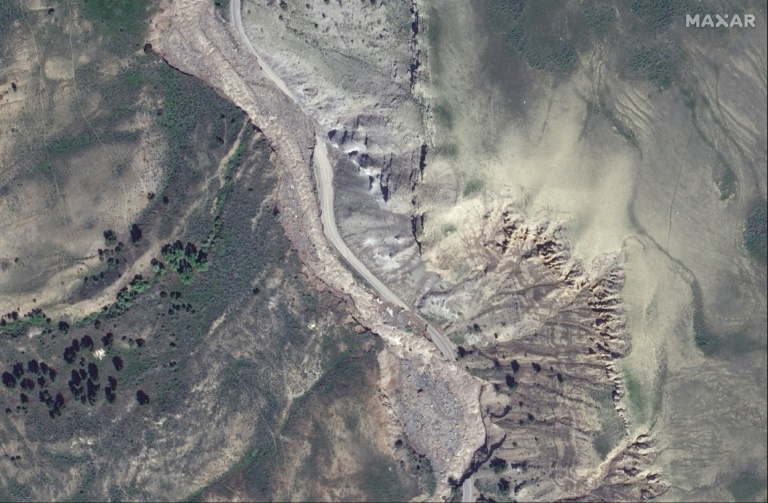
Images released by the National Park Service showed large sections of paved road had been swept away by raging rivers.

Aerial reconnaissance revealed “major damage to multiple sections of road” in the northern part of the park, the agency said.

Several communities on the north side of the park in Montana also experienced significant flooding, with bridges and roads washed out in Park County. 

Montana Governor Greg Gianforte declared a statewide disaster on Tuesday “to help impacted communities get back on their feet as soon as possible,” he said on Twitter.

A huge dome of high pressure is sitting over the United States, sending temperatures soaring for tens of millions of people.

Meteorologists say the edge of that dome, where colder air meets warm air, is experiencing wild weather, including heavy rainfall.

Higher-than-usual temperatures have also caused snowpack on the high mountains to melt, adding to the influx of water into rivers.

Dozens rescued by helicopter in Yellowstone floods

Dozens of people have been plucked to safety by National Guard helicopter crews this week as floods devastate Yellowstone National Park in the United States.

Over three days Montana National Guard units scrambled to reach 87 people cut off by raging rivers that have swept through the park and its surroundings following torrential rain and rapid snowmelt.

“At the request of local officials, the Montana National Guard continues to assist with search and rescue operations due to significant flooding in South Central Montana,” the National Guard said in a release Wednesday.

They have flown more than 41 hours of search and rescue operations, and also staffed road checkpoints to help with travelers’ safety, the release said. 

Thousands of visitors have been forced to leave Yellowstone, the oldest national park in the United States, where roads and bridges have been swept away by raging rivers.

Park managers said this week they expect sections of the park — which chiefly lies in Wyoming, but also extends into Montana and Idaho — will remain closed for the rest of the year because of the extensive damage caused by flooding.

Images released by the National Park Service showed large sections of paved road had been swept away by raging rivers.

Aerial reconnaissance revealed “major damage to multiple sections of road” in the northern part of the park, the agency said.

Several communities on the north side of the park in Montana also experienced significant flooding, with bridges and roads washed out in Park County. 

Montana Governor Greg Gianforte declared a statewide disaster on Tuesday “to help impacted communities get back on their feet as soon as possible,” he said on Twitter.

A huge dome of high pressure is sitting over the United States, sending temperatures soaring for tens of millions of people.

Meteorologists say the edge of that dome, where colder air meets warm air, is experiencing wild weather, including heavy rainfall.

Higher-than-usual temperatures have also caused snowpack on the high mountains to melt, adding to the influx of water into rivers.

US to boost help for veterans exposed to toxic burn pits

US senators approved a large expansion of health care and disability benefits Thursday for veterans exposed to toxic burn pits in Iraq and Afghanistan.

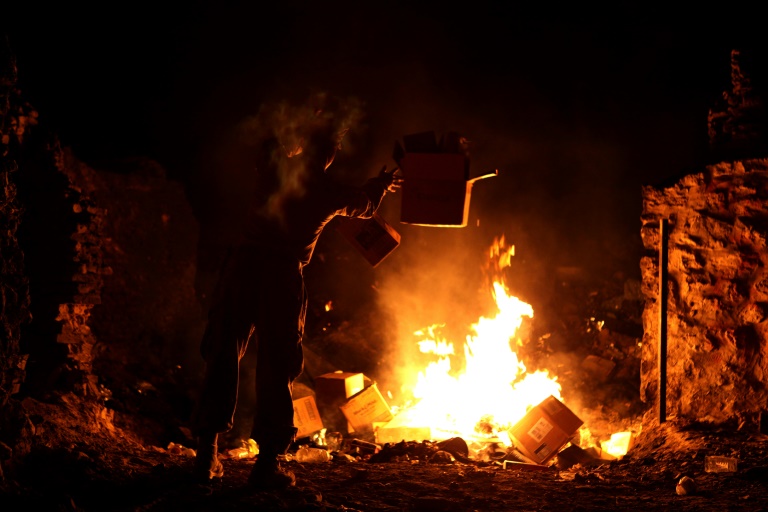
The open trash fires have been commonly used by the US military in post-September 11 conflicts, and are lit to get rid of everything from plastic bottles and human waste to old tires — all incinerated with jet fuel.

But the fumes from these holes in the ground are suspected of causing a range of illnesses among soldiers, from chronic respiratory ailments to a variety of cancers.

President Joe Biden believes the pits are at the root of the brain cancer that claimed the life of his son Beau, who served in Iraq in 2008.

The PACT Act expands the window of eligibility for free medical care and ensures that, for certain respiratory illnesses and cancers, veterans will get disability benefits without having to prove they were made sick by exposure to the pits. 

“For too long our nation’s veterans have faced an absurd indignity,” said Democratic Senate Majority Leader Chuck Schumer.

“They enlisted to serve our country, went abroad in good health and came back only to get sick from toxic chemical exposure endured while in the line of duty.”

The Department of Veterans Affairs estimates that some 3.5 million US service members were exposed to toxic smoke in Afghanistan, Iraq or other conflict zones, and more than 200,000 veterans have registered on lists of people who came into contact with burn pits.

The Pentagon funded a $10 million study in 2018 that concluded there was “a potential cause and effect relationship between exposure to emissions from simulated burn pits and subsequent health outcomes.”

As it stands, nearly 80 percent of veterans’ requests to have suspected burn pit ailments acknowledged by the government are rejected, according to the Iraq and Afghanistan Veterans of America (IAVA).

A poll by the organization found that 82 percent of those questioned said they were exposed to burn pits or other airborne toxic chemicals. 

Of these people, 90 percent said they are or may be suffering from symptoms linked to that exposure.

The legislation will cost around about $283 billion over 10 years. 

Before it reaches Biden’s desk it will need to get a final sign-off from the House of Representatives, which already passed its own version. This is expected to happen next week.

Ferrari says 80% of its models will be electric or hybrid by 2030

Ferrari unveiled Thursday plans to turn 80 percent of its production into all-electric or hybrid cars by 2030 in a major shift for an iconic brand renowned for its powerful combustion engines.

“Electrification is a way to improve performance,” new chief executive Benedetto Vigna said as he unveiled a four-year strategic plan at the brand’s historic Maranello site in northern Italy.

The 2022-2026 plan will be driven by the launch of new products — including Ferrari’s first 100 percent electric car, set to be presented in 2025.

“Ferrari’s first all-electric car will be 100 percent a sports car,” commercial director Enrico Galliera told AFP.

“We will develop an electric car that will deliver the same emotions as when you drive a (traditional) Ferrari,” he pledged, without revealing any technical details.

The Italian luxury carmaker plans to expand the Maranello plant and create a third production line for hybrid and electric vehicles.

Under the plan, some 60 percent of its production would be all-electric or hybrid models by 2026, rising to 80 percent by 2030.

Other upcoming new products include Ferrari’s first SUV, “Purosangue” (Thoroughbred), which will be unveiled in September, with deliveries from 2023.

Including the all-electric offer, another 15 new launches are expected between 2023 and 2026, Vigna said.

Ferrari, which celebrates its 75th anniversary this year, broke results records in 2021, delivering 11,155 cars — up 22.3 percent  — and generating revenue of 4.3 billion euros (up 23.4 percent).

It said Thursday it was setting an ambitious target for revenues. The 6.7-billion-euro ($7-billion) goal for 2026 is well above this year’s estimated revenue of around 4.8 billion euros.  

Vigna did not give many details of the new Purosangue, other than that it will be a sports car and will have a V12 engine, a trademark of the mythical brand.

But he said: “I am confident it will exceed all expectations.”

He emphasised its exclusivity, saying it would make up on average fewer than 20 percent of total deliveries.

Under the previous strategic plan unveiled in 2018, Ferrari had also promised the launch of 15 cars — a target Vigna said had been reached.

Close Bitnami banner
Bitnami