AFP

BoE unveils fifth rate hike in row as inflation soars

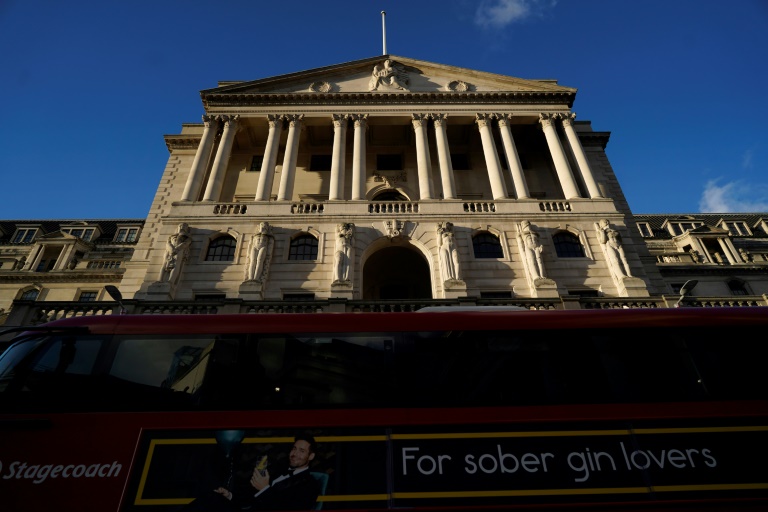
The Bank of England on Thursday hiked its main interest rate for a fifth straight time, as it forecast British inflation to soar further this year to above 11 percent.

BoE policymakers agreed at a regular meeting to increase the cost of borrowing by a quarter-point to 1.25 percent, the highest level since the global financial crisis in 2009.

The pound slumped one percent against the dollar following the announcement, one day after the Federal Reserve hiked US interest rates far more aggressively to fight runaway consumer prices in the world’s biggest economy.

The BoE’s latest rise was in response to “continuing signs of robust cost and price pressures… and the risk that those pressures become more persistent”, said minutes of the UK meeting.

A minority of BoE policymakers had voted for an increase to 1.5 percent.

– BoE lags Fed –

The Bank of England is avoiding “shock and awe tactics being employed across the Atlantic”, said Laith Khalaf, head of investment analysis at AJ Bell.

“Despite the UK starting to tighten monetary policy first, interest rates are now higher in the US.”

The US Federal Reserve on Wednesday announced the most aggressive interest rate increase in nearly 30 years — and said it is prepared to do so again next month in an all-out battle to drive down surging consumer prices.

The Fed’s rate hike of 0.75 percentage points comes after US inflation rocketed to 8.6 percent in May, the highest level in more than four decades.

In the UK, inflation stands at nine percent, the highest level in 40 years.

Prices are soaring worldwide as economies reopen from pandemic lockdowns and amid the Ukraine war that is pushing already high energy costs even higher.

– ‘Slow poison’ –

British economic output declined for a second month in a row in April, weighed down by rocketing prices that are causing a cost-of-living crisis for millions of Britons, while increasing the risk of a UK recession this year.

The BoE on Thursday forecast the UK economy to contract by 0.3 percent in the second quarter that ends on June 30 and after growth in the first three months of the year.

A recession is two quarters in a row of negative growth.

“Inflation risks being a slow poison for the economy, so the Bank of England is trying to take an antidote now by raising interest rates,” said Susannah Streeter, senior investment and markets analyst at Hargreaves Lansdown.

“However, it can only take a small dose at a time given the ailing nature of the economy… with more hikes to follow.”

Higher interest rates, while boosting returns for savers, ramps up loan repayments for businesses and households.

Data this week also revealed the first rise in the UK unemployment rate since the end of 2020 — although at 3.8 percent it remains at a near 50-year low point amid record-high job vacancies.

At the same time, the value of average UK wages is falling at the fastest pace in more than a decade.

Fearing fallout from surging inflation, the BoE began to raise its key interest rate in December, from a record-low level of 0.1 percent.

Almost two years earlier, as the Covid-19 pandemic began to take hold, the BoE slashed the rate to just above zero and decided to pump massive sums of new cash into the economy.

In the neighbouring eurozone, the European Central Bank is next month set to raise interest rates for the first time in more than a decade.

Switzerland’s central bank hiked its rate Thursday for the first time in 15 years.

burs-bcp/rfj/kjm
Tanzania starts moving Maasai out of Ngorongoro reserve

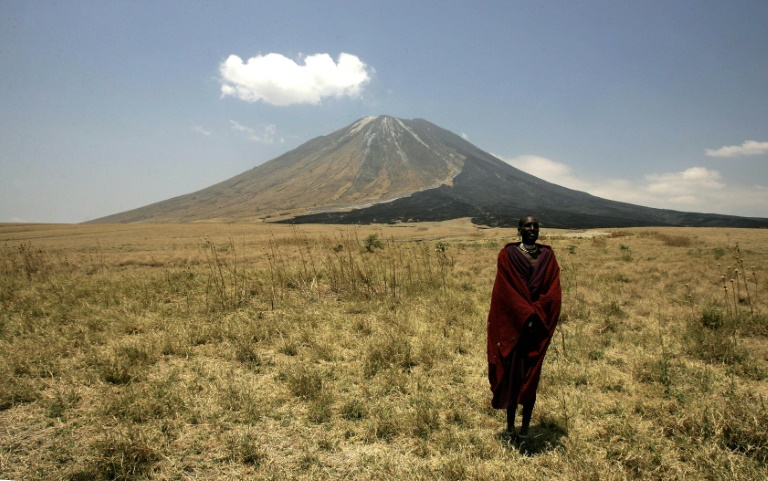
Tanzania on Thursday began relocating Maasai pastoralists from the famed Ngorongoro conservation area in a move that rights campaigners described as unlawful evictions.

The indigenous community has lived in the reserve, a UNESCO World Heritage site in northern Tanzania, for over a century.

But they now face the threat of eviction, as the authorities contend that their growing population is encroaching on wildlife habitat.

Officials insist the relocation is voluntary.

Arusha regional commissioner John Mongella said around 296 families had registered for the move to Handeni, a district 600 kilometres (370 miles) south of Ngorongoro.

“There is no eviction here, all people who are leaving (are) voluntarily registered and the government is facilitating them,” he said in a video statement.

The government has earmarked 162,000 hectares (400,000 acres) of land for relocated Maasai households, he said.

But the community remains sharply divided over the issue, with many reluctant to leave the only home they have ever known.

“This eviction has never been voluntary for Ngorongoro people,” Ngorongoro-based human rights lawyer and activist Joseph Oleshangay told AFP.

The relocation has sparked concern, with a team of UN-appointed independent rights experts warning that “it could jeopardize the Maasai’s physical and cultural survival.”

“This will cause irreparable harm, and could amount to dispossession, forced eviction and arbitrary displacement prohibited under international law,” they said in a statement on Wednesday.

Tanzania has historically allowed indigenous communities such as the Maasai to live within some national parks.

But since 1959, the number of humans living in Ngorongoro has shot up from 8,000 to more than 100,000.

The livestock population has grown even more quickly, from around 260,000 in 2017 to over one million today.

– ‘Shocking brutality’ –

The Maasai say the authorities are attempting to force them off their land in order to organise safaris and private hunting expeditions for tourists.

The government has rejected these accusations, but the issue has led to clashes between the pastoralists and police.

One officer was killed and several protesters were injured during demonstrations in Ngorongoro district’s Loliondo town last weekend.

The protest broke out over the government’s push to cordon off 1,500 square kilometres (550 square miles) of Loliondo to create a wildlife protection area.

Amnesty International said Wednesday the “unlawful forced eviction” in Loliondo was “shocking both in its scale and brutality.” 

“Authorities must halt the ongoing demarcation and security operation in Loliondo, and begin genuine consultations with the community,” it said.  

In 2009, thousands of Maasai families were moved from Loliondo to allow an Emirati safari company, Ortelo Business Corporation, to organise hunting expeditions there. 

The government cancelled that deal in 2017, following allegations of corruption.

EU leaders vow to back Ukraine in visit to war-torn Kyiv

The leaders of major EU powers France, Germany and Italy vowed Thursday to help Ukraine defeat Russia and to rebuild its shattered cities, in a visit to a war-torn Kyiv suburb.

French President Emmanuel Macron, Germany’s Chancellor Olaf Scholz and Italian premier Mario Draghi arrived in Ukraine by train and headed to Irpin, scene of fierce battles early in Russia’s invasion.

“France has been alongside Ukraine since day one. We stand with the Ukrainians without ambiguity. Ukraine must resist and win,” Macron told journalists.

Surrounded by the wreckage left by Ukraine’s successful but hard-fought defence of its capital in the early stages of the 113-day-old conflict, Draghi said: “We will rebuild everything.

“They destroyed kindergartens, they destroyed playgrounds. Everything will be rebuilt,” he promised.

It is the first time the three have visited Kyiv since Russia’s February 24 invasion. 

Ukraine has applied to join the European Union and, although no-one in Brussels expects this to be a quick process, the leaders of the bloc’s most powerful countries were expected to bring President Volodymyr Zelensky a positive message.

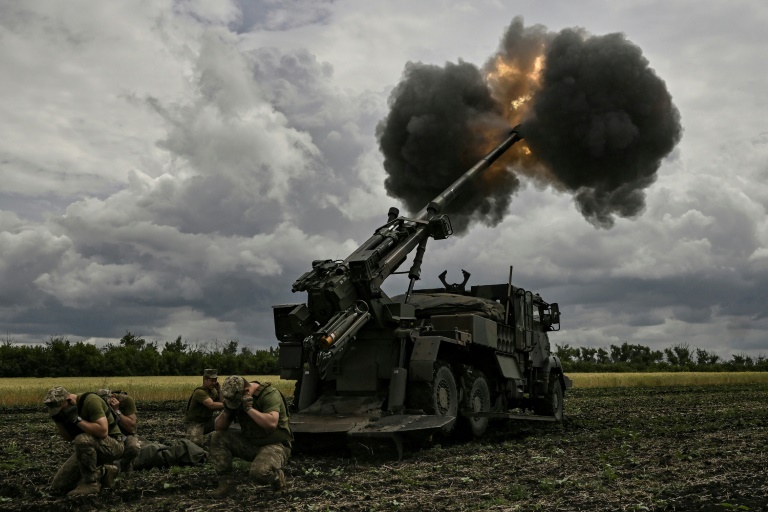
Kyiv is also pleading with its western allies to step up supplies of weapons to its forces, which are outgunned by Russian artillery on the frontline in east of the country. 

– ‘Stand by Ukraine’ –

Germany, especially, has been criticised for slow weapons deliveries, but western defence ministers are meeting in Brussels to discuss what more they can do and on Wednesday US President Joe Biden announced $1 billion worth of new arms for Ukrainian forces.

Moscow was dismissive of the European visit, and of the arms supplies.

“Supporting Ukraine by further pumping Ukraine with weapons,” warned Kremlin spokesman Dmitry Peskov would be “absolutely useless and will cause further damage to the country”. 

The new US support package includes howitzers, ammunition, anti-ship missile systems, and additional rockets for new artillery systems that Ukraine will soon put in the field.

Fighting in eastern Ukraine is focused on the industrial city of Severodonetsk, and Russians forces appear close to consolidating control after weeks of intense battles.

Sergiy Gaiday — the governor of the Lugansk region, which includes the city — said Thursday around 10,000 civilians remain trapped in the city, out of a pre-war population of some 100,000. 

Kyiv’s army is “holding back the enemy as much as possible,” he said on Telegram. “For almost four months they have dreamt of controlling Severodonetsk… and they do not count the victims.”

– Civilians trapped –

Moscow’s forces have destroyed the three bridges spanning a river between the city and Lysychansk. 

Hundreds of civilians are trapped in a Severodonetsk chemical plant, which is under constant bombardment, according to Ukrainian authorities.

Russia said Ukrainian authorities had on Wednesday prevented an attempt at evacuating them.

From an elevated position in Lysychansk, an AFP team saw black smoke rising from the Azot chemical factory in Severodonetsk and another area in the city.

The head of the Severodonetsk city administration Oleksandr Stryuk told Ukrainian television on Thursday that there were about 500 civilians trapped in shelters at the plant. 

“Fighting and constant shelling have been going on there for almost a week now,” he said, warning that the shelling could damage ammonia storage and trigger a chemical disaster. “It is a miracle that the whole city has not been affected.”

The Ukrainian military was using the high ground to exchange fire with Russian forces across the river.

– Seeking more arms –

Elsewhere, Russia launched a missile strike in Ukraine’s north-east Sumy region, killing four people and injuring six others, governor Dmytro Zhyvytsky said on Telegram.

In Brussels, Ukrainian defence minister Oleksiy Reznikov and other officials met with around 50 countries of the Ukraine Defence Contact Group at NATO headquarters asking for a surge in weapons and ammunition.

“Ukraine is really in a very critical situation and therefore, it’s an urgent need to step up,” NATO chief Jens Stoltenberg told journalists ahead of two days of talks. 

Russian President Vladimir Putin meanwhile underscored that he was not as isolated internationally as his foes would wish with a call with China’s leader Xi Jinping, their second reported call since Russia attacked Ukraine.

China has refused to condemn Moscow’s invasion of Ukraine and has been accused of providing diplomatic cover for Russia by criticising Western sanctions and arms sales to Kyiv.

The United Nations warned a hunger crisis that has been worsened by the war in Ukraine, traditionally a breadbasket to the world, could swell already record global displacement numbers.

Addressing the food insecurity crisis is “of paramount importance… to prevent a larger number of people moving,” the United Nations refugee chief Filippo Grandi told reporters.

burs-dc/jm

Qatar Airways posts 'record' $1.54 bn profit despite pandemic

Qatar Airways on Thursday posted a record net profit of $1.54 billion for the 2021-2022 financial year, a result it attributed to a “successful strategy” during the coronavirus pandemic.

The state-owned airline said the profit result was “200 percent above its highest annual historical profit” and achieved on the back of $14.4 billion in overall income.

It said that the revenue figure was “a remarkable two percent higher than the full financial year pre-Covid” in 2019-2020.

“In the most difficult period ever in the global airline industry, the airline credits its positive results to its agility and successful strategy,” it said in a statement.

Qatar Airways said it “continued to focus on customer needs and evolving market opportunities, as well as efficiency and the commitment of its worldwide employees”.

“This profit is not only a record for Qatar Airways Group, but also a record among all other airlines that have published financial results for this financial year worldwide,” the airline said.

Europe stocks tank as central banks fail to quell recession fears

European stock markets tumbled Thursday on fears of recession, despite central bank efforts to tame soaring inflation.

One day after the Federal Reserve’s biggest US interest-rate hike in nearly 30 years, the Bank of England was set to increase borrowing costs for the fifth time in a row.

Economists forecast the BoE to hike its rate by a quarter-point to 1.25 percent, the highest since the 2009 global financial crisis, in a decision due at 1100 GMT.

Thrown into the mix, the Swiss National Bank (SNB) unexpectedly hiked rates for the first time since 2007.

“European bourses are tanking on recession fears as central banks act aggressively to tame inflation,” City Index analyst Fiona Cincotta told AFP.

“While the move by the Fed was priced in, the SNB’s hike was a shock that caught investors off guard. Harder and faster rate hikes from central banks mean that a recession will be hard to avoid.”

Approaching the half-way stage in Europe, Frankfurt’s stock market led the losses with a drop of nearly three percent. London and Paris were down 2.3 percent.

Markets have been pummelled this year as soaring consumer prices — particularly on fallout from the Ukraine conflict — have forced central banks to tamp up borrowing costs.

That has intensified fear that the world economy, which is still in recovery from the deadly Covid pandemic, could lurch back into a lengthy downturn.

“Central banks remain the focus as the baton passes to the Bank of England from the Federal Reserve,” noted Richard Hunter, head of markets at Interactive Investor.

Despite the Fed’s rate hike of 0.75 percentage points, “investors were sanguine on the basis of the news already being priced in”, he said.

“Opinion is now split between whether this accelerated tightening will be more beneficial for the US economy in the long run, or whether an overenthusiastic policy will result in recession.”

Elsewhere Thursday, Asian stock markets mostly closed lower and the dollar advanced.

Traders initially tracked Wednesday’s strong performance on Wall Street as the US central bank move signalled it is intent on fighting runaway prices, but Fed boss Jerome Powell said such big moves would not be commonplace.

The size of the US rate hike had been expected after data showed inflation in the world’s biggest economy at its highest since 1981.

Oil prices extended losses Thursday on demand worries caused by new Covid containment measures in China and news of surging US production.

– Key figures at around 0950 GMT –

London – FTSE 100: DOWN 2.3 percent at 7,104.85 points

Frankfurt – DAX: DOWN 2.9 percent at 13,094.23 

Paris – CAC 40: DOWN 2.3 percent at 5,890.35

EURO STOXX 50: DOWN 2.7 percent at 3,435.97

Tokyo – Nikkei 225: UP 0.4 percent at 26,431.20 (close)

Hong Kong – Hang Seng Index: DOWN 2.2 percent at 20,845.53 (close) 

Shanghai – Composite: DOWN 0.6 percent at 3,285.38 (close)

New York – Dow: UP 1.0 percent at 30,668.53 (close)

Euro/dollar: DOWN at $1.0419 from $1.0444 late Wednesday

Pound/dollar: DOWN at $1.2133 from $1.2180

Euro/pound: UP at 85.86 pence from 85.75 pence

Dollar/yen: DOWN at 132.84 yen from 133.84 yen

Brent North Sea crude: DOWN 0.5 percent at $117.92 per barrel

West Texas Intermediate: DOWN 0.7 percent at $114.54

France braces for early heatwave as Spain battles forest fires

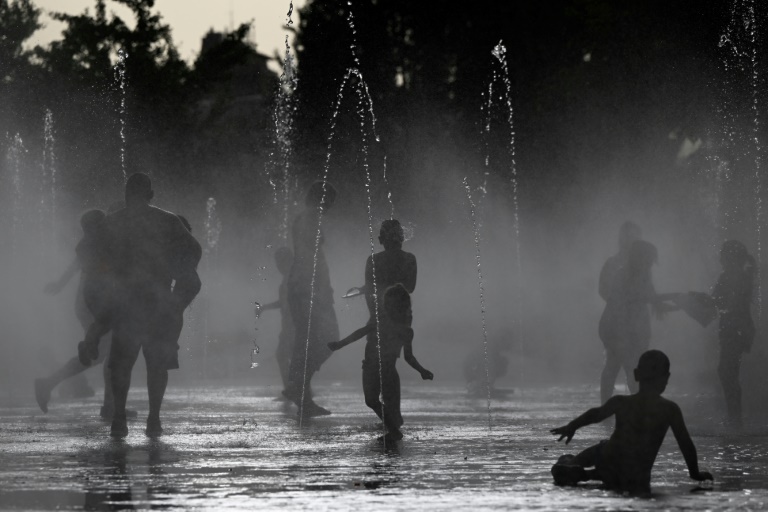
French officials warned Thursday that a record pre-summer heatwave was spreading north from Spain, where authorities were fighting several forest fires as the country sizzles under a sixth day of sweltering temperatures.

The Meteo France weather service said it was the earliest hot spell to hit the country since at least 2005, worsening a drought caused by an unusually dry winter and spring and raising the risk of forest fires.

Spain, which had already seen its hottest month of May since the beginning of this century, was sweating under temperatures forecast as high as 43 degrees Celsius (109 Fahrenheit) and no relief is expected before Sunday, the Aemet weather service said.

At least three blazes had erupted in Catalonia, including one near Baldomar, around 140 kilometres northeast of Barcelona, that had already burned 500 hectares but could grow to 20,000 hectares before it is contained, the regional government said.

No evacuations have yet been ordered but people are being urged to remain in their homes.

In neighbouring Portugal, last month was the hottest May since 1931, with most scientists attributing the early season heat to global warming caused by greenhouse gas emissions.

The heat crossed the Pyrenees into southern France on Tuesday and was set to hit most of the country by Saturday, when thermometers could reach 38 Celsius in Paris.

Authorities have already warned of increased wildfire risks in forests surrounding the capital, and Paris and other areas have issued alerts over ozone pollution, which occurs when intense sunlight transforms carbon emissions into smog.

“I’m 86 years old, I was born here, but I think this is the worst heat wave I’ve ever seen,” Jacqueline Bonnaud told AFP at a shaded park in the southern city of Toulouse.

– Electricity, rail hit –

A surge in the use of air-conditioners and fans was forcing France to import electricity from neighbouring countries, grid operator RTE said Thursday, since many of the country’s nuclear reactors are offline to evaluate potential corrosion risks or for maintenance.

The intense heat is also lowering river levels, meaning some nuclear plants must reduce output because water used for cooling reactors is too hot to be returned to waterways without endangering plants and wildlife.

Spain, Italy and other countries have recently limited the use of air-conditioners to save energy, and French Energy Minister Agnes Pannier-Runacher told France 2 television that she was considering the same.

Meteo France issued heatwave alerts covering half the country in the south and west Thursday and said more departments would be impacted in the coming days.

“Saturday will be the peak, with temperatures of 35 to 39 degrees across most of the country,” said Tristan Amm, a forecaster at the agency.

Schools have stocked up on water and several have moved end-of-year exams to north-facing rooms, while some departments in the south have said classes will be cancelled on Friday afternoon.

Cities such as Bordeaux have also installed misting devices on the hottest squares and streets. 

Rail operator SNCF has warned of potential delays as trains are forced to slow because the heat has deformed tracks or damaged electrical equipment.

“Our infrastructure suffers” in the heat, said SNCF regional director Thierry Rose, noting that track-level temperatures in Bordeaux had hit 52 Celsius (126 Fahrenheit) on Wednesday.

McDonald's to pay 1.25 bn euros to settle French tax case

McDonald’s will pay 1.25 billion euros ($1.3 billion) in France to avoid a legal case over tax evasion between 2009 and 2020, under an agreement approved Thursday by a Paris court.

Judge Stephane Noel confirmed the second-biggest tax settlement in French history, made up of a 508-million-euro fine and 737 million euros in back taxes already agreed in May, years after McDonald’s was accused of reporting artificially low profits to reduce its tax bill.

“On condition of payment of the fine, the validation of the agreement means the end of the prosecution,” chief financial prosecutor Jean-Francois Bohnert said in a statement.

Hailing the fine as the “maximum amount possible” under such a deal, he added that McDonald’s would pay “2.5 times the amount of tax avoided”.

Investigators had since 2014 been probing whether fees paid by McDonald’s French operation to its European parent company in Luxembourg for use of the chain’s brand in fact served to artificially slash its profits.

These let the company “soak up a large amount of the profits made by restaurants in France,” judge Noel said.

A source familiar with the case told AFP this week that such practices within the same group are “used exclusively to avoid taxes”.

They added that the brand fees “could double” from one McDonald’s branch to the next “without any justification at all, which made it possible to prove that it was done ‘exclusively’ for tax reasons”.

Prosecutors had opened an official probe in 2016 after union officials reported the company for covering up tax evasion.

In a statement, McDonald’s said it had already paid 2.2 billion euros in taxes over the period in question.

“This agreement ends a tax case and a judicial investigation without acknowledging fault,” the company added.

“McDonald’s France is working proactively with French tax authorities to agree the current and future level of brand and knowhow fees,” it said.

France’s biggest-ever tax fine dates to 2020, when aircraft builder Airbus had to cough up 2.1 billion euros.

Spain battles wildfires as heatwave persists

Emergency services battled several wildfires Thursday as Spain remained in the grip of an exceptional heatwave that has seen temperatures reach 43 degrees Celsius (109 degrees Farenheit).

The most alarming blaze, near Baldomar in Catalonia, has already destroyed 500 hectares of forest but could spread to over 20,000, the government in the northwestern region said.

No-one has been evacuated yet but the Catalan authorities have cordoned off several residential areas as a precaution.

In Lerida province, where Baldomar is located, temperatures reached 41C on Thursday. 

Spanish meteorologial office AEMET also forecast temperatures above 40C in Badajoz in the southwest and Zaragoza in the northeast.

Two other wildfires were raging in Catalonia on Thursday morning, in Lerida and Tarragona provinces, and had destroyed nearly 300 hectares, the Catalan authorities said.

Another was burning in the Sierra de la Culebra mountains in Zamora, central Spain.

In the northern province of Navarra, firefighters brought two forest fires under control during Wednesday night, regional emergency services said.

The six-day-old heatwave, exceptional in Spain for this time of year, has affected the entire country and is forecast to last until Saturday, AEMET said.

Spain recorded its hottest May since the start of the 21st century and has seen four extreme temperature episodes in less than a year.

In neighbouring Portugal, last month was the hottest May since 1931.

Heatwaves have become more prevalent due to climate change, scientists say. 

As global temperatures rise over time, heatwaves are predicted to become more frequent and intense, and their impacts more widespread.

Asian markets mixed as Fed rate hike rally fades

Asian markets were mixed Thursday as an early rally fuelled by a “dovish” Federal Reserve interest rate hike gave way to the prospect of an extended period of tight monetary policy.

Traders tracked a strong performance on Wall Street at the open as the US central bank move signalled it is intent on fighting runaway prices, while its boss Jerome Powell said such big moves would not be commonplace.

The 0.75 percentage point increase — the biggest in nearly 28 years — had been expected after data Friday showed inflation at its highest since 1981, as the Ukraine war supply chain snarls sent energy and food costs spiralling.

Powell said it was “essential” to lower inflation, and policymakers “have both the tools we need and the resolve it will take to restore price stability on behalf of American families”.

He stressed that the goal is to achieve that without derailing the US economy but acknowledged there was always a risk of going too far.

In his post-meeting news conference, he told reporters the move was “an unusually large one” but he did not expect “moves of this size to be common”.

But “from the perspective of today, either a 50-basis-point or a 75-basis-point increase seems most likely at our next meeting”.

While the lift was bigger than the 50 basis points flagged before Friday’s figures, it was welcomed as a sign the Fed was on the case and helped push down Treasury yields — a key guide to future rate expectations.

The 75 basis points hike “is a solid showing that will, all else being equal, serve to improve Fed credibility and leave monetary policy slightly less behind the inflationary curve”, said BMO Capital Markets strategists Benjamin Jeffery and Ian Lyngen.

“The response in risk assets will ultimately define the extent to which the Fed will be able to normalise monetary policy.”

However, after chasing higher in the first few hours of the day, Asia lost momentum in the afternoon.

Tokyo, Singapore, Seoul, Wellington, Manila and Jakarta held up, but Shanghai, Sydney, Taipei, Mumbai and Bangkok were all in negative territory.

Hong Kong led the losses after a big gain Wednesday and as investors there contemplated a sharp rate hike in the city owing to its monetary policy link to the United States. 

“Powell must be pretty pleased with his press conference and the market reaction as he delivered what I would interpret as a ‘dovish’ 75 basis point hike. Equities are up, rate expectations are slightly down and the dollar is a bit softer,” said SPI Asset Management’s Stephen Innes.

But he added: “The Fed now needs the data to play along for the ride and inflation to not surprise on the upside again. If it does, 75 basis points for July and September will be quickly repriced.”

“The much taller order for stocks to return to any semblance of bullish form would likely require an improbable upbeat mix of a seamless China growth recovery, a convincing deceleration of US inflation, and much softer oil prices.”

– Recession fears –

Other analysts were also wary about the outlook, with some concerned that the Fed measures could tip the world’s top economy into recession.

“The volatility in bond markets is definitely not over,” Jasmin Argyrou, of Credit Suisse Private Bank, told Bloomberg Television. “The likelihood is that policy rates in the US may need to go to a more restrictive stance than even the market is pricing in.”

European markets dropped at the open, with London traders awaiting a Bank of England policy meeting that is expected to see it hike rates for a fifth straight time.

On currency markets the dollar resumed its upward march across the board as the gap between the monetary policies of the Fed and other central banks widens.

The euro was particularly under pressure, having enjoyed a selling respite Wednesday after the European Central Bank said at an emergency meeting that it would act to ease stress on sovereign debt markets and design a new instrument to ward off a fresh crisis in the eurozone.

Borrowing costs in some eurozone countries are rising faster than in others as the ECB tightens its monetary policy, but officials said they would prevent such “fragmentation” that occurred during the region’s debt crisis a decade ago.

Oil prices ticked up a day after taking a hit from demand worries caused by new Covid containment measures in China and data showing a surge in US production.

The black gold was helped by a warning from the International Energy Agency that global supplies — hammered by the Ukraine conflict — will struggle to meet demand next year.

– Key figures at around 0720 GMT –

Tokyo – Nikkei 225: UP 0.4 percent at 26,431.20 (close)

Hong Kong – Hang Seng Index: DOWN 1.7 percent at 20,944.74 

Shanghai – Composite: DOWN 0.6 percent at 3,285.38 (close)

London – FTSE 100: DOWN 0.5 percent at 7,237.71

Dollar/yen: UP at 134.45 yen from 133.69 yen late Wednesday

Euro/dollar: DOWN at $1.0416 from $1.0457

Pound/dollar: DOWN at $1.2130 from $1.2181

Euro/pound: UP at 85.88 pence from 85.80 pence

West Texas Intermediate: UP 0.6 percent at $116.02 per barrel

Brent North Sea crude: UP 0.5 percent at $119.07 per barrel

New York – Dow: UP 1.0 percent at 30,668.53 (close)

European leaders visit Ukraine in show of support

The leaders of France, Germany and Italy visited Kyiv on Thursday in a show of European support for Ukraine, as Russia presses its brutal offensive in the east of the country.

French President Emmanuel Macron, German Chancellor Olaf Scholz, and Italian Prime Minister Mario Draghi arrived in the Ukrainian capital by train from Poland, according to an AFP reporter travelling with them.

Asked by a journalist why he had come to Ukraine, Macron said: “For a message of European unity.”

Scholz told German daily Bild that they “want to show not only solidarity, but also assure that the help that we’re organising — financial, humanitarian, but also, when it comes to weapons — will continue”.

“And that we will continue it as long as it is necessary for Ukraine’s fight” against Moscow, he said.

It is the first time that the leaders of the three European Union countries have visited Kyiv since Russia’s February 24 invasion. 

They are due to meet Ukrainian President Volodymyr Zelensky, at a time when Kyiv is pushing to be given official candidate status to join the EU.

France — which holds the rotating presidency of the EU until the end of this month — Germany and Italy view Ukraine’s aspirations to join the bloc favourably. 

But officials and leaders in the bloc caution that, even with candidacy status, membership could take years or even decades.

Despite reservations among some member states, EU leaders are expected to approve Ukraine’s candidate status, though with strict conditions attached.

Other leading figures to have visited Ukraine since the start of the war include British Prime Minister Boris Johnson, US Secretary of State Antony Blinken and UN chief Antonio Guterres. 

– ‘Stand by Ukraine’ –

Ukraine is also expected to reiterate its pleas for allies to send more weapons, with officials saying only a fraction of what they have asked for has so far been delivered. 

On Wednesday, US President Joe Biden announced $1 billion worth of new arms for Ukrainian forces.

The new package features howitzers, ammunition, anti-ship missile systems, and additional rockets for new artillery systems that Ukraine will soon put in the field.

Biden said that he told Zelensky in a phone call Wednesday that “the United States will stand by Ukraine as it defends its democracy and support its sovereignty and territorial integrity in the face of unprovoked Russian aggression.”

“The bravery, resilience, and determination of the Ukrainian people continues to inspire the world.”

Fighting in eastern Ukraine is focused on the industrial city of Severodonetsk, and the Russians appear close to consolidating control after weeks of intense battles.

Sergiy Gaiday — the governor of the Lugansk region, which includes the city — said Thursday around 10,000 civilians remain trapped in the city, out of a pre-war population of some 100,000. 

Kyiv’s army is “holding back the enemy as much as possible,” he said on Telegram. “For almost four months they have dreamt of controlling Severodonetsk… and they do not count the victims.”

Moscow’s forces have destroyed the three bridges spanning a river between the city and Lysychansk. 

Hundreds of civilians are trapped in a Severodonetsk chemical plant, which is under constant bombardment, according to Ukrainian authorities.

Russia said Ukrainian authorities had on Wednesday prevented an attempt at evacuating them.

From an elevated position in Lysychansk, an AFP team saw black smoke rising from the chemical factory in Severodonetsk and another area in the city.

The Ukrainian military was using the high ground to exchange fire with Russian forces across the river.

“It’s scary, very scary,” 83-year-old Lysychansk pensioner Valentina said. “Why can’t they agree at last, for God’s sake, just shake hands?”

Elsewhere, Russia launched a missile strike in Ukraine’s northeast Sumy region, killing four people and injuring six others, governor Dmytro Zhyvytsky said on Telegram.

– Seeking more arms –

In Brussels Wednesday, Ukrainian defence minister Oleksiy Reznikov and other officials met with some 50 countries of the Ukraine Defence Contact Group at NATO headquarters asking for a surge in weapons and ammunition.

“Ukraine is really in a very critical situation and therefore, it’s an urgent need to step up,” NATO chief Jens Stoltenberg told journalists. 

Russian President Vladimir Putin meanwhile underscored that he was not as isolated internationally as his foes would wish with a call with China’s leader Xi Jinping, their second reported call since Russia attacked Ukraine.

China has refused to condemn Moscow’s invasion of Ukraine and has been accused of providing diplomatic cover for Russia by criticising Western sanctions and arms sales to Kyiv.

The United Nations warned a hunger crisis that has been worsened by the war in Ukraine, traditionally a breadbasket to the world, could swell already record global displacement numbers.

Addressing the food insecurity crisis is “of paramount importance… to prevent a larger number of people moving,” the United Nations refugee chief Filippo Grandi told reporters.

Close Bitnami banner
Bitnami