AFP

YouTube Shorts touts 1.5 bn users, taking on TikTok

YouTube on Wednesday said that more than 1.5 billion people monthly tune into its Shorts video service, which competes with global sensation TikTok.

Alphabet-owned YouTube and Facebook-parent Meta both added short-form video sharing formats to their services after TikTok — which late last year said it topped a billion users — became the rage.

YouTube Shorts went live less than two years ago, adding videos of no longer than 60 seconds to the mix of offerings on the platform.

“Shorts has really taken off and are now being watched by over 1.5 billion logged-in users every month,” said YouTube chief product officer Neal Mohan.

“We know the product will continue to be an integral part of the YouTube experience moving forward.”

YouTube last year launched a $100 million fund to “reward creators” whose video clips attract audiences to the online stage.

YouTube has also put the Silicon Valley tech titan’s advertising skills to work helping creators generate income from content on the platform, which brought in billions of dollars in revenue in 2021.

Creators are taking advantage of podcasting, shorts, and live streaming at YouTube in a “multi-platform approach,” said vice president of the Americas Tara Walpert Levy.

“This approach is yielding real results; channels uploading both short and long-form content are seeing better overall watch time and subscriber growth than those uploading only one format,” Levy said.

She billed YouTube as a one-stop shop for people to “flex their creative muscles.”

TikTok, owned by China-based ByteDance, early this year began letting users upload slightly longer videos, raising the maximum length to 10 minutes from 3 minutes.

YouTube, Meta, and TikTok compete to be the platform of preference from popular online personalities with revenue making features such as subscriptions or shares in ad revenue.

European leaders expected in Kyiv as US pledges more weapons

The leaders of France, Germany and Italy are expected to visit Kyiv on Thursday, a day after the United States announced $1 billion worth of new arms for embattled Ukrainian forces.

Kyiv’s troops are resisting a fierce onslaught in the Donbas region by Russian President Vladimir Putin’s forces, which are pushing to seize a swathe of eastern and southern Ukraine.

In a show of support, French President Emmanuel Macron, German Chancellor Olaf Scholz, and Italian Prime Minister Mario Draghi are expected in Kyiv. 

While there has been no official announcement about the trip, Macron is already in the region, having visited two of Ukraine’s neighbours — Romania and Moldova — in recent days. 

Speaking in Romania Wednesday after meeting French troops stationed there, Macron said that “we, the European Union, need to send clear political signals to Ukraine and the Ukrainian people, who have been resisting heroically for several months”.

Italian and German media have reported that Draghi and Scholz will visit Kyiv, and the three European leaders are reportedly set to meet Ukrainian President Volodymyr Zelensky. 

It will be the leaders’ first visit since Russia’s February invasion of Ukraine, and comes as Kyiv pushes to become a member of the European Union. 

Draghi has strongly supported EU sanctions against Moscow over the war, and has also backed Ukraine’s hopes of joining the bloc.

The European Commission has said it will give recommendations on Kyiv’s membership prospects soon. France holds the rotating presidency of the EU until the end of this month.

Other leading figures to have visited Ukraine since the start of the war include British Prime Minister Boris Johnson, US Secretary of State Antony Blinken and UN chief Antonio Guterres. 

– ‘Stand by Ukraine’ –

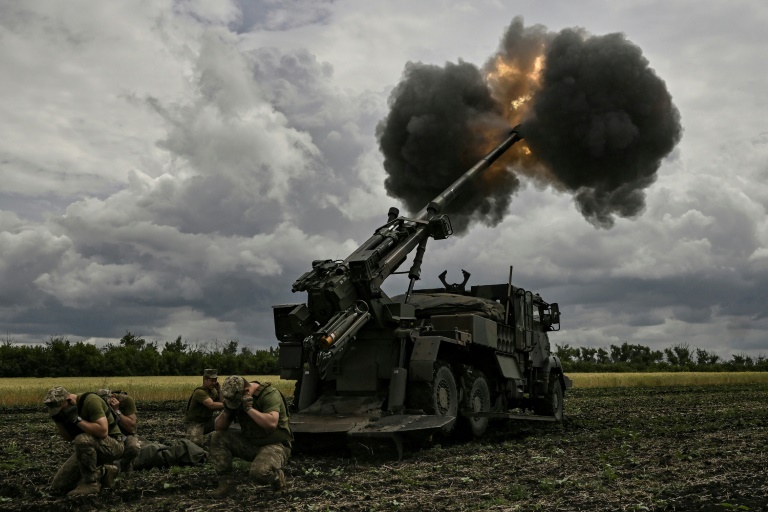
On Wednesday, President Joe Biden unveiled the new US arms package, featuring howitzers, ammunition, anti-ship missile systems, and additional rockets for new artillery systems that Ukraine will soon put in the field.

Biden said that he told Zelensky in a phone call Wednesday that “the United States will stand by Ukraine as it defends its democracy and support its sovereignty and territorial integrity in the face of unprovoked Russian aggression.”

“The bravery, resilience, and determination of the Ukrainian people continues to inspire the world.”

Fighting in eastern Ukraine is focused on the industrial city of Severodonetsk, and the Russians appear close to consolidating control after weeks of intense battles.

Moscow’s forces have destroyed the three bridges spanning a river between the city and Lysychansk just to the west, which is “likely to isolate the remaining Ukrainian defenders within the city from critical lines of communication,” according to the US Institute of War.

Hundreds of civilians are trapped in a Severodonetsk chemical plant, which is under constant bombardment, according to Ukrainian authorities.

Russia said it had sought to establish a humanitarian corridor Wednesday to evacuate them, but that Ukrainian forces “cynically scuppered” the operation and prevented it from going ahead.

From an elevated position in Lysychansk, an AFP team saw black smoke rising from the chemical factory in Sevorodonetsk and another area in the city.

The Ukrainian military was using the high ground to exchange fire with Russian forces across the river.

“It’s scary, very scary,” 83-year-old Lysychansk pensioner Valentina said. “Why can’t they agree at last, for God’s sake, just shake hands?”

– Seeking more arms –

In Brussels, Ukrainian defence minister Oleksiy Reznikov and other officials met with some 50 countries of the Ukraine Defence Contact Group at NATO headquarters asking for a surge in weapons and ammunition.

“Ukraine is really in a very critical situation and therefore, it’s an urgent need to step up,” NATO chief Jens Stoltenberg told journalists. 

Top US defence officials defended the pace of arms deliveries while stressing that some weapons Kyiv wants require weeks of training before they can enter battle.

“We really are focused on what the leadership believes that its current needs are in this fight,” said US Defense Secretary Lloyd Austin.

“And I think that the international community has done a pretty good job of providing that capability. But it’s never enough.”

Putin meanwhile underscored that he was not as isolated internationally as his foes would wish with a call with China’s Xi, their second reported call since Russian attacked Ukraine.

China has refused to condemn Moscow’s invasion of Ukraine and has been accused of providing diplomatic cover for Russia by criticising Western sanctions and arms sales to Kyiv.

The United Nations warned a hunger crisis that has been worsened by the war in Ukraine, traditionally a breadbasket to the world, could swell already record global displacement numbers.

Addressing the food insecurity crisis is “of paramount importance… to prevent a larger number of people moving,” the United Nations refugee chief Filippo Grandi told reporters.

Watergate: A scandal for the ages that could yet be eclipsed

Fifty years since it ignited Washington, the Watergate affair remains a cautionary tale on the threat of untrammeled presidential power and the yardstick against which all other political scandals are judged.

Yet some historians believe its architect, Richard Nixon, risks being displaced as the norm-breaking exemplar of presidential corruption by Donald Trump and the firestorm over his role in the 2021 US Capitol assault.

Nixon’s underlying crime was covering up a break-in at the Democratic National Committee headquarters in Washington’s Watergate complex to steal documents that might have helped him in an election he would ultimately win by a landslide anyway.

The accusations against Trump — that he incited a deadly riot to disrupt the peaceful transfer of power as part of a conspiracy to overturn an election — appear “far more serious,” says history professor Michael Green.

Nixon “already has been knocked off his perch, frankly,” Green, of the University of Nevada Las Vegas, told AFP. 

“One of the ironies is that Nixon did not need to order a break-in to win that election,” he said. “And there is no evidence, even with all of the tapes, that there was ever a discussion or thought of overturning the result if it went against him.” 

Five Watergate burglars were caught red-handed on June 17, 1972 and it quickly emerged that some were linked to the Nixon campaign and the White House.

The ensuing probe eventually opened a Pandora’s box of abuses and dirty tricks that included political spying, the forgery of correspondence and even the theft of a pair of shoes to intimidate a Nixon rival.

But the cover-up was initially so successful that Nixon won 49 of the 50 states in his landslide victory over Democrat George McGovern in that year’s presidential election.

– ‘The first seditious president’ –

The whitewash might have succeeded were it not for the chance discovery in the summer of 1973 that the president had secretly recorded all of his White House meetings.

They included a “smoking gun” tape in which Nixon could be heard ordering that the FBI, which was set to investigate the Watergate break-in, be told to “stay the hell out of this.”

Nixon resigned after a delegation of Republican elders, led by ultra-conservative Barry Goldwater, came to the White House in 1974 to tell him he was likely to be impeached and the jig was up.

He was ultimately pardoned but many of his top aides went to jail.

Carl Bernstein and Bob Woodward, the reporters who played a pivotal role in bringing down Nixon, have written a new foreword for their iconic book “All the President’s Men” drawing parallels to Trump. 

Their comparison offers an insight into a pair of outsiders who felt besieged by enemies in the media and institutions of state.

But they suggest that Trump’s incitement of a mob to march on the Capitol constituted “a deception that exceeded even Nixon’s imagination.”

“By legal definition this is clearly sedition… thus Trump became the first seditious president in our history,” they say.

Analysts interviewed by AFP pointed to the vastly different political and media landscape Nixon and Trump faced when it came to consequences for their actions.

The Goldwater intervention, for example, would be inconceivable among the vast majority of today’s serving Republicans, who have stuck by Trump through two impeachments and numerous other controversies. 

– ‘Just another story’ –

And while the Senate voted unanimously to set up a cross-party investigative committee on Watergate, the Republicans of the 2020s vetoed a bipartisan commission and punished two members who joined the Democratic-led House committee investigating January 6.

Some 80 million Americans — considerably more than a third of the population — tuned in to White House counsel John Dean’s televised testimony against Nixon at the Watergate hearings.

Around 20 million — just six percent of Americans — watched the blockbuster first hearing put on by the January 6 panel.

For David Greenberg, author of “Nixon’s Shadow: The History of an Image,” the Watergate hearings were “instrumental” in bringing down a president attempting to subvert democracy.

“The difference, however, is that in 1973 and 1974 a great many Republican congressmen and senators loyal to Nixon ended up admitting that he was engaged in criminal activity,” he told AFP.

“Today, only a few… have been willing to acknowledge Trump’s complicity. Our polarized, partisan environment may prevent the January 6 hearings from achieving all they should.”

Meanwhile Trump’s impeachment for inciting the insurrection — and the apparent cover up of almost eight hours of his phone calls on January 6 — have not significantly eroded his support base.

“At the time of Watergate, Americans were united and trusted their media sources as part of one national conversation. Today that is impossible,” former CNN anchor Rick Sanchez told AFP.

If the right-wing cable news outlets that dominate current conservative discourse had been around in the 1970s, argues Sanchez, Watergate would have been “just another story in the 24-hour news cycle of America.”

Watergate: The president-toppling scandal triggered by a piece of tape

It all began when a vigilant night watchman noticed a piece of tape on a door of the building where the Democratic National Committee’s headquarters was located in Washington in June 1972.

Calling the police, he triggered the Watergate scandal that would topple the presidency of Richard Nixon, the only US leader ever to resign.

The tape, it turned out, was placed during a break-in by five men who had been tasked by officials with ties to the White House with placing microphones and taking pictures of documents to find compromising information on Nixon’s opponents.

– Tape on a door –

The night of June 16-17, 24-year-old security guard Frank Wills was making the rounds at the Watergate buliding complex when he noticed the tape on a door that prevented it from locking.

At first, he didn’t worry, removing it and continuing working.

But when he returned, so had the tape, leading him to suspect a break-in had occurred. Wills — who plays himself for a few seconds at the beginning of the film “All the President’s Men” that chronicles the saga — immediately called police.

“Found tape on door. Call police to make a inspection,” he wrote in a building security officer’s log, which has been preserved by the US National Archives.

Police officers arrived on the scene within “a minute, a minute and a half,” one of them, John Barrett, told ABC News in 2017.

He and fellow officer Paul Leeper were dressed in plain clothes, and were even a little scruffy.

That worked in their favor, as Alfred Baldwin, the man who was supposed to be keeping watch during the break-in, did not seem to notice them right away. His attention may have been focused on the movie “Attack of the Puppet People,” which was being shown on TV.

“He was glued to the TV set,” and by the time he warned the others, “it was too late and they had to run and hide like rats,” Barrett said.

– ‘Come out with your hands up’ –

Once inside the office, the two officers found tape on several doors, realizing that something fishy was going on.

“Our adrenaline is pumped,” Leeper told ABC.

They found ransacked offices and suspected that the perpetrators were still present, and started to search for them room by room.

Suddenly, Barrett saw an arm. “It scared the living bejeezus out of me,” he said.

“I scream something to the effect, ‘Come out with your hands up or I’m gonna blow your head off.'”

“Ten hands went up, and they came out, and that’s where the arrest occurred,” Barrett said.

Across the street, Baldwin had his ear to a walkie-talkie. “In a very soft whisper, I heard a voice: They’ve got us,” he said.

– Not a ‘typical burglary’ –

The 10 hands belonged to James McCord, Virgilio Gonzalez, Frank Sturgis, Eugenio Martinez and Bernard Barker.

The police soon realized that this “was not your normal, typical burglary,” Barrett said.

Not only were the burglars dressed in suits and ties, but they had bugging devices, tear gas pens, numerous rolls of film, locksmith tools, and thousands of dollars in hundred dollar bills, he said.

On June 18, The Washington Post published its first article on the subject. It was bylined Alfred E Lewis, the reporter covering the police. But its list of contributors at the end also included the names Bob Woodward and Carl Bernstein.

The two young reporters took over, investigating the details of the case that brought down Nixon’s presidency two years later, and winning the prestigious Pulitzer Prize for their work.

50 years ago, the Watergate scandal breaks

On June 17, 1972, Watergate erupted, one of the most spectacular political scandals in US history which led two years later to the resignation of president Richard Nixon.

Here is a timeline of how the events unfolded.

– Five ‘burglars’ –

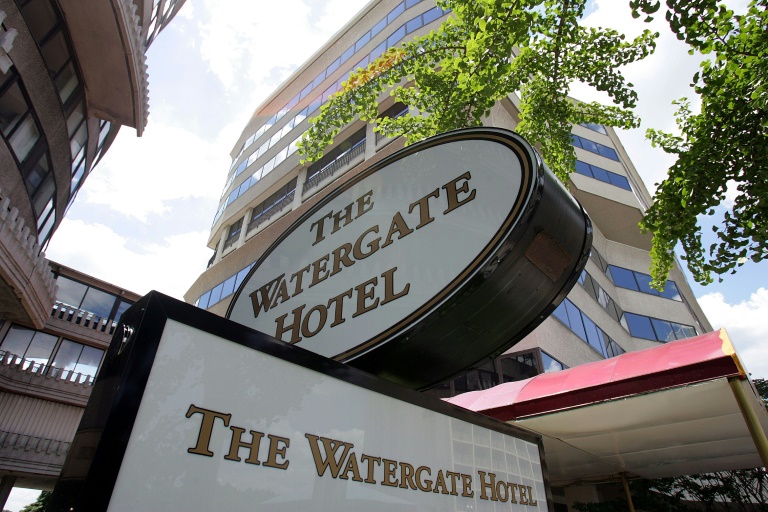
On the night of June 16 to 17, 1972, five men are arrested at the Democratic National Committee headquarters in the Watergate hotel and office complex in Washington.

The so-called “plumbers,” clad in surgical gloves, are armed with photographic and recording equipment.

The next day The Washington Post slaps on its front page the break-in which took place at the height of the reelection campaign of Republican president Richard Nixon.

Two young journalists, Bob Woodward and Carl Bernstein, name James McCord, a member of Nixon’s reelection committee and an ex-member of the CIA, as one of the intruders.

The reporters say the break-in was clearly linked to the White House.

On June 22, Nixon denies any involvement by his administration in the affair, which attracts little public attention.

– ‘Deep throat’ –

But things don’t stop there. The reporter duo goes on to establish that two men who had worked for Nixon as well as his special aide Charles Colson guided the burglars in their mission, using walkie talkies from a hotel near the Watergate.

Their source is “Deep Throat,” named after a porn film popular at the time — and identified many years later, in 2005, as Mark Felt, deputy director of the FBI.

Between October 1972 and November 1973 he meets Woodward six times in a Washington parking lot.

On October 10, 1972 the two journalists reveal a massive spying and political sabotage scandal by the White House which is seeking to get Nixon reelected.

Hundreds of thousands of dollars from donations to the Nixon campaign were siphoned off to finance a secret campaign to destabilize the Democratic camp.

Despite the controversy Nixon is triumphantly reelected on November 6 against his Democratic rival George McGovern.

– Democratic senators open probe –

On January 8, 1973 the trial of the Watergate burglars opens in the face of public indifference.

On February 7, the Democratic majority in the Senate sets up a committee charged with investigating the 1972 electoral campaign. Broadcast live on television, the hearings end up transfixing Americans.

McCord soon admits to having lied before the court due to pressure from the White House.

On April 30, attorney general Richard Kleindienst and two of the president’s aides — Bob Haldeman and John Ehrlichman — resign. A third aide, John Dean, is fired.

On June 25, Dean tells the committee that the president was aware from September 15, 1972, of a cover-up of the burglary.

He says Nixon was ready to spend nearly a million dollars to buy the burglars’ silence.

He thus becomes the first witness to directly implicate the head of state.

– Oval Office bugged –

An earthquake erupts on July 16 when an employee at the White House tells the committee the Oval Office is packed with hidden microphones. This secret bugging system, installed in 1970, is the beginning of a new scandal.

On July 23, 1973 Nixon refuses to provide the recordings to the committee.

Cornered, he ends up handing over nine tapes on October 20. But two are missing and a conversation between Nixon and his aide Dean on June 20, 1972, three days after the Watergate break-in, is inaudible.

– Resignation before impeachment –

On May 9, 1974 the Judiciary Committee of the House of Representatives launches hearings with a view to impeaching Nixon.

After a bitter year-long battle the Supreme Court orders Nixon on July 24 to hand over the missing tapes. With his back to the wall, the president agrees on August 5.

On July 30 the committee votes for three grounds for a future impeachment: obstruction of justice, abuse of power and contempt of Congress.

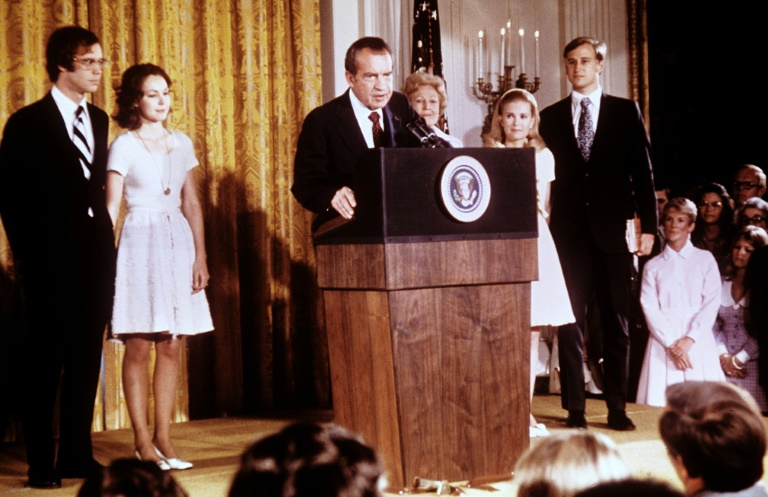
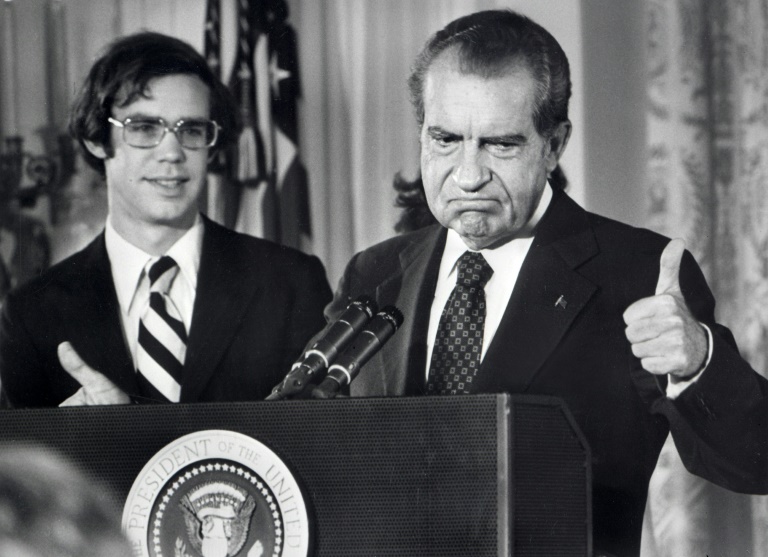
To avoid impeachment proceedings, Nixon announces his resignation on August 8, a first in the United States.

On September 8, 1974, his successor Gerald Ford grants him a total pardon.

Shorthand for scandal, from Watergate to Partygate

The break-in 50 years ago by Republican operatives at a Washington office led to the historic resignation of US president Richard Nixon — but arguably it reverberated more deeply around the world with the coining of a single term: Watergate.

Ever since the Potomac riverside building lent its name to one of Washington’s greatest political crimes, -gate has become the signifier of choice for scandals worldwide — a fact not lost on British Prime Minister Boris Johnson, nearly undone just this year by his own Partygate.

Over the past five decades there have been more than 200 -gate scandals, according to a Wikipedia list, and the suffix is used by many without any recollection of the original Watergate.

Indeed, it was already going global when Nixon, embroiled in a snowballing mess of his own making, was forced to resign the presidency in 1974.

That same year, the shocking news that Bordeaux vintners were doctoring their product was dubbed Winegate.

The year after that, the United Brands company was exposed for paying bribes to the president of Honduras to cut export taxes on fruit: Bananagate.

And then in 1976 Koreagate swept Washington, when US congressmen were shown taking payoffs from a foreign lobbyist.

“Gate” had officially become shorthand for “scandal.”

– Monicagate –

It didn’t always stick. 

When in the early 1980s president Ronald Reagan became caught up in the self-made web of secretly selling arms to US enemies in Iran to fund US-backed “Contra” paramilitaries in Nicaragua, pundits experimented with Irangate and Contragate.

But it went down in history as the “Iran-Contra Affair.”

In the 1990s Republicans sought their revenge over Watergate by trying to tag the suffix onto any whiff of controversy around president Bill Clinton and his wife Hillary.

More than a dozen -gates came and went around the Clintons, the most famous Troopergate and Travelgate, and finally, Monicagate — from Bill Clinton’s affair with intern Monica Lewinsky.

Clinton barely avoided Nixon’s fate, yet Monicagate as a term of political shame did not take deep root. 

By that point, says former senior New York Times editor Merrill Perlman, US media had developed an aversion to using -gate every time scandal erupted.

In addition, she added, “Language is fickle.” 

“Monicagate doesn’t roll trippingly off the tongue. It’s three syllables.”

– Gate in Italian is… –

Over time -gate as a metonym for scandal spread well beyond American politics.

In 1992 The Sun newspaper published juicy details from phone conversations between Britain’s Princess Diana and her close friend James Gilbey. 

The shock that someone had been able to eavesdrop on her calls, and that The Sun obtained the recordings and published them, gave rise to a moniker based on Gilbey’s affectionate nickname for Diana: Squidgygate.

Janet Jackson’s supposedly inadvertent baring of a breast in the 2004 Super Bowl halftime show became Nipplegate.

IPhone maker Apple had its turn with Antennagate. Its iPhone 4, introduced in 2010, lost connections when in the left hand of a user, due to a design flaw that the tech giant denied at first.

In Italy, -gate replaced the homegrown suffix -opoli — born from a vast 1990s corruption scandal dubbed Tangentopoli (“Bribesville”) — with Rubygate, the sordid story of politician Silvio Berlusconi’s affair with a 17-year-old Moroccan woman who used the name Ruby Rubacuori.

And a football scandal first branded Calciopoli was renamed Calciogate.

Perlman said her favorite is the rhyming Deflategate: the allegation that the king of Super Bowls, New England Patriots quarterback Tom Brady, deliberately played in 2016 with underinflated balls to earn an advantage.

Deflategate caught on widely. “Whether you believe Tom Brady or not, it has everything to do with the rhythm of it.”

– Political heft –

Perlman said the expanded use has watered down the term from its original roots in Nixon-level political scandal, perhaps understandably, as few people under 40 know what Watergate was.

“It’s already lost a lot of its political heft … the presidential disgrace part, because of things like Nipplegate and Deflategate,” she said.

Yet it persists. Former president Donald Trump faced Russiagate, Ukrainegate and others, none of which stuck, perhaps because the twice-impeached leader had an surfeit of controversies.

But his across-the-Atlantic contemporary, Johnson, has carried on the tradition.

Early this month he barely escaped the fate of Nixon due to the cover-up scandal of his secret booze-fueled Downing Street bashes during the Covid-19 lockdown: Partygate.

Australia submits more ambitious 2030 emissions target to UN

Australia’s new centre-left government submitted more ambitious emissions targets to the United Nations Thursday, seeking to end a decade of footdragging on climate change.

Prime Minister Anthony Albanese raised the country’s 2030 emissions reduction target to 43 percent, up from a more modest previous target of 26-28 percent.

The new goal “sets Australia up for a prosperous future, a future powered by cleaner, cheaper energy,” Albanese said.

Despite being ravaged by floods, fires and droughts, Australia has long been seen as a laggard on climate action.

The vast continent-country is replete with fossil fuel deposits and is one of the world’s top exporters of coal and gas.

Coal still plays a key role in domestic electricity production. 

In 2022, MIT ranked Australia 52nd of 76 nations on its Green Future Index, which rates how much countries are shifting towards an environmentally sustainable economy. 

– The ‘climate wars’ –

But Albanese made emissions cuts a centrepiece of his recent election campaign and pledged to “end the climate wars” that led to decades of policy stasis.

Albanese sought to frame the decision as an economic boon: “What business has been crying out for is investment certainty,” he said.

The Business Council of Australia welcomed the raised targets, saying they “should be a line in the sand.”

“Australia can’t afford to stall progress again because failure will see Australians miss out on new opportunities, new industries and better jobs,” the council’s chief executive Jennifer Westacott said.

– ‘Seize the opportunity’ –

Albanese said Thursday that world leaders had “all welcomed Australia’s changed position” on climate action during his conversations with them since taking power last month.

The issue of emissions reduction and fossil fuel exports was a key point of tension between Australia’s previous government and Pacific leaders, who have labelled climate change the greatest threat to their region.

Albanese tried to sidestep criticism that higher targets could harm Australian jobs saying he wanted to “seize the opportunity that is there from acting on climate change”.

The new targets would give business the certainty it needed to “invest over a longer time frame than the political cycle of three years,” he said.

But he has so far refused to set a deadline for phasing out coal, in line with other rich countries.

Even before the announcement, Australia’s fossil fuel industry was in flux with many major companies seeking to decarbonise their operations.

On Wednesday, global miner BHP announced it had been unable to find a buyer for its coal mines in the Australian state of New South Wales and would instead close the project by 2030.

The news came just a day after fossil fuel giant BP announced it would take out a 40.5 per cent stake in a renewables project in Australia, billed as the largest power station on earth.

Anja-Isabel Dotzenrath, BP’s executive vice president of gas and low carbon energy, said the company believed that “Australia has the potential to be a powerhouse in the global energy transition”.

A forlorn fight to stop America's gun factories

Clai Lasher-Sommers alternates between tears and fury over the flow of guns from the factories in her home state of New Hampshire, a top producer in America’s multi-billion dollar firearms industry. 

Speaking just miles from the house where an abusive stepfather shot her with a hunting rifle when she was 13, the survivor-turned-activist said she thinks about moving — just to get away from the gun makers.

“I don’t want to be anywhere near them, and the damage that they perpetuate every day,” she said. “I want them to close, but that’s not going to happen.”

The American state that produced and shipped out the most firearms since 2015, New Hampshire has funneled millions of weapons into the already-flooded domestic market of a nation beset by a gun death epidemic.

Recent tragedies were unlikely to disrupt the flow from the small northeastern state, where a lawmaker can walk the legislature’s halls with his pistol, guns aren’t necessarily blamed in deadly shootings and firearms firms provide thousands of jobs.

“It’s definitely a David vs. Goliath situation,” Melissa Rigazio, another state anti-gun violence activist, says of efforts to confront the industry. 

“It simply equals more death by guns… The gun manufacturers are very responsible for what’s going on.”

One of the biggest producers is Sig Sauer, which operates a factory surrounded by a green lawn, flapping American flag and “no trespassing” signs in the town of Newington.

The other local heavyweight is Ruger, about two hours’ drive away in Newport. Neither company granted AFP requests for an interview or a factory visit.

Between them, the two firms produced over 1.7 million rifles and handguns in New Hampshire in 2020, a year that saw firearms purchases explode in a nation rattled by the pandemic, a bruising election and mass social justice protests.

– Lack of gun restrictions –

Just over eight million handguns and rifles for domestic sale were produced in the state from 2015-2020 or about 17 percent of the national total, according to the most recent government figures.

While giants like Texas have more gun-linked business — with constellations of suppliers for firearms, parts and ammunition — New Hampshire dominates in per capita number of gun industry jobs, economic output and federal excise taxes, according to industry group NSSF.

The state with a motto of “Live free or die” has long been home to gun makers, as have other manufacturing hubs on America’s eastern seaboard.

A key factor that sets New Hampshire apart from neighbors New York or Massachusetts is a lack of gun restrictions.

It’s among half of America’s 50 states with rules that generally allow people legally able to buy guns to also carry them in many public places without a special license.

States that have tightened gun rules have in turn seen gun makers take their operations — and jobs — to friendlier places.

Mike Hammond, legislative counsel for hardline advocacy group Gun Owners of America, pointed to events after the mass shooting at Sandy Hook elementary school in the eastern state of Connecticut that killed 20 children in 2012.

“Connecticut, after Newtown, basically outlawed certain types of firearms that were made in Connecticut. Guess what?” he asked. 

“The firearms manufacturer left Connecticut.”

Advocates like Hammond note that although New Hampshire has made millions of guns, firearm violence mostly happens elsewhere in America.

But homicides take lives in the state too — one of them was Amy Innarelli’s 22-year-old son Chandler, who was shot dead in 2020 while waiting for his girlfriend and young child.

– ‘Guns didn’t murder my son’ –

Innarelli wore an orange t-shirt with her son’s smiling picture for an anti-gun violence vigil in New Hampshire’s largest city Manchester.

She sees the problem as complex, and requiring a multi-fronted response to tackle broader social ills — a sentiment echoed by others at the rally. 

“The gun didn’t murder my son, a person did,” she said afterwards.

“We have systematically broken down family dynamics, they are missing humanity in a lot of these kids.”

For Lasher-Sommers, the activist shot by her own stepfather, there’s no escaping that access to weapons is the core of the problem.

“It’s the gun, it’s the gun,” the 65-year-old told AFP at her home in Westmoreland, a small town near the border with Vermont.

But on the other end of the spectrum are people like John Burt, a representative in New Hampshire’s state legislature dedicated to fighting firearms restrictions — who wore a revolver-shaped pin on his lapel, and a handgun holstered on his belt when interviewed.

“The manufacturers help us stay a pro-gun state,” he said, noting his state had not enacted new gun laws after high-profile mass shootings in the country.

“I really do believe some of it is from the manufacturers, their support here. And we don’t want them to leave,” said Burt, speaking to AFP outside the legislature. 

Wearing his pistol, the lawmaker walked into the gold-domed building, which had no metal detectors — noting later with a chuckle that neither food nor water are allowed in the house chamber, “but I can have my gun.”


Small gun makers boom as US demand soars

Tony Hook flipped through cell phone pictures of finished work by his New Hampshire shop, explaining how one customer wanted mementos of major life events: a gun to mark each of his children’s births.

Smaller gun makers like him are booming in the United States, thanks to ravenous and sometimes specialized demand for pricey limited-production pistols and custom rifles, engraved with bible passages or the American flag.

“He had us build a gun for every newborn he had,” explained Hook, the owner of RTD Arms & Sport. “So this is his son’s name and his date of birth,” he said, showing the engraving on a rifle.

The millions of guns produced annually in the United States are primarily made by the nation’s biggest manufacturers, yet smaller operators have poured into a market that saw production nearly triple from 2000 to 2020.

The smaller makers can churn out parts destined for major firms like Sig Sauer or Smith & Wesson and for enthusiasts and gun shops, or they can be manufacturers themselves of specialized or customized weapons.

“It’s just like maybe stitching your name onto your baseball glove or having custom pinstriping put on your car,” said Hook. “People do the same with their guns. It’s a piece of them.” 

– $1,700 guns –

The United States has a deep culture of gun ownership centered around a constitutional guarantee for Americans to keep and bear arms, and as a result has a sprawling market of weapons, gear and accessories. 

America also sees roughly 40,000 gun deaths a year, about half of which are suicides, though homicides increased at historic rates during the pandemic. 

In this context, the gun and ammunition industry added an estimated $70 billion to the US economy in 2021 according to industry group NSSF — perhaps not surprising when a single rifle from a smaller workshop like Hook’s can sell between $1,295-$1,695.

“Seeing that the gun doesn’t have to look so generic, it’s attracting people in that never considered it before,” he added.

The boom in gun making is illuminated in US federal firearms license statistics, with the number of so-called “type 7” permits that allow production as well as sales increasing by over 694 percent from 2000 to 2020.

Getting one of those permits requires paperwork from applicants that includes their photo, fingerprints and other information, while the government also does a background check and in-person interview.

Big states like Texas and Florida each had hundreds of manufacturers of all sizes that reported, as required by law, their production to federal authorities for 2020, the most recent figures available. 

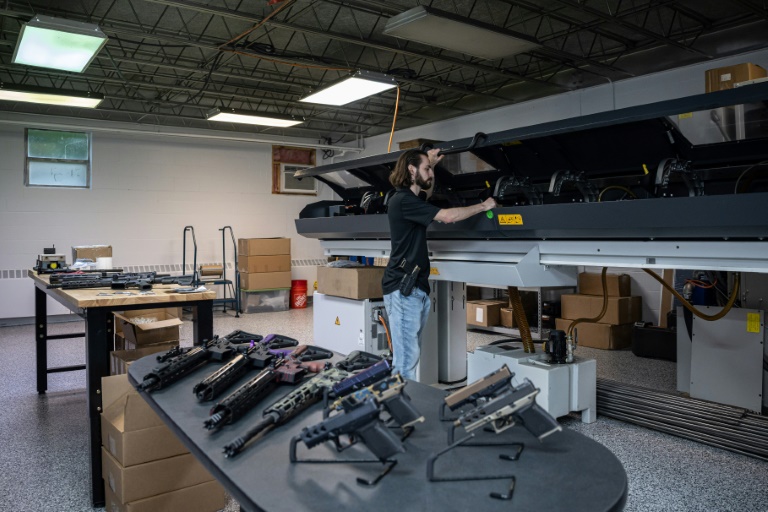
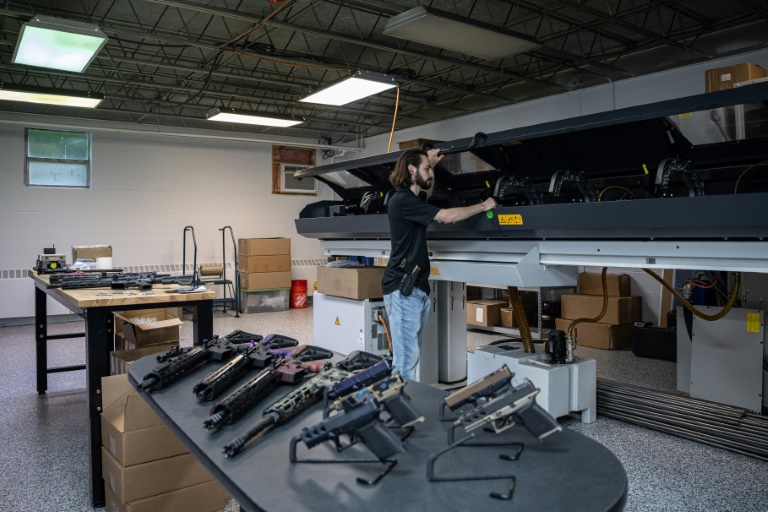
Matrix Arms in New Hampshire is one of those makers and its CEO and owner Allen Farris said so many manufacturers have joined the industry that the market has been saturated for at least the past six years now. 

– ‘People are the problem’ –

Yet his company appeared to be staying busy, with a row of machines the size of shipping containers churning out gun parts on a recent weekday. 

He noted that each week they produce 4,300-5,300 rifle receivers — key central components to making a gun.

“Our state motto in New Hampshire is ‘Live free or die’ and I think the firearm industry kind of goes hand in hand with that,” he added.

Hook and Farris emphasized they did not want their guns to be used in crime or mass murder and said they followed the law — with Hook also citing his own instinct, if a would-be buyer sets off alarm bells — to try to prevent that.

Inevitably, as the gun making industry has grown, more people face the risk the firearms they produce could be used in a crime, mass shooting or suicide.

“We don’t look at it as guns are the problem. People are the problem. Whether it’s a gun, a knife or a rock — Cain didn’t kill Abel with a gun. He killed him with a rock,” Hook said.

Farris added: “If somebody has the motivation to go out and try to kill people, first of all they could choose a million different ways.”

“Obviously I don’t want my guns being used in that way, but there’s nothing I can do to prevent it at that point.”

Small gun makers boom as US demand soars

Tony Hook flipped through cell phone pictures of finished work by his New Hampshire shop, explaining how one customer wanted mementos of major life events: a gun to mark each of his children’s births.

Smaller gun makers like him are booming in the United States, thanks to ravenous and sometimes specialized demand for pricey limited-production pistols and custom rifles, engraved with bible passages or the American flag.

“He had us build a gun for every newborn he had,” explained Hook, the owner of RTD Arms & Sport. “So this is his son’s name and his date of birth,” he said, showing the engraving on a rifle.

The millions of guns produced annually in the United States are primarily made by the nation’s biggest manufacturers, yet smaller operators have poured into a market that saw production nearly triple from 2000 to 2020.

The smaller makers can churn out parts destined for major firms like Sig Sauer or Smith & Wesson and for enthusiasts and gun shops, or they can be manufacturers themselves of specialized or customized weapons.

“It’s just like maybe stitching your name onto your baseball glove or having custom pinstriping put on your car,” said Hook. “People do the same with their guns. It’s a piece of them.” 

– $1,700 guns –

The United States has a deep culture of gun ownership centered around a constitutional guarantee for Americans to keep and bear arms, and as a result has a sprawling market of weapons, gear and accessories. 

America also sees roughly 40,000 gun deaths a year, about half of which are suicides, though homicides increased at historic rates during the pandemic. 

In this context, the gun and ammunition industry added an estimated $70 billion to the US economy in 2021 according to industry group NSSF — perhaps not surprising when a single rifle from a smaller workshop like Hook’s can sell between $1,295-$1,695.

“Seeing that the gun doesn’t have to look so generic, it’s attracting people in that never considered it before,” he added.

The boom in gun making is illuminated in US federal firearms license statistics, with the number of so-called “type 7” permits that allow production as well as sales increasing by over 694 percent from 2000 to 2020.

Getting one of those permits requires paperwork from applicants that includes their photo, fingerprints and other information, while the government also does a background check and in-person interview.

Big states like Texas and Florida each had hundreds of manufacturers of all sizes that reported, as required by law, their production to federal authorities for 2020, the most recent figures available. 

Matrix Arms in New Hampshire is one of those makers and its CEO and owner Allen Farris said so many manufacturers have joined the industry that the market has been saturated for at least the past six years now. 

– ‘People are the problem’ –

Yet his company appeared to be staying busy, with a row of machines the size of shipping containers churning out gun parts on a recent weekday. 

He noted that each week they produce 4,300-5,300 rifle receivers — key central components to making a gun.

“Our state motto in New Hampshire is ‘Live free or die’ and I think the firearm industry kind of goes hand in hand with that,” he added.

Hook and Farris emphasized they did not want their guns to be used in crime or mass murder and said they followed the law — with Hook also citing his own instinct, if a would-be buyer sets off alarm bells — to try to prevent that.

Inevitably, as the gun making industry has grown, more people face the risk the firearms they produce could be used in a crime, mass shooting or suicide.

“We don’t look at it as guns are the problem. People are the problem. Whether it’s a gun, a knife or a rock — Cain didn’t kill Abel with a gun. He killed him with a rock,” Hook said.

Farris added: “If somebody has the motivation to go out and try to kill people, first of all they could choose a million different ways.”

“Obviously I don’t want my guns being used in that way, but there’s nothing I can do to prevent it at that point.”

Close Bitnami banner
Bitnami