AFP

Polluted air cuts global life expectancy by two years

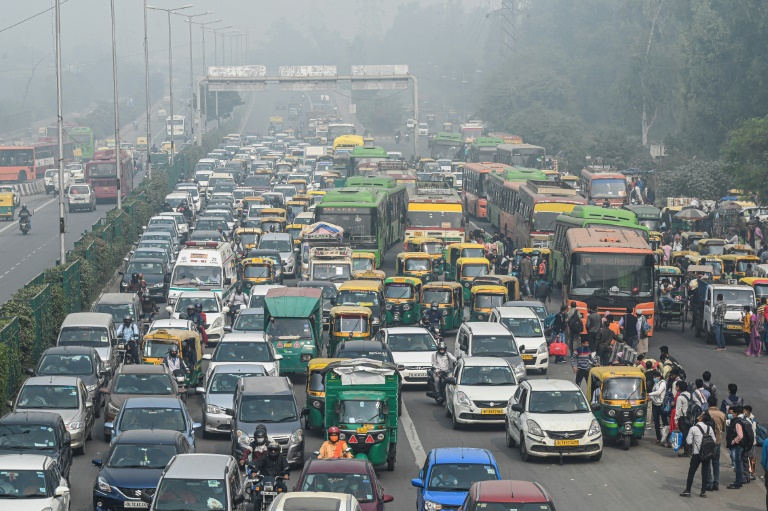
Microscopic air pollution caused mostly by burning fossil fuels shortens lives worldwide by more than two years, researchers reported Tuesday. 

Across South Asia, the average person would live five years longer if levels of fine particulate matter met World Health Organization standards, according to a report from the University of Chicago’s Energy Policy Institute.

In the Indian states of Uttar Pradesh and Bihar, home to 300 million, crippling lung and heart disease caused by so-called PM2.5 pollution reduces life expectancy by eight years, and in the capital city of New Delhi by a decade.

PM2.5 pollution — 2.5 microns across or less, roughly the diameter of a human hair — penetrates deep into the lungs and enters the bloodstream. 

In 2013, the United Nations classified it as a cancer-causing agent.

The WHO says PM2.5 density in the air should not top 15 microgrammes per cubic metre in any 24-hour period, or 5 mcg/m3 averaged across an entire year.

Faced with mounting evidence of damaging health impacts, the WHO tightened these standards last year, the first change since establishing air quality guidance in 2005.

“Clean air pays back in additional years of life for people across the world,” lead research Crista Hasenkopf and colleagues said in the Air Quality Life Index report.

“Permanently reducing global air pollution to meet the WHO’s guidelines would add 2.2 years onto average life expectancy.”

– Major gains in China –

Almost all populated regions in the world exceed WHO guidelines, but nowhere more so that in Asia: by 15-fold in Bangladesh, 10-fold in India, and nine-fold in Nepal and Pakistan.

Central and West Africa, along with much of Southeast Asia and parts of central America, also face pollution levels — and shortened lives — well above the global average.

Surprisingly, PM2.5 pollution in 2020, the most recent data available, was virtually unchanged from the year before despite a sharp slow-down in the global economy and a corresponding drop in CO2 emissions due to Covid lockdowns.

“In South Asia, pollution actually rose during the first year of the pandemic,” the authors noted.

One country that has seen major improvements is China.

PM2.5 pollution fell in the nation of 1.4 billion people by almost 40 percent between 2013 and 2020, adding two years to life expectancy. 

But even with this progress, lives in China are on average cut short today by 2.6 years.

The worst-hit provinces include Henan and Hebei, in north-central China, and the coastal province of Shandong.

Compared to other causes of premature death, the impact of PM2.5 pollution is comparable to smoking tobacco, more than three times that of alcohol use, and six times that of HIV/AIDS, the report said.
Famed Hong Kong floating restaurant towed away after half a century

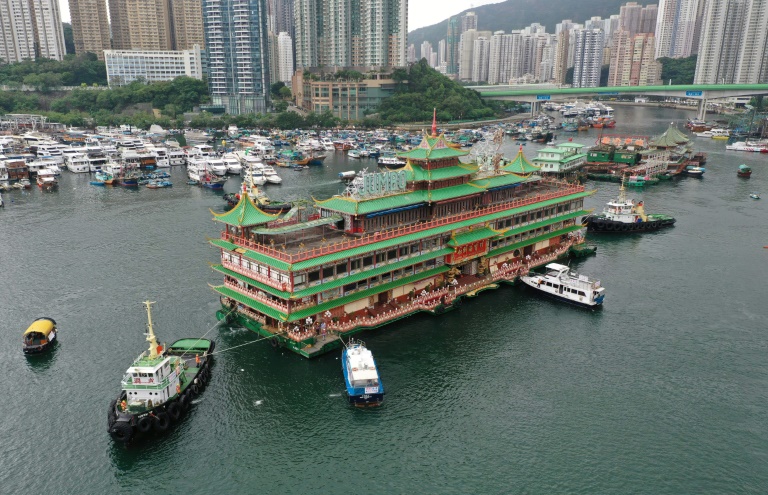
Hong Kong’s Jumbo Floating Restaurant, a famed but ageing tourist attraction that featured in multiple Cantonese and Hollywood films, was towed out of the city Tuesday after years of revitalisation efforts went nowhere.

The buoyant behemoth, which at 76 metres long could house 2,300 diners, set out shortly before noon from the southern Hong Kong Island typhoon shelter where it has sat for nearly half a century. 

Designed like a Chinese imperial palace and once considered a must-see landmark, the restaurant drew visitors from Queen Elizabeth II to Tom Cruise, and featured in several films — including Steven Soderbergh’s “Contagion”, about a deadly global pandemic.   

The lavish restaurant’s operators cited the Covid-19 pandemic as the reason for finally closing its doors in March 2020, after around a decade of financial woes. 

Restaurant owner Melco International Development announced last month that ahead of its licence expiration in June, Jumbo would leave Hong Kong and await a new operator at an undisclosed location.

Under overcast skies, a scattered group of onlookers gathered on the Aberdeen waterfront to see it be dragged away. 

Watching the restaurant’s ponderous progress across the shelter waters was Mr Wong, a 60-year-old man who told AFP he had come specially to see its departure. 

“The exterior was for many years a symbol of Hong Kong,” he said, adding he had eaten there once 20 years ago. 

“I believe it will come back and I look forward to it.”

Opened in 1976 by the late casino tycoon Stanley Ho, the Jumbo Floating Restaurant embodied the height of luxury, reportedly costing over HK$30 million ($3.8 million) to build. 

It featured a “dragon throne” in the style of the Ming dynasty as well as an opulent mural, according to the South China Morning Post.

The restaurant’s berth in Aberdeen harbour was traditionally a hotspot for seafood eateries — and fierce competition for customers only cooled when Jumbo’s operators acquired its biggest competitor, Tai Pak Floating Restaurant, in the 1980s.

The restaurant was kept afloat by Hong Kong’s booming tourism industry but its popularity had dimmed in recent years even before the coronavirus hit.

Restaurant operator Melco said last month the business had not been profitable since 2013 and cumulative losses had exceeded HK$100 million ($12.7 million).

It was still costing millions in maintenance fees every year and around a dozen businesses and organisations had declined an invitation to take it over at no charge, Melco added. 

In her 2020 policy address, Hong Kong leader Carrie Lam announced plans to turn the restaurant over to local theme park Ocean Park for revitalisation, but the project fell through after the park said it could not find a suitable operator.

The ailing restaurant’s fate was sealed just days before Lam is set to leave office. 

In a sign of its dilapidation, on June 1, Jumbo’s kitchen boat listed into the water after a suspected hull breach, tilting almost 90 degrees. 

The derelict kitchen boat will be left behind, according to local media. 

Families of overdose victims demand action from social media platforms

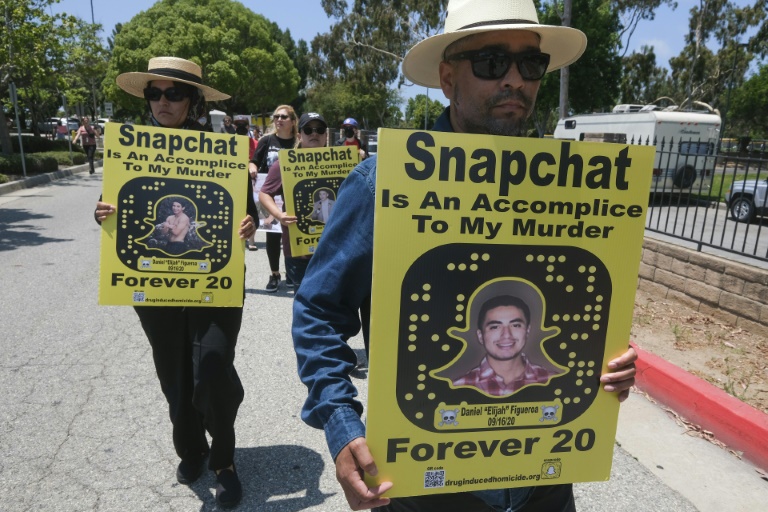
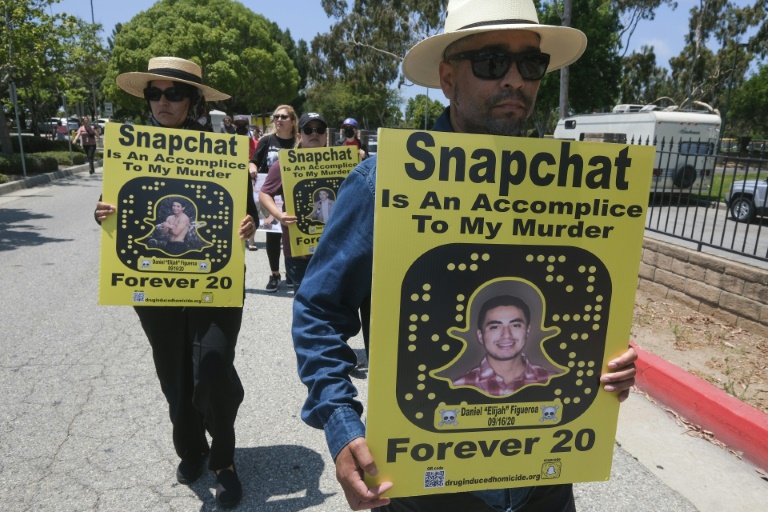
Families of teens who died after overdosing on drugs they bought through Snapchat and other social media platforms called Monday for tech firms to do more to address the problem.

Sam Chapman, part of a group that staged a protest Monday in front of Snapchat’s Santa Monica headquarters, told AFP his son died in February 2021 after a pill he purchased through the platform was laced with the extremely powerful opioid fentanyl.

“I’m here today to warn people about the dangers of social media, delivering drugs and other criminal acts into the lives of our families, through our children,” said Chapman, 57.

His son Sammy would have celebrated his 18th birthday last weekend.

Chapman described the horrific scene of finding his son dead on the floor in his bedroom, in what he said was called the “fentanyl death pose.”

“He had stopped breathing and fell backwards in his chair and vomited, and he choked on his own vomit… It’s a very common way of going,” said Chapman.

Of the 107,000 overdose deaths recorded last year in the United States, 70 percent were caused by “fentanyl poisoning,” which is now the leading cause of death for Americans aged 18 to 45, according to the groups backing Monday’s protest.

Chapman said a drug dealer had contacted his son on Snapchat, and sent him a “colorful drug menu with pictures.”

“At the bottom it said that he delivered. And so he connected with our son and delivered the drugs to our home after we were asleep, like it was a pizza,” he added.

Like the other victims’ family members, Chapman is calling on Snapchat and other social media platforms geared toward young people to take stronger action against drug sales.

“We have been working tirelessly to help combat this national crisis by eradicating illicit drug dealers from our platform,” a Snapchat spokesperson told AFP.

“We use advanced technology to proactively detect and shut down drug dealers who try to abuse our platform, and block search results for dangerous drug-related content,” the representative added.

But Chapman said the tools currently in place do not work because dealers use emojis and code words that aren’t blocked.

The group Victims of Illicit Drugs (VOID) is demanding US law to be updated so that social networks are held liable for what happens to their users on their platforms.

“If you’re walking in a grocery store, you slip and fall, you can sue them,” said VOID president Jaime Puerta.

“The law was written in 1996,” he added.

“The legislators had no idea of where the internet would be today.”

Families of overdose victims demand action from social media platforms

Families of teens who died after overdosing on drugs they bought through Snapchat and other social media platforms called Monday for tech firms to do more to address the problem.

Sam Chapman, part of a group that staged a protest Monday in front of Snapchat’s Santa Monica headquarters, told AFP his son died in February 2021 after a pill he purchased through the platform was laced with the extremely powerful opioid fentanyl.

“I’m here today to warn people about the dangers of social media, delivering drugs and other criminal acts into the lives of our families, through our children,” said Chapman, 57.

His son Sammy would have celebrated his 18th birthday last weekend.

Chapman described the horrific scene of finding his son dead on the floor in his bedroom, in what he said was called the “fentanyl death pose.”

“He had stopped breathing and fell backwards in his chair and vomited, and he choked on his own vomit… It’s a very common way of going,” said Chapman.

Of the 107,000 overdose deaths recorded last year in the United States, 70 percent were caused by “fentanyl poisoning,” which is now the leading cause of death for Americans aged 18 to 45, according to the groups backing Monday’s protest.

Chapman said a drug dealer had contacted his son on Snapchat, and sent him a “colorful drug menu with pictures.”

“At the bottom it said that he delivered. And so he connected with our son and delivered the drugs to our home after we were asleep, like it was a pizza,” he added.

Like the other victims’ family members, Chapman is calling on Snapchat and other social media platforms geared toward young people to take stronger action against drug sales.

“We have been working tirelessly to help combat this national crisis by eradicating illicit drug dealers from our platform,” a Snapchat spokesperson told AFP.

“We use advanced technology to proactively detect and shut down drug dealers who try to abuse our platform, and block search results for dangerous drug-related content,” the representative added.

But Chapman said the tools currently in place do not work because dealers use emojis and code words that aren’t blocked.

The group Victims of Illicit Drugs (VOID) is demanding US law to be updated so that social networks are held liable for what happens to their users on their platforms.

“If you’re walking in a grocery store, you slip and fall, you can sue them,” said VOID president Jaime Puerta.

“The law was written in 1996,” he added.

“The legislators had no idea of where the internet would be today.”

Top US, Chinese national security figures hold 'candid' talks

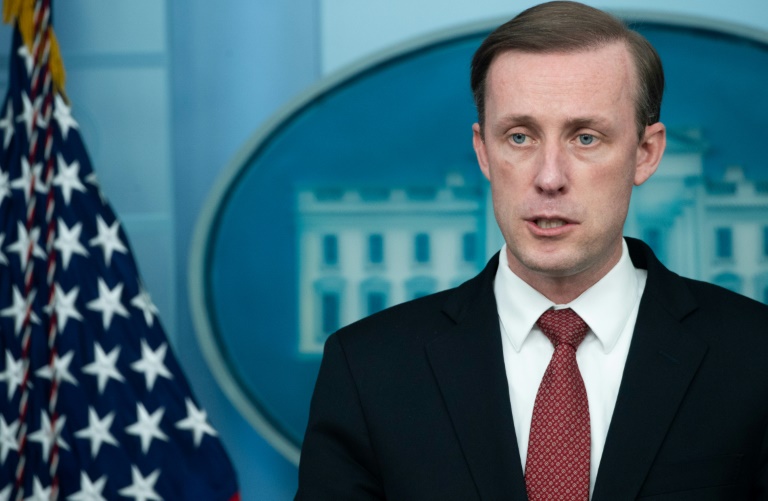
The top Chinese and US security advisers have held lengthy talks, with both sides describing them as “candid” following days of acrimonious exchanges over Taiwan and other flashpoint issues.

Readouts of the meeting in Luxembourg on Monday were toned down compared with last week, when China’s defence minister warned his country would not “hesitate to start a war” over Taiwan, while the US defense secretary blasted Beijing’s “provocative, destabilising” military activity.

But US security advisor Jake Sullivan and top diplomat Yang Jiechi did not indicate any compromise on their core points of disagreement, especially Taiwan. China considers the self-ruled island a part of its territory, to be seized by force one day if necessary.

“The Taiwan question concerns the political foundation of China-US relations which, unless handled properly, will have a subversive impact,” Yang was quoted as saying by China’s official Xinhua news agency.

“The United States should not have any misjudgements or illusions (about Taiwan).”

A senior White House official said Sullivan reiterated the US policy of recognising Chinese sovereignty but expressed “concerns about Beijing’s coercive and aggressive actions across the Taiwan Strait”.

Tensions over Taiwan have escalated in recent months due to increasing Chinese military aircraft incursions into the island’s air defence identification zone (ADIZ).

US President Joe Biden, during a visit to Japan last month, appeared to break decades of US policy when, in response to a question, he said Washington would defend Taiwan militarily if it was attacked by China.

The White House has since insisted its policy of “strategic ambiguity” over whether or not it would intervene had not changed.

The Sullivan-Yang meeting, which followed up on a May 18 phone call, lasted about four and a half hours, the White House official told reporters.

Xinhua said the talks were “candid, in-depth, and constructive” while the White House statement described them as “candid, substantive, and productive”.

– Red lines –

The US-China relationship has deteriorated in recent years, with the two powers locking horns on several issues, from international trade and security to human rights in China and — most recently — the Russian invasion of Ukraine.

On Monday, Sullivan “underscored the importance of keeping open lines of communication to manage competition between our two countries”, according to the White House.

Yang also agreed on maintaining dialogue, Xinhua said, but made clear that Beijing was not going to shift its red lines.

“For some time… the US side has been insisting on further containing and suppressing China in an all-round way,” he said, according to Xinhua.

But “China firmly opposes using competition to define bilateral ties.”

The Xinhua readout said Yang “also stated China’s solemn position on issues concerning Xinjiang, Hong Kong, Tibet, the South China Sea, as well as human rights and religion”.

China’s treatment of Tibetans, Uyghurs in Xinjiang and the ongoing crackdown on dissent in Hong Kong have faced growing international condemnation.

But Beijing has bristled at any criticism, saying it will not tolerate interference in its internal affairs.

It has also faced a growing chorus of warnings from the United States and Western allies over its naval ambitions in the South China Sea, which it claims almost entirely.

There are competing claims from the Philippines, Brunei, Malaysia, Taiwan and Vietnam.

US-China relations entered tense new territory under the previous president Donald Trump, who triggered a trade war in response to what he described as China’s abusive trade practices.

Biden has said he is considering lifting some tariffs in an attempt to defuse roaring inflation at home.

Zelensky pleads for arms as Russian forces lay siege to Severodonetsk

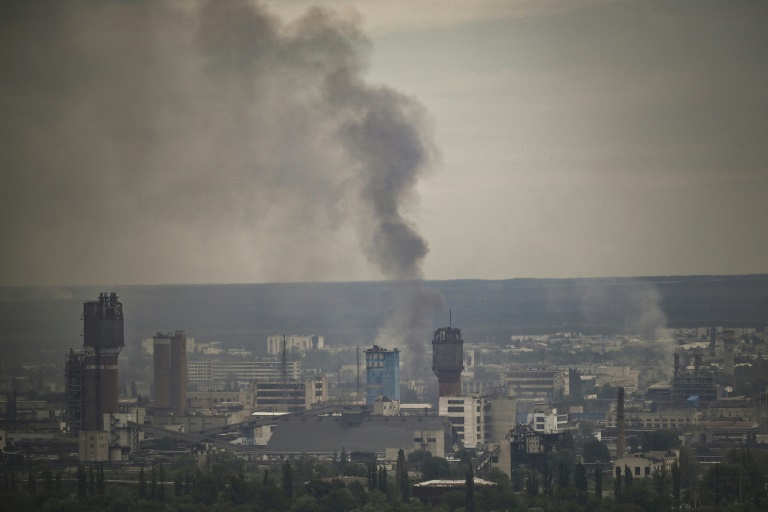
Ukraine’s president has made an impassioned plea to Western allies to speed arms deliveries and help stem “terrifying” casualties as Russian forces lay siege to the eastern city of Severodonetsk, destroying the last bridges into the industrial hub.

The cities of Severodonetsk and Lysychansk have been targeted for weeks as the last areas in the eastern Donbas region of Lugansk still under Ukrainian control.

President Volodymyr Zelensky said Monday the human cost of the battle for the region was “simply terrifying”. 

Zelensky expressed confidence in Ukraine’s ability to reclaim territory, calling on the nation’s allies to send more weapons.

“We just need enough weapons to ensure all of this. Our partners have them.”

Presidential advisor Mikhaylo Podolyak on Monday listed items he said the Ukrainian army requires, including hundreds of howitzers, tanks and armoured vehicles.

“Being straightforward — to end the war we need heavy weapons,” he tweeted.

– Severodonetsk under siege –

Regional governor Sergiy Gaiday said Monday that Ukraine’s forces had been pushed back from Severodonetsk’s centre after a weeks-long Russian offensive.

“They destroyed all the bridges, and getting into the city is no longer possible. Evacuation is also not possible,” he told Radio Free Europe.

He said Russian forces control 70 to 80 percent of the city but had not captured or encircled it.

Last week, Ukraine’s defence minister said up to 100 of his troops were dying daily and 500 sustaining injuries. Previously, Zelensky had estimated 60-100 Ukrainian soldiers were dying daily. 

With the screws tightening on the Lugansk region, Ukrainian forces have two choices: “to surrender or die”, said Eduard Basurin, a representative for pro-Russian separatists.

The capture of Severodonetsk would open the road to Sloviansk and another major city, Kramatorsk, in Moscow’s push to conquer Donbas, a mainly Russian-speaking region partly held by pro-Kremlin separatists since 2014.

– ‘War crimes’ –

On Monday, Amnesty International accused Russia of war crimes in Ukraine, saying that attacks on the northeastern city of Kharkiv — many using banned cluster bombs — had killed hundreds of civilians. 

“The repeated bombardments of residential neighbourhoods in Kharkiv are indiscriminate attacks which killed and injured hundreds of civilians, and as such constitute war crimes,” the rights group said in a report about Ukraine’s second-biggest city.

In Bucha, a town near Kyiv that has become synonymous with war crimes allegations, police said they had discovered another seven bodies in a grave.

“Several victims had their hands tied and knees bound,” Kyiv regional police chief Andriy Nebytov said on Facebook.

Dozens of bodies in civilian clothing were found in the town in April after Russian troops withdrew from the area following a month-long occupation.

– ‘They bomb and they bomb’ –

Elsewhere in northern Ukraine on Monday, Russian rocket strikes hit the town of Pryluky, authorities said.

Pryluky, which lies about 150 kilometres (93 miles) east of the capital, is home to a military airfield.

In Donetsk, separatist authorities said three people were killed and four wounded in Ukrainian shelling on a market.

The nearby city of Lysychansk has been massively damaged after months of shelling, with no water, electricity or phone signal.

Ukrainian artillery uses the city’s high ground to exchange fire with Russian forces fighting for control of Severodonetsk, just across the river.

Lysychansk resident Maksym Katerin buried his mother and stepfather in his garden Monday after a shell ripped through his yard, killing them instantly.  

“I don’t know who did this, but if I knew, I would tear off their arms,” said Katerin.

Katerin’s neighbour Yevgeniya Panicheva wept, saying Katerin’s mother “was lying here, her stomach was ripped and her guts were falling out. She was a very good, kind and helpful woman. Why did they do this to her?”

“They bomb and they bomb and we don’t know what to do.”

A six-year-old boy was also killed in the city on Sunday, police told AFP.

– Harvest delayed –

Far from the battlefield, World Trade Organization members gathered in Geneva to address the threat to global food security since Russia’s invasion.

Ukraine’s deputy agriculture minister said on Monday that a quarter of his country’s arable land had been lost but insisted national food security was not threatened.

On a farm near the southern Ukrainian city Mykolaiv, the harvest has been delayed by the need to undo damage by Russian troops who passed through the area in March.

“We planted really late because we needed to clear everything beforehand,” including bombshells, Nadiia Ivanova, 42, told AFP.

The farm’s warehouses currently hold 2,000 tonnes of last season’s grain but there are no takers.

burs-sea/imm/dva/lb

Asian stocks sink again as inflation panic grips world markets

Equity markets tumbled again Tuesday to extend a global rout fuelled by fears of recession, with the Federal Reserve preparing to ramp up interest rates as inflation shows no sign of slowing.

Panic has swept through trading floors since data on Friday showed US consumer prices rising at their fastest pace in a generation owing to a spike in energy and food costs caused by the Ukraine war, China’s lockdowns and supply chain snarls.

The pain has been felt across all assets, with bitcoin threatening to fall below $20,000 for the first time since December 2020, currencies retreating against the dollar, and even safe-haven plays including the yen and gold feeling the squeeze.

Investors are now laser-focused on Wednesday’s Fed interest rate decision as it struggles to walk a fine line between reining in inflation and trying to keep the economy on track.

Danielle DiMartino Booth, at Quill Intelligence, said: “While tightening into a recession is no easy task, the Federal Reserve must indicate a willingness to raise interest rates by more than a half-percentage point at upcoming meetings if inflation continues to surprise to the upside.”

But JP Morgan Asset Management’s warned: “While there is no doubt that inflation is a considerable challenge for the US at this point, slamming on the brakes too hard risks pushing the economy off its track.”

Before Friday’s news, expectations had been for a 50-point basis hike and a signal that more of the same was to come at the next few meetings. But now analysts say there is a one-in-three chance officials could announce a three-quarter point increase, with some even predicting a one percentage point hike.

That has ramped up fears that the world’s top economy is heading for a recession, and on Monday Wall Street plunged with the broad-based S&P 500 sinking into a bear market after dropping more than 20 percent from its recent peak.

And the selling continued in Asia, with Sydney tanking five percent at one point as it reopened after a holiday weekend to catch up with Monday’s drama, while Tokyo was off around two percent and Wellington more than three percent.

Hong Kong, Shanghai, Seoul, Singapore, Taipei and Manila were also deep in the red.

Commentators warned that the Fed was in a tough place on what to do Wednesday. A decision to lift rates more than 0.50 percentage points could signal its determination to finally defeat inflation but also hit its credibility as it confuses officials’ signals to traders.

“Once the Fed starts moving in 75s it would be hard to stop, and the combination of this and the Fed’s outcome-based approach to inflation feels like it could be a recipe for recession,” said Evercore ISI’s Krishna Guha and Peter Williams.

Bets on a more aggressive approach have sent the dollar spiralling higher against other currencies, hitting a 24-year high Monday against the yen and a record peak on the Indian rupee. 

Both units have clawed back some of the losses but remain under severe pressure, while the euro is in danger of hitting a two-decade low. The pound is at its weakest level in two years.

And bitcoin remains in the firing line, hitting $20,823 for the first time since December 2020, with selling compounded by news that crypto lending platform Celsius Network had paused withdrawals owing to volatile conditions. The announcement raised worries about a possible contagion for other firms.

– Key figures at around 0250 GMT –

Tokyo – Nikkei 225: DOWN 2.0 percent at 26,446.82 (break)

Hong Kong – Hang Seng Index: DOWN 0.7 percent at 20,926.15

Shanghai – Composite: DOWN 0.5 percent at 3237.98

Dollar/yen: DOWN at 134.40 yen from 134.42 yen late Monday

Euro/dollar: DOWN at $1.0408 from $1.0412

Pound/dollar: UP at $1.2142 from $1.2136

Euro/pound: DOWN at 85.71 pence from 85.76 pence

Brent North Sea crude: UP 0.2 percent at $122.45 per barrel

West Texas Intermediate: UP 0.2 percent at $121.13 per barrel

New York – Dow: DOWN 2.8 percent at 30,516.74 (close)

London – FTSE 100: DOWN 1.5 percent at 7,205.81 (close)

— Bloomberg News contributed to this story —

Keeping China fed as inflation surges brings risk for commodity prices

Bedevilled by high fuel and fertiliser costs, along with a labour crisis driven by Covid-19 restrictions, China risks a smaller autumn harvest that could supercharge demand for commodities just as the world can afford it least.

Global food prices have spiked since Russia’s February invasion of Ukraine, a major world producer of wheat, corn and sunflower oil, driving costs to record highs.

Moscow stands accused of pushing the globe to the brink of catastrophe by blockading Ukrainian ports and seizing commodity stocks, driving up prices and leaving the world’s poorest nations facing hunger.

China is relatively self-reliant, producing more than 95 percent of its needs in rice, wheat and maize.

But relentless Covid disruptions — caused by restrictions on the movement of goods and farm workers — on top of higher fertiliser and fuel costs and issues with access to equipment, threaten the autumn harvest of key crops such as soybean and corn.

Experts caution even a small rise in demand from the world’s most populous nation could drive global commodity costs up sharply.

“The last thing the global market needs right now is for China to become a more active buyer,” said Even Pay, an agriculture analyst with consultancy Trivium China.

Corn prices hit a nine-year high in April, while soybean prices traded near a 10-year high this month.

China is the last major economy to adhere to a zero-Covid policy.

How that manifests itself in the next harvest is uncertain, but Pay said “last-mile logistics” have been complicated by virus restrictions in rural areas afraid of the spread of the disease.

“Villages have been very resistant to letting outsiders in during Covid-control periods,” she added.

If China ends up going to the global market to fill any shortfall, there will be “a big impact” on prices, said Darin Friedrichs, co-founder of agriculture research firm Sitonia Consulting.

– Seeds of doubt –

For now, Beijing is keeping a close eye on the country’s wheat harvest.

At a meeting last month, Premier Li Keqiang said a strong summer harvest with manageable prices depended in part on “unimpeded” access of workers and machines to wheat-growing provinces from eastern Anhui to northern Shanxi.

China has harvested about 80 percent of its winter wheat crop so far, according to state media, although Friedrichs cautioned that prices are 25 percent higher than last year, at about 3,000 yuan ($450) per tonne.

While a decent wheat harvest is good news to world markets, “Covid-related disruptions haven’t gone away”, according to Pay, who added that prices of fertilisers and fuels were riding high.

China has “massively ramped up its wheat, corn, barley purchases” in recent years, from below 20 million tonnes a year around four years ago to some 50 million tonnes now, according to Andrew Whitelaw, an analyst at Thomas Elder Markets.

But global inflation and uncertainty will make it expensive for China to import more.

Already, China has bought newly harvested wheat for its reserves at sky-high prices this month.

The political dimension of feeding China’s vast population has not been lost on Beijing.

President Xi Jinping has said China should make “unrelenting efforts to ensure grain security”, state media reported.

The issue has grown in importance since 2020, when the coronavirus spread worldwide, said Friedrichs.

“There were worries about global disruptions to supply chains, and now we have the global food crisis — that’s redoubled focus on food security,” he said.

Trump became 'detached from reality,' says ex-justice chief

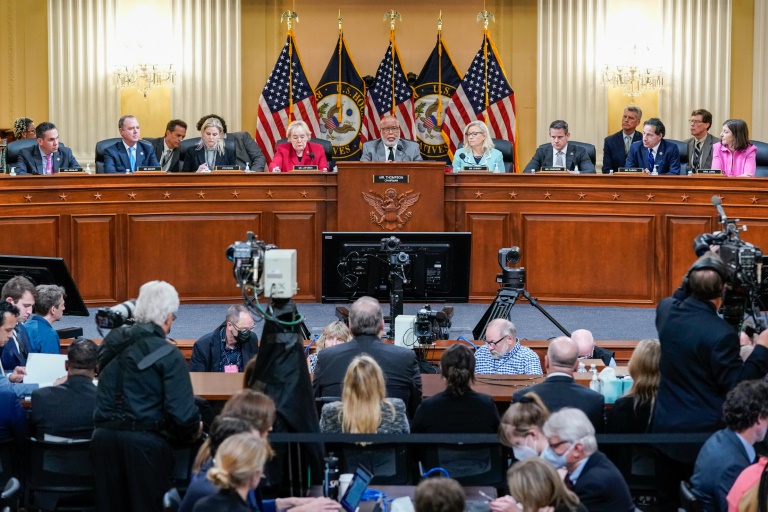
Donald Trump deluged aides with wild voter fraud conspiracy theories after losing the 2020 US election, his top law-enforcement official said in testimony revealed Monday by a congressional probe which the ex-president branded a “mockery of justice.”

Appearing in a pre-recorded deposition at a congressional hearing into the 2021 assault on the US Capitol, former attorney general Bill Barr described his then-boss as having no interest in the facts that debunked his groundless narrative.

“I was demoralized because I thought, boy… he’s become detached from reality if he really believes this stuff,” Barr told the House committee investigating the January 6 insurrection by supporters of Trump.

“When I went into this and would tell him how crazy some of these allegations were, there was never an indication of interest in the actual facts,” said Barr, who likened addressing Trump’s avalanche of false allegations with playing the game “whack-a-mole.”

The panel is holding six hearings throughout June to outline its case that the riot at the seat of US democracy in Washington was the culmination of a seven-step conspiracy by Trump and his inner circle to overturn his defeat to Joe Biden.

Trump ignored repeated warnings from top aides against falsely claiming the November 2020 election was stolen, according to testimony unveiled by the panel.

“We will tell the story of how Donald Trump lost the election — and knew he lost the election — and as a result of his loss, decided to wage an attack on our democracy,” the committee’s Democratic chairman Bennie Thompson said in his opening remarks.

Trump released his first extended reaction to the probe Monday evening, with a rambling 12-page statement in which he called the panel a “mockery of justice” and a “Kangaroo Court hoping to distract the American people from the great pain they are experiencing.”

The second of six planned hearings was shown videotaped accounts from the former president’s advisors, including Barr and campaign manager Bill Stepien, saying they repeatedly counseled him not to declare victory on election night because he hadn’t won — but that Trump went ahead anyway.

“He thought I was wrong, he told me so, and that they were going to go in a different direction,” Stepien said.

– ‘Far flung conspiracies’ –

Thompson’s deputy on the panel, Republican lawmaker Liz Cheney, said Trump chose to listen to the advice of “apparently inebriated” former New York mayor Rudy Giuliani “to just claim he won, and insist that the vote counting stop — to falsely claim everything was fraudulent.”

Trump started pushing what came to be known as his “Big Lie” around 2:30 am on November 4, 2020, prematurely declaring victory on the night of an election he ultimately lost to Biden by seven million votes.

Barr said in his testimony that Trump claimed major fraud “right out of the box on election night… before there was actually any potential of looking at evidence.”

Giuliani and associates including the lawyer Sidney Powell would go on to push debunked theories of massive voter fraud that put them at odds with the White House lawyers Stepien referred to as “Team Normal.”

Cheney highlighted “far-flung conspiracies” — dismissed as “nonsense” by Barr — of fraud involving voting machines “with a deceased Venezuelan Communist allegedly pulling the strings.”

Trump repeated a number of unfounded claims in his statement late Monday.

“Democrats created the narrative of January 6th to detract from the much larger and more important truth that the 2020 Election was Rigged and Stolen,” he said.

– ‘Big rip-off’ –

The committee says the initial claim of fraud grew quickly into a conspiracy to cling to power by Trump and his inner circle — and a fundraising campaign that raised $250 million between election night and the Capitol insurrection.

The committee’s senior investigative counsel Amanda Wick said much of the cash was funneled into a political action committee that made donations to pro-Trump organizations.

“As early as April 2020, Mr Trump claimed that the only way he could lose an election would be as a result of fraud,” Democratic panel member Zoe Lofgren said.

“The big lie was also a big rip-off,” she said, promising to show how the Trump campaign raised hundreds of millions of dollars from supporters who were falsely led to believe their donations would be used for the legal fight over fraud claims.

All but one of the 62 lawsuits filed by the Trump campaign were dismissed — the vast majority by Republican-appointed judges — while the one that was upheld didn’t affect the outcome.

Powell filed four federal lawsuits in staunchly Democratic cities that were all rejected as frivolous and, in Detroit, a judge ordered that she face sanctions for a “historic and profound abuse of the judicial process.”

The panel ended the hearing by returning to the Capitol riot, showing footage of mob participants explaining how Trump’s voter fraud claims had motivated their actions.

“I know exactly what’s going on right now. Fake election,” one said.

VW faces Brazil hearing over dictatorship-era slavery claims

German carmaker Volkswagen faces an audience with Brazilian prosecutors Tuesday over allegations of human-rights violations at a farm it ran during Brazil’s military dictatorship, including slave labor, rapes and beatings.

Prosecutors have assembled a 90-page dossier they say documents years of atrocities committed by Volkswagen managers and hired guns at a cattle ranch the company owned in the Amazon rainforest basin in the 1970s and 80s.

In the latest attempt to bring justice for abuses committed under Brazil’s 1964-1985 military regime, the federal prosecutor’s office for labor affairs summoned VW representatives to a hearing in Brasilia to answer for evidence of abuses including torture and killings at the property in the northern state of Para, known as Fazenda Vale do Rio Cristalino.

“There were grave and systematic violations of human rights, and Volkswagen is directly responsible,” lead prosecutor Rafael Garcia told AFP.

The audience will be an initial contact “to see if it’s possible to reach a settlement” without opening criminal proceedings, he said.

Volkswagen has declined to comment on specifics of the case, saying it first needs “clarity on all the allegations.”

But the company is “committed to contributing very seriously to the investigations,” a spokeswoman for Volkswagen Brasil told AFP by email.

In 2020, Volkswagen agreed to pay 36 million reais ($6.4 million at the time) in compensation for collaborating with Brazil’s secret police during the dictatorship to identify suspected leftist opponents and union leaders at its local operation, who were then detained and tortured.

– Crusading priest –

That settlement caught the eye of Ricardo Rezende, a Catholic priest who spent years compiling evidence of abuses at Volkswagen’s farm after moving to Para in 1977 and hearing what he says were horrifying stories from victims.

Rezende wondered if the company could also be held to account for that case, and decided to share his files with prosecutors, he told AFP.

“You can’t fix someone suffering torture by paying reparations. The suffering of the women whose sons and husbands went to the farm and never came back — there’s no reparation for that pain,” said the priest, now 70.

“But there could be a symbolic reparation. I think it’s necessary.”

Rezende’s hundreds of pages of testimony and other documents convinced prosecutors to launch a task force, which spent three years assembling evidence — boiled down to the dossier they will now present to VW.

In it, victims tell investigators of being lured to the 70,000-hectare (173,000-acre) farm with false promises of lucrative jobs, then forced to cut down the jungle under grueling conditions for Volkswagen’s cattle ranch, which became the biggest in Para for a time.

Workers were kept in “debt-slavery” by being forced to buy food and supplies from the farm at exorbitant prices, prosecutors said.

Those who tried to escape were beaten, tied to trees and left for days by armed guards who kept violent watch over the workforce, they said.

In one case, three witnesses said gunmen kidnapped a worker’s wife and raped her as punishment after he tried to escape.

“There were extremely grave abuses,” said Rezende, who estimates hundreds and probably thousands of workers were essentially enslaved from 1974 to 1986.

– VW in the jungle? –

What was a German automaker doing raising cattle in the Brazilian Amazon in the first place?

The story is a window on how the military regime saw the Amazon, and helps explain why the world’s biggest rainforest is threatened today.

It was a time when Brazil was urgently pushing to develop the rainforest, which the regime saw as backwards, luring settlers with promised riches and the slogan: “Land without men for men without land.”

The government also lured companies. Volkswagen benefited from tax exemptions and negative-interest loans for cutting down the forest to develop a farm, not to mention close ties with the regime, Rezende said.

“On the one hand, Volkswagen loved the dictatorship. On the other, it was a highly profitable business,” he said.

“It could have 6,000 people working almost for free.”

Authorities say such practices were widespread in the Amazon region, even after the dictatorship.

Holding other companies to account would depend on gathering sufficient evidence, Garcia said.

Close Bitnami banner
Bitnami