AFP

Stocks extend losses as ECB eyes multiple rate hikes

Stock markets moved deeper into the red on Thursday after the European Central Bank said it was planning a series of rate hikes from next month to tame runaway inflation in the single currency area.

The ECB said after its policy meeting that it would raise interest rates for the first time in over a decade in July, bringing the curtain down on the eurozone’s era of cheap money.

While the announcement had been widely anticipated, stock prices in Frankfurt, London and Paris — which had been weaker all morning — extended their losses and yields on eurozone countries’ sovereign bonds moved higher.

“Inflation expectations are higher than anticipated, which is worrying the markets and explains the rise in long-term rates,” said Guillaume Truttmann, bond trader at Meeschaert Amilton.

Over on the other side of the Atlantic, Wall Street also opened lower. 

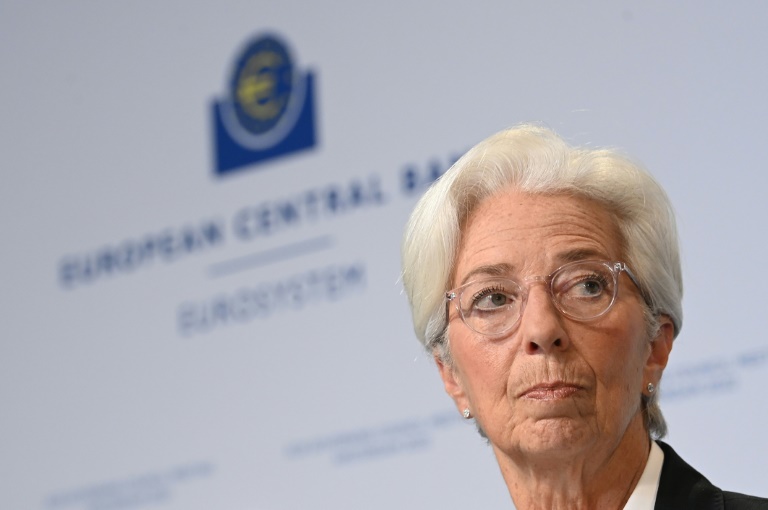
After refusing to act while other central banks around the world already started tightening monetary policy, ECB chief Christine Lagarde cautioned that the first quarter-point rate hike in July was not expected to have an immediate effect on inflation.

As a first step, the ECB said it would end its massive bond-buying stimulus as of July 1.

The central bank also sharply upgraded its inflation forecasts for this year and next year while lowering the economic growth outlook.

But for Clemens Fuest, head of the Ifo economic think tank in Munich, the move comes too late. 

“It is the right step, but it comes too late,” he said. “It was not acceptable that, with an inflation rate of eight percent, the ECB stuck to negative interest rates and asset purchases.” 

In foreign exchange, the euro softened against the dollar and pound.

Inflation around the world has reached the highest levels in decades, fuelled largely by soaring oil and gas prices.

Energy demand has surged as economies emerge from pandemic lockdowns, while supplies have been hit by the invasion of Ukraine by major producer Russia.

Oil prices fell slightly on Thursday.

– ‘Gloomy summer’ –

Traders were also awaiting US inflation data due Friday.

Analysts expect the Federal Reserve to stick to its hawkish path and hike US interest rates by half a point for at least three more meetings this year as it tries to bring down American consumer prices.

“Until we reach peak inflation, which will trigger a less hawkish Fed and lower recession odds, it could be a gloomy summer for global stock pickers,” forecast SPI Asset Management’s Stephen Innes. 

There was fresh uncertainty over the economic outlook in China as Covid fears linger over the world’s second-biggest economy.

While data showed China’s exports rebounded strongly in May, with factories restarting and supply chains untangling as Shanghai slowly emerged from a gruelling lockdown, the metropolis will Saturday shut a district of 2.7 million people for mass coronavirus testing.

“There are lingering concerns that China’s brisk recovery could be a false dawn given that the zero-Covid strategy is staying firmly in place and that could mean rolling lockdowns will continue,” noted Hargreaves Lansdown analyst Susannah Streeter.

– Key figures at around 1340 GMT –

London – FTSE 100: DOWN 1.1 percent at 7,506.85 points

Frankfurt – DAX: DOWN 1.6 percent at 14,210.49

Paris – CAC 40: DOWN 1.5 percent at 6,351.45

EURO STOXX 50: DOWN 1.7 percent at 3,724.65

New York – Dow: DOWN 0.3 percent at 32,806.43

Tokyo – Nikkei 225: FLAT at 28,246.53 (close)

Hong Kong – Hang Seng Index: DOWN 0.7 percent at 21,869.05 (close)

Shanghai – Composite: DOWN 0.8 percent at 3,238.95 (close)

Brent North Sea crude: DOWN 0.5 percent at $122.94 per barrel

West Texas Intermediate: DOWN 0.8 percent at $121.11 per barrel

Dollar/yen: DOWN at 133.70 yen from 134.29 yen late Wednesday

Euro/dollar: DONW at $1.0698 from $1.0720 

Pound/dollar: UP at $1.2548 from $1.2535

Euro/pound: DOWN at 85.24 pence from 85.54 pence

burs/spm/lth
Rocketing petrol prices fuel British PM's woes

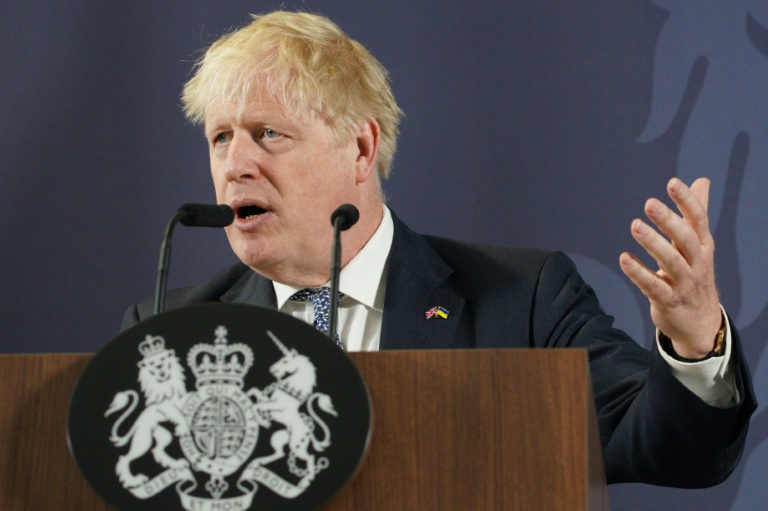
Prime Minister Boris Johnson on Thursday sought to reset his embattled leadership with vows to tackle Britain’s cost-of-living crisis, including contentious new measures to boost home ownership.

After narrowly surviving a no-confidence vote among his own Conservative MPs on Monday, Johnson is under pressure to turn the page on a series of scandals including lockdown-breaching parties in Downing Street.

In a speech in Blackpool, northwest England, he promised new reforms “to help people cut costs in every area of household expenditure — from food to energy to childcare to transport and housing”. 

“This government is on the side of the British public in coping with those pressures,” Johnson insisted.  

The scale of the inflationary crisis hitting millions of Britons was underlined as the price of filling up the average family car topped £100 ($125) for the first time, according to the RAC motoring group.

RAC spokesman Simon Williams called it “a truly dark day” for hard-pressed drivers, and urged the government to slash sales tax on petrol and diesel.

Johnson said much of the crisis was caused by factors beyond the government’s control, such as the impact of the Covid pandemic and the war in Ukraine.

But with two difficult by-elections coming up this month, unhappy Tory MPs want bolder measures including tax cuts after 40 percent of them voted against Johnson on Monday.

The Organisation for Economic Co-operation and Development (OECD) has warned that Britain must cut taxes or raise spending, forecasting it will suffer the developed world’s weakest economic growth next year.

Johnson did not promise any such cuts in Blackpool, although he and his finance minister Rishi Sunak are working on another tax-focussed speech for the coming days. 

Johnson did warn against a “wage-price spiral” by workers, and signalled no compromise with Britain’s biggest rail union, which is planning to shut down the train network this month to press wage demands.

– Back to the 80s –

Updating a signature policy of 1980s predecessor Margaret Thatcher, Johnson’s speech detailed a plan to enable more low-income renters to buy their own social housing in England.

Senior minister Michael Gove told Sky News that “home ownership is not just good for individuals, it’s good for society overall”.

He vowed the measures would help redress a crippling shortage in housing stock that has seen both purchase and rental prices rocket well out of reach of many Britons, especially younger adults.

But the opposition Labour party noted that the plan would need billions in extra money, which Gove admitted was not on offer, relying instead on existing funding at a time when the Treasury is already trying to rein in government spending.

“By their own reckoning, this will help a few thousand families a year,” senior Labour MP Lisa Nandy told BBC radio.

“For those families that will be very welcome,” she said, while warning it could make “the housing crisis worse for everybody else”.

The government plan focusses on making it easier for benefit claimants to save towards a mortgage deposit. 

But it said little about building new homes in England, which is often hampered by local planning objections.

Housing policy expert Toby Lloyd doubted the plan would have much effect.

“I’d be very surprised if it happens in anything like the scale they expect, and if it does I don’t expect it to have that much impact,” he told BBC radio.

– Fight with EU –

Under current Conservative party rules, Johnson cannot be challenged again for a year, which leaves little time for any new leader to emerge before the next general election due by 2024.

But Johnson’s Tory enemies still appear to be manoeuvring, with reports that he faces “vote strikes” to paralyse the government’s legislative agenda. 

Such tactics hurt Theresa May’s three-year stint in Downing Street, before she was brought down in 2019 by Johnson and his allies over how to execute Britain’s exit from the European Union.

Johnson is set to launch another counter-offensive on the Brexit front, by introducing legislation next week to rewrite a pact with the EU governing trade with Northern Ireland, unless Brussels agrees to changes.

Gove denied the prime minister was seeking to appease Brexit hardliners on the Tory backbenches after this week’s vote.

Family of UK man missing in Amazon call for deeper search

The family of a British journalist missing in the Amazon urged British and Brazilian authorities in London on Thursday to step up their efforts to find him.

Dom Phillips, 57, a regular contributor to The Guardian, and Bruno Pereira, 41, a specialist in indigenous peoples, were reported missing on Sunday after they ventured into the middle of the Amazon rainforest. 

“Where is Dom Phillips? Where is Bruno Pereira?” asked the journalist’s sister, Sian Phillips, in a statement to the media during a gathering of around 30 people in front of Brazil’s embassy in London. 

“We want the UK authorities to put pressure on the Brazilian government,” she added, before she and other family members were received by the ambassador.

“We want to carry on with the search. We want to find out what is happening to them and we want anyone responsible for any criminal act to be brought to justice. We want a persistent deep and open investigation,” she added. 

She blamed the Brazilian authorities for delaying the search but said they “all have hope” that the pair will be found.

“He is a great writer and journalist. He is a caring man. He cares about the environment. He loves Brazil,” Phillips said of her brother.

“He’s a great guy and we love him with all our heart”.

The Brazilian authorities said they are hopeful of finding the men alive but do not exclude any outcome, including that of homicide, in a region where trafficking is rife. 

High-profile personalities and environmental and human rights groups have rallied to the cause, urging President Jair Bolsonaro to step up the search. 

“We’ve been assured that everything has been done that can be done,” Paul Sherwood, Phillips’ brother-in-law, told AFP. 

Phillips and Pereira pair went missing in the Javari Valley in Amazonas state, located in the west of the Amazon basin, near Peru.

The remote region is experiencing an escalation in armed violence due to the presence of miners, gold diggers, poachers and drug traffickers.

UK yachting champ turned environmental activist wins Spain prize

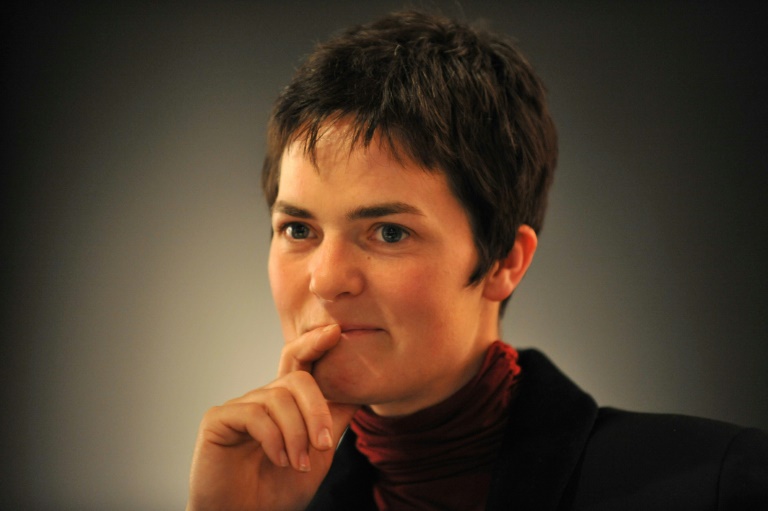
Former British yachting champion turned environmental campaigner Ellen MacArthur on Thursday won Spain’s prestigious Princess of Asturias prize for international cooperation for her work to promote the circular economy. 

MacArthur, who heads a foundation which bears her name, was recognised “for being an inspirational model in the fight for the better use of natural resources and for accelerating the transition to what is known as circular economy,” the jury said in a statement. 

A professional yachtswoman, she made history in 2005 by breaking the world record for sailing solo around the globe, showing she could outlast and outpace men in one of the most demanding and dangerous of challenges.

After retiring from professional yachting in 2010, she created the Ellen MacArthur Foundation, which advocates for a more sustainable model of production and consumption, focusing on reusing, recycling and extending the life of existing materials. 

As well as conducting research focused on increasing sustainability in food and fashion production, the Foundation has also made important advances in the war on plastic waste. 

“Her ability to promote alliances with governments, companies, scientific institutions and civil society has contributed to forging the first major legally-binding international agreement against plastic pollution,” the jury said, referring to a UN decision in March to negotiate a global treaty on plastic pollution. 

MacArthur’s Foundation played a key role alongside the World Wildlife Fund in bringing about the move in what has been hailed as a watershed moment for the planet.

She has also worked in the fashion industry, collaborating in 2018 with British designer Stella McCartney to launch the “Make Fashion Circular” campaign which advocates for greater sustainability and responsibility within the industry. 

Forest fire fears over new Greek migrant camp

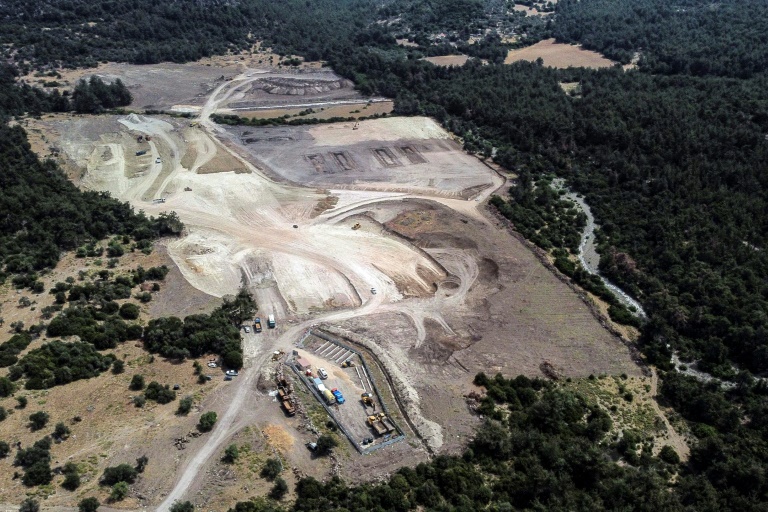
Months behind schedule and dogged by lawsuits, critics say a vast new migrant camp on the Greek island of Lesbos is a potential forest fire hazard that could wreak havoc on the environment.

Officials say it is desperately needed on an island at the forefront of Europe’s migrant crisis, where hundreds of thousands of asylum seekers have arrived from countries such as Syria and Afghanistan since 2015.

The worksite is as far as possible from the island’s main town of Mytilene and its tourist resorts. Barbed wire keeps out intruders. A private security company now guards the entrance 24 hours a day, after protesters set fire to construction machinery in February.

“It’s the worst location possible to build the camp,” Yiorgos Dinos, head of the firemen union in the region, tells AFP.

“Should a fire start there, it will burn down half the island.”

According to local community leaders, Greece’s propensity for forest fires and a troubling history of blazes at other camps makes the new facility — on the edge of a dense pine forest in the middle of nowhere — a potential hazard of major proportions.

“We have so many examples of what can happen to a forest in case of fire in adverse weather conditions,” says Christos Tsivgoulis, head of Komi, one of six communities that oppose the project.

“Nothing can save you.”

– Safeguards –

The migration ministry insists the new camp will come equipped with the “most advanced” fire safeguards available and will be built 20 metres (22 yards) from the nearest treeline.

“We are also developing artificial intelligence fire sensors in collaboration with the European Union,” a ministry official told AFP.

High temperatures and strong winds cause wildfires every summer in Greece, especially on islands where the rugged landscape presents an added impediment to firefighters.

Scientists say climate change has increased the frequency and intensity of the fires in recent years.

Europe’s largest migrant camp of Moria, also on Lesbos, was entirely gutted by fire in 2020.

At the time, Moria housed more than 10,000 people. Most of them were sleeping under makeshift shelter outdoors.

Last month, a communal tent for 150 people burned down at Moria’s temporary replacement of Mavrovouni, which currently houses around 1,100 people. 

On Tuesday, two 18-year-old Afghan asylum seekers were sentenced to four years on appeal for starting the Moria fire. Four other Afghans were handed 10-year sentences last June.

– ‘Completely unsuitable’ –

Michael Bakas, a member of Greece’s Greens party, says “dozens” of fires broke out around Moria in previous summers despite the presence of a dedicated fire response team.

But Tsivgoulis, the local community representative, argues the densely forested landscape around the new camp at Plati is more dangerous than Moria.

“Moria was surrounded by an olive grove, olive trees don’t burn easily, imagine what can happen in a pine forest,” Tsivgoulis said.

“In the summer months, locals are not allowed to enter at night because of the risk of fire. So how does the (migration) ministry ensure that there will be no accidents when hundreds will be coming and going” to build the camp, he wonders.

“This is a completely unsuitable location to build an entire community,” adds Antonis Komlos, head of the community of Pighi.

“With one spark, whole villages and crops could be lost,” he said.

There are also fears that the remote location, accessible via a rural road, 15 kilometres (nine miles) from the closest village as the bird flies and 30 kilometres from the island’s main town of Mytilene, will be hard to evacuate in an emergency.

– ‘Far from our children’ –

With a capacity of 3,000, Plati is to be the largest of five new camps for which the European Union has allocated $296 million combined for Lesbos and four other Greek islands in the Aegean where migrants arrive from neighbouring Turkey.

The new camps come with barbed-wire fencing, surveillance cameras, X-ray scanners and magnetic gates that are closed at night.

Mytilene mayor Stratis Kytelis has called the camp a “starting point” for the island to “leave the migration issue behind for good — far from the city of Mytilene, our children and our daily lives.”

Yet disagreements over the location have delayed the project for months, with various alternative locations examined and rejected. 

This week, Kytelis said Plati was “the only solution to restore serenity to the island.”

In a statement to AFP, he insisted authorities are taking “all (necessary) fire precautions”.

The camp was originally supposed to have been completed last September.

An injunction against the project will be discussed later in June.

Completion is expected next year, the migration ministry source said.

ECB begins inflation fightback with July rate hike

The European Central Bank on Thursday said it would raise interest rates for the first time in over a decade next month to combat runaway inflation, bringing the curtain down on the eurozone’s era of cheap money.

ECB governors, exceptionally meeting in Amsterdam instead of Frankfurt, provided markets with an unexpectedly precise statement setting out their path to monetary policy normalisation after years of ultra-low rates and easy credit.

As a first step, the ECB said it would end its massive bond-buying stimulus as of July 1.

The bank’s governing council then plans “to raise the key ECB interest rates by 25 basis points” at its next meeting on July 21, the ECB said in a statement.

It will raise rates again in September, with the size dependent on the economic outlook.

The last time the ECB hiked rates was in 2011.

“The ECB officially ends its long era of unconventional monetary policy,” said ING bank economist Carsten Brzeski.

Pressure had been growing on the ECB to take tough action after other major central banks like the US Federal Reserve and the Bank of England already moved to rein in prices with aggressive rate hikes. 

Inflation in the 19-nation euro area rose to a record 8.1 percent in May, well above the ECB’s two-percent target.

The surge has largely been driven by the war in Ukraine, which has pushed up the cost of energy, food and raw materials around the globe.

The ECB lowered its eurozone economic growth forecast while raising its projections for inflation.

“High inflation is a major challenge for all of us,” the ECB said in a statement.

Attention now shifts to ECB chief Christine Lagarde’s afternoon press conference, where she will be grilled about the ECB’s next moves.

– ‘Dampened growth’ –

The biggest challenge facing Lagarde right now is finding the right balance between raising borrowing costs to cool inflation, without jeopardising the eurozone’s already stuttering economy.

Underscoring those worries, the ECB slashed its growth outlook for the 19-nation club to 2.8 percent in 2022 and 2.1 percent in 2023, from 3.7 and 2.8 percent previously.

The war in Ukraine “is disrupting trade, is leading to shortages of materials, and is contributing to high energy and commodity prices,” it said, adding that “these factors will continue to weigh on confidence and dampen growth, especially in the near term.”

The July 1 end of its bond-buying scheme will draw a line under the last in a series of debt-purchasing measures worth a total of around five trillion euros ($5.4 trillion) since 2014.

Scrapping the scheme paves the way for what Lagarde has called a “lift off” in rates.

Of the ECB’s three main rates, the so-called deposit rate currently stands at minus 0.5 percent — meaning lenders pay to park excess cash at the bank.

Lagarde has said the ECB aims to exit eight years of negative rates by the end of September.

“Today’s decision shows it’s managed to find a compromise between the doves and the hawks,” Brzeski said. 

“A 50 basis point rate hike in July seemed to be fended off by opening the door for 50 basis points in September.”

– Strong labour market –

The size of September’s hike will depend to a large extent on how the outlook for the economy changes.

Despite unveiling a downgraded forecast for economic growth on Thursday, the ECB expressed optimism over the longer term outlook.

“Once current headwinds abate, economic activity is expected to pick up again,” it said.

“The conditions are in place for the economy to continue to grow on account of the ongoing reopening of the economy, a strong labour market, fiscal support and savings built up during the pandemic.”

On inflation, the ECB said it expected consumer prices to soar to 6.8 percent in 2022, up from 5.1 percent in its previous forecast.

Inflation is seen easing to 3.5 percent in 2023 and 2.1 percent in 2024 — both also higher than earlier estimates.

“These projections indicate that inflation will remain undesirably elevated for some time,” it said.

France probes alleged nuclear power cover-up: source

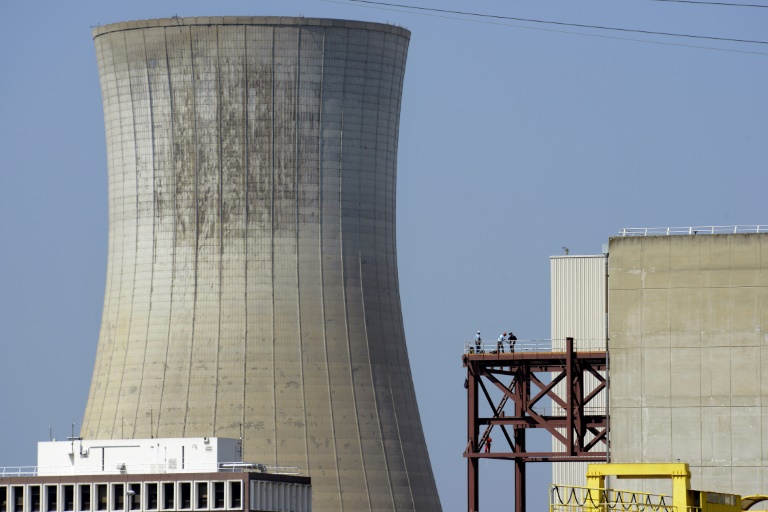
French prosecutors are investigating claims that officials at a nuclear power station covered up incidents of malfunction at an ageing plant, a source close to the probe told AFP on Thursday.

The move follows a legal complaint filed by a whistleblower, a former engineer at the Tricastin power station in the southeast of the country.

In his complaint to police in October 2021 targeting nuclear plant operator EDF, the engineer, whose identity was not given, said he had repeatedly alerted the company to the incidents and also written to the environment minister.

Events that the nuclear operator failed to declare to the national safety agency ASN, or played down, include an unexplained power surge at one of the reactors in 2017 and flooding inside the station the following year, according to the engineer.

An investigating magistrate in the southern port city of Marseille is now probing the power station for fraud and “endangering the lives of others”, the legal source said.

Other suspected violations include damage to the environment by leakage of toxic substances, obstructing checks by nuclear inspectors and workplace harassment of the engineer, who says he was sidelined after sounding the alarm.

France, which derives around 70 percent of its electricity from nuclear power, has been exploring a possible extension of the lifetime of its ageing stations, several of which have come up against their 40-year limit.

That includes Tricastin, built in 1980-81 — making it one of France’s oldest nuclear stations.

It is on a list of installations that the ASN agency said last year could be renovated to extend their lifespan.

Currently operations at 12 of France’s 56 nuclear reactors are shut down because of corrosion issues, EDF said last month.

In February, President Emmanuel Macron called for a “rebirth” of France’s nuclear industry, with 14 new plants, as part of efforts to move away from fossil fuels.

The launch of the Tricastin probe was evidence of the accusations’ “extreme gravity”, the whistleblower’s high-profile lawyers Vincent Brengarth and William Bourdon said in a statement to AFP.

Contacted by AFP, both EDF and ASN declined to comment.

Last November, however, ASN chief inspector Christophe Quintin told AFP that routine checks at Tricastin had not revealed any incidents that might have gone unreported.

Independent radioactivity research association CRIIRAD welcomed the investigation, saying it raised important issues such as nuclear safety and transparency on nuclear issues.

“The judiciary is sending a strong signal, but will it be able to get to the bottom of this?” asked the association’s spokesman, Roland Desbordes.

cal-jpa-ol-gd/jh/sjw/ach 

France probes alleged nuclear power cover-up: source

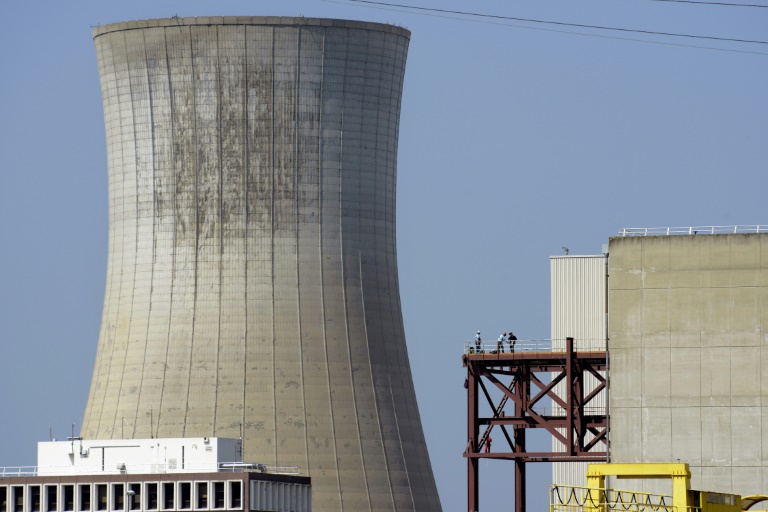
French prosecutors are investigating claims that officials at a nuclear power station covered up incidents of malfunction at an ageing plant, a source close to the probe told AFP on Thursday.

The move follows a legal complaint filed by a whistleblower, a former engineer at the Tricastin power station in the southeast of the country.

In his complaint to police in October 2021 targeting nuclear plant operator EDF, the engineer, whose identity was not given, said he had repeatedly alerted the company to the incidents and also written to the environment minister.

Events that the nuclear operator failed to declare to the national safety agency ASN, or played down, include an unexplained power surge at one of the reactors in 2017 and flooding inside the station the following year, according to the engineer.

An investigating magistrate in the southern port city of Marseille is now probing the power station for fraud and “endangering the lives of others”, the legal source said.

Other suspected violations include damage to the environment by leakage of toxic substances, obstructing checks by nuclear inspectors and workplace harassment of the engineer, who says he was sidelined after sounding the alarm.

France, which derives around 70 percent of its electricity from nuclear power, has been exploring a possible extension of the lifetime of its ageing stations, several of which have come up against their 40-year limit.

That includes Tricastin, built in 1980-81 — making it one of France’s oldest nuclear stations.

It is on a list of installations that the ASN agency said last year could be renovated to extend their lifespan.

Currently operations at 12 of France’s 56 nuclear reactors are shut down because of corrosion issues, EDF said last month.

In February, President Emmanuel Macron called for a “rebirth” of France’s nuclear industry, with 14 new plants, as part of efforts to move away from fossil fuels.

The launch of the Tricastin probe was evidence of the accusations’ “extreme gravity”, the whistleblower’s high-profile lawyers Vincent Brengarth and William Bourdon said in a statement to AFP.

Contacted by AFP, both EDF and ASN declined to comment.

Last November, however, ASN chief inspector Christophe Quintin told AFP that routine checks at Tricastin had not revealed any incidents that might have gone unreported.

Independent radioactivity research association CRIIRAD welcomed the investigation, saying it raised important issues such as nuclear safety and transparency on nuclear issues.

“The judiciary is sending a strong signal, but will it be able to get to the bottom of this?” asked the association’s spokesman, Roland Desbordes.

cal-jpa-ol-gd/jh/sjw/ach 

Biden eyes climate progress as Brazil leader joins Americas summit

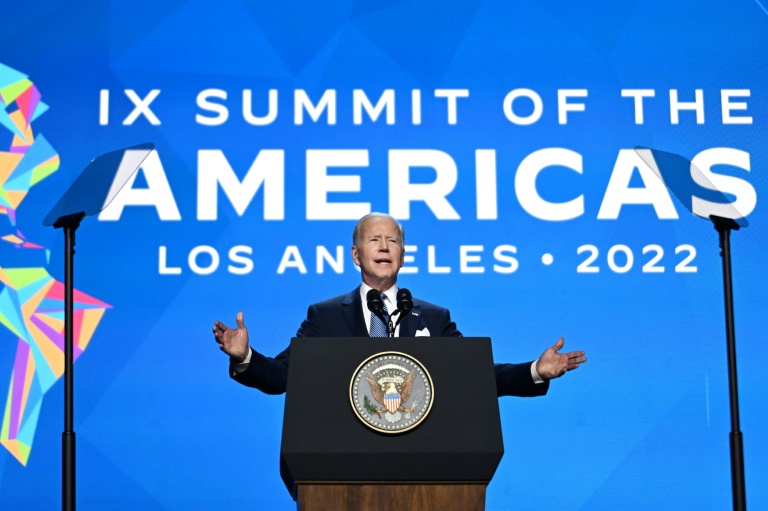
Joe Biden sought Thursday to step up action on climate at an Americas summit with hopes for at least small progress with Brazil, whose far-right leader will hold a potentially tense meeting with the US president.

Some two dozen leaders have descended on Los Angeles for the Summit of the Americas, where Biden late Wednesday implored them to show that democracy can produce results.

“There is no reason why the Western Hemisphere shouldn’t be secure, prosperous and democratic, from Canada’s northernmost reaches to the southern tips of Chile,” he told a welcoming reception with pop performers at a downtown Los Angeles theater.

But as China makes rapid inroads in Latin America, long viewed by Washington as its turf, Biden has steered clear of big-dollar pledges and has instead sought cooperation in targeted areas.

The summit on Thursday will focus on climate, with Vice President Kamala Harris tasked with meeting leaders of Caribbean nations that are particularly vulnerable to rising sea levels.

One outlier from the international chorus to battle climate change has been Brazilian President Jair Bolsonaro, a champion of agribusiness who has horrified environmentalists who warn that further erosion of the Amazon rainforest will disrupt a vital natural sink for the planet’s carbon emissions.

Ahead of Biden’s first meeting with Bolsonaro on Thursday, the White House said Brazil, Colombia and Peru would join a US-backed initiative to explore ways to reduce Amazon deforestation motivated by commodities industries.

The White House also said that Brazil and four other nations were joining a renewable energy initiative launched at last year’s UN climate summit in Copenhagen.

In the pact, countries promise to work toward a goal of 70 percent renewables in their energy mix by 2030. 

Despite coming under criticism over the Amazon, Brazil — the sixth most populous nation — has one of least carbon-intensive economies for a major economy and already meets the goal on renewables, mostly through hydropower.

– The ‘Tropical Trump’ –

The meeting with Bolsonaro could be awkward due to more than climate. Bolsonaro was an ally of Biden’s predecessor Donald Trump and has appeared to follow the former president’s playbook by alleging that Brazil’s October elections are threatened by fraud.

On the eve of his trip, Bolsonaro went further by backing Trump’s claims of irregularities in the 2020 US election won by Biden. There has been no evidence of widespread fraud.

Jake Sullivan, Biden’s national security advisor, said the president would not shy away from discussing the Brazilian election.

“I do anticipate that the president will discuss open, free, fair, transparent democratic elections,” Sullivan told reporters.

Bolsonaro has trailed in early polls against his likely challenger, former president Luiz Inacio Lula da Silva, a leftist icon who was jailed on controversial corruption charges.

A victory by Lula would mark a further swing to the left in Latin America. Colombia, one of the closest US allies, could see a historic shift on June 19 if there is a victory by leftist Gustavo Petro, who topped the first round of voting.

While promising to work with leaders across ideology, Biden has held firm against inviting the leftist leaders of Cuba, Nicaragua and Venezuela on the grounds that they are autocrats.

His stance led to a boycott of the summit by Mexican President Andres Manuel Lopez Obrador, a crucial partner on addressing rising migration into the United States.

Harris started the week-long summit by announcing commitments of $1.9 billion by businesses in El Salvador, Guatemala and Honduras in hopes of creating jobs and discouraging migration — an issue seized upon by Trump’s Republican Party.

Also at the summit, the Biden administration announced a plan to help train 500,000 health workers in Latin America and a $300 million project to improve food security, with Russia’s invasion of Ukraine disrupting grain exports.

Biden also announced what he called a new economic partnership for the Americas, although there were few concrete details and no promises of funding or greater market access.

Sandberg exit unlikely to improve Facebook: whistleblower

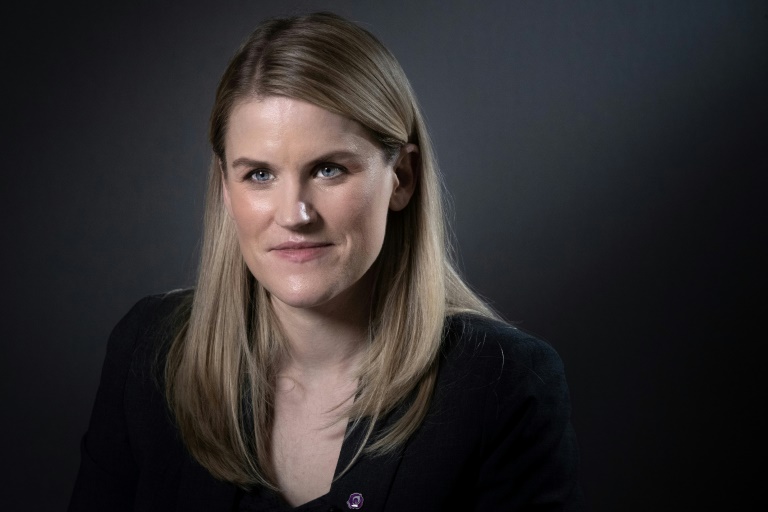
The departure of controversial Facebook executive Sheryl Sandberg is unlikely to improve the troubled social media giant, whistleblower Frances Haugen told AFP.

Haugen, a former Facebook engineer who leaked internal documents last year suggesting the firm put profits before safety, pointed out that Sandberg’s replacement came from a team whose remit was to help the firm to expand.

The “growth team” was part of the problem and the decision showed the company was “not listening to the heart of the critiques”, she said.

Sandberg, the number two at Facebook parent Meta, shocked Silicon Valley last week by announcing she was stepping down after 14 years at the firm, steering its rise from niche social network to ad-tech juggernaut.

But she had increasingly become the public face of a firm beset by scandals over misinformation, data protection and even accusations of fuelling ethnic violence.

Haugen’s leaked documents suggested executives knew their platforms could fuel hate speech and damage the mental health of young people.

The revelations led to huge criticism of Sandberg and her boss, Mark Zuckerberg, whose business — renamed Meta in 2021 — also includes Instagram and WhatsApp.

– ‘Did she do enough?’ –

Haugen, speaking to AFP this week ahead of addressing a cybersecurity forum in Lille in northern France, said there was a “fundamental tension” about Sandberg’s role.

“Did she do enough to stand up to Mark, or to demand Mark be a better leader? I don’t think so.”

She praised Sandberg, though, for establishing a strategic response team in 2018 to combat efforts to misuse the network.

“Sheryl did set up the parts of the company that were actively concerned with the safety of people who live in fragile places like Ethiopia,” she said.

But she said it “doesn’t seem particularly promising” that Sandberg will be replaced by Javier Olivan, the head of Meta’s “growth team”.

In announcing Olivan’s promotion, Zuckerberg wrote on Facebook that he had a “strong track record of making our execution more efficient and rigorous”.

Haugen wished him luck in his new role but said the growth team embodied “many of the things that I consider problematic about Facebook”.

Much of Haugen’s criticism stemmed from a central accusation that Facebook had pursued growth and profit with no concern for the safety or wellbeing of its users.

The growth team was central to that effort.

“The fact that the person who got to replace Sheryl comes from that part of the organisation feels that they are not really listening to the heart of the critiques,” said Haugen.

Meta did not immediately respond to a request for comment.

– Optimism on Musk –

Haugen has never fitted the stereotypical whistleblower image of a scrappy outsider — she has wealthy backers and a slick campaign that has seen her addressing parliaments around the world.

She told AFP in an interview last year she planned to start a youth movement to help empower young people to take charge of their online lives.

Aside from Facebook, she is sanguine about other recent developments in tech.

The saga of Elon Musk’s on-off takeover of Twitter, for example, has left many commentators questioning whether the billionaire magnate might do more harm than good to the social media firm.

But Haugen reckons he might just be on to something, saying she was “cautiously optimistic”.

“Part of why Facebook makes bad decisions is because it’s a publicly traded company,” she said.

“Elon Musk taking Twitter private provides an opportunity to go and do the house cleaning that Twitter needs.”

And she is heartened by a new European Union law — known as the Digital Services Act — that forces social media to regulate content.

She said it should break open the tech giants to independent scrutiny, which was a “really, really good deal”.

Overall, she said her revelations had made a positive impact — Facebook has doubled its spending on safety and staff working on safety issues say they have more space to operate.

“I’m incredibly heartened by how seriously leaders around the world have taken us,” she said.

“We have different conversations now about what social media should be.”

Close Bitnami banner
Bitnami