AFP

Sandberg exit unlikely to improve Facebook: whistleblower

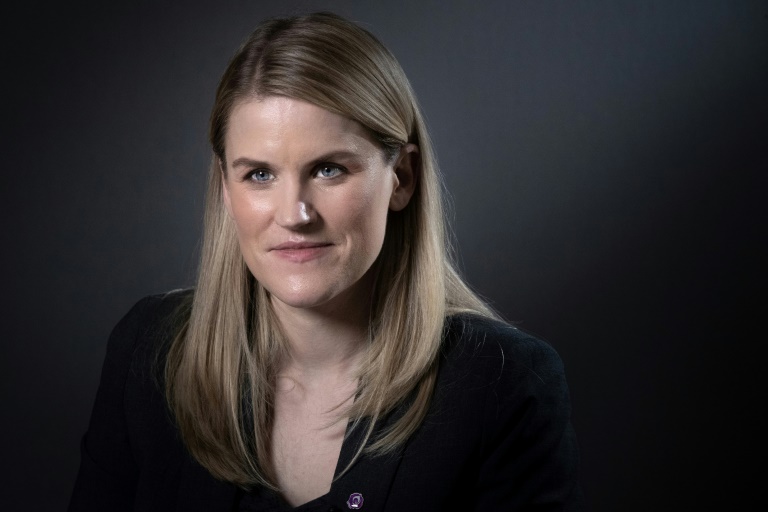
The departure of controversial Facebook executive Sheryl Sandberg is unlikely to improve the troubled social media giant, whistleblower Frances Haugen told AFP.

Haugen, a former Facebook engineer who leaked internal documents last year suggesting the firm put profits before safety, pointed out that Sandberg’s replacement came from a team whose remit was to help the firm to expand.

The “growth team” was part of the problem and the decision showed the company was “not listening to the heart of the critiques”, she said.

Sandberg, the number two at Facebook parent Meta, shocked Silicon Valley last week by announcing she was stepping down after 14 years at the firm, steering its rise from niche social network to ad-tech juggernaut.

But she had increasingly become the public face of a firm beset by scandals over misinformation, data protection and even accusations of fuelling ethnic violence.

Haugen’s leaked documents suggested executives knew their platforms could fuel hate speech and damage the mental health of young people.

The revelations led to huge criticism of Sandberg and her boss, Mark Zuckerberg, whose business — renamed Meta in 2021 — also includes Instagram and WhatsApp.

– ‘Did she do enough?’ –

Haugen, speaking to AFP this week ahead of addressing a cybersecurity forum in Lille in northern France, said there was a “fundamental tension” about Sandberg’s role.

“Did she do enough to stand up to Mark, or to demand Mark be a better leader? I don’t think so.”

She praised Sandberg, though, for establishing a strategic response team in 2018 to combat efforts to misuse the network.

“Sheryl did set up the parts of the company that were actively concerned with the safety of people who live in fragile places like Ethiopia,” she said.

But she said it “doesn’t seem particularly promising” that Sandberg will be replaced by Javier Olivan, the head of Meta’s “growth team”.

In announcing Olivan’s promotion, Zuckerberg wrote on Facebook that he had a “strong track record of making our execution more efficient and rigorous”.

Haugen wished him luck in his new role but said the growth team embodied “many of the things that I consider problematic about Facebook”.

Much of Haugen’s criticism stemmed from a central accusation that Facebook had pursued growth and profit with no concern for the safety or wellbeing of its users.

The growth team was central to that effort.

“The fact that the person who got to replace Sheryl comes from that part of the organisation feels that they are not really listening to the heart of the critiques,” said Haugen.

Meta did not immediately respond to a request for comment.

– Optimism on Musk –

Haugen has never fitted the stereotypical whistleblower image of a scrappy outsider — she has wealthy backers and a slick campaign that has seen her addressing parliaments around the world.

She told AFP in an interview last year she planned to start a youth movement to help empower young people to take charge of their online lives.

Aside from Facebook, she is sanguine about other recent developments in tech.

The saga of Elon Musk’s on-off takeover of Twitter, for example, has left many commentators questioning whether the billionaire magnate might do more harm than good to the social media firm.

But Haugen reckons he might just be on to something, saying she was “cautiously optimistic”.

“Part of why Facebook makes bad decisions is because it’s a publicly traded company,” she said.

“Elon Musk taking Twitter private provides an opportunity to go and do the house cleaning that Twitter needs.”

And she is heartened by a new European Union law — known as the Digital Services Act — that forces social media to regulate content.

She said it should break open the tech giants to independent scrutiny, which was a “really, really good deal”.

Overall, she said her revelations had made a positive impact — Facebook has doubled its spending on safety and staff working on safety issues say they have more space to operate.

“I’m incredibly heartened by how seriously leaders around the world have taken us,” she said.

“We have different conversations now about what social media should be.”

Europe's 'largest predatory dinosaur' found by UK fossil hunter

A giant crocodile-faced dinosaur discovered on the Isle of Wight by one of Britain’s best fossil hunters was probably the largest predator ever to stalk Europe, scientists said on Thursday.

Most of the bones of the two-legged spinosaurid were found by the late local collector Nick Chase, who dedicated his life to combing the beaches of the island on England’s southern coast for dinosaur remains.

Researchers at the University of Southampton then used the few bones available to identify what they have called the “White Rock spinosaurid”, they said in a study published in the journal PeerJ.

“This was a huge animal, exceeding 10 metres (33 feet) in length and judging from some of the dimensions, probably represents the largest predatory dinosaur ever found in Europe,” said Chris Barker, a PhD student who led the study.

While admitting it would be better to have more bones, Barker told AFP the “numbers don’t lie — it is bigger than the biggest known specimen” previously found in Europe.

Thomas Richard Holtz, a vertebrate paleontologist from the University of Maryland not involved in study, agreed that the new find “does seem to be larger” than a huge predator whose fossilised remains were discovered in Portugal.

– Why the long face? –

The White Rock spinosaurid — which the researchers hope to formally name as a new species — is from the Early Cretaceous period and is estimated to be around 125 million years old.

Barker said that makes it the youngest spinosaurid found in Britain, two or three million years younger than the well-known Baryonyx.

Spinosaurids are known for their elongated heads. Rather than having the boxy skull of a Tyrannosaurus rex, their faces look more like that of a crocodile.

A leading theory to explain this trait is that they hunted on water as well as land.

“They’re kind of like storks and herons, wading in and snatching fish from the surface,” Barker said.

The White Rock spinosaurid was discovered in a lagoonal coastal environment where few dinosaur fossils are normally found.

“It helps start to paint a picture of what animals were living in the time, which is a very poorly known part of English palaeontological heritage,” Barker added.

The team had already discovered two new spinosaurid species on the Isle of Wight, including the Ceratosuchops inferodios — dubbed the “hell heron”.

“This new animal bolsters our previous argument — published last year — that spinosaurid dinosaurs originated and diversified in western Europe before becoming more widespread,” study co-author Darren Naish said.

– Collector’s ‘uncanny ability’ –

The palaeontologists paid tribute to Chase, who always donated whatever bones he found to museums.

“Most of these amazing fossils were found by Nick Chase, one of Britain’s most skilled dinosaur hunters, who sadly died just before the Covid epidemic,” said study co-author Jeremy Lockwood, a PhD student at the University of Portsmouth.

Barker said Chase’s “uncanny ability” to find bones showed that “it’s not just professional palaeontologists who are making impacts in the discipline”.

The discovery “highlights the fact that collectors have a big role to play in modern palaeontology and their generosity helps move science forwards”, he added.

And if there any aspiring fossil hunters hoping to pick up where Chase left off, the palaeontologists would welcome more White Rock spinosaurid bones.

“We hope that a passerby might pick up some bits and donate them,” Barker said.

Stocks drop as inflation fears mount, eyes on ECB

Equity markets mostly fell Thursday as inflation fears gain momentum, with all eyes on the outcome of a European Central Bank policy meeting aimed at tackling soaring consumer prices in the eurozone.

The ECB is expected to announce the end date to its bond-buying stimulus, as concerns over the accelerating pace of inflation in the eurozone grip policymakers.

The stop is a prelude to the ECB hiking interest rates for the first time in more than a decade, following in the footsteps of other central banks who are raising borrowing costs.

In foreign exchange, the euro steadied against the dollar and pound.

“There is a sense of nervousness ahead of the ECB’s interest rate decision later today as the central bank looks to usher in a new era of monetary policy tightening,” noted Victoria Scholar, head of investment at Interactive Investor. 

“With euro-area inflation hitting a record high in May, the ECB is widely anticipated to begin hiking rates in July.”

Inflation around the world has reached the highest levels in decades, fuelled largely by soaring oil and gas prices.

Energy demand has surged as economies emerge from pandemic lockdowns, while supplies have been hit by the invasion of Ukraine by major producer Russia. 

Traders were also awaiting US inflation data due Friday.

Analysts expect the Federal Reserve to stick to its hawkish path and hike US interest rates by half a point for at least three more meetings this year as it tries to bring down American consumer prices.

“Until we reach peak inflation, which will trigger a less hawkish Fed and lower recession odds, it could be a gloomy summer for global stock pickers,” forecast SPI Asset Management’s Stephen Innes. 

There was fresh uncertainty over the economic outlook in China as Covid fears linger over the world’s second-biggest economy.

While data showed China’s exports rebounded strongly in May, with factories restarting and supply chains untangling as Shanghai slowly emerged from a gruelling lockdown, the metropolis will Saturday shut a district of 2.7 million people for mass coronavirus testing.

“There are lingering concerns that China’s brisk recovery could be a false dawn given that the zero-Covid strategy is staying firmly in place and that could mean rolling lockdowns will continue,” noted Hargreaves Lansdown analyst Susannah Streeter.

– Key figures at around 1015 GMT –

London – FTSE 100: DOWN 0.4 percent at 7,562.26 points

Frankfurt – DAX: DOWN 0.7 percent at 14,350.22

Paris – CAC 40: DOWN 0.3 percent at 6,427.47

EURO STOXX 50: DOWN 0.5 percent at 3,771.30

Tokyo – Nikkei 225: FLAT at 28,246.53 (close)

Hong Kong – Hang Seng Index: DOWN 0.7 percent at 21,869.05 (close)

Shanghai – Composite: DOWN 0.8 percent at 3,238.95 (close)

New York – Dow: DOWN 0.8 percent at 32,910.90 (close)

Brent North Sea crude: DOWN 0.3 percent at $123.20 per barrel

West Texas Intermediate: DOWN 0.2 percent at $121.89 per barrel

Dollar/yen: DOWN at 133.30 yen from 134.29 yen late Wednesday

Euro/dollar: FLAT at $1.0720 

Pound/dollar: DOWN at $1.2526 from $1.2535

Euro/pound: UP at 85.58 pence from 85.54 pence

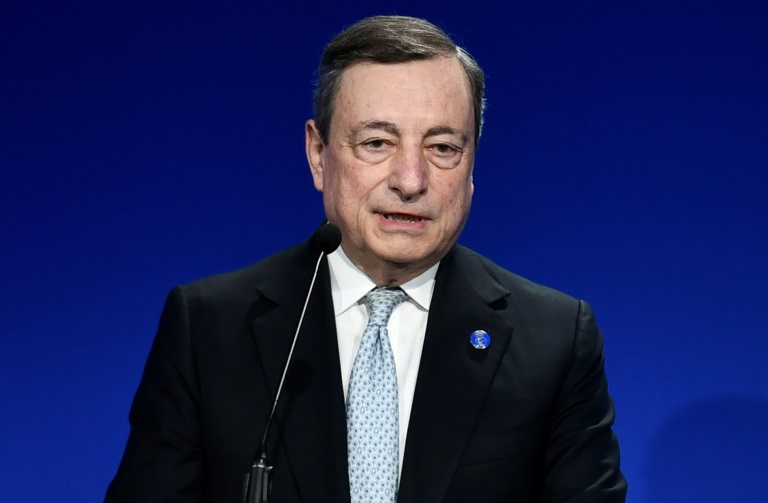
Italy's Draghi says EU should cushion energy inflation blow

Italian Prime Minister Mario Draghi on Thursday suggested an EU-wide scheme to protect citizens from higher energy costs resulting from Russia’s invasion of Ukraine.

“We must consider replicating some of the joint tools that have helped us recover swiftly from the pandemic,” Draghi told delegates gathered in Paris for a meeting of the Organisation for Economic Cooperation and Development (OECD).

He highlighted that inflation in the eurozone single currency area reached 8.1 percent in May — much of it driven by higher prices for energy including oil and gas following Moscow’s assault on its neighbour.

“Rising inflation is not wholly the sign of overheating (in the economy), but largely the result of a series of supply shocks,” Draghi said.

The former European Central Bank chief said the SURE unemployment support scheme, agreed by EU nations in 2020 as the first pandemic wave was breaking over the continent, could serve as a model.

It provided up to 100 billion euros ($107 billion) across the bloc to buttress national budgets sapped by the sudden need to aid large numbers of people with measures like short-time work schemes.

SURE “provided cheap and stable loans to the EU member states so that they could save jobs and support incomes”, Draghi said.

“A similar instrument — this time targeting energy — could ensure vulnerable countries have more room to help their citizens at a time of crisis” as well as “shore up popular support for our joint sanctions” against Russia, he added.

Ukraine says fate of Donbas rests in battleground city

Ukrainian President Volodymyr Zelensky said the fate of the whole Donbas region hinges on the “very fierce” battle with Russian troops for the flashpoint eastern city of Severodonetsk.

Moscow’s forces are concentrating their firepower on the strategically important industrial hub as part of efforts to capture a swathe of eastern Ukraine.

As shelling and air strikes killed another 11 people around the country, Ukraine said on Thursday that the western long-range artillery it has been begging for would end the fight for Severodonetsk in days.

In his evening address to the nation on Wednesday, Zelensky said the battle for the city was “very fierce… very difficult. Probably one of the most difficult throughout this war.

“In many ways, the fate of our Donbas is being decided there.”

Following days of raging street battles, Ukrainian officials conceded that Russian troops control a large part of Severodonetsk and that their own forces might have to pull back due to constant shelling.

The cities of Severodonetsk and Lysychansk, which are separated by a river, were the last areas still under Ukrainian control in Lugansk. Lysychansk is still in Ukrainian hands but under fierce Russian bombardment. 

After being repelled from Kyiv following their February 24 invasion, Russian President Vladimir Putin’s troops have refocused their offensive on the Donbas region, comprising Lugansk and Donetsk.

– ‘Very primitive’ –

Part of the Donbas had already been held by pro-Russian separatists since 2014.

At the United Nations, Secretary-General Antonio Guterres added his voice to increasingly dire warnings about the war’s impact. 

“For people around the world, the war is threatening to unleash an unprecedented wave of hunger and destitution, leaving social and economic chaos in its wake,” he said.

Severodonetsk appeared close to being captured just days ago but outgunned Ukrainian forces launched counterattacks and managed to hold out.

Lugansk regional governor Sergiy Gaiday said Western artillery would help secure a Ukrainian victory, echoing Kyiv’s repeated calls for more military aid.

“As soon as we have long-range artillery to be able to conduct duels with Russian artillery, our special forces can clean up the city in two to three days,” he said.

Gaiday added that Ukrainian forces in the city remained “highly motivated” and that “everyone is holding their positions”, while describing Russian tactics as “very primitive.”

The United States and Britain have announced they are providing Kyiv with long-range precision artillery batteries, defying warnings from Putin.

– Global food crisis –

The Ukrainian presidency said four people were killed and five more wounded in a Russian air strike on Toshkivka, a village around 25 kilometres (14 miles) south of Severodonetsk.

Four more people were killed in fighting in Donetsk, and two were killed by shelling in the north-eastern city of Kharkiv, it said. Another person was killed in the Mykolayiv region in the south. 

Russia’s defence ministry meanwhile said it had targeted a Ukrainian training centre for “foreign mercenaries” in the Zhytomyr region. 

Zhytomyr governor Vitaliy Bunechko confirmed a Russian strike overnight in the town of Novograd-Volynskyi but did not mention a training centre and said he had no information about victims.

The shockwaves from the Ukraine conflict continue to reverberate, especially from a looming global food crisis.

Russia and Turkey made little headway in striking a deal to secure safe passage for grain exports stuck in Ukraine.

At the request of the United Nations, Turkey has offered its services to escort maritime convoys from Ukrainian ports, despite the presence of mines.

“We are ready to do this in cooperation with our Turkish colleagues,” Russian Foreign Minister Sergei Lavrov told reporters in Ankara.

Lavrov’s Turkish counterpart Mevlut Cavusoglu called Russian demands for an end to sanctions to help grain onto the world market “legitimate”.

– ‘Everyone has run away’ –

But Kyiv, which was not represented at the Ankara talks, blamed “Russian aggression, not sanctions” for high grain prices.

Before the war, Ukraine was a major exporter of wheat, corn and sunflower oil.

The situation on the ground in other parts of the Donbas is increasingly desperate. 

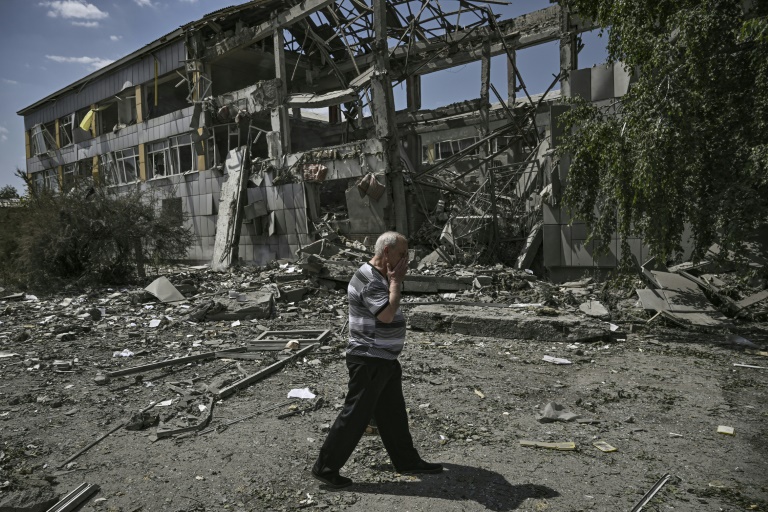
In the city of Bakhmut, an unoccupied school building was reduced to a smouldering wreck after being shelled Wednesday, with burnt books visible among the rubble, according to AFP journalists. No injuries or deaths were reported. 

In Severodonetsk’s twin city Lysychansk, residents who had chosen to stay were facing fierce Russian bombardments. 

“Every day there are bombings and every day something burns. A house, a flat… And there is nobody to help me,” 70-year-old Yuriy Krasnikov told AFP.

“I tried to go to the city authorities, but nobody’s there, everyone has run away.”

There was some rare good news for Ukraine, as their football side clinched a 1-0 Nations League victory over the Republic of Ireland on Wednesday.

The victory — thanks to a free kick from Viktor Tsygankov — lifted the country’s spirits after their painful failure to qualify for the World Cup.

burs-dk/jm

Rocketing petrol prices fuel British PM's woes

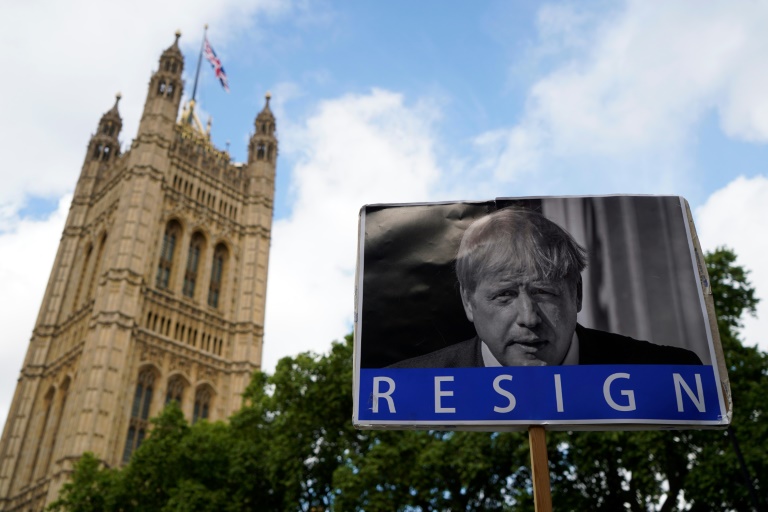
Prime Minister Boris Johnson on Thursday sought to reset his embattled leadership with a policy blitz to tackle Britain’s cost-of-living crisis, including contentious new measures to boost home ownership.

After narrowly surviving a no-confidence vote among his own Conservative MPs on Monday, Johnson is under pressure to turn the page on a series of scandals including lockdown-breaching parties in Downing Street.

In a speech later, he was to vow “more affordable energy, childcare, transport and housing”, according to excerpts released by Downing Street.

“And, while it’s not going to be quick or easy, you can be confident that things will get better, that we will emerge from this a strong country with a healthy economy,” Johnson added.

The scale of the inflationary crisis hitting millions of Britons was underlined as the price of filling up the average family car topped £100 ($125) for the first time, according to data from the RAC motoring group.

RAC spokesman Simon Williams called it “a truly dark day” for hard-pressed drivers, and urged the government to slash sales tax on petrol and diesel.

The government says much of the crisis is caused by factors beyond its control, such as the impact of the Covid pandemic and the war in Ukraine.

But with two difficult by-elections coming up this month, unhappy Tory MPs want bolder measures including tax cuts after 40 percent of them voted against Johnson on Monday.

– Back to the 80s –

Updating a signature policy of 1980s predecessor Margaret Thatcher, Johnson’s speech was set to detail a plan to enable more low-income renters to buy their own social housing.

Senior minister Michael Gove told Sky News that “home ownership is not just good for individuals, it’s good for society overall”.

He vowed the measures would help redress a crippling shortage in housing stock that has seen both purchase and rental prices rocket well out of reach of many Britons, especially younger adults.

But the opposition Labour party noted that the plan would need billions in extra money, which Gove admitted was not on offer, relying instead on existing funding at a time when the Treasury is already trying to rein in government spending.

“By their own reckoning, this will help a few thousand families a year,” senior Labour MP Lisa Nandy told BBC radio.

“For those families that will be very welcome,” she said, while warning it could make “the housing crisis worse for everybody else”.

Britain’s newspapers honed in on the surging prices on Thursday, with the Guardian, Daily Mirror and Johnson’s former employers at the Daily Telegraph featuring front-page stories on the record fuel costs.

But the conservative Daily Mail declared that “emboldened Boris Johnson will cut bills left, right and centre in his most radical move yet to ease the cost-of-living crisis”.

All the papers noted a warning from the Organisation for Economic Co-operation and Development (OECD) that Britain must cut taxes or raise spending, as it forecast the country would have the weakest economic growth in the developed world next year.

– Fight with EU –

Under current Conservative party rules, Johnson cannot be challenged again for a year, which leaves little time for any new leader to emerge before the next general election due by 2024.

But Johnson’s Tory enemies still appear to be manoeuvring, with reports that he faces a “war of attrition” and “vote strikes” to paralyse the government’s legislative agenda. 

Such “vote strikes” hurt Theresa May’s three-year stint in Downing Street, before she was brought down in 2019 by Johnson and his allies over how to execute Britain’s exit from the European Union.

The government is set to launch another counter-offensive on the Brexit front, by introducing legislation soon to rewrite a pact with the EU governing trade with Northern Ireland, unless Brussels agrees to changes.

Gove denied that Johnson was looking to divert attention following the confidence vote, by placating Brexit hardliners on the Tory backbenches.

I don’t think it’s about picking a fight,” the minister said on BBC radio.

“It is absolutely right that we fix the problems with the Northern Ireland Protocol,” he said, after the territory’s biggest pro-UK party refused to join a new power-sharing government.

Forest fire fears over new Greek migrant camp

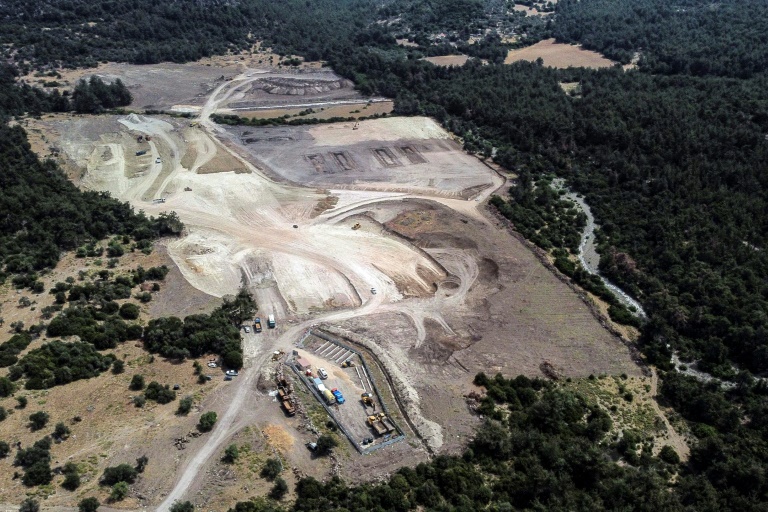
Months behind schedule and dogged by lawsuits, critics say a vast new migrant camp on the Greek island of Lesbos is a potential forest fire hazard that could wreak havoc on the environment.

Officials say it is desperately needed on an island at the forefront of Europe’s migrant crisis, where hundreds of thousands of asylum seekers have arrived from countries such as Syria and Afghanistan since 2015.

The worksite is as far as possible from the island’s main town of Mytilene and its tourist resorts. Barbed wire keeps out intruders. A private security company now guards the entrance 24 hours a day, after protesters set fire to construction machinery in February.

“It’s the worst location possible to build the camp,” Yiorgos Dinos, head of the firemen union in the region, tells AFP.

“Should a fire start there, it will burn down half the island.”

According to local community leaders, Greece’s propensity for forest fires and a troubling history of blazes at other camps makes the new facility — on the edge of a dense pine forest in the middle of nowhere — a potential hazard of major proportions.

“We have so many examples of what can happen to a forest in case of fire in adverse weather conditions,” says Christos Tsivgoulis, head of Komi, one of six communities that oppose the project. 

“Nothing can save you.”

High temperatures and strong winds cause wildfires every summer in Greece, especially on islands where the rugged landscape presents an added impediment to firefighters.

Scientists say climate change has increased the frequency and intensity of the fires in recent years.  

Greece’s and indeed Europe’s largest migrant camp of Moria, also on Lesbos, was entirely gutted by fire in 2020.

– ‘Completely unsuitable’ –

At the time, Moria housed more than 10,000 people. Most of them were sleeping under makeshift shelter outdoors.

Last month, a communal tent for 150 people burned down at Moria’s temporary replacement of Mavrovouni, which currently houses around 1,100 people. 

On Tuesday, two 18-year-old Afghan asylum seekers were sentenced to four years on appeal for starting the Moria fire. Four other Afghans were handed 10-year sentences last June.

Michael Bakas, a member of Greece’s Greens party, says “dozens” of fires broke out around Moria in previous summers despite the presence of a dedicated fire response team.

Tsivgoulis, the local community representative, says the densely forested landscape around the new camp at Plati is more dangerous than Moria.

“Moria was surrounded by an olive grove, olive trees don’t burn easily, imagine what can happen in a pine forest,” Tsivgoulis said.

“In the summer months, locals are not allowed to enter at night because of the risk of fire. So how does the (migration) ministry ensure that there will be no accidents when hundreds will be coming and going” to build the camp, he wonders.

“This is a completely unsuitable location to build an entire community,” adds Antonis Komlos, head of the community of Pighi.

“With one spark, whole villages and crops could be lost,” he said.

– ‘Far from our children’ –

There are also fears that the remote location, accessible via a rural road, 15 kilometres (nine miles) from the closest village as the bird flies and 30 kilometres from the island’s main town of Mytilene, will be hard to evacuate in an emergency.

With a capacity of 3,000, Plati is to be the largest of five new camps for which the European Union has allocated $296 million combined for Lesbos and four other Greek islands in the Aegean where migrants arrive from neighbouring Turkey.

The new camps come with barbed-wire fencing, surveillance cameras, X-ray scanners and magnetic gates that are closed at night.

Mytilene mayor Stratis Kytelis has called the camp a “starting point” for the island to “leave the migration issue behind for good — far from the city of Mytilene, our children and our daily lives.”

Yet disagreements over the location have delayed the project for months, with various alternative locations examined and rejected. 

This week, Kytelis said Plati was “the only solution to restore serenity to the island.”

In a statement to AFP, he insisted authorities are taking “all (necessary) fire precautions”.

The camp was originally supposed to have been completed last September.

An injunction against the project will be discussed later in June.

US Capitol riot hearings to link Trump election plots to insurrection

The year-long congressional panel probing the 2021 assault on the US Capitol begins outlining its findings Thursday, promising explosive new revelations that will tie the deadly siege to Donald Trump’s attempts to overturn his election defeat.

The first hearing — an evening primetime presentation — will serve as an “opening statement” on the January 6 insurrection, according to aides of the investigating House select committee, which began its work last July.

It will also aim to demonstrate that the violence was part of a broader conspiracy by Trump and his inner circle to illegitimately hold on to power, tearing up the Constitution and more than two centuries of peaceful transitions from one administration to the next.

“We will be revealing new details showing that the violence of January 6 was the result of a coordinated multi-step effort to overturn the results of the 2020 election and stop the transfer of power from Donald Trump to Joe Biden,” a select committee aide said.

“And indeed that former president Donald Trump was at the center of that effort.”

A slickly-produced 90-plus minutes of television — and five subsequent hearings over the coming weeks — will focus on Trump’s role in the multi-pronged effort to return him to the Oval Office as an unelected president by disenfranchising millions of voters. 

The case the committee plans to make is that Trump laid the groundwork for the insurrection through months of lies about fraud in an election described by his own administration as the most secure in history.

His White House is accused of involvement in several potentially illegal schemes to aid the effort, including a plot to seize voting machines and another to appoint fake “alternative electors” from swing states who would ignore the will of their voters and hand victory to Trump. 

– ‘Chilling’ conspiracy –

The select committee’s Republican vice-chairwoman Liz Cheney said on Sunday that the assault on the Capitol was part of a “chilling” conspiracy.

“It is extremely broad. It’s extremely well organized,” she told CBS.

The committee is planning to present live testimony Thursday from two people who interacted with members of the neofascist organization the Proud Boys on January 6 and in the days leading to the violence.

Cheney and chairman Bennie Thompson will make opening arguments before explaining how each of the six hearings, organized by theme, is expected to play out.

They will feature previously unseen video clips of the violence itself and excerpts from a trove of 1,000 interviews, including a “meaningful portion” of discussions with Trump’s senior White House and campaign officials — as well as members of his family.

Trump’s daughter Ivanka and her husband Jared Kushner, as well as the former president’s eldest son Don Jr., have all cooperated voluntarily with the committee.

British documentary filmmaker Nick Quested will testify Thursday about his experience shadowing members of the Proud Boys in the days leading up to January 6 and his interactions with them on the day itself.

The Emmy Award-winning director’s evidence is seen as crucial, said a committee aide, because he was on the scene during the first moments of violence against the Capitol Police and “all the chaos that ensued.”

– ‘Ongoing threats’ –

Capitol Police Officer Caroline Edwards, who was present at the breach of the first barricade, will describe sustaining head injuries in clashes with the far-right group, which saw its leader and four lieutenants charged on Monday with seditious conspiracy.

The hearings will differ from Trump’s two impeachments, however, in that he will not be represented in the room as he is not on trial — except perhaps in the court of public opinion.

Nevertheless, a number of his most loyal counter-punchers are expected to circle the wagons on Capitol Hill, questioning any damning testimony and challenging the validity of the investigation in TV appearances. 

AFP asked Trump spokesman Taylor Budowich for details of the plan for Trump’s defense, but there was no response.

The committee has not confirmed its plans for after the initial slate of hearings, but at least one more presentation and a final report are expected in the fall.

The panel, which sees Trump as a potential threat to the next election, will make legislative recommendations to ensure there is no repeat of the events of January 6.

“The investigation has flagged ongoing threats to our democracy, and our job is to tell the story of what happened,” said an aide.

“And, frankly, to let others judge about continuing threats and what needs to be done.”

Asian, European markets hit as inflation fears ramp up

Most Asian and European markets fell Thursday as a rally in oil ramped up inflation fears, with top officials warning of more pain to come as the Ukraine war continues to push prices up and put further pressure on the global economy.

Buyers on Wall Street were in retreat again after data showed US crude and gasoline stockpiles sank, just as the summer driving season begins and a leading OPEC member warned demand would surge further as China reopens.

Adding to the gloom was the OECD’s sharp downward revision of its global growth outlook and doubling of its inflation forecast.

The glum mood was only slightly offset by ongoing optimism that Beijing’s tech crackdown was close to an end.

Both main crude contracts edged down but held most gains after jumping more than two percent Wednesday to three-month highs after figures showed the biggest US storage depot had seen a big fall in reserves last week, suggesting elevated prices were not deterring people from driving.

Meanwhile, White House Press Secretary Karine Jean-Pierre said officials expect Friday’s keenly awaited consumer price index will be “elevated”.

The comment lifted expectations that the Federal Reserve will stick to its hawkish path and hike interest rates by half a point for at least three more meetings this year as it tries to bring down inflation from four-decade highs.

Analysts said investors were unlikely to get any reprieve until crude — a key driver of inflation since Russia’s invasion of Ukraine — was brought under control.

“A pullback in crude would be crucial for any prolonged risk rally, given implications for inflation expectations,” said SPI Asset Management’s Stephen Innes. 

“And for the central bank fraternity intent on frontloading rates, chapter two of the current playbook reads that aggressive tightening risks a material decline in housing, consumer confidence, and consumption that will eventually drive their respective economies into recession and send stocks tumbling.

“So until we reach peak inflation, which will trigger a less hawkish Fed and lower recession odds, it could be a gloomy summer for global stock pickers.”

He added that prices were expected to rise further for now as China emerges from months of lockdown, a sentiment that United Arab Emirates Energy Minister Suhail Al-Mazrouei agreed with.

“With the pace of consumption we have, we are nowhere near the peak because China is not back yet,” he told a conference Wednesday. “China will come with more consumption.”

And OANDA’s Jeffrey Halley said difficulties monitoring Iran’s nuclear compliance meant a nuclear deal with Iran — and the release of its crude onto world markets — was “as far away as ever”.

The unease about rising prices and rates saw all three main indexes fall on Wall Street, with focus on the European Central Bank’s policy meeting later Thursday and the release of US inflation data Friday.

The ECB is expected to begin winding down its massive bond-buying programme and signal a rate hike is in the pipeline.

Asian traders followed suit Thursday.

Hong Kong dropped, even as tech firms continued to benefit from hopes that China’s crackdown was almost over, while Shanghai, Sydney, Seoul, Singapore, Taipei, Manila and Wellington were also in the red.

Traders were nervous about news that officials in Shanghai will lock down a district of 2.7 million people Saturday to conduct mass coronavirus testing, highlighting the problems they have in running an economy while chasing their zero-Covid strategy.

There was little reaction to news that China’s exports surged last month.

Tokyo, however, was marginally in positive territory as the yen sat at two-decade lows owing to widening monetary policies of the United States and Japan, which shows no signs of lifting rates. Mumbai, Jakarta and Bangkok also edged up.

London, Paris and Frankfurt opened lower.

Investors were jarred by a report from the Organisation for Economic Co-operation and Development, which said it had cut its 2022 growth outlook to three percent — from 4.5 percent predicted in December — owing to the Ukraine war.

It also doubled its inflation estimate to 8.5 percent, a 34-year high. 

“The world is set to pay a hefty price for Russia’s war against Ukraine,” wrote the OECD’s chief economist and deputy secretary-general Laurence Boone.

And Anna Han, at Wells Fargo Securities, told Bloomberg Television: “Our view is that the chance of recession by the end of 2023 is 40 percent or so.” 

– Key figures at around 0720 GMT –

Tokyo – Nikkei 225: FLAT at 28,246.53 (close)

Hong Kong – Hang Seng Index: DOWN 1.0 percent at 21,795.62

Shanghai – Composite: DOWN 0.8 percent at 3,238.95 (close)

London – FTSE 100: DOWN 0.2 percent at 7,581.81

Brent North Sea crude: DOWN 0.2 percent at $123.29 per barrel

West Texas Intermediate: DOWN 0.3 percent at $121.75 per barrel

Dollar/yen: DOWN at 133.83 yen from 134.29 yen late Wednesday

Euro/dollar: DOWN at $1.0716 from $1.0720 

Pound/dollar: DOWN at $1.2520 from $1.2535

Euro/pound: UP at 85.59 pence from 85.54 pence

New York – Dow: DOWN 0.8 percent to 32,910.90 (close)

Dying children reflect brutal toll of Somalia drought

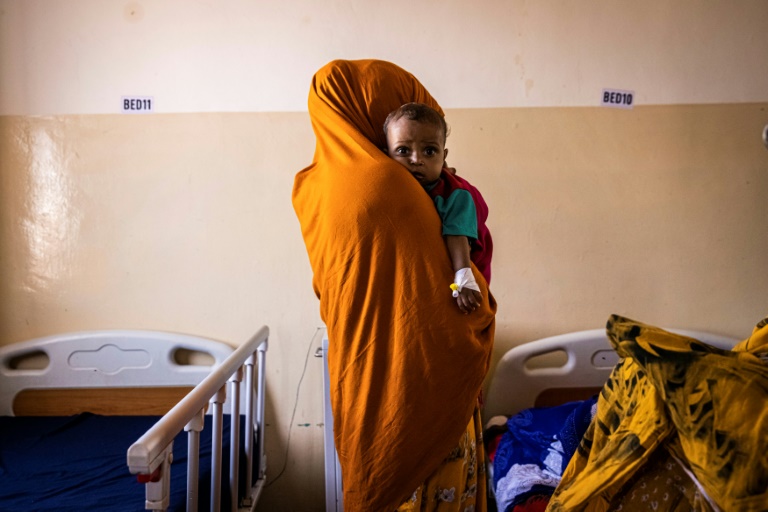
Arbay Mahad Qasim has already lost two children to a vicious drought, and now the Somali villager fears she could lose a third as her malnourished toddler Ifrah awaits treatment in a Mogadishu hospital.

Barely out of her teens, Qasim is among dozens of weary parents crowding Banadir Maternity & Children Hospital, which has become ground zero for the starvation crisis sweeping across Somalia as a record drought grips the Horn of Africa.

Entire villages have been forced to uproot their lives and flee their homes after poor rainfall destroyed crops and killed livestock.

When the rains failed for a fourth consecutive season last month, UN aid agencies and meteorologists warned that a famine was looming in Somalia, Kenya and Ethiopia.

But for many Somalis like Qasim, who has been surviving on government handouts for the past few months, catastrophe has already struck.

Two of her children died of hunger in the last 18 months.

When two-year-old Ifrah’s tiny body began to swell, showing symptoms of severe malnutrition, Qasim wasted no time, spending a day travelling to Mogadishu from her village in the southwest in a desperate bid to save her youngest child’s life.

– ‘Worst conditions’ –

The Banadir facility is packed with parents fearing the worst for their children.

Some have walked for days to find help, carrying their sick, skeletal toddlers on their backs.

Many told AFP they had never endured a crisis of such terrifying magnitude, echoing the warnings of climate scientists who say the unprecedented drought is the worst seen in four decades.

“The crops failed. We lost the livestock. The river dried up,” said Khadija Mohamed Hassan, whose 14-month-old son Bilal is among those admitted to the Banadir facility.

“I am 45 years old and I have never seen such a devastating drought ever in my life. We are living in the worst conditions of our time,” she told AFP.

Health workers are already overwhelmed, with doctor Hafsa Mohamed Hassan telling AFP that the number of patients arriving at Banadir’s stabilisation centre for malnutrition had trebled since the drought began, leading to a shortage of beds on some days.

“The cases we are receiving include children with other health complications like acute measles and others who are in a coma due to severe malnutrition,” she said.

The situation is at a tipping point, said Bishar Osman Hussein of the non-profit organisation Concern Worldwide, which has been supporting the Banadir centre since 2017.

“Between January and June this year, the number of children admitted at the Banadir Hospital stabilisation centre with severe malnutrition and other complications has increased from 120 to 230 per month,” he told AFP.

Meteorologists have warned that the October-November monsoon could also fail, plunging the region into further turmoil.

– ‘Cannot wait’ –

Conflict-wracked Somalia is particularly ill-equipped to cope with the crisis, with a grinding Islamist insurgency limiting humanitarian access to parts of the country.

Thousands of miles away, the war in Ukraine has also had a devastating impact on the lives of Somalis, with food prices soaring and aid in short supply.

Some 7.1 million Somalis — nearly half the population — are battling hunger, with more than 200,000 on the brink of starvation, the UN said this week.

Meanwhile appeals for aid have largely gone unnoticed, with agencies raising less than 20 percent of the funds needed to prevent a repeat of the 2011 famine that killed 260,000 people — half of them children under the age of six.

“We cannot wait for a declaration of famine to act,” El-Khidir Daloum, the World Food Programme’s country director in Somalia, said in a statement Monday, warning of a race against time.

As humanitarian aid falls short, Somalia’s newly elected President Hassan Sheikh Mohamud has urged Somalis to help their fellow citizens.

“Anyone with a plate of food in their table today must think about the child who is crying somewhere because of hunger and help them in any way possible,” he said during a recent visit to a camp housing drought-displaced communities.

Back at Banadir hospital, Khadija Mohamed Hassan anxiously keeps vigil over little Bilal, his bony body a mess of tubes and bandages.

“We have been here for 13 days, and he looks better now,” she said. 

Close Bitnami banner
Bitnami