AFP

Hi-tech herd: Spain school turns out 21st-century shepherds

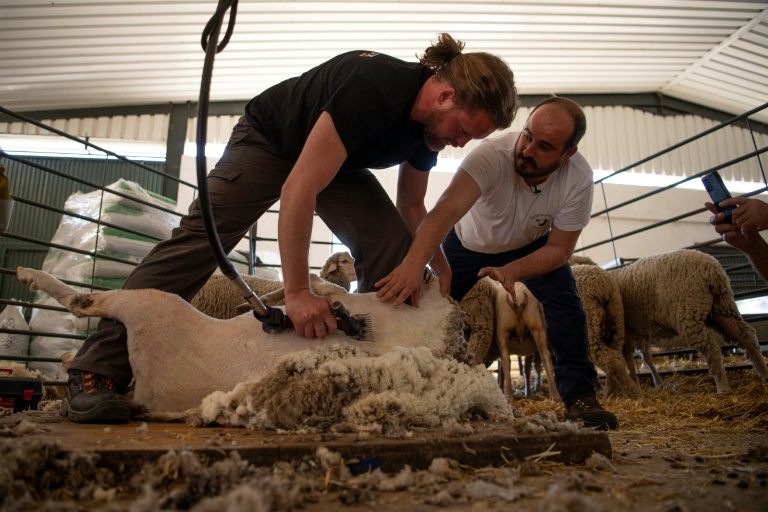
Gripping a sheep firmly between her legs, Vanesa Castillo holds its head with one hand while she tries to shear off its thick fleece with electric clippers. 

“It’s scary!” said Castillo, 37, slightly unnerved by her first attempt at sheep shearing at a school for shepherds in western Spain. 

“You have to pull the animal’s skin taut, really slowly, so you don’t cut it,” explained Jose Rivero, the professional sheep shearer giving the course. 

Sheep shearing is just one of the classes offered at the school in Casar de Caceres in rural Extremadura to counter the flight from the land that has left large swathes of inland Spain thinly populated.

Set up in 2015, the idea was “to bring in people who love the countryside”, said Enrique “Quique” Izquierdo, who runs the school. 

It aims to provide all the training and resources needed to create “a shepherd for the 21st century… with the most up-to-date methods in a sector where the traditional and the cutting-edge merge.”

Much of Spain’s sheep and goat farming is concentrated in rugged Extremadura. The school at Casar de Caceres is one of several across the country, the first set up in the northern Basque Country in 1997. 

– Tech and tradition –

“The traditional image of a shepherd wandering through the fields all day” doesn’t exist any more, said Jurgen Robledo, a vet who said the students are taught how to use many hi-tech tools including milk control programmes.

This year, 10 students are taking the five-month course which also includes hands-on experience of working with animals. 

Thibault Gohier, 26, is learning how to milk goats and to identify whether any of them are sick, which could affect the quality of their milk. 

“You need to use your fingertips as if they were your eyes,” said Felipe Escobero, who heads the farm where the school is based, as they feel a black goat’s mammary lymph nodes at the top of the udder.

When they’re healthy, “they should feel like an almond”, Escobero added. 

The course also covers financial matters and how to fill out certificates attesting to animal welfare or pesticide use. 

Completely free, it is funded by the Cooprado livestock farmers’ cooperative. 

Vet Robledo said modern hi-tech tools mean shepherds can now “measure the individual (milk) production of each animal.

“Such data can let a farmer see if production has dropped due to a subclinical mastitis infection by detecting a drop in production in a certain number of animals.” 

Unlike normal mastitis, such infections don’t cause any visible changes to the milk or udder appearance, making them difficult to detect, although they do affect the farmer’s bottom line by reducing milk production and quality.

– Different backgrounds –

Some students already work in farming and want to specialise, while others are completely new to the field, such as Vanesa Castillo, who is taking the course with her 17-year-old daughter Arancha Morales.

Originally employed at an old people’s home until it shut down two years ago, leaving her scrambling for work, her dream now is to have a sheep farm. 

“We’re looking for a way to bring home some money,” said her daughter, whose father can’t work after having an accident. 

Both women know they face an uphill battle, above all to find an affordable piece of land for their flock, a common problem across Extremadura. 

Thibault Gohier comes from a very different background.

A young Frenchman who loves animals and the countryside, his dream is to have “a bed and breakfast with a small farm attached with about 30 animals” in a mountainous area of France.

As the other students are learning to shear, El Ouardani El Boutaybi is feeding dozens of restless goats who are scampering around a pen. 

“I did the shepherds’ school and all the practical courses in June 2020… and then they took me on to work with them,” said the 20-year-old, who comes from the coastal town of Nador in northeastern Morocco. 

He got to Spain in 2017 after crossing the fence into the Spanish enclave of Melilla in North Africa, where he spent time in a centre for unaccompanied minors before being transferred to the peninsula. 

“I’ve got a future working in the countryside,” he said proudly.
Liberal prosecutor booted out by voters in left-leaning San Francisco

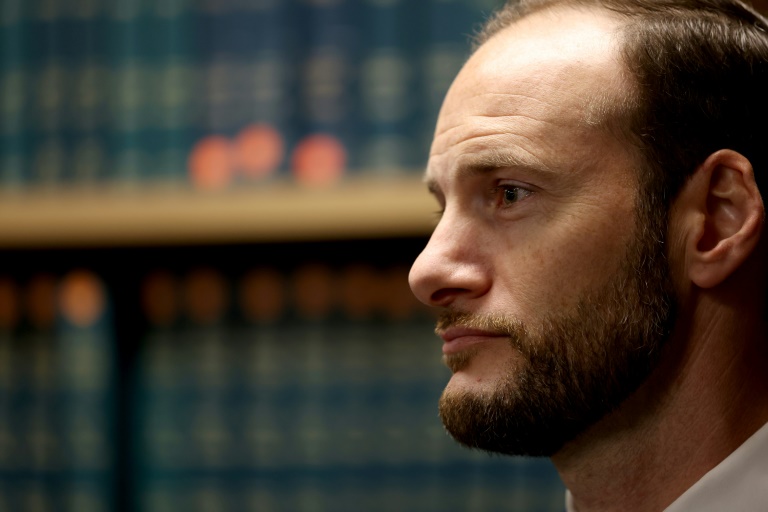
Voters in famously liberal San Francisco turfed the city’s chief prosecutor from office Tuesday after complaints that he was just a little bit too left-leaning — even for them.

District Attorney Chesa Boudin lost a recall vote sparked by perceptions of rising crime and exploding homelessness that blight what was once one of the most livable cities in the United States.

Critics charge it is his fault; that his refusal to seek the death penalty, his use of treatment — not punishment — for criminals with drug habits, and his attempt to reform the police have given criminals free rein.

Shortly after polls closed on Tuesday, the San Francisco Chronicle reported that early results showed a six-to-four majority of voters in favor of booting him out.

“Boudin will be removed from office 10 days after the Board of Supervisors formally [accepts] the election results,” the paper explained.

The recall mirrors a larger discontent in some American cities where liberal voters who have traditionally shunned the tough-on-crime rhetoric of the political right are calling for a crackdown.

In Los Angeles, a similarly minded district attorney is fending off a second slow-burning attempt to fire him for his supposedly soft approach to prosecution.

And in Seattle, taxpayers are chafing at rocketing robberies and surging violent crime at a time the number of law enforcement officers working in the city has shrunk in the wake of campaigns to “Defund the Police”.

– Progressive –

Boudin, 41, who was elected in 2019, has a thoroughly progressive pedigree.

His parents were radicals in the revolutionary communist Weather Underground group, and were jailed for their part in an armed robbery that left two police officers dead.

He worked for a while as a translator for left-wing Venezuelan firebrand Hugo Chavez, and spent much of his career as a public defender.

His policies in office — not prosecuting children as adults, aggressively going after wrongdoing by police officers, and reducing the prison population — were not radical by European standards, but stand out in the United States.

And they are not universally popular, even in a city that prides itself on tolerance and enlightenment.

Statistics show overall crime in San Francisco has been largely stable during Boudin’s time in office, though burglaries and car break-ins are up.

But a few well-publicized incidents — smash-and-grab raids at swanky department stores, and vicious anti-Asian attacks — have combined with the long shadow of pandemic frustration to generate a perception that the city is going to the dogs.

Boudin says the recall effort was driven by right-wing businesspeople and by less-than-liberal police officers.

“This is a Republican- and police union-led playbook to undermine and attack progressive prosecutors who have been winning elections across the country,” he told The Guardian.

“The playbook involves delegitimizing and fear-mongering and recalling. It’s a tactic being used by folks who are increasingly unable to prevail in elections when they put forward their views about public safety and justice.”

But the recall push also garnered support closer to home, with many fellow Democrats lukewarm about Boudin, including Mayor London Breed, who is likely to appoint a moderate as interim district attorney until a citywide vote later this year.

Tuesday’s vote in San Francisco was one of a number of ballots taking place in the United States, most of them primaries that will decide who goes through to a run-off in November, when Americans will cast midterm votes for Congress and in a slew of local and state races.

Los Angeles is likely to narrow down a crowded field of mayoral candidates to two, including a billionaire former Republican promising to be tough on crime.

Democrats in solidly blue New Mexico voted on a new attorney general, and there were also contests in New Jersey, Iowa, South Dakota and Montana.

China approves 60 new games, sparking hopes tech crackdown is ending

China has approved the release of dozens of new video games, boosting the shares of some of its biggest tech firms Wednesday on hopes that a long-running and painful crackdown on the sector is easing.

The announcement follows a report in The Wall Street Journal on Monday that said regulators were wrapping up their investigation into ride-hailing giant Didi and will allow it to register new users.

Officials in China — the world’s biggest gaming market — rolled out a series of restrictions last year as part of a sweeping government campaign to rein in huge tech firms.

They capped the amount of gaming time for children with the stated aim of fighting addiction and froze approvals for new games for nine months, hammering the bottom lines of many companies including sector titan Tencent.

China’s National Press and Publication Administration said Tuesday it had approved 60 new games, following the year’s first batch of approvals in April.

Titles from Tencent or rival NetEase were not among the latest approvals, but they did include games from Perfect World and miHoYo — developer of the international hit “Genshin Impact”.

“We are delighted to see established studios such as Perfect World, Shengqu Games, MiHoYo, and Changyou obtained approval titles this time, which we believe could indicate higher possibilities for Tencent’s and NetEase’s titles to be approved in coming batches,” said Citi analysts in a note.

“The approval announcement will also send a positive signal of policy support to the overall China Internet sector.”

Chinese tech stocks surged in Hong Kong on the news, building on the positive sentiment among investors and analysts after the report on Didi earlier in the week.

At the break in Hong Kong, Tencent was up 4.7 percent while NetEase climbed 2.9 percent

The gaming news also boosted other major tech stocks — Hong Kong market heavyweight Alibaba was up more than eight percent and JD.com piling on more than four percent.

During the clampdown, hundreds of Chinese game makers pledged to scrub “politically harmful” content from their products and enforce curbs on underage players to comply with government demands.

China’s economy, the world’s second-largest, has been hammered in recent months by a series of major Covid lockdowns, and the government has rolled out a series of measures to resuscitate it.

— Bloomberg News contributed to this story —

Fears mount for UK journalist, Indigenous expert missing in Amazon

Rights groups and families of a British journalist and Brazilian Indigenous expert who went missing deep in the Amazon after receiving threats pleaded Tuesday for authorities to accelerate the search operation.

Veteran freelance journalist Dom Phillips, 57, and respected Indigenous specialist Bruno Pereira, 41, went missing early Sunday while traveling by boat in Brazil’s Javari Valley, near the border with Peru, where Phillips was researching a book.

As the 48-hour mark passed, speculation swirled around whether they could have fallen victims to an accident or foul play.

As of Tuesday night, authorities had no reports on their whereabouts but Amazonas state civil police said they were questioning a “suspect” and that four other people had testified as “witnesses,” though no arrests were made.

Local Indigenous activists said the pair received threats last week for their work in the remote region, which has seen a surge of illegal logging, gold mining, poaching and drug trafficking.

Loved ones were holding out hope the pair would be found.

“I want to make an appeal to the government to intensify the search,” Phillips’s Brazilian wife, Alessandra Sampaio, said in a video message.

“We still have some small hope of finding them. Even if I don’t find the love of my life alive, please find them,” she said, choking back sobs.

The Brazilian government expressed its “grave concern,” and said police were taking “all possible measures to find (the men) as quickly as possible.”

But the authorities faced accusations of failing to act urgently enough.

The Ministry of Defense said in a statement that since Monday the army had deployed 150 soldiers who are “specialists in jungle environment operations, who know the terrain where the searches are being carried out.”

But three Indigenous rights groups in the region earlier said in a joint statement that just six state police officers were actively working on the operation, and urged the government to deploy helicopters and a task force.

“The Brazilian government was very slow to act, in a situation where acting quickly is absolutely essential,” the World Wildlife Fund (WWF) Brazil office said in a statement.

Brazil’s federal police later said they had deployed a second helicopter to aid the effort.

– Bolsonaro response criticized –

President Jair Bolsonaro drew criticism for appearing to blame the missing men, both of whom have extensive experience in the Amazon rainforest basin.

“Two people in a boat in a region like that, completely wild — it’s an unadvisable adventure. Anything can happen,” Bolsonaro said.

“Maybe there was an accident, maybe they were executed.”

The far-right president has faced accusations of fueling invasions of Indigenous lands in the Amazon with his pro-mining and pro-agribusiness policies.

Pereira, an expert currently on leave from Brazil’s Indigenous affairs agency FUNAI, has spent much of his career fighting such invasions — making him a target of frequent threats.

– ‘Anguished’ wait –

The men’s families urged the authorities to act fast.

“Time is a key factor in rescue operations, particularly if they are injured,” Pereira’s family said in a statement.

It said his partner, three children and other relatives were in “anguish.”

Phillips’s sister Sian posted a video message online, fighting back tears.

“We are really worried about him and urge the authorities in Brazil to do all they can,” she said. “Every minute counts.”

A group of about 40 reporters and friends of Phillips appealed to Brazilian authorities in a letter published in O Globo newspaper to expand the search effort.

In addition, 11 press organizations requested an emergency meeting with the justice minister and other high-level officials to get a progress report on the hunt.

Phillips, who is based in the city of Salvador, had previously accompanied Pereira in 2018 to the Javari Valley for a story in Britain’s Guardian newspaper, where he was a regular contributor.

The 85,000-square-kilometer (33,000-square-mile) reservation is home to around 6,300 Indigenous people from 26 groups, including 19 with virtually no contact with the outside world.

FUNAI’s base there, set up to protect Indigenous inhabitants, has come under attack several times in recent years.

In 2019, a FUNAI officer there was shot dead.

The region has seen a surge of illegal mining, logging and poaching in recent years, and its remoteness makes it a haven for drug traffickers, said Fiona Watson, research director at Indigenous rights group Survival International.

“You’re talking about dense tropical forest,” she told AFP.

“The operation to try and locate Bruno and Dom is immensely challenging.”

Zelensky defiant as Russia claims Severodonetsk gains

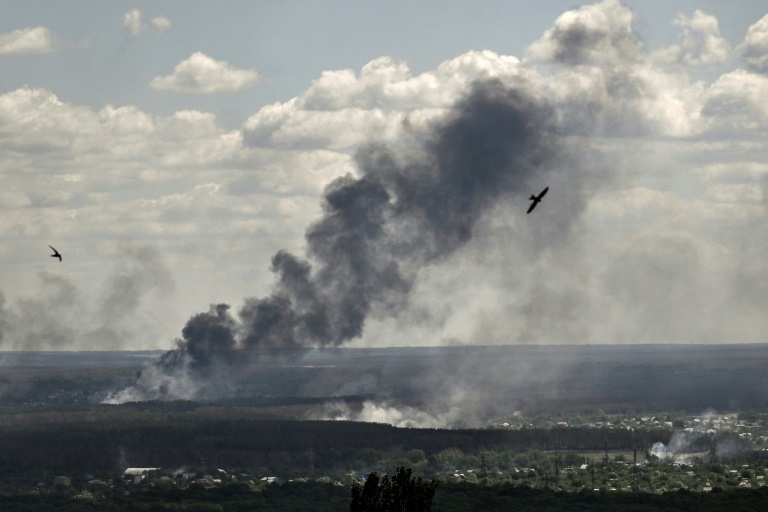
Russia claimed its forces have taken full control of residential neighbourhoods in eastern Ukraine’s Severodonetsk, as President Volodymyr Zelensky vowed the “heroic defence” of the Donbas region will persist against the odds.

The strategic city is currently the focus of Russia’s offensive after their forces were repelled from other parts of Ukraine following the February invasion.

Intense street fighting has raged for days, with the situation on the ground changing rapidly. 

Russia claimed Tuesday residential areas had been “fully liberated” but that Ukrainian forces still hold the industrial zone and surrounding settlements.

Ukrainian officials later countered that the Russians weren’t in control of the city, and Zelensky struck a defiant tone in his daily video address late Tuesday.

“The absolutely heroic defence of Donbas continues,” he said.

“The occupiers did not believe that the resistance of our military would be so strong.”

The cities of Severodonetsk and Lysychansk, which are separated by a river, are the last areas still under Ukrainian control in the Lugansk, which together with Donetsk forms the Donbas region. 

After being repelled from Kyiv, Russia is seeking to capture a vast swathe of eastern Ukraine.

The war’s impact continued to reverberate, with the World Bank cutting its global growth estimate to 2.9 percent — 1.2 percentage points below the January forecast — due largely to the invasion of Ukraine.

The toxic combination of weak growth and rising prices could trigger widespread suffering in dozens of poorer countries still struggling to recover from the upheaval of the Covid-19 pandemic, the bank said.

“The risk from stagflation is considerable with potentially destabilising consequences for low and middle income economies,” World Bank President David Malpass told reporters.

“For many countries recession will be hard to avoid,” Malpass said.

The bank additionally announced $1.5 billion more in aid for Ukraine, bringing the total planned support package to more than $4 billion.

– Lavrov in Turkey –

Amid stark warnings of global food shortages partly blamed on the war, Russian Foreign Minister Sergei Lavrov is set to meet Wednesday with his Turkish counterpart Mevlut Cavusoglu during a visit to Ankara.

Talks will focus on efforts to open a security corridor to ship Ukrainian grain — cereals and wheat in particular — stuck in the war-torn country’s ports due to a Russian blockade. 

“Right now we have about 20-25 million tonnes blocked. In the autumn that could be 70-75 million tonnes,” Zelensky said Monday.

At the request of the United Nations, Turkey has offered its services to escort maritime convoys from Ukrainian ports, despite the presence of mines — some of which have been detected near the Turkish coast.

Both sides accuse one another of destroying agricultural areas, which could worsen global food shortages.

“Those who pretend to be concerned about the global food crisis are, in fact, hitting agricultural fields and infrastructure, where fires are breaking out on an impressive scale,” the Ukrainian military said Tuesday, pointing to attacks in the southern city of Mykolaiv.

– Trapped in chemical plant –

Severodonetsk appeared close to being captured just days ago but Ukrainian forces launched counterattacks and have so far managed to hold out, despite Zelensky warning the defenders are outnumbered by superior forces.

Lanny Davis, a US lawyer for Ukraine tycoon Dmytro Firtash, said 800 civilians had taken refuge in the bunkers inside Firtash’s huge Azot chemical plant in the city.

“These 800 civilians include around 200 out of the plant’s 3,000 employees and approximately 600 inhabitants of the city of Severodonetsk,” Davis said.

The Ukrainian army said Tuesday that Russian troops were also preparing to attack the key city of Sloviansk, about 65 kilometers (40 miles) west of Severodonetsk.

Its capture would open up the route to Kramatorsk, the main city of the Ukrainian-held part of the Donetsk region.

The leader of Ukraine’s pro-Russian separatists in Donetsk, Denis Pushilin, on Tuesday confirmed the death of another Russian general in the fighting.

Pushilin expressed on Telegram his “sincere condolences to the family and friends” of Major General Roman Kutuzov, “who showed by example how to serve the fatherland”.

Ukraine’s forces have claimed to have killed several of Russia’s top brass but their exact number is not known as Moscow is tight-lipped on losses. 

On Tuesday, Zelensky announced the launch next week of a “Book of Torturers”, a system that will collect details of alleged war crimes and Russian soldiers accused of committing them. 

“I have repeatedly stressed that they will all be held accountable. And we are approaching this step by step,” he said.

“Everyone will be brought to justice.”

burs-sr/oho

Thai railway market back on track post-pandemic

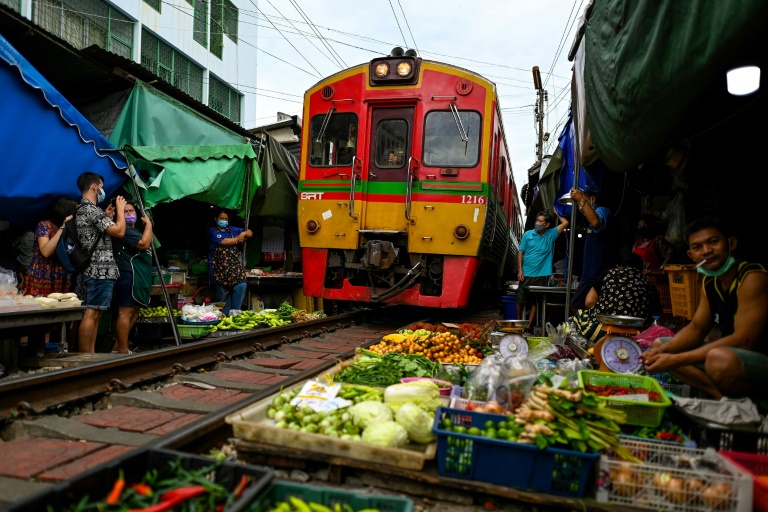
A train bell rouses a Thai grandmother dozing in her fruit and flower stall, sending her rushing to fold in her awning before the locomotive slowly rumbles past, so close it almost touches her wares.

Six times a day at the Mae Klong Railway Market, local customers and foreign tourists scramble into nooks and crannies while vendors calmly move their woven baskets of goods away from the tracks and close their umbrellas to make way.

Hundreds of stallholders carve out a living along this 500-metre stretch of railway in Samut Songkhram, 80 kilometres (50 miles) west of Bangkok, selling everything from fresh produce to live turtles to clothes and souvenirs.

“Even though it looks risky and dangerous, it’s not dangerous at all,” said fruit and vegetable vendor Samorn Armasiri.

Her family has run a stall in the bazaar — nicknamed in Thai “talad rom hup”, or the umbrella-pull-down market — for five decades, and she’s never witnessed an accident.

“When the train enters, officers sound the horn and everybody packs their stuff — they know the drill,” she said.

– Big train, tiny space –

The sides of the train carriages pass directly over — with just centimetres to spare — bags of lettuce, broccoli, onions, ginger, chilli, tomatoes and carrots placed carefully on the outside of the rails.

In recent years, the spectacle had become a hub for coconut-drinking backpackers in elephant pants and Instagram selfie enthusiasts, but the pandemic hit hard.

Now, with Thailand dropping Covid-19 entry restrictions, tourism is picking up once more.

Australian Ella McDonald, on a two-day stopover on her way to Turkey, was among those marvelling at the market’s organised chaos.

“It was crazy and hectic,” she told AFP. “I was shocked at how big the train was in the small amount of space.

“It’s a unique experience. I’ve never seen anything like this anywhere else in the world.”

– Not just for tourists –

Before Covid-19 hit, the market was also beloved by Chinese tourists buying durian — the pungent-smelling “king of fruit”.

Strict quarantine rules presently discourage would-be visitors from China, who once made up the largest share of foreign tourists in Thailand.

But even without them, fishmonger Somporn Thathom — a stallholder since 1988 — said business was finally picking up after two years of hardship and financial strain.

“During Covid, I barely made enough to pay my staff. I managed to sell 10 fish per day,” the 60-year-old said.

“I used up all my savings… and had to borrow money from the bank.”

Station manager Charoen Charoenpun believes the market’s authenticity ensures its popularity.

“It’s not made up. It’s not built for the tourists,” he said.

“The tourists, when they come they can see the tradition and culture of the local people of Samut Songkhram.”

But for eight-year-old Australian William, the pandemonium ensuing as the train passed through was captivating.

“The most exciting thing is when you get the train going past — just seeing the (market vendors) pack up,” he said.

Out of the frying pan: Indonesians pay price of cooking oil crisis

About three weeks after Russian troops invaded Ukraine, Indonesian housewife Liesye Setiana was forced to close her banana chip business as cooking oil supplies dried up across the country.

Millions of consumers and small business owners in the world’s fourth most populous nation have been rattled for months by skyrocketing cooking oil prices. 

As the war between the two major grain and sunflower seed producers sent jitters through global markets, many producers rushed to shift their goods abroad to cash in on soaring rates.

Setiana would travel to a supermarket over an hour from her remote East Java village of Baruharjo to buy a daily eight-litre batch of palm oil that could keep her business alive.

But the 49-year-old mother of two would be turned away, with sellers heavily rationing the commodity used in products ranging from cosmetics to chocolate spreads.

“I was fuming and told the employees that I really need the cooking oil for personal use, not for hoarding,” said Setiana, who used to make up to 750,000 rupiah ($52) a day selling her savoury yellow snack.

“How come we have cooking oil shortages when Indonesia is the world’s top palm oil producer?” 

Her battle for supplies is just a snapshot of the cooking oil crisis that has spurred hours-long queues of residents with jerry cans in hand across Indonesia’s most populous island, Java, and others such as Borneo.

Two people died in March from exhaustion — including one who had queued at three different supermarkets, according to local media — as they waited in searing heat to get their hands on a product that rose to 20,100 rupiah a litre at its height.

– Counting costs –

Indonesia produces about 60 percent of global palm oil supplies, with one-third consumed domestically. India, China, the European Union and Pakistan are among its major export customers.

The squeeze on cooking oil at home forced the Indonesian government to impose a now-lifted ban on exports last month, easing prices and shoring up domestic supplies.

But at the end of May, the price of bulk cooking oil, the most affordable in the country, still hovered at about 18,300 rupiah per litre on average, above the government’s target of 14,000 rupiah, according to official data.

The price spike has left many with difficult decisions to make.

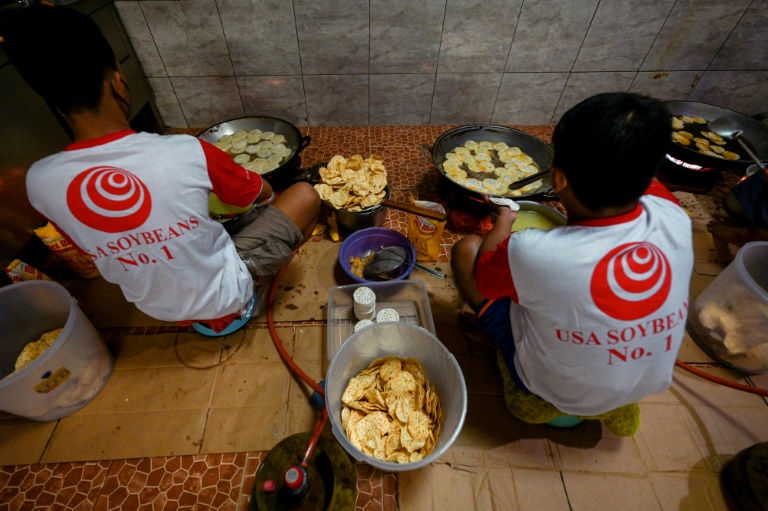
Sutaryo, who like many Indonesians goes by one name, runs a tempe chip business out of his home in South Jakarta. He was forced to jack up his prices and lay off four employees to stay afloat.

“After the surge of cooking oil prices, we have to be smart in calculating our production cost. Our consumers are left with no other choice but to accept a higher price for our kripik tempe,” he said, referring to the traditional soy-based crackers.

With demand yet to recover, production at Sutaryo’s home factory has slid from 300 to 100 kilogrammes a day, and daily revenue is down to six million rupiah from 15 million before the pandemic.

About half-a-dozen workers cut thin slices of tempe before throwing them into frying pans of hot oil, letting them sizzle until crispy. 

It is a far cry from the hustle and bustle of the business’s pre-pandemic peak, said Sutaryo, when he had workers frying tempe chips outside for lack of space.

– ‘Significant’ impact on poor – 

Cooking oil prices were already on the rise in 2021, but the impact of Moscow’s assault has driven them to record highs, said Mohammad Faisal, executive director of the Center of Reform on Economics (CORE Indonesia) think tank.

The government is now moving to secure even more supplies at home, meaning there is unlikely to be a repeat of the spike seen after Russia’s invasion of Ukraine, he said.

But while prices may come down in Indonesia’s towns and cities, they will stay high for those living in rural and remote areas like Setiana.

“For lower-income people, the impact is significant because, at the same time, there are increases in the prices [of other commodities],” Faisal told AFP.

With local prices unlikely to fall, and with little money coming in since her husband was laid off, Setiana now has other worries — like no longer being able to afford school fees for her children.

“If prices of staple goods go up, we have little left for other expenses.”

Asian markets track Wall St rally, boosted by China hopes

Asian markets rallied Wednesday, building on a hearty performance on Wall Street and helped by the reopening in China, though analysts continue to warn of near-term volatility caused by surging inflation, rising interest rates and the Ukraine war.

Equities have enjoyed some respite in recent weeks from a painful sell-off caused by central bank monetary tightening — particularly by the Federal Reserve — and a spike in prices that is beginning to hit consumers, raising concerns of an economic slowdown or recession.

A retreat in US Treasury yields provided a lift to New York traders, as did a jump in Chinese firms listed there fuelled by growing optimism that Beijing is to ease back on its long-running crackdown against the tech sector.

The improved mood around tech has come after a report this week said China was close to ending a probe into ride-hailing app Didi Global and restoring its main apps this week.

The Wall Street Journal also said investigations into two other firms — Full Truck Alliance and recruitment platform Kanzhun — were coming to a conclusion.

And on Tuesday authorities approved a second batch of 60 games in a further step to lightening their approach in the world’s largest mobile entertainment market.

Citi analysts said the “announcement will also send a positive signal of policy support to the overall China internet sector”.

Market heavyweights rallied in Hong Kong with Alibaba up more than six percent, Netease four percent higher and Tencent up more than three percent, helping the Hang Seng Index climb more than one percent.

Shanghai, Tokyo, Sydney, Seoul, Wellington, Taipei and Manila were also well in positive territory.

The moves come as Beijing relaxes its strict Covid lockdown measures, allowing the world’s number two economy to edge back into life after months.

“The bounce in risk sentiment is due to a more positive China tilt where the outlook is set to brighten up as Covid restrictions ease, and state-owned banks are obliged to increase lending again,” said SPI Asset Management’s Stephen Innes.

“It certainly feels like the tide is turning on the Mainland, though the overall tone still leans more cautiously optimistic, with key emphasis on ‘cautiously’.”

All eyes are on the release Friday of US inflation data for a better idea about the Fed’s plans as it hikes borrowing costs.

Officials are expected to lift rates half a point each in June and July with some commentators warning a strong report on Friday could allow them to unveil a three-quarter-point move in September.

Such a move would push the dollar up even further against its peers, with the unit at a 20-year high against the yen.

And observers said that the uncertainty would continue to cause volatility on markets.

“The reality for the economy and probably the stock markets is that aggressive central bank rate hikes are likely to take a sharp bite out of household consumption as costs of living pressures come from goods and services, depressed real wage gains and markedly higher mortgage servicing,” Innes added. 

“Hence, the central bank’s endgame is to cool inflation by slowing the economy and tightening financial conditions at stock market investors’ expense until price pressures abate.”

And Kate Moore at BlackRock explained to Bloomberg Television that “figuring out the direction over the next couple of months becomes increasingly difficult”.

“There seems to be across all of the investing segments a lack of strong conviction in the direction of the market. We are going to see a lot more investors remain on the sidelines, remain cautiously positioned.”

– Key figures at around 0230 GMT –

Tokyo – Nikkei 225: UP 1.0 percent at 28,208.92 (break)

Hong Kong – Hang Seng Index: UP 2.0 percent at 21,696.89

Shanghai – Composite: UP 0.7 percent at 3,264.90

Dollar/yen: UP at 133.00 yen from 132.62 yen late Tuesday

Euro/dollar: DOWN at $1.0693 from $1.0715 

Pound/dollar: DOWN at $1.2580 from $1.2592

Euro/pound: DOWN at 85.00 pence from 85.02 pence

Brent North Sea crude: UP 0.1 percent at $120.71 per barrel

West Texas Intermediate: UP 0.2 percent at $119.65 per barrel

New York – Dow: UP 0.8 percent to 33,180.14 (close)

London – FTSE 100: DOWN 0.1 percent at 7,598.93 (close)

US VP Harris announces migration funds as Mexico snubs Americas summit

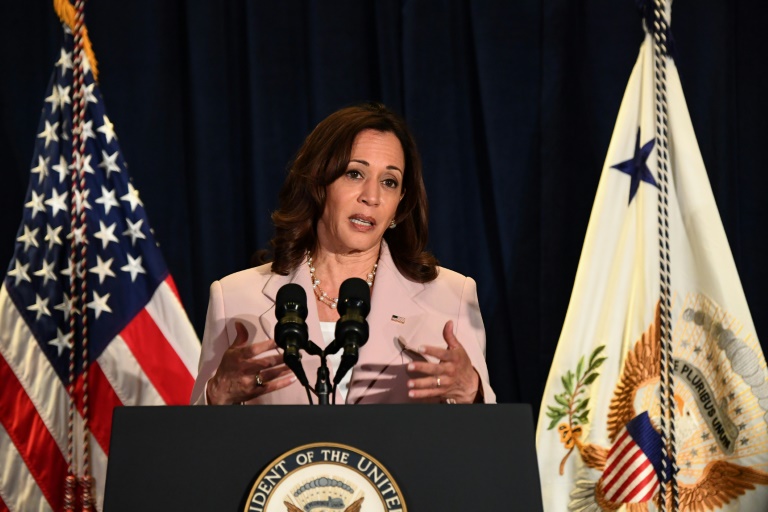
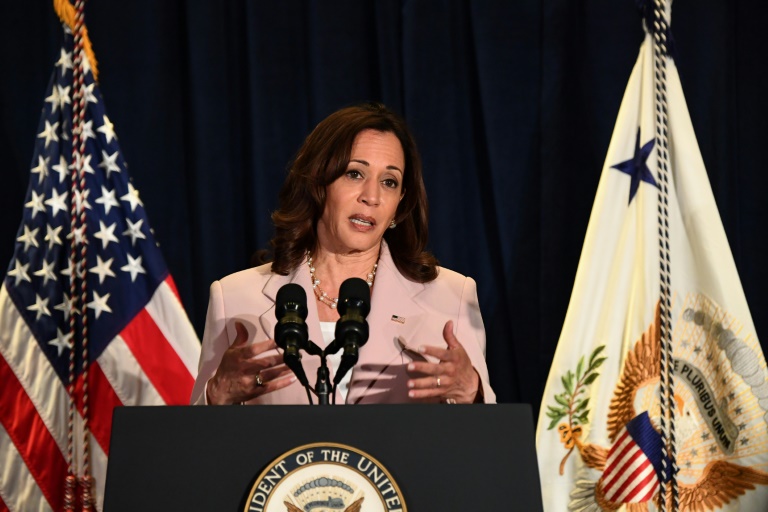
US Vice President Kamala Harris on Tuesday announced a fresh $1.9 billion in private sector funding to boost jobs in hopes of reducing migration from Central America, at a Latin America summit in Los Angeles snubbed by the leaders of Mexico and other affected countries.

Harris has been given the unenviable task of tackling the root causes of rising migration into the United States, an issue seized upon by the rival Republican Party that has turned into a top priority for President Joe Biden at a week-long Summit of the Americas.

A day before Biden’s arrival, Harris unveiled $1.9 billion in commitments by businesses — in addition to $1.2 billion announced last year — for the impoverished and violence-ravaged so-called Northern Triangle of El Salvador, Guatemala and Honduras.

Harris, who met business leaders, female entrepreneurs and civil society as part of the summit in her home state, said the efforts come from “our shared belief that most people don’t want to leave home” but also that “government cannot do it alone.”

“We know the American people will benefit from stable and prosperous neighbors. And when we provide economic opportunity for people in Central America, we address an important driver of migration,” she said.

Harris also announced the creation of the “Central American Service Corps” funded through US aid to mentor young people.

But none of the Northern Triangle leaders are attending the summit, nor is President Andres Manuel Lopez Obrador of Mexico, the crucial US partner on migration policy due to the 2,000-mile (3,200-kilometer) shared border. 

Lopez Obrador, a leftist populist, had insisted that Biden invite all governments including Cuba, Nicaragua and Venezuela — which the United States is excluding on the grounds that the summit is only for democracies.

– Seeking ‘unity’ –

Argentina’s center-left president, Alberto Fernandez, who confirmed his attendance after a phone call and invitation to Washington from Biden, said he would try to “give a voice” to the absent countries.

“We enormously regret the non-presence of the countries that weren’t invited,” he told reporters before heading to Los Angeles.

“Unity is not spoken, it is exercised, and the best way to exercise it is by not segregating anyone,” he said.

Mexican Foreign Secretary Marcelo Ebrard, attending instead of Lopez Obrador, said his president would visit Washington next month and insisted that ties were not at risk.

The relationship between the neighbors “is positive and will remain so and we don’t expect any change in that,” he said.

But Lopez Obrador’s absence set a sour tone after the Mexican leader’s surprisingly close partnership with Biden’s predecessor Donald Trump, who had threatened Mexico with sanctions unless it cracked down on Central American migrants.

US Secretary of State Antony Blinken sought until the last minute to woo Lopez Obrador, including by seeking lower-level participation by Cuba and easing some restrictions including on US flights to the communist island.

But US officials said they saw no reciprocation from Cuban authorities, who recently went ahead with the trial of two dissident artists.

– No Venezuela –

On Venezuela, the United States does not recognize President Nicolas Maduro, whose 2018 re-election was clouded by widespread reports of irregularities. Maduro instead traveled to Turkey, which maintains relations with him.

But Biden also did not invite opposition leader Juan Guaido, whom the United States still considers interim president despite what some Latin American officials privately see as his dwindling chances.

Biden will instead speak to Guaido by telephone, Brian Nichols, the top US diplomat for Latin America, told VPI television.

Biden is separately expected to meet President Jair Bolsonaro of Brazil, Latin America’s most populous nation, despite rising fears that the Trump ally will not accept the legitimacy of upcoming elections.

Ebrard hoped that the summit would address the needs for “massive investment” in Latin America and the Caribbean in the wake of the Covid-19 pandemic.

The new funding announced by Harris included a commitment by credit card giant Visa to invest more than $270 million over five years with an aim of bringing another 6.5 million people into a formal financial system in a region rife with corruption.

The North America branch of Yazaki, the Japanese auto parts maker, will invest $110 million, hiring more than 14,000 new employees in Guatemala and El Salvador, the White House said. 

Other companies making commitments include clothing maker Gap and Millicom, a telecommunications company that plans to invest $700 million to expand mobile and broadband networks across the three countries.

US VP Harris announces migration funds as Mexico snubs Americas summit

US Vice President Kamala Harris on Tuesday announced a fresh $1.9 billion in private sector funding to boost jobs in hopes of reducing migration from Central America, at a Latin America summit in Los Angeles snubbed by the leaders of Mexico and other affected countries.

Harris has been given the unenviable task of tackling the root causes of rising migration into the United States, an issue seized upon by the rival Republican Party that has turned into a top priority for President Joe Biden at a week-long Summit of the Americas.

A day before Biden’s arrival, Harris unveiled $1.9 billion in commitments by businesses — in addition to $1.2 billion announced last year — for the impoverished and violence-ravaged so-called Northern Triangle of El Salvador, Guatemala and Honduras.

Harris, who met business leaders, female entrepreneurs and civil society as part of the summit in her home state, said the efforts come from “our shared belief that most people don’t want to leave home” but also that “government cannot do it alone.”

“We know the American people will benefit from stable and prosperous neighbors. And when we provide economic opportunity for people in Central America, we address an important driver of migration,” she said.

Harris also announced the creation of the “Central American Service Corps” funded through US aid to mentor young people.

But none of the Northern Triangle leaders are attending the summit, nor is President Andres Manuel Lopez Obrador of Mexico, the crucial US partner on migration policy due to the 2,000-mile (3,200-kilometer) shared border. 

Lopez Obrador, a leftist populist, had insisted that Biden invite all governments including Cuba, Nicaragua and Venezuela — which the United States is excluding on the grounds that the summit is only for democracies.

– Seeking ‘unity’ –

Argentina’s center-left president, Alberto Fernandez, who confirmed his attendance after a phone call and invitation to Washington from Biden, said he would try to “give a voice” to the absent countries.

“We enormously regret the non-presence of the countries that weren’t invited,” he told reporters before heading to Los Angeles.

“Unity is not spoken, it is exercised, and the best way to exercise it is by not segregating anyone,” he said.

Mexican Foreign Secretary Marcelo Ebrard, attending instead of Lopez Obrador, said his president would visit Washington next month and insisted that ties were not at risk.

The relationship between the neighbors “is positive and will remain so and we don’t expect any change in that,” he said.

But Lopez Obrador’s absence set a sour tone after the Mexican leader’s surprisingly close partnership with Biden’s predecessor Donald Trump, who had threatened Mexico with sanctions unless it cracked down on Central American migrants.

US Secretary of State Antony Blinken sought until the last minute to woo Lopez Obrador, including by seeking lower-level participation by Cuba and easing some restrictions including on US flights to the communist island.

But US officials said they saw no reciprocation from Cuban authorities, who recently went ahead with the trial of two dissident artists.

– No Venezuela –

On Venezuela, the United States does not recognize President Nicolas Maduro, whose 2018 re-election was clouded by widespread reports of irregularities. Maduro instead traveled to Turkey, which maintains relations with him.

But Biden also did not invite opposition leader Juan Guaido, whom the United States still considers interim president despite what some Latin American officials privately see as his dwindling chances.

Biden will instead speak to Guaido by telephone, Brian Nichols, the top US diplomat for Latin America, told VPI television.

Biden is separately expected to meet President Jair Bolsonaro of Brazil, Latin America’s most populous nation, despite rising fears that the Trump ally will not accept the legitimacy of upcoming elections.

Ebrard hoped that the summit would address the needs for “massive investment” in Latin America and the Caribbean in the wake of the Covid-19 pandemic.

The new funding announced by Harris included a commitment by credit card giant Visa to invest more than $270 million over five years with an aim of bringing another 6.5 million people into a formal financial system in a region rife with corruption.

The North America branch of Yazaki, the Japanese auto parts maker, will invest $110 million, hiring more than 14,000 new employees in Guatemala and El Salvador, the White House said. 

Other companies making commitments include clothing maker Gap and Millicom, a telecommunications company that plans to invest $700 million to expand mobile and broadband networks across the three countries.

Close Bitnami banner
Bitnami