AFP

January 6, 2021: When US democracy was shaken to its core

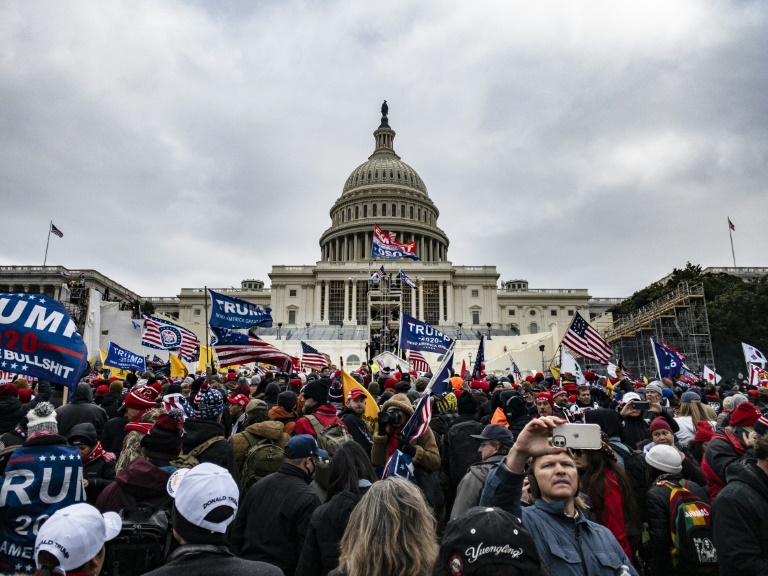
On January 6, 2021, thousands of Americans answered defeated president Donald Trump’s call to descend on Washington and protest against the outcome of the presidential election.

Within a few hours, the US Congress had been overrun in scenes of mayhem without precedent in two centuries.

A year and a half later, the House of Representatives select committee investigating the insurrection launches a series of public hearings on Thursday, hoping to demonstrate Trump’s culpability for the violence.

Here is a look back at this frigid January day when American democracy was shaken to its foundations.

– 7:00 am: Trump supporters hit Washington –

Brandishing Trump 2020 flags and wearing red “Make America Great Again” caps, tens of thousands of Trump supporters crowd into central Washington, convinced that the election he lost was tainted by fraud.

Coming from across the United States, many in buses, they cross the deeply liberal capital city, where most downtown stores and office fronts are barricaded, with locals fearing trouble. 

They converge at a stage erected near the White House, where Trump is due to speak around midday. The Republican leader has previewed proceedings in a tweet predicting the day will be “wild.”

– 11:57 am: Trump on stage –

The US president arrives on stage under heavy winter cloud cover.  

“We will never give up, we will never concede,” he vows. 

“You’ll never take back our country with weakness. You have to show strength and you have to be strong.” 

The crowd gathered in the bracing January chill is galvanized. 

The Republican billionaire urges his vice president, Mike Pence, not to certify Joe Biden’s victory during the upcoming special session of Congress, over which Trump’s most loyal lieutenant is due to preside. 

As he concludes his speech, Trump says: “We’re going to the Capitol.”

His compliant supporters take note and head to the US Congress, at the eastern end of the National Mall. 

– 1:02 pm: The Pence letter –

At the same time, lawmakers in both chambers begin the process of certifying the results of the presidential election.  

Just before the start of the session, Pence makes clear in a letter that he has no plans to oppose certification, a right he says belongs solely to the legislators.

Mitch McConnell, the leader of the Senate’s Republican majority, has been broadly supportive of Trump during his four years in office — but now warns colleagues that doing his will and blocking certification would send democracy into a “death spiral.”  

But from the beginning of the session, some Republicans raise objections to the results of the election in the state of Arizona. 

– 2:00 pm: Protesters breach the Capitol –

Meanwhile, pro-Trump protesters begin to deluge Congress.

Nearby buildings are evacuated as rioters force their way through police barricades. The election certification session is halted and both chambers are placed in lockdown.  

Tear gas is fired into the Capitol rotunda, under the famous neoclassical dome, where police draw their weapons. 

Images of a shirtless man sporting buffalo horns as he wanders the halls of Congress, and of another putting his feet up on Democratic House Speaker Nancy Pelosi’s desk, circulate quickly around the world. 

Police shoot dead a protester who is trying to slip into the chamber through a broken window. 

Ashli Babbitt — an extremist and conspiracy theorist to some, a patriotic martyr for others — will come to symbolize the deep political faultline that divides the United States after the events of January 6.  

– 2:24 pm: Tweets and texts –

While the vice president and lawmakers are evacuated from the chaos of the Capitol, Trump castigates Pence for not having “the courage to do what was necessary to protect the country.” 

The president is following the events on television in a room next to the Oval Office. 

Republican politicians and conservative celebrities implore his chief of staff Mark Meadows to push him to act, text messages released by the House investigation show.  

“Hey Mark, The president needs to tell people in the Capitol to go home. This is hurting all of us,” star Fox News host Laura Ingraham says in a text message at 2:32 pm. 

“He needs to condemn this shit ASAP,” warns the president’s son, Donald Trump Jr., in another message at 2:53 pm. 

– 4:17 pm: Trump tells supporters: ‘Go home’ –

At 4:17 pm, Trump finally posts a video on his Twitter account. 

“I know your pain, I know you’re hurt,” he says from the White House grounds, before launching into by now familiar falsehoods about election fraud.

“We had an election that was stolen from us. It was a landslide election and everyone knows it, especially the other side. But you have to go home now, we have to have peace.” 

– 6:30 pm: Calm restored –

At 6:00 pm, a curfew imposed by the mayor of Washington goes into effect. The demonstrators still on site are dispersed by law enforcement. 

Half an hour later, an official announces that the Capitol is once again secure. 

At 8:06 pm, Congress resumes the certification process.

From the chamber floor where members of the pro-Trump mob were parading a few hours earlier, Pence vows: “To those who wreaked havoc in our Capitol today — you did not win.”

At 3:42 am, the election of Joe Biden is officially certified.
The US Capitol riot public hearings: six questions

The investigation into last year’s assault on the US Capitol by a mob of Donald Trump’s supporters is entering a public phase, with two weeks of blockbuster televised hearings slated to start Thursday.

The seven Democrats and two Republicans who make up the House of Representatives committee probing the insurrection will set out exactly what happened on January 6, 2021 and who they believe aided the ringleaders.

A final hearing in September is expected to reveal the committee’s finished report, outlining its findings and recommendations to prevent such attacks in the future.

Republicans including House Minority Leader Kevin McCarthy say the committee is partisan and “not conducting a legitimate investigation” — an argument that has been rejected by a Trump-appointed federal judge.

– What has the committee been doing? –

The panel has issued around 100 subpoenas and has conducted around 1,000 interviews, with star witnesses including two of Trump’s children — Ivanka and Don Jr. — as well as his son-in-law and senior advisor Jared Kushner.

Investigators have collected more than 100,000 documents, including emails, texts and official White House photographs allowing the committee to dig into the goings-on in and around the Oval Office.

Four of Trump’s most senior aides have refused to comply with subpoenas, and five Republican lawmakers — including McCarthy — have dismissed their subpoenas for testimony as illegitimate.

– What have we learned? –

Revelations around who knew what and when have largely dripped out via court filings in civil cases involving potential committee witnesses and separate criminal cases against the insurrectionists.

Among the most explosive was a trove of text messages between Trump’s chief of staff Mark Meadows and lawmakers, media allies and the Trump family urging the then-president to call on his supporters to end the riot. 

Other texts among more than 2,000 handed over by Meadows show Ginni Thomas, the wife of US Supreme Court Justice Clarence Thomas, agitating for the election results to be overturned.

Meadows burned documents in his office after a meeting with House Republican Scott Perry, who was working to challenge the 2020 election, according to testimony by a former Meadows aide.

– What will the hearings reveal? –

The committee will seek to distill a sprawling, multi-faceted year-long probe into a compelling narrative that will “paint a picture as clear as possible as to what occurred,” chairman Bennie Thompson told reporters.

Investigators hope to set out through public testimony the role the Trump White House played in the campaign to overturn his 2020 election defeat to Democrat Joe Biden.

Those efforts allegedly include an illegal scheme to send fake “electors” — the people appointed to vote for president in the state-by-state “Electoral College” — to Congress.

They also take in an authoritarian plan to seize voting machines and the alleged plot to delay the certification of Biden’s win through the violence at the Capitol.

Investigators want to get to the bottom of a 187-minute delay before law enforcement was beefed up to protect the Capitol and learn why there is a gap of almost eight hours in White House logs of Trump calls as the violence played out.

– Will anyone face charges? –

A federal judge ruled in March that Trump more likely than not committed a crime in the run-up to January 6, 2021.

While the Justice Department is prosecuting more than 800 suspects for alleged lawbreaking at the Capitol, the committee itself has no powers to issue indictments.

The panel is expected to turn over evidence to federal prosecutors but has not announced whether it will recommend charges, a largely symbolic gesture.

– How will the hearings work? –

The committee will hold prime-time hearings at 8:00 pm (0000 GMT) on June 9 and 23, bookending 10:00 am hearings on June 13, 15, 16 and 21. 

Testimony is expected to be accompanied by visual illustrations such as text messages, photographs and videos.

Thursday’s hearing is set to feature testimony from US Capitol Police officer Caroline Edwards, the first to be injured by rioters, and filmmaker Nick Quested, who recorded the first moments of violence.

J. Michael Luttig, a former federal judge who advised Trump’s vice president Mike Pence, is expected to testify.

Other witnesses could include Marc Short, a chief of staff to Pence, Justice Department official Richard Donoghue and Jeffrey Rosen, Trump’s last attorney general.

All four were party to much of the relevant discussion between Trump’s election defeat and the insurrection two months later, investigators say.

The committee has been lukewarm about the idea of forcing Trump to testify, asserting that his appearance would likely add little to its understanding of the facts.

– Will they change any minds? –

Supporters see the committee’s work as vital in ensuring one of the darkest episodes in the history of US democracy is never repeated.

Yet Democrats worry the hearings could be seen as another “partisan” attack on Trump, imperiling bipartisan efforts at reform and obscuring the broader story of a slow-moving coup attempt aided by a violent insurrection.

“The top issues for most US voters have nothing to do with the January 6 insurrection, unfortunately,” Democratic analyst Mike Hernandez told AFP as his party faces tricky midterm elections later this year. 

“Inflation, gas prices, school shootings, school safety and reproductive rights are all issues that more Americans care about.”

Helium shortage deflates American celebrations

Helium balloons are part of nearly every American celebration, but a global shortage of the lighter-than-air gas has disrupted many traditions.

One college football team has suspended its traditional release of red balloons, and party planners will have to make do with less — if they get any.

“Due to the global helium shortage, we only allow 20 balloons to be ordered,” Litin’s Party Value, a party supplier in Minneapolis, Minnesota, warns on its website. 

“We’ve had some customers pretty disappointed that they couldn’t get more,” Kristi Holmstrom, the chain’s general manager, told AFP. 

“I’ve never seen it this bad before,” she said, adding that many stores have run out of helium entirely.

Whether it floats at the end of a string or grouped in a bouquet, shaped like a cartoon character, a number, or a Halloween pumpkin, helium balloons are a must. 

Between the lost sales and the suspension of the helium rental business, Holmstrom estimates the shortfall to be between $5,000 and $10,000 a month. 

The University of Nebraska football team, the Cornhuskers, will do without its traditional release of red balloons — the school color — before each home game this season. 

“Acquiring helium … is really challenged and it’s been hard to get,” university athletic director Trev Alberts said in late May. 

University officials asked “that the helium we are getting as a university we need to use for medical purposes” at the university’s medical center in Omaha,” he said.

The inert gas, a byproduct of natural gas production, is liquified to cool magnetic resonance imaging scanners (MRIS), was once deployed on space shuttle missions, and also is used in the manufacturing of semiconductors.

– ‘No store had helium’ –

Only a handful of countries — led by the United States — produce the gas, and the already-fragile supply chain has been disrupted by plant closures: in Texas over safety issues, in Russia after a fire (prior to the war in Ukraine), and in Qatar for maintenance.

Brad Weston, chief executive officer of Party City, said during an earnings call last month that the party supply chain has faced higher costs for helium, which cut about $2 million from gross profit in the first three months of the year and will inflict a bigger hit in the second quarter.

“The good news is we’ve secured helium to meet our customers’ needs,” ahead of the peak graduation season in May and June, he said of the retailer, which has 830 stores in North America.

The situation is even worse for the Dollar Tree discount chain.

“We are once again, experiencing shortages in availability of helium, and have not been able to procure the volume and the needs which will negatively affect balloon sales,” CEO Mike Witynski lamented late last month.

That’s small comfort for families trying to celebrate graduations, weddings and birthdays.

“Tried to get my baby some balloons for her graduation. No stores got helium,” Guy Fisher of Indiana said on Twitter.

– Priority for medical use –

Anna Bondareva, creator of the Wonder Party Rental agency outside of Washington, DC, along with her partner Laura Badmaev, said they are trying to find alternatives. 

“I think it’s getting worse because it’s getting more expensive. It’s harder to get it,” Bondareva told AFP. “That should give us a chance to more creative to rethink our decorations.”

One client opted against using helium balloons for her 33rd birthday celebration due to the high cost. They no longer offer their customers this expensive option, and instead have focused on using balloons in other ways, including arches.

Even the National Weather Service has had to reduce the launch of balloons used for forecasting at a handful of its sites. 

“Where needed, we reduced launches during clear weather to conserve the supply so we can launch in support of forecasts for bad weather days,” a spokeswoman said.

Harvey Weinstein sues Stellantis for 2019 car accident

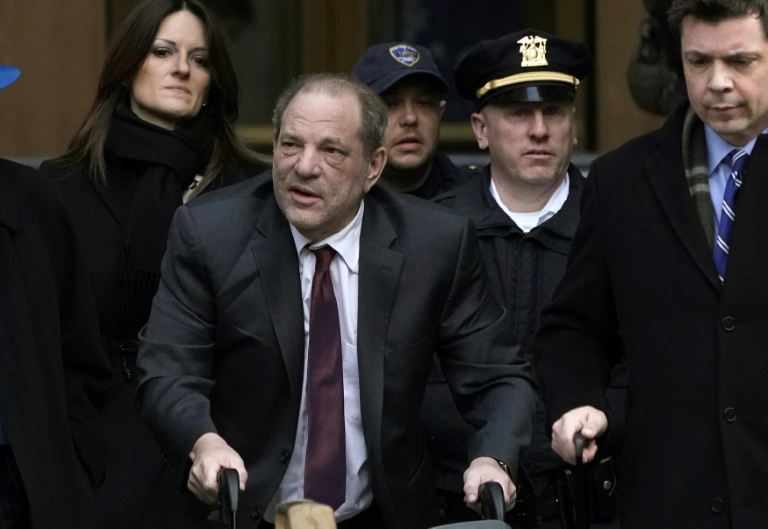
Jailed movie producer Harvey Weinstein filed a lawsuit in New York court on Tuesday against the Fiat Chrysler company, which is now part of Stellantis, claiming $5 million in compensation for an accident he had in 2019 in a Jeep.

Stellantis, in a message sent to AFP, said, “We intend to vigorously defend our product against these claims.”

Weinstein, who was sentenced in 2020 to 23 years in prison for a sexual assault and rape, said in his complaint that he was driving in a Jeep loaned by the company in return for product placement in one of his movies, on August 17, 2019 and that the vehicle’s brakes failed when he tried to avoid hitting a deer. 

The car then overturned, causing Weinstein, who had properly buckled his seat belt, to suffer “catastrophic, permanent paralyzing injuries as well as significant and continuing conscious pain and suffering,” the complaint said.

Weinstein had back surgery in December 2019 following the car accident according to his lawyers, and appeared physically weakened during his trial, often moving with a walker. 

Aged 70, Weinstein is currently incarcerated in a prison in California where he is awaiting another trial for alleged sexual assault against five women.

Academy names new CEO after years of Oscars drama, reforms

The Academy of Motion Picture Arts and Sciences named its new CEO Tuesday, ending a tumultuous 11 years under Dawn Hudson that included the #OscarsSoWhite controversy, a huge expansion of the group’s membership — and Will Smith’s infamous slap.

Hudson first announced plans to step down last October, shortly after the successful opening of the Academy’s major new film museum in Los Angeles. She will be replaced by Bill Kramer, who oversaw that museum launch.

Kramer is “the ideal choice to lead at this pivotal moment for the organization,” Academy president David Rubin said in a statement.

As Hollywood’s most elite group of filmmakers, which also oversees the Oscars, the Academy has had to navigate multiple controversies in recent years, including accusations of a lack of racial diversity.

Most notably, the group was pummeled with criticism for a dearth of Black Oscar nominees during the #OscarsSoWhite movement, which emerged in 2015. 

Hudson oversaw and fulfilled a pledge to double the number of women and minority members by 2020, significantly expanding overall membership from around 6,000 to nearly 10,000 in the process.

“She initiated unprecedented efforts to create more space for diverse voices, both within the membership and our industry,” said Rubin.

Hudson and senior leadership faced criticism for their perceived lack of reaction after Smith struck comedian Chris Rock on stage during this year’s Oscars ceremony.

The Academy has said Smith was asked to leave the Hollywood ballroom shortly after the attack — but that claim was disputed, including by Smith’s representatives.

Smith — who won the Academy Award for best actor shortly after the altercation — was later banned from attending the Oscars for the next decade.

Kramer, who will start as CEO next month, oversaw nearly $400 million in fundraising for the Academy Museum, which was decades in the planning, and has become a top priority for the organization’s future.

The museum — home to Tinseltown memorabilia from Judy Garland’s “Wizard of Oz” ruby slippers to Dracula’s cape — has sold more than 550,000 tickets in nine months, the Academy said.

Pitt says Jolie sought 'harm' by selling vineyard stake to Russian oligarch

Brad Pitt has accused his ex-wife Angelina Jolie of seeking to “inflict harm” on him by selling her 50 percent stake in their French vineyard to a Russian oligarch with “poisonous associations and intentions.”

The allegations, made in new court filings as part of Pitt’s lawsuit against Jolie over the sale of Chateau Miraval, are the latest barb in a bitter legal battle between the former Hollywood power couple who filed for divorce in 2016.

Last October, Jolie sold her share of the southern France vineyard — where she and Pitt had their wedding — to Tenute del Mondo, a subsidiary of Russia-born billionaire Yuri Shefler’s drinks conglomerate.

Pitt sued in February, saying the couple had agreed never to sell their interests without the other’s consent, and accusing Jolie of seeking “unearned” profits.

In an amended complaint seen by AFP, Pitt’s lawyers argue “Jolie sought to inflict harm on Pitt” with the sale, and describe Shefler as “a stranger with poisonous associations and intentions.”

The filing received by a Los Angeles court last Friday alleges Shefler “maintains personal and professional relationships with individuals in Vladimir Putin’s inner circle.”

Shefler has long been an outspoken critic of Putin, and his Stoli Group drinks conglomerate is based in Latvia. 

In March, following Russia’s invasion of Ukraine, Shelfer issued a statement saying he has been “exiled from Russia since 2002 due to my opposition to Putin,” and rebranded his company in “solidarity with Ukraine.”

But Pitt’s latest filing says: “Despite Shefler’s desperate attempt to disassociate himself from the Putin regime, the Stoli brand is now a massive international liability.”

It adds: “Stoli vodka is synonymous with Russia, as the countless images of consumers pouring Stoli vodka down the drain make clear.”

“Since Russia’s February 2022 invasion of Ukraine, Miraval’s insurer has sought assurances that Shefler is not aligned with Putin and that affiliation with Stoli would not create commercial risk,” the filing says.

The complaint also lists Saudi Crown Prince Mohammed bin Salman within Shefler’s alleged “network of ill-reputed professional associates” which “threatens lasting harm to Miraval’s reputation.”

– ‘False narrative’ –

The Stoli Group did not immediately respond to request for comment.

A source close to the situation told AFP that Jolie decided to sell as she and her children “have not been able to return” to Chateau Miraval, and she had made multiple offers to her ex-husband before signing the deal with Shefler.

Pitt’s lawsuit against Jolie was “an extension of a false narrative” and “the truth of the situation has still not been made public,” said the source.

Once Tinseltown’s highest-profile couple, Pitt and Jolie first got together after co-starring as married assassins in the 2005 film “Mr. and Mrs. Smith.” Pitt was married to Jennifer Aniston at the time.

The A-listers announced in 2018 they had reached an amicable settlement over their children — three biological and three adopted — but any deal appeared to quickly fall apart.

Last July, Jolie scored a win in their custody battle as the private judge overseeing their divorce and custody matters was disqualified from the case.

Liberal prosecutor faces recall vote in liberal San Francisco

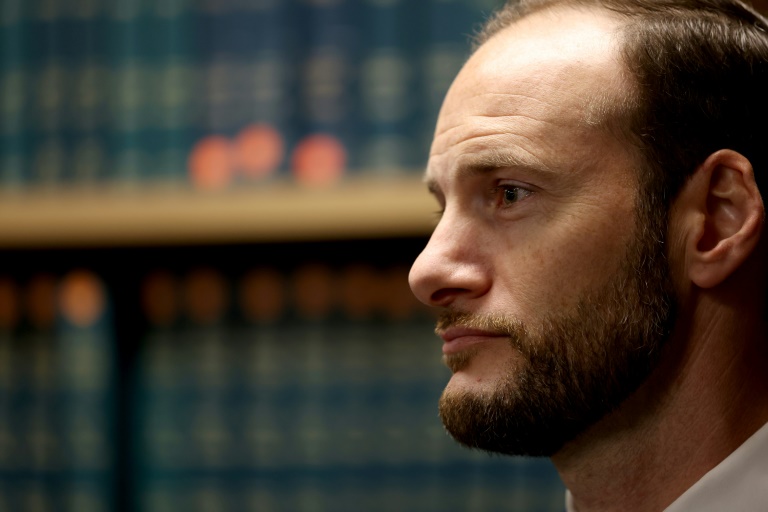
Voters in famously liberal San Francisco will decide Tuesday if the city’s chief prosecutor is just a little bit too liberal even for them.

District Attorney Chesa Boudin faces a recall vote sparked by perceptions of rising crime and exploding homelessness that blight what was once one of the most livable cities in the United States.

Critics charge that it is his fault; that his refusal to seek the death penalty, his use of treatment — not punishment — for criminals with drug habits, and his attempt to reform the police have given criminals free rein.

The recall attempt mirrors a larger discontent in some American cities where liberal voters who have traditionally shunned the tough-on-crime rhetoric of the political right are calling for a crackdown.

In Los Angeles, a similarly minded district attorney is fending off a second attempt to fire him for his supposedly soft approach to prosecution.

And in Seattle, taxpayers are chafing at rocketing robberies and surging violent crime, at a time the number of law enforcement officers working the city has shrunk in the wake of campaigns to “Defund the Police”.

Boudin, 41, who was elected in 2019, has a thoroughly progressive pedigree.

His parents were radicals in the Weather Underground militant leftist group, and were jailed for their part in an armed robbery that left two police officers dead.

He worked for a while as a translator for left-wing Venezuelan firebrand Hugo Chavez, and spent much of his career as a public defender.

His policies in office — not prosecuting children as adults, aggressively prosecuting wrongdoing by police officers, and reducing the prison population — are not radical by European standards, but stand out in the United States.

Statistics show overall crime has not increased during his time in office, though burglaries and car break-ins are up.

But a few well-publicized incidents — smash-and-grab raids at swanky department stores, and vicious anti-Asian attacks — have combined with the long shadow of pandemic frustration.

Boudin says the recall effort has been driven by right-wing businesspeople and by less-than-liberal police officers.

“This is a Republican- and police union-led playbook to undermine and attack progressive prosecutors who have been winning elections across the country,” he told The Guardian.

“The playbook involves delegitimizing and fear-mongering and recalling. It’s a tactic being used by folks who are increasingly unable to prevail in elections when they put forward their views about public safety and justice.”

But the recall push has also garnered support closer to home, with many fellow Democrats lukewarm about Boudin, including Mayor London Breed, who is likely to appoint a moderate if the recall succeeds.

Tuesday’s vote is one of a number of ballots taking place in the United States, most of them primaries that will decide who goes through to a run-off in November, when Americans will cast midterm votes for Congress and in a slew of local and state races.

Los Angeles is likely to narrow down a crowded field of mayoral candidates to two, including a former Republican promising to be tough on crime.

Democrats in solidly blue New Mexico vote on a new attorney general, and there are contests in New Jersey, Iowa, South Dakota and Montana.

Uber and Waymo team up to get driverless trucks rolling

Uber and Google’s autonomous vehicle unit Waymo on Tuesday said they are joining forces to get driverless trucks hauling cargo on roads across the United States.

Due to the vast distances between American cities and with truck transport key to the economy, companies see self-driving as a way to cut costs and reduce risk.

Waymo will allow its technology to mesh with an Uber Freight platform that connects truckers with loads in a spin on how Uber lets people summon rides using smartphone apps.

“Uber Freight’s network of shippers, carriers, and marketplace technology is a great match for the Waymo Driver,” Waymo head of commercialization for trucking Charlie Jatt said in a statement.

Carriers that buy trucks equipped with Waymo systems will be able to opt in to having the vehicles deployed as “autonomous assets” on the Uber Freight network, the companies said.

The firms will also explore together the potential for creating hubs where cargo is easily handed off from self-driving trucks to human truckers.

“Both companies envision a future where autonomous trucks tackle the long-haul portion of driving, easing some of the burden of the increasing demand for freight while also enabling drivers to shift into short-haul jobs,” they said in the release.

Before driverless trucks are allowed onto roads and highways, however, multiple tests must still be conducted to ensure they are safe.

Waymo has been testing self-driving trucks in a handful of US states.

“Uber Freight’s extensive, efficient, and reliable digital network is essential to making autonomous trucks a reality,” said unit head Lior Ron.

The Freight unit has been steadily growing, according to quarterly earnings releases.

Uber and Waymo team up to get driverless trucks rolling

Uber and Google’s autonomous vehicle unit Waymo on Tuesday said they are joining forces to get driverless trucks hauling cargo on roads across the United States.

Due to the vast distances between American cities and with truck transport key to the economy, companies see self-driving as a way to cut costs and reduce risk.

Waymo will allow its technology to mesh with an Uber Freight platform that connects truckers with loads in a spin on how Uber lets people summon rides using smartphone apps.

“Uber Freight’s network of shippers, carriers, and marketplace technology is a great match for the Waymo Driver,” Waymo head of commercialization for trucking Charlie Jatt said in a statement.

Carriers that buy trucks equipped with Waymo systems will be able to opt in to having the vehicles deployed as “autonomous assets” on the Uber Freight network, the companies said.

The firms will also explore together the potential for creating hubs where cargo is easily handed off from self-driving trucks to human truckers.

“Both companies envision a future where autonomous trucks tackle the long-haul portion of driving, easing some of the burden of the increasing demand for freight while also enabling drivers to shift into short-haul jobs,” they said in the release.

Before driverless trucks are allowed onto roads and highways, however, multiple tests must still be conducted to ensure they are safe.

Waymo has been testing self-driving trucks in a handful of US states.

“Uber Freight’s extensive, efficient, and reliable digital network is essential to making autonomous trucks a reality,” said unit head Lior Ron.

The Freight unit has been steadily growing, according to quarterly earnings releases.

US ex-teacher pleads guilty to leading Islamic State women's brigade

A former US schoolteacher who became a high-ranking Islamic State official and organized an all-female IS military battalion, pleaded guilty Tuesday to supporting a foreign terrorist group, the Justice Department said.

Kansas-born Allison Fluke-Ekren, 42, admitted to engaging in “terrorism-related activities” in Syria, Libya, and Iraq between 2011 and 2019.

“Fluke-Ekren ultimately served as the leader and organizer of an ISIS military battalion, known as the Khatiba Nusaybah, where she trained women on the use of automatic firing AK-47 assault rifles, grenades, and suicide belts,” the department said.

“Over 100 women and young girls, including as young as 10 or 11-years-old, received military training from Fluke-Ekren in Syria on behalf of ISIS (Islamic State).”

Her husband was a member of the extremist Ansar al-Sharia group which attacked the US mission in Bebghazi, Libya in 2012, and then became a leader of an Islamic State sniper group in Syria.

The department said the two were involved in extremist activities across the Middle East after they left the United States in 2011.

While in Syria, the department said, she spoke of desires to bomb a US shopping mall or university.

In 2016-17 she became leader of the all-woman Khatiba Nusaybah battalion, which undertook physical, medical and weapons training to support Islamic state.

Fluke-Ekren was apprehended in Syria sometime after the early-2019 territorial defeat of Islamic State, and flown to the United States on January 28.

The court record indicates that her attorneys and the Justice Department spent months negotiating her guilty plea on a single count, supporting a foreign terrorist organization, a charge which brings up to 20 years in prison.

She is scheduled to be sentenced on October 25.

– Born on Kansas farm –

Fluke-Ekren was apparently notorious even inside Islamic State, where she carried the nom de guerre Umm Mohammed al-Amriki. 

On a ten-point scale of radicalization, a person who knew her in Syria called her “an 11 or a 12.”

She was born on a Kansas farm and grew up Christian in Topeka, where she was known as a bright student.

“Never would any of us who knew her back then ever thought she would end up as she has today,” Larry Miller, a retired science teacher, told the Topeka Capital-Journal in January.

She married a man named Fluke and had two children. They split and she married Volkan Ekren, a Muslim with whom she had at least three more children.

As Fluke-Ekren, she studied at the University of Kansas and then earned a master’s degree in teaching from a college in Indiana.

In a 2004 article in the Lawrence Journal-World, Fluke-Ekren is shown wearing a headscarf while home-schooling her two eldest children, which included regular Arabic lessons.

The family moved to Egypt in 2008. Her personal blog showed the family celebrating birthdays, taking a cruise on the Nile and visiting the Pyramids.

– Joining extremists –

But the Justice department suggested her husband was already involved with radical Islamists at that time.

They moved to Libya in 2011, the year of the Arab Spring uprisings and the beginning of the Libyan civil war.

They were in Banghazi in September 2012 when Ansar al-Sharia attacked the US mission and CIA office there, killing the US ambassador and three others. 

Her husband took documents and an electronic device from the fire-charred compound and Fluke-Ekren helped him analyze the contents for the group, the Justice Department said.

They then moved to Turkey and Syria, where they became deeply involved with Islamic State, even living in the group’s Mosul, Iraq stronghold for a time.

She told a person she met that wanted to attack a shopping mall back home, and “spoke about learning how to make bombs and explosives,” the department said.

“Fluke-Ekren further said that she considered any attack that did not kill a large number of individuals to be a waste of resources,” it said.

Close Bitnami banner
Bitnami