AFP

Putin warns of strikes over missile supplies as blasts rock Kyiv

Russian President Vladimir Putin warned Sunday that Moscow will hit new targets if the West supplies Ukraine with long-range missiles, hours after several explosions rocked the Ukrainian capital Kyiv.

If Kyiv is provided with such missiles “we will draw the appropriate conclusions and use our arms… to strike targets we haven’t hit before,” Putin was quoted by Russian news agencies as saying.

He did not specify which targets he meant.

Putin’s comments came after the United States last week announced that it would supply Ukraine with advanced missile systems.

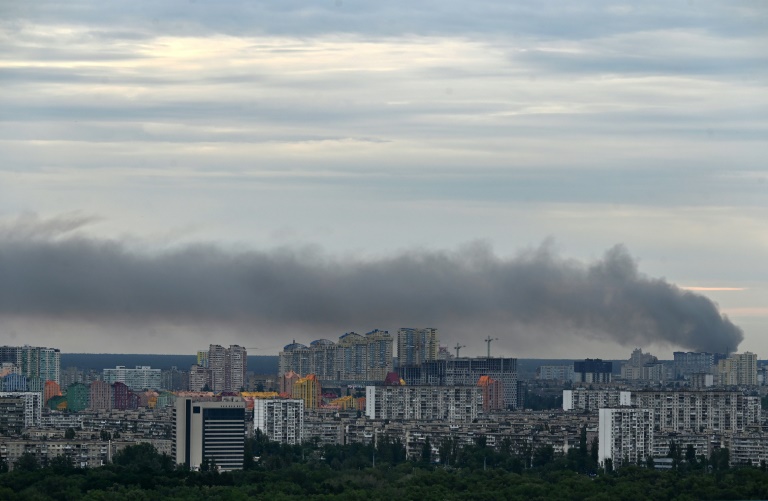
Ukrainian officials earlier on Sunday said Russian missiles hit railway infrastructure sites in the first such strikes on Kyiv since April 28.

Russia said that it had destroyed tanks supplied to Ukraine by eastern European countries during the strikes.

“High-precision, long-range missiles fired by the Russian Aerospace Forces on the outskirts of Kyiv destroyed T-72 tanks supplied by eastern European countries and other armoured vehicles that were in hangars,” Russian defence ministry spokesman Igor Konashenkov said.

One person was wounded and AFP reporters saw several buildings with blown-out windows near one of the sites that was targeted.

Leonid, a 63-year-old local resident who used to work at the facility, said he heard three or four explosions.

“There is nothing military there but they are bombing everything,” he said.

Vasyl, 43, said he heard five blasts.

“People are afraid now,” he said, walking back to his damaged home with two loaves of bread.

Ukrainian authorities did not want to identify the precise locations of the explosions for security reasons.

– Severodonetsk ‘divided’ –

Meanwhile, in the east of the country, the battle for control of Severodonetsk raged on.

The city is the largest still in Ukrainian hands in the Lugansk region of the Donbas, where Russian forces have been advancing gradually after retreating or being beaten back from other parts of the country, including Kyiv.

Lugansk regional governor Sergiy Gaiday said that Russian forces had lost ground in the city and it was now “divided in two”.

“The Russians were in control of about 70 percent of the city, but have been forced back over the past two days,” he said on Telegram.

“They are afraid to move freely around the city.”

Russia’s army on Saturday claimed some Ukrainian military units were withdrawing from Severodonetsk, but Mayor Oleksandr Striuk said Ukrainian forces were fighting to retake the city.

“We are currently doing everything necessary to re-establish total control” of the city, he said in an interview broadcast on Telegram.

– ‘Put Russia in its place’ –

Tens of thousands of people have been killed, millions forced to flee and towns turned into rubble since Russian President Vladimir Putin ordered an all-out assault on his pro-Western neighbour on February 24.

Western powers have imposed increasingly stringent sanctions on Russia and supplied arms to Ukraine, but divisions have emerged on how to react.

French President Emmanuel Macron said Friday Putin had committed a “fundamental error” but that Russia should not be “humiliated” so that a diplomatic solution could be found.

Ukrainian Foreign Minister Dmytro Kuleba reacted Saturday by saying such calls “only humiliate France” and any country taking a similar position.

“It is Russia that humiliates itself. We all better focus on how to put Russia in its place,” he said.

Despite diplomatic efforts, the conflict has raged in the south and east of the country.

The press service of the Ukrainian president’s office on Sunday reported nine civilians killed in the Donetsk and Lugansk regions from shelling.

– Fears over food –

Apart from the human toll, the conflict has caused widespread damage to Ukraine’s cultural heritage.

On Saturday, Ukrainian officials reported a large Orthodox wooden monastery, a popular pilgrim site, had burnt down and blamed Russia shelling.

Moscow continues to prove “its inability to be part of the civilised world,” Culture Minister Oleksandr Tkachenko said in a statement.

Russia’s defence ministry blamed “Ukrainian nationalists” for the blaze.

Russian troops now occupy a fifth of Ukraine’s territory, according to Kyiv, and Moscow has imposed a blockade on its Black Sea ports, sparking fears of a global food crisis. Ukraine and Russia are among the top wheat exporters in the world.

The United Nations said it was leading intense negotiations with Russia to allow Ukraine’s grain harvest to leave the country.

The UN has warned that African countries, which normally import over half of their wheat consumption from Ukraine and Russia, face an “unprecedented” crisis.

Food prices in Africa have already exceeded those in the aftermath of the 2011 Arab Spring uprisings and the 2008 food riots.

– ‘Game of survival’ –

Away from the battlefield, Ukraine will be fighting for victory over Wales in Sunday’s play-off final as the war-torn country aims to reach its first football World Cup since 2006.

“We all understand that the game with Wales will no longer be about physical condition or tactics, it will be a game of survival,” said Ukraine player Oleksandr Zinchenko.

“Everyone will fight to the end and give their all, because we will play for our country.”

burs-dt/ah
Residents return home as Athens firefighters bring blaze under control

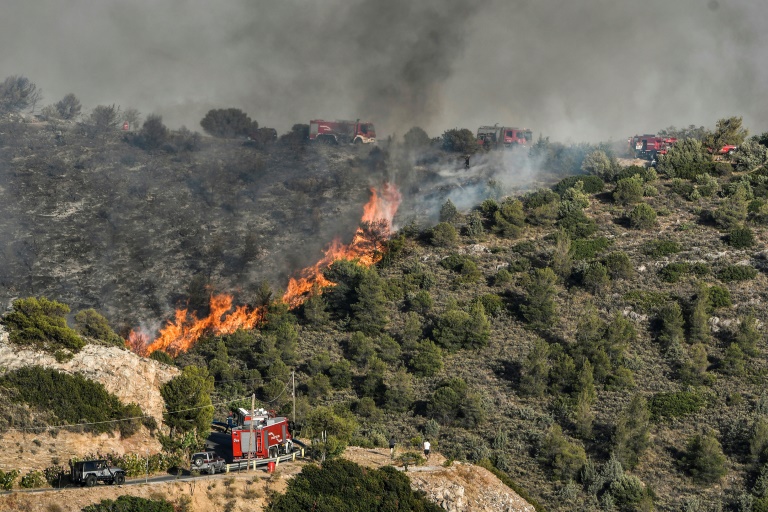
Residents of a southern suburb of Athens returned to their homes on Sunday after firefighters managed to bring under control a wildfire that had forced them to evacuate the day before, the emergency services said. 

“At this point, the fire has been demarcated, the residents are back in their houses,” deputy civil protection minister, Evangelos Tournas, told a news briefing. 

A substantial number of firefighters remained in the area “and will remain as long as it is needed, while aircrafts will continue dropping water protectively,” he said. 

A total of 283 firefighters in 65 vehicles, with the help of groups of bystanders, had battled overnight to bring the fire under control.

And two firefighting planes and two helicopters were still in operation early Sunday. 

While the fire is in remission, with no burning spots, authorities said they remain on high alert in case it breaks out again. 

On Saturday, the Greek Civil Protection agency had issued an emergency appeal via SMS for people to leave the suburb of Ano Voula. 

Officials reported no casualties, but four more neighbourhoods were evacuated as the wind changed direction and drove the fire front towards the town of Vari later on Saturday evening. 

Giorgos Papanikolaou, the mayor of Glyfada, where the fire first broke out, said that it started at a high voltage electricity power station. 

Last summer, Greece’s most severe heatwave in decades, which authorities blamed on climate change, saw fires destroy more than 100,000 hectares of forest and farmland, the country’s worst wildfire damage since 2007. 

More than 200 firefighters and technical equipment provided by European Union countries will be soon deployed to Greece to help boost the battle against large wildfires.

Bulgaria, Finland, France, Germany, Romania and Norway will take part in the deployment, coordinated by the EU’s Civil Protection Mechanism.

Athens wildfire losing intensity, firefighters say

A wildfire whipped up by gale-force winds in a southern suburb of Athens on Saturday, forcing residents to evacuate and damaging properties, has faded in intensity as the winds have dropped, the fire brigade said on Sunday.

A total of 283 firefighters in 65 vehicles, with the help of groups of bystanders, had battled overnight to bring the fire under control.

And two firefighting planes and two helicopters were still in operation early Sunday. 

On Saturday, the Greek Civil Protection agency had issued an emergency appeal via SMS for people to leave the suburb of Ano Voula. 

Officials reported no casualties, but four more neighbourhoods were evacuated as the wind changed direction and drove the fire front towards the town of Vari later on Saturday evening. 

Giorgos Papanikolaou, the mayor of Glyfada, where the fire first broke out, said that it started at a high voltage electricity power station. 

Last summer, Greece’s most severe heatwave in decades, which authorities blamed on climate change, saw fires destroy more than 100,000 hectares of forest and farmland, the country’s worst wildfire damage since 2007. 

More than 200 firefighters and technical equipment provided by European Union countries will be soon deployed to Greece to help boost the battle against large wildfires.

Bulgaria, Finland, France, Germany, Romania and Norway will take part in the deployment, coordinated by the EU’s Civil Protection Mechanism.

Ukrainian jobseekers collide with German language barrier

Ganna Nikolska comes back dejected from the stand of an insurer ready to hire Ukrainian refugees in Berlin: “I don’t speak German,” she explains in halting English.

The 42-year-old trained doctor fled Kharkiv in eastern Ukraine in March “with her backpack and her daughter”, her sister Olena Nikitoshkina, 36, who speaks fluent German, told AFP.

Nikolska would like to stay in Germany, but is having trouble finding work in her field “because her degree would need to be recognised and she’d need to speak German but that takes a long time”, Nikitoshkina said.

Around 1,000 Ukrainian new arrivals showed up this week at the stands of companies gathered at the Berlin Chamber of Commerce and Industry (IHK) for a job fair.

Three months after the start of the Russian invasion of Ukraine which touched off a mass exodus of more than six million people, Germany has taken in more Ukrainians than any other nation apart from the bordering countries, according to the United Nations.  

German authorities estimate that more than 700,000 people have arrived from Ukraine since February 24, without knowing how many have continued on to third countries. 

– Manpower shortage –

In Berlin, some 44,000 Ukrainians have applied for a permanent residence permit. 

Following the hectic first few weeks getting settled, the refugees — the vast majority of them women — now aim to integrate and earn a living. 

A wide range of around 60 employers including hotels, private clinics and construction companies took part in the job fair, said Yvonne Meyer of the IHK.

As Europe’s biggest economy with its ageing population and low unemployment faces a manpower shortage across many sectors, Ukrainian newcomers are seen as an attractive option in industry, retail jobs and healthcare.

The Institute for Employment Research at Germany’s Federal Employment Agency reports that there are currently 1.69 million jobs unfilled in the country — a new record.

“We are still searching for personnel so it’s a very good opportunity for us,” a recruiter from the Berlin street cleaning service (BSR) said at the fair. 

Some companies including the Grill Royal group of upscale restaurants and Policum health clinics have started offering new staff German courses.   

But none of the jobs that interest Yuliia Bokk provide this possibility.

“It’s not enough that I speak English. I ask everybody and they all say to me ‘learn basic German and come back’,” said the 24-year-old woman, who had a good job in retail back in Kyiv.

– The Syrian precedent –

Bokk nevertheless considers herself lucky to be in Germany.

Since June 1, Ukrainian refugees have been able to benefit from state assistance of up to 449 euros ($481) per month and are registered with the social security service.

She has also started a free “integration course” offering a six-month introduction to the German language and culture. Around 80,000 Ukrainians have already been enrolled, according to the Office for Migration and Refugees (BAMF).

“The courses are very in demand and because a lot of refugees arrived in Germany in 2015 from Syria or Afghanistan, the structures were already in place,” said Martin Eckermann, a consultant at the BAMF. 

In 2015, Germany left its borders open to more than one million people fleeing war and misery so the number of asylum seekers working in Germany has increased more than sixfold since then.

Daria Tatarenko, a 23-year-old with a degree in management and energy sector economics, applied for a job at a bakery “because you don’t need to speak German”. 

It’s a temporary solution for the young woman who fled Kyiv in March.

“I feel gratitude for the German people because they helped us a lot, but I want to go home when the war is over. Because it is my home, it is my country,” she said. 

China sends three astronauts to complete space station

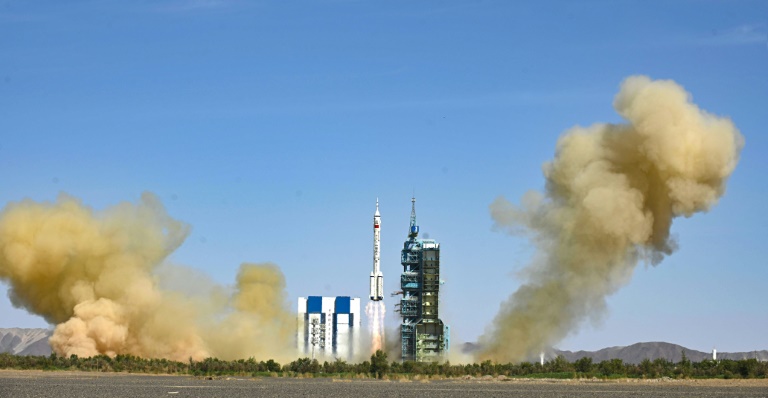
China on Sunday launched a rocket carrying three astronauts on a mission to complete construction on its new space station, the latest milestone in Beijing’s drive to become a major space power.

The trio blasted off in a Long March-2F rocket at (0244 GMT) from the Jiuquan launch center in northwestern China’s Gobi desert, said state broadcaster CCTV, with the team to spend six months expanding the Tiangong space station.

Tiangong, which means “heavenly palace,” is expected to become fully operational by the end of the year. 

China’s heavily promoted space programme has already seen the nation land a rover on Mars and send probes to the Moon.

The Shenzhou-14 crew is tasked with “completing in-orbit assembly and construction of the space station,” as well as “commissioning of equipment” and conducting scientific experiments, state-run CGTN said Saturday.

Led by air force pilot Chen Dong, 43, the three-person crew’s main challenge will be connecting the station’s two lab modules to the main body.

Dong, along with fellow pilots Liu Yang and Cai Xuzhe, will become the second crew to spend six months aboard the Tiangong after the last returned to earth in April following 183 days on the space station.

Tiangong’s core module entered orbit earlier last year and is expected to operate for at least a decade.

The completed station will be similar to the Soviet Mir station that orbited Earth from the 1980s until 2001.

– Space ambitions –

The world’s second-largest economy has poured billions into its military-run space programme, with hopes of having a permanently crewed space station by 2022 and eventually sending humans to the Moon.

The country has made large strides in catching up with the United States and Russia, whose astronauts and cosmonauts have decades of experience in space exploration.

But under Chinese President Xi Jinping, the country’s plans for its heavily promoted “space dream” have been put into overdrive.

In addition to a space station, Beijing is also planning to build a base on the Moon, and the country’s National Space Administration said it aims to launch a crewed lunar mission by 2029.

China has been excluded from the International Space Station since 2011, when the United States banned NASA from engaging with the country.

While China does not plan to use its space station for global cooperation on the scale of the ISS, Beijing has said it is open to foreign collaboration.

The ISS is due for retirement after 2024, although NASA has said it could remain functional until 2030.

'Street fighting' in Severodonetsk as explosions rock Kyiv

The battle for Ukraine’s eastern city of Severodonetsk was being waged street by street, President Volodymyr Zelensky said, while explosions rocked the capital Kyiv early Sunday.

“Several explosions in Darnytsky and Dniprovsky districts of the city. Services are extinguishing,” Mayor Vitali Klitschko said on Telegram shortly after air raid warnings sounded in Kyiv and several other cities.

“There are currently no dead from missile strikes on infrastructure. One wounded was hospitalised. The services are still working in the affected areas.”

Separately, at least 11 civilians were reported killed in the Lugansk region where Severodonetsk is located, the nearby Donetsk region and in the southern city of Mykolaiv.

“The situation in Severodonetsk, where street fighting continues, remains extremely difficult,” Zelensky said in his daily address Saturday evening.

Cities in the eastern Donbas area at the heart of the Russian offensive were under “constant air strikes, artillery and missile fire” but Ukrainian forces were holding their ground, he said.

Severodonetsk is the largest city still in Ukrainian hands in the Lugansk region of the Donbas, where Russian forces have been gradually advancing in recent weeks after retreating or being repelled from other areas, including around the capital Kyiv.

Russia’s army claimed some Ukrainian military units were withdrawing from Severodonetsk but Mayor Oleksandr Striuk said Ukrainian forces were fighting to retake the city.

“Our soldiers have managed to redeploy, build a line of defence,” he said in an interview broadcast on Telegram Saturday.

“We are currently doing everything necessary to re-establish total control” of the city. 

Earlier, Lugansk regional governor Sergiy Gaiday said the Russians had captured most of Severodonetsk, but that Ukraine’s forces were pushing them back.

“The Russian army, as we understand, is throwing all its power, all its reserves in this direction,” said Gaiday.

“Russians are blowing up the bridges, so that we cannot supply reinforcements to our boys, who are in Severodonetsk,” he added.

For its part, Moscow claims to have destroyed two Ukrainian command centres and six ammunition depots in the Donetsk and Lugansk regions.

“Ukrainian forces are successfully slowing down Russian operations to encircle Ukrainian positions in Luhansk Oblast as well as Russian frontal assaults in Severodonetsk through prudent and effective local counterattacks in Severodonetsk”, the US-based Institute for the Study of War said in an assessment late Saturday.

– ‘Put Russia in its place’ –

Tens of thousands of people have been killed, millions forced to flee and towns turned into rubble since Russian President Vladimir Putin ordered an all-out assault on his pro-Western neighbour on February 24.

Western powers have imposed increasingly stringent sanctions on Russia and supplied arms to Ukraine, but divisions have emerged on how to react.

French President Emmanuel Macron said Friday Putin had committed a “fundamental error” but that Russia should not be “humiliated” so that a diplomatic solution could be found.

Ukrainian Foreign Minister Dmytro Kuleba reacted Saturday by saying such calls “only humiliate France” and any country taking a similar position.

“It is Russia that humiliates itself. We all better focus on how to put Russia in its place,” he said.

Despite diplomatic efforts, the conflict has raged in the south and east of the country.

Ukraine reported two victims from a Russian missile strike on Odessa in the southwest, without specifying if they were dead or wounded.

Russia’s defence ministry said it had struck a “deployment point for foreign mercenaries” in the village of Dachne in the Odessa region.

It also claimed a missile strike in the northeastern Sumy region on an artillery training centre with “foreign instructors”.

– Fears over food –

Apart from the human toll, the conflict has caused widespread damage to Ukraine’s cultural heritage.

On Saturday, Ukrainian officials reported a large Orthodox wooden church, a popular pilgrim site, was on fire and blamed Russia.

Moscow continues to prove “its inability to be part of the civilised world,” Culture Minister Oleksandr Tkachenko said in a statement.

Russia’s defence ministry blamed “Ukrainian nationalists” for the blaze and said its forces were not operating in the area.

Russian troops now occupy a fifth of Ukraine’s territory, according to Kyiv, and Moscow has imposed a blockade on its Black Sea ports, sparking fears of a global food crisis. Ukraine and Russia are among the top wheat exporters in the world.

The United Nations said it was leading intense negotiations with Russia to allow Ukraine’s grain harvest to leave the country.

Putin said Friday there was “no problem” to export grain from Ukraine, via Kyiv- or Moscow-controlled ports or even through Central Europe.

The UN has warned that African countries, which normally import over half of their wheat consumption from Ukraine and Russia, face an “unprecedented” crisis.

Food prices in Africa have already exceeded those in the aftermath of the 2011 Arab Spring uprisings and the 2008 food riots.

The head of the African Union, Senegalese President Macky Sall, said Saturday he intended to visit Ukraine after meeting with Putin the day before to discuss the wheat shortage.

Ukraine’s Defence Minister Oleksiy Reznikov repeated the government’s appeal for the swift delivery of heavy artillery in a telecast address to the Globsec-2022 forum on international security Saturday.

If Kyiv gets the equipment they had asked for, he said, “I cannot forecast definitely what month we will kick them out, but I hope — and it’s absolutely a realistic plan — to do it this year.”

Away from the battlefield, Ukraine will be fighting for victory over Wales in Sunday’s play-off final as they aim to reach their first football World Cup since 1958.

“We all understand that the game with Wales will no longer be about physical condition or tactics, it will be a game of survival,” said Ukraine player Oleksandr Zinchenko.

“Everyone will fight to the end and give their all, because we will play for our country.”

burs-to/mtp/lb

At least 16 killed, 170 injured in Bangladesh depot fire

At least 16 people were killed and 170 others injured after a massive fire tore through a container depot in southern Bangladesh, officials said Sunday.

The fire broke out shortly before midnight at a container storage facility in Sitakunda, about 40 kilometres (25 miles) from the key port of Chittagong, fire service official Jalal Ahmed said.

“Sixteen people have been killed in the fire. The number of fatalities is expected to rise as some of the injured are in critical condition,” Chittagong’s chief doctor, Elias Chowdhury, told AFP.

Multiple firefighting units were at the scene attempting to douse the blaze when a massive explosion rocked the site, injuring scores of people, including firefighters, Abul Kalam Azad, the local police chief, told AFP.

“Some 170 people were injured including at least 40 firefighters and 10 police officers. Three firefighters were also killed,” he said.

Chowdhury said the injured had been rushed to different hospitals in the region as doctors were brought back from holiday to help in the emergency.

He said the number of fatalities could still grow as some 20 people remained in critical condition with burns covering 60 to 90 percent of their bodies. 

Local media put the number of injuries at about 300, and requests for blood donations for the injured flooded social media. 

Emergency crews were still working to put out the fire Sunday morning and military clinics were helping to treat the injured.

Mominur Rahman, chief administrator of Chittagong district, said while the fire was largely under control, there were “still several pockets of fire in the depot”. 

“Firefighters are trying to control these pocket fires,” he said. 

Rahman said the depot contained millions of dollars of garment products waiting to be exported to Western retailers, for whom Bangladesh is a key supplier.

Ruhul Amin Sikder, spokesman for the Bangladesh Inland Container Association (BICA), said some of the containers at the 30-acre private depot contained chemicals, including hydrogen peroxide.

The director of the B.M. Container Depot, Mujibur Rahman, said the fire’s cause was still unknown. He added the facility employs about 600 people.

In 2020, three workers were killed after an oil tank exploded in another container depot in the neighbouring Patenga area.

Fires are common in Bangladesh due to lax enforcement of safety rules. In July 2021, 54 people died when a blaze ripped through a massive food-processing factory outside the capital Dhaka. 

In 2020, 70 people were killed when another fire engulfed several Dhaka apartment blocks.

Managing inventories a pandemic headache for US businesses

More than two years into the Covid-19 pandemic, American businesses are still struggling to manage their inventories in a feast-or-famine cycle caused by fickle consumer demand.

“We have way too much inventory right now,” said Ginny Pasqualone, chief executive of Sparkledots, a children’s clothing manufacturer.

“It’s important that we have a large selection of merchandise that our clients can choose from,” she said, but store traffic has been hit by inflation concerns, with some customers “very scared that they’re not going to survive another recession.” 

For now, Sparkledots is holding more goods in inventory, but that ties up company capital and limits its ability to add to its 18-worker staff.

“It sucks our growth for the future,” Pasqualone said.

Such is the dilemma affecting businesses of all sizes. 

Large store chains like Walmart, Target and Macy’s have acknowledged in recent weeks that they misread consumer patterns, leaving them with excess supplies of appliances, casual clothing and bicycles.

Bicycles were a hot commodity early in the pandemic, prompting surprisingly large orders, said Wayne Sosin, owner of Worksman Cycles, a New York manufacturer best known for its tricycles. 

“Retailers bought whatever they could as if bike sales would continue to have unprecedented demand,” Sosin said. “It was so obvious to me that (this) would not last.”

Still, Sosin said demand remains strong in some parts of the business, placing stress on supplies of some key bicycle parts.

– Unexpected shift –

Torrid consumer demand since 2020 fueled by government pandemic relief programs has led to product shortages and backlogs in seaports.

“The business can no longer count on the idea that you’re going to have this easy, just-in-time inventory and that you can only keep stock on hand that you need,” said Phil Levy, an economist for logistics company Flexport. 

Companies are unsure how much the outsized buying during the pandemic will persist and for which goods.

“The way we tend to predict things is by looking at past patterns,” Levy said. “But we don’t have data on how the consumers behaved during the five recent major modern pandemics.”

In the most recent quarter, the big-box chain Target saw sales of appliances, clothing and other goods slow as consumers shifted spending to travel and other service-oriented consumption.

“We didn’t anticipate the magnitude of that shift,” Target Chief Executive Brian Cornell said on an analyst conference call.

As a result, Target had bought too many televisions and too much outdoor furniture.

Similarly, department-store chain Macy’s was caught off guard by a 20 percent drop in sales of casual clothing and housewares in the most recent period, compared with the prior quarter.

At the same time, “supply chain constraints relaxed,” unexpectedly boosting deliveries of merchandise, said Macy’s Chief Executive Jeffrey Gennette.

– ‘Wildcards’ –

Retailers have adopted different strategies for dealing with a glut of goods.

Target has moved some of its goods outside of stores into temporary storage facilities, while liquidating seasonal merchandise no longer in demand.

Others plan to offer more discounted items. Apparel chain Urban Outfitters expects promotions to increase “not just in the second quarter, but throughout the year and into the holiday season,” said Chief Executive Richard Hayne.

The consumer remains the “wildcard,” said Brian Yarbrough, an analyst who follows consumer companies at Edward Jones.

Demand for goods has remained fairly robust even as consumers spend more on services and contend with inflation, Yarbrough said.

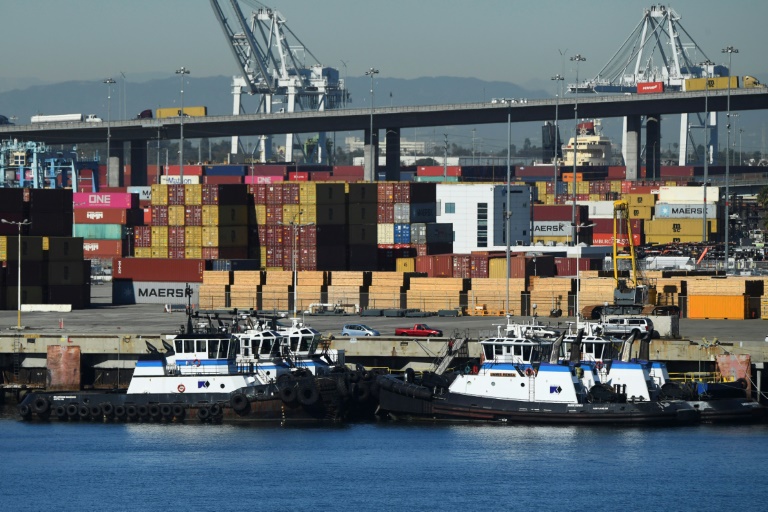
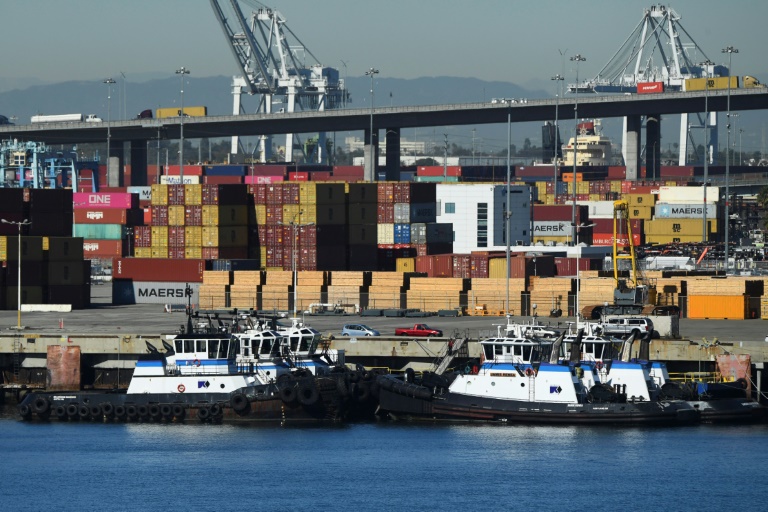
Among other unknowns is the state of ocean shipping between Asia and the United States. Will ports on the US West Coast again struggle with delays, or even a possible strike due to high-stakes labor negotiations this summer?

“How long will it take to ship freight from Asia to the US to have stuff on the shelves this fall?” wonders Levy. “You just don’t know.”

Managing inventories a pandemic headache for US businesses

More than two years into the Covid-19 pandemic, American businesses are still struggling to manage their inventories in a feast-or-famine cycle caused by fickle consumer demand.

“We have way too much inventory right now,” said Ginny Pasqualone, chief executive of Sparkledots, a children’s clothing manufacturer.

“It’s important that we have a large selection of merchandise that our clients can choose from,” she said, but store traffic has been hit by inflation concerns, with some customers “very scared that they’re not going to survive another recession.” 

For now, Sparkledots is holding more goods in inventory, but that ties up company capital and limits its ability to add to its 18-worker staff.

“It sucks our growth for the future,” Pasqualone said.

Such is the dilemma affecting businesses of all sizes. 

Large store chains like Walmart, Target and Macy’s have acknowledged in recent weeks that they misread consumer patterns, leaving them with excess supplies of appliances, casual clothing and bicycles.

Bicycles were a hot commodity early in the pandemic, prompting surprisingly large orders, said Wayne Sosin, owner of Worksman Cycles, a New York manufacturer best known for its tricycles. 

“Retailers bought whatever they could as if bike sales would continue to have unprecedented demand,” Sosin said. “It was so obvious to me that (this) would not last.”

Still, Sosin said demand remains strong in some parts of the business, placing stress on supplies of some key bicycle parts.

– Unexpected shift –

Torrid consumer demand since 2020 fueled by government pandemic relief programs has led to product shortages and backlogs in seaports.

“The business can no longer count on the idea that you’re going to have this easy, just-in-time inventory and that you can only keep stock on hand that you need,” said Phil Levy, an economist for logistics company Flexport. 

Companies are unsure how much the outsized buying during the pandemic will persist and for which goods.

“The way we tend to predict things is by looking at past patterns,” Levy said. “But we don’t have data on how the consumers behaved during the five recent major modern pandemics.”

In the most recent quarter, the big-box chain Target saw sales of appliances, clothing and other goods slow as consumers shifted spending to travel and other service-oriented consumption.

“We didn’t anticipate the magnitude of that shift,” Target Chief Executive Brian Cornell said on an analyst conference call.

As a result, Target had bought too many televisions and too much outdoor furniture.

Similarly, department-store chain Macy’s was caught off guard by a 20 percent drop in sales of casual clothing and housewares in the most recent period, compared with the prior quarter.

At the same time, “supply chain constraints relaxed,” unexpectedly boosting deliveries of merchandise, said Macy’s Chief Executive Jeffrey Gennette.

– ‘Wildcards’ –

Retailers have adopted different strategies for dealing with a glut of goods.

Target has moved some of its goods outside of stores into temporary storage facilities, while liquidating seasonal merchandise no longer in demand.

Others plan to offer more discounted items. Apparel chain Urban Outfitters expects promotions to increase “not just in the second quarter, but throughout the year and into the holiday season,” said Chief Executive Richard Hayne.

The consumer remains the “wildcard,” said Brian Yarbrough, an analyst who follows consumer companies at Edward Jones.

Demand for goods has remained fairly robust even as consumers spend more on services and contend with inflation, Yarbrough said.

Among other unknowns is the state of ocean shipping between Asia and the United States. Will ports on the US West Coast again struggle with delays, or even a possible strike due to high-stakes labor negotiations this summer?

“How long will it take to ship freight from Asia to the US to have stuff on the shelves this fall?” wonders Levy. “You just don’t know.”

Canada handgun sales soar after Trudeau proposes freeze

Aman Sandhu checked store after store for a handgun in Canada’s British Columbia, hoping to make a purchase before a freeze on sales takes effect, but struggled to find one in stock.

“I’m concerned that if I don’t buy one now, I may never have the choice again,” Sandhu, a member of the Dawson Creek Sportsman’s Club, told AFP.

Prime Minister Justin Trudeau’s proposed freeze on pistol sales — which he announced in the wake of a series of high-profile mass shootings in the United States — has pushed some Canadians to rush out to gun stores while they still can.

While Sandhu is keen to buy a pistol, he is also wary of becoming mired in new rules that include hefty penalties for even minor lapses.

“Jeez, if I slip up, I could screw up the rest of my firearms ownership,” he said, describing a handful of long guns in his collection.

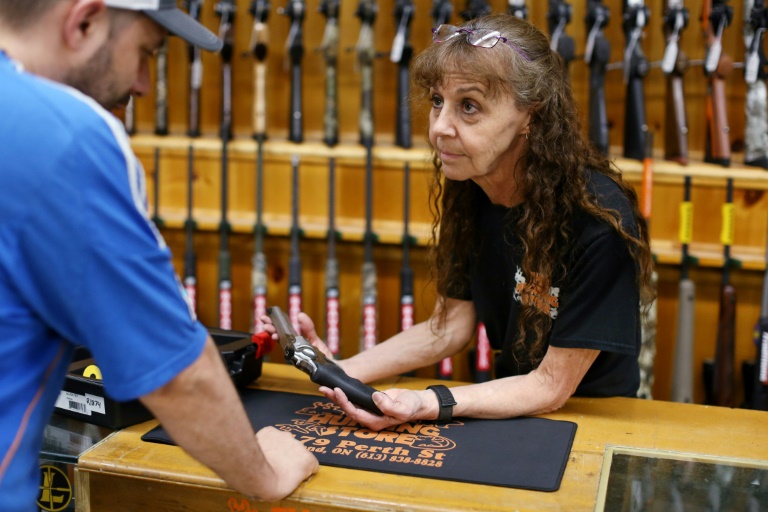
Several gun stores in British Columbia province saw lines out the door within hours of the liberal leader’s declaration on Monday. Other shops across Canada said they sold out within days.

“Sales have been brisk,” said Jen Lavigne, co-owner of That Hunting Store in a strip mall on the outskirts of the capital Ottawa, nestled between a barbershop, a Chinese buffet restaurant, and a conservative lawmaker’s constituency office.

“We sold 100 handguns, or almost our entire stock, in the last three days, since the prime minister announced the freeze,” she said, showing off her nearly empty handgun cabinet.

– ‘Panic’ –

At DoubleTap Sports in Toronto, a similar scene unfolded. Owner Josko Kovic said the government announcement “created a panic, and people are now rushing out to buy handguns.”

“Almost all stores are sold out, including me,” he said.

According to government estimates, there are more than one million handguns in Canada, which has a population of 38 million people. Some 2,500 stores sell pistols in the country.

At present, a person must have a restricted firearms license in order to purchase a handgun. Most also require a special permit to transport them from any location to another, and they must be in secured cases.

Shooting ranges are about the only places where they can be legally fired.

The new regulations, unveiled after mass shootings killed 21 people at an elementary school in Texas and 10 at a supermarket in New York state, would prohibit the purchase, sale, transfer and importation of handguns.

They are expected to come into force in the fall, along with a border crackdown on weapons smuggling from the United States.

“We are capping the number of handguns in this country,” Trudeau said Monday, citing “a level of gun violence in our communities that is unacceptable.”

– ‘Catch-22’ –

Almost two-thirds of gun crimes in Canadian cities over the past decade involved handguns, according to government data.

At That Hunting Store, a man picking up a new handgun for competition, who identified himself as David, lamented the new restrictions on top of already cumbersome rules that drag out purchases.

“It’s ridiculous,” he said. “It takes two months just to get a license with all the background checks.”

Gun shop owners interviewed by AFP unanimously decried the freeze, which must still be passed by parliament.

“This measure is only going to hurt legal gun owners,”  Lavigne said, adding: “It’s not going to reduce any of the crime because the bad guys don’t follow the rules.”

Darryl Tomlinson, owner of Canadian Gun Guys in Winnipeg, said he worries for the future of his store and shooting range, as well as the social network of members.

“This handgun measure is going to take away livelihoods and break up communities,” he said.

“It’s a Catch-22. We’re busy now, but I fear we’re going to be put out of business in the fall,” Tomlinson said of the week’s sales boom.

Close Bitnami banner
Bitnami