AFP

US warns talks on Yemen truce in 'trouble'

The United States warned Tuesday that talks on Yemen’s two-month truce were in “trouble” as it pushed for an extension to help support millions at risk.

Yemen’s Saudi-backed government and Iran-aligned Huthi rebels on April 2 entered a UN-brokered truce, the first since the brutal war broke out in 2016, but it expires on Thursday.

Talks to extend the pause in fighting “haven’t ended yet but seem to be in a bit of trouble,” said Linda Thomas-Greenfield, the US ambassador to the United Nations.

The talks impasse “is troublesome to us,” she told reporters.

“We encourage the parties on both sides to continue those efforts and find a peaceful way to provide needed humanitarian assistance to the people of Yemen.”

Secretary of State Antony Blinken also raised “efforts to strengthen and extend the truce in Yemen” during talks Monday with his Saudi counterpart, Foreign Minister Prince Faisal bin Farhan, the State Department said.

The war has killed hundreds of thousands of people and left millions on the brink of famine.

Aid groups have appealed for an extension of the truce, saying it has brought long-needed humanitarian dividends.

Earlier this month, the Norwegian Refugee Council said the number of civilian casualties in Yemen had dropped by more than half since the truce took effect.

The UN special envoy on Yemen, Hans Grundberg, last week also publicly urged progress and said that the truce had produced “tangible benefits.”

Biden, Fed chair discuss US inflation at White House

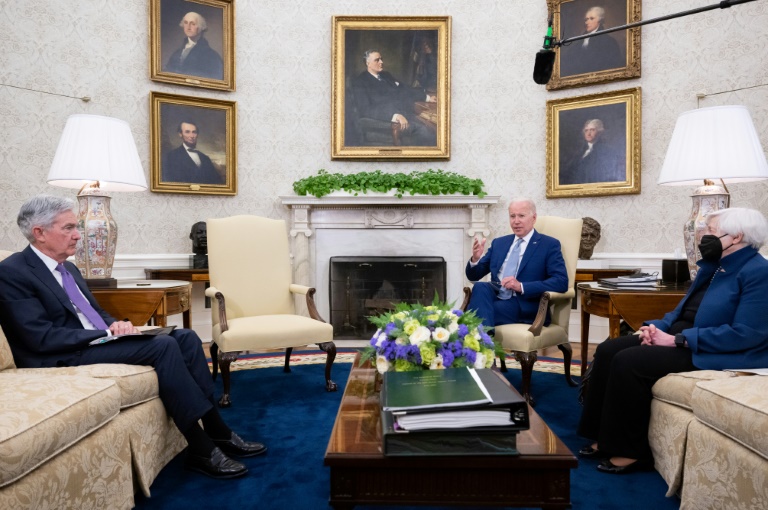
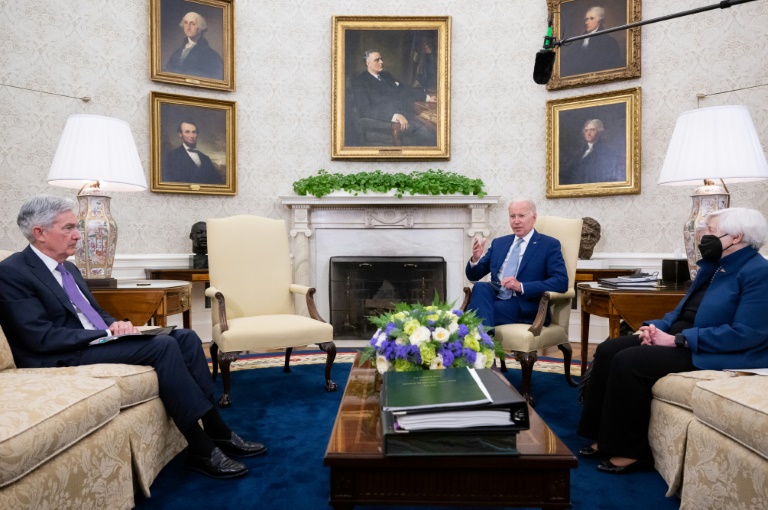
President Joe Biden held a rare White House meeting with the head of the Federal Reserve, Jerome Powell, on Tuesday to discuss soaring inflation and White House attempts to tame the politically damaging price surge ahead of midterm elections.

“I am meeting today to discuss my top priority: that is addressing inflation in order to transition from historic recovery to a steady growth,” Biden said.

Also joined in the Oval Office by Treasury Secretary Janet Yellen, Biden stressed to reporters that while the Fed has a “laser focus” on inflation, he does not intend to infringe on the central bank’s traditional independence.

“It starts with a simple proposition: respect the Fed, respect the Fed’s independence,” he said.

The White House said that the first Biden-Powell meeting this year would focus on inflation but in general “discuss the state of the American and global economy.”

This is Biden’s “top economic priority,” the White House said, “as we transition… to stable, steady growth that works for working families.”

Inflation of more than eight percent is casting a heavy shadow on Biden’s claims to be steering the US economy to health after the Covid-19-induced crash.

Employment is back near pre-pandemic levels and growth is strong, but savage price increases for essentials including food and fuel are driving growing public dissatisfaction.

The Fed has raised rates three quarters of a percentage point, kicking off what central bank officials say could be a series of hikes aimed at calming down the economy, although there are fears that the unintended result may be recession.

Federal Reserve Governor Christopher Waller said Monday that he backs several more half-point rate hikes — “until I see inflation coming down closer to our two percent target.”

According to a poll in mid-May by Pew Research Center, inflation is easily the biggest topic of concern for Americans, with 70 percent making it number one, compared to 54 percent listing violent crime. 

– Midterm elections pressure –

Biden is scrambling to ease the pressure on American consumers ahead of November midterm elections in which his Democrats are forecast to lose control of Congress to the Republicans.

Biden’s own approval ratings are barely in the 40 percent range, reflecting his inability to sell voters on his upbeat message of US economic recovery.

As the election approaches, Biden has pivoted to more aggressively trying to explain the inflation phenomenon as a byproduct of forces beyond his control.

These include the Russian invasion of Ukraine, which triggered Western sanctions disrupting the huge Russian energy industry. President Vladimir Putin’s invading forces, meanwhile, have all but put a halt to Ukraine’s important wheat exports.

Biden calls the effect “Putin’s price hike.”

Writing in the Wall Street Journal on Monday, Biden underlined the importance of not interfering in the Federal Reserve’s work.

Biden recalled that his predecessor Donald Trump frequently launched political attacks on the Fed and that other presidents had also “sought to influence its decisions inappropriately during periods of elevated inflation.”

“I won’t do this,” he pledged.

In the op-ed, Biden said his longterm plan for economic health includes easing the pace of post-Covid recovery to more sustainable levels, boosting economic productivity and reducing the federal budget deficit.

Republican National Committee Chairwoman Ronna McDaniel issued a statement on Biden’s Oval Office meeting, saying the president is “lying to hardworking Americans about the economy.”

“Under Biden, inflation and gas prices have only gone up and families are struggling to afford basic needs as a result.”

Biden, Fed chair discuss US inflation at White House

President Joe Biden held a rare White House meeting with the head of the Federal Reserve, Jerome Powell, on Tuesday to discuss soaring inflation and White House attempts to tame the politically damaging price surge ahead of midterm elections.

“I am meeting today to discuss my top priority: that is addressing inflation in order to transition from historic recovery to a steady growth,” Biden said.

Also joined in the Oval Office by Treasury Secretary Janet Yellen, Biden stressed to reporters that while the Fed has a “laser focus” on inflation, he does not intend to infringe on the central bank’s traditional independence.

“It starts with a simple proposition: respect the Fed, respect the Fed’s independence,” he said.

The White House said that the first Biden-Powell meeting this year would focus on inflation but in general “discuss the state of the American and global economy.”

This is Biden’s “top economic priority,” the White House said, “as we transition… to stable, steady growth that works for working families.”

Inflation of more than eight percent is casting a heavy shadow on Biden’s claims to be steering the US economy to health after the Covid-19-induced crash.

Employment is back near pre-pandemic levels and growth is strong, but savage price increases for essentials including food and fuel are driving growing public dissatisfaction.

The Fed has raised rates three quarters of a percentage point, kicking off what central bank officials say could be a series of hikes aimed at calming down the economy, although there are fears that the unintended result may be recession.

Federal Reserve Governor Christopher Waller said Monday that he backs several more half-point rate hikes — “until I see inflation coming down closer to our two percent target.”

According to a poll in mid-May by Pew Research Center, inflation is easily the biggest topic of concern for Americans, with 70 percent making it number one, compared to 54 percent listing violent crime. 

– Midterm elections pressure –

Biden is scrambling to ease the pressure on American consumers ahead of November midterm elections in which his Democrats are forecast to lose control of Congress to the Republicans.

Biden’s own approval ratings are barely in the 40 percent range, reflecting his inability to sell voters on his upbeat message of US economic recovery.

As the election approaches, Biden has pivoted to more aggressively trying to explain the inflation phenomenon as a byproduct of forces beyond his control.

These include the Russian invasion of Ukraine, which triggered Western sanctions disrupting the huge Russian energy industry. President Vladimir Putin’s invading forces, meanwhile, have all but put a halt to Ukraine’s important wheat exports.

Biden calls the effect “Putin’s price hike.”

Writing in the Wall Street Journal on Monday, Biden underlined the importance of not interfering in the Federal Reserve’s work.

Biden recalled that his predecessor Donald Trump frequently launched political attacks on the Fed and that other presidents had also “sought to influence its decisions inappropriately during periods of elevated inflation.”

“I won’t do this,” he pledged.

In the op-ed, Biden said his longterm plan for economic health includes easing the pace of post-Covid recovery to more sustainable levels, boosting economic productivity and reducing the federal budget deficit.

Republican National Committee Chairwoman Ronna McDaniel issued a statement on Biden’s Oval Office meeting, saying the president is “lying to hardworking Americans about the economy.”

“Under Biden, inflation and gas prices have only gone up and families are struggling to afford basic needs as a result.”

Brazil storm death toll rises to 100

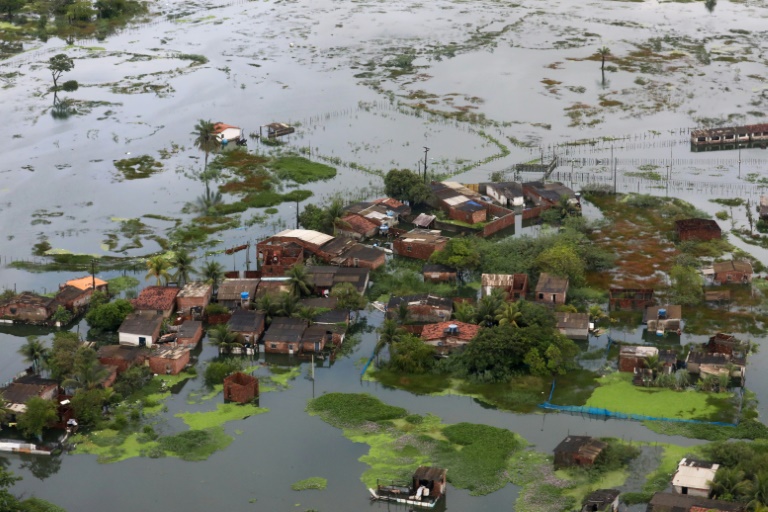
Flooding and landslides triggered by torrential rain have now killed at least 100 people in northeastern Brazil, officials said Tuesday as emergency workers searched for bodies and survivors.

The force of the landslides ripped apart houses in neighborhoods including Jardim Monteverde, a poor community just outside the city of Recife. Locals have likened the roaring surge of mud to a tsunami.

Rescue teams have found dozens of bodies buried after floodwater tore through the neighborhood on Saturday, and said they expect to find more.

At least 14 people remain missing, said disaster management officials for the state of Pernambuco, scene of the latest in a series of deadly weather disasters to hit the country in recent months.

Crews are using dogs trained to sniff for people and planes to locate the missing.

At least 24 municipalities in Pernambuco have declared a state of emergency and more than 6,000 people have lost their homes or been forced to flee.

President Jair Bolsonaro posted a video on Twitter on Monday that showed him flying in a helicopter over the disaster zone where brown flood water inundated large areas and gashes of mud scarred hillsides where houses once stood.

“I tried to land, but the pilots’ recommendation was that, given the instability of the soil, we could have an accident. So we decided against it,” the far-right president told a news conference.

He recalled a string of devastating floods in Brazil that have killed hundreds of people in recent months, and which experts say are being aggravated by climate change.

The rains began last week but intensified over the weekend. Overnight Friday into Saturday, the rain that fell in some parts of Pernambuco was 70 percent of what would be normal for the whole month of May.

“We never saw so much rain fall in so little time,” said 60-year-old retiree Mario Guadalupe.

“I saw the landslide happen. First part of the hill gave way, then it was just a tsunami of mud. It nearly took out my house.”

Weather-related tragedies are becoming a familiar script in Brazil. They tend to hit hardest in poor neighborhoods, especially hillside favelas, or slums.

“Climate change could be responsible for the rise in extreme, violent rain that is being detected not only in Brazil but around the world,” Jose Marengo, research coordinator at the National Center for Natural Disaster Monitoring and Alerts, told AFP.

In February, 233 people were killed in floods and landslides in the southeastern city of Petropolis, in Rio de Janeiro state.

In January, torrential rains claimed at least 28 lives in southeastern Brazil, mostly in Sao Paulo state.

Bolsonaro drew criticism for sounding dismissive after saying “unfortunately these tragedies happen, a country the size of a continent has its share of problems.”

Global chip shortage likely to last through 2023: US official

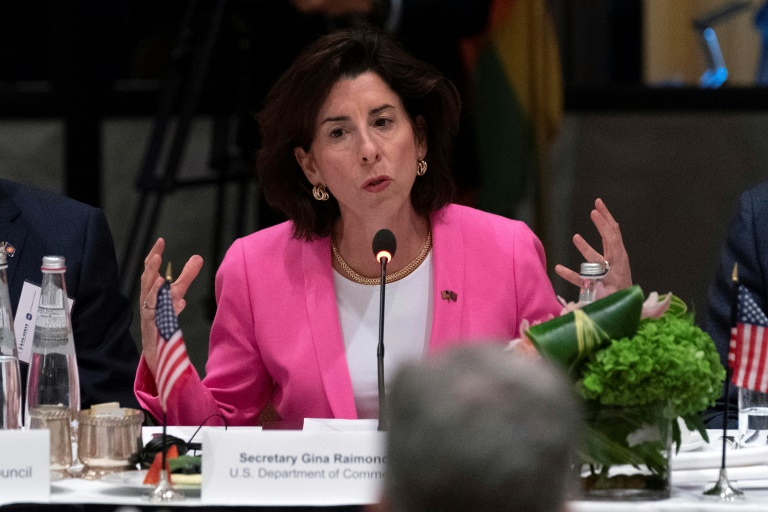
The global shortage of critical semiconductors is likely to last at least through next year and perhaps longer, US Commerce Secretary Gina Raimondo warned on Tuesday.

Shutdowns of key Asian suppliers due to the Covid-19 pandemic crippled supplies last year, just when American consumers, flush with cash from government aid, went on a spending spree buying cars and electronics, which depend on the chips.

“I do not unfortunately see the chip shortage abating in any meaningful way anytime in the next year,” Raimondo told reporters following her recent trip to Asia.

She said she convened a dozen CEOs, including leaders of chipmakers, during her time in South Korea to discuss the shortage “and they all agreed that … deep into 2023, possibly early ’24 before we see any real relief.”

She repeated her call for Congress to act to provide funding for legislation that aims to stimulate domestic manufacturing of the computer chips that are key to a wide array of products, from smartphones to medical equipment to vacuum cleaners.

“We are really on borrowed time,” she said.

“Every other country has subsidies on the table now, and if Congress doesn’t act very quickly,” key producers like Samsung, Intel and Micron “are going to build in another country and that be that would be hugely problematic.”

The US Senate and the House of Representatives each have approved $52 billion bills — the CHIPS Act and the America COMPETES Act — that would invest in domestic chip research and manufacturing, but so far have failed to agree on the final form of the legislation.

Biden asks New Zealand's Ardern for advice on extremist gun violence

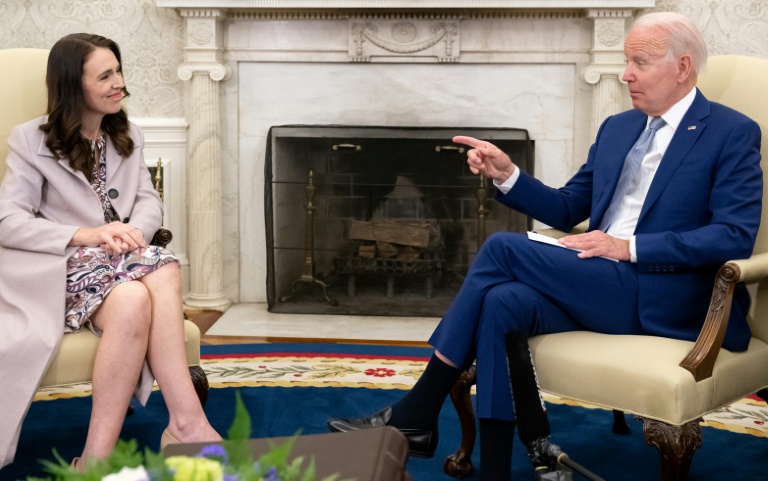
President Joe Biden on Tuesday told New Zealand’s Prime Minister Jacinda Ardern that after the latest US mass shooting he wants her advice in tackling a rise in gun violence and extremist ideologies.

Meeting in the Oval Office with Ardern, Biden referred to the 2019 Christchurch slaying of 51 people in mass shootings targeting Muslims.

The bloodshed prompted New Zealand to ban military-style rifles. A gun buy-back was also instituted.

“We need your guidance,” Biden said, calling for a “global effort to counter violence and extremism online.”

“I want to work with you on that effort,” he said.

Biden, who visited the Texan town of Uvalde on Sunday to mourn the deaths of 19 children and two teachers slain by a gunman using an assault-style rifle, said there was an “awful lot of suffering” and that “much of it is preventable.”

Less than two weeks earlier, Biden had also visited the site in New York state of another mass shooting, this time targeting African Americans.

Biden, who is under pressure to show the government is responding to the ever-growing toll, told reporters he would “meet with the Congress on guns, I promise you.”

However, with Republicans almost uniformly opposed to new restrictions on gun ownership, it appears unlikely that Biden’s Democrats can make signficant change.

Ardern offered condolences over the Texas and New York murders, saying that “our experience in this regard is our own, but if there is anything we can share that would be of any value we are here to share it.”

Eurozone stocks sink as inflation accelerates to record high

Eurozone equity markets sank Tuesday on news that the region’s inflation rate hit another record high in May on fallout from Russia’s invasion of Ukraine.

Consumer prices in the eurozone rose by 8.1 percent, compared with 7.4 percent in April, official data showed, with energy surging the fastest.

Sentiment took another battering on fears of severe economic fallout from a deal agreed by the European Union late Monday for a partial embargo of Russian oil imports over its assault on Ukraine.

The embargo also sent oil prices soaring to two-month peaks, in turn fuelling more inflationary fears and pressuring central banks to tighten monetary policy and prevent consumer prices rocketing even higher.

The resurgent oil market, however, lifted the London stock market because it boosts profits and revenues for energy majors BP and Shell.

– Energy ‘may soar faster’ –

“Inflation in the eurozone increased even further,” said Jonas Keck, economist at UK-based research group the Centre for Economics and Business Research.

“As the EU reached an agreement on new sanctions targeting Russian oil supplies, energy prices may well soar even faster in the coming months.”

Markets have been rocked this year as the Ukraine conflict has fuelled massive price gains for energy and food, translating into soaring inflation that threatens to derail the post-pandemic economic recovery.

Red-hot eurozone inflation has intensified calls for interest rate hikes from the European Central Bank, which has already flagged plans to raise borrowing costs in July.

“Higher inflation rates will raise serious question marks about the ECB’s viewpoint on whether gradual rate increases will be enough to deal with such high price growth,” market analyst Fawad Razaqzada from City Index and FOREX.com said.

“Investors are starting to project a faster pace of tightening from the ECB, which could be another factor holding stocks back.”

Following a holiday weekend in the US, Wall Street stocks were also on the backfoot, as a survey showed that Americans’ feelings about the economy deteriorated in May but remained relatively strong even as high inflation bites.

– Brent oil tops $124 –

In reaction to the EU’s partial embargo, Brent oil briefly broke above $124 per barrel and WTI crude breached $119.

European chiefs said the latest sanctions would ban purchases of Russian oil delivered by sea, though there would be a temporary exemption for pipelines.

“The gradual phasing in of the deal along with the exemptions included prevented the price from rising much higher but ultimately it further tightens a market that’s already undersupplied,” said Craig Erlam at OANDA. 

While widely expected, the agreement adds further upside to crude just as China begins to ease Covid restrictions in Shanghai and Beijing, raising the likelihood of a jump in demand from the world’s number-two economy.

There was some much-needed cheer from data showing China’s manufacturing shrunk in May at a slower rate than expected.

The Purchasing Managers’ Index (PMI) — a key gauge of manufacturing activity — hit 49.6 last month, improving from 47.4 in April, which was the worst reading since early 2020.

However, it remained below the 50-point mark separating growth from contraction and showed the Chinese economy was still struggling.

– Key figures at around 1550 GMT –

Frankfurt – DAX: DOWN 1.3 percent at 14,388.35  points (close)

Paris – CAC 40: DOWN 1.4 percent at 6,468.80  points (close)

EURO STOXX 50: DOWN 1.4 percent at 3,789.21 points 

London – FTSE 100: UP 0.1 percent at 7,607.66  points (close)

Brent North Sea crude: UP 1.4 percent at $123.37 per barrel

West Texas Intermediate: UP 1.95 percent at $117.31

New York – Dow: DOWN 0.3 percent at 33,111.09 points 

Tokyo – Nikkei 225: DOWN 0.3 percent at 27,279.80 (close)

Hong Kong – Hang Seng Index: UP 1.4 percent at 21,415.20 (close)

Shanghai – Composite: UP 1.2 percent at 3,186.43 (close)

Euro/dollar: DOWN at $1.0733 from $1.0779 on Monday

Pound/dollar: DOWN at $1.2624 from $1.2652

Euro/pound: DOWN at 85.01  pence from 85.20 pence

Dollar/yen: UP at 128.51 yen from 127.59 yen

burs-rfj-kjm/spm

US girl survives rare attack by cougar

A nine year old American girl has survived a very rare attack from a cougar during a camping trip in the western United States, says her uncle, who is trying to raise money for her medical expenses.

The cat attacked the girl, Lily, on Saturday morning while she was camping with her family in Washington state, her uncle Alex Mantsevich wrote on GoFundMe.

His post features before and after shots of his niece, the latter a photo of her unconscious in a hospital bed with scrapes and bruises from the mauling clearly visible on her face.

“She was airlifted to the hospital with many different injuries to her upper body/Face,” Mantsevich wrote.

The child underwent hours of surgery and remains in intensive care, he added in his fund-raising post.

Since 1924, only 20 people have been attacked by cougars in the wilds of Washington state and two of them died, the state environmental protection agency says.

An official with the agency told a local TV station that a probe would be carried out to try to understand the circumstances of this particular attack.

The body of the cougar — which was killed by someone present on the scene — will be analyzed for possible diseases, the official said.

Also known as pumas or mountain lions, cougars can weigh from 75 to 250 pounds (35 to 115 kilos), according to bigcatrescue.org.

US trans swimmer says transitioning never for 'advantage'

Swimmer Lia Thomas, the first transgender athlete to win a top-tier US university title, insisted Tuesday that trans athletes don’t transition to gain an edge in sports and voiced ambitions to compete in the Olympics.

“It’s been a goal of mine to swim at Olympic trials for a very long time, and I would love to see that through,” Thomas said on the ABC program “Good Morning America.”

Thomas won the 500-yard freestyle at the US collegiate championships in March.

She competes for the University of Pennsylvania, and was on the men’s team for three years before switching to the women’s squad this season.

Controversy has shrouded Thomas throughout the year, with critics and some fellow swimmers saying she should not have been allowed to compete and has an unfair physiological advantage.

Others say she should be allowed to compete freely as a woman.

In the ABC interview she said, “Trans people don’t transition for athletics.”

“We transition to be happy and authentic and our true selves. Transitioning to get an advantage is not something that ever factors into our decisions,” said Thomas.

“Trans women are not a threat to women’s sports,” she added.

US Olympic swimming trials for the Summer Games of 2024 in Paris begin in June in Indianapolis, Indiana.

After a weightlifter in the Tokyo games last year became the first trans athlete to compete in the Olympics, transgender issues have roiled the world of sports.

In November the International Olympic Committee essentially left it up to each sport, saying there was no scientific consensus on the role of testosterone on performance in sports.

The controversy has political overtones, too, in the United States.

Several states run by conservatives have recently barred trans girls from competing in school sports.

'No way out': Life under the Russians at Chernobyl

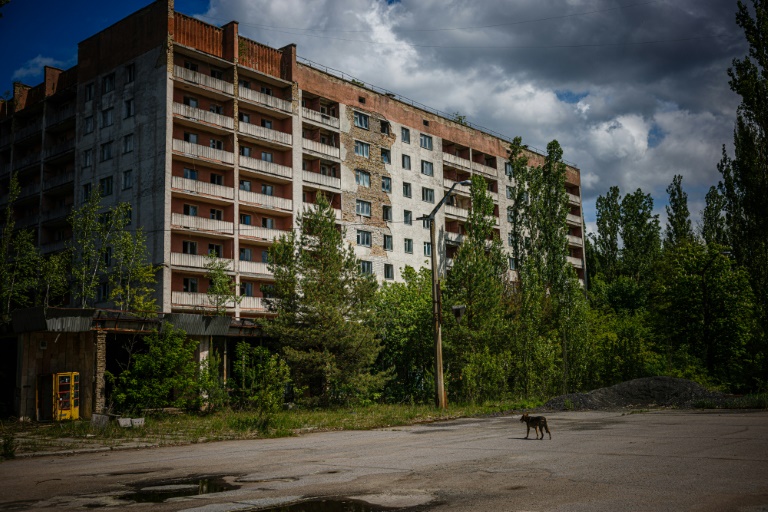
It began as a normal shift at Chernobyl for Oleksiy Shelestiy but as night turned to day on February 24, distant artillery fire and the arrival of Russian troops changed everything.

More than 100 employees, who had arrived at the defunct nuclear plant for their night shift just hours earlier, were now trapped as Russian forces crossed into Ukraine and seized swathes of land on their way towards Kyiv. 

The capture of Chernobyl by Russian forces kicked off a weeks-long ordeal that saw power briefly cut at the facility and employees carefully monitored by the invaders.

“We were not mentally prepared for this,” Shelestiy told AFP. “But we had no way out.”

As a night shift supervisor, Shelestiy oversaw a team of nearly a dozen people charged with monitoring electricity supplies at Chernobyl, where a massive sarcophagus covers the remains of a destroyed nuclear reactor to prevent radioactive contamination. 

The plant was the site in 1986 of the world’s worst nuclear accident. Since then, it has been maintained by thousands of Ukrainian workers and closely monitored by international experts to contain its radioactive waste. 

For years, a carefully executed shift schedule and monitoring network kept a close eye on radiation levels at the facility. Then Russian forces poured across the border from Belarus and seized Chernobyl, holding its workers captive and cutting it off from the world. 

“I understood that an accident was possible,” Shelestiy recalled.

“Emotional and psychological pressure did not allow me to focus on this. We just tried to do our job and tried to control all the parameters so that nothing could happen.”

– Power struggle –

The most harrowing period of the occupation began on March 9, when power was cut to the plant due to nearby fighting, Shelestiy said.

Experts acknowledged there would be no repeat of the 1986 meltdown in the absence of a working reactor on the grounds. But electricity is nonetheless vital to power the security infrastructure, including the cooling systems for the spent nuclear fuel storage facility.

For days, the workers relied first on their diesel supplies and later fuel provided by the Russians until they were able to re-route power through the Belarus grid. 

All the while, the Ukrainians trapped at the plant were only able to catch snippets of what was happening outside Chernobyl by listening to radio broadcasts and through occasional calls back home on one of the plant’s landlines.

The staff were not able to return home and became increasingly drained. That risked compromising their ability to fulfil their safety and security duties.

“It was mentally and emotionally difficult,” Shelestiy explained. 

Employees were also closely watched and forced to navigate a dizzying network of checkpoints set up by the Russians on the plant’s grounds — hindering basic movements and maintenance at the facility. 

Ukrainian authorities have since accused the Russians of showing wanton disregard for basic safety during their occupation of Chernobyl, saying its soldiers dug trenches and set up camps in contaminated areas of the facility that had received heavy doses of radiation.

“They dug bare soil contaminated with radiation, collected radioactive sand in bags for fortification, breathed this dust,” said Energy Minister German Galushchenko in April, claiming the Russian forces had been exposed to a “shocking” amount of radiation. 

“Every Russian soldier will bring a piece of Chernobyl home. Dead or alive,” the minister added.

The head of the International Atomic Energy Agency, Rafael Grossi, later said “an increase in the levels” of radiation had been recorded at Chernobyl but insisted the matter was under control. 

“The situation is not one that could be judged as posing a great danger to the environment and to people at the moment we were taking these measures,” he added.

Shelestiy was unable to confirm details about alleged Russian misconduct at Chernobyl, where he was mostly forced to remain at his workstation and had little interaction with their troops.  

– ‘Worried, nervous’ –

Amid the uncertainty, Shelestiy said he tried to console his team, whose families in the nearby town of Slavutych had been largely surrounded by Russian forces. 

Back in Slavutych, mayor Yuriy Fomichev walked a fine line, managing relations with Russian forces, helping smuggle supplies into the besieged community and comforting the families of the captive workers.

“I had to calm them down and explain that it was necessary to be patient,” said Fomichev. 

Built in the aftermath of the Chernobyl accident as a settlement for evacuated families who had been living near the plant in 1986, Slavutych was one of the last purpose-made towns constructed from scratch during the final days of the Soviet Union. 

For many of its residents, seeing chaos engulf Chernobyl again was an unwelcome case of deja-vu. 

“We were worried, nervous,” said Tamara Shyrobokova, 75, a former Chernobyl employee who was resettled in Slavutych following the meltdown.

“I was literally shocked by the fact that Russia attacked Ukraine. No-one could ever imagine this,” she added.

The whole episode also perplexes Shelestiy. He was released following a round of negotiations days before the Russians retreated, after their troops were routed in the battle for Kyiv. 

“They said they were trying to free me from something but I don’t understand from what,” said Shelestiy. “I can’t understand it.”

Close Bitnami banner
Bitnami