AFP

From US death-row cell, he turns to music for salvation

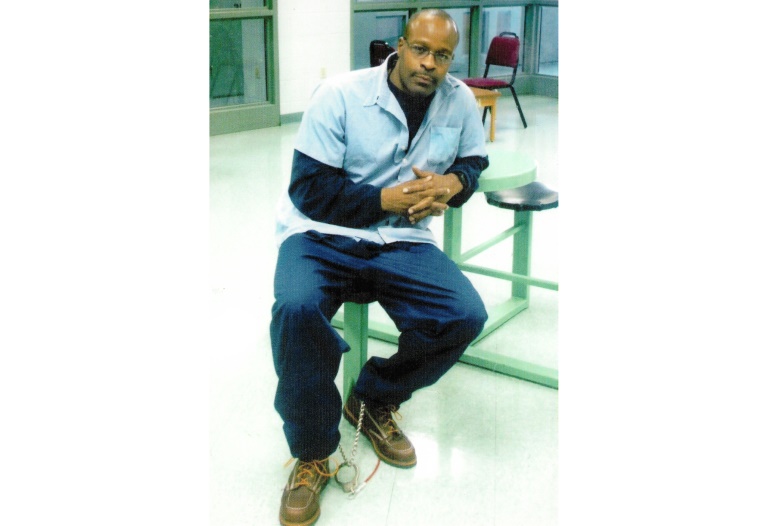
Music has helped Keith LaMar survive the mind-numbing sameness of nearly 30 years on death row in a maximum-security prison in the US state of Ohio.

Now he hopes his love and involvement in jazz — along with the intervention of musicians drawing public attention to his case — will help him escape execution for a murderous crime he insists he did not commit.

LaMar, who turns 53 on Tuesday, is accused of killing or ordering the killing of five fellow inmates during an 11-day prison riot in 1993.

His execution is already scheduled — for November 16, 2023.

LaMar said he has spent the past 30 years preparing himself psychologically, morally and legally for whatever comes next.

“So, if and when the time comes, and I am an unfortunate victim of the state … it won’t be because I didn’t try to do everything in my power to prevent that,” he told AFP by telephone.

During those decades behind bars, though, he has become a huge jazz buff.

“Music is a big part of my life,” he said.

He is particularly a fan of the music of John Coltrane, saying iconic albums like “A Love Supreme” have helped him cope with his anger and isolation.

The very first thing he does when he wakes up in the morning in a cell “the size of a closet” is to put on a CD, he said — that, and write.

– Jazz concert from behind bars –

LaMar pleaded guilty for the crime he was originally arrested for at 19: the murder of a childhood friend — an addict who had tried, at gunpoint, to steal drugs LaMar was selling.

He says he tried to turn his life around during the early years of his original 18-year sentence, completing a high-school equivalency degree before enrolling in university classes from his cell.

But he wants his case around the Lucasville Prison Riot to be reopened, contending that trial was gravely tainted by judicial irregularities.

In that regard LaMar is no longer alone. In addition to a team of lawyers working to reopen his case, several jazz musicians — including the Spaniard Albert Marques — have come together to demand “Justice for Keith LaMar” and raise awareness of his case.

Last weekend Marques’s group gave a concert at New York’s Jazz Gallery to celebrate release of the CD “Freedom First,” composed jointly by LaMar and Marques. Some of the proceeds will cover LaMar’s legal expenses.

During the concert, the firm but seductive voice of LaMar himself could often be heard over the speaker system. 

Marques said LaMar, who wrote several of the song lyrics, narrating his life and commenting on his fate, “is part of the band and earns the same as the musicians.” 

“The idea is not to play for Keith, it’s to play with Keith,” Marques told AFP.

But how could LaMar participate from a death-row cell hundreds of miles away? 

“He can make calls from jail, for which he has to pay,” Marques said, adding with a touch of sarcasm that the guards “can’t prohibit something that they can’t imagine happening.”

Marques said the band wants to “raise awareness” about a case involving one of his “best friends,” whom he has visited in maximum-security Ohio State Penitentiary in Youngstown.

– ‘Meaningful, purposeful things’ –

LaMar says in his book “Condemned” — written in his cell, then dictated by phone to a friend — that he has been “trying, with all my might, to redeem myself.” And he explains his version of what happened during the riots, which changed his life forever.

According to LaMar, prosecutors wrongfully withheld interviews with 13 inmates who witnessed or took part in the riots; evidence was destroyed; and prosecutors failed to disclose information that might have proved his innocence.

Prosecutors and appeals court judges, however, have insisted LaMar’s guilt is proven.

“When you (are) poor, Black and in a racist country, you plead guilty,” he said, referring to limited recourse he believes African Americans have in the justice system.

In a country which has seen stunning cases of wrongful conviction, “the truth can only set you free when you have enough money,” LaMar said.

But music can also deliver truth. Musician Marques has been “one of the blessings of my life,” LaMar says, and his last, best hope of drawing wider attention to his case. 

Above all, he says, he has gained a “friend.”

“I’m trying to stay caught up with meaningful, purposeful things,” LaMar said, because that gives some sense to his life — and ensures those who believe in his innocence also “believe in me as a human being.”
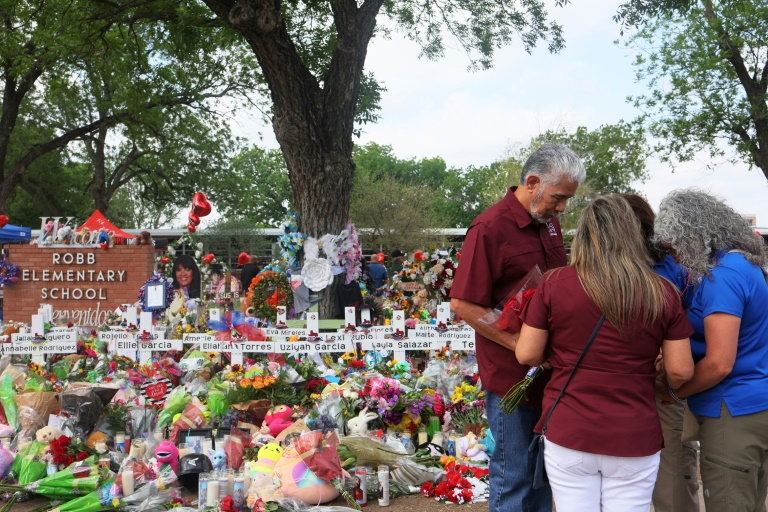

Funerals to begin for Uvalde victims as Biden vows action on guns

Grieving families were to hold the first funerals Tuesday for Texas shooting victims one week after a school massacre left 19 children and two teachers dead, with President Joe Biden vowing to push for stricter US gun regulation.

Mourners attended wakes in the town of Uvalde on Monday for some of the child victims gunned down by a local 18-year-old man who was then killed by police.

At one funeral home — just across the street from Robb Elementary School where the shooting occurred — friends, family and strangers attended a closed-casket visitation for 10-year-old victim Amerie Jo Garza. Pictures of the young girl decorated the space.

Esther Rubio, who described the scene as “very somber,” came from nearby San Antonio with her husband.

“I don’t know what else to say, because there’s no words to describe (it),” she said.

Remembrances for another slain student, Maite Rodriguez, began just hours later. 

In Washington, Biden — who visited the small town about an hour’s drive from the Mexico border earlier in the weekend — responded to desperate calls for weapons reform.

“I’ve been pretty motivated all along” to act on guns, Biden told reporters Monday.

“I’m going to continue to push,” he said, adding, “I think things have gotten so bad that everybody is getting more rational about it.”

A bipartisan group of US lawmakers worked through the Memorial Day weekend to pursue possible areas of compromise. 

They reportedly were focusing on laws to raise the age for gun purchases or to allow police to remove guns from people deemed at risk — but not on an outright ban on high-powered rifles like the weapon used Tuesday in Uvalde or the one used 10 days earlier in Buffalo, New York.

Uvalde’s first funerals are set for Tuesday, with others scheduled through mid-June. The huge number of victims, many with horrific wounds, has left the town’s two funeral homes turning to embalmers and morticians from across Texas for help.

One anonymous donor has pledged $175,000 to help cover funeral costs, Texas Governor Greg Abbott said.

– ‘Rational action’ –

The Uvalde massacre — the deadliest school attack since 20 children and six staff were killed in Newtown, Connecticut in 2012 — came less than two weeks after 10 people died in the attack at a Buffalo grocery store by a young gunman targeting African Americans.

While mass shootings draw anguished attention and spur momentary demands for change, most US gun violence passes with scant notice.

The country’s Memorial Day weekend — Monday is a national holiday — has been marked by yet more graphic violence. 

At least 132 gun deaths and 329 injuries were recorded nationwide from Saturday to Monday evening, according to the Gun Violence Archive website.

Gun-control advocates hoped the shock over the Uvalde tragedy, coming even as people in Buffalo were burying victims of the attack there, might finally prompt politicians to act.

A few key lawmakers, including a Democratic senator involved in the weekend talks in Washington, have expressed guarded optimism that the group might make progress, even in the face of deep resistance from most Republicans and some rural-state Democrats.

“There are more Republicans interested in talking about finding a path forward this time than I have seen since Sandy Hook,” Senator Chris Murphy of Connecticut told TV interviewers Sunday, adding that bipartisan “serious negotiations” were underway.

Biden said Monday he is deliberately “not negotiating with any of the Republicans yet.”

But, he added, “I know what happened when we had rational action before” on gun regulation.

“It did significantly cut down mass murders.”

Mourners in Uvalde — a mostly Latino town of 15,000 — have echoed calls for change.

“At the end of the day, if this child cannot even sip a glass of wine because he’s too young, then guess what? He’s too young to purchase a firearm,” said Pamela Ellis, who traveled from Houston to pay her respects.

Asian markets swing on new inflation, rates concerns

Asian markets fluctuated Tuesday as investors struggled to maintain a global rally, with inflation continuing to niggle owing to a pick-up in oil prices while a top Federal Reserve official pressed for a series of sharp interest rate hikes.

With Wall Street closed for a holiday there were few catalysts to help extend the gains enjoyed in recent days, allowing inflation and borrowing costs to take centre stage.

Crude prices built on Monday’s advance after the European Union reached a deal on a partial embargo of Russian imports as part of a punishment for its invasion of Ukraine.

Brent broke above $122 for the first time in two months and WTI was sitting around $117 as European chiefs said the latest sanction would ban purchases of Russian oil delivered by sea, though there would be a temporary exemption for pipelines.

While widely expected, the agreement adds further upside to crude just as China begins to ease Covid restrictions in Shanghai and Beijing, raising the likelihood of a jump in demand from the world’s number two economy.

The lift in oil prices will help fan already elevated inflation and pile further pressure on central banks to tighten monetary policy to prevent it running out of control.

In a sign of the struggle policymakers face, German prices are rising at their fastest pace ever while Spain’s topped forecasts. 

In the United States, the chances of an extended period of rate hikes were increased after Federal Reserve Governor Christopher Waller said he favoured half-point hikes “for several meetings” until inflation slows towards the bank’s two percent target. 

He added that his goal was in line with market expectations, which is about 2.75 percent in December. 

Joe Biden is due to hold talks with Fed boss Jerome Powell on Tuesday to discuss the inflation situation. US jobs data Friday will provide an update on the state of the US economy in light of soaring prices and rising rates.

The prospect of a period of rates rising higher for longer lifted the dollar against the euro, pound and yen as well as other currencies. 

Asian equity markets swung through the morning, though there was some cheer from data showing China’s manufacturing shrunk in May at a slower rate than expected.

Hong Kong edged slightly lower after two days of gains that saw it put on around five percent, while Shanghai was also marginally off.

Sydney, Taipei and Manila were also in the red, though Tokyo, Seoul, Singapore, Jakarta and Wellington rose.

But AXA Investment Managers’ Chris Iggo warned that another 10-15 percent retreat for stocks could still be a possibility.

“The mood is temporarily better in markets,” he said, adding that “I think the worst is over for bond markets but picking the bottom in equities is trickier.”

– Key figures at around 0230 GMT –

Tokyo – Nikkei 225: UP 0.1 percent at 27,404.14 (break)

Hong Kong – Hang Seng Index: DOWN 0.2 percent at 21,092.51

Shanghai – Composite: DOWN 0.1 percent at 3,147.12

Euro/dollar: DOWN at $1.0754 from $1.0779 on Monday

Pound/dollar: DOWN at $1.2621 from $1.2650

Euro/pound: DOWN at 85.20 pence from 85.21 pence

Dollar/yen: UP at 128.10 yen from 127.59 yen

Brent North Sea crude: UP 0.4 percent at $122.20 per barrel

West Texas Intermediate: UP 2.2 percent at $117.54

New York – Dow: Closed for a holiday

London – FTSE 100: UP 0.2 percent at 7,600.06 points (close)

2TK, Canada's migratory bird that fell for Uruguayan resort

The first cold winds announce the arrival of winter in Uruguay’s jet setters’ playground, Punta del Este.

It’s time for “2TK” to set flight from the plush seaside resort and return to Canada, a feat of endurance that fascinates scientists and delights local birdwatchers.

Identifiable by a plastic band on one ankle bearing the name 2TK and a metal one with nine digits on the other, this ruddy turnstone (Arenaria interpres) has spent the southern hemisphere summer on the rocks off Uruguay’s Atlantic coast feeding off mussels, alongside oystercatchers and other birds.

When the food became scarce in Canada’s artic tundra as winter swept in, the turnstone migrated 15,000 kilometers (9,300 miles) to South America.

By April, 2TK had become “fatter” and ditched his grey plumage for one tinged with brown and orange ahead of his return to his native lands to reproduce, said Alvaro Perez Tort, 48, an amateur photographer and member of the Punta del Este birdwatching society that has been documenting the bird’s trips to Uruguay since 2016.

“2TK stole my heart,” Perez told AFP.

Every year he waits for the male turnstone’s return to document him “as much as possible” to share on reportband.gov — the continental database for observing banded birds run by the United States Geological Survey.

“What’s interesting is that a banded bird has a history: there’s a city, a country or faraway place, a journey and people,” said Perez.

By photographing the bird “we feel like we’re a part” of that history, he added, noting he has seen 2TK eight times at Uruguay’s southernmost tip.

– Bird ‘jigsaw puzzle’ –

2TK is around 14 years old, according to the Bird Banding Laboratory, which organises the banding of one million birds annually in North America for conservation purposes.

He was banded in 2012 in Delaware Bay on the US Atlantic coast, an important stopover for many migratory species.

For laboratory chief Antonio Celis-Murillo, information provided by amateur birdwatchers is vital to “build the jigsaw puzzle” of each bird’s movements.

“Our work is successful thanks to the general public — every person who reports a banded bird,” he told AFP. 

“The reported information is so simple but valuable, because scientifically it tells us a lot.

“Especially those reports from South America that we lack,” he added.

These details allow scientists to plot the behavior of every species: their migration routes, where they stop, how long they stay there, how they live.

It all helps to refine conservation projects.

According to a 2019 study published in Science magazine, some 3,000 species of wild birds have disappeared from North America since 1970.

– ‘Lots of food’ –

Loss of habitat affecting all biodiversity “clearly shows its impact on migratory birds,” who face ever-greater difficulties in their extraordinary journeys, said Adrian Azpiroz, a biologist and ornithologist who promotes ecotourism initiatives.

And while turnstones are not threatened like other waders, their population is nonetheless shrinking.

Of the estimated 300,000 on the continent, only several hundred or thousand winter on the Uruguayan coast. Others prefer southern Brazil or Argentina.

Scientists believe these long-distance migratory birds have favorite winter retreats and are remarkably loyal, returning year after year — just like 2TK.

Uruguay’s many coastal lagunas are “very productive from a nourishment point of view” for waders, said Azpiroz.

That is why 2TK is likely to have traveled some 350,000 kilometers in his life — the equivalent of nine times around the planet.

That’s a truly staggering accomplishment for a bird measuring little more than 20 centimeters (eight inches).

Experts are still studying the sophisticated physiological and neurological mechanisms that allow him to recognize a location with such precision following a weeks-long air journey of thousands of kilometers.

Many Uruguayan birdwatchers like to think the same thing that attracts them to return time and again to Punta del Este is what also caught 2TK’s attention.

Hurricane Agatha drenches Mexican beach resorts

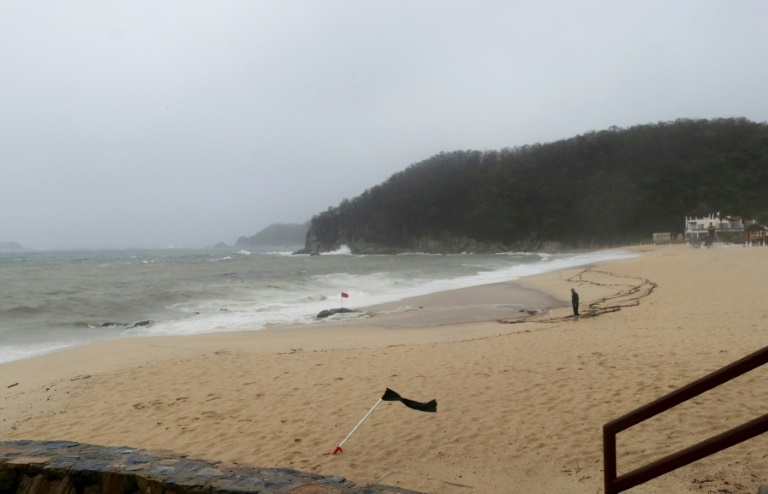
Hurricane Agatha, the first of the season, lashed a string of beach resorts on Mexico’s Pacific Coast as it barreled ashore Monday, bringing strong winds, heavy rain and flood warnings.

Agatha was the strongest storm to make landfall along Mexico’s Pacific coast in May since record keeping began in 1949, the US National Hurricane Center (NHC) said.

It touched land near Puerto Angel in the southern state of Oaxaca as a Category 2 hurricane — the second lowest on a scale of five.

Agatha later weakened to a Category 1 storm, but still packed maximum sustained winds of 130 kilometers (80 miles) per hour, the NHC said.

“Rapid weakening is expected as the hurricane moves farther inland. Agatha is forecast to weaken to a tropical storm tonight, and dissipate over southeastern Mexico by late Tuesday,” it said.

Small landslides were reported in parts of Oaxaca, civil protection coordinator Oscar Valencia told the Milenio television channel.

Residents along the coast had stocked up on food and water and boarded up windows of homes and businesses as Agatha approached.

Seaports in the area closed and airlines canceled flights to the region.

Authorities opened around 200 storm shelters with room for up to 26,800 people, while hotels provided refuge to the estimated 5,200 national and foreign tourists in the danger zone.

“We are already on red alert. This is coming and it is coming strong,” Roberto Castillo, a civil protection official in Huatulco, told AFP as the storm neared.

A hurricane warning was issued for a stretch of coastline including Puerto Escondido and other surf towns popular with Mexican and foreign tourists, leaving normally busy beaches deserted.

“Storm surge is expected to produce extremely dangerous coastal flooding” and will be accompanied by “large and destructive waves,” the NHC said.

“Agatha will produce heavy rains over portions of southern Mexico through Tuesday night,” as well as “life-threatening surf and rip current conditions,” it predicted.

In Oaxaca and neighboring Chiapas state, “life-threatening flash flooding and mudslides may occur,” the NHC added.

The region is home to several major rivers and Mexico’s meteorological service warned of possible overflows and landslides.

Mexico is regularly lashed by tropical storms on both its Pacific and Atlantic coasts, generally between the months of May and November.

The deadliest storm to hit Mexico last year was a Category 3 hurricane called Grace that killed 11 people in the eastern states of Veracruz and Puebla in August.

Mexico president's tourist train suffers new legal blow

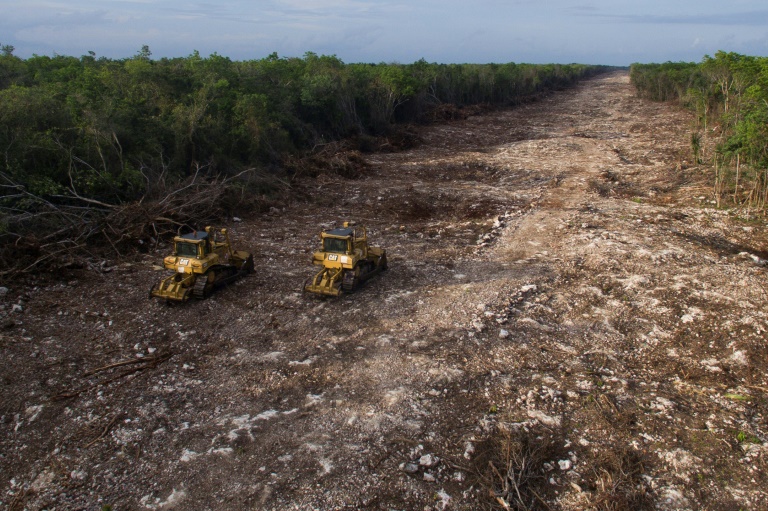
A Mexican judge has indefinitely suspended construction of part of President Andres Manuel Lopez Obrador’s flagship tourist train project in the Yucatan peninsula on environmental grounds, campaigners said Monday.

The ruling follows a legal challenge brought by opponents, including scuba divers, who are concerned about the impact of the Mayan Train on wildlife, caves and water-filled sinkholes known as cenotes.

The indefinite halt to work on the 60-kilometer (37-mile) section between the resorts of Playa del Carmen and Tulum goes a step further than a provisional suspension order issued in April.

The federal judge cited the “imminent danger” of causing “irreversible damage” to ecosystems, according to one of the plaintiffs, the non-governmental group Defending the Right to a Healthy Environment.

Authorities were found to have failed to carry out the necessary environmental impact studies before starting construction of the section, one of several being built by the military, it said in a statement.

The National Fund for the Promotion of Tourism, the government agency overseeing the project, said that it expected the work to be allowed to continue after the environmental impact statement is finalized.

It said the document would contain “numerous mitigation actions in favor of the environment.”

Lopez Obrador hopes to inaugurate the roughly 1,500-kilometer (950 mile) rail loop linking popular Caribbean beach resorts and archeological ruins by the end of 2023.

The original plan for the disputed section was for an overpass over a highway, but the route was modified early this year to go through jungle at ground level.

Opponents fear that the construction will cause irreparable damage to a subterranean network of caves, rivers and freshwater sinkholes connected to the Caribbean Sea.

Lopez Obrador has insisted the railroad will not affect the cenotes and alleged that environmentalists have been infiltrated by “impostors.”

Mexico president's tourist train suffers new legal blow

A Mexican judge has indefinitely suspended construction of part of President Andres Manuel Lopez Obrador’s flagship tourist train project in the Yucatan peninsula on environmental grounds, campaigners said Monday.

The ruling follows a legal challenge brought by opponents, including scuba divers, who are concerned about the impact of the Mayan Train on wildlife, caves and water-filled sinkholes known as cenotes.

The indefinite halt to work on the 60-kilometer (37-mile) section between the resorts of Playa del Carmen and Tulum goes a step further than a provisional suspension order issued in April.

The federal judge cited the “imminent danger” of causing “irreversible damage” to ecosystems, according to one of the plaintiffs, the non-governmental group Defending the Right to a Healthy Environment.

Authorities were found to have failed to carry out the necessary environmental impact studies before starting construction of the section, one of several being built by the military, it said in a statement.

The National Fund for the Promotion of Tourism, the government agency overseeing the project, said that it expected the work to be allowed to continue after the environmental impact statement is finalized.

It said the document would contain “numerous mitigation actions in favor of the environment.”

Lopez Obrador hopes to inaugurate the roughly 1,500-kilometer (950 mile) rail loop linking popular Caribbean beach resorts and archeological ruins by the end of 2023.

The original plan for the disputed section was for an overpass over a highway, but the route was modified early this year to go through jungle at ground level.

Opponents fear that the construction will cause irreparable damage to a subterranean network of caves, rivers and freshwater sinkholes connected to the Caribbean Sea.

Lopez Obrador has insisted the railroad will not affect the cenotes and alleged that environmentalists have been infiltrated by “impostors.”

EU leaders agree ban on most Russian oil imports

EU leaders on Monday backed a ban on most Russian oil imports, after a compromise deal with Hungary to punish Moscow for the war in Ukraine.

The 27-nation bloc has spent weeks haggling over a proposed total embargo on Russian oil but came up against stubborn resistance from Hungarian Prime Minister Viktor Orban.

EU leaders meeting in Brussels hatched a compromise deal to exempt deliveries arriving in Europe by pipeline from the ban, after Budapest warned halting supplies would wreck its economy.

“Agreement to ban export of Russian oil to the EU. This immediately covers more than two thirds of oil imports from Russia, cutting a huge source of financing for its war machine,” European Council chief Charles Michel tweeted during the summit. 

“Maximum pressure on Russia to end the war.”

The head of the EU’s executive, Ursula von der Leyen, said the move “will effectively cut around 90 percent of oil imports from Russia to the EU by the end of the year” as Germany and Poland had committed to renounce deliveries via a pipeline to their territory. 

“Russia has chosen to continue its war in Ukraine. Tonight, as Europeans, united and in solidarity with the Ukrainian people, we are taking new decisive sanctions,” French President Emmanuel Macron tweeted, echoing the figure of 90 percent by the end of 2022. 

The wrangling over the sixth package of sanctions has rocked European unity in the face of the Kremlin’s attack on Ukraine after five waves of unprecedented economic punishment on Russia.

The compromise excluded the Druzhba pipeline from the oil embargo and only imposed sanctions on crude shipped to the EU by tanker vessel.

Despite the gap in the embargo left by Hungary’s opposition, the latest round of sanctions represents some of the most damaging measures taken by the EU so far.

The EU imports some 26 percent of its oil from Russia and has been criticised for keeping money flowing to Moscow’s coffers at the same time as it seeks to halt the Kremlin’s war. 

Michel said the sanctions package also involved disconnecting Russia’s biggest bank Sberbank from the global SWIFT system, banning three state broadcasters and blacklisting individuals blamed for war crimes.

He also said that the EU had agreed to to send Ukraine nine billion euros ($9.7 billion) to support Kyiv’s “immediate liquidity needs” as it grapples with Russia’s invasion. 

– Stop ‘quarrels’ –

The negotiations over the oil ban had dogged the EU for weeks and the bloc’s leaders got chivvied along Monday by Ukraine’s President Volodymyr Zelensky.

Zelensky, in a video address, called on them to adopt “effective” sanctions against Russian oil to make the Kremlin pay the price for its war on Ukraine.

“All quarrels in Europe must end, internal disputes that only encourage Russia to put more and more pressure on you,” Zelensky told the EU summit.

“It is time for you to be not separate, not fragments, but one whole.”

Orban, often the odd man out in EU decision making, had called the proposal only to stop oil deliveries to the EU by ship a “good solution” before the talks began.

“It means that an atomic bomb won’t be thrown on the Hungarian economy,” he said. 

But he warned that Budapest needed a “guarantee” it could keep on receiving Russian oil by sea if anything happened to the pipeline crossing Ukraine.

Michel said the EU had “decided to take the appropriate measures to react and to make sure that we will protect the security of supply”.

– Return to Hungary issue? –

Landlocked Hungary imports 65 percent of its oil from Russia through the Druzhba pipeline and, along with Slovakia and the Czech Republic, had asked for an exception from the import ban.

Diplomats said a two-year delay to the embargo had been offered to the countries concerned, but that Budapest wanted at least four years and nearly 800 million euros ($860 million) in EU funding to adapt its refineries.

Von der Leyen said that the EU would return “as soon as possible in one way or the other” to the issue of trying to ban oil through the Druzhba pipeline to Hungary.

Budapest’s intransigence came on the back of Orban’s recent resounding re-election to a fourth term and some experts are sceptical about the official claims of alarm over a Russian oil ban.

Further complicating the stand-off had been Hungary’s share of the EU’s 800-billion-euro recovery fund, which Brussels has yet to approve due to disagreements over Budapest’s respect for the rule of law.

burs-del/dc/mtp

Big tobacco's environmental impact is 'devastating': WHO

The tobacco industry is a far greater threat than many realise as it is one of the world’s biggest polluters, from leaving mountains of waste to driving global warming, the WHO charged Tuesday.

The World Health Organization accused the industry of causing widespread deforestation, diverting badly needed land and water in poor countries away from food production, spewing out plastic and chemical waste as well as emitting millions of tonnes of carbon dioxide. 

In its report released on World No Tobacco Day, the UN agency called for the tobacco industry to be held to account and foot the bill for the cleanup.

The report, “Tobacco: poisoning our planet”, looks at the impacts of the whole cycle, from the growth of plants to the manufacturing of tobacco products, to consumption and waste.

While tobacco’s health impacts have been well documented for decades — with smoking still causing more than eight million deaths worldwide every year — the report focuses on its broader environmental consequences.

The findings are “quite devastating,” Ruediger Krech, WHO director of health promotion, told AFP, slamming the industry as “one of the biggest polluters that we know of.”

The industry is responsible for the loss of some 600 million trees each year, while tobacco growing and production uses 200,000 hectares of land and 22 billion tonnes of water annually, the report found.

It also emits around 84 million tonnes of carbon dioxide, it said.

– 4.5 trillion cigarette butts –

In addition, “tobacco products are the most littered item on the planet, containing over 7,000 toxic chemicals, which leech into our environment when discarded,” Krech said.

He pointed out that each one of the estimated 4.5 trillion cigarette butts that end up in our oceans, rivers, sidewalks and beaches every year can pollute 100 litres of water. 

And up to a quarter of all tobacco farmers contract so-called green tobacco sickness, or poisoning from the nicotine they absorb through the skin.

Farmers who handle tobacco leaves all day consume the equivalent of 50 cigarettes worth of nicotine a day, Krech said.

This is especially worrying for the many children involved in tobacco farming.

“Just imagine a 12-year-old being exposed to 50 cigarettes a day,” he said.

Most tobacco is grown in poorer countries, where water and farmland are often in short supply, and where such crops are often grown at the expense of vital food production, the report said.

Tobacco farming also accounts for about five percent of global deforestation, and drives depletion of precious water resources.

– Plastic pollution –

At the same time the processing and transportation of tobacco account for a significant share of global greenhouse gas emissions — with the equivalent of one-fifth of the global airline industry’s carbon footprint.

In addition, products like cigarettes, smokeless tobacco and e-cigarettes also contribute significantly to the global build-up of plastic pollution, WHO warned.

Cigarette filters contain microplastics — the tiny fragments that have been detected in every ocean and even at the bottom of the world’s deepest trench — and make up the second-highest form of plastic pollution worldwide, the report said.

And yet, despite tobacco industry marketing, WHO stressed that there is no evidence filters provide any proven health benefits over smoking non-filtered cigarettes.

The UN agency urged policy makers worldwide to treat cigarette filters as single-use plastics, and to consider banning them.

It also decried that taxpayers around the world had been covering the towering costs of cleaning up the tobacco industry’s mess.

Each year, China for instance dishes out around $2.6 billion and India around $766 million, while Brazil and Germany pay some $200 million each to clean up littered tobacco products, the report found.

WHO insisted that more countries should follow the so-called Polluter Pays Principle, as in France and Spain.

It is important, Krech said, that “the industry pay actually for the mess that they are creating.”

Giants' Kapler suspends Uvalde anthem protest on Memorial Day

San Francisco Giants manager Gabe Kapler stood on the field for the pre-game national anthem Sunday, suspending his protest of US gun violence for the Memorial Day holiday.

Kapler, also a former Phillies skipper, said over the weekend he wouldn’t take the field for the anthem following the shooting deaths of 19 children and two teachers last week at a Uvalde, Texas elementary school.

But on his personal blog he explained Monday that he would make an exception for Memorial Day, when the Giants played in Philadelphia.

“Today, I’ll be standing for the anthem,” Kapler wrote. 

“While I believe strongly in the right to protest and the importance of doing so, I also believe strongly in honoring and mourning our country’s servicemen and women who fought and died for that right,” he added.

“Those who serve in our military, and especially those who have paid the ultimate price for our rights and freedoms, deserve that acknowledgement and respect, and I am honored to stand on the line today to show mine.”

On Friday, Kapler said he would stay in the clubhouse during the anthem performance “until I feel better about the direction of our country.”

Kapler wrote that he knew the decision would be divisive, with many preferring sports to offer a respite from “the horrors of the world.”

“But I am not OK with the state of this country,” he wrote. “I learned from my dad, that when you’re dissatisfied with your country, you let it be known through protest. The home of the brave should encourage this.”

Chicago White Sox manager Tony La Russa disagreed with that stance, but others in baseball, including New York Mets manager Buck Showalter, Texas Rangers manager Chris Woodward and Boston Red Sox manager Alex Cora said they supported him.

Steve Kerr, coach of the NBA’s Golden State Warriors, said peaceful protest such as Kapler’s was “what our country is founded on.”

Kerr had used his basketball team’s pre-game press conference Tuesday to make a powerful plea for gun control just hours after the shooting at Uvalde’s Robb Elementary School.

Boston Celtics coach Ime Udoka kept the matter at the forefront Sunday night, even as his team celebrated a victory over the Miami Heat to reach the NBA Finals.

As he took questions about the game and his team’s championship prospects, Udoka interjected remarks saying it was too soon to let the Uvalde shooting slip from mind.

“We talk about this game that we love and put all our passion into, and it’s not life or death,” Udoka said. “We win or we lose, we go home and kiss our kids, and you move on either way.

“But you sit back and think about 19 children and two adults that don’t get that. That’s life or death. That’s real,” he said.

“That’s something that I don’t want to be forgotten. The awareness of that. It just happened a week ago, and it seems to be pushed in people’s memory already. Change is needed.”

Close Bitnami banner
Bitnami