AFP

Bolsonaro visits disaster zone after deadly Brazil rains

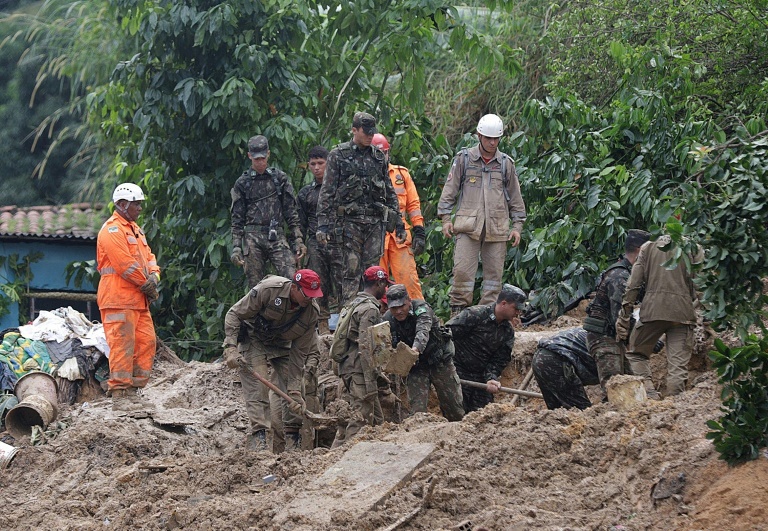
President Jair Bolsonaro sent his condolences Monday to the families of 91 people who died in torrential rains in northeastern Brazil, as rescue workers continued a grim search for victims.

Releasing an updated toll, authorities said 26 people remained missing in the region around the city of Recife, where days of downpours triggered flooding and landslides that swept up virtually everything in their path.

Bolsonaro posted a video on Twitter that showed him flying in a helicopter over a disaster zone where brown floodwater still inundated large areas and gashes of mud scarred hillsides where houses once stood.

“I tried to land, but the pilots’ recommendation was that, given the instability of the soil, we could have an accident. So we decided against it,” the far-right president told a news conference.

He recalled a string of devastating floods in Brazil that have killed hundreds of people in recent months, which experts say are being aggravated by climate change.

“We send our condolences to the families. Our top priority is comforting the families and getting aid to the population,” he said.

The government has allocated a total of one billion reais ($210 million) in emergency and reconstruction funds, said Regional Development Minister Daniel Ferreira.

“The forecast is for more rain in the coming days. We urge people to respect the alerts issued by the authorities” and evacuate if necessary, the minister added.

The risk of floods in and around Recife, the capital of Pernambuco state, remains “very high” for Monday, said the national disaster monitoring center, Cemaden.

– Ocean of muck –

The force of the landslides ripped apart houses in neighborhoods such as Jardim Monteverde, on the far outskirts of Recife.

Rescue workers have found more than 20 bodies buried in the mud that tore through the neighborhood Saturday, and said they expect to find more.

Dozens of emergency workers are still digging through the ocean of muck, as clean-up crews in yellow uniforms clear the streets, slowly working their way through the wreckage, an AFP photographer said.

In just hours on Friday and Saturday, parts of Pernambuco received 70 percent of the rain they usually get in the entire month of May.

Such tragedies are becoming a familiar script in Brazil.

In February, 233 people were killed in floods and landslides in the southeastern city of Petropolis, in Rio de Janeiro state.

In January, floods and landslides killed at least 28 people in southeastern Brazil, mostly in Sao Paulo state.

And in December, torrential rains killed 24 people in the northeastern state of Bahia.

On that occasion, Bolsonaro — who is trailing leftist ex-president Luiz Inacio Lula da Silva in the polls ahead of elections in October — faced criticism for not interrupting his year-end beach vacation to visit the disaster zone.

“Unfortunately these tragedies happen, a country the size of a continent has its share of problems,” Bolsonaro said Monday.

Meteorologists say the heavy rains lashing Pernambuco and, to a lesser extent, four other northeastern states are the product of a typical seasonal phenomenon called “eastern waves” — areas of atmospheric disturbance that move from Africa to Brazil’s northeastern coastal region.

Experts say the rains are now being augmented by climate change. Because a hotter atmosphere holds more water, global warming increases the risk and intensity of flooding from extreme rainfall.

In Brazil, such tragedies have tended to hit hardest in poor neighborhoods, especially hillside “favelas,” or slums.
EU leaders seek to break oil ban deadlock as Russia advances in Donbas

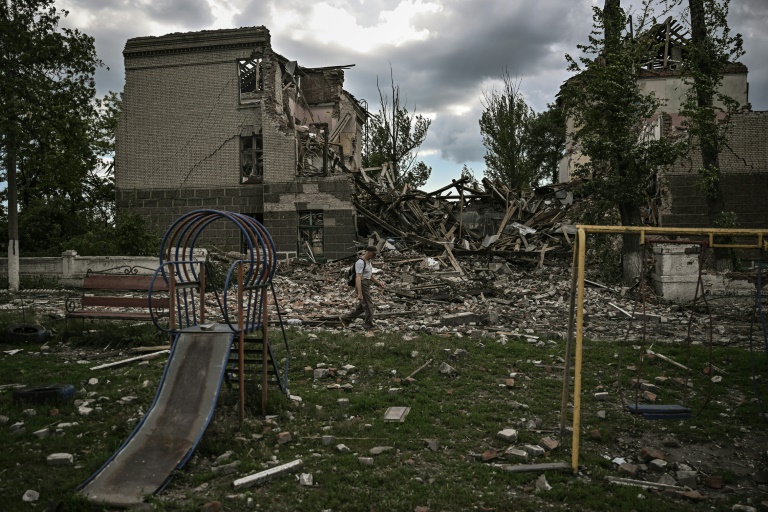
European Union leaders met in Brussels on Monday seeking to overcome Hungarian opposition to an embargo on Russian oil, as Moscow’s forces made gains in the eastern Donbas region of Ukraine. 

Ukrainian President Volodymyr Zelensky was set to address leaders at the emergency summit, expected to press the block “to kill Russian exports” as he seeks to crank up international pressure on Moscow.

In Washington, US President Joe Biden said he would not send rocket systems to Ukraine that could hit Russian territory, despite urgent requests from Kyiv for such weapons and extensive US military aid for Ukraine since the war began.

EU diplomats have drafted a watered-down agreement that would see pipeline oil exempted from the ban, in the hopes of unblocking talks on the bloc’s sixth round of Russian sanctions.

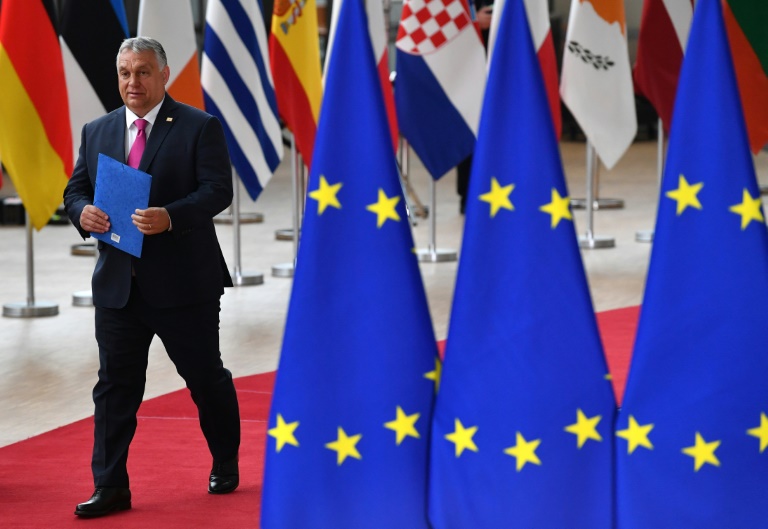
Ahead of the meeting, Hungarian Prime Minister Viktor Orban told reporters the proposal was a “good solution” but warned there was “no agreement at all” as things stood.

On the ground, Russian forces pressed their offensive in Donbas.

The situation in Severodonetsk, just across the Donets river from its sister city of Lysychansk, was “very difficult”, the local Lugansk regional governor Sergiy Gaiday said in a statement on social media.

“The Russians are advancing into the middle of Severodonetsk”, while the fighting continued, Gaiday said.

– Weapons supplies –

“We are not going to send to Ukraine rocket systems that can strike into Russia,” Biden told reporters in Washington.

Ukraine has received extensive US military aid since with legislators approving another $40 billion (37.1 billion euros) assistance package earlier in May.

France’s new foreign minister Catherine Colonna said on a visit to Kyiv that Paris was ready to boost military aid to Ukraine to help it counter Russia’s invasion.

France will “continue to reinforce arms deliveries,” Colonna said at a news conference with her Ukrainian counterpart Dmytro Kuleba.

The arms would arrive “in the coming weeks”, she said.

The highest-ranking French official to visit the capital since Russia invaded Ukraine on February 24, Colonna also visited the town of Bucha, where Russian troops have been accused of committing war crimes against the civilian population.

“This should never have happened. It must never happen again,” Colonna told reporters after visiting an Orthodox church in the town.

The foreign minister’s visit came as a French journalist was killed while working in Ukraine.

Frederic Leclerc-Imhoff was “on board a humanitarian bus” when “he was mortally wounded,” French president Emmanuel Macron wrote on Twitter on Monday.

– Oil sanctions –

Speaking alongside Colonna, Kuleba said he hoped “divisions will be overcome” at the EU leaders meeting.

A sixth wave of EU measures against Moscow was put on the table weeks ago, but has been rejected by Orban and resisted by neighbouring countries also reliant on pipelined Russia oil.

Macron cautiously told reporters that a long-sought-after deal was “getting closer”, but others doubted that the Hungarian leader was ready to sign on at this stage.

“I don’t think we’ll reach an agreement today,” Estonian Prime Minister Kaja Kallas said at a political meeting ahead of the summit

Hungary has asked for at least four years and 800 million euros ($860 million) in EU funds to adapt its refineries and increase pipeline capacity for alternative suppliers, like Croatia.

But under the compromise proposal the Druzhba pipeline could be excluded from a sanctions package “for the time being”, an EU official told AFP.

– ‘We’re close!’ –

Since failing to capture Kyiv in the war’s early stages, Russia’s army has narrowed its focus, hammering Donbas cities with relentless artillery and missile barrages as it seeks to consolidate its control.

But Ukrainian forces pushed back over the weekend in the southern region of Kherson, the country’s military leadership said.

The Ukrainian general staff claimed the move had put their adversary into “unfavourable positions” around the villages of Andriyivka, Lozovo and Bilohorka and forced Moscow to send reserves to the area.

“Kherson, hold on. We’re close!” it tweeted Sunday.

At the same time, two people were injured following an explosion in the Moscow-controlled city of Melitopol in south-eastern Ukraine, with local pro-Kremlin authorities blaming Kyiv.

Russia-installed authorities said the city had been targeted by a “terrorist attack”.

“The Ukrainian government continues its war on the civilian population and the infrastructure of cities,” a statement said.

At least five people died following strikes on civilian infrastructure in Ukraine’s separatist-controlled city of Donetsk, according to Russian investigators.

Authorities in the DNR said on Telegram that two apartment blocks and three schools were hit in the attack, accusing Kyiv of using artillery and rockets with cluster munitions.

burs-sea/jm

Statuette of architect among new cache of ancient Egyptian artifacts

Egypt on Monday unveiled a cache of sarcophagi and bronze statuettes — including one of pioneering architect Imhotep — at the Saqqara archaeological site south of Cairo.

They were the latest in a series of discoveries made in the area.

Saqqara is a vast necropolis of the ancient Egyptian capital Memphis, a UNESCO World Heritage site home to more than a dozen pyramids, animal burial sites and ancient Coptic Christian monasteries.

Among the 150 bronze statuettes unearthed in the latest findings is one of Imhotep, who “revolutionised architecture” in the ancient world, Mostafa Waziri, head of Egypt’s Supreme Council of Antiquities, told reporters.

Imhotep, who lived in the third millenium BC, built the Djoser step pyramid, one of the earliest in ancient Egypt. He later became the god of medicine. 

Waziri revealed a goal for the archaeological mission, which has so far undertaken four seasons of excavations in the area: “To find the tomb of Imhotep.”

Other unearthed statuettes depict various gods and goddesses including Bastet, Anubis, Osiris, Amunmeen, Isis, Nefertum and Hathor, according to a statement from the Ministry of Tourism and Antiquities.

The mission also unveiled “250 wooden sarcophagi with mummies inside, dating back to the Late Period,” around the fifth century BC, Waziri said.

Inside one sarcophagus, the team found an untouched and sealed papyrus, he said. It has been transferred to the laboratory of the Egyptian Museum in central Cairo for full restoration and study, Waziri said. 

He added the papyrus — estimated at nine metres (9.9 yards) long — likely contains chapters of the Book of the Dead, collections of funerary texts composed of spells that Egyptian used to guide the dead through the underworld.

The sarcophagi will be moved to the Grand Egyptian Museum, which authorities hope to inaugurate near Cairo’s Giza pyramids later this year after repeated delays.

Hopes are high that the new museum, in addition to archaeological discoveries of recent years, will help revive the country’s vital tourism industry.

The sector has been battered by successive blows, including the 2011 revolution and ensuing unrest, the coronavirus pandemic, and now a halt of Russian and Ukranian tourists, who accounted for a large portion of the country’s visitors.

Among other findings at Saqqara, Egypt in March unveiled five ancient Pharaonic tombs, and in January last year announced the discovery of more than 50 wooden sarcophagi dating from the New Kingdom which ended in the 11th century BC.

EU leaders plead with Orban to back Russian oil ban

EU leaders were hoping Monday to persuade Prime Minister Viktor Orban to back a watered-down oil embargo against Russia after a month of haggling over a blocked sanctions package.

But the Hungarian leader, who has demanded an exemption from the ban and guarantees for his country’s energy supply, warned on arrival at the EU summit that no compromise had yet been reached.

Orban confirmed that the proposal on the table would see Russian oil arriving in the EU and in Hungary by pipeline, rather than by sea, exempted from the sanctions.

“For Hungary this is a good solution, it means that an atomic bomb won’t be thrown on the Hungarian economy,” he said. But he warned that this would not be enough to guarantee supply.

“What causes us a problem is that in the case that something happens to the pipeline carrying Russian oil, which is something that the Ukrainians and others have spoken about,” he said. 

“If Russian oil does not arrive by pipeline, then we would have the right to receive oil by sea, and have it arrive from elsewhere, that is the guarantee that we need.”

Orban said “there is no agreement at all”. He did not, however, threaten to veto the leaders’ planned summit statement, arguing that it was the European Commission’s job to fine-tune the sanctions package.

— ‘Exceptions’ being negotiated —

A sixth wave of EU measures against Moscow was put on the table weeks ago, but has been rejected by Orban and resisted by neighbouring countries also reliant on pipelined Russia oil.

French President Emmanuel Macron cautiously told reporters that a long-sought-after deal was “getting closer”, but others doubted that.

“I don’t think we’ll reach an agreement today,” Estonian Prime Minister Kaja Kallas said at a political meeting Monday ahead of the summit.

“Of course, we’re going to have discussions, but everybody needs to be on board,” she said, adding that she did not expect a solution before a summit in late June. 

EU sanctions require the backing of all 27 member states and ambassadors fell short of finalising a deal just hours before the start of the summit. 

A senior EU diplomat described the failure as the “elephant in the room”, especially given that Ukrainian President Volodymyr Zelensky was also slated to address the leaders by video link.

An EU official said the leaders would attempt to find a “political agreement” on the Russian oil ban, with exceptions for specific countries worked out “as soon as possible”.

– ‘Orban’s antics’ –

Landlocked Hungary imports 65 percent of its oil from Russia through the Druzhba pipeline and, along with Slovakia and the Czech Republic, have asked for an exception from the import ban.

Diplomats said a two-year delay to the embargo has been granted to the countries concerned, but that Budapest wants at least four years and nearly 800 million euros ($860 million) in EU funding to adapt its refineries.

“There is quite a lot of sympathy for Hungary’s oil supply issues, which are great, despite the antics by Orban,” an EU diplomat said on condition of anonymity.

The latest compromise solution would exclude the Druzhba pipeline from the embargo and only impose sanctions on oil shipped to the EU by tanker vessel, which counts for two-thirds of Russian oil imports.

“The European Council aims to reach a political agreement today on an embargo on Russian oil,” an EU official told reporters.

“Some temporary exceptions have been granted to ensure security of supply for certain member states.”

Hungary’s intransigence comes on the back of Orban’s recent resounding re-election to a fourth term and some experts are sceptical about the official claims of alarm over a Russian oil ban.  

Also complicating the stand-off is Hungary’s share of the EU’s 800-billion-euro recovery fund, which Brussels has yet to approve due to disagreements over Budapest’s respect for the rule of law and human rights.

A senior diplomat warned that some leaders had accused negotiators of going too far in their efforts to placate Orban, who before the war was Russian President Vladimir Putin’s closest EU ally.

The question of how we answer Russia is always “emotional” for certain member states and will be “one of the most sensitive issues” at the summit, the diplomat added.

Killer whale stranded in France's River Seine dies

A killer whale stranded for weeks in France’s River Seine was found dead Monday after attempts to guide it back to sea failed and revealed it was severely sick, local authorities said.

Regional officials had already decided to euthanise the killer whale — also known as an orca — to end its suffering, but a sailor spotted the animal lying on its side Monday morning. 

Sea Shepherd France, who went out to the animal and confirmed its death, said on Twitter they were watching over the orca’s body to prevent it from being hit by a ship, which would compromise the autopsy.

The investigation will try to establish why the orca got stranded and how it died, as well as gather information on its illness, local authorities said. 

A group of experts attempted to use sonar techniques to help guide the animal back into its natural salt-water habitat this weekend, after its appearance in the iconic French river that flows through Paris astonished onlookers.

But the operation seeking to save the animal encountered “a lack of alertness, inconsistent reactions to sound stimuli and erratic and disoriented behaviour,” regional authorities said in a statement. 

“The sound recordings also revealed vocal calls similar to cries of distress,” it said, adding that the animal appeared to be in a “critical state of health”.

“Her skin was so ulcerated… She must have been in agony. Pieces of skin were falling off, there was nothing that could be done,” said Gerard Mauger, vice-president of GECC, a Cherbourg-based association for the conservation of marine animals in the Channel.

“Everything was ready to euthanise her” when she was found dead, Mauger added. 

The animal appeared to be suffering from mucormycosis, a fungal infection increasingly seen among marine mammals and which causes them severe distress.

Killer whales, which, despite their name belong to the dolphin family, are occasionally spotted in the English Channel but such sightings are considered rare, and even rarer in a river.

Experts said that while being in a river helped the animal to conserve energy, it also complicated its search for prey, especially for a species known to hunt in packs.

Norwegian buys 50 Boeing 737 MAX, ending dispute

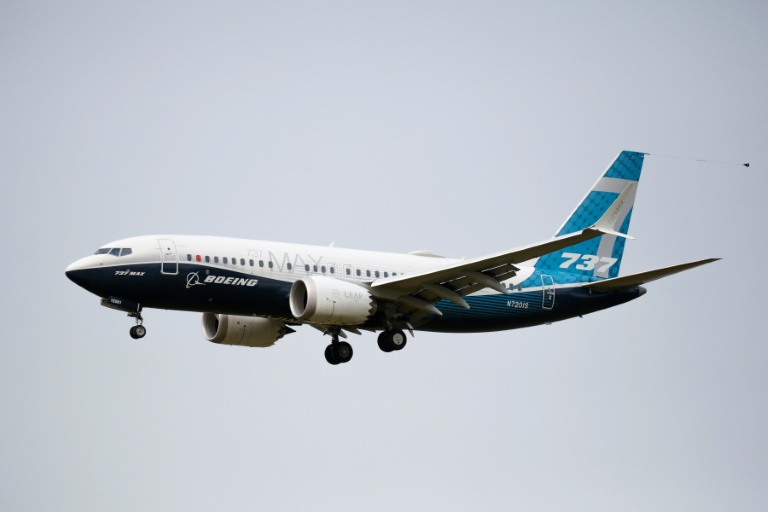
Low-cost carrier Norwegian Air Shuttle said Monday it would buy 50 Boeing 737 MAX 8 planes, ending a dispute between the companies and helping revive the US-made aircraft after two deadly crashes.

The jets will be delivered between 2025 and 2028, or around the same time that Norwegian’s aircraft leasing deals come to an end, and the contract includes an option for 30 more, the company said in a statement.

The order is welcome news for the US manufacturer’s flagship Boeing 737 MAX 8, which was grounded for 20 months following two fatal accidents and has been gradually returning to service since late 2020. 

Norwegian’s order is part of “the resolution of a dispute we have” with Boeing, the company’s chief executive Geir Karlsen told broadcaster TV2.

The Nordic low-cost carrier and Boeing have been locked in a legal battle for several years, with the Norwegian carrier launching legal proceedings against the US giant for compensation following setbacks related to its 737 MAX and 787 Dreamliner long-range jets.

Without giving further details, Karlsen mentioned “a compensation of two billion kroner ($212 million, 197 million euros) that we used to buy planes under advantageous conditions.

Norwegian said the deal remains subject to “various closing conditions” that it hopes will be concluded by the end of June.

Norwegian, which currently operates 61 aircraft, plans to ramp operations to have 70 in service this summer and 85 in the summer of 2023. 

Plagued by over-ambitious expansion, technical problems and the Covid pandemic, the company narrowly avoided bankruptcy last year via an extensive restructuring that led it, among other things, to give up its long-haul flight, reduce its fleet and cancel numerous orders.

Securing the 50 aircraft, means Norwegian is also returning to fully owning its own fleet after it was forced to rely on leased aircraft due to its financial woes.

For Boeing, this order solidifies the revival of the 737 MAX aircraft.

The 737 MAX was temporarily grounded worldwide following two crashes in Indonesia and Ethiopia, in 2018 and 2019, that killed a combined 346 people.

After Caribbean Arajet and  American Allegiant Air put in orders for the aircraft, British carrier IAG — parent company of British Airways — also just ordered 50 planes with an option for 100 more.

Norwegian on Monday also noted that the Boeing 737 MAX 8 is “approximately 14 percent more fuel-efficient compared to the previous-generation aircraft,” thus limiting emissions and cutting energy costs in view of rising fuel prices.

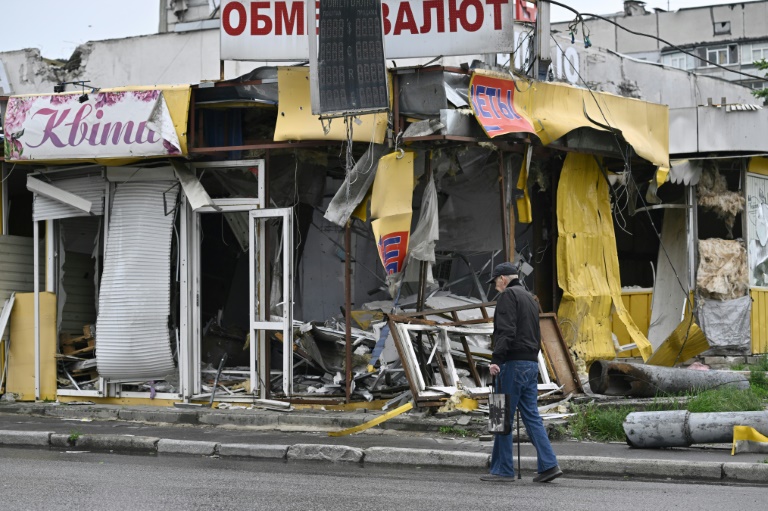
Russia advances in east Ukraine as EU meets on oil ban

Russian forces edged toward the centre of the eastern Ukrainian city of Severodonetsk Monday, while President Volodymyr Zelensky prepared to appeal to EU leaders at an emergency summit where a ban on Russian oil imports is on the agenda. 

Zelensky is expected to press EU officials at the summit “to kill Russian exports” as he seeks to crank up international pressure on Moscow.

Member states are searching for a compromise on a sixth round of sanctions, which has been delayed by resistance from within the bloc, namely from Hungary.

Meanwhile, Russia forces continued their push in the eastern Donbas region, upping the pressure on the twin cities of Severodonetsk and Lysychansk.

Since failing to capture Kyiv in the war’s early stages, Russia’s army has narrowed its focus, hammering cities with relentless artillery and missile barrages as it seeks to consolidate its control.

The situation in Severodonetsk, just across the Donets river from Lysychansk, was “very difficult”, the local Lugansk regional governor Sergiy Gaiday said in a statement on social media.

“The Russians are advancing into the middle of Severodonetsk”, while the fighting continued, Gaiday said.

– Pressure on the east –

While Russia concentrated its efforts in the east, Ukrainian forces pushed back over the weekend in the southern region of Kherson, the country’s military leadership said.

At the same time, two people were injured following an explosion in the Moscow-controlled city of Melitopol in southeastern Ukraine, with local pro-Kremlin authorities said pinning the blame on Kyiv.

Newly appointed French Foreign Minister Catherine Colonna also made the journey to the Ukrainian capital Monday for talks with Zelensky.

The highest-ranking French official to visit Kyiv since Russia invaded Ukraine on February 24, Colonna also visited the town of Bucha, where Russian troops have been accused of committing war crimes against the civilian population.

In the eastern Donbas region, Moscow’s forces were making slow progress towards taking the city of Severodonetsk.

Zelensky, in his daily address Sunday, described a scene of devastation in Severodonetsk. 

“All critical infrastructure has already been destroyed… More than two-thirds of the city’s housing stock has been completely destroyed,” he said. 

– ‘Constant shelling’ –

In Severodonetsk, where an estimated 15,000 civilians remain, a local official said “constant shelling” made it increasingly difficult to get in or out while the water supply is increasingly unstable.

Ukrainian forces counterattacked in the region of Kherson, the only region of the country fully controlled by Russian troops.

Russia gained control over most of Kherson, which borders Crimea, in the early stages of the war and Moscow-backed officials in the region have recently pushed for annexation.

While limited in nature, the attack could have the effect of stretching Russian forces. 

The Ukrainian general staff claimed the move had put their adversary into “unfavourable positions” around the villages of Andriyivka, Lozovo and Bilohorka and forced Moscow to send reserves to the area.

“Kherson, hold on. We’re close!” it tweeted Sunday.

In Melitopol, Russia-installed authorities said in a statement the city had been targeted by a “terrorist attack”.

According to the statement, car packed with explosives exploded in the city centre, injuring two “humanitarian aid” volunteers, a 28-year-old woman and a 25-year-old man.

“The Ukrainian government continues its war on the civilian population and the infrastructure of cities,” the officials said.

– Oil sanctions –

A new, sixth round of European sanctions has been held up by Hungary, whose Prime Minister Viktor Orban has close relations with Russian leader Vladimir Putin.

EU ambassadors made a final push ahead of the summit to persuade Hungary to accept a watered-down oil embargo against Russia.

The landlocked country is heavily dependent on Russian crude oil supplied via the Druzhba pipeline.

Hungary has asked for at least four years and 800 million euros ($860 million) in EU funds to adapt its refineries and increase pipeline capacity for alternative suppliers, like Croatia.

But under the compromise proposal the Druzhba pipeline could be excluded from a sanctions package “for the time being”, an EU official told AFP.

– ‘New face’ –

Meanwhile Zelensky on Sunday made his first visit to the embattled east since the start of the war, walking the streets of the Kharkiv region’s devastated capital in a bullet-proof vest.

While in Kharkiv, Zelensky discussed reconstruction plans with local officials, saying there was a chance for areas wrecked by Russian attacks to “have a new face”.

Despite an estimated 2,000 apartment blocks having been wholly or partially destroyed by shelling, the city has returned to a degree of normality in recent weeks.

While one-third of the northeastern region remains under Russian control, “we will for sure liberate the entire area,” the Ukrainian president said after the visit.

burs-sea/jv

Gabon takes grassroots approach in anti-poaching drive

A whistle blows. The car stops, and the driver is politely asked to turn off the engine and get out.

A team from Gabon’s anti-poaching brigade then searches the vehicle from top to bottom, looking in every cranny for guns or game. Nothing is found, and the driver is allowed to move on.

The unit’s task is to help guard Gabon’s rich biodiversity.

Forests cover 88 percent of the surface of this small central African nation, providing a haven — and a tourism magnet — for species ranging from tropical hardwoods and plants to panthers, elephants and chimps.

The team was on patrol close to a small village called Lastourville, 500 kilometres (300 miles) southeast of the capital Libreville.

The area has been badly hit by poaching, and tracks dug into the forest floor by logging vehicles are also used by illegal hunters to enter and shoot game.

– ‘Everyone poaches’ –

“There’s no standard profile of a poacher. Everyone poaches — from the villager who is looking for something to eat to some big guy in the city who has an international network,” the brigade’s commander, Jerry Ibala Mayombo, told AFP.

The unarmed unit sees its role as “educating, awareness-building and, as a last resort, punishing,” he said. The heaviest sentences are for ivory smuggling, which can carry a 10-year jail term.

The two-year-old service was created by a partnership between Gabon’s ministry for water and forests, a Belgian NGO called Conservation Justice and a Swiss-Gabonese sustainable forestry firm, Precious Woods CEB.

“At the start, the overall feeling towards us was mistrust. But that’s not the case today, because we have got the message across to people about what we do,” said Ibala Mayombo. 

“We sometimes face violent poachers who threaten us, sometimes with their guns,” he said. The team can be given a police escort when necessary.

Last year, the unit seized 26 weapons, several dozen items of game and arrested eight individuals for ivory smuggling.

“The trend is downward,” said Ibala Mayombo.

– Daily challenges –

Gabon, an oil-rich former French colony, is putting itself forward as a major advocate for conservation in central Africa, where wildlife has been battered by wars, habitat destruction and the bushmeat trade.

In 2002, Gabon set up a network of 13 national parks covering 11 percent of its territory.

In 2017, it created 20 marine sanctuaries covering 53,000 square kilometres (20,500 square miles) — the biggest ocean haven in Africa, and equivalent to more than a quarter of its territorial waters.

These initiatives have helped to place Gabon firmly on the map for lucrative eco-tourism.

But beneath the applause, there is the daily challenge of managing problems when humans and animals collide.

Gabon has a huge success story in its conservation of African forest elephants.

Across Africa, numbers of this species have fallen by 86 percent in 30 years — the animal is now in the Critically Endangered category on the Red List compiled by the International Union for Conservation of Nature (IUCN).

But in Gabon, the forest elephant population has doubled in a decade to 90,000 animals — although this has also come at a cost of frequent conflict between animals and farmers.

In one of the villages, Helene Benga, 67, was in tears over what to do.

“You go into the field in the morning and you see he’s eaten a bit (of the crop). You go the following day, and he’s eaten another bit. Within a few days, all the crop will be gone. I’ve got no money and nothing left to eat. What am I going to do?” she asked.

– ‘We hunt to live’ –

In the village of Bouma, around 30 local people attended a meeting to promote awareness about hunting restrictions — which species could be hunted and at what dates, areas where hunting was banned, how to obtain a permit, and so on.

The mood was tense. 

“What can we do when animals invade our fields?” asked one person. “How can you tell the difference between a protected species and a (non-protected) one when you’re hunting at night?” said another.

“I do understand that we have to protect wildlife,” said Leon Ndjanganoye, a man in his 50s.

“But here, in the village, what do we do to live? We hunt. The laws are a vexation.” 

Key talking points of Depp vs Heard trial

After weeks of explosive testimony, the jury is finally deliberating in the defamation case between actors Johnny Depp and his ex-wife Amber Heard.

Depp filed suit against Heard over an op-ed she wrote for The Washington Post in December 2018 in which she described herself as a “public figure representing domestic abuse.”

Heard did not name Depp in the piece, but he sued her for implying he was a domestic abuser and is seeking $50 million in damages.

Heard countersued for $100 million, claiming she suffered “rampant physical violence and abuse.”

Here are some of the key talking points from the blockbuster trial.

– The severed fingertip –

Hours of testimony during the six-week trial were devoted to a grisly incident in March 2015 in Australia, where Depp was filming the fifth installment of “Pirates of the Caribbean.”

The tip of Depp’s right-hand middle finger was severed during a heated argument with Heard at their rented home.

Depp said it occurred when Heard threw a vodka bottle at him.

Heard said she did not know how it happened but it may have been when he smashed a wall-mounted phone.

Both agreed though that Depp used his bloody digit to scrawl cryptic messages on walls, lampshades and mirrors in the home.

– Poop on the bed –

Among many bizarre incidents cited during the trial was a story about feces deposited one day on Depp’s side of the couple’s bed.

Depp said he was shown a photograph of “human fecal matter” on the bed after he and Heard argued during her 30th birthday party.

Heard tried to blame it on their dogs, Depp said, but “they’re teacup Yorkies, they weigh about four pounds each.”

Heard said the dog had bowel problems after eating some of Depp’s marijuana as a puppy.

As for the dogs, Heard accused Depp of once holding one of them out of the window of a moving car while “howling like an animal.”

The dog was unhurt.

– The witnesses –

Both sides presented multiple witnesses although rumored testimony by billionaire Elon Musk, Heard’s ex-boyfriend, and her co-star James Franco ultimately did not materialize.

But there were celebrity appearances.

Kate Moss, Depp’s former girlfriend, shot down a longstanding rumor he had once thrown the British model down a flight of stairs.

Moss said by videolink that it never happened.

Actress Ellen Barkin, another ex-girlfriend, testified Depp was jealous, controlling, and drunk “a lot of the time,” and once threw a wine bottle in a hotel room.

Other witnesses included bodyguards, agents, business managers, psychiatrists, doctors, friends, relatives, and even the former doorman of the luxury penthouse complex where the couple once lived in Los Angeles.

Doorman Alejandro Romero probably spoke for many involved in the case when he said: “I am so stressed out. I don’t want to deal with this anymore.”

– The evidence –

Audio and video recordings of heated, profanity-laced arguments between Depp and Heard were also entered into evidence.

In one video recorded by Heard in their kitchen, Depp is seen shouting, smashing glass cabinets and pouring himself an enormous glass of red wine.

Both Depp and Heard submitted photos of injuries they claimed were inflicted by the other.

Heard’s lawyers also presented photos purporting to show Depp passed out after drinking excessively or using drugs.

Text messages between Depp and various people were displayed in which he described in crude and violent language what he would like to see happen to Heard.

Depp’s lawyers downplayed the texts, saying he just had a colorful way of writing, similar to that of his late friend, the journalist Hunter S. Thompson.


– The Depp fans –

Fans of Depp queued up for hours daily to secure coveted seats in the public gallery for the trial held in Fairfax, Virginia.

While the spectators mostly behaved themselves, Judge Penney Azcarate threatened to expel them at one point during Heard’s testimony.

“If I hear one more sound, I will clear the gallery and we will continue this testimony without anybody in the courtroom,” Azcarate warned. “Understood?”

Depp fans also waged a massive campaign on social media in support of the actor with the hashtag #JusticeForJohnnyDepp.

Heard said she had received thousands of death threats. “People want to kill me and they tell me so every day,” she said.

The trial has also been closely followed online by millions of people tuning in to YouTube livestreams of proceedings. Many of them generated memes or animated GIFs in real-time, often either lauding Depp or ridiculing Heard.

– Damaged Hollywood careers –

Both Depp, a three-time Oscar nominee, and Heard claimed their careers have been damaged.

Heard, who starred in “Aquaman,” one of the top-grossing films ever, said she had to fight to retain a role in “Aquaman 2” and Depp tried to get Warner Brothers to cut her from the sequel.

Heard’s legal team presented an entertainment industry expert who estimated she has suffered $45-50 million in lost film and TV roles and endorsements.

An industry expert hired by Depp’s side said he has lost millions because of the abuse accusations, including a $22.5 million payday for a sixth “Pirates” installment.

But Tracey Jacobs, Depp’s former agent, said there never was a formal agreement for another “Pirates” film.

Jacobs also said the actor’s star had begun to dim since 2010 because of “unprofessional behavior” which included drinking and drug use.

Equity markets extend Wall St rally as China eases curbs

Markets rose Monday as investors rediscovered some verve after the release of healthy US data and as China eases some of its strict Covid curbs in Shanghai and Beijing, lifting hopes for the world’s number two economy.

The gains extended a positive end to last week for global equities with some commentators saying there was a growing hope that the months-long sell-off may have run its course.

Wall Street provided a strong lead and snapped a series of weekly losses, with Friday’s rally supported by data showing an easing of the key personal consumption expenditures (PCE) price index.

Markets have been pummelled this year as soaring prices — caused by the Ukraine war, supply chain snags and China’s lockdowns among other things — forced central banks to hike interest rates and warn of more to come.

The US reading lent hope that the worst of the inflation surge may have passed and could allow the Federal Reserve to ease back from its hawkish rate hike drive later in the year.

May jobs data — due for release on Friday — should provide a fresh snapshot of the economy and possibly an idea about the Fed’s next policy moves.

Asian investors followed the lead from their US counterparts.

Hong Kong put on more than two percent after a strong Friday performance fuelled by a rally in tech firms, while Tokyo, Sydney, Shanghai, Seoul, Mumbai, Taipei, Manila, Bangkok and Wellington were also well up.

London, Paris and Frankfurt all rallied at the open.

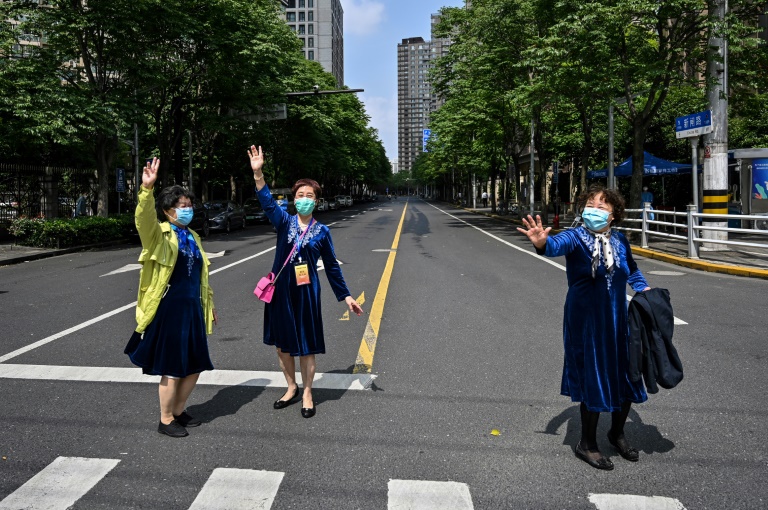
An easing of long-running lockdown measures in Shanghai provided a much-needed lift to sentiment, with China’s biggest city seeing a drop in Covid cases, while some curbs were also being lifted in Beijing.

Officials have also announced measures to ease the impact on the world’s number two economy, which has been hammered by the restrictions.

Still, OANDA’s Jeffrey Halley said: “The devil is in the detail of course, and workers in both cities still face challenges either going to work, or even being allowed to leave the house.”

He added that traders were also aware another flare-up could see the reimposition of tightened restrictions. 

“Such minutiae are usually ignored by markets when it doesn’t suit the preferred narrative, and so it is today. Asia is pricing in peak virus in China and a recovery in growth,” he said.

The possibility that the measures could be gradually removed helped oil prices rise, with Brent topping $120 for the first time in two months as traders bet on a pick-up in demand.

That comes as European leaders are said to be edging towards a deal to impose sanctions on imports of crude from Russia in retaliation for its invasion of Ukraine.

Still, while optimism is higher on trading floors at the moment, it remains at a premium with inflation still elevated and borrowing costs expected to rise further, while the war in Ukraine and China’s still-struggling economy continue to drag.

“We are in the middle of a bear market rally,” Mahjabeen Zaman, of Citigroup Australia, told Bloomberg Television. “I think the market is going to be trading range bound trying to figure out how soon is that recession coming or how quickly is inflation going down.”

– Key figures at around 0720 GMT –

Tokyo – Nikkei 225: UP 2.2 percent at 27,369.43 (close)

Hong Kong – Hang Seng Index: UP 2.2 percent at 21,145.89

Shanghai – Composite: UP 0.6 percent at 3,149.06 (close)

London – FTSE 100: UP 0.4 percent at 7,613.50

Euro/dollar: UP at $1.0754 from $1.0739 on Friday

Pound/dollar: UP at $1.2644 from $1.2631

Euro/pound: UP at 85.05 pence from 84.99 pence

Dollar/yen: UP at 127.11 yen from 127.09 yen 

Brent North Sea crude: UP 0.5 percent at $120.03 per barrel

West Texas Intermediate: UP 0.7 percent at $115.91 per barrel

New York – Dow: UP 1.8 percent at 33,212.96 (close)

Close Bitnami banner
Bitnami