AFP

Ukraine says 'everything' being done to defend Donbas from Russian onslaught

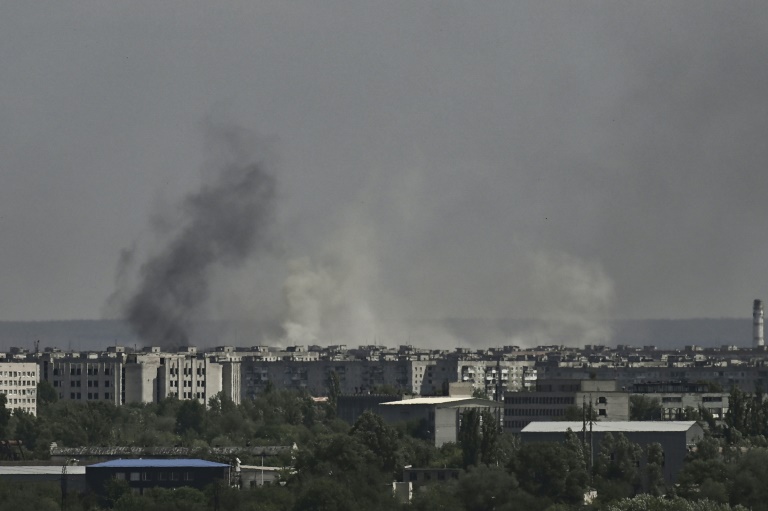
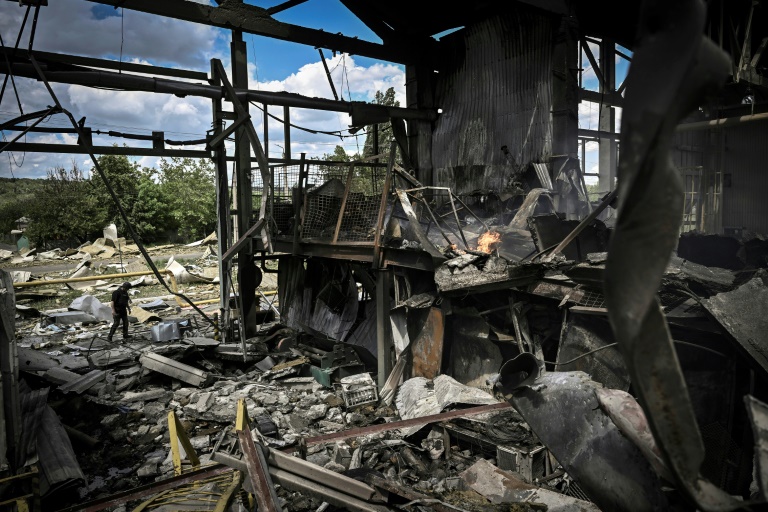
Ukraine has pledged to do “everything” to defend Donbas, where an intensifying Russian offensive is prompting Kyiv’s forces to consider a strategic retreat from some key areas to avoid being surrounded.

Russia is waging all-out war for the eastern Donetsk and Lugansk regions that make up Donbas — the country’s industrial heartland — where Ukraine’s President Volodymyr Zelensky has accused Moscow of carrying out a “genocide”.

In his daily address to Ukrainians, Zelensky said the Russians had “concentrated maximum artillery, maximum reserves in Donbas.”

“There are missile strikes and aircraft attacks — everything,” he said. 

“We are protecting our land in the way that our current defense resources allow,” he added. “We are doing everything to increase them.”

Pro-Russian separatists said Friday they had captured the town of Lyman between Severodonetsk and Kramatorsk, on the road leading to the key cities still under Kyiv’s control.

Russian forces are also closing in on Severodonetsk and Lysychansk in the Lugansk province, with conflicting reports about the extent of their advance.

Regional governor Sergiy Gaiday insisted that the Russian forces would not be able to seize the entire region within two to three days — but said that Ukraine’s troops may have to withdraw from some areas to avoid being surrounded. 

“Most probably they will not seize (Lugansk), because there’s enough strength and means to hold the defence,” he said on Telegram.

“Maybe even to avoid encircling there might be a command to our troops to retreat.”

– Escalation –

A Lugansk police official, cited by Russia’s state news agency RIA Novosti, said Severodonetsk was “now surrounded” and Ukrainian troops could no longer leave the city.

That was denied by senior city official Oleksandr Stryuk, though he acknowledged the situation was “very difficult” with incessant bombing.

“People are willing to risk everything to get food and water,” said the head of the main aid distribution centre in Lysychansk, Oleksandr Kozyr.

“They are so psychologically depressed that they are no longer scared. All they care about is finding food.” 

Three months after Russia launched its invasion on February 24, leaving thousands dead on both sides and forcing 6.6 million people out of the country, Moscow has gained control over swathes of eastern and southern Ukraine, including port cities Kherson and Mariupol.

“Russian forces have made steady, incremental gains in heavy fighting in eastern Ukraine in the past several days, though Ukrainian defenses remain effective overall,” said the US-based Institute for the Study of War.

To further help Ukraine fight back against the invasion, Washington was preparing to send advanced long-range rocket systems, according to US media reports.

Pentagon spokesman John Kirby did not confirm the plans to deliver the M270 Multiple Launch Rocket System (MLRS) to Ukraine, a highly mobile system that can fire up to 300 kilometres (186 miles) which Kyiv has said it badly needs.

“We are still committed to helping them succeed on the battlefield,” he said.

Mykhaylo Podolyak, an adviser to President Zelensky, referring to the rocket systems, said on Twitter that some of the country’s partners “avoid giving the necessary weapons because of fear of the escalation. Escalation, really?” 

– ‘Suffering’ –

In a historic move against Russia’s spiritual authorities, the Moscow branch of Kyiv’s Orthodox Church said Friday it was cutting ties with Russia over its invasion of Ukraine, declaring “full independence”

A church council that focused on Russia’s “aggression” condemned the pro-war stance of Patriarch Kirill of the Russian Orthodox Church.

“Not only did he (Kirill) fail to condemn Russia’s military aggression but he also failed to find words for the suffering Ukrainian people,” church spokesman Archbishop Kliment told AFP.

Ukraine has been under Moscow’s spiritual leadership since at least the 17th century, but part of its Orthodox Church broke with Moscow in 2019 over Russia’s annexation of Crimea and support for separatists in Donbas.

Seeking to build on the international pressure on Russia, Zelensky will speak with EU leaders at an emergency summit Monday as they try to agree on an embargo on Russian oil, which is being held up by Hungary, whose Prime Minister Viktor Orban has close relations with Russian President Vladimir Putin.

“Rather than continue trading with (Russia), we need to act until they stop their policy of aggression,” Zelensky told a think tank in Indonesia.

But in Moscow, Finance Minister Anton Siluanov said the country expects to receive one trillion rubles ($15 billion) in additional oil and gas revenues this year, a windfall from the sharp rise in oil prices caused in part by its invasion of Ukraine.

As his navy blockades Ukrainian ports, Putin also rejected accusations that he was using food shortages as a weapon. Russia and Ukraine supply some 30 percent of the wheat traded on global markets.

Russia has tightened its own exports and Ukraine has vast amounts stuck in storage, driving up prices and cutting availability for importers across the globe.

In a call Friday with Austrian Chancellor Karl Nehammer, Putin put the blame on “anti-Russian sanctions by the United States and the European Union, among other things,” according to the Kremlin.

He also accused Kyiv of “sabotaging” negotiations and urged Ukraine to de-mine ports “as soon as possible” to allow the passage of grain-carrying vessels, the Kremlin said.

burs-oho/dhc
Freedom and fear: the foundations of America's deadly gun culture

It was 1776, the American colonies had just declared their independence from England, and as war raged the founding fathers were deep in debate: should Americans have the right to own firearms as individuals, or just as members of local militia?

Days after 19 children and two teachers were slaughtered in a Texas town, the debate rages on as outsiders wonder why Americans are so wedded to the firearms that stoke such massacres with appalling frequency.

The answer, experts say, lies both in the traditions underpinning the country’s winning its freedom from Britain, and most recently, a growing belief among consumers that they need guns for their personal safety.

Over the past two decades — a period in which more than 200 million guns hit the US market — the country has shifted from “Gun Culture 1.0,” where guns were for sport and hunting, to “Gun Culture 2.0” where many Americans see them as essential to protect their homes and families.

That shift has been driven heavily by advertising by the nearly $20 billion gun industry that has tapped fears of crime and racial upheaval, according to Ryan Busse, a former industry executive.

Recent mass murders “are the byproduct of a gun industry business model designed to profit from increasing hatred, fear, and conspiracy,” Busse wrote this week in the online magazine The Bulwark.

– Guns and the new nation –

For the men designing the new United States in the 1770s and 1780s, there was no question about gun ownership.

They said the monopoly on guns by the monarchies of Europe and their armies was the very source of oppression that the American colonists were fighting.

James Madison, the “father of the constitution,” cited “the advantage of being armed, which the Americans possess over the people of almost every other nation.”

But he and the other founders understood the issue was complex. The new states did not trust the nascent federal government, and wanted their own laws, and own arms.

They recognized people needed to hunt and protect themselves against wild animals and thieves. But some worried more private guns could just increase frontier lawlessness.

Were private guns essential to protect against tyranny? Couldn’t local armed militia fulfil that role? Or would militia become a source of local oppression?

In 1791, a compromise was struck in what has become the most parsed phrase in the Constitution, the Second Amendment guaranteeing gun rights:

“A well regulated militia, being necessary to the security of a free state, the right of the people to keep and bear arms, shall not be infringed.”

– 1960s gun control –

Over the following two centuries, guns became an essential part of American life and myth.

Gun Culture 1.0, as Wake Forest University professor David Yamane describes it, was about guns as critical tools for pioneers hunting game and fending off varmints — as well as the genocidal conquest of native Americans and the control of slaves.

But by the early 20th century, the increasingly urbanized United States was awash with firearms and experiencing notable levels of gun crime not seen in other countries. 

From 1900 to 1964, wrote the late historian Richard Hofstadter, the country recorded more than 265,000 gun homicides, 330,000 suicides, and 139,000 gun accidents. 

In reaction to a surge in organized crime violence, in 1934 the federal government banned machine guns and required guns to be registered and taxed. 

Individual states added their own controls, like bans on carrying guns in public, openly or concealed.

The public was for such controls: pollster Gallup says that in 1959, 60 percent of Americans supported a complete ban on personal handguns.

The assassinations of John F. Kennedy, Robert F. Kennedy and Martin Luther King, brought a push for strenuous regulation in 1968.

But gunmakers and the increasingly assertive National Rifle Association, citing the Second Amendment, prevented new legislation from doing more than implement an easily circumvented restriction on direct mail-order gun sales.

– The holy Second amendment –

Over the next two decades, the NRA built common cause with Republicans to insist that the Second Amendment was absolute in its protection of gun rights, and that any regulation was an attack on Americans’ “freedom.”

According to Matthew Lacombe, a Barnard College professor, achieving that involved the NRA creating and advertising a distinct gun-centric ideology and social identity for gun owners.

Gun owners banded together around that ideology, forming a powerful voting bloc, especially in rural areas that Republicans sought to seize from Democrats.

Jessica Dawson, a professor at the West Point military academy, said the NRA made common cause with the religious right, a group that believes in Christianity’s primacy in American culture and the constitution.

Drawing “on the New Christian Right’s belief in moral decay, distrust of the government, and belief in evil,” the NRA leadership “began to use more religiously coded language to elevate the Second Amendment above the restrictions of a secular government,” Dawson wrote.

– Self-defense –

Yet the shift of focus to the Second Amendment did not help gunmakers, who saw flat sales due to the steep decline by the 1990s in hunting and shooting sports. 

That paved the way for Gun Culture 2.0 — when the NRA and the gun industry began telling consumers that they needed personal firearms to protect themselves, according to Busse.

Gun marketing increasingly showed people under attack from rioters and thieves, and hyped the need for personal “tactical” equipment.

The timing paralleled Barack Obama becoming the first African American president and a rise in white nationalism.

“Fifteen years ago, at the behest of the NRA, the firearms industry took a dark turn when it started marketing increasingly aggressive and militaristic guns and tactical gear,” Busse wrote.

Meanwhile, many states answered worries about a perceived rise in crime by allowing people to carry guns in public without permits. 

In fact, violent crime has trended downward over the past two decades — though gun-related murders have surged in recent years.

That, said Wake Forest’s Yamane, was a key turning point for Gun Culture 2.0, giving a sharp boost to handgun sales, which people of all races bought, amid exaggerated fears of internecine violence.

Since 2009, sales have soared, topping more than 10 million a year since 2013, mainly AR-15-type assault rifles and semi-automatic pistols.

“The majority of gun owners today — especially new gun owners — point to self-defense as the primary reason for owning a gun,” Yamane wrote.

Turkey shows off drones at Azerbaijan air show

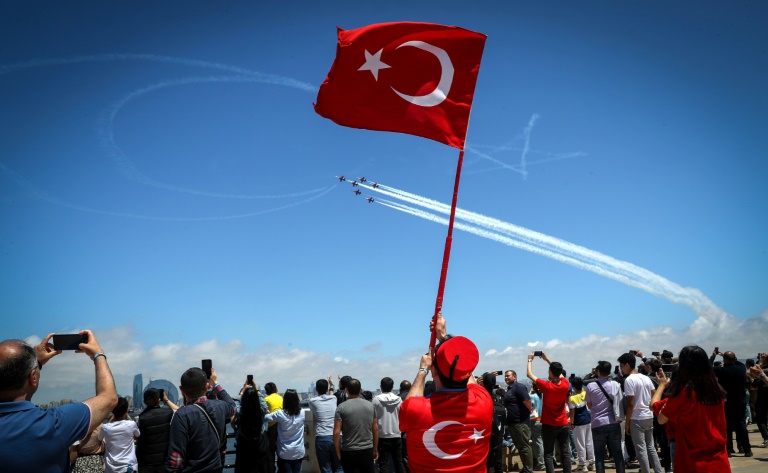
Looping in the air at lightning speed, Turkish drones like those used against Russian forces in Ukraine draw cheers from the crowd at an air show in Azerbaijan.

Turkey is showcasing its defence technology at the aerospace and technology festival “Teknofest” that started in Azerbaijan’s capital Baku this week.

Turkish President Recep Tayyip Erdogan is expected to attend on Saturday.

Turkey’s TB2 drones are manufactured by aerospace company Baykar Defence, where Erdogan’s increasingly prominent son-in-law Selcuk Bayraktar is chief technology officer.

On Wednesday, Bayraktar flew over Baku aboard an Azerbaijani air force Mikoyan MiG-29 plane. One of his combat drones, the “Akinci”, accompanied the flight. 

A video showing Bayraktar in command of the warplane, dressed in a pilot’s uniform decorated with Turkish and Azerbaijani flag patches, went viral on social media. 

“This has been a childhood dream for me,” Bayraktar told reporters after the flight. 

– Proximity to ‘threats’ –

Turkey’s drones first attracted attention in 2019 when they were used during the war in Libya to thwart an advance by rebel commander, General Khalifa Haftar, against the government in Tripoli. 

They were then again put into action the following year when Turkey-backed Azerbaijan in recapturing most of the land it lost to separatist Armenian forces in the disputed Nagorno-Karabakh region. 

Azerbaijani audience members at the aviation festival applauded during a display of TB2 drones, which are now playing a prominent role against invading Russian forces in Ukraine.

A senior official from the Turkish defence industry said his country was facing a wide spectrum of “threats”, including the Kurdistan Workers’ Party (PKK) and Islamic State group jihadists.  

The PKK is listed as a terror group by Ankara and its Western allies.

But with NATO allies — including the United States — having imposed embargoes on Turkey, Ankara was forced to take matters into its own hands to build defence equipment, the official told AFP.

“The situation is changing now with the war in Ukraine,” the official said.

Turkey has been looking to modernise its air force after it was kicked out of the F-35 fighter jet programme because of its purchase of Russia’s S-400 missile defence system.

But Ankara’s role in trying to mediate an end to the Ukraine conflict through direct negotiations may have helped improve its relations with Washington in the past months.

In April, US President Joe Biden’s administration said it now believed that supplying Turkey with F-16 fighter jets would serve Washington’s strategic interests.

– Exports to 25 countries –

Michael Boyle, of the Rutgers University-Camden in the United States, said Turkish drones such as Bayraktar TB2 drones were “increasingly important to modern conflicts because they have spread so widely”.

For years, leading exporters like the United States and Israel limited the number of countries they would sell to, and also limited the models they were willing to sell, he told AFP. 

“This created an opening in the export market which other countries, notably Turkey and China, have been willing to fill,” added the author of the book “The Drone Age: How Drone Technology Will Change War and Peace”.

The Turkish official said Turkey has been investing in the defence industry since the 2000s, but the real leap came in 2014 after serious investments in advanced technologies and a shift towards using locally made goods. 

While Turkey’s export of defence technologies amounted to $248 million in early 2000, it surpassed $3 billion in 2021 and was expected to reach $4 billion in 2022, he said. 

Today Turkey exports its relatively cheap and effective drones to more than 25 countries.

Boyle said these drones could be used “for direct strikes, particularly against insurgent and terrorist forces, but also for battlefield reconnaissance to increase the accuracy and lethality of strikes”. 

“So they are an enabler of ground forces, and this makes them particularly useful for countries like Ukraine which are fighting a militarily superior enemy,” he said.

Don't blame the gun: NRA supporters react to Uvalde massacre

Keith Jehlen says the shooting at a Texas elementary school makes him “sick,” but that “you can’t blame the gun” used to murder 19 small children and two teachers.

“We’ve always had guns in this country,” the 68-year-old retired US Postal Service worker said, noting that he personally owns more than 50 firearms.

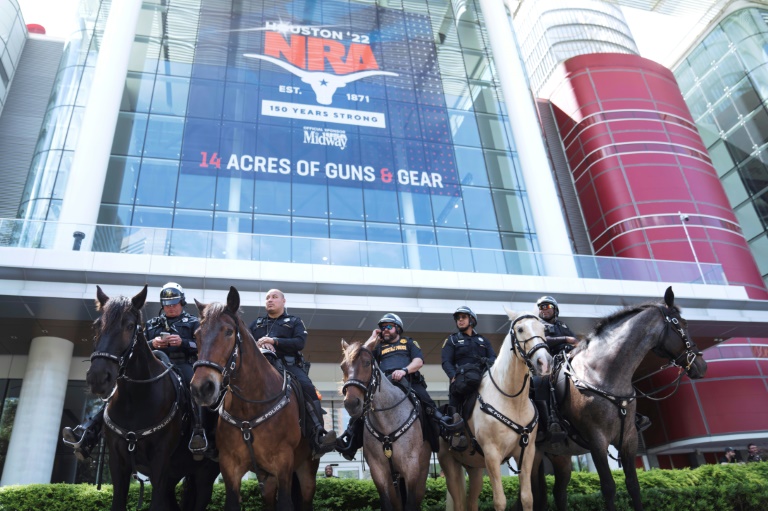
Jehlen was standing in line to see former president Donald Trump speak at a National Rifle Association convention that is controversially being held just hours from Uvalde, the town where the school massacre took place earlier in the week.

Reflecting on the shooting, he grimaced and said: “It made me sick to my stomach.”

But guns are not the problem, said Jehlen, who was dressed in camouflage shorts and a Trump hat. He argued that the disaster may well have unfolded differently if people at the school were armed.

“Killers aren’t afraid of the judge, they’re not afraid of the police,” he said. “They should be afraid of the victim they’re going after.”

The NRA event — which lasts through Sunday — is being held in a vast downtown convention center with anti-gun protesters gathering outside.

“Blood is on your hands,” one protester’s sign said. “Guns = death,” read another.

Trump drew loud applause from the crowd when he addressed the convention later in the day. He somberly read out the names of the Uvalde shooting victims, and urged Americans regardless of political affiliation to “find common ground.”

But he nevertheless turned political, blasting “repulsive” Democrats for villainizing “peaceful, law-abiding” NRA members who own guns.

– ‘This is not Australia’ –

In booth after booth in the cavernous convention hall, hundreds of firearms — all made inert with their firing pins removed — were on display, from small handguns to AR-15s, the ubiquitous semi-automatic weapon used by the gunman in Uvalde.

Tactical gear, hunting equipment and clothing shared space with gun accessories including high-power scopes, suppressors and 60-round magazines.

Retired law enforcement officer Rick Gammon eyed a wall of black semi-automatic rifles at the convention, saying any efforts to take firearms from Americans were doomed to fail. 

“You’ll never take people’s guns away. This is not Australia,” 51-year-old Gammon said as he looked at the Hellion rifles — a compact bullpup design that he noted would fit well behind his driver’s seat or in his gun safe at home.

After the April 1996 Port Arthur massacre of 35 people, Australia enacted tougher new gun laws that included a general ban on the use of semi-automatic rifles, shotguns and pump-action shotguns except for specific purposes.

America — plagued by far more frequent gun violence, but with the right to bear arms enshrined in the Constitution — has repeatedly failed to take action after mass shootings.

“I’d love to see universal background checks,” said Gammon, referring to a long-sought reform that has majority support in the United States. “But it’s not going to stop someone hell-bent on crime.”

– ‘Villainizing a tool’ –

The convention is not just a gathering of gun enthusiasts, but also a place where they can test the “feel” of weapons they are considering buying.

“Oh I like this,” Lisy V, 31, told a gun manufacturer representative as she tested the weight and balance of a 9-millimeter pistol.

“You put it in purple too, and that got my attention,” added the military veteran, who is in the market for a new pistol that she can conceal in a holster under her skirt, because “it’s too hot for pants in Texas.”

But she turned contemplative when asked about Uvalde.

“Personally I feel like there should be more gun education,” she said, but with 18-year-olds able to join the military, the veteran believes they should be able to buy assault rifles as well.

“They can enlist, right? If they can enlist, they can shoot a weapon,” she said.

Jim Maynard, a gun owner and industry advocate, said that while there is “a lot of uncertainty” in America today, and people are grieving, he agreed with the decision to not postpone the NRA convention.

“Villainizing a tool doesn’t address the problem that we’re having,” he said.

People blaming guns for America’s violence crisis was just “hype,” and they should focus more on expanding mental health programs.

“The protest outside does zero for preventing the next shooting from happening — and it’s not going to stop a person from committing violence,” Maynard added.

Police 'wrong' not to breach door during Texas shooting

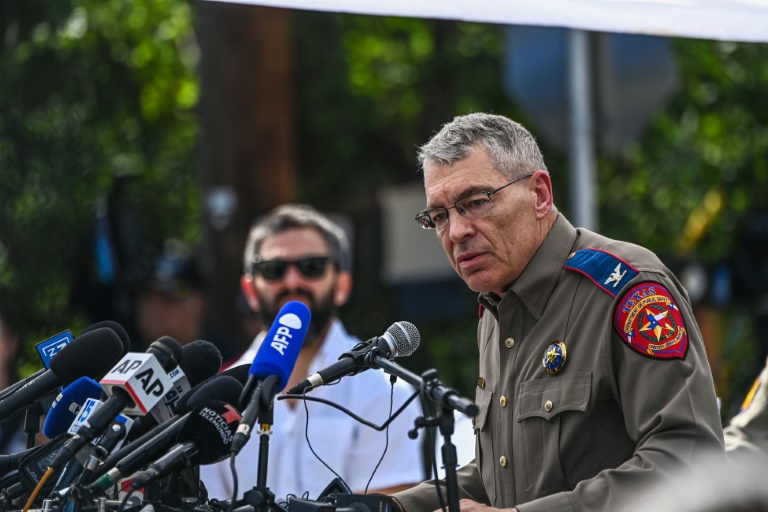
A top Texas security official said Friday that police were wrong to delay storming the classroom where a teen gunman was holed up with dead and wounded children — fueling fears that police inaction cost lives in Uvalde.

Police have come under intense criticism since Tuesday’s tragedy over why it took well over an hour to neutralize the gunman — who ultimately killed 19 children and two teachers at Robb Elementary School.

“From the benefit of hindsight… it was the wrong decision, period,” Texas Department of Public Safety director Steven McCraw told an emotional news conference, at which his voice broke repeatedly as he was assailed by questions over the delay.

“From what we know, we believe there should have been an entry as soon as you can,” McCraw said, adding: “If I thought it would help, I’d apologize.”

McCraw revealed in harrowing detail a series of emergency calls — including by a child begging for police help — that were made from the two adjoining classrooms where the gunman was barricaded.

But in seeking to explain the delay, he also said the on-scene commander believed at the time that the 18-year-old gunman Salvador Ramos was in there alone, with no survivors, after his initial assault.

“I’m not defending anything, but you go back in the timeline, there was a barrage, hundreds of rounds were pumped in in four minutes, okay, into those two classrooms,” McCraw said.

“Any firing afterwards was sporadic and it was at the door. So the belief is that there may not be anybody living anymore.”

McCraw separately told reporters, however, that a 911 call received at 12:16 pm — one of several made from inside the classrooms — reported eight or nine children still alive. 

As many as 19 officers were outside the classroom door at that time, plus an unknown number of tactical team members who had just arrived, according to McCraw’s timeline.

The door was eventually opened at 12:50 pm with keys provided by a janitor.

McCraw said the caller — a child who dialed 911 multiple times — begged for police to come. Her final call was cut off as she made it outside.

Texas Governor Gregg Abbott meanwhile told journalists who grilled him during a testy news conference Friday that he was given inaccurate information in the wake of the massacre.

“I was misled,” Abbott said. “The information that I was given turned out in part to be inaccurate, and I’m absolutely livid about that.”

– NRA convention –

The powerful National Rifle Association kicked off a major convention in Houston Friday, but a string of high-profile no-shows underscored deep unease at the timing of the gun lobby event.

Former president Donald Trump criticized calls for tightened gun controls in remarks at the three-day annual convention, held around four hours’ drive from Uvalde.

“The existence of evil in our world is not a reason to disarm law-abiding citizens,” Trump said. “The existence of evil is one of the very best reasons to arm law-abiding citizens.” 

Thousands of gun enthusiasts descended on the event, filling a vast convention hall packed with booths displaying guns, walls of semi-automatic rifles and hunting products.

“This is it, this is the mega,” said a man in his 60s, as he handled a new rifle he was considering purchasing.

But with millions of Americans grieving and angry following the Uvalde shooting, “American Pie” singer Don McLean led a wave of dropouts from the event, while Abbott said he would no longer appear in person.

McLean said it would be “disrespectful and hurtful” to perform at the “Grand Ole Night of Freedom” concert scheduled during the convention on Saturday. At least five other country music stars, including Lee Greenwood and Larry Gatlin, have also reportedly pulled out.

Facing mounting scrutiny, the gun manufacturer Daniel Defense — which made the assault rifle purchased by Ramos — also decided to stay away.

– Horror and trauma –

The Uvalde shooting was the deadliest since 20 children and six staff were killed at the Sandy Hook school in Newtown, Connecticut in 2012.

Highlighting the horror and trauma of the Uvalde massacre, 11-year-old Miah Cerrillo described smearing herself with the blood of a dead classmate in a bid to hide from the gunman, saying she lay there for what felt like hours until help finally came.

Cerrillo, whose hair has begun to fall out in clumps since the massacre, also told CNN that she and a friend scrabbled for their dead teacher’s cellphone and used it to make an urgent plea to 911 operators for help.

President Joe Biden will visit Uvalde on Sunday to once again make the case for gun control, as activists set about galvanizing voters on the issue in the run-up to November’s midterm election.

Despite the scourge of mass shootings, efforts at nationwide gun control — from banning assault rifles to mandating mental health and criminal background checks on buyers — have repeatedly failed, although polls show support from a majority of Americans.

War in Ukraine: Latest developments

Here are the latest developments in the war in Ukraine:

– Pro-Russian forces claim key eastern town – 

Moscow-backed separatist forces in eastern Ukraine say they have captured Lyman, a strategic town between the city of Severodonetsk and the eastern administrative centre of Kramatorsk, which remain under Kyiv’s control.

The pro-Russian separatists in the Donetsk region say they have “liberated and taken full control of 220 settlements, including Krasny Liman”, using an old name for Lyman.

Ukrainian forces are also battling to hold onto Severodonetsk as Russia wages all-out war for the Donetsk and Lugansk regions, which make up Donbas, Ukraine’s industrial heartland.

– Orthodox Church cuts Russia ties –

The Moscow branch of Kyiv’s Orthodox Church says it is cutting ties with Russia over the invasion, declaring “full independence” in a historic move against Russia’s spiritual authorities.

After holding a council focused on Russia’s “aggression”, the church declares “full independence” from Russian Patriarch Kirill, the second Orthodox schism in Ukraine in recent years.

Ukraine has been under Moscow’s spiritual leadership since at least the 17th century.

– 10 killed in central city – 

Ukraine’s national guard says around 10 people have been killed in strikes on a military facility in the central city of Dnipro, which had so far been relatively spared by the fighting.

– Zelensky warns of Donbas ‘genocide’ –

Ukraine’s President Volodymyr Zelensky accuses Moscow of carrying out a “genocide” in Donbas, where Russian forces are closing in on the cities of Severodonetsk and Lysychansk.

In his daily televised address, Zelensky warns that Russia’s offensive could empty Donbas of its population.

“All this, including the deportation of our people and the mass killings of civilians, is an obvious policy of genocide pursued by Russia,” he says.

– Ukraine flag removed from Putin Peak –

Kyrgyzstan’s climbing federation says it has removed a Ukrainian flag from a mountain named after Russian President Vladimir Putin, following a police investigation of the stunt, and replaced it with the Kyrgyz flag.

A climber earlier this week posted a video of the flag on the mountain dubbed Putin Peak, which rises 4,446 metres (14,587 feet) above sea level.

– Russian lawmakers urge ‘immediate withdrawal’ –

Two Communist lawmakers in Russia’s far east urge Putin to put an end to Moscow’s offensive in Ukraine in a rare public show of dissent.

Lawmaker Leonid Vasyukevich warns “there will be even more orphans in our country” if troops are not immediately withdrawn. He is backed by another lawmaker in the assembly of the Primorsky Krai region.

The head of the local Communist faction says the statement had not been agreed with the party and promises to take “the toughest measures” against the pair.

– Russian to boost grain exports –

Russia says it plans to ramp up grain exports against the backdrop of a looming global food crisis exacerbated by the war in Ukraine. 

Agriculture Minister Dmitry Patrushev says Russia will increase its grain exports from over 37 million tonnes in the 2021-2022 season ending June 30 to 50 million tonnes in the new season starting July 1.

Kyiv and the West blames Russia’s blockade of Ukrainian ports for stalling grain exports from Europe’s breadbasket.

Putin tells Austrian Chancellor Karl Nehammer in a telephone call that the accusations are “groundless” and blamed Western sanctions on Russia for spiralling food prices.

– Ukraine’s debt rating cut –

S&P Global Ratings cuts Ukraine’s debt rating and says the outlook is negative, due to the ongoing fallout from the Russian invasion and the expectation the conflict will not end any time soon.

The agency lowers the grade on Ukraine’s long- and short-term foreign currency debt to ‘CCC+/C’ from ‘B-/B’ due to the “expectation of a prolonged period of macroeconomic instability in the country.”

– Russia expects energy revenue windfall –

Russia expects to receive $14.4 billion in additional oil and gas revenues this year, the finance minister says, adding that part of the windfall will be spent on Moscow’s offensive in Ukraine.

“We expect to receive up to a trillion rubles in additional oil and gas revenues, according to the forecast that we have developed with the ministry of economic development,” Finance Minister Anton Siluanov said in remarks broadcast on state television.

burs-cb/imm/ach 

Blockbuster Depp vs Heard defamation case goes to the jury

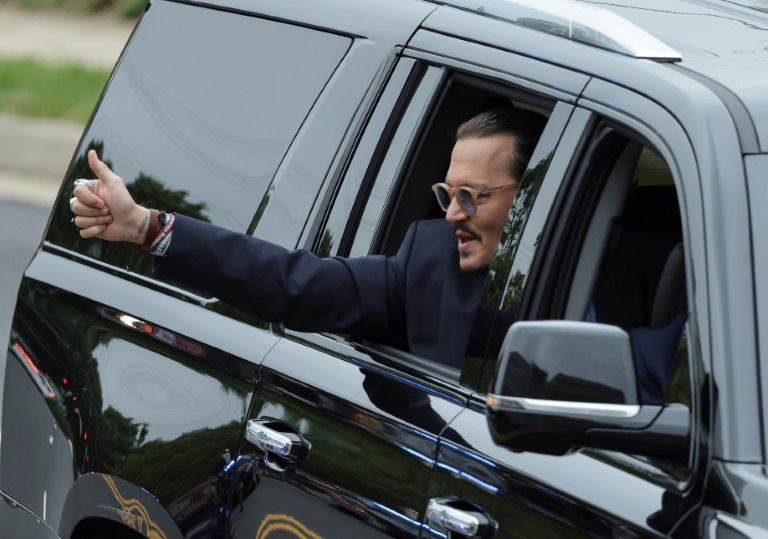
A jury began deliberations on Friday in the blockbuster defamation case between Johnny Depp and his ex-wife Amber Heard after a six-week trial featuring blistering mutual accusations of domestic abuse.

The seven-person jury met for about two hours after lawyers delivered closing arguments in the case heard in Fairfax, Virginia, near the US capital.

The jury, which is considering both Depp’s defamation claim against Heard and her counterclaim against him, will resume deliberations on Tuesday after the holiday weekend.

Elaine Bredehoft, an attorney for Heard, said the defamation suit filed against the “Aquaman” star by Depp and a campaign of “global humiliation” has made her life “pure hell.”

“It has destroyed her life. This has consumed her. She’s getting death threats,” Bredehoft told the jury.

Benjamin Chew, one of Depp’s lawyers, countered that while the 58-year-old “Pirates of the Caribbean” star may not be a “saint” and has struggled with drugs and alcohol, “he is not a violent abuser.”

“He did not and does not deserve to have his life, his legacy destroyed by a vicious lie,” Chew said. “Miss Heard’s attempt to paint herself as a heroic survivor, an innocent survivor, and Mr Depp as a terrifying abuser, are utterly false.

“We ask you, we implore you, to give him his name, his reputation and his career back,” he told the jury.

Bredehoft said any damage to Depp’s career was self-inflicted.

“Hold this man responsible,” she told the jury. “He has never accepted responsibility for anything in his life.

“He’s blamed everybody in the world — his agent, his manager, his lawyer, Amber, his friends, everybody.”

Depp’s lawyer Chew meanwhile referenced the #Metoo movement but said “it’s for true survivors of abuse, not Miss Heard.”

“Nobody has come out of the woodwork to say ‘me too.’ This is the unique and singular ‘me too’ case where there’s not a single ‘me too.'”

Camille Vasquez, another of Depp’s attorneys, told the jury the evidence has “shown that Miss Heard is the abuser.” 

“She was violent, she was abusive and she was cruel,” Vasquez said.

– ‘Monster’ –

Depp filed suit against Heard over an op-ed she wrote for The Washington Post in December 2018 in which she described herself as a “public figure representing domestic abuse.”

The Texas-born Heard did not name Depp in the piece, but he sued her for implying he was a domestic abuser and is seeking $50 million in damages.

The 36-year-old Heard countersued for $100 million, claiming that she suffered “rampant physical violence and abuse” at his hands.

Dozens of witnesses testified during the trial, including bodyguards, Hollywood executives, agents, entertainment industry experts, doctors, friends and relatives.

Depp and Heard each spent days on the witness stand during the televised trial, attended by hundreds of fans of the “Pirates” star and accompanied by a #JusticeForJohnnyDepp campaign on social media.

Video and audio recordings of heated, profanity-laced arguments between the couple were played for the jury, which was also shown photographs of injuries allegedly suffered by Heard during their volatile relationship.

Hours of testimony was devoted to a finger injury that Depp suffered while filming an installment of “Pirates” in Australia in March 2015.

Depp claimed the tip of a finger was severed when Heard threw a vodka bottle at him. Heard said she did not know how the injury occurred.

Both agreed that Depp went on to scrawl messages on walls, lampshades and mirrors using the bloody digit.

Heard said Depp would become a physically and sexually abusive “monster” during alcohol- and drug-fueled binges and resisted her repeated efforts to curb his drinking and drug use.

Depp testified that it was Heard who was frequently violent and said it has been “brutal” to listen to “outlandish” accusations of domestic abuse made against him.

“No human being is perfect, certainly not, none of us, but I have never in my life committed sexual battery, physical abuse,” he said.

– Damaged Hollywood careers –

Heard, who was married to Depp from 2015 to 2017, obtained a restraining order against him in May 2016, citing domestic violence.

Depp, a three-time Oscar nominee, filed a libel suit in London against the British tabloid The Sun for calling him a “wife-beater.” He lost that case in November 2020.

Both sides have claimed damage to their Hollywood careers.

Heard’s legal team presented an entertainment industry expert who estimated that the actress has suffered $45-50 million in lost film and TV roles and endorsements.

An industry expert hired by Depp’s side said the actor has lost millions because of the abuse accusations, including a potential $22.5 million payday for a sixth installment of “Pirates.”

Country music stars distance themselves from NRA after school massacre

Country music has long been closely linked to America’s pro-gun lobby, but several stars have distanced themselves from the National Rife Association following the mass shooting at a Texas school.

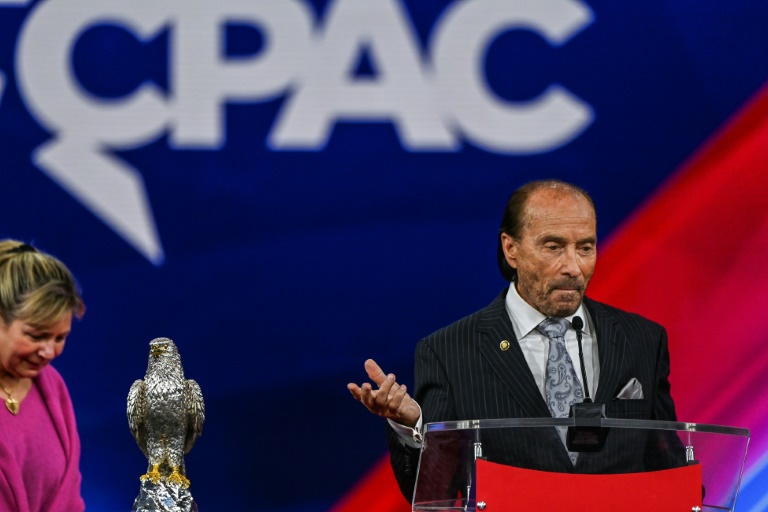
At least five country musicians, including “God Bless the USA” performer Lee Greenwood, pulled out of the NRA’s annual convention that opened Friday in Texas. “American Pie” singer-songwriter Don McLean also withdrew.

Their initial billing highlights the close links between country music and the gun-supporting right in the United States, but experts say their withdrawal is indicative of shifting attitudes.

McLean, 76, said it would be “disrespectful and hurtful” to perform at the convention’s “Grand Ole Night of Freedom” concert scheduled for Saturday after 19 students and two teachers were killed at an elementary school in the small town of Uvalde.

Greenwood, whose patriotic signature song regularly rings out at Donald Trump rallies, said he canceled “out of respect” for those mourning, while Larry Gatlin said he couldn’t perform “in good conscience.”

T. Graham Brown and Larry Stewart, lead singer of country band Restless Heart, also withdrew, according to statements carried by USA Today.

– ‘Not monolithic’ –

Conjuring up images of stetson hats, cowboy boots and the Stars and Stripes flag, country has traditionally been the favorite music of conservative white Americans.

Its fan base is predominantly white, with roots in the largely Republican southern US states.

“Country music is not monolithic by any means,” Professor Mark Brewer, who teaches a class on music and American politics at the University of Maine, told AFP.

“But I think it’s safe to say that the predominant themes over the years have been more conservative, maybe with a hint of libertarian populism mixed in.”

Brewer says there have been “longstanding connections” between country music, conservative politics, and gun culture. One of the reasons is geography.

“There’s a big regional overlap. Country music has its origins in the American south and southern American politics have always been conservative.

“The United States as a whole has a pretty prevalent gun culture, but it’s even more pronounced in the south,” he added.

Professor Joel Schwindt, who teaches country music history at the Boston Conservatory at Berklee, said the genre was “very specifically marketed” to white America from the start.

Adding to its appeal amongst white working class groups was a “firm support for the military.”

-2017 Las Vegas shooting –

Unlike Hollywood and the US pop music industry, which lean left, country music has plenty of conservative artists.

The musicians who withdrew from the NRA convention were careful not to criticize the gun body in their statements.

Stewart praised it as a “great organization” as he defended the US constitution’s famous Second Amendment right to bear arms.

Numerous country musicians have called for more gun regulations though, including Eric Church, Jason Isbell, Maren Morris and Kacey Musgraves.

Several spoke out after a man opened fire from his hotel on a Las Vegas country music festival in 2017, killing 60 people in the deadliest mass shooting in modern US history.

Rosanne Cash, singer-songwriter and daughter of late country musician Johnny Cash, wrote an Op-Ed in the New York Times later that year calling on country musicians to stand up to the NRA.

“I think we’ve had more genuinely progressive stands in the last decade than we’ve probably ever had before,” including on LGBTQ issues, said Brewer.

Although there are no conclusive studies, he thinks this might be because younger performers tend to be more progressive, as are the fans they are trying to attract.

Schwindt notes that while country music’s fan base is primarily white, “regular listenership among non-white listeners, Black listeners and Hispanic listeners in particular, has grown pretty significantly over the past 10 to 20 years.”

Could that lead to more country stars taking progressive stances in the future?

“It’s something we’re seeing more of,” said Brewer. “I don’t know if I’d say that’s the dominant position still by any means. But it’s becoming more and more visible,” he added.

Global stocks push higher as US inflation shows signs of moderating

Global stocks pushed higher on Friday, with US indices snapping a slump of weekly losses, while oil prices rallied to their highest level in two months.

Following a positive day in European and Asian stock bourses, Wall Street stocks enjoyed another session entirely in positive territory, finishing higher for a third straight session.

It’s been a blistering 2022 thus far for US equities as the Federal Reserve has launched aggressive steps to tighten monetary policy in response to inflation.

But the Dow finished at 33,212.96, up 1.8 percent for the day or 6.2 percent for the week. The index had posted weekly losses the last eight weeks.

“The market itself was oversold and we knew that we were overdue for a bounce,” Quincy Krosby, chief equity strategist of LPL Financial.

A catalyst was Commerce Department data that showed the personal consumption expenditures (PCE) price index climbed 0.2 percent after several months of accelerating at more than twice that pace.

The data gives support to the argument from stock market bulls that the US economy is moving past — or has progressed from — a period of “peak inflation” — indicating there will be less grim consumer price news in the months ahead.

The report also showed US personal income rose 0.4 percent in April compared to March, and consumers continued to increase spending.

“Encouragingly, the latest US personal spending data showed that US consumers were still inclined to spend money with a rise of 0.9 percent, which was slightly higher than markets had been expecting,” said Michael Hewson at CMC Markets.

Meanwhile, oil prices also forged higher, with Brent futures ending up 1.7 percent at $119.43 a barrel. Analysts cited speculation of a compromise deal in the European Union to ban Russian crude imports.

Back in Asia, investors were in a buying mood as Hong Kong jumped more than two percent, with market heavyweight Alibaba piling on more than 11 percent and search engine Baidu advancing 15 percent.

The two firms posted better-than-expected sales growth in the January-March quarter, soothing fears about the impact of Covid and inflation on their bottom lines.

Hong Kong’s tech index jumped nearly three percent, with other giants also enjoying buying interest with JD.com and Meituan sharply up.

The reports were much-needed pieces of good news out of the world’s second-biggest economy, which is being battered by lockdowns in major cities as leaders refuse to budge from their zero-Covid strategy.

– Key figures at around 2100 GMT –

New York – Dow: UP 1.8 percent at 33,212.96 (close)

New York – S&P 500: UP 2.5 percent at 4,158.24 (close)

New York – Nasdaq: UP 3.3 percent at 12,131.13 (close)

London – FTSE 100: UP 0.3 percent at 7,585.46 (close)

Frankfurt – DAX: UP 1.6 percent at 14,462.19 (close)

Paris – CAC 40: UP 1.6 percent at 6,515.75 (close)

EURO STOXX 50: UP 1.8 percent at 3,808.86 (close)

Tokyo – Nikkei 225: UP 0.7 percent at 26,7781.68 (close)

Hong Kong – Hang Seng Index: UP 2.9 percent at 20,697.36 (close)

Shanghai – Composite: UP 0.2 percent at 3,130.24 (close)

Euro/dollar: UP at $1.0739 from $1.0725 on Thursday

Pound/dollar: UP at $1.2631 from $1.2600

Euro/pound: DOWN at 84.99 pence from 85.12 pence

Dollar/yen: DOWN at 127.09 yen from 127.12 yen 

Brent North Sea crude: UP 1.7 percent at $119.43 per barrel

West Texas Intermediate: UP 0.9 percent at $115.07 per barrel

burs-jmb/mdl

US regulators scrutinize Musk's Twitter stock buys

US market authorities have asked Elon Musk to explain an apparent delay in reporting his Twitter stock buys, the agency revealed Friday, the latest questions on the methods and intent of his troubled bid for the platform.

Musk became a major Twitter stockholder following the purchase of 73.5 million shares in early April, and less than two weeks later launched a hostile takeover bid.

He went on to ink a $44 billion deal to buy the San Francisco-based company, but has since given mixed signals regarding how committed he is to following through.

The Securities and Exchange Commission (SEC) letter to Musk showed regulators asked him to explain why he didn’t disclose within a required 10-day time period his increased stake in Twitter, especially if he planned to buy the company.

“Your response should address, among other things, your recent public statements on the Twitter platform regarding Twitter, including statements questioning whether Twitter rigorously adheres to free speech principles,” regulators said in the letter dated April 4.

Neither Musk nor the SEC immediately responded to requests for comment.

The Tesla chief is a frequent Twitter user, regularly firing off inflammatory and controversial statements about issues or other public figures with remarks that are whimsical or business-focused. 

He has sparred repeatedly with federal securities regulators, who cracked down on his social media use after a purported effort to take Tesla private in 2018 fell apart.

Musk has cited the right to freedom of speech as a driver of his efforts to undo an agreement with the SEC that tightened his use of the social media platform following his August 2018 tweet that funding was “secured” to take Tesla private.

Musk also faces a lawsuit filed this week accusing him of pushing down Twitter’s stock price in order to either give himself an escape hatch from his buyout bid, or room to negotiate a discount.

The suit alleges Musk tweeted and made statements intended to create doubt about the deal, which has roiled the social media platform for weeks.

“Musk proceeded to make statements, send tweets, and engage in conduct designed to create doubt about the deal and drive Twitter’s stock down substantially,” according to the complaint.

His aim was to gain leverage to get Twitter at a much cheaper price, or back out of the deal without suffering any penalty, the suit argued.

Close Bitnami banner
Bitnami