AFP

Guns are now the leading cause of death for American children

Firearm deaths have surpassed motor vehicle crashes as the leading cause of death among American youngsters, with official data showing a strong rise in gun-related homicides such as the killing of 19 children in a Texas school rampage.

Overall, 4,368 children and adolescents up to the age of 19 died from firearm-caused injuries in 2020, a rate of 5.4 per 100,000 a dashboard by the Centers for Disease Control and Prevention (CDC) showed.

Homicides made up nearly two-thirds of the gun deaths.

By comparison, there were 4,036 deaths linked to motor vehicles, the previous leading cause of death among this age group. 

The gap has been narrowing as road safety measures have improved over the decades, while gun related deaths have risen. 

The trend lines crossed in 2020, the latest year for which data is available — a finding identified in a letter to the New England Journal of Medicine (NEJM) last week.

The letter’s authors noted the new data was consistent with other evidence that gun violence rose during the Covid-19 pandemic, for reasons that aren’t fully clear, but “it cannot be assumed that (it) will later revert to pre-pandemic levels.”

The newly-updated CDC dashboard shows that nearly 30 percent of the deaths were suicides, just over three percent were unintentional, and two percent were of undetermined intent.

– ‘Deadly consequences’ –

A small number were categorized as “legal intervention” or self-defense.

The deaths disproportionately impacted Black children and adolescents, who were more than four times as likely to die as white children — for whom motor vehicles still posed a greater threat.

The second most impacted group by guns were American Indians.

Males meanwhile were six times likelier to die by a gun than females.

By region, the gun-related death rate was highest in the capital Washington, followed by the state of Louisiana, then Alaska.

The figures served to underscore that while mass shootings such as the one in Uvalde provoke horror, they make up only a tiny fraction of overall childhood gun deaths.

“Since the 1960s, continuous efforts have been directed toward preventing deaths from motor vehicle crashes,” wrote the authors of another recent letter to the NEJM, contrasting the situation with that of firearms, where regulations have been loosened.

Holden Thorp, editor-in-chief of leading journal Science published an editorial Thursday calling for more research into the public health impacts of gun ownership to advance policy change.

“Scientists should not sit on the sidelines and watch others fight this out,” he said.

“More research into the public health impacts of gun ownership will provide further evidence of its deadly consequences,” he continued, arguing that severe mental illness, often blamed for mass shootings, was prevalent at similar levels in other countries that do not have regular mass shootings.
Guns are now the leading cause of death for American children

Firearm deaths have surpassed motor vehicle crashes as the leading cause of death among American youngsters, with official data showing a strong rise in gun-related homicides such as the killing of 19 children in a Texas school rampage.

Overall, 4,368 children and adolescents up to the age of 19 died from firearm-caused injuries in 2020, a rate of 5.4 per 100,000 a dashboard by the Centers for Disease Control and Prevention (CDC) showed.

Homicides made up nearly two-thirds of the gun deaths.

By comparison, there were 4,036 deaths linked to motor vehicles, the previous leading cause of death among this age group. 

The gap has been narrowing as road safety measures have improved over the decades, while gun related deaths have risen. 

The trend lines crossed in 2020, the latest year for which data is available — a finding identified in a letter to the New England Journal of Medicine (NEJM) last week.

The letter’s authors noted the new data was consistent with other evidence that gun violence rose during the Covid-19 pandemic, for reasons that aren’t fully clear, but “it cannot be assumed that (it) will later revert to pre-pandemic levels.”

The newly-updated CDC dashboard shows that nearly 30 percent of the deaths were suicides, just over three percent were unintentional, and two percent were of undetermined intent.

– ‘Deadly consequences’ –

A small number were categorized as “legal intervention” or self-defense.

The deaths disproportionately impacted Black children and adolescents, who were more than four times as likely to die as white children — for whom motor vehicles still posed a greater threat.

The second most impacted group by guns were American Indians.

Males meanwhile were six times likelier to die by a gun than females.

By region, the gun-related death rate was highest in the capital Washington, followed by the state of Louisiana, then Alaska.

The figures served to underscore that while mass shootings such as the one in Uvalde provoke horror, they make up only a tiny fraction of overall childhood gun deaths.

“Since the 1960s, continuous efforts have been directed toward preventing deaths from motor vehicle crashes,” wrote the authors of another recent letter to the NEJM, contrasting the situation with that of firearms, where regulations have been loosened.

Holden Thorp, editor-in-chief of leading journal Science published an editorial Thursday calling for more research into the public health impacts of gun ownership to advance policy change.

“Scientists should not sit on the sidelines and watch others fight this out,” he said.

“More research into the public health impacts of gun ownership will provide further evidence of its deadly consequences,” he continued, arguing that severe mental illness, often blamed for mass shootings, was prevalent at similar levels in other countries that do not have regular mass shootings.
McDonald's investors reject Icahn challenge on animal welfare

McDonald’s shareholders overwhelmingly rejected billionaire Carl Icahn’s efforts to install two board members to remake the company’s animal welfare policies, the restaurant chain said Thursday.

Icahn, known on Wall Street for playing hardball in messy corporate battles, had launched the unlikely crusade earlier this spring, accusing the food giant of inhumane pig-farming practices and breaking its promises to address the problem.

But Icahn’s nominees garnered only about one percent of outstanding shares, according to preliminary results released by McDonald’s that said all 12 company directors had been reelected.

“McDonald’s is committed to remaining a leader on environmental, social and governance (ESG) initiatives, including animal welfare,” the company said. “Its approach is governed by making a meaningful impact in the communities it serves while also meeting the needs of customers.”

Icahn had launched the campaign in February following numerous meetings with McDonald’s executives and the Humane Society.

According to the Humane Society, metal gestation crates — used to contain sows for almost all of a pregnancy — are so small that the animal cannot turn around, and can lead to health issues such as infection or anatomical problems.

A May 4 investor presentation by Icahn touted nominees Maisie Ganzler and Leslie Samuelrich as ESG experts, saying McDonald’s had missed a pledge to end use of gestation crates by 2022. 

The fast-food chain rebutted by saying it was on track to phase out the stalls by the end of 2024, citing the Covid-19 pandemic and the outbreak of African Swine Fever for causing “unprecedented disruption” to supply chains and global pork production.

McDonald's investors reject Icahn challenge on animal welfare

McDonald’s shareholders overwhelmingly rejected billionaire Carl Icahn’s efforts to install two board members to remake the company’s animal welfare policies, the restaurant chain said Thursday.

Icahn, known on Wall Street for playing hardball in messy corporate battles, had launched the unlikely crusade earlier this spring, accusing the food giant of inhumane pig-farming practices and breaking its promises to address the problem.

But Icahn’s nominees garnered only about one percent of outstanding shares, according to preliminary results released by McDonald’s that said all 12 company directors had been reelected.

“McDonald’s is committed to remaining a leader on environmental, social and governance (ESG) initiatives, including animal welfare,” the company said. “Its approach is governed by making a meaningful impact in the communities it serves while also meeting the needs of customers.”

Icahn had launched the campaign in February following numerous meetings with McDonald’s executives and the Humane Society.

According to the Humane Society, metal gestation crates — used to contain sows for almost all of a pregnancy — are so small that the animal cannot turn around, and can lead to health issues such as infection or anatomical problems.

A May 4 investor presentation by Icahn touted nominees Maisie Ganzler and Leslie Samuelrich as ESG experts, saying McDonald’s had missed a pledge to end use of gestation crates by 2022. 

The fast-food chain rebutted by saying it was on track to phase out the stalls by the end of 2024, citing the Covid-19 pandemic and the outbreak of African Swine Fever for causing “unprecedented disruption” to supply chains and global pork production.

'Goodfellas' actor Ray Liotta dead

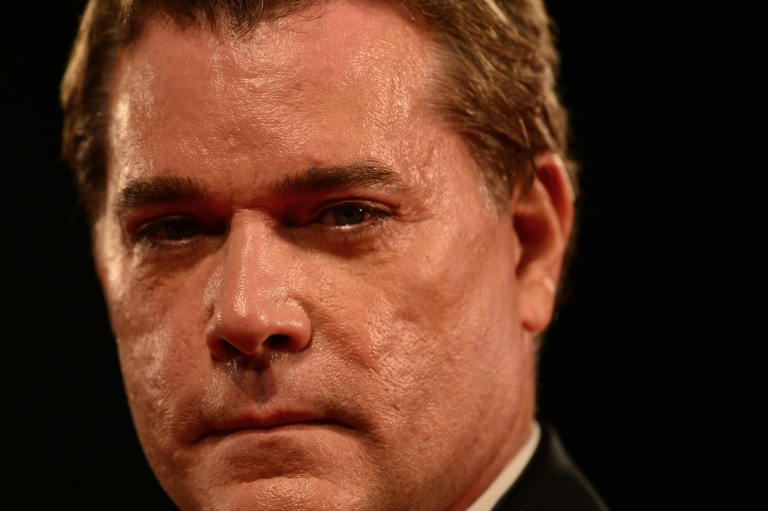
Actor Ray Liotta, who starred in Martin Scorsese’s gangster classic “Goodfellas,” has died in the Dominican Republic, the country’s cinema authority said Thursday. He was 67.

Liotta, whose blistering turn as real-life mobster Henry Hill in Scorsese’s crime masterpiece won universal admiration, was shooting a new film in the country when he died, a spokeswoman for the Dominican Republic’s General Direction of Cinema said.

“We understand that he was accompanied by his (fiancee) and that the (fiancee) asks that you please respect her grief,” the spokeswoman told AFP.

Liotta’s publicist in Los Angeles confirmed his death, saying the actor died in his sleep and that there were no suspicious circumstances.

He was working on a movie called “Dangerous Waters” at the time of his death. 

Liotta’s breakout came in 1990 when he was cast alongside Robert De Niro and Joe Pesci in what is widely considered one of the greatest films of the 20th century.

“Goodfellas” won one Oscar, and was nominated for five others, and scenes from the movie continue to resonate as cultural touchstones more than three decades later.

A year before “Goodfellas,” Liotta had played baseball star “Shoeless Joe” Jackson in beloved sports movie “Field of Dreams,” opposite Kevin Costner.

The film was nominated for three Oscars, including best picture.

Tributes began to be paid soon after news of Liotta’s death broke, with “Goodfellas” co-star Lorraine Bracco, who played his on-screen wife, Karen, saying she was “utterly shattered to hear this terrible news.”

“I can be anywhere in the world & people will come up & tell me their favorite movie is Goodfellas,” she tweeted.

“Then they always ask what was the best part of making that movie. My response has always been the same… Ray Liotta.”

Despite branching out to show his breadth as an actor, Liotta had recently returned to the world of mob films, with roles in Steven Soderbergh’s “No Sudden Move” and “The Sopranos” prequel “The Many Saints of Newark.”

Liotta was born in Newark, on the US East Coast, in December 1954.

Variety reported he was left at an orphanage at birth and adopted when he was six months old.

At the University of Miami he performed in musicals, and after graduating landed a role in a soap opera that would provide him with three years’ work to 1981.

His first movie came in 1983, but it wasn’t until 1986’s “Something Wild” opposite Melanie Griffith and Jeff Daniels that he came to wider attention.

The comedy-action-romance was screened at Cannes and scored Liotta a Golden Globe nomination for supporting actor.

'Do something now:' mourners demand action after US school shooting

A distraught Texas grandmother of a girl killed in the massacre in Uvalde pleaded Thursday for urgent action by US authorities to prevent future school shootings, as the country plunges again into the roiling debate over guns.

Ten-year-old Amerie Garza — a fourth-grader who loved her classes, drawing, and playing with clay — was one of 19 children murdered by a teen gunman at Robb Elementary School in an act of evil that has forever changed this small Texas town.

“My granddaughter was in there. She was an innocent little girl, loving school and looking forward to summer,” Dora Mendoza told reporters after paying respects at a makeshift memorial outside the school.

But the 63-year-old, who lived with Amerie and saw her at an end-of-year ceremony Tuesday just hours before she was killed, quickly made clear she wanted US officials like President Joe Biden and Texas Governor Greg Abbott not to shy away from working together on reforms.

Biden, who is due to visit Uvalde in the coming days, and Abbott are polar opposites regarding restrictions on gun sales. Like many in the Democrat vs Republican divide, the two also differ on other paths to take to curb the nation’s surging gun violence. 

“They shouldn’t just wait for… tragedy to start,” she said. 

“They need to do something about it. They need to not forget us, the babies…. Don’t forget them, please,” Mendoza, speaking in a mix of English and Spanish, pleaded through her tears.

“Do something about it, I beg you. I beg you!” she wailed. “All the cries and all these little innocent babies… we don’t know what they went through.”

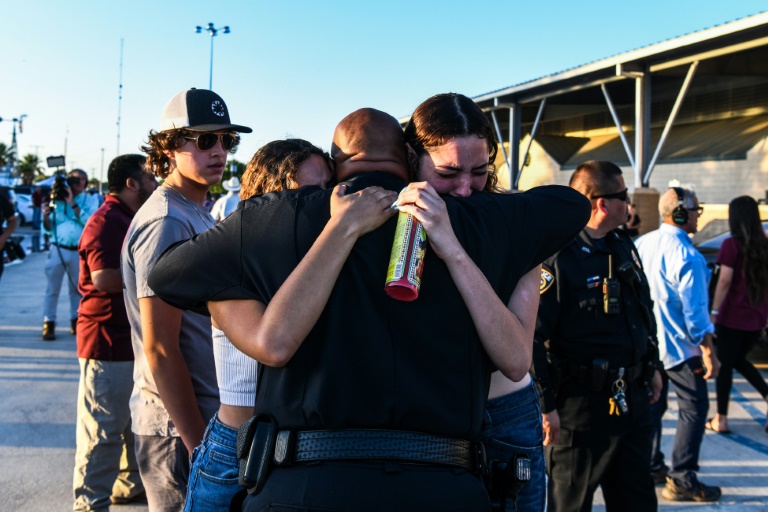
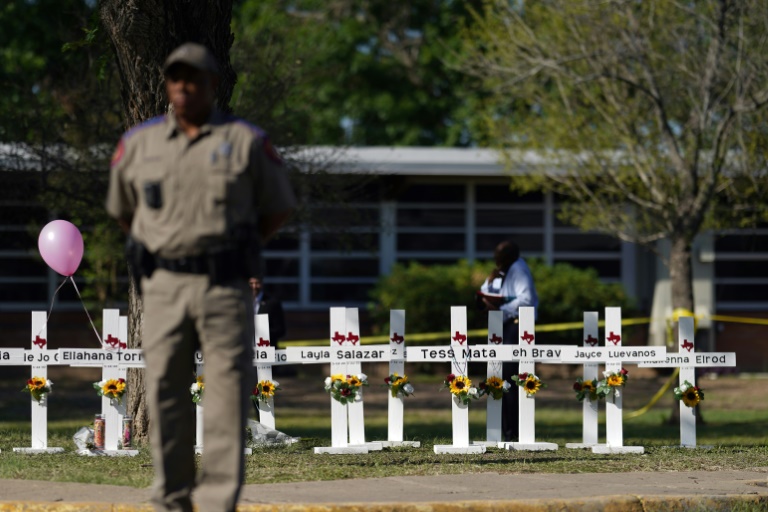
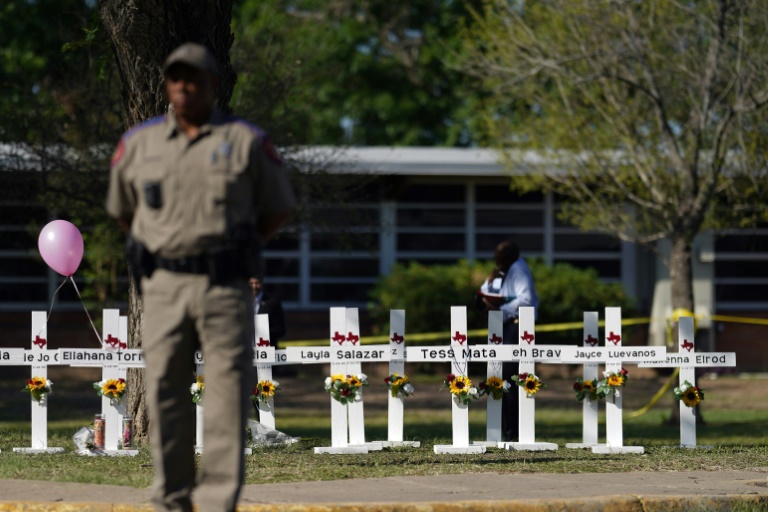
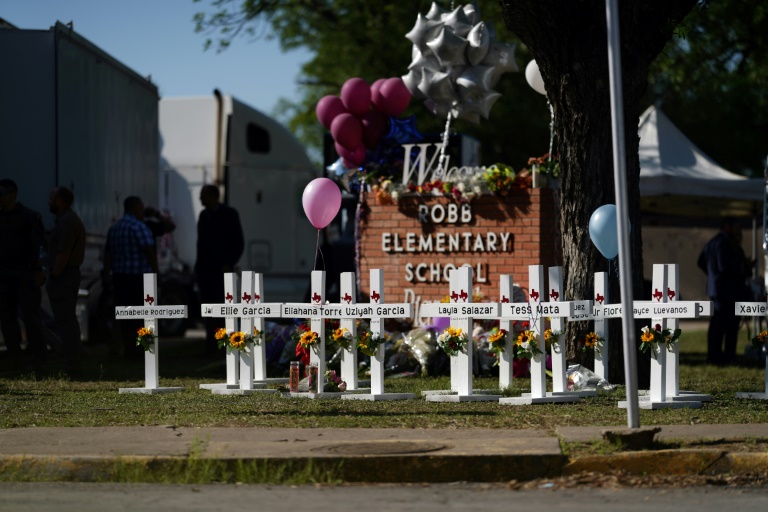
Amerie’s “abuela” was among several Uvalde residents who came to pray or leave flowers at the school memorial, where 21 small white wooden crosses have been erected bearing names of the 19 children and two teachers who were killed.

Among the mourners was Yaritza Rangel, 23, who brought her four children to lay flowers.

“We’re all hurt. We never thought this would happen here” where most town residents know each other, she said.

But Rangel, while avoiding politics, did point to three reforms she wants enacted: an expansion of background checks for gun purchases, tightening of security in schools, and raising the minimum age for buying firearms.

“It doesn’t make sense,” she said. “You have to go and wait until you’re 21 to go and buy alcohol. Why are they letting 18-year-olds be able to buy rifles?” she questioned. 

Rangel, whose young nephew was in a Robb Elementary classroom that the shooter tried but failed to enter, and has been traumatized by the attack, is now worried about her own children.

Her son will be going to elementary school soon, and the prospect of violence keeps her awake at night.

“What if it happens again?”

As US mourns gun victims, Republicans block action on domestic terror

Republicans in the US Senate prevented action Thursday on a bill to address domestic terrorism in the wake of a racist massacre at a grocery store in upstate New York.

Democrats had been expecting defeat but were seeking to use the procedural vote to highlight Republican opposition to tougher gun control measures following a second massacre at a Texas elementary school on Tuesday.

There was no suggestion of any racial motive on the part of the gunman who shot dead 19 children and two adults at an elementary school in Uvalde, Texas. 

But the shock of the bloodshed, less than two weeks after the May 14 murders in Buffalo, New York, has catapulted America’s gun violence crisis back to the top of the agenda in Washington. 

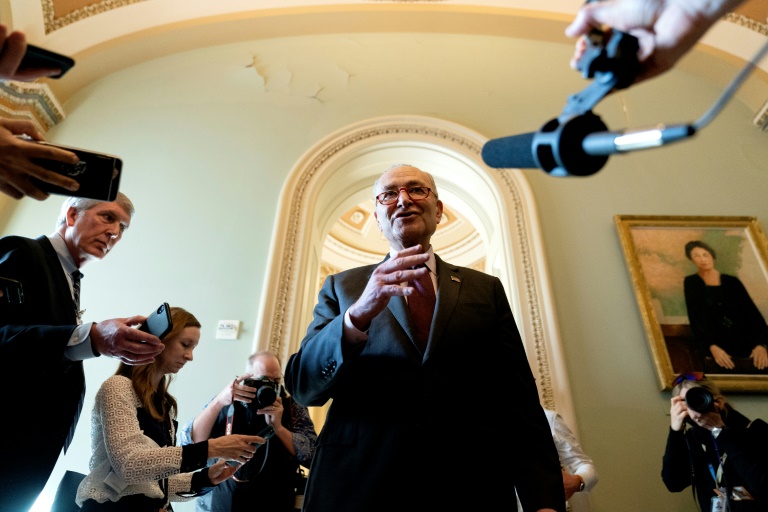
“The bill is so important, because the mass shooting in Buffalo was an act of domestic terrorism. We need to call it what it is: Domestic terrorism,” Democratic Senate leader Chuck Schumer said ahead of the vote.

The Domestic Terrorism Prevention Act would have created units inside the FBI and departments of justice and homeland security to combat domestic terror threats, with a focus on white supremacy.

A task force that includes Pentagon officials would also have been launched “to combat white supremacist infiltration of the uniformed services and federal law enforcement.” 

Schumer had urged Republicans Wednesday to allow the chamber to start debate on the bill, offering to accommodate Republican provisions to “harden” schools in the wake of the Texas murders.

Just ahead of the vote, Schumer said he had wept while studying pictures of the young victims, calling the state’s pro-gun governor, Greg Abbott, “an absolute fraud.”

Abbott has made efforts to loosen gun restrictions in Texas, including signing into law a measure last year authorizing residents to carry handguns without licenses or training.

The domestic terrorism bill’s 207 co-sponsors included three moderate Republicans in the House. 

But there was not enough support in the evenly split 100-member Senate to overcome the Republican filibuster — the 60-vote threshold required to allow debate to go forward.

Republicans say there are already laws on the books targeting white supremacists and other domestic terrorists, and have accused Democrats of politicizing the Buffalo massacre, in which 10 Black people died.

They have also argued that the legislation could be abused to go after political opponents of the party in power. 

Democrats are looking for Republicans to support a separate gun control bill, and said Wednesday they would work over the coming days to see if they could find common ground with enough opposition senators to circumvent a filibuster.

“Make no mistake about it, if these negotiations do not bear fruit in a short period of time, the Senate will vote on gun safety legislation,” Schumer said

Texas police face scrutiny over 'late' massacre response

Desperate parents scuffled with police and pleaded with them to storm the Texas school where a gunman ultimately killed 19 children and two teachers, new video showed Thursday, as questions mounted over the authorities’ response to the massacre.

In one jolty, nearly seven minute clip posted on YouTube, parents living a nightmare — a school shooting under way with their kids inside — are seen screaming expletives at police behind yellow tape trying to keep them away from Robb Elementary School in the town of Uvalde.

“It’s my daughter!” one woman bellows amid chaotic scenes of moaning, crying and shoving.

In another shorter video, parents mill around what is apparently the rear of the school, and complain angrily that police are doing nothing as the worst school shooting in a decade is unfolding.

One woman, frantic about her son, yells to police, “if they’ve got a shot, shoot him or something. Go on.”

Jacinto Cazares, whose daughter Jacklyn died in Tuesday’s massacre, said he raced to the school when he heard about the shooting.

“There was at least 40 lawmen armed to the teeth but didn’t do a darn thing (until) it was far too late,” Cazares told ABC News Wednesday night.

“The situation could’ve been over quick if they had better tactical training.”

Daniel Myers and his wife Matilda — both local pastors — told AFP they saw parents at the scene growing frantic as police appeared to wait on reinforcements before entering the school.

“Parents were desperate,” said Daniel Myers, 72. “They were ready to go in. One family member, he says: ‘I was in the military, just give me a gun, I’ll go in. I’m not going to hesitate. I’ll go in.'”

– 40 minutes –

The tight-knit Latino community was changed forever when Salvador Ramos, an 18-year-old with a history of being bullied, entered the school with an assault rifle and hundreds of rounds of ammunition.

According to the Austin Statesman, authorities are examining the police response, including what steps they took to stop the gunman.

Texas Department of Public Safety director Steven McCraw told CNN Ramos was inside for about 40 minutes before police managed to shoot and kill him.

Officials say he was confronted by a school resource officer, but was able to enter through a back door, making his way to two adjoining classrooms where he started shooting.

Hearing shots from the school, police officers at first ran inside and themselves came under gunfire.

Some police started to break windows and evacuate children and teachers, while law enforcement helped pin the shooter in place until a tactical team that included US Border Patrol agents was assembled. 

Border Patrol chief Raul Ortiz said the force’s agents “didn’t hesitate.”

“They came up with a plan. They entered that classroom and they took care of the situation as quickly as they possibly could,” Ortiz told CNN.

– ‘I have no words’ –

Speaking out for the first time, Ramos’s mother Adriana Reyes told ABC News her son could be aggressive when angry but was “not a monster” — and that she was not aware he had been buying weapons.

“I had an uneasy feeling sometimes, like ‘what are you up to?,'” she told ABC Wednesday evening. “We all have a rage, that some people have it more than others.”

Authorities said Ramos shot his 66-year-old grandmother in the face before attacking the school.

“Those kids… I have no words,” Reyes said through tears. “I don’t know what to say about those poor kids.”

The Uvalde shooting was the deadliest since 20 elementary-age children and six staff were killed at the Sandy Hook school in Newtown, Connecticut in 2012.

– ‘Common sense’ –

The Georgia-based gun manufacturer Daniel Defense said it was its “understanding” that Ramos used a weapon made by the company, without specifying how he obtained it.

“Our thoughts and prayers go out to the families and community devastated by this evil act,” the company said in a statement to AFP, promising its full cooperation with investigators.

Pressed Wednesday on how Ramos was able to obtain the murder weapon, Texas Governor Greg Abbott brushed aside suggestions tougher gun laws were needed in his state — where attachment to the right to bear arms runs deep.

But in the shooting’s wake President Joe Biden — who will head to Uvalde in coming days — has called on lawmakers to take on America’s powerful gun lobby and enact “common sense gun reforms.”

Gun control activists and lawmakers addressed reporters outside the US Capitol on Thursday, vowing no let-up in their efforts in the run-up to November’s midterm elections.

“Gun violence prevention is going to be on the ballot,” said the Democratic senator from Connecticut, Richard Blumenthal

The March for Our Lives — founded by survivors of the 2018 Parkland school shooting in Florida — has meanwhile called for nationwide protests on June 11 to press for gun control.

bur-dw/ec

Ukraine says war in east at 'maximum intensity'

Ukraine said Thursday the war in the east of the country had hit its fiercest level yet as it urged Western allies to match words with support against invading Russian forces.

Moscow’s troops pushed into the industrial Donbas region after failing to take the capital Kyiv, closing in on several urban centres including the strategically located Severodonetsk and Lysychansk.

Russian forces also shelled Ukraine’s second city Kharkiv, killing seven people, after Moscow’s efforts to capture the north-eastern hub were repelled by heavy battles early in the war. 

Britain and Germany both said Thursday that Russian President Vladimir Putin must be defeated in the conflict, now in its fourth month, but Kyiv called on the West to urgently supply more heavy weapons for its outgunned forces.

“The fighting has reached its maximum intensity,” Ukraine’s Deputy Defence Minister Ganna Malyar told a press briefing about the battles in the east.

“Enemy forces are storming the positions of our troops simultaneously in several directions. We have an extremely difficult and long stage of fighting ahead of us.”

Pro-Moscow separatist groups have controlled parts of Donbas, the industrial basin comprising Donetsk and Lugansk regions, since 2014 but Russia now appears set on taking the whole region.

Lugansk regional governor Sergiy Gaiday said that “heavy” Russian bombardments on Lysychansk had done extensive damage to civilian infrastructure, including a humanitarian aid centre.

– ‘Used to shelling’ –

Three people died in recent Russian attacks on Severodonetsk and Lysychansk, which stand on the crucial route to Ukraine’s eastern administrative centre in Kramatorsk, Gaiday said.

In Kramatorsk itself, children roamed the rubble left by Russian attacks as the sound of shellfire booms.

“That was a 22 (122-mm artillery),” said Yevgen, a sombre-looking 13-year-old who moved to Kramatorsk with his mother from the ruins of his village Galyna. 

“I am not scared,” he declared as he sat alone on a slab of a destroyed apartment block. “I got used to the shelling.”

Four civilians were killed in shelling in the Donetsk region around Kramatorsk, the Ukrainian presidency said.

Fresh shelling around Kharkiv killed another seven people and injured 17, including a nine-year-old child, officials said.

“Today the enemy insidiously fired on Kharkiv,” regional governor Oleg Sinegubov said on social media, warning residents to take to air raid shelters.

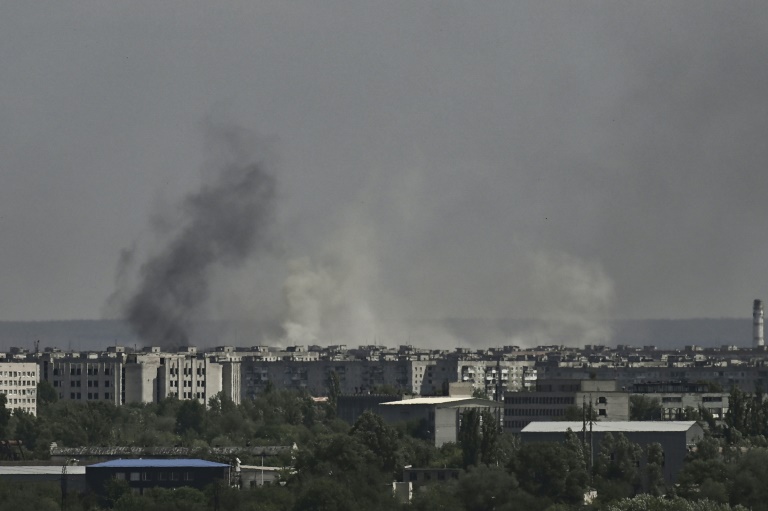
An AFP reporter in Kharkiv saw plumes of smoke rising from the stricken area, along with several people injured near a shuttered shopping centre. An elderly man with injuries to his arm and leg was carried away by medics.

– ‘Show me one Nazi!’ –

Russia’s rationale of a “special military operation” to “demilitarise and de-Nazify” Ukraine drew a snort of derision in one village near Kharkiv which came under fire.

“Show me one Nazi in the village! We have our nation, we are nationalists but not Nazis nor fascists,” said retired nurse Larysa Kosynets.

As the toll mounted, Ukrainian President Volodymyr Zelensky called on the West to add to the billions of dollars in weaponry it has already poured in, and blasted suggestions a negotiated peace could include territorial concessions.

“We need the help of our partners — above all, weapons for Ukraine. Full help, without exceptions, without limits, enough to win,” Zelensky said in his daily address to the nation.

Ukrainian Foreign Minister Dmytro Kuleba had earlier told Davos that his country “badly” needs multiple-launch rocket systems to match Russian firepower.

German Chancellor Olaf Scholz, who has faced criticism over Berlin’s slow response, said Putin will not negotiate seriously until he realises he could not win in Ukraine.

“Our goal is crystal clear — Putin must not win this war. And I am convinced that he will not win it,” the German chancellor told the World Economic Forum in Davos.

British Foreign Secretary Liz Truss echoed the German chancellor’s comments and warned against offering “backsliding” on support for Kyiv.

“We need to make sure that Putin loses in Ukraine and that Ukraine prevails,” Truss told reporters during a visit to Sarajevo.

– ‘Illegal’ sanctions –

The Ukraine conflict has sparked fears of a global food crisis, on top of the political and economic shockwaves that have already reverberated around the world since the February 24 invasion.

The Kremlin on Thursday pointed the finger at Western countries for stopping grain-carrying vessels from leaving ports in Ukraine — rejecting accusations that Russia was to blame.

Putin said Moscow was ready to make a “significant contribution” to averting the crisis if the West lifts sanctions imposed on Russia over Ukraine, in a telephone call with Italy’s Prime Minister Mario Draghi.

The Russian central bank meanwhile cut its key interest rate to 11 percent from 14 percent following an emergency meeting, as authorities sought to rein in the ruble which has surged in value despite the conflict.

Moscow slapped strict capital controls to boost the economy after the imposition of the sanctions and since then the ruble has staged a spectacular rebound — but Russia fears a strong ruble can hit budget revenues and exporters. 

The Kremlin is also seeking to tighten its grip over the parts of Ukraine it occupies, including fast-tracking citizenship for residents of two southern regions that are mostly under Russian control.

The United States branded the plan an “attempt to subjugate the people of Ukraine”.

World Health Organization member states meanwhile strongly condemned Russia’s war in Ukraine and attacks on health facilities. A Russian resolution which made no reference to the invasion flopped.

burs-dk/jm

Blinken says global order must survive China but no 'Cold War'

US Secretary of State Antony Blinken called Thursday for vigorous competition with China to preserve the existing global order but said the United States did not seek a “Cold War.”

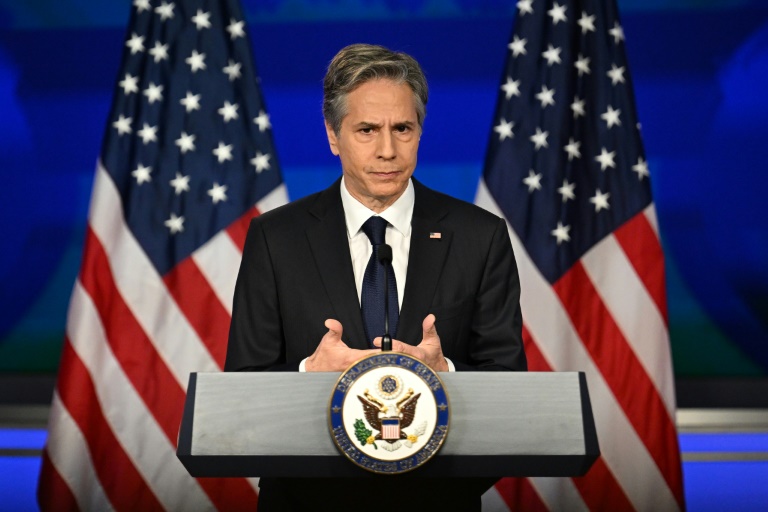
In a long-awaited speech billed as the most comprehensive statement to date on China by President Joe Biden’s administration, Blinken said that Beijing posed “the most serious long-term challenge to the international order” despite months of US focus on Russia’s invasion of Ukraine.

“China is the only country with both the intent to reshape the international order — and, increasingly, the economic, diplomatic, military and technological power to do it,” Blinken said at George Washington University.

“Beijing’s vision would move us away from the universal values that have sustained so much of the world’s progress over the past 75 years,” he said.

“President Biden believes this decade will be decisive. The actions that we take at home and with countries worldwide will determine whether our shared vision of the future will be realized.”

The Biden administration recently launched a loose new trade framework across Asia and has set up a forum with the European Union to set technological standards, efforts aimed at uniting like-minded nations as China dominates new fields such as artificial intelligence.

Blinken acknowledged a growing consensus that other nations cannot change the trajectory of China, saying that under President Xi Jinping it has become “more repressive at home, more aggressive abroad.”

“There is growing convergence about the need to approach relations with Beijing with more realism,” he said.

– ‘No Cold War’ –

With no rhetorical bombast or surprises, Blinken drew an implicit contrast to the approach of the previous administration of Donald Trump which spoke in stark terms of an all-out global conflict with China.

On trips to Africa and Latin America, where China has invested billions of dollars on infrastructure, Blinken has downplayed the competition and not asked nations to take sides.

“We are not looking for conflict or a new Cold War. To the contrary, we’re determined to avoid both,” Blinken said in his speech.

“We don’t seek to block China from its role as a major power, nor to stop China — or any other country for that matter – from growing their economy or advancing the interests of their people,” he said.

But he said that defending the global order, including international law and agreements, would “make it possible for all countries — including the United States and China — to coexist and cooperate.”

He pointed to climate change, saying that the United States and China — the world’s two largest emitters — worked together to make progress at last year’s summit in Glasgow and that a healthy competition on clean energy would have global benefits.

His willingness to cooperate comes even as he charged again that Beijing is carrying out genocide against its Uyghur minority and also denounced its “brutal campaign” in Tibet and crackdown in Hong Kong.

– Refocusing on Asia –

Saying that China will “test American diplomacy like nothing we’ve seen before,” Blinken announced the formation of a “China House” inside the State Department to coordinate policy across regions.

Blinken’s speech — delayed from earlier this month after he tested positive for Covid-19 — was the latest attempt by the Biden administration to show its eyes are on Asia despite the Ukraine war.

Biden this month visited allies Japan and South Korea and invited leaders from Southeast Asia for a first-of-a-kind summit in Washington.

Blinken pledged to support US allies including by promoting freedom of navigation in the South China Sea, where Beijing has been increasingly assertive on its myriad territorial claims.

The speech comes days after Biden made waves at a Tokyo news conference by giving the most explicit commitment in decades that the United States would militarily defend Taiwan in an invasion by Beijing, which claims the self-governing democracy.

Blinken again insisted that the United States was not deviating from its longstanding stance and said Beijing had raised tensions including with its nearly daily military flights near the island.

“While our policy has not changed, what has changed is Beijing’s growing coercion,” Blinken said.

Close Bitnami banner
Bitnami