AFP

Shakira loses appeal, inches closer to Spanish tax fraud trial

Colombian superstar Shakira inched closer to standing trial in Spain for tax fraud after a Barcelona court dismissed an appeal from the singer, in a ruling made public Thursday.

Prosecutors accuse the 45-year-old “Hips don’t Lie” songstress of defrauding the Spanish tax office out of 14.5 million euros ($15.5 million) on income earned between 2012 and 2014.

Prosecutors say she moved to Spain in 2011 when her relationship with FC Barcelona defender Gerard Pique became public but maintained official tax residency in the Bahamas until 2015.

Her defence team argues she moved to Spain full time only in 2015 and has met all tax obligations.

They say that until 2014 she earned most of her money from international tours, did not live more than six months a year in Spain and was therefore not resident under tax law.

But a Barcelona court ruled that “documentation provided to prove” tax residence overseas “does not appear to sufficient”.

“We can consider that the appellant had her usual residence in Spain,” the court added in a ruling made public on Thursday.

The ruling ratifies a prior court decision issued in 2021.

Prosecutors now need to present an indictment before the court can order a trial.

Shakira’s lawyers insisted Thursday that her “conduct on tax matters has always been impeccable in all the countries she had to pay taxes”.

She has “no debts to the Spanish tax authorities” and paid any sums claimed by the tax authorities “as soon as she became aware of the amount,” they added in a statement.

Shakira, who has sold over 60 million albums, lives with Pique on the outskirts of Barcelona. The couple have two children.

Deforestation surges in Brazil Atlantic Forest: report

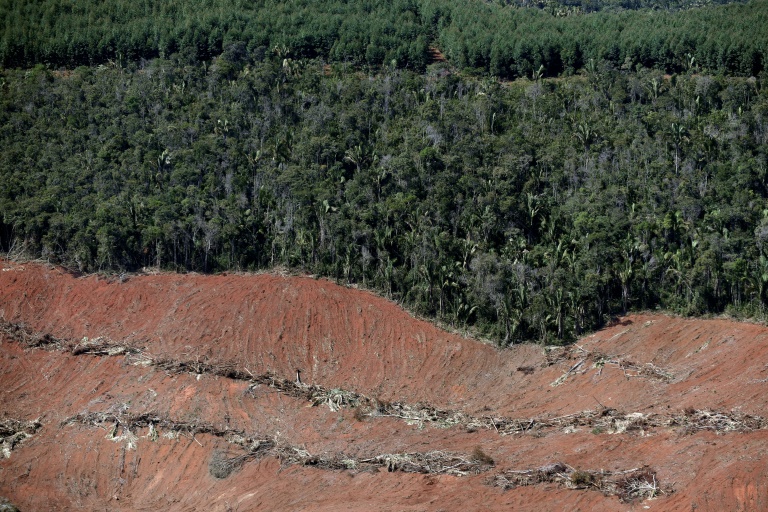
Deforestation surged 66 percent last year in Brazil’s Atlantic Forest, according to a new report, compounding fears over the rampant destruction of the Amazon rainforest further north.

The “Mata Atlantica,” which stretches down Brazil’s eastern coast, lost 21,642 hectares (53,479 acres) of forest cover from November 2020 to October 2021, up two-thirds from the year before, according to the report, which was based on satellite monitoring data and published late Wednesday by an environmental group.

Cutting down that forest — the size of more than 20,000 football fields — released the equivalent of 10.3 million tonnes of carbon dioxide into the atmosphere, said the group, SOS Mata Atlantica.

“We weren’t expecting such a huge increase. We thought the Atlantic Forest would be a bit more immune to the explosion of deforestation (in other parts of Brazil), as a region with more governance and policing,” spokesman Luis Guedes Pinto told AFP.

“It shows the Atlantic Forest is also suffering from the dismantling of environmental policies and legislation.”

Deforestation has surged in Brazil under President Jair Bolsonaro, whom critics accuse of gutting environmental protection programs to benefit Brazil’s powerful agribusiness industry.

Since the far-right president took office in 2019, average annual deforestation in the Brazilian Amazon has increased by 75 percent from the previous decade, according to official figures.

Like the Amazon, the less-known Atlantic Forest is a critical buffer against climate change, and a key ecosystem without which Brazil’s supplies of food, water and hydroelectric power would be threatened, experts say.

Its destruction “is a disaster not just for Brazil, but for the world,” Pinto said.

“Research shows the Atlantic Forest is one of the biomes that will have to be urgently restored if we are to reach the goal of holding global warming to 1.5 degrees C in line with the Paris climate accord.”

Stocks and oil advance, ruble retreats

European and US stock markets rose Thursday on relief about the pace of interest rate hikes, while the Russian ruble slumped following a cut in the interest rate.

Meanwhile, oil prices surged above $117 a barrel, hitting levels not seen since March.

“Another attempt at a relief rally is underway across equities, with a fairly substantial bounce across European and US markets coming in the wake of last night’s Fed minutes,” said  Chris Beauchamp, chief market analyst at online trading platform IG.

In the United States, central bankers stressed their “strong commitment and determination” to bring raging inflation under control via further large interest rate increases, according to the minutes of the latest policy meeting released Wednesday.

With US inflation rising at the fastest pace in nearly four decades, the Fed’s policy committee early this month hiked the key rate by a half point — the biggest increase since 2000.

Most members said similar increases “would likely be appropriate at the next couple of meetings”, according to the minutes.

“While these minutes didn’t really add much to the outlook for monetary policy, they did at least calm fears that a faster pace of tightening is on the way,” said Beauchamp.

“But beyond bargain hunting there seems little concrete rationale for the bounce, which leaves investors wondering whether next week will see yet another dramatic reversal in stocks,” he added.

Stock markets have taken a beating this year as central banks have begun to raise interest rates in order to curb the highest consumer price rises in decades.

Economists fear the hikes, combined with supply disruptions due to the Ukraine war and the coronavirus pandemic, could tip many countries into recession.

Bucking the trend on borrowing costs however, Russia’s central bank on Thursday slashed its key interest rate following an emergency meeting, as authorities seek to rein in the ruble which has surged in value following the invasion of Ukraine.

The ruble, which Wednesday hit a seven-year dollar high, slumped seven percent after Russia cut its interest rate to 11 percent from 14.

The ruble has been buoyed by capital controls and high energy prices amid the Ukraine war. 

Across Asia on Thursday, stock markets were mixed after Chinese Premier Li Keqiang’s warning that the world’s number two economy was in some ways worse off now than during the early days of the pandemic.

It comes as China persists with a zero-Covid policy to eradicate the fast-spreading Omicron virus variant despite the economic agony caused by lockdowns that have knocked global supply chains.

Recent economic data has shown that a series of pledges by Beijing to kickstart growth has essentially fallen flat owing to a lack of concrete action, while analysts said the easing of the Covid policy was the only thing investors wanted to see.

Meanwhile, the UK announced a £15-billion ($19 billion) support package for consumers hit by soaring energy bills, paid for in part by a windfall profit tax on oil and gas companies.

The announcement had little impact on the shares of both BP and Shell, both of which rose following the removal of uncertainty about the measure, and oil prices moved even higher.

In corporate news, chipmaker Broadcom announced a $61-billion deal to purchase cloud computing firm VMware, which is being called one of the biggest technology acquisitions ever.

Shares in Broadcom climbed 2.8 percent, while those in VMware rose 2.1 percent.

– Key figures at around 1530 GMT –

New York – Dow: UP 1.5 percent at 32,587.01 points

EURO STOXX 50: UP 1.7 percent at 3,740.31

London – FTSE 100: UP 0.6 percent at 7,564.92 (close)

Frankfurt – DAX: UP 1.6 percent at 14,231.29 (close)

Paris – CAC 40: UP 1.8 percent at 6,410.58 (close)

Tokyo – Nikkei 225: DOWN 0.3 percent at 26,604.84 (close)

Hong Kong – Hang Seng Index: DOWN 0.3 percent at 20,116.20 (close)

Shanghai – Composite: UP 0.5 percent at 3,123.11 (close)

Euro/dollar: UP at $1.0728 from $1.0685 on Wednesday

Pound/dollar: UP at $1.2586 from $1.2579

Euro/pound: UP at 85.23 pence from 84.89 pence

Dollar/yen: UP at 127.35 yen from 127.26 yen 

Brent North Sea crude: UP 2.7 percent at $117.08 per barrel

West Texas Intermediate: UP 3.5 percent at $114.21 per barrel

burs-rl/ach 

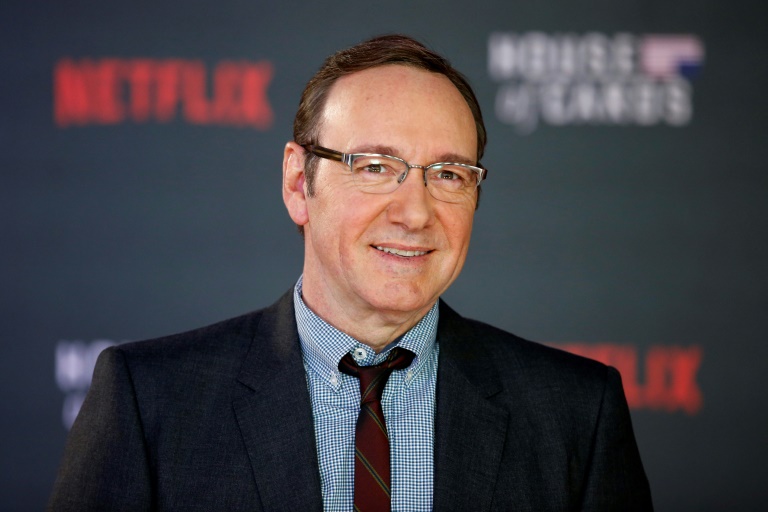
Actor Kevin Spacey facing sexual assault charges in UK

Hollywood actor Kevin Spacey is facing sexual assault charges in the UK, police and prosecutors said on Thursday, after a review of allegations against him.

The two-time Oscar winner for “The Usual Suspects” and “American Beauty” was artistic director of The Old Vic theatre in London between 2004 and 2015.

Allegations against him first emerged in the wake of the #MeToo movement that saw numerous claims of sexual assault and harassment in the movie industry.

That prompted an investigation by London’s Metropolitan Police, and a review by The Old Vic of the 62-year-old Spacey’s time in charge there.

The Crown Prosecution Service said in a statement that it had “authorised criminal charges” against the actor “for four counts of sexual assault against three men”.

“He has also been charged with causing a person to engage in penetrative sexual activity without consent,” said Rosemary Ainslie, from the service.

“The charges follow a review of the evidence gathered by the Metropolitan Police in its investigation,” added Ainslie, who heads the special crime division.

The Met said separately that the first two counts of sexual assault date from March 2005 in London, and concern the same man, who is now in his 40s.

The third is alleged to have happened in London in August 2008 against a man who is now in his 30s. The same man is alleged to be the victim of the separate charge.

The fourth sexual assault charge is alleged to have occurred in Gloucestershire, western England, in April 2013 against a third man, who is now in his 30s.

None of the alleged victims can be identified under English law.

The CPS, which brings prosecutions in England and Wales, and the police both referred to Spacey by his full name, Kevin Spacey Fowler.

Legal restrictions are in place limiting what the media can report until the case comes before a jury to avoid prejudicing any trial.

The CPS said that when considering whether to approve charges, it makes “fair, independent and objective” assessments about whether a case should go to court.

Claims against Stacey in 2017 led to the end of his involvement in the filming of the final season of the political drama “House of Cards”

He was also dropped from a Gore Vidal biopic on Netflix and as the industrialist John Paul Getty in “All the Money in the World”.

Christopher Plummer was brought in as a last-minute replacement.

Stacey, considered one of the finest actors of his generation, has previously denied similar charges in the United States.

Covid tests, no snow and no Russians: A strange Davos

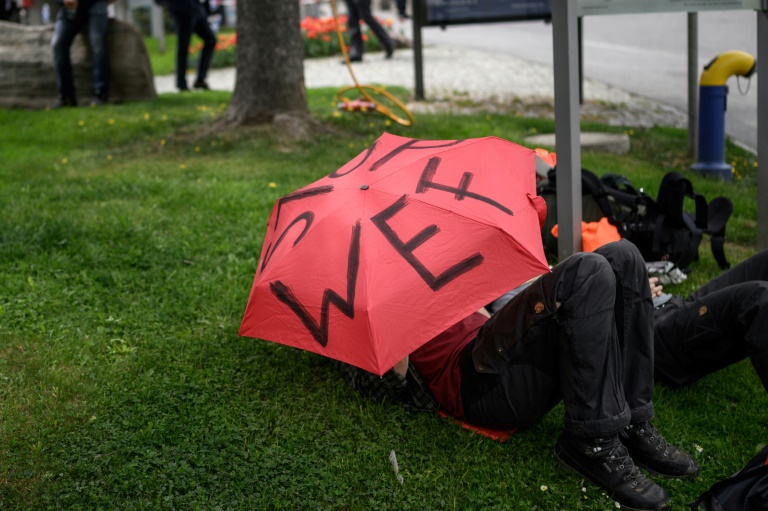
The Swiss Alpine village of Davos greeted the world’s political and corporate A-listers again, but it was not business as usual.

There was no snow, no Russians and fewer Chinese delegates — but plenty of rain and Ukrainians.

The World Economic Forum is typically held in January under a blanket of snow.

But after the 2020 event was cancelled due to the Covid pandemic, this year’s WEF was postponed until the spring.

– Wet streets and tests –

While the streets were wet, it was easier for delegates to get to and from the congress centre and their hotels than usual.

In the winter, it takes longer to go from place to place — and it can be a slippery affair.

But Adam Tooze, a prominent economics history professor at Columbia University in New York, was not a fan of the spring date.

“I really think this time of year doesn’t suit Davos at all. It’s not summer and it’s not winter,” Tooze said. “It’s a lot prettier, it’s really exotic and weird in the winter.”

While the WEF returned as Covid restrictions fell in Europe, organisers did not take any chances and required participants to be vaccinated and tested before travelling to Davos.

Arriving on site, delegates had to take another Covid test to be able to participate. Only one percent of attendees tested positive, according to the WEF.

This allowed people to mingle around the congress and party at night without masks on.

– Russians out –

The WEF decided to exclude Russians in the wake of Moscow’s invasion of Ukraine.

The Russians have traditionally been a major presence in Davos and held court at the “Russia House” on the main street.

But the red-shutter house was taken over by Ukrainians, who renamed it the “Russian War Crimes House” to put a spotlight on the alleged atrocities committed in their country.

The forum usually focuses on economic and climate issues, but the war in Ukraine took centre stage at the event, which was held under the theme “History at a Turning Point”.

Ukraine’s foreign minister, lawmakers and mayors seized on the event to plead for more heavy weapons for their army and harsher sanctions on Russia.

“This year, Davos is (the) Ukrainian forum, Ukrainian Davos,” Ukrainian oligarch Viktor Pinchuk, whose foundation was behind the “Russian War Crimes House”, said at an event.

– Smaller Chinese presence –

Organiser said 2,500 delegates, including 50 heads of state and government, were expected at this year’s edition.

But there were far fewer Chinese participants than usual.

Organisers said 21 delegates from China attended this year’s WEF, compared to 79 at the last in-person forum in January 2020.

While European nations have dropped their Covid restrictions, Chinese authorities have imposed lockdowns on Shanghai as the country battles its worst outbreak since the start of the pandemic.

Travelling also requires a lengthy quarantine when returning to China.

Zhu Ning, finance professor at the Shanghai Advanced Institute of Finance, said some also missed this year’s event because it was difficult to reschedule after it was postponed.

But he decided it was important to make the trip.

“I think there is some misunderstanding and misperception of China right now,” he told AFP. “I just try to be this bridge to help the West understand China better.”

The most prominent Chinese participant was the country’s climate envoy, Xie Zhenhua, who appeared on a panel alongside US counterpart John Kerry. 

Past events featured the likes of Alibaba founder Jack Ma and Huawei chief Ren Zhengfei.

President Xi Jinping made a splash when he showed up in 2017.

Ukraine says war in east at 'maximum intensity'

Ukraine said Thursday the war in the east of the country had hit its fiercest level yet as it urged Western allies to match words with support against invading Russian forces.

Moscow’s troops are pushing into the industrial Donbas region after failing to take the capital Kyiv, closing in on several urban centres including the strategically located Severodonetsk and Lysychansk.

Russian forces also shelled Ukraine’s second city Kharkiv, killing four people, after Moscow’s efforts to capture the north-eastern hub were repelled by heavy battles early in the war. 

Britain and Germany both said Thursday that Russian President Vladimir Putin must be defeated in the conflict, now in its fourth month, but Kyiv called on the West to urgently supply more heavy weapons for its outgunned forces.

“The fighting has reached its maximum intensity,” Ukraine’s Deputy Defence Minister Ganna Malyar told a press briefing about the battles in the east.

“Enemy forces are storming the positions of our troops simultaneously in several directions. We have an extremely difficult and long stage of fighting ahead of us.”

Pro-Moscow separatist groups have controlled parts of Donbas, the industrial basin comprising Donetsk and Lugansk regions, since 2014 but Russia now appears set on taking the whole region.

Lugansk regional governor Sergiy Gaiday said that “heavy” Russian bombardments on Lysychansk had done extensive damage to civilian infrastructure, including a humanitarian aid centre.

– ‘Show me one Nazi!’ –

Three people died in recent Russian attacks on Severodonetsk and Lysychansk, which stand on the crucial route to Ukraine’s eastern administrative centre in Kramatorsk, Gaiday said.

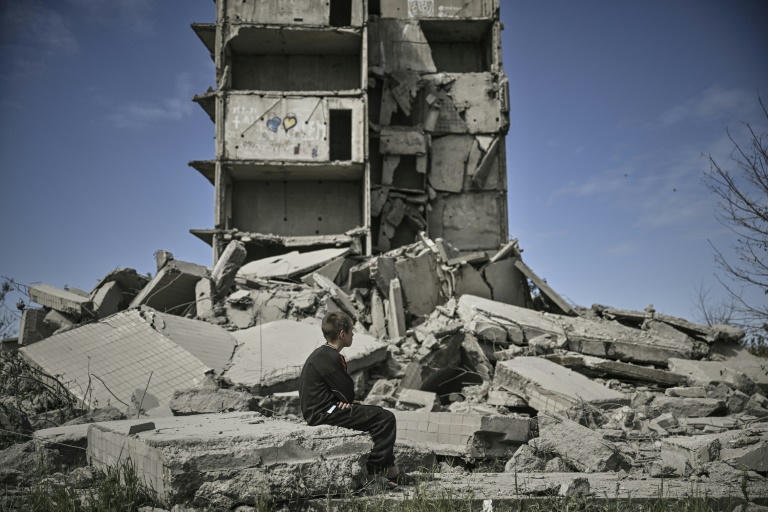
In Kramatorsk itself, children roamed the rubble left by Russian attacks as the sound of shellfire booms.

“That was a 22 (122-mm artillery),” said Yevgen, a sombre-looking 13-year-old who moved to Kramatorsk with his mother from the ruins of his village Galyna. 

“I am not scared,” he declared as he sat alone on a slab of a destroyed apartment block. “I got used to the shelling.”

Four civilians were killed in shelling in the Donetsk region around Kramatorsk, the Ukrainian presidency said.

Fresh shelling around Kharkiv in the northeast killed another four people, with officials warning residents to take to air raid shelters.

“The occupiers are again shelling the regional centre,” the governor of the Kharkiv region, Oleg Sinegubov, said on Telegram. 

Russia’s rationale of a “special military operation” to “demilitarise and de-Nazify” Ukraine draws a snort of derision in one village near Kharkiv.

“Show me one Nazi in the village! We have our nation, we are nationalists but not Nazis nor fascists,” says retired nurse Larysa Kosynets.

– ‘Putin must not win’ –

As the toll mounted, Ukrainian President Volodymyr Zelensky called on the West to add to the billions of dollars in weaponry it has already poured in, and blasted suggestions a negotiated peace could include territorial concessions.

“We need the help of our partners — above all, weapons for Ukraine. Full help, without exceptions, without limits, enough to win,” Zelensky said in his daily address to the nation.

Ukrainian Foreign Minister Dmytro Kuleba had earlier told Davos that his country “badly” needs multiple-launch rocket systems to match Russian firepower.

German Chancellor Olaf Scholz, who has faced criticism over Berlin’s slow response, underscored the “resolve and strength” of the West.

“Our goal is crystal clear — Putin must not win this war. And I am convinced that he will not win it,” the German chancellor told the World Economic Forum in Davos.

Scholz added that it was a “matter of making it clear to Putin that there will be no dictated peace.” 

British Foreign Secretary Liz Truss echoed the German chancellor’s comments and warned against offering “compromise or appeasement” to Putin.

“We need to make sure that Putin loses in Ukraine and that Ukraine prevails,” Truss told reporters during a visit to Sarajevo, saying that Kyiv needed to be supported without “backsliding”.

– ‘Illegal’ sanctions –

The Ukraine conflict has sparked fears of a global food crisis, on top of the political and economic shockwaves that have already reverberated around the world since the February 24 invasion.

The Kremlin on Thursday accused Western countries of stopping grain-carrying vessels from leaving ports in Ukraine, rejecting accusations that Russia was to blame.

“We accuse Western countries of taking a number of illegal actions that have led to this blockade,” Kremlin spokesman Dmitry Peskov told reporters 

Russian Foreign Minister Sergei Lavrov meanwhile poured cold water on an Italian peace plan to end the war.

The Russian central bank cut its key interest rate to 11 percent from 14 percent following an emergency meeting, as authorities sought to rein in the ruble which has surged in value despite the conflict.

Moscow slapped strict capital controls to boost the economy after the imposition of the sanctions and since then the ruble has staged a spectacular rebound — but Russia fears a strong ruble can hit budget revenues and exporters. 

The Kremlin is also seeking to tighten its grip over the parts of Ukraine it occupies, including fast-tracking citizenship for residents of two southern regions that are mostly under Russian control.

The United States branded the plan an “attempt to subjugate the people of Ukraine”.

burs-dk/jm

Texas massacre parents question 'late' police response

Witnesses to the Texas school shooting rampage on Thursday questioned the early police response to the massacre, as bereaved parents said they pleaded for officers to storm the building and stop the bloodshed — to no avail.

As the town of Uvalde mourned 19 children and two teachers killed in America’s latest mass shooting, Jacinto Cazares, whose daughter Jacklyn died in Tuesday’s massacre, said he raced to Robb Elementary School in the small town of Uvalde when he heard about the shooting.

“There was at least 40 lawmen armed to the teeth but didn’t do a darn thing (until) it was far too late,” Cazares told ABC News Wednesday night, joining other grief-stricken parents quoted in US media as saying they urged police to act more forcefully, as America’s worst school shooting in a decade unfolded.

“The situation could’ve been over quick if they had better tactical training, and we as a community witnessed it firsthand,” said Cazares.

Daniel Myers and his wife Matilda — both local pastors — told AFP they were at the scene, and saw parents growing frantic as police appeared to wait on reinforcements before entering the school.

“Parents were desperate,” said Daniel Myers, 72. “They were ready to go in. One family member, he says: ‘I was in the military, just give me a gun, I’ll go in. I’m not going to hesitate. I’ll go in.'”

“So there was desperation there, there was time lapse,” he told AFP at a makeshift memorial outside the school, where wooden crosses have been erected with victims’ names.

The tight-knit Latino community was changed forever when an 18-year-old with a history of being bullied entered the school with an assault rifle and hundreds of rounds of ammunition.

Officials say the gunman, Salvador Ramos, wearing a military-style vest, was confronted by a school resource officer, but was able to enter through a back door. Ramos then made his way to two adjoining classrooms and started shooting.

Texas Department of Public Safety director Steven McCraw told CNN Ramos was inside for about 40 minutes before police managed to shoot and kill him.

US Border Patrol chief Raul Ortiz, meanwhile, said the force’s agents “didn’t hesitate.”

“They came up with a plan. They entered that classroom and they took care of the situation as quickly as they possibly could,” Ortiz told CNN.

– ‘I have no words’ –

Speaking out for the first time, Ramos’s mother Adriana Reyes told ABC News her son could be aggressive when he got really angry but was “not a monster.”

“I had an uneasy feeling sometimes, like ‘what are you up to?,'” she told ABC Wednesday evening.

“We all have a rage, that some people have it more than others,” Reyes said.

Reyes expressed sympathy for the slain children and their parents, saying she was not aware that her son had been buying weapons.

“Those kids… I have no words,” Reyes said through tears. “I don’t know what to say about those poor kids.”

A teacher who was in the school building and spoke to NBC on condition she not be named said she had not been able to eat since the tragedy.

She said her students were watching a Disney movie to celebrate the imminent end of the school year, when she heard gunfire down the hall. She told the kids to get under their desks and rushed to lock the door.

“They knew this wasn’t a drill,” the teacher said, referring to the so-called active shooter exercises sadly common in US schools. “We knew we had to be quiet or else we were going to give ourselves away.”

Eventually police broke her classroom windows from the outside and helped the kids to safety.

Authorities have said Ramos shot his 66-year-old grandmother in the face before heading to Robb Elementary School with an AR-15 rifle.

According to Uvalde’s justice of the peace Eulalio Dia, anguished families waiting for news of their children had to provide DNA samples to help in the identification process.

“Some of the children were not in good shape,” Diaz told the El Paso Times.

– ‘Common sense’ –

Pressed Wednesday on how the teen was able to obtain the murder weapon, Texas Governor Greg Abbott brushed aside suggestions tougher gun laws were needed in his state — where attachment to the right to bear arms runs deep.

But in the shooting’s wake President Joe Biden — who will head to Uvalde in coming days — has called on lawmakers to take on America’s powerful gun lobby and enact “common sense gun reforms.”

The Uvalde shooting was the deadliest since 20 elementary-age children and six staff were killed at the Sandy Hook school in Newtown, Connecticut in 2012.

Burning Love or Suspicious Minds? 'Elvis' divides Cannes

Australian director Baz Luhrmann’s long-awaited fever dream of a biopic about the King of Rock’n’Roll, “Elvis”, split Cannes down the middle on Thursday between cheering admirers and barb-throwing critics.

The epic features a star-making turn by young actor Austin Butler as the swivel-hipped, rule-breaking cultural pioneer and Tom Hanks as his exploitative manager, Colonel Tom Parker.

As one of the hottest tickets this year at the world’s top film festival, the movie drew a 12-minute standing ovation at the premiere attended by Kylie Minogue, Shakira, Ricky Martin and the late rocker’s ex-wife Priscilla Presley.

But as the first reviews emerged, the glowing portrayal of an American icon and the top solo recording artist of all time divided Cannes.

Robbie Collin of London’s Daily Telegraph called it “indecently entertaining” and set for a “big” box office this summer. 

“Elvis Presley grooving down 1950s Beale Street to the sound of (American rapper) Doja Cat and singing Viva Las Vegas in the style of Britney Spears?” he said of the movie’s head-spinning musical mashups. “Man, it’s good to have Baz Luhrmann back.”

Oscar-winning Mexican director Guillermo del Toro tweeted that the film was “dazzling, bold and moving…Loved it. Loved it. Loved it”.

– ‘Deliriously awful’ –

The New York Times’s Kyle Buchanan said fans of Luhrmann, the brashly flamboyant director of “Moulin Rouge!”, “The Great Gatsby” and “William Shakespeare’s Romeo and Juliet”, would get exactly what they came for.

“Overcranked, glittery, silly, fun, ridiculous… sometimes all of those within the same five seconds! The only variables are lead actor Austin Butler (better than expected) and Tom Hanks (much worse!),” he said.

France’s Le Figaro called it a “departure from the conventional biopic” while its “baroque touch does the rest” to make it a crowd-pleaser.     

The picture traces the King’s life from his dirt-poor childhood living in a black neighbourhood in the segregated Deep South to his final, drug-addled years as a bloated shadow of himself during a lengthy residency in a Las Vegas hotel.

It trains a spotlight on the role of blues, gospel and soul in shaping his music, showing Elvis as a respectful and devoted admirer of black culture rather than a white profiteer ripping it off.

In a scathing review, US movie website IndieWire zeroed in on what it called its historical whitewashing.

“Martin Luther King Jr.’s assassination is framed as something that personally happened to Elvis Presley, and made him feel very sad,” reviewer David Ehrlich wrote, calling the film “deliriously awful”. 

The Guardian was similarly unimpressed: “Incurious yet frantic, Luhrmann’s spangly epic is off-key – and Austin Butler flounders in those blue suede shoes.”

– Not a Bond baddie –

At a news conference, Luhrmann said he was unfazed about occasionally being panned. 

He said he was most concerned about the reaction of Elvis’s granddaughter, Riley Keough, an actress and film-maker screening her new feature “War Pony” at Cannes, and Priscilla Presley. Both have given their blessing to the film.  

“Criticism of anything you make — I’m used to it,” Luhrmann said. 

“No critique, no review was ever going to mean more to us than the review of the woman who was married to Elvis Presley.”

Hanks said he didn’t take on the role of Colonel Parker as a typical villain. 

“I’m not interested in playing a bad guy just for the sake of ‘Before I kill you Mr Bond, perhaps you’d like a tour of my installation?'” he said, joking about the cartoonish evildoers of the 007 movies.

“What Baz tantalised me with right off the bat was: here was a guy who saw an opportunity to manifest a once-in-a-lifetime talent into a cultural force.

“I give Colonel credit for doing that very thing.”

China premier issues warning on Covid-hit economy

China’s premier called for more to be done to stabilise the world’s second-largest economy, issuing an unusually stark warning as the country’s zero-Covid strategy bites into growth.

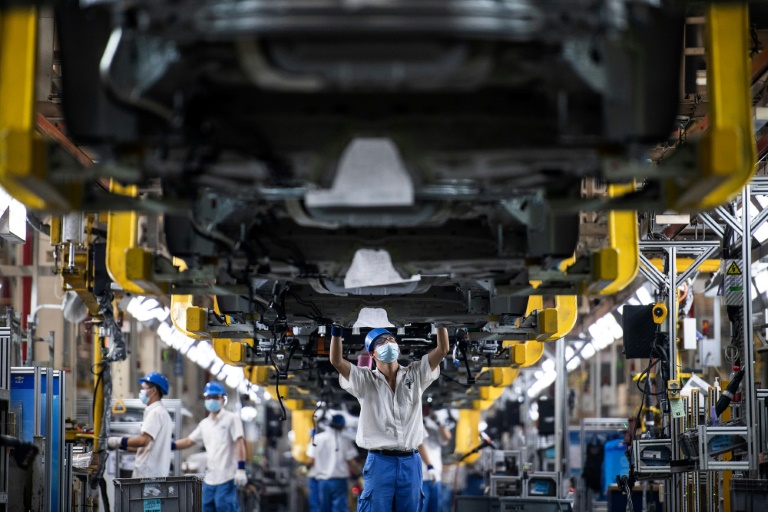
China is the last major economy welded to a policy of mass testing and hard lockdowns to eliminate virus clusters, but the strict curbs have battered businesses.

Restrictions around the nation in recent months — including on the manufacturing hubs of Shenzhen and Shanghai, as well as the breadbasket province of Jilin — have tangled supply chains and dragged economic indicators to their lowest levels in around two years.

In some ways, the challenges now are “greater than when the pandemic hit hard in 2020”, Premier Li Keqiang told a State Council meeting on Wednesday, according to a readout by the official Xinhua news agency.

“We are currently at a critical juncture in determining the economic trend of the whole year,” Xinhua quoted Li as saying.

“We must seize the time window and strive to bring the economy back onto a normal track.”

Li also said officials ought to make sure there is “reasonable” growth in the second quarter, fuelling fears that the country’s target for yearly expansion of around 5.5 percent may not be met.

Li’s remarks are the latest in a growing chorus of calls from officials and business leaders for more balance between stopping the virus and helping the ailing economy.

On Monday, the central bank and banking regulator urged financial institutions to boost lending, citing pressure on the economy, Chinese media reported.

This came as retail sales plunged 11.1 percent on year in April while factory output sank 2.9 percent — the worst showing since the early days of the Covid crisis.

And the urban unemployment rate edged back towards its February 2020 peak.

In March, and particularly in April, indicators including employment, industrial production and freight dropped “significantly”, Li said at the Wednesday meeting.

He stressed the importance of coordinating virus control and economic development, according to Xinhua.

On Thursday, the State Council will also send teams to 12 provinces to oversee local work in implementing state policies, the report said.

– Wilting growth –

Two more companies sounded a warning Thursday on the impact of the stringent Covid measures, with e-commerce titan Alibaba reporting its annual profit was down nearly 60 percent.

The group warned its domestic business has been “significantly affected by the Covid-19 resurgence in China”, and said it had decided not to offer its usual financial outlook for the year ahead.

In addition, tech giant Baidu reported $140 million in net loss over the January-March period, while co-founder Robin Li warned that “challenges related to the virus continue to pressure” their operations.

China’s current outbreak — fuelled by the Omicron variant — is the worst since early in the pandemic in 2020.

Financial hub Shanghai has been almost entirely sealed off since April, crushing businesses, while curbs are creeping in across the capital Beijing with no clear end in sight.

The government has offered tax relief and a bond drive to help industries, and President Xi Jinping earlier called for an “all-out” infrastructure push.

But analysts cautioned that growth will keep wilting until China eases its rigid virus controls.

S&P Global Ratings this month lowered its full-year growth forecast for China from 4.9 percent to 4.2 percent due to Covid curbs.

And Nomura analysts warned in a recent note that there is “increasing potential for negative GDP growth in the second quarter”.

Wednesday’s State Council teleconference involved an unusually large cohort of officials, Chinese outlet The Economic Observer reported.

The economic woes come in a pivotal political year for Xi, who is eyeing another term in power at the Communist Party Congress this autumn.

China’s economy is a key driver of global growth and is crucial domestically for the Communist Party, which has based its legitimacy on delivering steady expansion and improved standards of living.

Chipmaker Broadcom to buy VMware for $61 bn

Broadcom announced Thursday a $61-billion deal to purchase cloud computing firm VMware in a giant tech transaction that expands the chipmaker’s software offerings.

The cash and stock deal — one of the biggest tech mergers ever — will merge chipmaker Broadcom’s software assets into those of VMware, a leader in cloud computing and virtualization technology.

The combination is designed to boost Broadcom’s offerings to customers enabling “greater choice and flexibility to build, run, manage, connect and protect applications at scale across diversified, distributed environments,” said a joint press release from the companies announcing the deal.

Led by chief executive Hock Tan, Broadcom has grown by acquisition, reporting fiscal 2021 revenues of about $27.5 billion.

In 2017, Broadcom made an unsolicited offer to acquire rival chipmaker Qualcomm for $117 billion, but the transaction was blocked by then-president Donald Trump’s administration on national security grounds. 

Qualcomm’s activities are mostly in the United States, but it is based in Singapore.

The deal with VMware would dilute Broadcom’s dependence on semiconductor revenues amid concerns of “chip cycle peaking,” said a note from UBS that also alluded to concerns about higher debt levels due to the deal.  

Under the transaction, VMware shareholders can elect to receive either $142.50 in cash or slightly more than one-fourth of a Broadcom share for each VMware share. That represents a premium of 49 percent compared with VMware’s stock price Friday before news reports of the deal surfaced.

Broadcom will also assume $8 billion of VMware debt.

VMware was spun out of Dell Technologies in 2021.

Michael Dell and private equity firm Silver Lake, who own 40.2 percent and 10 percent of VMware shares respectively, have signed in support of the deal so long as the VMware board backs the transaction, the press release said,

Shares of VMware rose 0.9 percent to $121.65 in morning trading, while Broadcom gained 1.9 percent to $541.89.

Close Bitnami banner
Bitnami