AFP

Alibaba profit slumps nearly 60% as tech crackdown, Covid bite

Chinese e-commerce giant Alibaba said Thursday its profit fell 59 percent in the last fiscal year, joining other tech firms that reported lacklustre results while grappling with Covid-19 restrictions and a sector crackdown.

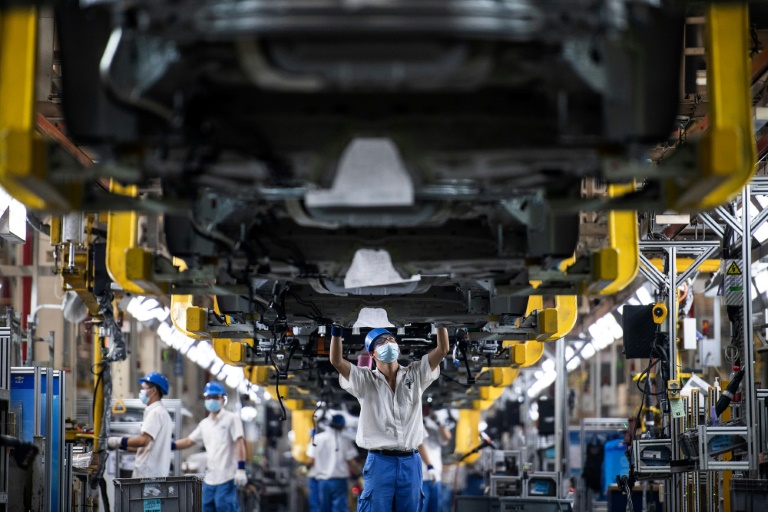
China’s economy has been battered by the fallout from strict Covid curbs including lockdowns and transport restrictions that have kept consumers home, pushed up unemployment, and tangled supply chains.

Alibaba has also had to contend with heightened competition and a wide-ranging regulatory crackdown on alleged anti-competitive practices by China’s tech giants, driven by fears that massive internet companies control too much data and expanded too quickly.

The Hangzhou-based group warned it would not give forward-looking financial guidance due to Covid risks and uncertainty after full-year profit slumped to 62 billion yuan ($9.8 billion).

Citing “macro challenges that impacted supply chains and consumer sentiment”, Alibaba also announced a loss of 16.2 billion yuan for the January-March quarter, as the value of its investments fell.

The tech behemoth has seen its market value plummet since Beijing launched its sweeping crackdown in 2020 on some of China’s largest home-grown companies.

The crackdown included a last-minute cancellation of a planned IPO by Alibaba’s financial arm Ant Group — which would have been the world’s largest public offering at the time.

The company was also hit with a record $2.75 billion fine for alleged unfair practices last year.

But Alibaba — seen as a gauge of consumer sentiment — said Thursday its revenue grew nine percent in the last quarter to 204.1 billion yuan.

This was better than expected in a Bloomberg forecast, after Chinese consumers took to online shopping during Covid lockdowns that kept millions at home.

The company’s revenues — generated mainly by its core e-commerce operations — were up 19 percent for the fiscal year ending March 31.

– Covid ‘uncertainties’ –

In a sign of a patchy outlook however, the company warned that its domestic business has been “significantly affected by the Covid-19 resurgence in China, particularly in Shanghai”. 

“Considering the risks and uncertainties arising from Covid-19… we believe it is prudent at this time not to give financial guidance as we typically do at the start of the fiscal year,” it added.

Alibaba’s earnings follow a series of sluggish results by prominent Chinese tech firms, with internet giant Baidu on Thursday reporting a net loss of 885 million yuan ($140 million) in the first quarter.

Baidu’s business has been “negatively impacted” by China’s recent Covid-19 resurgence since mid-March, co-founder Robin Li said in a statement.

He added that virus-related challenges continue to pressure its near-term operations.

Tencent last Wednesday reported record low quarterly revenue growth at 135.5 billion yuan ($20.1 billion) in the first quarter, putting year-on-year expansion at nearly zero.

China is the last major economy to stick to a strict zero-Covid policy, which is now being tested by the infectious Omicron variant.

The country’s economic slowdown now appears to have motivated a softer approach towards the vast, money-spinning tech sector.

In recent weeks the government has said it will roll out measures to support the virus-battered economy, and indicated that it will ease the crackdown.

Chinese tech shares surged in late April after officials pledged support for internet firms at a Politburo meeting.


Alibaba full-year profit slumps nearly 60% on tech crackdown, Covid

Chinese e-commerce giant Alibaba said Thursday its profit fell 59 percent in the last fiscal year, joining other tech firms that reported lacklustre results while grappling with Covid-19 restrictions and a sector crackdown.

China’s economy has been battered by the fallout from strict Covid curbs including lockdowns and transport restrictions that have kept consumers home, pushed up unemployment, and tangled supply chains.

Alibaba has also had to contend with a wide-ranging regulatory crackdown on alleged anti-competitive practices by China’s tech giants.

The Hangzhou-based group cited “macro challenges that impacted supply chains and consumer sentiment” as it announced a loss of 16.2 billion yuan ($2.56 billion) for the January-March quarter. 

It warned it would not give forward-looking financial guidance due to Covid risks and uncertainty.

Alibaba has seen its market value plummet since Beijing launched its sweeping crackdown in 2020 on some of China’s largest home-grown companies.

The crackdown included a last-minute cancellation of a planned IPO by Alibaba’s financial arm Ant Group — which would have been the world’s largest public offering at the time.

The company was also hit with a record $2.75 billion fine for alleged unfair practices last year.

But Alibaba Group said Thursday its revenue grew around nine percent in the last quarter to 204.1 billion yuan, better than expected in a Bloomberg forecast.

The company’s revenues — generated mainly by its core e-commerce operations — were up 19 percent for the fiscal year ending March 31.

Meanwhile, its full-year profit came to 62 billion yuan ($9.8 billion).

“Since mid-March 2022, our domestic businesses have been significantly affected by the Covid-19 resurgence in China, particularly in Shanghai,” the company said. 

“Considering the risks and uncertainties arising from Covid-19… we believe it is prudent at this time not to give financial guidance as we typically do at the start of the fiscal year,” it added.

Alibaba’s earnings follow a series of sluggish results by prominent Chinese tech firms, with internet giant Baidu on Thursday reporting a net loss of 885 million yuan ($140 million) in the first quarter.

Baidu’s business has been “negatively impacted” by China’s recent Covid-19 resurgence since mid-March, co-founder Robin Li said in a statement. 

Virus-related challenges continue to pressure Baidu’s near-term operations, Li said.

Tencent last Wednesday reported record low quarterly revenue growth at 135.5 billion yuan ($20.1 billion) in the first quarter, putting year-on-year expansion at nearly zero.

China is the last major economy to stick to a strict zero-Covid policy, which is now being tested by the infectious Omicron variant.

Critically endangered elephant, unborn baby suspected poisoned in Indonesia

A critically endangered Sumatran elephant and its unborn baby were found dead from suspected poisoning in western Indonesia, a conservation official said on Thursday.

The carcass of the heavily pregnant mammal was found next to a palm plantation in Riau province on Sumatra, a large island home to some of the world’s rarest animals.

The archipelago nation faces an ongoing battle against wildlife crime and several elephant poisoning cases have been reported in recent years, including one in 2019 when a Sumatran elephant was found decapitated with its tusks ripped off.

A plantation worker discovered the mother, who was 22 months pregnant, on Thursday and immediately reported the carcass to authorities who collected samples before burying the body.

“We estimated the female elephant to be around 25 years old and during the necropsy test we found that it was pregnant and was close to giving birth,” said Hartono, the head of the local chapter of the Natural Resource Conservation Agency.

Officials are still testing samples to determine the cause of death, added Hartono, who like many Indonesians goes by one name.

They suspect poisoning because the mother was foaming at the mouth when she was discovered.

According to the World Wildlife Fund, Sumatran elephants are on the brink of extinction with only about 2,400-2,800 left in the world. 

The elephant population is also threatened by rampant poachings because of their tusks, which are prized in the illegal wildlife trade. 

Rampant deforestation has reduced the critically endangered elephants’ natural habitat and brought them into increasing conflict with humans.

Zimbabwe's ballooning jumbo herds a growing threat to humans

Seventy-five-year-old  Hanganani Gideon Dube has walked with a slight limp and his speech been laboured since he miraculously survived being trampled by an elephant in northwestern Zimbabwe.

He considers himself lucky to be alive following the assault one afternoon in May 2021 near Mabale village on the outskirts of Hwange National Park, the country’s biggest.

But the injuries have left him unable to fend for his family of six.

Dube was tending his cattle when “suddenly I found myself face-to-face with an elephant”.

He sprinted off, without realising he was running straight into the path of another elephant.

“There was no time for me to evade the second elephant. It attacked me swiftly and I blacked out,” he said in the local Ndebele language.

Dube said he’s still puzzled “why the elephant didn’t finish me off”. 

“I am lucky to be alive but I am now useless as I can no longer do any physical work, including looking after my cattle,” he said sitting on a stool by a cooking fire at his homestead.

At least 60 people have been killed by elephants in Zimbabwe since the start of the year, compared with 72 over all of 2021 year.

Zimbabwe’s conservation success story has had unfortunate side-effect of heightening jumbo-human conflict.

With some 100,000 elephants, Zimbabwe has the world’s second-largest population after Botswana, and about one-quarter of the elephants in all of Africa.

More than half of those pachyderms live in and outside the unfenced Hwange, a wildlife park nearly half the size of Belgium, some 14,600 square kilometres (5,637 square miles) of vegetation.

Elephants roam freely from Zimbabwe’s sprawling and unfenced game reserves and it is common to find herds crossing or resting along the main highway from Hwange to the nearby prime tourist resort of Victoria Falls.

– ‘Reward not punishment’ –

Zimbabwe’s elephant population is growing at about five percent a year, reaching unsustainable levels.

“Our conservation methods are working and I believe that instead of being punished we should be rewarded,” Fulton Mangwanya, the Zimbabwe Parks and Wildlife Management Authority director told AFP.

He spoke on the sidelines of a conference in Hwange where the government is this week lobbying allies to push for legal ivory trade.

Zimbabwe, along with Botswana, Namibia and Zambia, wants the UN Convention on International Trade Endangered Species of Wild Fauna and Flora, commonly referred to as CITES, to lift the ban on the trade in ivory.

They argue that scrapping the ban can help to better preserve the animals and bring economic benefit to local communities who live close to the animals.

Zimbabwe has a huge $600-million stockpile of ivory which it recently showed to  ambassadors representing various countries including the European Union, China and Japan. It has urged EU diplomats to allow a one-off sale of the ivory.

The country’s last official elephant census in 2014 counted more than 80,000, a figure now estimated at 100,000, which authorities say is three times more than capacity. 

But some conservationists doubt the accuracy of the statistics and fear that lifting the trade ban would pose a threat to elephant populations.

America, along with EU countries and Britain remain opposed to lifting the ban while China and Japan are some of the countries in support.

International trade in ivory and elephants has been banned since 1989 under the CITES. One-off sales were allowed in 1999 and 2008, despite fierce opposition.

The Harare government has threatened to pull out of the convention if it doesn’t have its way on ivory trading. 

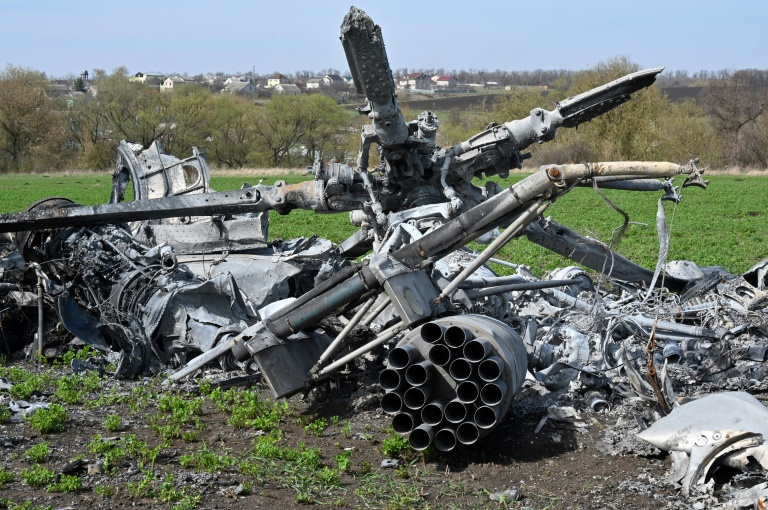
Is Ukraine the attack helicopter's grave?

Is the war in Ukraine sounding the death knell for attack helicopters? The large number destroyed has sparked a debate among experts over whether the aircraft are under-performing or being used poorly by Russian forces.

Saturated with anti-aircraft defences, both long-range systems and short-range missiles that can be carried and launched by a soldier (Manpads), the skies above Ukraine are deadly for helicopters.

The numerous videos on social media of Russian helicopter gunships being shot down are very public evidence of the extent of the losses.

Russia has lost at least 42 helicopters since its February 24 invasion and Ukraine seven, according to specialist blog Oryx, which has recorded material losses from photographs and videos taken from the battlefields.

Attack helicopters were designed to aid troops and tanks on the battlefield.

They are armoured themselves and heavily armed, but as the conflict shows, they too are extremely vulnerable.

Experts are divided as to why.

“Since those early days of the war, the air defences of both sides have had a clear deterrent effect on helicopter operations,” according to Sash Tusa, an aerospace and defence analyst at Britain-based Agency Partners.

“These unpleasant reminders of the realities of high-intensity warfare against near-peer adversaries are in turn undermining the case for further investment in and maintenance of Western air assault capabilities, whether fixed- or rotary-wing,” he wrote in the specialist magazine Aviation Week.

In other words, the future of the helicopter as an assault craft is in question, according to Tusa. 

– ‘Russian fiasco’ –

Other experts point to Russian mistakes, such as the helicopter assault on the Gostomel airport near Kyiv at the opening of the invasion, which Ukrainian forces repelled.

Joseph Henrotin, a researcher at the Paris-based Institute of Comparative Strategy, called the operation a “Russian fiasco” that had nothing to do with the capabilities of the helicopters, but with how they were used.

“The Russians did a poor job,” he said. “Before an airborne operation, you have to ensure the skies have been cleared and anti-aircraft defences wiped out.”

One of the major surprises of the war is that Russia did not gain air superiority at the start of the conflict by suppressing Ukraine’s anti-aircraft defences, a mission normally carried out by fixed-wing aircraft and missiles rather than helicopters.

Michael O’Hanlon, an expert at the Brookings Institution think tank in Washington, agreed the problem is not with the helicopters but how the Russians are using them.

“They aren’t outdated, but assaulting a predictable location when an enemy is on alert won’t generally work,” he told AFP.

Yet the conflict in Ukraine is very much like the war envisaged by Soviet and NATO experts during the Cold War, when the current generation of attack helicopters were developed.

That includes the Russian Mi-24 and Mi-28, earlier versions of the Ka-52, and the US Apache and Franco-German Tiger.

“They were conceived in an epoch where they might have been engaged above Germany or Poland, with a very high density of fire and threats for helicopters,” said Henrotin.

– ‘Bloody reminder’ –

Patrick Brethous, a former general who headed up the helicopter detachment of the French special forces, said that before predicting the end of attack helicopters one had to look at how the Russians and Ukrainians were using them.

“We’ve seen many Russian helicopters flying by day, 300 feet from the ground, being shot” down, said Brethous, who now works as a military adviser to Airbus Helicopters.

“It’s an employment of the helicopter which is very dangerous,” he noted, saying they are better used for night operations and should be flown closer to the ground to avoid enemy missiles.

Henrotin also believes that the conflict “is a fairly bloody reminder for the Russians of the fundamentals: a helicopter should not be used alone” but in conjunction with other types of military forces.

Military experts call that a combined arms approach, where aircraft, armoured vehicles, artillery and infantry work together, providing complementary effects to overcome an enemy and protect one another.

Tusa believes helicopters’ future as an assault weapon is being thrown further into doubt as many of their missions can now be carried out by much cheaper drones.

But Henrotin said that although drones can complete some of their missions, such as reconnaissance, they are complementary and cannot do everything as they lack an attack helicopter’s firepower.

For example, a Turkish Bayraktar drone used by Ukrainian forces can carry four missiles, whereas the Russian Ka-52 helicopter, with its 12 missiles and rocket capacity, remains “the gunboat of the sky”.

Russian central bank slashes rate to rein in ruble

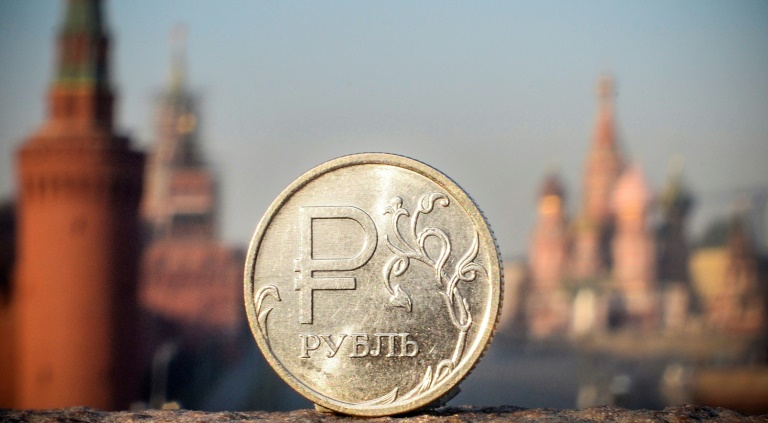
Russia’s central bank cut its key interest rate Thursday following an emergency meeting, as authorities seek to rein in the ruble which has surged in value despite the conflict in Ukraine.

The Bank of Russia slashed the rate to 11 percent from 14 percent, saying external conditions for the economy remained “challenging, considerably constraining economic activity.”

The policy-setting meeting was originally set to take place on June 10 but the central bank surprised the market by announcing Wednesday that an extraordinary meeting would take place the next day.

“Financial stability risks decreased somewhat, enabling a relaxation of some capital control measures,” it said in a statement on Thursday.

The Bank of Russia said it “holds open the prospect of key rate reduction at its upcoming meetings.” 

Central Bank head Elvira Nabiullina said that Russia managed to stabilise the economy but it was too early to “exhale calmly”. 

“As the economy adapts, it will be difficult for both companies and citizens,” she said after the meeting.

“The first months were a time of tactical decisions: the first shock of the sanctions had to be counteracted,” she added.

“As a result, we managed to protect financial stability and prevent an inflationary spiral. But this, of course, does not mean that we can exhale calmly.”

The next rate-setting meeting is set to take place on June 10.

After the West slapped Russia with debilitating sanctions over the start of Moscow’s military campaign in Ukraine in February, financial authorities introduced strict capital controls to boost the economy.

Since then, the ruble has staged a spectacular rebound and strengthened by around 30 percent against the dollar.

After the decision on Thursday, the ruble weakened 

by 7 percent against the dollar. 

A strong ruble is not desirable for the Russian government, which fears it can hit budget revenues and exports. 

Generally, lower interest rates are unattractive for foreign investment and decrease the value of a country’s currency.

– ‘Dollar is shrinking’ –

The Kremlin said on Wednesday the government was paying “special attention” to the strong ruble but President Vladimir Putin sought to cast the rallying currency as a positive development.

“As we know, the dollar is shrinking, the ruble is strengthening,” he said on Wednesday.

But analysts say the strong ruble is a sign of Russia’s weakening economy.

“The ruble strength reflects high oil/energy prices, but mostly a collapse in import demand with sanctions. That suggests that growth is going to be massively challenged — likely deep recession this year,” wrote Timothy Ash, an emerging markets strategist at BlueBay Asset Management.

“A strong currency will not help that and will also stall the ruble value of oil export earnings to the budget, boosting the budget deficit,” he added.

The government had earlier taken steps to loosen capital controls but the ruble continued to appreciate.

On Monday, Russia’s finance ministry announced domestic companies would have to sell 50 percent of their foreign currency export earnings, a reduction from 80 percent earlier. 

“High oil and gas revenues are providing policymakers with a lifeline, allowing them to row back emergency economic measures,” said William Jackson, chief emerging markets economist at Capital Economics.

Germany vows Putin 'won't win' Ukraine war as Russians advance

German Chancellor Olaf Scholz vowed Thursday that Vladimir Putin will neither win the Ukraine war nor dictate the terms for peace, as Russian troops made fresh attempts to take a key eastern city.

Ukrainian officials said Russian forces had tried to storm the besieged industrial hub of Severodonetsk and nearby Lysychansk, the focal point of Moscow’s renewed offensive in the Donbas region.

Ukrainian President Volodymyr Zelensky called on the West to offer help “without limits”, specifically heavy weaponry for his outgunned troops, and blasted suggestions a negotiated peace could include territorial concessions.

European powerhouse Germany has faced frequent Ukrainian criticism for not doing enough to help, but Scholz underscored the “resolve and strength” of Berlin and Western allies.

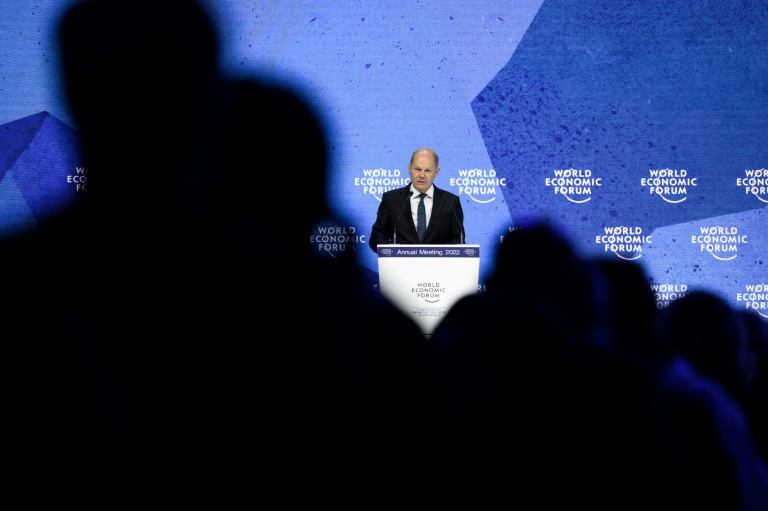
“Our goal is crystal clear — Putin must not win this war. And I am convinced that he will not win it,” the German chancellor told the World Economic Forum in Davos.

Putin has “already failed in all his strategic aims” and Russia’s plan to capture all of Ukraine is “further away today than it was at the beginning” of its invasion on February 24.

“It is a matter of making it clear to Putin that there will be no dictated peace,” said Scholz. “Ukraine will not accept that and neither will we.”

– ‘I am not scared’ –

Since failing in its early objective of capturing Ukraine’s capital, Moscow’s army has plotted a slow but steady course deeper into the country’s eastern Donbas region.

Fierce fighting is now centred on Severodonetsk, as Ukrainian forces try to stop Russian troops encircling the city and cutting off the lone road in.

Ukraine’s presidency said in a morning update that “Russian troops tried to storm Severodonetsk and Lysychansk”, with three people killed in Lysychansk.

“It is clear that slowly, slowly, our guys (Ukrainian soldiers) are simply retreating to more fortified positions,” Lugansk regional governor Sergiy Gaiday said on Telegram Thursday.

“It’s very hard for the guys. Extremely hard. But they are holding on”. 

In the eastern front city of Kramatorsk, children are roaming the rubble as the sound of shellfire booms.

“That was a 22 (122-mm artillery),” said Yevgen, a sombre-looking 13-year-old who moved to Kramatorsk with his mother from the ruins of his village Galyna. 

“I am not scared,” he declared as he sat alone on a slab of a destroyed apartment block. “I got used to the shelling in Galyna.”

Four civilians were killed in shelling in the Donetsk region around Kramatorsk, while two were killed in Kharkiv region in the northeast, the Ukrainian presidency said.

– ‘Without limits’ –

As the fighting raged, Zelensky called out the international community for paying too much attention to Moscow’s interests. 

He took specific aim at former US Secretary of State Henry Kissinger and the New York Times for suggesting territorial sacrifices might be necessary to end the conflict.

Kissinger, the 98-year-old champion of realpolitik, this week told Davos that a return to the “status quo” before Russia’s invasion would could prevent a broader war.

Russia formally annexed Crimea in 2014, while separatist groups aligned with Moscow have controlled parts of Donbas, which comprises Donetsk and Lugansk regions, since the same time.

But Zelensky ruled out any such concessions and urged the West to add to the billions of dollars of weapons it has already poured into Ukraine.

“We need the help of our partners — above all, weapons for Ukraine. Full help, without exceptions, without limits, enough to win,” Zelensky said in his daily address to the nation.

Ukrainian Foreign Minister Dmytro Kuleba had earlier told Davos that his country “badly” needs multiple-launch rocket systems to match Russian firepower.

Kyiv has also been pushing for a full energy embargo on Russia in addition to the sweeping economic sanctions already imposed on Moscow since the invasion.

– ‘Show me one Nazi!’ –

Russia’s central bank cut its key interest rate Thursday to 11 percent from 14 percent following an emergency meeting, as authorities sought to rein in the ruble which has surged in value despite the conflict in Ukraine.

Moscow slapped strict capital controls to boost the economy after the imposition of the sanctions and since then the ruble has staged a spectacular rebound — but Russia fears a strong ruble can hit budget revenues and exporters. 

Russia has meanwhile called on the West to lift the sanctions in exchange for freeing up grain exports, with fears mounting of a global food crisis, particularly in Africa.

The Kremlin is also seeking to tighten its grip over the parts of Ukraine it occupies, including fast-tracking citizenship for residents of two southern regions that are mostly under Russian control.

The United States branded the plan an “attempt to subjugate the people of Ukraine”.

Even in areas where Ukraine has pushed back Russian forces, such as around the second city of Kharkiv, the shells continue to fall. 

Russia’s rationale of a “special military operation” to “demilitarise and de-Nazify” Ukraine draws a snort of derision in one village near Kharkiv.

“Show me one Nazi in the village! We have our nation, we are nationalists but not Nazis nor fascists,” says retired nurse Larysa Kosynets.

burs-dk/spm

Stocks diverge, ruble slides tracking economic unrest

Europe’s top stock markets rose Thursday after a mixed Asian showing, as traders assessed chances of a global recession in the wake of runaway inflation.

Analysts warn that interest rate rises by central banks aimed at curbing the highest consumer price rises in decades could push the world economy into a downturn.

Bucking the trend on borrowing costs however, Russia’s central bank on Thursday slashed its key interest rate following an emergency meeting, as authorities seek to rein in the ruble which has surged in value following the invasion of Ukraine.

The ruble, which Wednesday hit a seven-year dollar high, was down nearly three percent after Russia cut its interest rate to 11 percent from 14.

The ruble has been buoyed by capital controls and high energy prices amid the Ukraine war.

In the United States, central bankers stressed their “strong commitment and determination” to bring raging inflation under control via further large interest rate increases, according to the minutes of the latest policy meeting released Wednesday.

With US inflation rising at the fastest pace in nearly four decades, the Fed’s policy committee early this month hiked the key rate by a half point — the biggest increase since 2000.

Most members said similar increases “would likely be appropriate at the next couple of meetings”, according to the minutes.

“The Fed’s minutes were hawkish but… with policymakers sounding optimistic and in control,” noted Victoria Scholar, head of investment at Interactive Investor.

Across Asia on Thursday, stock markets were mixed after Chinese Premier Li Keqiang’s warning  that the world’s number two economy was in some ways worse off now than during the early days of the pandemic.

It comes as China persists with a zero-Covid policy to eradicate the fast-spreading Omicron virus variant.

The economic agony caused by lockdowns and other strict containment measures has hammered growth across China and knocked global supply chains.

Recent economic data has shown that a series of pledges by Beijing to kickstart growth has essentially fallen flat owing to a lack of concrete action, while analysts said the easing of the Covid policy was the only thing investors wanted to see.

There is a general feeling among commentators that China’s economic growth will fall well short of the government’s target this year.

– Key figures at around 1030 GMT –

London – FTSE 100: UP 0.1 percent at 7,533.65 points

Frankfurt – DAX: UP 0.6 percent at 14,088.70

Paris – CAC 40: UP 0.7 percent at 6,342.31

EURO STOXX 50: UP 0.6 percent at 3,698.83

Tokyo – Nikkei 225: DOWN 0.3 percent at 26,604.84 (close)

Hong Kong – Hang Seng Index: DOWN 0.3 percent at 20,116.20 (close)

Shanghai – Composite: UP 0.5 percent at 3,123.11 (close)

New York – Dow: UP 0.6 percent at 32,120.28 (close)

Euro/dollar: UP at $1.0714 from $1.0685 on Wednesday

Pound/dollar: UP at $1.2613 from $1.2579

Euro/pound: UP at 84.94 pence from 84.89 pence

Dollar/yen: DOWN at 126.69 yen from 127.26 yen 

Brent North Sea crude: UP 0.7 percent at $114.86 per barrel

West Texas Intermediate: UP 0.9 percent at $111.31 per barrel

After long trek to Davos, Ukrainians await more Western aid

Ukraine’s foreign minister, lawmakers and mayors made long journeys by car, train and plane to the Swiss Alps to convince global elites to send more help to repel Russian invaders.

As the four-day World Economic Forum in Davos wrapped up on Thursday, they were returning home without the heavy weapons they desperately want or the new sanctions they demand against Moscow.

But while major announcements were not expected in Davos, the summit gave the Ukrainians a chance to press the world’s political and business leaders face-to-face for urgent help after three months of fighting.

Ivan Fedorov, the mayor of the southeastern city of Melitopol, drove from Zaporizhzhia to Warsaw, then by plane to Zurich, and again by car from Zurich to Davos — a two-day trek.

“It’s very important for us (to come to Davos) because for a long time Russian propaganda and diplomacy worked very well,” Fedorov told AFP.

“Civilised countries must be united with Ukraine… not with their words but with their deeds,” said Fedorov, who was held for several days by Russian forces in March.

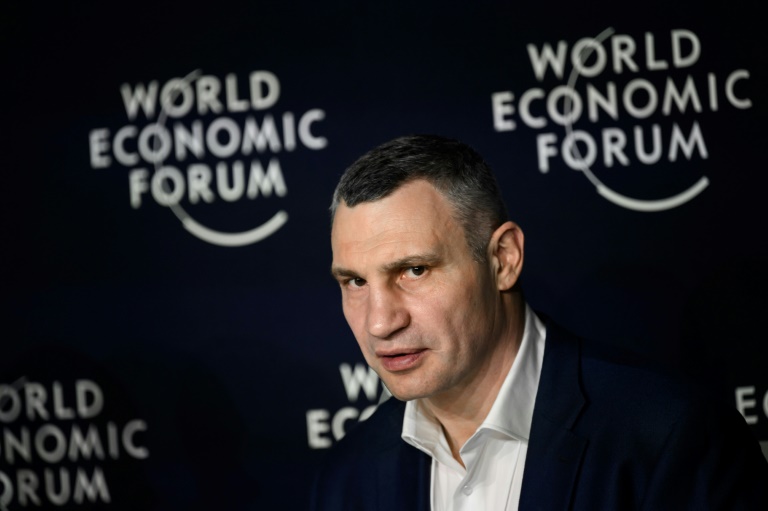
President Volodymyr Zelensky led the pleas in a headline speech via videolink at the start of the confab, while the Ukrainian delegation included the star power of Kyiv mayor, Vitali Klitschko, and his brother Wladimir, the former heavyweight boxers.

“Usually, Davos is considered a place where people only talk, but we took the opportunity to also discuss and agree on some issues with our counterparts,” said Foreign Minister Dmytro Kuleba, who travelled by train, car and plane.

– ‘Russian War Crimes House’ –

The gathering was also a chance for Ukraine to push its case to gain candidate status to join the European Union.

Ukrainian officials and lawmakers took the opportunity to meet corporate chief executives as Kyiv seeks help to rebuild the country.

Another major concern raised in Davos was the Russian blockade preventing Ukraine, once the world’s breadbasket, from exporting its wheat to countries that depend on it.

Kuleba said Ukraine was in talks with the United Nations on the idea of opening a safe passage for ships out of the port of Odessa, which would require de-mining the harbour and getting security guarantees from Moscow.

But the main refrain in Davos was Kyiv’s more immediate need for military help to defeat a better-armed Russia. 

To press their case, they reminded the world of the atrocities of conflict.

With Russians banned from attending this year’s meeting, Ukraine took over Moscow’s usual residence in Davos, turning the “Russia House” into the “Russian War Crimes House” and covering its walls with images of dead bodies.

Zelensky used Davos to urge the West to show more unity with Ukraine, singling out Hungary for holding up an EU embargo on Russian oil, while Kuleba lamented that some are “dragging their feet” on providing heavy weapons.

Washington and European countries have poured billions of dollars’ worth of arms into Ukraine, but Kuleba appealed for multiple-launch rocket systems to match Russian firepower.

– ‘Full-court press’ –

The Ukrainians also made it clear that the endgame of the war should be defeating Russia, not ceding territory as former US secretary of state Henry Kissinger suggested in a video appearance at the WEF.

German Chancellor Olaf Scholz, who addressed the forum on its last day, said Russian President Vladimir Putin will not be allowed to dictate peace in Ukraine.

“Our goal is crystal clear — Putin must not win this war. And I am convinced that he will not win it,” Scholz said.

Scholz, however, did not directly address Ukrainian criticism that Berlin was not moving fast enough in supplying tanks and armoured vehicles. 

Alexander Stubb, the former prime minister of Finland, said he had advised Ukrainian delegates that they should use Davos as a “communication exercise”.

“The West is strongly on their side, but there’s always the risk of war fatigue,” Stubb told AFP, adding that the Ukrainians should use a “full-court press”.

“I do think Davos is the right place to communicate,” said Stubb, now the director of the School of Transnational Governance at the European University Institute.

The lobbying may have worked, with Kuleba saying that “some weapons that we discussed here… will be on their way pretty soon.”

He conceded, however, that he “will arrive in Kyiv before new weapons arrive or new sanctions are introduced”.

“But this is the political process,” he said. “It takes time.”

Blinken to call for China to adhere to rules

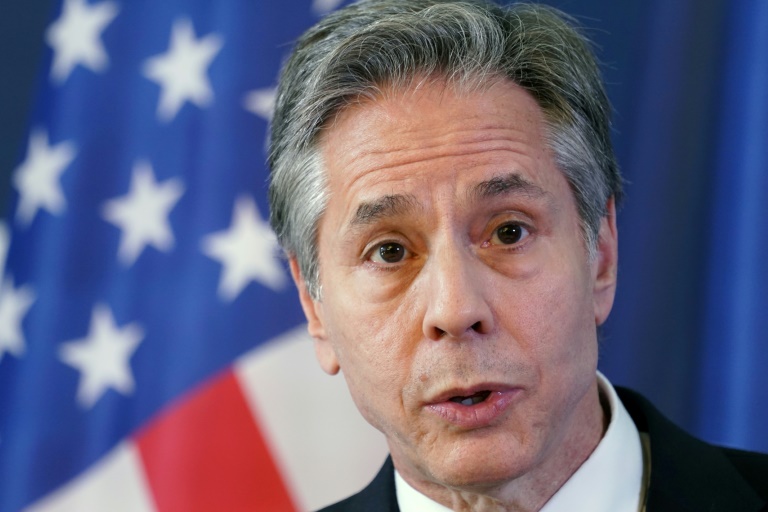
US Secretary of State Antony Blinken will call for China to abide by international rules as he delivers a major speech Thursday on America’s relationship with its rival.

Days after President Joe Biden visited Japan and South Korea to shore up key alliances, Blinken will give a long-awaited speech billed as the most comprehensive statement by the administration yet on China.

In a contrast with the abrasive approach of Biden’s predecessor Donald Trump, Blinken will steer clear of talk of a sweeping global conflict and will not ask nations to shun China, officials said.

“This is not about a new Cold War. This is not about dividing the world into rigid ideological blocs,” a senior official said as he previewed the speech.

“It is not about containing or keeping down any power. It is about upholding and, just as importantly, revitalizing the international order in a way that protects core principles that have enabled peace and prosperity for decades — and, indeed, enabled China’s remarkable rise.”

The White House had long mulled whether Biden should deliver the speech but finally decided it would be given by Blinken, part of the administration’s attempt to compete with China but also lower the temperature.

Blinken had been set to deliver the speech, to take place at George Washington University with the Asia Society as host, in early May but postponed it after being diagnosed with Covid-19.

– Shifting focus from Russia –

Blinken’s speech, Biden’s trip and a first-of-a-kind summit in Washington in early May with Southeast Asian leaders have aimed to show that the United States is still focused on Asia — identified from the start of the administration as a priority — despite months of effort to confront Russia over its invasion of Ukraine.

The United States believes that Russian President Vladimir Putin presents an “acute, immediate threat” to the international order and that countering him reinforces the message on upholding rules, the official said on customary condition of anonymity.

“China is the one country that has the intention, as well as the economic, technological, military and diplomatic means, to advance a different vision of international order,” the official said.

The Biden administration has repeatedly spoken of pressing China to abide by established rules, including in its conflicts in the dispute-ridden South China Sea and on trade, in which the United States accuses Beijing of widespread theft.

Biden has been seeking to unite allies in the face of China’s rise, unveiling in Tokyo the Asia Pacific Economic Framework billed as coordinating trade policies around the region.

The Biden administration has similarly launched a forum with the European Union to develop technological standards, hoping to prevent China from dominating the 21st century through its rapid gains in artificial intelligence.

Blinken will also voice support for working with China in limited areas where cooperation is seen as feasible, such as on climate change, after diplomacy between the world’s two largest emitters ahead of last year’s Glasgow summit.

But officials said Blinken would not shy away from human rights and would reiterate the US view that Beijing is carrying out genocide against the mostly Muslim Uyghur minority through the mass incarceration of more than one million people.

The speech comes days after Biden made waves at a Tokyo news conference by saying the United States would militarily defend Taiwan, the self-governing democracy claimed by Beijing.

Officials said Blinken would repeat Biden’s later insistence that he was not deviating from longstanding US policy on Taiwan.

The United States switched recognition from Taipei to Beijing in 1979. It provides Taiwan weapons for self-defense, all while staying deliberately ambiguous on whether it would intervene militarily in an invasion.

Close Bitnami banner
Bitnami