AFP

Boeing's Starliner faces one more challenge as it returns to Earth

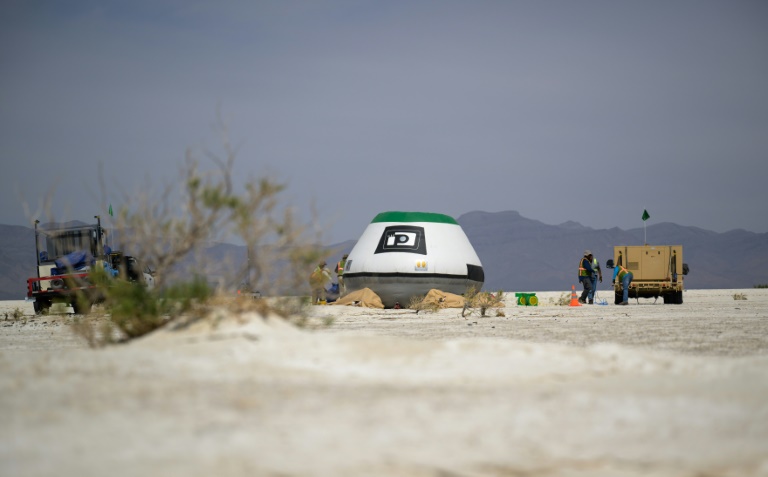
Boeing’s Starliner capsule headed back to Earth Wednesday in the final step of a key test flight to prove itself worthy of providing rides for NASA astronauts to the International Space Station.

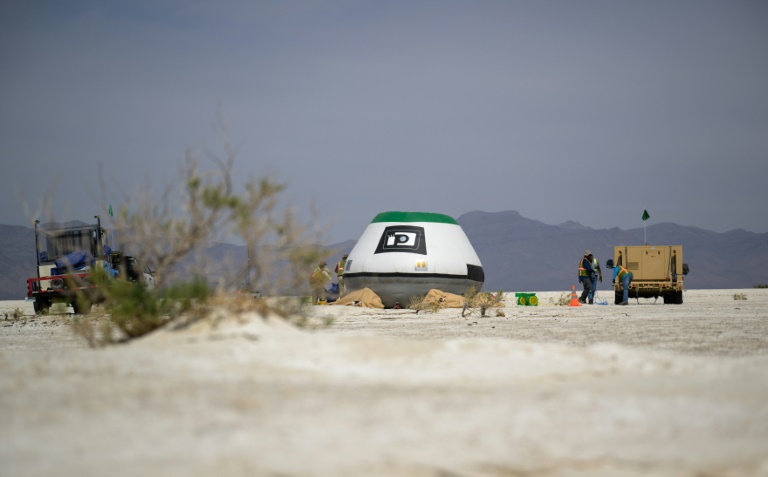
The spaceship autonomously undocked at 2:36 pm Eastern time (1836 GMT) and was set to touch down in New Mexico just over four hours later, at 2249 GMT, wrapping up a six-day mission crucial to restoring Boeing’s reputation after past failures.

“#Starliner separation confirmed,” tweeted Boeing Space.

Orbital Flight Test-2 (OFT-2) is the last hurdle for Starliner to clear before it carries humans in another test flight that could take place by the end of this year.

Starliner docked with the ISS on Friday, a day after blasting off from the Kennedy Space Center in Florida.

Over the weekend, astronauts living aboard the research platform opened the hatch and “greeted” the capsule’s passengers: Rosie the Rocketeer, a sensor-equipped mannequin, and a plush toy named Jebediah Kerman, a video game character and the ship’s zero-g indicator.

The mission hasn’t been without its hiccups.

Two thrusters responsible for placing Starliner in a stable orbit failed, though officials insisted there was plenty of redundancy built into the system to overcome the problem.

On the day of docking, the vessel missed its scheduled contact time by more than an hour, after a ring responsible for latching on to the station failed to deploy correctly. Engineers had to retract the ring and pop it out again before it worked the second time.

– Second taxi service –

Still, the glitches are minor compared to the troubles Starliner saw during its first test launch, back in 2019, when one software bug caused it to burn too much fuel to reach its destination, and another almost meant that the vehicle was destroyed during re-entry.

The second error was caught in time to upload a patch, and the vessel was able to achieve a gentle landing, slowed by its enormous parachutes, at White Sands Space Harbor — the same spaceport where the space shuttle Columbia once landed, and where Starliner is once more expected for touchdown.

The spacecraft will bring back more than 600 pounds (270 kilograms) of cargo, including reusable tanks that provide breathable air to station crew members, which will be refurbished and taken back up on a future flight.

Boeing and NASA also tried to launch Starliner in August 2021, but the capsule was rolled back from the launchpad to address sticky valves that did not open as they should, and the ship was eventually sent back to the factory for fixes.

NASA is looking to certify Starliner as a second “taxi” service for its astronauts to the space station — a role that Elon Musk’s SpaceX has provided since succeeding in a test mission for its Dragon capsule in 2020.

Both companies were awarded fixed-price contracts — $4.2 billion to Boeing and $2.6 billion to SpaceX — in 2014, shortly after the end of the space shuttle program, during a time when the United States was left reliant on Russian Soyuz rockets for rides to the orbital outpost.
Boeing's Starliner faces one more challenge as it returns to Earth

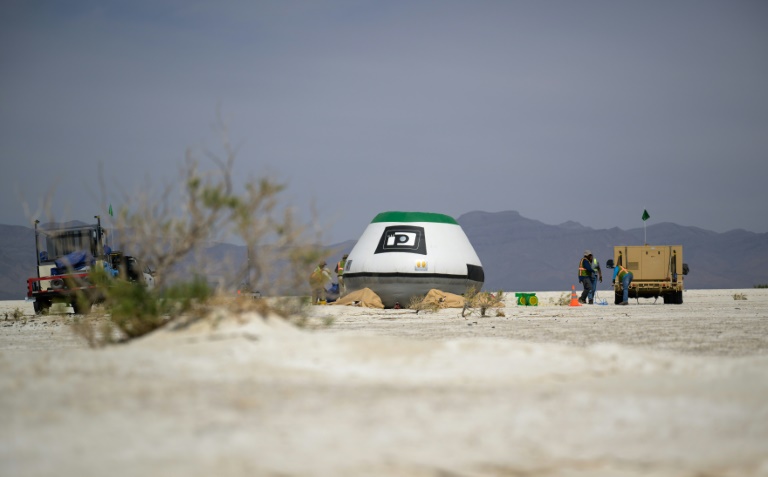
Boeing’s Starliner capsule headed back to Earth Wednesday in the final step of a key test flight to prove itself worthy of providing rides for NASA astronauts to the International Space Station.

The spaceship autonomously undocked at 2:36 pm Eastern time (1836 GMT) and was set to touch down in New Mexico just over four hours later, at 2249 GMT, wrapping up a six-day mission crucial to restoring Boeing’s reputation after past failures.

“#Starliner separation confirmed,” tweeted Boeing Space.

Orbital Flight Test-2 (OFT-2) is the last hurdle for Starliner to clear before it carries humans in another test flight that could take place by the end of this year.

Starliner docked with the ISS on Friday, a day after blasting off from the Kennedy Space Center in Florida.

Over the weekend, astronauts living aboard the research platform opened the hatch and “greeted” the capsule’s passengers: Rosie the Rocketeer, a sensor-equipped mannequin, and a plush toy named Jebediah Kerman, a video game character and the ship’s zero-g indicator.

The mission hasn’t been without its hiccups.

Two thrusters responsible for placing Starliner in a stable orbit failed, though officials insisted there was plenty of redundancy built into the system to overcome the problem.

On the day of docking, the vessel missed its scheduled contact time by more than an hour, after a ring responsible for latching on to the station failed to deploy correctly. Engineers had to retract the ring and pop it out again before it worked the second time.

– Second taxi service –

Still, the glitches are minor compared to the troubles Starliner saw during its first test launch, back in 2019, when one software bug caused it to burn too much fuel to reach its destination, and another almost meant that the vehicle was destroyed during re-entry.

The second error was caught in time to upload a patch, and the vessel was able to achieve a gentle landing, slowed by its enormous parachutes, at White Sands Space Harbor — the same spaceport where the space shuttle Columbia once landed, and where Starliner is once more expected for touchdown.

The spacecraft will bring back more than 600 pounds (270 kilograms) of cargo, including reusable tanks that provide breathable air to station crew members, which will be refurbished and taken back up on a future flight.

Boeing and NASA also tried to launch Starliner in August 2021, but the capsule was rolled back from the launchpad to address sticky valves that did not open as they should, and the ship was eventually sent back to the factory for fixes.

NASA is looking to certify Starliner as a second “taxi” service for its astronauts to the space station — a role that Elon Musk’s SpaceX has provided since succeeding in a test mission for its Dragon capsule in 2020.

Both companies were awarded fixed-price contracts — $4.2 billion to Boeing and $2.6 billion to SpaceX — in 2014, shortly after the end of the space shuttle program, during a time when the United States was left reliant on Russian Soyuz rockets for rides to the orbital outpost.
Boeing's Starliner faces one more challenge as it returns to Earth

Boeing’s Starliner capsule headed back to Earth Wednesday in the final step of a key test flight to prove itself worthy of providing rides for NASA astronauts to the International Space Station.

The spaceship autonomously undocked at 2:36 pm Eastern time (1836 GMT) and was set to touch down in New Mexico just over four hours later, at 2249 GMT, wrapping up a six-day mission crucial to restoring Boeing’s reputation after past failures.

“#Starliner separation confirmed,” tweeted Boeing Space.

Orbital Flight Test-2 (OFT-2) is the last hurdle for Starliner to clear before it carries humans in another test flight that could take place by the end of this year.

Starliner docked with the ISS on Friday, a day after blasting off from the Kennedy Space Center in Florida.

Over the weekend, astronauts living aboard the research platform opened the hatch and “greeted” the capsule’s passengers: Rosie the Rocketeer, a sensor-equipped mannequin, and a plush toy named Jebediah Kerman, a video game character and the ship’s zero-g indicator.

The mission hasn’t been without its hiccups.

Two thrusters responsible for placing Starliner in a stable orbit failed, though officials insisted there was plenty of redundancy built into the system to overcome the problem.

On the day of docking, the vessel missed its scheduled contact time by more than an hour, after a ring responsible for latching on to the station failed to deploy correctly. Engineers had to retract the ring and pop it out again before it worked the second time.

– Second taxi service –

Still, the glitches are minor compared to the troubles Starliner saw during its first test launch, back in 2019, when one software bug caused it to burn too much fuel to reach its destination, and another almost meant that the vehicle was destroyed during re-entry.

The second error was caught in time to upload a patch, and the vessel was able to achieve a gentle landing, slowed by its enormous parachutes, at White Sands Space Harbor — the same spaceport where the space shuttle Columbia once landed, and where Starliner is once more expected for touchdown.

The spacecraft will bring back more than 600 pounds (270 kilograms) of cargo, including reusable tanks that provide breathable air to station crew members, which will be refurbished and taken back up on a future flight.

Boeing and NASA also tried to launch Starliner in August 2021, but the capsule was rolled back from the launchpad to address sticky valves that did not open as they should, and the ship was eventually sent back to the factory for fixes.

NASA is looking to certify Starliner as a second “taxi” service for its astronauts to the space station — a role that Elon Musk’s SpaceX has provided since succeeding in a test mission for its Dragon capsule in 2020.

Both companies were awarded fixed-price contracts — $4.2 billion to Boeing and $2.6 billion to SpaceX — in 2014, shortly after the end of the space shuttle program, during a time when the United States was left reliant on Russian Soyuz rockets for rides to the orbital outpost.
Gun violence response leaves US standing a world apart

For nearly a decade, America’s satirical “The Onion” publication has run a headline that’s come to epitomize the futility many people feel in the wake of yet another US gun massacre.

“‘No Way To Prevent This,’ Says Only Nation Where This Regularly Happens” reads the title, which the outlet published on Wednesday for the 21st time since 2014.

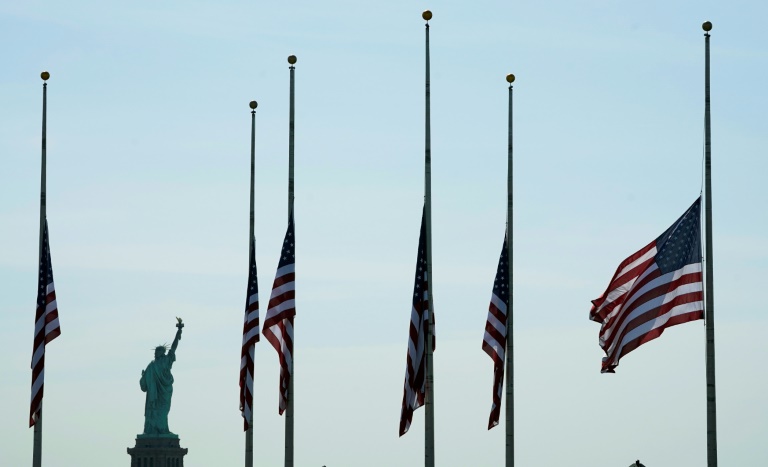
The headline routinely makes the social media rounds after mass shootings, as flags are lowered to half-staff, moments of silence are held and US lawmakers offer words of condolence, perhaps even anger or tears — but ultimately little else.

The Onion article was also run earlier this month, after a racist shooting at a grocery store in upstate New York. Less than two weeks later, a teenage gunman on Tuesday shot dead 19 primary schoolchildren and two teachers in Texas.

It echoed the school massacres that came before it: Columbine, Sandy Hook, Parkside.

The attacks remain open wounds on the American psyche but have resulted in little to no legal changes. In many places across the nation, gun ownership today is easier than ever.

The inertia in the face of cyclical violence stands in stark contrast to responses elsewhere in the world.

Hours after the Texas attack New Zealand’s prime minister, Jacinda Ardern, appeared on the US program “The Late Show with Stephen Colbert” and drove home just how uniquely American the problem is.

In 2019 a white supremacist gunman opened fire at two mosques in Christchurch, New Zealand, murdering 51 people and injuring dozens more.

Less than a month later, the country outlawed almost all semi-automatic weapons and assault rifles.

“I could not fathom how weapons that could cause such destruction and large-scale death could have been obtained legally in this country,” Ardern said at the time.

Speaking Tuesday, she explained that New Zealanders are “a very pragmatic people.”

“When we saw something like that happen, everyone said never again,” she said. “So then it was incumbent on us as politicians to respond to that.”

– ‘Carnage’ –

Ardern also invalidated fears that gun control would have an adverse impact on activities like hunting.

“We have legitimate needs for guns in our country, for things like pest control and to protect our biodiversity,” she told Colbert. “But you don’t need a military-style semi-automatic to do that.”

“And so we got rid of them.”

Australian economy ministry Jim Chalmers summed up a large part of the global reaction to the Texas attack, saying “it is hard to imagine that a great country like the United States can go on like this, with this gun violence, these mass atrocities.”

US rival China also spoke out, with foreign ministry spokesperson Wang Wenbin accusing Washington of failing to tackle gun violence, as well as racism.

“The US government has not been seen to do anything substantive to address these problems in the past decades,” he said.

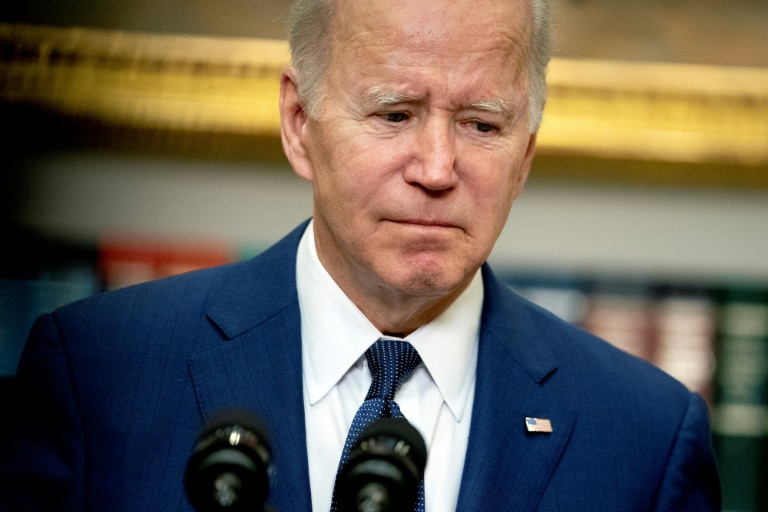
The American distinction isn’t lost on politicians including President Joe Biden, who in the aftermath of the latest shooting tweeted that “these kinds of mass shootings rarely happen elsewhere in the world.”

“Why are we willing to live with this carnage? Why do we keep letting this happen?” he pleaded.

Speaking Tuesday night he urged US lawmakers to stand up to the National Rifle Association, the country’s powerful pro-gun lobby that has given millions of dollars to primarily conservative politicians in a successful bid to keep gun laws loose.

Even incremental US legislative change — including background checks, raising the minimum firearms purchasing age, and creating a system that would empower courts to keep guns away from potentially dangerous people — faces apparently insurmountable obstacles.

“The difference between America and these other nations is not that there aren’t people with homicidal thoughts in other nations,” said Senator Chris Murphy of Connecticut on MSNBC Tuesday night, after he delivered an emotional plea for gun control on the Senate floor.

“It’s that they can’t go down to their local Walmart and buy a weapon that kills 20 kids in two minutes.”

Two years after Floyd murder, Biden a spectator to America's tragedies

President Joe Biden will mark the second anniversary of the murder of George Floyd on Wednesday, the day after a school shooting that came as a cruel reminder of his powerlessness to rein in America’s demons.

It was to be a ceremony symbolizing reconciliation, in one of the White House’s state rooms, with families of victims of police violence alongside representatives of the police.

But the school massacre in Uvale, Texas, in which 19 schoolchildren and two teachers died, will be on everyone’s mind when Biden signs a decree described as historic by his administration, aimed at promoting accountability and tightening standards among federal law enforcement.

It comes two years to the day after the death of Floyd in Minneapolis, which sparked protests against racism and police brutality that spread across the United States and globally.

Floyd, an African-American, was murdered by a police officer who knelt on his neck for nearly 10 minutes during an arrest.

– Healing –

“To heal as a nation, we must acknowledge that fatal encounters with law enforcement have disproportionately involved Black and brown people,” the White House said.

The text, which has taken months to work out, provides for a series of measures that will concern federal law enforcement agencies.

The executive order establishes a national database of police misconduct, mandates the use of body-worn cameras, and bans, in all but the most exceptional of cases, the use of chokeholds and carotid restraints.

But these restrictions will not be imposed on states and local authorities, which in the United States have very extensive police and judicial powers. 

For that, it would take a law, passed by Congress, which the Democratic president has failed to pass. 

Nor has Biden managed to toughen gun laws, from banning assault rifles to mandating mental health and criminal background checks on clients when buying weapons.

As with police reform, the administration has been limited in its efforts on firearms to ruling by decree, for example increasing restrictions on so-called “ghost guns.”

The anniversary of Floyd’s death, the massacre in the school in Texas but also, ten days ago, a racist massacre in Buffalo, are all cruel reminders of Biden’s failure to keep his promises to curtail the violence.

– Institutional paralysis –

This is partly due to the institutional landscape: despite an image of enormous power, an American president has to count on alignment with the legislative branch and the judiciary to enact his vision.

But the Democratic Party has only a very slim majority in Congress and some of its Senators are reluctant to blow up the rules requiring super majorities that would allow them to override Republican stonewalling on a host of issues.

In addition, Biden faces a Supreme Court which his predecessor Donald Trump has given a resolutely conservative slant. 

Add to all this the personality of the 79-year-old Democrat, a centrist at heart who would like to govern by consensus, which in today’s America seems impossible.

While the United States has experienced a surge in the number of shootings since the beginning of the year, the president has still not succeeded in appointing a director to the Bureau of Alcohol, Tobacco, Firearms and Explosives.

The agency in fact hasn’t had a permanent leader since 2015.

A first nomination attempt by the White House, with a fierce supporter of regulation as its candidate, was withdrawn after a fierce backlash.

Biden has launched a new candidate, Steve Dettelbach, a former prosecutor who begins the Senate hearing process this week, where he is likely to face unanimous Republican opposition.

Abbott apologizes for US baby formula shortage

A top Abbott official apologized Wednesday to US families affected by the baby formula shortage, telling them the manufacturer of the essential supply “let you down.”

“We are deeply sorry and are committed to making sure that a shortage like this never happens again,” said Christopher Calamari, the senior vice president of nutrition, in prepared testimony for a congressional committee hearing.

“It will take time” to regain families’ trust, he said, noting that the company is doing everything it can to resolve the crisis.

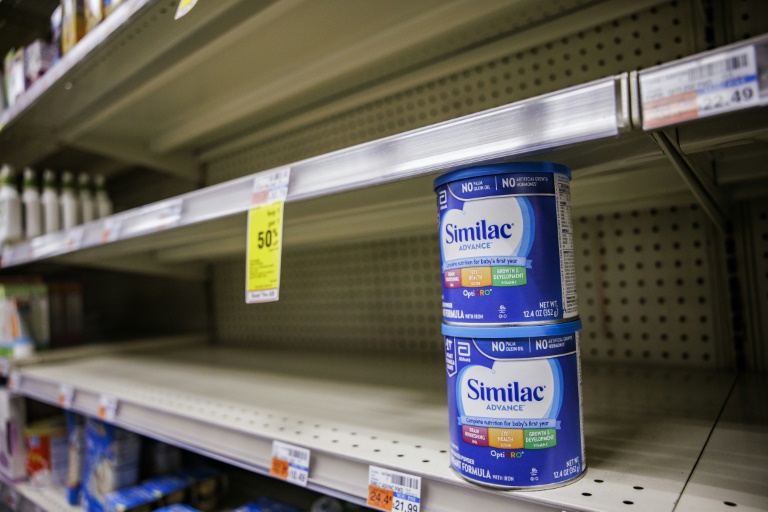
The United States has been struggling with a severe shortage of infant formula for months.

Initially caused by supply chain blockages and a lack of production workers due to the pandemic, the shortage was exacerbated in February when, after the death of two infants, Abbott announced a “voluntary recall” for formula made at its factory in Michigan and shut down that location.

“We continue to believe that there is no conclusive evidence to link our formula” to the infant illnesses and deaths blamed on the bacteria Cronobacter sakazakii, which was found in certain areas of the Michigan factory, Calamari said.

He said the samples that tested positive from the bacteria were taken from areas that “do not come into direct contact” with the formula.

Abbott’s Michigan plant is one of the largest formula factories in the United States, including specialized recipes for children with certain allergies or metabolic conditions.

The FDA said it has made a series of visits to the Sturgis, Michigan location, the last on March 18.

FDA chief Robert Califf acknowledged that the investigation was slow to start, which he blamed on the pandemic. He said the FDA could not start the probe until late January because of Abbott employees testing positive for Covid-19.

The crisis has gotten so bad that President Joe Biden announced last week that the US government would fly in formula on commercial planes contracted by the military. Biden also invoked the Defense Production Act to give baby formula manufacturers first priority in supplies.

The first military plane carrying several tons of formula from Germany landed Sunday at an airport in Indiana.

Salvador Ramos: From troubled teen to school shooter

Bullied at school, difficulties at home, a history of self-harm: the young man who gunned down 19 small children in Texas had a troubled background mirroring that of past school shooters.

Salvador Ramos, an 18-year-old who died when police tried to arrest him, was a US citizen and a student in Uvalde, a small community near the Mexican border where the tragedy took place.

His since-removed Instagram account featured photos of a young man with shoulder-length hair, his eyes closed. The account also included images of two assault rifles and a plastic gun magazine.

A day after the deadly attack at Robb Elementary — which also left two teachers dead — a picture is beginning to emerge of the man who allegedly moved through the school, shooting children as he went, before barricading himself in a classroom for his final assault.

Ramos’s cousin Mia told The Washington Post that he was mocked for a speech impediment in middle school, and would tell his grandmother that he wanted to stop attending class.

Stephen Garcia, a former friend of Ramos, confirmed that bullying was a problem. “He would get bullied hard, like bullied by a lot of people,” Garcia told the Post.

There were also problems between Ramos and his mother, which were bad enough that police were called, and he had a history of harming himself, once showing up to a park with self-inflicted cuts on his face, US media reported.

Bullying and mental health problems have been common denominators in the tragically frequent deadly US school shootings that leave students fearing for their safety and parents wondering if their children will make it home from class.

More than 20 years ago, two teenagers who had been bullied by other students went on a rampage at their local high school in Columbine, Colorado. They killed 13 people and themselves.

That attack helped inspire shootings by a mentally troubled student at Virginia Polytechnic Institute in 2007 that killed 32 people. The gunman — who also killed himself — had referred to the Columbine shooters as “martyrs” in a video before the attack.

– Grandmother shot –

Mental health issues also plagued the man who killed 20 children in Newton, Connecticut in 2012, as well as a student who was expelled for disciplinary reasons and later killed 17 people in Parkland, Florida in 2018.

The first victim of the attack carried out by Ramos was his grandmother, said Erick Estrada of the Texas Department of Public Safety, adding she was later airlifted to a medical facility.

A 66-year-old woman was admitted to a hospital in San Antonio in critical condition following the shooting, according to healthcare officials, who did not provide any further details.

After firing at his grandmother, Ramos fled the scene in a car wearing a bulletproof vest and armed with a rifle, Estrada said.

He then crashed near a ditch outside Robb Elementary School, got out, and headed for the school, where law enforcement officers tried, but failed, to stop him. At around 11:30 am local time (1630 GMT) Ramos burst into the school and opened fire.

Pete Arredondo, the Uvalde School District Police Chief in charge of the investigation, said Ramos acted alone.

Texas Governor Greg Abbott said investigators are still trying to piece together details about the shooter.

They are working to obtain “detailed background information on the subject, his motive, the types of weapons used, the legal authority to possess them, and conduct a comprehensive crime-scene investigation and reconstruction,” he said.

Gun violence response leaves US standing a world apart

For nearly a decade, America’s satirical “The Onion” publication has run a headline that’s come to epitomize the futility many people feel in the wake of yet another US gun massacre.

“‘No Way To Prevent This,’ Says Only Nation Where This Regularly Happens” reads the title, which the outlet published on Wednesday for the 21st time since 2014.

The headline routinely makes the social media rounds after mass shootings, as flags are lowered to half-staff, moments of silence are held and US lawmakers offer words of condolence, perhaps even anger or tears — but ultimately little else.

The Onion article was also run earlier this month, after a racist shooting at a grocery store in upstate New York. Less than two weeks later, a teenage gunman on Tuesday shot dead 19 primary schoolchildren and two teachers in Texas.

It echoed the school massacres that came before it: Columbine, Sandy Hook, Parkside.

The attacks remain open wounds on the American psyche but have resulted in little to no legal changes. In many places across the nation, gun ownership today is easier than ever.

The inertia in the face of cyclical violence stands in stark contrast to responses elsewhere in the world.

Hours after the Texas attack New Zealand’s prime minister, Jacinda Ardern, appeared on the US program “The Late Show with Stephen Colbert” and drove home just how uniquely American the problem is.

In 2019 a white supremacist gunman opened fire at two mosques in Christchurch, New Zealand, murdering 51 people and injuring dozens more.

Less than a month later, the country outlawed almost all semi-automatic weapons and assault rifles.

“I could not fathom how weapons that could cause such destruction and large-scale death could have been obtained legally in this country,” Ardern said at the time.

Speaking Tuesday, she explained that New Zealanders are “a very pragmatic people.”

“When we saw something like that happen, everyone said never again,” she said. “So then it was incumbent on us as politicians to respond to that.”

– ‘Carnage’ –

Ardern also invalidated fears that gun control would have an adverse impact on activities like hunting.

“We have legitimate needs for guns in our country, for things like pest control and to protect our biodiversity,” she told Colbert. “But you don’t need a military-style semi-automatic to do that.”

“And so we got rid of them.”

Australian economy ministry Jim Chalmers summed up a large part of the global reaction to the Texas attack.

“It is hard to imagine that a great country like the United States can go on like this, with this gun violence, these mass atrocities,” he said.

The American distinction isn’t lost on politicians including President Joe Biden, who in the aftermath of the Texas attack tweeted that “these kinds of mass shootings rarely happen elsewhere in the world.”

“Why are we willing to live with this carnage? Why do we keep letting this happen?” he pleaded.

Speaking Tuesday night he urged US lawmakers to stand up to the National Rifle Association, the country’s powerful pro-gun lobby that has given millions of dollars to primarily conservative politicians in a successful bid to keep gun laws loose.

Even incremental US legislative change — including background checks, raising the minimum firearms purchasing age, and creating a system that would empower courts to keep guns away from potentially dangerous people — faces an apparently insurmountable obstacles.

“The difference between America and these other nations is not that there aren’t people with homicidal thoughts in other nations,” said Senator Chris Murphy of Connecticut on MSNBC Tuesday night, after he delivered an emotional plea for gun control on the Senate floor.

“It’s that they can’t go down to their local Walmart and buy a weapon that kills 20 kids in two minutes.”

Russia bears down on key eastern Ukraine city

Russian forces threatened to encircle a crucial eastern Ukrainian city on Wednesday as Moscow said the West must drop sanctions over its invasion to end a global food crisis.

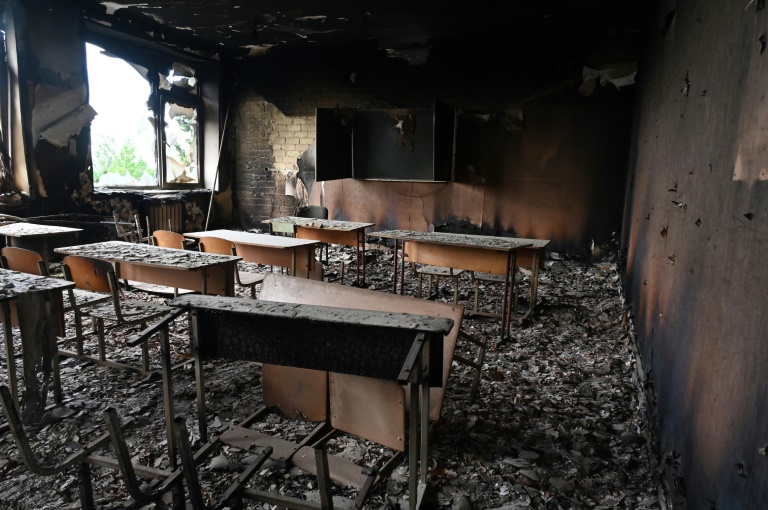
Ukrainian officials said fierce fighting had reached the edge of the industrial hub of Severodonetsk, under relentless bombardment by Russian forces trying to seize control of the Donbas region.

Ukraine’s President Volodymyr Zelensky called for Western more support for his outgunned troops as the Russian invasion entered its fourth month, while his foreign minister blasting NATO for doing “nothing”.

Kyiv meanwhile accused Moscow of “blackmail” over its proposal to allow grain exports if the West lifts sanctions, as the war between two of the world’s big wheat producers creates growing food shortages.

The governor of the eastern Ukrainian region of Lugansk, Sergiy Gaiday, described the situation around of Severodonetsk as “very difficult” and said there was “already fighting on the outskirts”.

“Russian troops have advanced far enough that they can already fire mortars” on the city, he said.

Western funds and weapons have helped Ukraine hold off its neighbour’s advances in many areas, including the capital Kyiv.

But Russia is now focused on expanding its gains in eastern Donbas, home to pro-Russian separatists, as well as the southern coast. Donbas comprises Lugansk and the region of Donetsk.

– ‘Clear blackmail’ –

Russia’s February 24 invasion of its pro-Western neighbour has caused global shockwaves, with the latest being fears of food shortages, particularly in Africa.

Moscow blamed the international sanctions imposed after the invasion, while the West says the shortage is mainly down to Russia’s blockade of Ukrainian ports.

“Solving the food problem requires a comprehensive approach, including the removal of sanctions that have been imposed on Russian exports and financial transactions,” said Russian deputy foreign minister Andrey Rudenko.

Ukrainian Foreign Minister Dmytro Kuleba urged the West not to give in.

“This is clear blackmail. You could not find a better example of blackmail in international relations,” Kuleba said at the World Economic Forum in Davos.

Kuleba also slammed the western military alliance NATO for “doing literally nothing” to stop Russia.

Ukraine’s Zelensky urged the West to send more heavy weapons, and urged Hungary to stop blocking an EU-wide embargo on Russian oil.

“Unity is about weapons. My question is, is there this unity in practice? I can’t see it. Our huge advantage over Russia would be when we are truly united,” Zelensky said via videolink to an event on the Davos sidelines.

He said in daily address to the nation late Tuesday that Russian forces “want to destroy everything” in eastern Ukraine.

– ‘Extremely heavy shelling’ –

In the eastern town of Soledar, Ukraine’s salt manufacturing hub, the ground shook moments after Natalia Timofeyenko climbed out of her bunker to reassure herself that she was not alone.

“I go outside just to see people. I know that there is shelling out there but I go,” the 47-year-old said after a thundering blast smashed apart a chunk of a mammoth salt mine where she worked with most of her friends and neighbours.

Ghostly frontline towns like Soledar are being hammered by Russian artillery as they sit along the crucial road that leads out of besieged Severodonetsk and its sister city Lysychansk.

Twelve people were killed by “extremely heavy shelling and attacks” in the neighbouring region of Donetsk, which also forms part of Donbas, the Ukrainian presidency said.

In a sign that the rest of the country remains at risk, Russian cruise missiles struck the major southern rail hub of Zaporizhzhia, killing one person and damaging dozens of houses, the presidency added.

– ‘It is just war’ –

Russia meanwhile sought to tighten its grip over the parts of southern Ukraine that it occupies.

President Vladimir Putin on Wednesday signed a decree simplifying a procedure to obtain a Russian passport for residents of the southern Ukrainian regions of Kherson, under the full control of Russian troops, and partly-occupied Zaporizhzhia.

Kyiv said the plan was a “flagrant violation” of Ukraine’s sovereignty.

Residents expressed concerns about the future in Kherson. Moscow-backed officials are pushing for formal annexation by Russia.

“People are very apprehensive,” trolleybus driver Alexander Loginov, 47, told AFP from the cabin of his vehicle, during a press trip organised by the Russian defence ministry. 

Day-to-day life remains marked by uncertainty, especially over payment of salaries as “Ukrainian banks are closing”.

“To be honest, it is just war,” Loginov added.

And 200 bodies were found in the basement of a destroyed building of the port city of Mariupol, which fell to Moscow recently after a devastating siege, Ukrainian authorities said.

As the locals refused to collect and pack the heavily decomposed bodies, the Russian emergency workers just left the scene, Ukrainian ombudswoman Lyudmyla Denisova said on Telegram Wednesday.

“It is impossible to be within the area due to the corpse smell,” she wrote. “The occupiers turned the entire Mariupol into a cemetery.”

burs-dk/spm

The staggering toll of gun violence in the United States

Only five months into 2022, more than 17,000 people, including 650 children, have been shot and killed in the United States.

The toll of gun violence in America is staggering, according to figures compiled by organizations pushing for stricter regulation of firearms sales.

– 111 deaths per day – 

Nearly 41,000 people are killed by gun violence every year in the United States on average, according to the organization Everytown for Gun Safety, translating to 111 victims every day. 

In Texas, where the sale of personal firearms is only marginally regulated, an average of more than 3,600 people are killed by guns every year, according to Everytown. 

Since the beginning of 2022, at least 17,199 people have been killed by guns, according to a count by the Gun Violence Archive. 

About 7,600 of them were victims of homicide, either purposeful or accidental, and more than 9,500 died by suicide. 

In 2021, more than 45,000 gun deaths were recorded, including 20,920 murders — the highest since 2017, when around 58,000 people were killed, according to the Gun Violence Archive. 

Shootings also leave other casualties: In the last six months, some 14,000 people have been wounded by a gun. 

– The youngest victims – 

Children are not spared when it comes to the cost of US gun violence. 

Even when they are not the direct targets of violence, such as in Tuesday’s massacre at a school in Uvalde, Texas, they can become the collateral victims of stray bullets or accidental discharges.

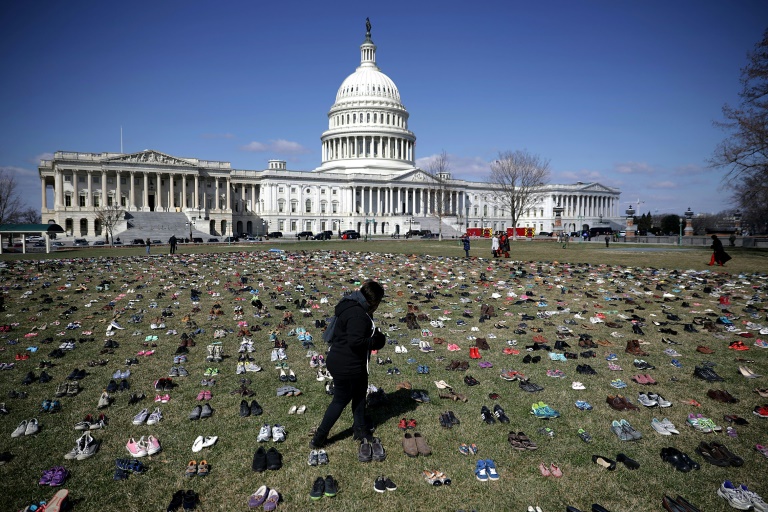
So far in 2022, some 640 minors have been shot and killed, and more than double that number — 1,594 — have been injured. 

Of that number, 140 of the children killed — and nearly 300 of those injured — have been age 11 or younger. 

Last year, 1,560 kids were killed and more than 4,000 wounded.

– More than one mass shooting per day –

There have been 213 known mass shootings in the United States in the first 145 days of 2022, according to the Gun Violence Archive, which categorizes such incidents as ones in which there are four or more people killed or wounded, not including the shooter.

“There have been more mass shootings than days in the year,” Connecticut Senator Chris Murphy said in Congress Tuesday. He represents the district where Sandy Hook elementary school, where 26 kids and teachers were killed in 2012, is located. It was the nation’s worst ever school shooting.

There were 692 mass shootings in 2021, the most since 2014, when the Gun Violence Archive began keeping records. 

– Record homicides –

In a country where firearms are easily bought and sold and laws vary by state, 2020 saw 19,350 shooting murders, a historic high — 35 percent more than in 2019 — and 24,245 suicides — 1.5 percent more than 2019 — according to statistics compiled by US health authorities. 

The homicide rate reached 6.1 per 100,000 residents in 2020, a 25-year record, according to the Centers for Disease Control and Prevention (CDC) in a report published this month, though the toll was still not as high as the peak of the 1980s. 

Officials speculated that the struggles of poverty and the Covid-19 pandemic could have contributed to the spike. 

– 390 million guns –

The right to bear arms is guaranteed in the second amendment of the US Constitution, and the number of pistols, revolvers and other gun types has increased in recent years. 

More than 23 million guns were sold in 2020, a record, and almost 20 million in 2021, according to numbers published by the site Small Arms Analytics. 

According to another project called the Small Arms Survey, 393.3 million firearms were in circulation throughout the United States in 2020 — or about 120 guns for every 100 people. 

And an unknown number of “ghost guns” — sold piece by piece and without serial numbers — must be added to that count. 

In June 2021, 30 percent of American adults said they owned at least one firearm, according to a survey by Pew Research Center. 

Close Bitnami banner
Bitnami