AFP

French green activists block TotalEnergies' annual meeting

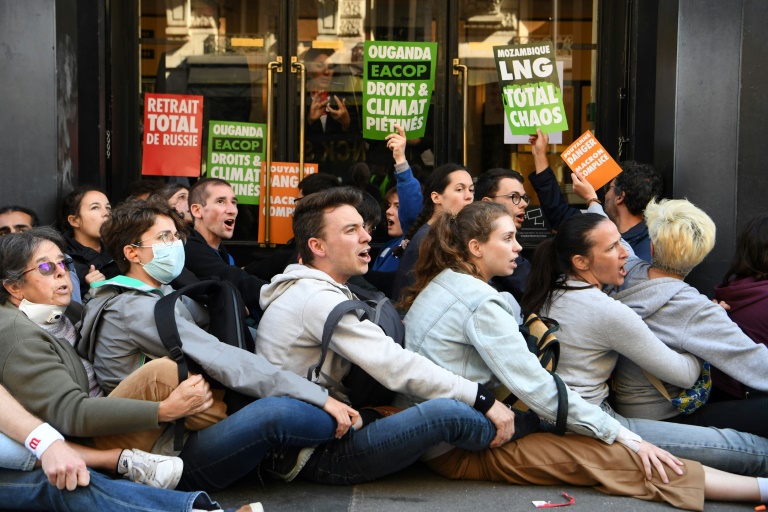
More than 100 activists sought to block oil giant TotalEnergies’ annual general meeting in central Paris on Wednesday to protest the energy firm’s climate policies and continued presence in Russia following the invasion of Ukraine. 

Greenpeace, Friends of the Earth and Alternatiba protesters handcuffed themselves to each other and impeded shareholders’ access to the building, claiming that TotalEnergies is not doing enough to fight climate change.

“It is no longer possible for the old world to serenely meet to validate projects that are destructive to the climate, human rights and peace,” the French branch of Friends of the Earth said on Twitter. 

Activists unfurled a five-metre (16-foot) long banner saying, “no retreat, no general assembly”, a reference to the energy firm’s presence in Russia, where it runs liquified gas extraction projects. 

The meeting at the Salle Pleyel concert hall in central Paris was eventually declared open by TotalEnergies chief executive Patrick Pouyanne, but with the venue almost empty as so few shareholders had been able to enter.

He said that the AGM could go ahead “as a certain number of shareholders are present”.

TotalEnergies is aiming for net-zero carbon emissions by mid-century and has pledged to reduce emissions of its petroleum products by 30 percent compared to 2015. 

Earlier on Wednesday, the group announced it had bought a 50-percent stake in the US renewables producer Clearway Energy Group, as it seeks to expand its portfolio in the sector in the United States.

Shareholders at TotalEnergies’ AGM are due to vote on the group’s climate plans, with some announcing in advance that they would vote against. 

A group of shareholders representing 0.78 percent of the giant’s capital deposited a resolution — that was rejected — asking for the group to respect the Paris climate deal, which seeks to limit global warming to 2 degrees Celsius and if possible 1.5 degrees.

“There are shareholders who recognise the climate emergency but on the whole they are still too passive,” Greenpeace France campaigner Edina Ifticene told AFP. 

On Tuesday, oil giant Shell’s general assembly in central London was suspended for two hours due to disruption from climate change activists.

els-mto-cdc-ech/sjw/kjm
French green activists block TotalEnergies' annual meeting

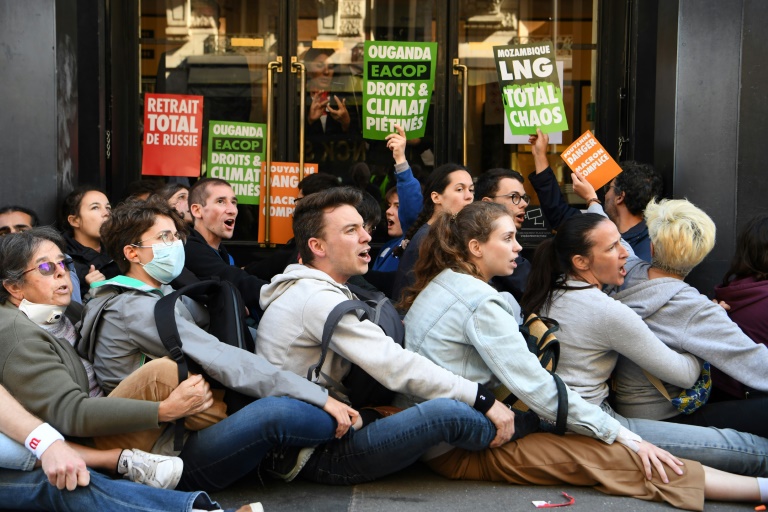
More than 100 activists sought to block oil giant TotalEnergies’ annual general meeting in central Paris on Wednesday to protest the energy firm’s climate policies and continued presence in Russia following the invasion of Ukraine. 

Greenpeace, Friends of the Earth and Alternatiba protesters handcuffed themselves to each other and impeded shareholders’ access to the building, claiming that TotalEnergies is not doing enough to fight climate change.

“It is no longer possible for the old world to serenely meet to validate projects that are destructive to the climate, human rights and peace,” the French branch of Friends of the Earth said on Twitter. 

Activists unfurled a five-metre (16-foot) long banner saying, “no retreat, no general assembly”, a reference to the energy firm’s presence in Russia, where it runs liquified gas extraction projects. 

The meeting at the Salle Pleyel concert hall in central Paris was eventually declared open by TotalEnergies chief executive Patrick Pouyanne, but with the venue almost empty as so few shareholders had been able to enter.

He said that the AGM could go ahead “as a certain number of shareholders are present”.

TotalEnergies is aiming for net-zero carbon emissions by mid-century and has pledged to reduce emissions of its petroleum products by 30 percent compared to 2015. 

Earlier on Wednesday, the group announced it had bought a 50-percent stake in the US renewables producer Clearway Energy Group, as it seeks to expand its portfolio in the sector in the United States.

Shareholders at TotalEnergies’ AGM are due to vote on the group’s climate plans, with some announcing in advance that they would vote against. 

A group of shareholders representing 0.78 percent of the giant’s capital deposited a resolution — that was rejected — asking for the group to respect the Paris climate deal, which seeks to limit global warming to 2 degrees Celsius and if possible 1.5 degrees.

“There are shareholders who recognise the climate emergency but on the whole they are still too passive,” Greenpeace France campaigner Edina Ifticene told AFP. 

On Tuesday, oil giant Shell’s general assembly in central London was suspended for two hours due to disruption from climate change activists.

els-mto-cdc-ech/sjw/kjm

Stock markets mixed as traders weigh dark outlook

Markets were mixed Wednesday, with little sign of any relief from recent dour performances as investors remain fearful about the economic outlook owing to the impact of inflation, higher interest rates, China’s slowdown and the Ukraine war.

A series of weak indicators around the world and downbeat forecasts from big firms have chilled trading floors in recent weeks as the surge in prices begins to drag on consumer confidence, with warnings now swirling of a possible global recession.

The tech sector was again in the firing line after Snap, the parent of social media app Snapchat, provided a gloomy economic outlook, sending its shares diving more than 40 percent.

Wall Street titans followed Snap down, with Facebook-parent Meta and Google-parent Alphabet tanking.

The mood was not helped by news that US new home sales tanked in April while the Richmond Fed manufacturing index also fell, with both at the lowest levels since the coronavirus pandemic began in 2020.

“The market is moving its focus — and has been for the last month or so — from inflation concerns to growth concerns,” said Ellen Hazen of FL Putnam.

Hong Kong, Shanghai, Sydney, Seoul, Taipei, Manila and Bangkok rose, while Tokyo, Mumbai, Singapore, Jakarta and Wellington fell.

London, Paris and Frankfurt were up in the morning after falling Tuesday.

Investors are now awaiting the Fed’s next move on interest rates, with expectations for more half-point hikes to come as officials struggle to bring inflation down from four-decade highs.

There was a little hope after one policymaker, Atlanta Fed chief Raphael Bostic, suggested a break in the increases in September could make sense as the bank tries to avert a recession.

National Australia Bank’s Tapas Strickland said that, while it was not clear that the Fed was close to being more supportive of markets, “it is clear that growth headwinds are becoming more evident in the data, particularly stemming from the profit reporting season”. 

“The Fed of course remains focused on inflation, but if inflation reads were to start to moderate, then Bostic has opened up the possibility of a Fed pause.”

Minutes from the Fed’s most recent policy meeting are due later in the day and will be closely watched for an idea about its plans. 

Meanwhile, China continues to struggle with the fast-spreading Omicron coronavirus variant, with leaders sticking to their zero-Covid strategy despite the dire impact of lockdowns on the economy.

And with no easing of that policy in sight, observers warned that a series of recent support measures would not be enough to lift optimism.

“Fiscal multipliers will be minimal in an economy where economic interaction and activity have slowed sharply,” said Stephen Innes of SPI Asset Management.

“Moving beyond mobility restrictions in short order is a pre-condition, but not a guarantee, for an Asia-led economic recovery.”

– Key figures at around 0810 GMT –

Tokyo – Nikkei 225: DOWN 0.3 percent at 26,677.80 (close)

Hong Kong – Hang Seng Index: UP 0.3 percent at 20,171.27 (close)

Shanghai – Composite: UP 1.2 percent at 3,107.46 (close)

London – FTSE 100: UP 0.4 percent at 7,516.69

Euro/dollar: DOWN at $1.0682 from $1.0739 on Tuesday

Pound/dollar: UP at $1.2543 from $1.2535

Euro/pound: DOWN at 85.15 pence from 85.64 pence

Dollar/yen: UP at 127.09 yen from 126.86 yen 

Brent North Sea crude: UP 1.0 percent at $114.69 per barrel

West Texas Intermediate: UP 1.0 percent at $110.86 per barrel

New York – Dow: UP 0.2 percent at 31,928.62 (close)

— Bloomberg News contributed to this story —

Stock markets mixed as traders weigh dark outlook

Markets were mixed Wednesday, with little sign of any relief from recent dour performances as investors remain fearful about the economic outlook owing to the impact of inflation, higher interest rates, China’s slowdown and the Ukraine war.

A series of weak indicators around the world and downbeat forecasts from big firms have chilled trading floors in recent weeks as the surge in prices begins to drag on consumer confidence, with warnings now swirling of a possible global recession.

The tech sector was again in the firing line after Snap, the parent of social media app Snapchat, provided a gloomy economic outlook, sending its shares diving more than 40 percent.

Wall Street titans followed Snap down, with Facebook-parent Meta and Google-parent Alphabet tanking.

The mood was not helped by news that US new home sales tanked in April while the Richmond Fed manufacturing index also fell, with both at the lowest levels since the coronavirus pandemic began in 2020.

“The market is moving its focus — and has been for the last month or so — from inflation concerns to growth concerns,” said Ellen Hazen of FL Putnam.

Hong Kong, Shanghai, Sydney, Seoul, Taipei, Manila and Bangkok rose, while Tokyo, Mumbai, Singapore, Jakarta and Wellington fell.

London, Paris and Frankfurt rose after tanking on Tuesday.

Investors are now awaiting the Fed’s next move on interest rates, with expectations for more half-point hikes to come as officials struggle to bring inflation down from four-decade highs.

There was a little hope after one policymaker, Atlanta Fed chief Raphael Bostic, suggested a break in the increases in September could make sense as the bank tries to avert a recession.

National Australia Bank’s Tapas Strickland said that, while it was not clear that the Fed was close to being more supportive of markets, “it is clear that growth headwinds are becoming more evident in the data, particularly stemming from the profit reporting season”. 

“The Fed of course remains focused on inflation, but if inflation reads were to start to moderate, then Bostic has opened up the possibility of a Fed pause.”

Minutes from the Fed’s most recent policy meeting are due later in the day and will be closely watched for an idea about its plans. 

Meanwhile, China continues to struggle with the fast-spreading Omicron coronavirus variant, with leaders sticking to their zero-Covid strategy despite the dire impact on the economy of lockdowns.

And with no easing of that policy in sight, observers warned that a series of recent support measures would not be enough to lift optimism.

“Fiscal multipliers will be minimal in an economy where economic interaction and activity have slowed sharply,” said Stephen Innes of SPI Asset Management.

“Moving beyond mobility restrictions in short order is a pre-condition, but not a guarantee, for an Asia-led economic recovery.”

– Key figures at around 0720 GMT –

Tokyo – Nikkei 225: DOWN 0.3 percent at 26,677.80 (close)

Hong Kong – Hang Seng Index: UP 0.5 percent at 20,201.89 

Shanghai – Composite: UP 1.2 percent at 3,107.46 (close)

London – FTSE 100: UP 0.6 percent at 7,525.38

Euro/dollar: DOWN at $1.0687 from $1.0739 on Tuesday

Pound/dollar: UP at $1.2542 from $1.2535

Euro/pound: DOWN at 85.20 pence from 85.64 pence

Dollar/yen: UP at 127.08 yen from 126.86 yen 

Brent North Sea crude: UP 0.8 percent at $114.49 per barrel

West Texas Intermediate: UP 0.8 percent at $110.65 per barrel

New York – Dow: UP 0.2 percent at 31,928.62 (close)

Pfizer offers to sell medicines at cost to world's poorest countries

US pharmaceutical giant Pfizer on Wednesday said it would sell its patented drugs at a not-for-profit basis to the world’s poorest countries, as part of a new initiative announced at the World Economic Forum in Davos.

“An Accord for a Healthier World” focuses on five areas: infectious diseases, cancer, inflammation, rare diseases and women’s health — where Pfizer currently holds 23 patents, including the likes of Comirnaty and Paxlovid, its Covid vaccine and oral treatment.

“This transformational commitment will increase access to Pfizer- patented medicines and vaccines available in the United States and the European Union to nearly 1.2 billion people,” Angela Hwang, group president of the Pfizer Biopharmaceuticals Group told AFP.

Five countries: Rwanda, Ghana, Malawi, Senegal and Uganda have committed to joining, with a further 40 countries — 27 low-income and 18 lower-middle-income — eligible to sign bilateral agreements to participate.

Developing countries experience 70 percent of the world’s disease burden but receive only 15 percent of global health spending, leading to devastating outcomes.

Across sub-Saharan Africa, one child in 13 dies before their fifth birthday, compared to one in 199 in high-income countries.

Cancer-related mortality rates are also far higher in low and middle-income countries — causing more fatalities in Africa every year than malaria.

All this is set to a backdrop of limited access to the latest drugs. 

Essential medicines and vaccines typically take four to seven years longer to reach the poorest countries, and supply chain issues and poorly resourced health systems make it difficult for patients to receive them once approved. 

“The Covid-19 pandemic further highlighted the complexities of access to quality healthcare and the resulting inequities,” said Hwang.

“We know there are a number of hurdles that countries have to overcome to gain access to our medicines. That is why we have initially selected five pilot countries to identify and come up with operational solutions and then share those learnings with the remaining countries.”

Specifically, the focus will be on overcoming regulatory and procurement challenges in the countries, while ensuring adequate levels of supply from Pfizer’s side.

The “not-for-profit” price tag takes into account the cost to manufacture and transport of each product to an agreed upon port of entry, with Pfizer charging only manufacturing and minimum distribution costs.

If a country already has access to a product at a lower price tier, for example vaccines supplied by GAVI, that lower price will be maintained.

Hwang acknowledged that even an at-cost approach could be challenging for the most cash-strapped countries, and “this is why we have reached out to financial institutions to brief them on the Accord and ask them to help support country level financing.”

Pfizer will also reach out to other stakeholders — including governments, multilateral organizations, NGOs and even other pharmaceuticals — to ask them to join the Accord.

It is also using funding from the Bill & Melinda Gates Foundation to advance work on a vaccine against Group B Streptococcus (GBS), the leading cause of stillbirth and newborn mortality in low-income countries.

Reacting to the news, Amesh Adalja, of Johns Hopkins Center for  Health Security, said: “The Pfizer Accord program will facilitate access to some of their critical medicines and hopefully lead to better control of the targeted diseases which include: Covid, antibiotic-resistant bacteria, meningococcal disease, tick-borne encephalitis, and pneumococcal disease.” 

Two decades of deadly gun violence in US schools

Nineteen students and two teachers were shot dead Tuesday when an 18-year-old gunman opened fire at their Texas elementary school, the latest in the United States’ relentless cycle of school mass shootings.

Here are America’s deadliest classroom gun massacres in the last two decades.

– Columbine High School (1999) –

Two teenagers from Columbine, Colorado, armed with an assortment of weapons and homemade bombs, went on a rampage at their local high school.

Twelve students and a teacher were killed during the April 20 massacre. Another 24 people were wounded.

Columbine, whose name has become synonymous with school shootings, is one of the first — and still among the deadliest — such shootings in the United States.

– Virginia Tech (2007) –

A South Korean student at the Virginia Polytechnic Institute opened fire on the Blacksburg, Virginia, campus, killing 32 students and professors before committing suicide.

Thirty-three people were wounded.

The gunman had apparently idolized the Columbine shooters, referring to them as “martyrs” in a video, part of a hate-filled manifesto he mailed to police during the shooting.

– Sandy Hook Elementary School (2012) –

A 20-year-old man with a history of mental health issues killed his mother in Newtown, Connecticut, on December 14 before blasting his way into Sandy Hook Elementary School.

Twenty children, aged six and seven, were shot dead, as well as six adults. The shooter then committed suicide.

The parents of Sandy Hook victims have led numerous campaigns to toughen gun control laws, but their efforts have largely failed.

Some conspiracy theorists insist the massacre was a government hoax, claiming the shooting involved “actors” in a plot to discredit the gun lobby.

– Marjory Stoneman Douglas High School (2018) –

On February 14, a 19-year-old former student at Marjory Stoneman Douglas High School who was expelled for disciplinary reasons returned to the Parkland, Florida, school and opened fire.

He killed 14 students and three adult staff.

Stoneman Douglas students have become crusaders against gun violence under the banner “March for Our Lives,” lobbying for tougher gun control laws and organizing protests and rallies.

Their campaign has taken off on social media, mobilizing hundreds of thousands of young Americans.

– Santa Fe High School (2018) –

Ten people, including eight students, were killed when a 17-year-old student armed with a shotgun and a revolver opened fire on his classmates in rural Santa Fe, Texas.

Classes had just started on the morning of May 18 when the shooting began.

Following the tragedy, Texas Governor Greg Abbott unveiled 40 recommendations, mainly focused on increasing armed security on school campuses and stepping up mental health screenings to identify troubled children. 

Gun ownership can be a point of pride for many Texans, and even some Santa Fe High School students spoke out against linking the shooting to the need for better gun control.

After wheat, India caps sugar exports

India said it has capped sugar exports to safeguard its own supplies and ease inflation, days after a ban on wheat shipments sent global prices soaring in the wake of the Ukraine war.

The world’s largest sugar producer and number two exporter after Brazil said on Tuesday that shipments would be limited to 10 million tonnes for the current marketing year to September.

The decision was taken “with a view to maintain the domestic availability and price stability during the sugar season,” the food ministry said in a statement.

Sugar exports are forecast to hit a record high this marketing year, with contracts signed for around nine million tonnes, and 7.8 million tonnes already shipped, it said.

Citing inflation and its own food security needs, in mid-May India banned any new wheat exports without government approval after the hottest March on record — blamed on climate change — hit harvests.

Although India is a marginal player on the global market, the move sparked a further surge in already-soaring global food prices since Russia’s February invasion of agricultural powerhouse Ukraine, which previously accounted for 12 percent of global exports.

The decision also stoked fears of growing protectionism in the wake of the conflict. 

The export ban also left hundreds of thousands of tonnes of wheat stranded at a major port in western India, with long lines of thousands of trucks waiting to unload.

Authorities stressed that government-to-government requests for wheat from other countries reeling from record high prices would be permitted.

Elsewhere in Asia, Indonesia temporarily halted palm oil exports and Malaysia banned chicken exports.

Boeing's Starliner faces one more challenge as it returns to Earth

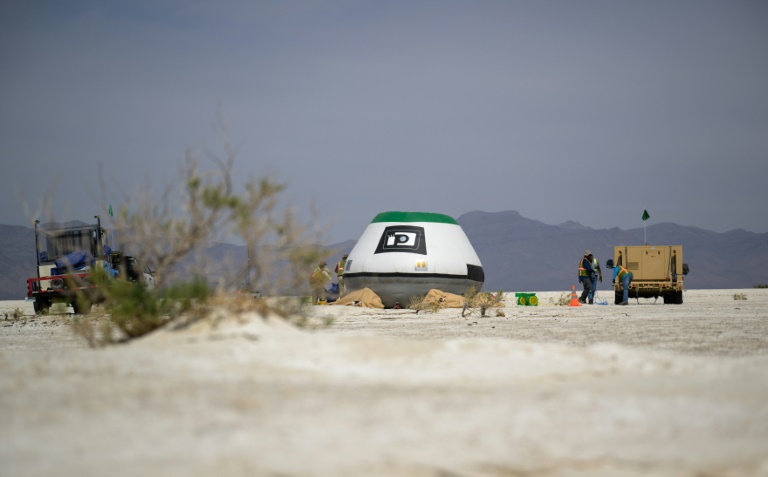
Boeing’s Starliner capsule is readying to return to Earth on Wednesday in the final step of a key test flight to prove itself worthy of providing rides for NASA astronauts to the International Space Station.

The spaceship is scheduled to autonomously undock at 2:36 pm Eastern Time (1836 GMT) and touch down in New Mexico just over four hours later, at 2249 GMT, wrapping up a six-day mission crucial to restoring Boeing’s reputation after past failures.

Orbital Flight Test-2 (OFT-2) is the last hurdle for Starliner to clear before it carries humans in another test flight that could take place by the end of this year.

Starliner rendezvoused with the ISS on Friday, a day after blasting off from the Kennedy Space Center in Florida.

Over the weekend, astronauts living aboard the research platform opened the hatch and “greeted” the capsule’s sole passenger: Rosie the Rocketeer, a mannequin equipped with sensors to understand what human crew would have experienced in the journey. 

The mission hasn’t been without its hiccups. These include propulsion problems early on Starliner’s journey that saw two thrusters responsible for placing it in a stable orbit failing, though officials insisted there was plenty of redundancy built into the system.

On the day of docking, the vessel missed its scheduled contact time by more than an hour, after a ring responsible for latching on to the station failed to deploy correctly. Engineers had to retract the ring then pop it out again before it worked the second time.

Still, the glitches are little compared to the troubles Starliner saw during its first test launch, back in 2019, when one software bug caused it to burn too much fuel to reach its destination, and another almost meant that the vehicle was destroyed during re-entry.

The second error was caught in time to upload a patch, and the vessel was able to achieve a gentle landing, slowed by its enormous parachutes, at White Sands Space Harbor — the same spaceport where Space Shuttles once launched, and where Starliner is once more expected for touchdown.

Boeing and NASA also tried to launch Starliner in August 2021, but the capsule was rolled back from the launchpad to address sticky valves that weren’t opening as they should and the ship was eventually sent back to the factory for fixes.

NASA is looking to certify Starliner as a second “taxi” service for its astronauts to the space station — a role that Elon Musk’s SpaceX has provided since succeeding in a test mission for its Dragon capsule in 2020.

Boeing's Starliner faces one more challenge as it returns to Earth

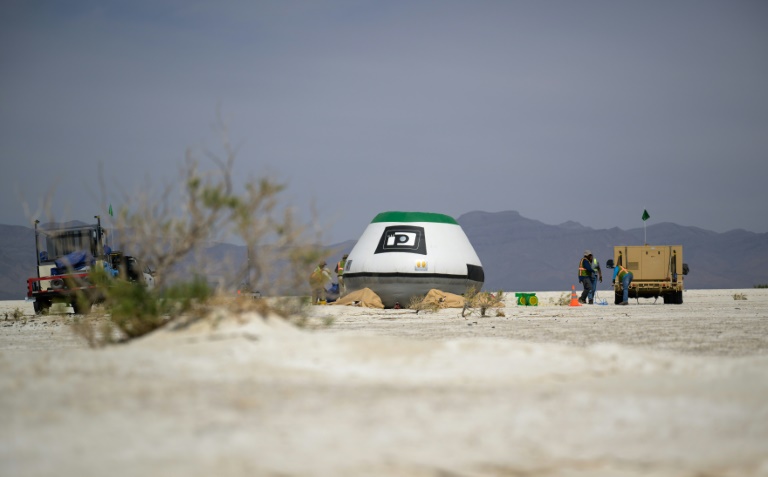
Boeing’s Starliner capsule is readying to return to Earth on Wednesday in the final step of a key test flight to prove itself worthy of providing rides for NASA astronauts to the International Space Station.

The spaceship is scheduled to autonomously undock at 2:36 pm Eastern Time (1836 GMT) and touch down in New Mexico just over four hours later, at 2249 GMT, wrapping up a six-day mission crucial to restoring Boeing’s reputation after past failures.

Orbital Flight Test-2 (OFT-2) is the last hurdle for Starliner to clear before it carries humans in another test flight that could take place by the end of this year.

Starliner rendezvoused with the ISS on Friday, a day after blasting off from the Kennedy Space Center in Florida.

Over the weekend, astronauts living aboard the research platform opened the hatch and “greeted” the capsule’s sole passenger: Rosie the Rocketeer, a mannequin equipped with sensors to understand what human crew would have experienced in the journey. 

The mission hasn’t been without its hiccups. These include propulsion problems early on Starliner’s journey that saw two thrusters responsible for placing it in a stable orbit failing, though officials insisted there was plenty of redundancy built into the system.

On the day of docking, the vessel missed its scheduled contact time by more than an hour, after a ring responsible for latching on to the station failed to deploy correctly. Engineers had to retract the ring then pop it out again before it worked the second time.

Still, the glitches are little compared to the troubles Starliner saw during its first test launch, back in 2019, when one software bug caused it to burn too much fuel to reach its destination, and another almost meant that the vehicle was destroyed during re-entry.

The second error was caught in time to upload a patch, and the vessel was able to achieve a gentle landing, slowed by its enormous parachutes, at White Sands Space Harbor — the same spaceport where Space Shuttles once launched, and where Starliner is once more expected for touchdown.

Boeing and NASA also tried to launch Starliner in August 2021, but the capsule was rolled back from the launchpad to address sticky valves that weren’t opening as they should and the ship was eventually sent back to the factory for fixes.

NASA is looking to certify Starliner as a second “taxi” service for its astronauts to the space station — a role that Elon Musk’s SpaceX has provided since succeeding in a test mission for its Dragon capsule in 2020.

Boeing's Starliner faces one more challenge as it returns to Earth

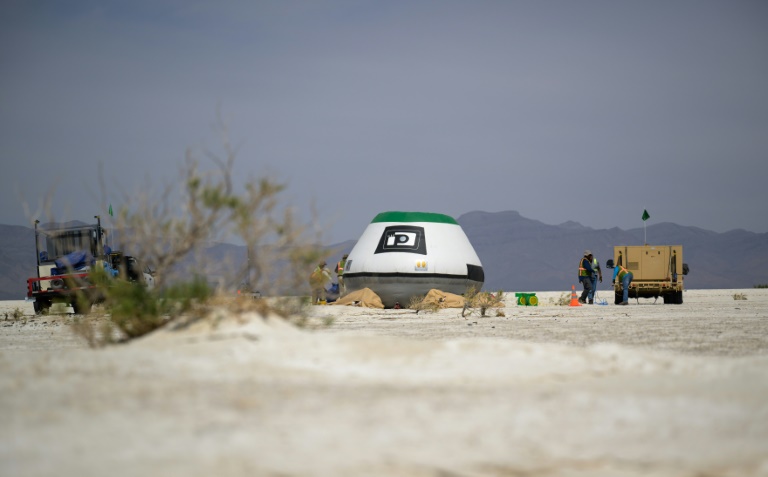
Boeing’s Starliner capsule is readying to return to Earth on Wednesday in the final step of a key test flight to prove itself worthy of providing rides for NASA astronauts to the International Space Station.

The spaceship is scheduled to autonomously undock at 2:36 pm Eastern Time (1836 GMT) and touch down in New Mexico just over four hours later, at 2249 GMT, wrapping up a six-day mission crucial to restoring Boeing’s reputation after past failures.

Orbital Flight Test-2 (OFT-2) is the last hurdle for Starliner to clear before it carries humans in another test flight that could take place by the end of this year.

Starliner rendezvoused with the ISS on Friday, a day after blasting off from the Kennedy Space Center in Florida.

Over the weekend, astronauts living aboard the research platform opened the hatch and “greeted” the capsule’s sole passenger: Rosie the Rocketeer, a mannequin equipped with sensors to understand what human crew would have experienced in the journey. 

The mission hasn’t been without its hiccups. These include propulsion problems early on Starliner’s journey that saw two thrusters responsible for placing it in a stable orbit failing, though officials insisted there was plenty of redundancy built into the system.

On the day of docking, the vessel missed its scheduled contact time by more than an hour, after a ring responsible for latching on to the station failed to deploy correctly. Engineers had to retract the ring then pop it out again before it worked the second time.

Still, the glitches are little compared to the troubles Starliner saw during its first test launch, back in 2019, when one software bug caused it to burn too much fuel to reach its destination, and another almost meant that the vehicle was destroyed during re-entry.

The second error was caught in time to upload a patch, and the vessel was able to achieve a gentle landing, slowed by its enormous parachutes, at White Sands Space Harbor — the same spaceport where Space Shuttles once launched, and where Starliner is once more expected for touchdown.

Boeing and NASA also tried to launch Starliner in August 2021, but the capsule was rolled back from the launchpad to address sticky valves that weren’t opening as they should and the ship was eventually sent back to the factory for fixes.

NASA is looking to certify Starliner as a second “taxi” service for its astronauts to the space station — a role that Elon Musk’s SpaceX has provided since succeeding in a test mission for its Dragon capsule in 2020.

Close Bitnami banner
Bitnami