AFP

US flight brings tons of needed baby formula from Germany

A US military plane bringing several tons of much-needed baby formula from Germany landed Sunday at an airport in Indiana as authorities scramble to address a critical shortage.

Scarcity of medical-grade baby formula caused by production problems and supply-chain issues has created grave problems for thousands of parents whose infants, allergic to cow’s milk protein, rely on it, sending them in frantic searches for the product.

The cargo plane took off from the US air base at Ramstein, Germany, carrying more than 70,000 pounds of powdered formula, the White House said. 

President Joe Biden posted about the flight on Twitter from Japan, where he is on a five-day Asia trip.

“Our team is working around the clock to get safe formula to everyone who needs it,” he said.

The initial shipment will cover about 15 percent of the immediate need, presidential economics advisor Brian Deese said on CNN.

He added there are “more flights in train that will be coming in early this week” as part of what the administration has dubbed “Operation Fly Formula.”

The formula was flown to Indiana because it is a hub for Nestle, a major domestic producer. It will be quality-tested at a nearby lab before being distributed.

The formula shortage has been developing for months, aggravated not only by supply-chain issues linked to the Covid-19 pandemic but by the closing of the nation’s largest formula-making plant, a Michigan factory owned by Abbott Laboratories, amid concerns that contamination may have led to the deaths of two infants.

“We had a manufacturer that wasn’t following the rules, and that was making formula that had the risk of making babies sick,” Deese said. “So we have to take action.”

Another problem, he said, was that US formula production had become concentrated among just three companies. 

“We’re going to have to work” on ways to increase competition, he said.

Abbott’s CEO, Robert Ford, apologized to consumers in a Washington Post op-ed Sunday, saying: “We’re sorry to every family we’ve let down since our voluntary recall exacerbated our nation’s baby formula shortage.”

Deese was asked separately about growing concerns that the US economy — hit by high inflation, supply chain troubles and the war in Ukraine — may be headed toward a recession. 

“Well, there are always risks,” he said.

“But there’s also no doubt that the United States is in a better position than any other major country around the world to address inflation without giving up all the economic gains that we have had.”

The US inflation rate hit a 40-year high of 8.5 percent in March, but slowed slightly in April to 8.3 percent.

Turtles freed in Tunisia with tracking monitor

Three rescued loggerhead turtles were released into the Mediterranean off Tunisia on Sunday, one with a tracking beacon glued to its shell to help researchers better protect the threatened species.

The main risks to sea turtles in Tunisia are linked to fisheries, since they become entangled in nets — including the three that were released into the wild.

The migratory species, which can live to as old as 45, are listed as “vulnerable” in the Red List of threatened species of the International Union for Conservation of Nature (IUCN).

The turtles’ release was watched by a crowd of some 50 people, many of them children, carried out by a specialised care centre in Tunisia’s eastern port of Sfax.

Some 35 turtles have been cared for at the centre in the past year as part of the Mediterranean-wide Life Med Turtle project.

Environmental activists helped carry the heavy turtles down the beach, before the animals crawled the final distance towards the sea.

All of them were tagged, but one of them also had a phone-sized tracking beacon glued to its hard shell, which will track its progress as it moves across the sea.

“This beacon, given to us by the University of Primorska in Slovenia, will allow us to follow this turtle in its movements,” said Imed Jribi, a science professor from the University of Sfax and a coordinator of the Life Med Turtle project.

“Identifying wintering, grazing and migration routes plays an important role in protecting this endangered species,” Jribi said.

As well as loggerhead turtles, two other turtle species are found in the Mediterranean, the green and leatherback turtle.

Biden warns of potentially 'consequential' monkeypox spread

Monkeypox has caught the attention of US President Joe Biden, who said Sunday that people should be on guard against the disease which has the potential for “consequential” impact if it were to spread further.

Several cases of monkeypox have been detected in North America and Europe since early May, sparking concern the disease, endemic in parts of Africa, is spreading.

The US leader, on his maiden trip to Asia as president, said in Seoul that health officials have not fully briefed him about “the level of exposure” in the United States.

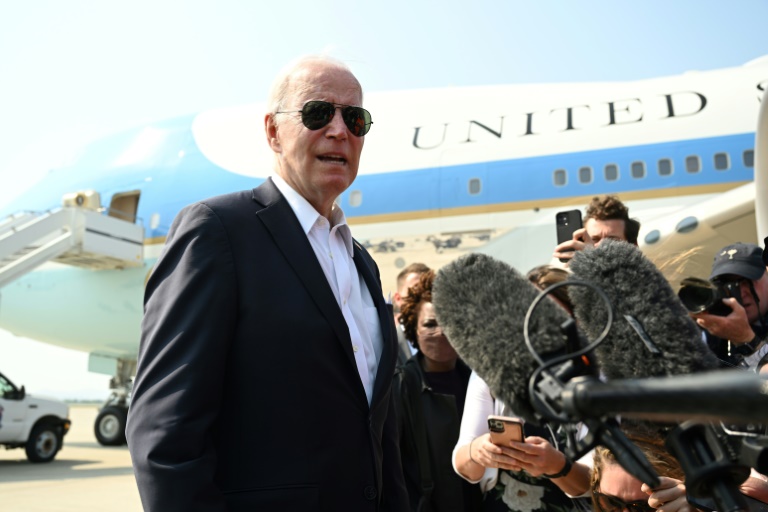
“But it is something that everybody should be concerned about,” Biden told reporters before boarding Air Force One to fly to Tokyo.

“It is a concern in that if it were to spread it would be consequential,” he added.

“We’re working on it hard to figure out what we do and what vaccine if any might be available for it.”

There have been thousands of human infections in parts of Central and Western Africa in recent years but it is rare in Europe and North America.

Most people recover within several weeks and monkeypox has only been fatal in rare cases.

The World Health Organization said that as of Saturday there were 92 confirmed cases of the disease in countries where monkeypox is not endemic.

The virus is transmitted to humans from animals, with symptoms very similar to smallpox but less severe clinically.

Bangladesh floods recede but millions still marooned

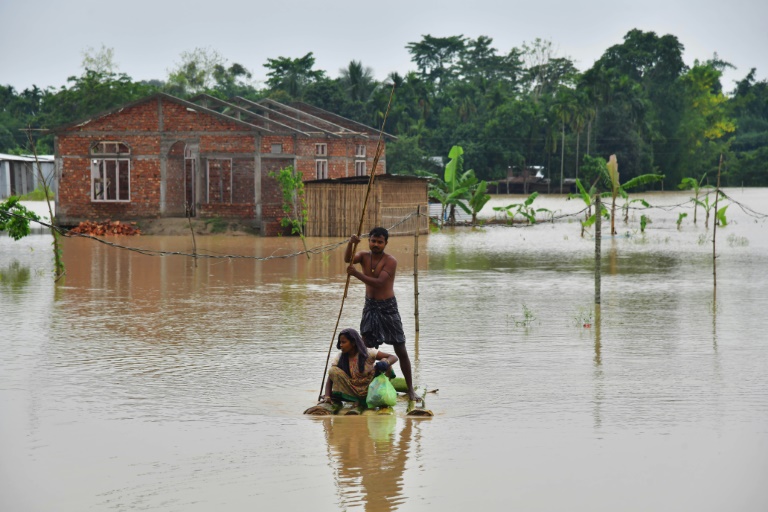
North-east Bangladesh’s worst floods in nearly 20 years began receding on Sunday, but rescue workers were struggling to help millions marooned by extreme weather across the region that has killed around 60 people.

Floods are a regular menace to millions of people in low-lying Bangladesh and neighbouring northeast India, but many experts say that climate change is increasing the frequency, ferocity and unpredictability.

In the past week after heavy rains in India, floodwater breached a major embankment in Bangladesh’s Sylhet region, affecting around two million people, swamping dozens of villages and killing at least 10.

Arifuzzman Bhuiyan, head of the state-run Flood Forecasting and Warning Centre, told AFP that the floods had hit some 70 percent of Sylhet district and about 60 percent of neighbouring Sunamganj.

“It is one of the worst floods in the region,” he told AFP.

But he said the situation would improve further in the next few days after heavy rains stopped.

Police said that a scuffle broke out in the rural town of Companyganj on Saturday as authorities stepped up relief operations for the roughly two million people hit.    

“There were more flood-affected people than the estimated relief packs. At one point everyone started to snatch relief goods when police dispersed the crowd,” local police chief Sukanto Chakrobarti told AFP. 

Mozibur Rahman, head of Sylhet district, said that the embankment washed away along the Bangladesh-India border was yet to be repaired.

“It is impossible to fix the embankment unless waterflow from India plunges. The inundation scenario in Sylhet city has improved. But outer towns are still underwater,” Rahman said.

“We are trying to send relief and have opened hundreds of shelters for the flood-hit people.”

Mofizul Islam, a resident of Sylhet city where floodwaters were slowly subsiding, said that he fell off his motorbike after he hit a pothole hidden under the water on Sunday.

“It is very risky for the people who are going out today,” Islam told AFP.

– 50 dead in India –

Over the border in India, around 50 people have been killed in days of flooding, landslides and thunderstorms, according to local disaster management authorities.

In the north-eastern state of Assam, authorities said on Sunday that the death toll from the floods had reached 18.

According to the Assam State Disaster Management Authority (ASDMA), almost 3,250 villages were partially or fully submerged.

ASDMA officials said the situation had improved slightly but that it remained critical in some districts. 

According to their estimate, more than 92,000 people were in relief camps.

The state and national rescue forces, helped by the army, were working to rescue people from villages and distribute food, clean drinking water and other essentials, as well as to clear roads.

West of Assam, at least 33 people were killed in Bihar state in thunderstorms on Thursday.  

Bihar, in common with other parts of northern India and Pakistan, has been suffering an intense heatwave, with temperatures reaching 40 degrees Celsius (104 degrees Fahrenheit).  

Biden arrives in Japan with no response on outreach to North Korea

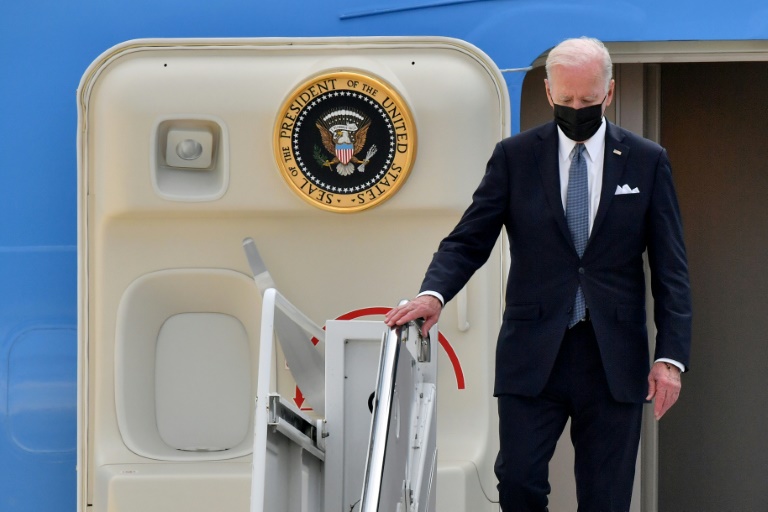
President Joe Biden arrived Sunday in Japan for the second leg of an Asia trip underlining US commitment to the region but overshadowed by concern that North Korea will test a nuclear weapon after ignoring Washington’s attempt at outreach.

Biden, making his first trip to Asia as president, flew from South Korea into Yokota Air Base outside Tokyo, where he will meet with Japan’s Prime Minister Fumio Kishida and emperor on Monday, as well as unveiling a US-led multilateral trade initiative.

On Tuesday, he reinforces the theme of American leadership in the Asia-Pacific by joining the leaders of Australia, India and Japan for a summit of the Quad group.

The trip, which comes as rival China is experiencing significant economic disruption due to Covid outbreaks, has been touted by Washington as a display of US determination to maintain its commercial and military edge across the region.

But hanging over every step of Biden’s tour is fear that unpredictable North Korea will test a nuclear-capable missile or a bomb.

Speculation that this might even happen while Biden was just across the border in Seoul did not materialise. However, US National Security Advisor Jake Sullivan told reporters that the threat remains.

Echoing Biden’s earlier statement that the United States is “prepared for anything North Korea does”, Sullivan said the dictatorship has a choice.

“If North Korea acts, we’ll be prepared to respond. If North Korea doesn’t act, North Korea has the opportunity, as we’ve said repeatedly, to come to the table.”

Pyongyang has so far declined to answer US appeals for dialogue, officials say, even ignoring offers of help to combat a sudden mass outbreak of Covid-19, according to Biden.

And while in Seoul, Biden confirmed he was prepared to meet with Kim Jong Un if the leader-for-life is “sincere”, but Sullivan said that remains far off.

“We’re not even at step one yet,” he said.

Symbolising the apparent one-way conversation, Biden said the only message he has right now for Kim would consist of a single word: “Hello. Period,” he said.

– Military exercises –

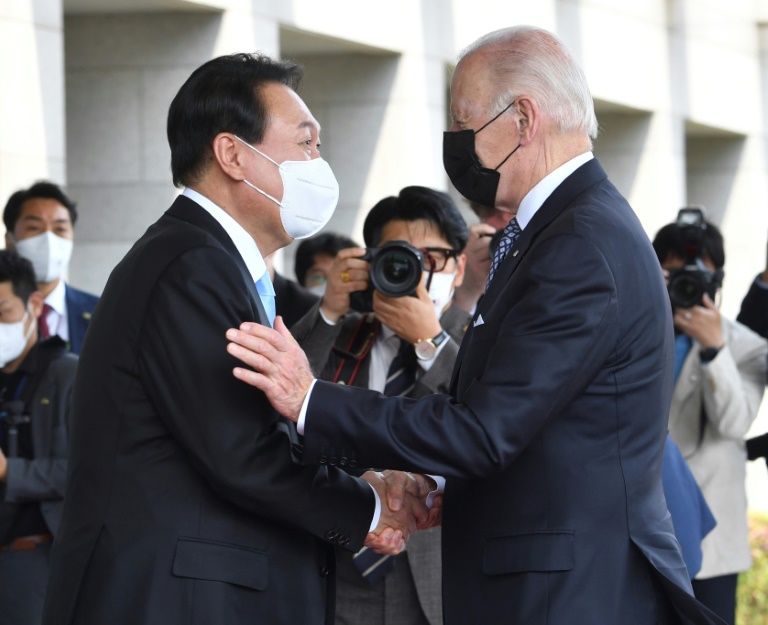
Biden spent two days with South Korea’s new President Yoon Suk-yeol, with beefing up the military defence against North Korea high on the agenda.

They issued a statement on Saturday saying that “considering the evolving threat” from Pyongyang, they were looking at expanding the “scope and scale” of joint US-South Korean military exercises.

Joint exercises had been scaled back due to Covid and for Biden and Yoon’s predecessors, Donald Trump and Moon Jae-in, to embark on a round of high-profile but ultimately unsuccessful diplomacy with North Korea.

In contrast to the dovish Moon, Yoon said he and Biden discussed possible “joint drills to prepare for a nuclear attack” and called for more US assets to be deployed to the region.

Any build-up of forces or expansion of joint military exercises would likely enrage Pyongyang, which views the drills as rehearsals for an invasion.

North Korea has conducted a blitz of sanctions-busting weapons tests this year, including firing an intercontinental ballistic missile at full range for the first time since 2017, with satellite imagery indicating a nuclear test is looming.

But its weapons testing schedule may also be affected by a raging Covid-19 outbreak.

More than 2.6 million cases of what the regime calls “fever” have been reported since the Omicron variant was first detected in April, state media said Sunday.

– Economic ties –

Before heading to Japan on Sunday, Biden met with the chairman of Hyundai to celebrate a decision by the South Korean auto giant to invest $5.5 billion in an electric vehicle plant in the southern US state of Georgia.

He also met US and South Korean troops alongside Yoon, a schedule that a senior White House official said was able to “reflect the truly integrated nature” of the countries’ economic and military alliance.

Biden is also emphasising a broader, almost existential aspect to his trip, saying that Asia is a key battleground in the global “competition between democracies and autocracies”.

“We talked in some length about the need for us to make this larger than just the United States, Japan, and Korea, but the entire Pacific and the South Pacific and Indo-Pacific. I think this is an opportunity,” Biden said after meeting Yoon.

While China is the main US rival in that struggle, Biden illustrated the acute challenge from Russia when he signed a $40 billion aid bill late Saturday to help Ukraine fight the invasion by Moscow’s forces.

Biden greets Kim, but says US 'prepared' for North Korea weapons test

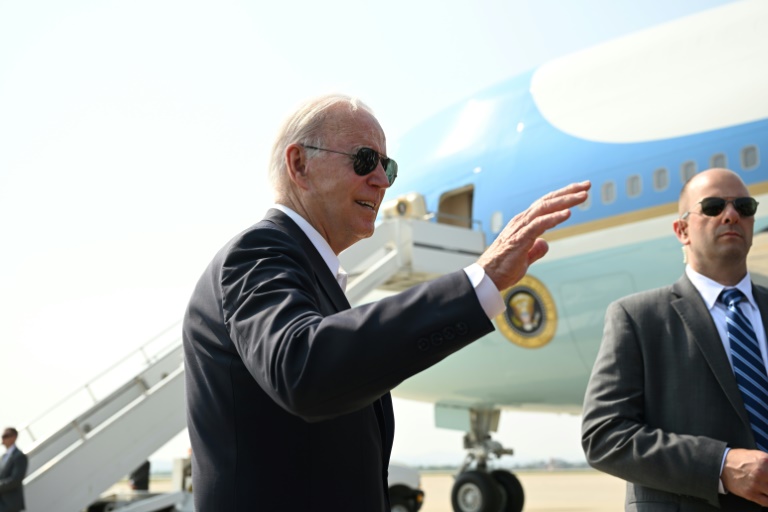
Before President Joe Biden left South Korea for Japan Sunday, he offered a brief message to Kim Jong Un, whose nuclear sabre-rattling has risked overshadowing the US leader’s first Asia trip: “Hello. Period.”

He offered the succinct greeting when reporters asked whether he had anything to say to North Korea’s leader, highlighting his administration’s openness to dialogue with Pyongyang, even as they look to ramp up joint military exercises with South Korea.

Biden said that he was “not concerned” about the risks of a fresh weapons test while he was in the region — something US officials have warned of repeatedly — saying: “We are prepared for anything North Korea does.”

He has spent two days with South Korea’s newly elected President Yoon Suk-yeol, with the pair saying Saturday that “considering the evolving threat” from Pyongyang, they were looking at expanding the “scope and scale” of joint military exercises.

North Korea has conducted a blitz of sanctions-busting weapons tests this year, including firing an intercontinental ballistic missile at full range for the first time since 2017, with satellite imagery indicating a nuclear test is looming.

Joint exercises had been scaled back due to Covid and in order for Biden and Yoon’s predecessors, Donald Trump and Moon Jae-in, to embark on a round of high-profile but ultimately unsuccessful diplomacy with North Korea.

In contrast to the dovish Moon, Yoon said he and Biden discussed possible “joint drills to prepare for a nuclear attack” and called for more tactical US assets to be deployed to the region.

Any build-up of forces or expansion of joint military exercises would likely enrage Pyongyang, which views the drills as rehearsals for invasion.

North Korea’s weapons testing schedule may also be affected by a raging Covid-19 outbreak.

More than 2.6 million cases of “fever” have been reported since the Omicron coronavirus variant was first detected in April, state media said Sunday.

Biden and Yoon extended an offer of help to North Korea, which has an unvaccinated population and a crumbling healthcare system, saying in a statement they were “willing to work with the international community to provide assistance”.

Biden added that he would not exclude a meeting with Kim if the North Korean leader were “sincere”.

“We’ve offered vaccines, not only to North Korea but to China as well and we’re prepared to do that immediately,” Biden said at a press conference with Yoon. “We’ve got no response.”

– Economic ties –

Early Sunday, Biden met with the chairman of Hyundai to celebrate a decision by the South Korean auto giant to invest $5.5 billion in an electric vehicle plant in the southern US state of Georgia.

He also met US and South Korean troops alongside Yoon, a schedule that a senior White House official said was able to “reflect the truly integrated nature” of the countries’ economic and military alliance.

Biden has used his visit to call for the allies to deepen ties, saying at a press conference with Yoon that Asia was a key battleground in the global “competition between democracies and autocracies”.

“We talked in some length about the need for us to make this larger than just the United States, Japan, and Korea, but the entire Pacific and the South Pacific and Indo-Pacific. I think this is an opportunity,” Biden said.

While China is the main US rival in that struggle, Biden illustrated the acute challenge from Russia when he signed a $40 billion aid bill late Saturday to help Ukraine fight the invasion by Moscow’s forces.

The bill, passed earlier by Congress, was flown to Seoul so that Biden could make it law without having to wait for his return to Washington next Tuesday.

In Japan, Biden will meet with Prime Minister Fumio Kishida and Emperor Naruhito on Monday ahead of Tuesday’s Quad summit, bringing together the leaders of Australia, India, Japan and the United States.

Also on Monday, Biden will unveil a major new US initiative for regional trade, the Indo-Pacific Economic Framework for Prosperity. 

Ukraine warns only diplomacy can end war

Ukrainian President Volodymyr Zelensky has warned only a diplomatic breakthrough rather than an outright military victory can end Russia’s war on his country, while pushing its case for EU membership.

Zelensky also appealed for more military aid, even as US President Joe Biden formally signed off on a $40-billion package of aid for the Ukrainian war effort.

That call came just hours after Russia claimed to have destroyed a cache of Western-delivered arms in the country’s northwest.

Zelensky also insisted his war-ravaged country should be a full candidate to join the EU, rejecting a suggestion from France’s President Emmanuel Macron and some other EU leaders that a sort of associated political community be created as a waiting zone for a membership bid.

“We don’t need such compromises,” Zelensky said Saturday during a joint news conference with visiting Portuguese Prime Minister Antonio Costa.

“Because, believe me, it will not be compromise with Ukraine in Europe, it will be another compromise between Europe and Russia.”

Zelensky, who will speak to the world’s political and business elite at the exclusive Davos forum via videolink on Monday, told Ukrainians in a televised address: “There are things that can only be reached at the negotiating table.”

The war “will be bloody, there will be fighting but will only definitively end through diplomacy”.

“Discussions between Ukraine and Russia will decidedly take place. Under what format I don’t know,” he added.

But he promised that the result would be “fair” for Ukraine.

– Cruise missile ‘strike’ –

After just over 12 weeks of fierce fighting, Ukrainian forces have halted Russian attempts to seize Kyiv and the northern city of Kharkiv, but they are under intense pressure in the eastern Donbas region.

Moscow’s army has flattened and seized the Black Sea port of Mariupol and subjected Ukrainian troops and towns in the east to relentless ground and artillery attacks.

On Saturday, Russia’s defence ministry claimed to have destroyed a large stockpile of weapons supplied by the West in a cruise missile strike on the town of Malyn in the northwest Zhytomyr region.

“Long-range, high-precision Kalibr missiles, launched from the sea, destroyed a large consignment of weapons and military equipment supplied by the United States and European countries,” the ministry said. 

While local authorities acknowledged three missiles had damaged “civil infrastructure” in Malyn, Ukraine’s defence ministry made no mention of the Russian claim in its Sunday briefing and the existence of an arms depot has yet to be independently confirmed.

– Russia cuts Finland’s gas-

Zelensky’s Western allies have shipped a steady stream of modern weaponry to his forces and imposed sweeping sanctions on the Russian economy and President Vladimir Putin’s inner circle.  

The Kremlin has responded by disrupting European energy supplies.

On Saturday, Russian energy giant Gazprom said it had halted gas supplies to Finland after Helsinki refused to pay its bill in rubles, which Moscow had demanded in a bid to side-step financial sanctions.

Finland’s state-owned energy company Gasum said it would use other sources, such as the Balticconnector pipeline, which links Finland to fellow EU member Estonia.

Moscow cut off gas to Poland and Bulgaria last month, a move the European Union denounced as “blackmail”.

The row over Finland’s gas bill comes just days after it joined Sweden in breaking their historical military non-alignment and applying to join NATO.

Moscow has warned Finland that joining NATO would be “a grave mistake with far-reaching consequences”, and Defence Minister Sergei Shoigu has said it will respond by building military bases in western Russia.

But both Finland and Sweden are now apparently on the fast track to join the military alliance, with Biden offering “full, total, complete backing” to their bids.

All 30 existing NATO members must agree, however, and Turkey has condemned Sweden’s alleged tolerance for the presence of exiled Kurdistan Workers’ Party (PKK) militants

– Dogged resistance –

On the ground in Ukraine, the fighting remains fiercest in the eastern region of Donbas, a Russian-speaking area partially controlled by pro-Kremlin separatists since 2014.

In Severodonetsk, a frontline city now at risk of encirclement, 12 people were killed and another 40 wounded by Russian shelling, said regional governor Sergiy Gaiday.

“The Russians are using artillery day and night,” he said.

In the neighbouring Donetsk region, governor Pavlo Kyrylenko said on Telegram on Saturday that seven civilians had been killed and 10 wounded.

Further north in Kharkiv, just 50 kilometres from the border with Russia, new networks of trenches and checkpoints have cropped up as the city prepares to defend against a fresh assault.

“When we were here on the 24th of February there were no positions at all,” says “Doctor”, a medic with the National Guard, referring to the day the Russians invaded.

“But now we have trenches, we have well-protected zones, so for them, it would be impossibly hard to capture (this position).” 

On the roads leading out of the city — some of which have been closed off — civilians help soldiers fill sandbags for the checkpoints.

“We have a problem, we are at war,” jokes a soldier as he checks a vehicle and turns it back.

-Prisoner swap mooted-

On Friday, Moscow declared its bloody, months-long battle for the Azovstal steelworks in Mariupol at an end.

Russian defence ministry spokesman Igor Konashenko said 2,439 Ukrainian personnel had surrendered at the plant since May 16, the final 500 on Friday.

Ukraine hopes to exchange the surrendering soldiers for Russian prisoners. But in Donetsk, pro-Kremlin authorities have threatened to put some of them on trial.

A Russian negotiator on Saturday said Moscow would consider exchanging prisoners from Ukraine’s far-right Azov battalion for Viktor Medvedchuk, a wealthy Ukrainian businessman known for his close ties to Putin.

“We are going to study the possibility,” said Leonid Slutsky, a senior member of Russia’s negotiating team, speaking from the separatist city of Donetsk, the RIA Novosti news agency reported.

Medvedchuk, 67, is a politician and one of Ukraine’s richest people. He escaped from house arrest after Russia invaded in February but was re-arrested in mid-April.

burs-jj/har/cwl/mtp

'A great joy': punk laureate Patti Smith granted France's highest honor

As a child, punk-poet icon Patti Smith was instructed never to accept anything from strangers — which meant one day she was forced to decline a campaign button she coveted and everyone else had.

While dejectedly walking to her New Jersey family home, she vowed to her future self that she would soon acquire her own medals to add to her lapel. 

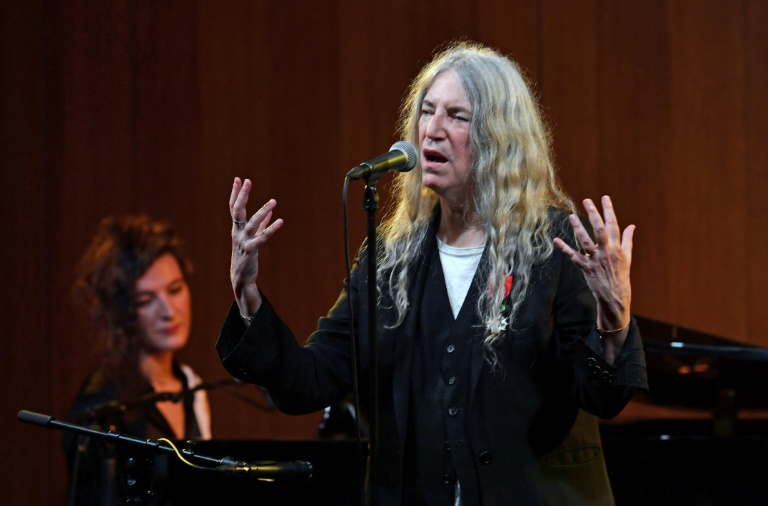
On Saturday, the 75-year-old rock legend made good on that promise, as France’s ambassador to the United States Philippe Etienne bestowed her with the Legion d’Honneur, his country’s highest order of merit.

Smith regaled a rapt audience with that touching anecdote after her medal ceremony in central Brooklyn, where crowds gathered for the “Night of Ideas,” an annual marathon of philosophy and performance put on by the French Embassy’s Villa Albertine in partnership with the Brooklyn Public Library.

“It’s an indescribable honor, I understand the gravity of it,” she told AFP backstage, after delivering a spirited performance alongside her daughter Jesse on piano and her long-time collaborator and guitarist Lenny Kaye.

“For someone… who has been greatly shaped by French culture, French literature, French art, and film, just my whole life — it’s especially meaningful,” she continued. 

“I embraced France my whole life, and to receive an embrace like this in return is a wonderful thing.”

For more than half-a-century, Smith has been celebrated as an artist’s artist, adored for her music, songwriting, poetry and deeply introspective, raw writing that in 2010 won the US National Book Award for her stirring memoir “Just Kids.”

The book sees Smith excavate memories from her relationship with Robert Mapplethorpe, the late photographer with whom she shared a deep friendship, romance and creative bond.

“I feel like it’s very fitting to have such an accolade here in Brooklyn — it’s only a couple of subway stops away that Robert Mapplethorpe and I lived at 20-years-old,” she told the audience. “At night, when Robert couldn’t sleep, he would ask me to read him French poetry… I remember those nights so clearly.”

Smith also felt a particular kinship to the venue of Saturday’s ceremony.

“It’s also fitting that it should be a library, because coming from a very rural area of South Jersey, with very little culture in the ’50s and mid-’60s, I depended on the library to open and expand my world,” she said.

In typical Smith fashion, she honored the artists who came before her in closing her acceptance speech, having opened with a performance of her 1996 song “Wing.”

The rock laureate read the final letter by spiritual-surrealist poet Rene Daumal, which he wrote to his wife before his death.

“Seeing that you are nothing you desire to become,” Smith read. “In desiring to become, you begin to live.”

– People make change –

Following the ceremony Smith — donning her signature black blazer atop a black vest, along with combat boots and her long, gray hair flowing as a few small braids framed her face — delighted fans with a show that included her hit “People Have The Power,” which she wrote with her late husband, Fred “Sonic” Smith.

Speaking to AFP, she said that while “artists can always inspire people, they can rally people, give people hope… in the end, it’s not artists who make change, it’s the people.”

“Through voting, through initiative, through mass marches — it’s the people that make change.”

Citing the ongoing pandemic and the “pain of war,” Smith said “we are living in a very troubled world,” underscoring climate change as the great crisis of our time.

“There are heat waves right now that are unprecedented… there’s tremendous famine, and violent weather patterns we’ve never seen,” she said. 

“The only way it can be solved is a global effort, and I think more than anything… that is the most important thing that people have to address.

“However small the gesture, every gesture is important.”

Smith is set in the fall to release a new book entitled “A Book Of Days,” a visual collection inspired by her beloved Instagram account.

These days “I’m writing just as always,” she told AFP, “writing songs, writing poems, writing another book — I’m always busy, always doing something.”

After her performance, Smith said the medal inspired her to do “more work, better work,” and it “felt very fitting to work right after I received it.”

“I still feel like I’ve got a little, you know, that post-performance adrenaline,” she smiled, “but also just the excitement and happiness… of receiving such an honor.”

“That I would be chosen to, you know, be a sort of a mini-ambassador for the country is really a great joy for me,” she said. 

“So you leave me a happy girl.”

mdo/aha

Biden says 'hi' to North Korea's Kim, despite weapons test fears

President Joe Biden had a short message for North Korea’s Kim Jong Un: “Hello. Period.” he told reporters Sunday in Seoul, before heading to Japan for the second leg of his Asia trip which has been overshadowed by fears of a nuclear test by Pyongyang.

Biden is leaving South Korea, after spending two days with newly elected President Yoon Suk-yeol, with the pair discussing possibly expanding joint military exercises to counter Kim Jong Un’s sabre-rattling.

His goal to reinforce US leadership across Asia has been dogged  by fears the unpredictable, nuclear-armed North could conduct a weapons test while Biden is in the region, but on his last day in Seoul, he told reporters he had a short message for Kim: “Hello. Period.”

He said he was “not concerned” about Pyongyang’s possible weapons test, saying: “We are prepared for anything North Korea does.”

Early Sunday, Biden met with the chairman of Hyundai to celebrate a decision by the auto giant to invest $5.5 billion in an electric vehicle plant in the southern US state of Georgia.

He will also meet US and South Korean troops with Yoon, a schedule that a senior White House official said was able to “reflect the truly integrated nature” of the countries’ economic and military alliance.

Biden has used his visit to call for the democratic allies to deepen ties, saying at a joint press conference with Yoon that Asia was a key battleground in the global “competition between democracies and autocracies”.

“We talked in some length about the need for us to make this larger than just the United States, Japan, and Korea, but the entire Pacific and the South Pacific and Indo-Pacific. I think this is an opportunity,” Biden said.

While China is the main US rival in that struggle, Biden illustrated the acute challenge from Russia when he signed a $40 billion aid bill late Saturday to help Ukraine fight the invasion by Moscow’s forces.

The bill, passed earlier by Congress, was flown to Seoul so that Biden could make it law without having to wait for his return to Washington late next Tuesday.

In Japan, Biden will meet with Prime Minister Fumio Kishida and Emperor Naruhito on Monday ahead of Tuesday’s Quad summit, bringing together the leaders of Australia, India, Japan and the United States.

Also on Monday, Biden will unveil a major new US initiative for regional trade, the Indo-Pacific Economic Framework for Prosperity. 

– North Korea threat –

Biden and Yoon said in a statement Saturday that “considering the evolving threat” from North Korea, they “agree to initiate discussions to expand the scope and scale of combined military exercises and training on and around the Korean peninsula”.

The possible beefing up of joint US-South Korean military exercises comes in response to North Korea’s blitz of sanctions-busting weapons tests this year.

Joint exercises had been scaled back due to Covid and in order for Biden and Yoon’s predecessors, Donald Trump and Moon Jae-in, to embark on a round of high-profile but ultimately unsuccessful diplomacy with the North.

In contrast to the dovish Moon, Yoon said he and Biden discussed possible “joint drills to prepare for a nuclear attack” and called for more tactical US assets to be deployed to the region.

Any build-up of forces or expansion of US-South Korea joint military exercises would likely enrage Pyongyang, which views the joint drills as rehearsals for invasion.

Meanwhile, Biden and Yoon extended an offer of help to Pyongyang, which has recently announced it is in the midst of a Covid-19 outbreak — a rare admission of internal troubles.

The US-South Korea statement said the two presidents “express concern over the recent Covid-19 outbreak” and “are willing to work with the international community to provide assistance” to North Korea.

On Sunday, North Korean state media said 2.6 million people had been sick with “fever” with 67 deaths — which they claimed was a fatality rate of just 0.003 percent, despite an unvaccinated population where malnutrition is widespread.

Biden, while adding that he would not exclude a meeting with Kim if he were “sincere”, indicated the difficulty of dealing with the unpredictable dictator.

“We’ve offered vaccines, not only to North Korea but to China as well and we’re prepared to do that immediately,” Biden said at a press conference with Yoon. “We’ve got no response.”

Moldova wine industry's EU focus pays off

In the small Moldovan village of Pereni, Nicolae Tronciu gazes at his vineyard, with its buds ready to bloom.

The 71-year-old launched his current brand four years ago, selling it to Europe rather than Russia, traditionally his country’s biggest customer — a move that is paying off amid the war in Ukraine.

“Most of my production goes to Europe, especially to our Romanian brothers,” Tronciu told AFP at his vineyard, about 50 kilometres (30 miles) away from the Ukrainian border.

Moldova — a small former Soviet republic of some 2.6 million people nestled between Ukraine and Romania, and among the world’s 20 largest wine producers — has long sought closer ties with Europe.

This has now mitigated the war’s impact as the industry struggles with rising prices for raw materials and a lack of Ukrainian consumers.

– ‘Freedom blend’ –

“The Russian market was our traditional market… In the EU you can charge higher prices for wine, but there the focus is on quality,” Tronciu said.

His family has been making wine for four generations, and he hopes to turn over his business to his sons working abroad.

He makes no secret of where his preferences stand.

“Geographically and as a person I’m pro-European, yes,” he said.

Moldova seeking stronger Europe ties has angered Moscow and resulted in two Russian embargoes in 2006 and 2013.

Those pushed the country further West with the EU liberalising its market for Moldovan wines and sealing a bilateral free trade agreement with Chisinau in 2014.

The transformation has been radical — Russia accounted for only 10 percent of Moldovan wine exports in 2021, down from 80 percent in the early 2000s, according to figures from the Moldovan Ministry of Agriculture.

Moldova exported more than 120 million litres to European countries last year, compared to 8.6 million litres to Russia.

“Before the 2006 (Russian) embargo, the country did not know the term ‘market diversification’… Today, it exports nearly 68 million bottles each year to more than 70 countries,” senior agriculture ministry official Sergiu Gherciu told AFP.

Moldova’s top wine maker Purcari has even taken a direct political stance against Russia’s influence with a wine called “Freedom Blend”, launched in 2014 and made from three grape varieties from Georgia, Ukraine and Moldova.

“This wine is a symbol of these countries which are de facto fighting for their freedom,” Purcari chief operating officer Eugen Comendant said.

After Russia invaded Ukraine in February, the company helped Ukrainian refugees — offering them free accommodation — and sponsored an anti-war banner in the Romanian capital Bucharest, where Purcari is listed on the stock exchange.

– Expensive raw materials –

Comendant said the war’s impact was “close to zero” in terms of Russians no longer purchasing Purcari wines.

There are currently no trade restrictions on wine between the two countries, but the war has made transport difficult and international sanctions make it difficult for Russia to conduct international trade.

But the Ukrainian market, which was in full development and represented four percent of the company’s sales, collapsed.

The war blocking the southern Ukrainian port of Odessa has also caused “major logistical problems and complicates our exports to Asia,” Comendant added.

In March, the Moldovan government said more than 750,000 euros ($790,000) worth of wine were blocked in the Ukrainian port. 

But the main challenge for Moldova’s wine producers lies with rising production costs, which are expected to soar by 50 percent this year, according to Gherciu.

Tronciu, who sells between eight and ten tonnes of wine every year, said all the raw materials have gotten more expensive. 

“Pesticide, fuel, gas, even the iron wire we use” for the grapevines, he said.

He also deplored a lack of tourists, who he used to welcome.

“Most of them were Ukrainians, but also a few Russians,” he said in his now empty tasting room.

Close Bitnami banner
Bitnami