AFP

More than 100 million people forcibly displaced: UN

Russia’s war in Ukraine has pushed the number of forcibly displaced people around the world above 100 million for the first time ever, the United Nations said Monday.

“The number of people forced to flee conflict, violence, human rights violations and persecution has now crossed the staggering milestone of 100 million for the first time on record, propelled by the war in Ukraine and other deadly conflicts,” said UNHCR, the UN Refugee Agency.

The “alarming” figure must shake the world into ending the conflicts forcing record numbers to flee their own homes, the UNHCR said in a statement.

UNHCR said the numbers of forcibly displaced people rose towards 90 million by the end of 2021, spurred by violence in Ethiopia, Burkina Faso, Myanmar, Nigeria, Afghanistan and the Democratic Republic of the Congo.

Russia invaded Ukraine on February 24 and since then, more than eight million people have been displaced within the country, while more than six million refugees have fled across the borders.

– ‘Wake-up call’ –

“One hundred million is a stark figure — sobering and alarming in equal measure. It’s a record that should never have been set,” said UNHCR chief Filippo Grandi.

“This must serve as a wake-up call to resolve and prevent destructive conflicts, end persecution, and address the underlying causes that force innocent people to flee their homes.”

The 100 million figure amounts to more than one percent of the global population, while only 13 countries have a bigger population than the number of forcibly displaced people in the world.

The figures combine refugees, asylum-seekers, as well as more than 50 million people displaced inside their own countries.

“The international response to people fleeing war in Ukraine has been overwhelmingly positive,” said Grandi.

“Compassion is alive and we need a similar mobilisation for all crises around the world. But ultimately, humanitarian aid is a palliative, not a cure.

“To reverse this trend, the only answer is peace and stability so that innocent people are not forced to gamble between acute danger at home or precarious flight and exile.”

UNHCR will outline the full data on forced displacement in 2021 in its annual Global Trends Report, due for release on June 16.

– ‘Never been as bad’ –

More than two years on since the start of the Covid-19 pandemic, at least 20 countries still deny access to asylum for people fleeing conflict, violence, and persecution based on measures to clamp down on the virus.

Grandi called Friday for those countries to lift any remaining pandemic-related asylum restrictions, saying they contravene a fundamental human right.

“I am worried that measures enacted on the pretext of responding to Covid-19 are being used as cover to exclude and deny asylum to people fleeing violence and persecution,” he said.

A joint report last week by the Internal Displacement Monitoring Centre (IDMC) and the Norwegian Refugee Council (NRC) said around 38 million new internal displacements were reported in 2021. Some of those were by people forced to flee multiple times during the year.

The figure marks the second-highest annual number of new internal displacements in a decade after 2020, which saw record-breaking movement due to a string of natural disasters.

Last year, new internal displacements specifically from conflict surged to 14.4 million — marking a 50-percent jump from 2020, the report showed.

“It has never been as bad as this,” NRC chief Jan Egeland told reporters.

“The world is falling apart.”

Natural disasters continued to account for most new internal displacement, spurring 23.7 million such movements in 2021.
Global elites return to Davos under Ukraine storm

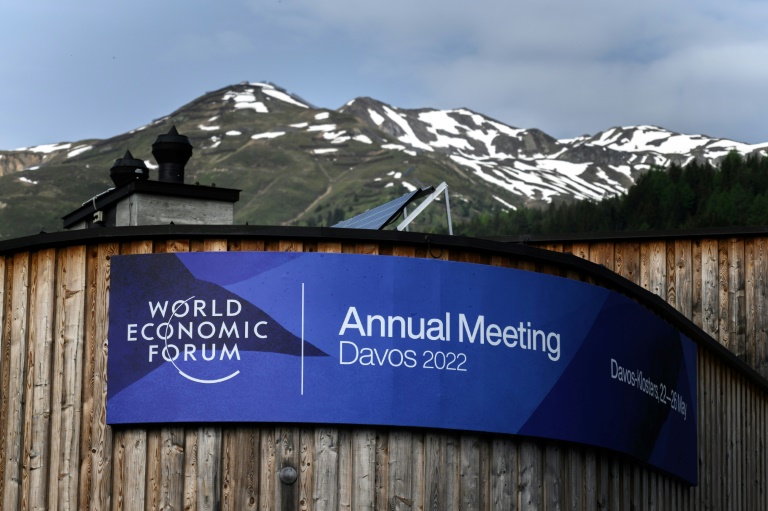
The Davos summit of global political and business elites returns Monday after a Covid-induced two-year break to face another momentous crisis: Russia’s invasion of Ukraine.

The theme of the World Economic Forum, “History at a Turning Point”, sets the tone for the four-day meeting in the glitzy Swiss mountain resort that will be dominated by the political and economic fallout from the conflict.

When the WEF last took place in Davos in January 2020, the coronavirus was just brewing in China before morphing into a devastating pandemic.

A Davos forum took place virtually last year, with Russian President Vladimir Putin among the speakers.

Russian business and political leaders, who used to participate in debates and mingle with other A-listers at champagne parties, were barred by organisers from attending this year’s gathering over the war.

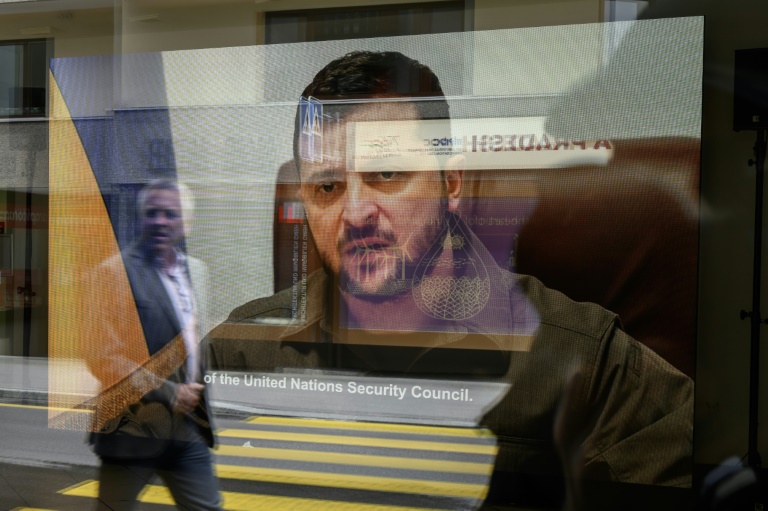
Ukrainians, meanwhile, have deployed a strong contingent, including the foreign minister, to plead their case, with President Volodymyr Zelensky scheduled to address the forum via videolink on Monday.

“The major request to the whole world here is: do not stop backing Ukraine,” Ukrainian lawmaker Ivanna Klympush Tsintsadze told reporters on the eve of the summit.

Another lawmaker, Anastasia Radina, appealed for NATO-style heavy weaponry to “win the war”.

“We actually need weapons more than we need anything else,” she said.

The Ukrainians have transformed the “Russia House” in Davos –- normally used by the Russian delegation — into the “Russia War Crimes House” to promote their cause.

WEF founder Klaus Schwab said last week that Davos would do what it can to support Ukraine and its recovery.

“Russia’s aggression on the country will be seen in future history books as the breakdown of the post-World War II and post-Cold War order,” he said.

More than 50 heads of state or government will be among the 2,500 delegates, ranging from business leaders to academics and civil society figures.

Some of the biggest names include Germany’s new chancellor, Olaf Scholz, European Union chief Ursula von der Leyen, NATO head Jens Stoltenberg and US climate envoy John Kerry.

– ‘Bonanza’ for billionaires –

While the summit is back, it lacks its usual snowy backdrop as the Omicron variant forced this year’s January meeting to be postponed until now. Instead, rain is forecast all week.

Climate change and concerns about the economic recovery from the pandemic are also at the forefront of the Davos talks.

Inflation has become a major concern as energy and food prices have soared further since Russia invaded Ukraine, raising fears of hunger in countries dependent on wheat from the region.

Global charity Oxfam warned Monday that 263 million people could sink into extreme poverty this year, at a rate of one million every 33 hours.

By contrast, 573 new billionaires have emerged during the pandemic, or one every 30 hours, Oxfam said as it called for taxes on the rich.

“Billionaires are arriving in Davos to celebrate an incredible surge in their fortunes,” Oxfam executive director Gabriela Bucher said in a statement.

“The pandemic and now the steep increases in food and energy prices have, simply put, been a bonanza for them,” Bucher said.

“Meanwhile, decades of progress on extreme poverty are now in reverse and millions of people are facing impossible rises in the cost of simply staying alive,” she said.

Key Iraq irrigation reservoir close to drying out

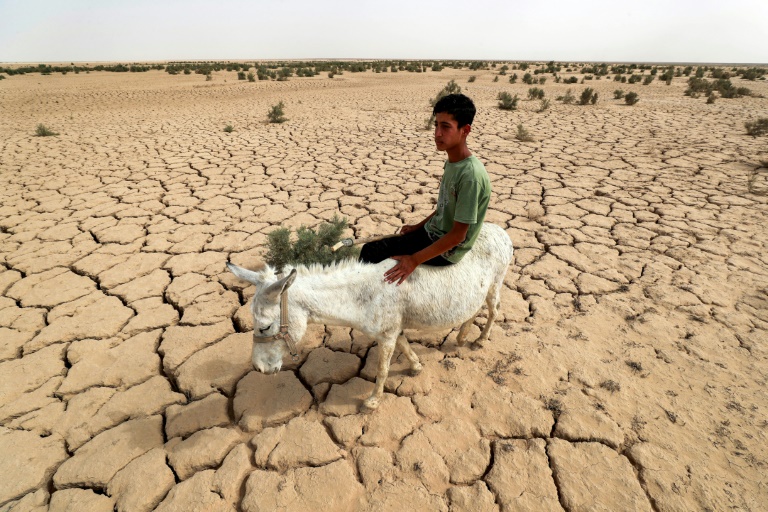
Iraq’s Lake Hamrin, a once-vast reservoir northeast of Baghdad that is the sole source of water for irrigation across Diyala province, has nearly dried out, a senior official said Friday.

Successive years of low rainfall and a sharp reduction in the flow of water down the Sirwan River from neighbouring Iran have reduced much of the lake to a dust bowl, the official told AFP.

“There has been a sharp reduction in the water level — reserves currently stand at 130 million cubic metres against two billion cubic metres normally,” said Aoun Dhiab, a senior adviser in the water ministry.

Dhiab said a number of factors were to blame including the prolonged drought and Iranian dam construction and river diversion projects upstream.

Dhiab said it was not the first time water levels had fallen so low. “In 2009, the lake dried out completely. There was just a stream.” 

He said the impact on surrounding farmland should not be underestimated.

“There are no other sources of water in the province — the volume arriving in Lake Hamrin is the volume used in the province.”

He said the government had asked Iran to increase the flow of water across the border. Otherwise all that could be done was to pray for higher rainfall next year.

The problem is not exclusive to Diyala province. The World Bank predicts that without major changes, Iraq will have lost 20 percent of its water resources by 2050.

The country is classified as one of five most vulnerable to climate change effects and desertification. Water shortages have led this year to reduced quotas for rice and wheat farmers.

Iraq’s upstream neighbours Iran, Turkey and Syria experience similar shortfalls, meaning that its appeals for help generally fall unheaded. 

US flight brings tons of needed baby formula from Germany

A US military plane bringing several tons of much-needed baby formula from Germany landed Sunday at an airport in Indiana as authorities scramble to address a critical shortage.

Scarcity of medical-grade baby formula caused by production problems and supply-chain issues has created grave problems for thousands of parents whose infants rely on it, sending them in frantic searches for the product.

The cargo plane took off from the US air base at Ramstein, Germany, carrying more than 70,000 pounds of powdered formula, the White House said. 

President Joe Biden posted about the flight on Twitter from Japan, where he is on a five-day Asia trip.

“Our team is working around the clock to get safe formula to everyone who needs it,” he said.

Biden tweeted an update later Sunday, saying more formula was on its way to the United States via a second shipment. 

“We have secured a second flight to transport Nestle specialty infant formula to Pennsylvania,” the president posted. 

“The flight and trucking will take place in the coming days, and I will continue to keep you updated,” he said.

The first shipment will cover about 15 percent of the immediate need, presidential economics advisor Brian Deese said on CNN.

He added there are “more flights in train that will be coming in early this week” as part of what the administration has dubbed “Operation Fly Formula.”

The formula was flown to Indiana because it is a hub for Nestle, a major domestic producer. It will be quality-tested at a nearby lab before being distributed.

The formula shortage has been developing for months, aggravated not only by supply-chain issues linked to the Covid-19 pandemic but by the closing of the largest US formula-making plant, a Michigan factory owned by Abbott Laboratories, amid concerns that contamination may have led to the deaths of two infants.

“We had a manufacturer that wasn’t following the rules, and that was making formula that had the risk of making babies sick,” Deese said. “So we have to take action.”

Another problem, he said, was that US formula production had become concentrated among just three companies. 

“We’re going to have to work” on ways to increase competition, he said.

Abbott’s CEO, Robert Ford, apologized to consumers in a Washington Post op-ed Sunday, saying: “We’re sorry to every family we’ve let down since our voluntary recall exacerbated our nation’s baby formula shortage.”

Deese was asked separately about growing concerns that the US economy — hit by high inflation, supply chain troubles and the war in Ukraine — may be headed toward a recession. 

“Well, there are always risks,” he said.

“But there’s also no doubt that the United States is in a better position than any other major country around the world to address inflation without giving up all the economic gains that we have had.”

The US inflation rate hit a 40-year high of 8.5 percent in March, but slowed slightly in April to 8.3 percent.

Biden warns of potentially 'consequential' monkeypox spread

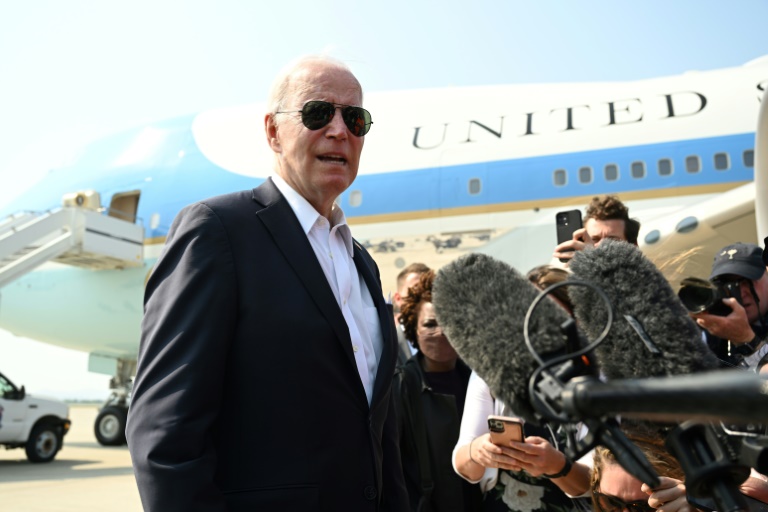
Monkeypox has caught the attention of US President Joe Biden, who said Sunday that people should be on guard against the disease which has the potential for “consequential” impact, if it were to spread further.

Several cases of monkeypox have been detected in North America and Europe since early May, sparking concern the disease, endemic in parts of Africa, is spreading.

The US leader, on his maiden trip to Asia as president, said in Seoul that health officials have not fully briefed him about “the level of exposure” in the United States.

“But it is something that everybody should be concerned about,” Biden told reporters before boarding Air Force One to fly to Tokyo.

“It is a concern, in that, if it were to spread, it would be consequential,” he added.

“We’re working on it hard to figure out what we do, and what vaccine if any might be available for it.”

The first US case in the recent global spate was reported on May 18 in Massachusetts, which was joined on Sunday by Florida.

Health authorities said they were investigating the southern state’s first presumptive case of monkeypox in someone who had recently traveled abroad.

There have been thousands of human infections in parts of Central and Western Africa in recent years but it is rare in Europe and North America.

Most people recover within several weeks and monkeypox has only been fatal in rare cases.

The World Health Organization said that as of Saturday there were 92 confirmed cases of the disease in countries where monkeypox is not endemic.

The virus is transmitted to humans from animals, with symptoms very similar to smallpox but less severe clinically.

Polish leader lends support in Ukraine as Zelensky looks to Davos

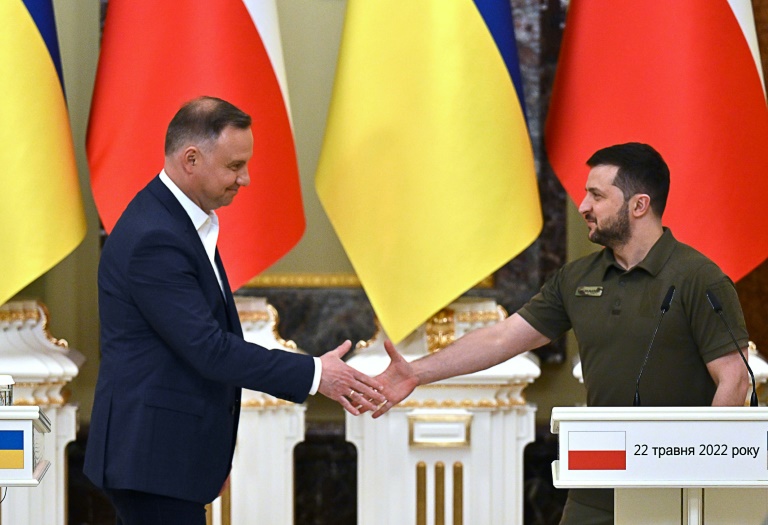
Polish President Andrzej Duda, speaking in Kyiv on Sunday, underscored his nation’s key support for embattled Ukraine as Russian forces pursued a relentless bombardment of frontline cities in the east.

Kyiv, meanwhile, continued a diplomatic counteroffensive, targeting the world’s business and political elite gathering in the Swiss mountain resort of Davos, as Western nations continued to rally behind Ukraine’s defence. 

Ukrainian President Volodymyr Zelensky is set to address the World Economic Forum via videoconference on Monday.

In another development, Russia’s lead negotiator in peace talks with Ukraine said Sunday that Moscow was willing to resume negotiations, but that the decision remained with Kyiv. 

“Freezing talks was entirely Ukraine’s initiative,” Vladimir Medinsky told Belarusian TV, adding that the “ball is completely in their court”.

He spoke a day after Zelensky said the war “will only definitively end through diplomacy”.

Duda’s visit to Kyiv, where he met with Zelensky, was noteworthy for the outsized role Poland has played in the conflict, welcoming millions of Ukrainian refugees — more than any other country — while serving as a vital staging post and transit point for Western arms and assistance headed to Ukraine. 

Duda struck a firm tone in his remarks in Kyiv.

“After Bucha, Borodianka, Mariupol, there cannot be business as usual with Russia,” he told the parliament, citing towns and cities where Russian forces have been accused of atrocities against civilians.

“An honest world cannot return to business as usual while forgetting the crimes, the aggression, the fundamental rights that have been trampled on,” he added.

– Martial law extended –

Shelling and missile strikes continued to pound Kharkiv in the north, and Mykolaiv and Zaporizhzhia in the south, Ukrainian officials said.

In the southern city of Enerhodar, the site of Europe’s largest nuclear power plant, the mayor appointed by Moscow after Russian troops took control of the city, Andrey Shevchik, was wounded in an explosion, a Ukrainian official and Russian news agencies said.

And in the eastern city of Severodonetsk, a focus of recent fighting, regional governor Sergiy Gaiday said Russian forces were “using scorched-earth tactics, deliberately destroying” the city.

Three months after launching their invasion, Moscow’s forces are focused on securing and expanding their gains in the Donbas region and on Ukraine’s southern coast.

Gaiday said Russia was drawing forces from a vast area — those withdrawn from the Kharkiv region, others involved in the siege and destruction of the southern port city of Mariupol, pro-Russian separatist militias, and even troops freshly mobilised from Siberia and the Russian Far East — and concentrating their firepower on the Donetsk and Lugansk regions. 

At least seven civilians were killed and eight others wounded in bombardment Sunday of the Donetsk region, according to the Ukrainian army’s Facebook page.

With the nation under relentless assault, Ukraine’s parliament voted on Sunday to extend martial law through August 23.

– Davos snubs Moscow –

Kyiv, meanwhile, is rallying international support, even as European Union members struggle to agree on expanding sanctions to Russia’s huge energy exports.

Zelensky is due to confer by videoconference with Davos delegates Monday evening to mark the opening of Ukraine House Davos, a forum for Kyiv and its international backers.

In March, Davos organisers cut ties with Russian firms and officials, and announced that anyone under international sanctions would not be welcome at the event.

Western nations have rallied behind Ukraine’s defence of its territories, led by the United States — which just approved a $40-billion war chest for Kyiv — and neighbours such as Poland.

But some European countries that are dependent on Russian oil supplies, including Hungary, are resisting calls for an embargo on crude, and major EU economic powers such as Germany remain huge gas importers.

Duda stressed that Poland and Ukraine have a “common future within the European Union”.

But some EU members are reticent.

France’s President Emmanuel Macron has suggested creating a “European political community” as a kind of antechamber to full membership.

But full membership might take “15 or 20 years”, France’s Europe minister, Clement Beaune, said Sunday on Radio J, adding, “I don’t want to offer Ukrainians any illusions.”

Zelensky has dismissed the idea of a conditional path to membership.

“We don’t need such compromises,” he said Saturday during a news conference with visiting Portuguese Prime Minister Antonio Costa.

– ‘No work, no food, no water’ –

While Russia’s top negotiator suggested Moscow remains open to negotiations, Kyiv — fighting to regain territory lost since Moscow began its offensive in February — has rejected concessions. But it has accepted that talks will come. 

“There are things that can only be reached at the negotiating table,” Zelensky said Saturday.

While Ukrainian forces have halted Russian attempts to seize Kyiv and Kharkiv, they continue to face intense pressure.

Millions of ordinary Ukrainians face a daily struggle to survive.

“There is no work, no food, no water,” said Angela Kopytsa, 52, breaking down into tears as she spoke to AFP reporters on a Russian-organised tour of Mariupol.

Kopytsa said her home had been destroyed during the fighting in the port and that “children at maternity wards were dying of hunger”. 

Once-bustling Mariupol has been without electricity since early March and has been reduced to a wasteland of charred buildings.

The Russian army and its separatist allies now patrol the streets.

Elena Ilyina, who used to teach at a Mariupol university, sobbed as she told AFP of how her apartment had been destroyed and that she now lives with her daughter.

“I’d like to live in my apartment, in peace, go to work and talk to my children,” the 55-year-old said.

But “I have nothing left.”

burs-dc/har/bbk/sw/caw

Biden arrives in Japan with no response on outreach to North Korea

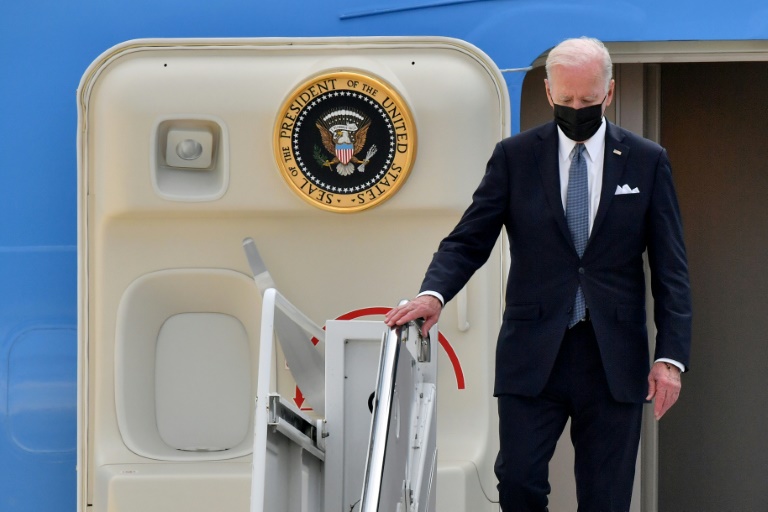
President Joe Biden arrived Sunday in Japan for the second leg of an Asia trip underlining US commitment to the region but overshadowed by concern that North Korea will test a nuclear weapon after ignoring Washington’s attempt at outreach.

Biden, making his first trip to Asia as president, flew from South Korea into Yokota Air Base outside Tokyo, where he will meet with Japan’s Prime Minister Fumio Kishida and emperor on Monday, as well as unveiling a US-led multilateral trade initiative.

On Tuesday, he reinforces the theme of American leadership in the Asia-Pacific by joining the leaders of Australia, India and Japan for a summit of the Quad group.

The trip, which comes as rival China is experiencing significant economic disruption due to Covid outbreaks, has been touted by Washington as a display of US determination to maintain its commercial and military edge across the region.

But hanging over every step of Biden’s tour is fear that unpredictable North Korea will test a nuclear-capable missile or a bomb.

Speculation that this might even happen while Biden was just across the border in Seoul did not materialise. However, US National Security Advisor Jake Sullivan told reporters that the threat remains.

Echoing Biden’s earlier statement that the United States is “prepared for anything North Korea does”, Sullivan said the dictatorship has a choice.

“If North Korea acts, we’ll be prepared to respond. If North Korea doesn’t act, North Korea has the opportunity, as we’ve said repeatedly, to come to the table.”

Pyongyang has so far declined to answer US appeals for dialogue, officials say, even ignoring offers of help to combat a sudden mass outbreak of Covid-19, according to Biden.

And while in Seoul, Biden confirmed he was prepared to meet with Kim Jong Un if the leader-for-life is “sincere”, but Sullivan said that remains far off.

“We’re not even at step one yet,” he said.

Symbolising the apparent one-way conversation, Biden said the only message he has right now for Kim would consist of a single word: “Hello. Period,” he said.

– Military exercises –

Biden spent two days with South Korea’s new President Yoon Suk-yeol, with beefing up the military defence against North Korea high on the agenda.

They issued a statement on Saturday saying that “considering the evolving threat” from Pyongyang, they were looking at expanding the “scope and scale” of joint US-South Korean military exercises.

Joint exercises had been scaled back due to Covid and for Biden and Yoon’s predecessors, Donald Trump and Moon Jae-in, to embark on a round of high-profile but ultimately unsuccessful diplomacy with North Korea.

In contrast to the dovish Moon, Yoon said he and Biden discussed possible “joint drills to prepare for a nuclear attack” and called for more US assets to be deployed to the region.

Any build-up of forces or expansion of joint military exercises would likely enrage Pyongyang, which views the drills as rehearsals for an invasion.

North Korea has conducted a blitz of sanctions-busting weapons tests this year, including firing an intercontinental ballistic missile at full range for the first time since 2017, with satellite imagery indicating a nuclear test is looming.

But its weapons testing schedule may also be affected by a raging Covid-19 outbreak.

More than 2.6 million cases of what the regime calls “fever” have been reported since the Omicron variant was first detected in April, state media said Sunday.

– Economic ties –

Before heading to Japan on Sunday, Biden met with the chairman of Hyundai to celebrate a decision by the South Korean auto giant to invest $5.5 billion in an electric vehicle plant in the southern US state of Georgia.

He also met US and South Korean troops alongside Yoon, a schedule that a senior White House official said was able to “reflect the truly integrated nature” of the countries’ economic and military alliance.

Biden is also emphasising a broader, almost existential aspect to his trip, saying that Asia is a key battleground in the global “competition between democracies and autocracies”.

“We talked in some length about the need for us to make this larger than just the United States, Japan, and Korea, but the entire Pacific and the South Pacific and Indo-Pacific. I think this is an opportunity,” Biden said after meeting Yoon.

Chinese Foreign Minister Wang Yi maintained Sunday, however, that US regional involvement was “in essence, a strategy of creating division, inciting confrontation and undermining peace”, according to state media outlet Xinhua.

“No matter how it is packaged or disguised, it will inevitably fail in the end,” he said.

While China is the main US rival in the Asia regional struggle, Biden illustrated the acute challenge from Russia when he signed a $40 billion aid bill late Saturday to help Ukraine fight the invasion by Moscow’s forces.

Pereira leads as McIlroy charges in PGA title showdown

Chile’s Mito Pereira, making only his second major start, teed off with a three-stroke lead in Sunday’s final round of the PGA Championship as Rory McIlroy made a late charge.

Five rivals who also chased a first major victory were also hot on Pereira’s heels at Southern Hills in a tension-packed crucible to decide the Wanamaker Trophy.

“It’s by far the biggest tournament I’ve played, the biggest round of golf,” Pereira said. “I’ll just try to keep it simple, do the same things that I’ve been doing, not even look at the people around me.”

Not since John Daly in 1991 has a player won in his PGA Championship debut.

World number 100 Pereira, who quit golf for two years as a teen for other sports, missed the 2019 US Open cut in his prior major start. 

The 27-year-old from Santiago could become only the third South American man to win a major title after Argentines Roberto de Vicenzo, the 1967 British Open champion, and Angel Cabrera, who took the 2007 US Open and 2009 Masters.

Pereira began on nine-under 201 after 54 holes with England’s Matthew Fitzpatrick and American Will Zalatoris sharing second on six-under.

Seventh-ranked McIlroy, who began nine back, birdied the second through fifth holes to show fast starts were on offer in cool, crisp conditions.

McIlroy missed the green and made bogey at the par-3 sixth, then lipped out a 43-foot birdie putt at the seventh to share fifth on 3-under after eight holes.

Zalatoris, last year’s Masters runner-up, has top-10 finishes in four of seven prior major starts.

Fitzpatrick, a seven-time winner on the DP World Tour, hasn’t cracked the top-six in 27 prior major starts.

World number 17 Fitzpatrick, 27, and 30th-ranked Zalatoris, 25, are the top-rated players without a US PGA Tour victory. Not since 2011 has a player won a major for his first US tour title.

American rookie Cameron Young was fourth on five-under with Mexico’s Abraham Ancer at three-under after an opening bogey alongside Irishman Seamus Power.

Young, 25, has three second-place finishes this season but missed the cut in his three prior major starts.

Ancer, 31, won his first PGA Tour title last August at the WGC St. Jude Invitational.

Power, 35, won his first PGA title at last July’s Barbasol Championship.

“Whoever is going to win it is going to earn it,” Power said. “Every hole here is pretty tough. You have no holes off. You have no easy shots.”

– Spieth, Rahm well back –

No one has ever rallied from more than seven strokes back in the last round to win the PGA, that historic fightback coming by American John Mahaffey in 1978 at Oakmont.

Three US major winners were trying to match that mark as they started seven adrift of Pereira — two-time Masters champion Bubba Watson, 2017 PGA champion Justin Thomas and 49-year-old Stewart Cink, the 2009 British open winner.

Watson matched the course record at the 7,556-yard layout with a 63 in the second round, equaling the mark shared by Ray Floyd and Tiger Woods.

Woods drew huge crowds in the first three rounds at the PGA in his second comeback start after suffering severe leg injuries in a February 2021 car crash, but the 15-time major winner withdrew after Saturday’s third round, when he limped to a 79, the third-worst round of his major career.

It was the first time Woods withdrew from a major as a professional. As an amateur, he pulled out of the 1995 US Open at Shinnecock, where he injured his wrist blasting out of deep grass.

Three-time major champion Jordan Spieth, who could have completed a career Grand Slam with a triumph, fired a 69 to finish on 284.

Second-ranked Jon Rahm, the reigning US Open champion from Spain, would have overtaken Masters winner Scottie Schefflera for the world number one ranking with a victory. He shot 68 to finish on 286.

Russia presses Donbas as Ukraine takes centre stage at Davos

Russian forces pursued their bombardment of frontline Ukrainian cities on Sunday, seeking to gain military momentum as Kyiv’s diplomatic counter-offensive targeted the world’s business and political elite gathering in Davos.

Shelling and missile strikes hit Kharkiv in the north, and Mykolaiv and Zaporizhzhia in the south, while eight civilians were killed on the eastern front in the Donbas, Ukrainian officials said.

Three months after launching their invasion, Moscow’s forces are focused on securing and expanding their gains in the Donbas region and on Ukraine’s southern coast.

Ukraine’s parliament voted on Sunday to extend martial law for a further three months through to August 23.

Kyiv, meanwhile, is rallying international support and receiving Western weapons supplies, even if EU powers are struggling to agree on expanding sanctions to Russia’s huge energy exports.

Poland’s President Andrzej Duda addressed the Ukrainian parliament and met President Volodymyr Zelensky, a day ahead of the Ukrainian leader’s Davos videoconference.

“After Bucha, Borodianka, Mariupol, there cannot be business as usual with Russia,” Duda told Ukrainian MPs, citing towns and cities where Russian forces have been accused of atrocities against civilians.

“An honest world cannot return to business as usual while forgetting the crimes, the aggression, the fundamental rights that have been trampled on,” he added.

The World Economic Forum brings together the world’s business and political elite in the Swiss mountain resort of Davos, and this year’s gathering will put Ukraine’s crisis centre stage.

– Davos snubs Moscow –

Zelensky is due to hold a videoconference with delegates Monday evening to mark the opening of Ukraine House Davos, a forum for Kyiv and its international backers.

In March, Davos organisers cut ties with Russian firms and officials, and announced that anyone under international sanctions would not be welcome at the event.

Western nations have rallied behind Ukraine’s defence of its territories, led by the United States — which just approved a $40-billion war chest for Kyiv — and neighbours such as Poland.

But some European countries that are dependent on Russian oil supplies, including Hungary, are resisting calls for an embargo on crude — and major EU economic powers like Germany remain huge gas importers.

Duda stressed that Poland and Ukraine have a “common future within the European Union” and warned against some European countries attempting to compromise with Russian or take decisions “behind Ukraine’s back”. 

But some EU members are reticent on Kyiv’s ambitions to join the bloc. France’s President Emmanuel Macron has suggested creating a “European political community” as a kind of antechamber to full membership.

Zelensky has dismissed this idea.

“We don’t need such compromises,” he said Saturday during a news conference with visiting Portuguese Prime Minister Antonio Costa.

“Because, believe me, it will not be compromise with Ukraine in Europe, it will be another compromise between Europe and Russia.”

France’s minister for European affairs, Clement Beaune, said Sunday that Macron’s proposed European community was not an alternative to full membership, but warned that the process of joining the EU would take “15 to 20 years”.

“We have to be honest. If you say Ukraine is going to join the EU in six months, or a year or two, you’re lying,” he told Radio J. “It’s probably in 15 or 20 years, it takes a long time.”

Kyiv, while rejecting any concessions — and fighting to regain territory lost since Moscow began its offensive in late February — has already accepted that talks with Russia will come. 

“There are things that can only be reached at the negotiating table,” Zelensky told Ukrainians Saturday.

The war, he said, “will be bloody, there will be fighting, but it will only definitively end through diplomacy”.

After just over 12 weeks of fierce fighting, Ukrainian forces have halted Russian attempts to seize Kyiv and the northern city of Kharkiv, but they are under intense pressure in the eastern Donbas region.

Moscow’s army has flattened and seized the Black Sea port of Mariupol and subjected Ukrainian troops and towns in the east to relentless ground and artillery attacks.

“There is no work, no food, no water,” said Angela Kopytsa, 52, breaking down into tears as she spoke to AFP reporters on a Russian-organised tour of Mariupol.

– Incessant fighting –

Kopytsa said both her home and life had been destroyed during the fighting in the port and that “children at maternity wards were dying of hunger”. 

The once-bustling Azov Sea port city has been without electricity since early March and has now been reduced to a wasteland, the carcasses of charred buildings standing amid the lush greenery of tree-lined streets and parks.

The incessant fighting of the previous weeks has died down, and the Russian army and its separatist allies now patrol the streets.

Elena Ilyina, who used to teach at a university in Mariupol, sobbed as she told AFP about her life, saying her apartment had been destroyed and she now lives with her daughter.

“I have nothing left,” the 55-year-old said. “I’d like to live in my apartment, in peace, go to work and talk to my children.”

burs-dc/har

US flight brings tons of needed baby formula from Germany

A US military plane bringing several tons of much-needed baby formula from Germany landed Sunday at an airport in Indiana as authorities scramble to address a critical shortage.

Scarcity of medical-grade baby formula caused by production problems and supply-chain issues has created grave problems for thousands of parents whose infants, allergic to cow’s milk protein, rely on it, sending them in frantic searches for the product.

The cargo plane took off from the US air base at Ramstein, Germany, carrying more than 70,000 pounds of powdered formula, the White House said. 

President Joe Biden posted about the flight on Twitter from Japan, where he is on a five-day Asia trip.

“Our team is working around the clock to get safe formula to everyone who needs it,” he said.

The initial shipment will cover about 15 percent of the immediate need, presidential economics advisor Brian Deese said on CNN.

He added there are “more flights in train that will be coming in early this week” as part of what the administration has dubbed “Operation Fly Formula.”

The formula was flown to Indiana because it is a hub for Nestle, a major domestic producer. It will be quality-tested at a nearby lab before being distributed.

The formula shortage has been developing for months, aggravated not only by supply-chain issues linked to the Covid-19 pandemic but by the closing of the nation’s largest formula-making plant, a Michigan factory owned by Abbott Laboratories, amid concerns that contamination may have led to the deaths of two infants.

“We had a manufacturer that wasn’t following the rules, and that was making formula that had the risk of making babies sick,” Deese said. “So we have to take action.”

Another problem, he said, was that US formula production had become concentrated among just three companies. 

“We’re going to have to work” on ways to increase competition, he said.

Abbott’s CEO, Robert Ford, apologized to consumers in a Washington Post op-ed Sunday, saying: “We’re sorry to every family we’ve let down since our voluntary recall exacerbated our nation’s baby formula shortage.”

Deese was asked separately about growing concerns that the US economy — hit by high inflation, supply chain troubles and the war in Ukraine — may be headed toward a recession. 

“Well, there are always risks,” he said.

“But there’s also no doubt that the United States is in a better position than any other major country around the world to address inflation without giving up all the economic gains that we have had.”

The US inflation rate hit a 40-year high of 8.5 percent in March, but slowed slightly in April to 8.3 percent.

Close Bitnami banner
Bitnami