AFP

Casino mogul Wynn sued for acting as agent for China

The US Justice Department sued Las Vegas and Macau casino mogul Steve Wynn Tuesday to force him to register officially as an agent for the Chinese government.

Wynn, the founder and former chief executive of Wynn Resorts, acted on behalf of Beijing in 2017 when he met with president Donald Trump and senior administration officials in a Chinese effort to gain custody over exiled tycoon Guo Wengui, the department said.

Guo was wanted in China for financial fraud and other allegations, but was close to Trump advisor Steve Bannon, supporting Bannon’s media business and other activities, and had asked for political asylum in the United States.

The Justice Department said that in June and August 2017, Wynn contacted Trump and had dinner with the president to convey Beijing’s request that the US cancel Guo’s visa or have him otherwise removed from the country.

“Wynn engaged in these efforts at the request of Sun Lijun, then-vice minister of the MPS,” the Justice Department said, referring to China’s Ministry of Public Security.

Besides raising it with Trump, Wynn, who was a former Republican Party finance chairman, also had “multiple discussions” with senior White House and National Security Council officials “about organizing a meeting with Sun and other PRC government officials” on the issue, it said.

At the time Wynn’s company owned and operated three casinos in Macau, Asia’s largest gambling hub.

The Justice Department alleges that Wynn carried out Sun’s requests “out of a desire to protect his business interests in Macau.”

It says that Wynn was advised that he had to register as a lobbyist for China under the Foreign Agents Registration Act, but refused to do so.

Asked about the department’s move at a regular press briefing on Wednesday, Beijing said Washington was “deliberately hyping the threat of China.”

“We hope the US can abandon a Cold War and zero-sum-game mentality, stop making China an issue, and stop throwing dirty water at China,” said foreign ministry spokesman Wang Wenbin.

Wynn was enlisted in the lobbying effort partly by another wealthy US businessman, Trump friend and former top Republican fundraiser, Elliott Broidy. 

In 2020, Broidy pleaded guilty to violating the Foreign Agents Registration Act and forfeited $6.6 million in a plea deal.

Wynn, 80, was forced to step down as CEO of Wynn Resorts in 2018 amid sexual misconduct allegations.

In September, three companies owned by Guo were ordered by the US Securities and Exchange Commission to pay $539 million in penalties to settle charges over illegal cryptocurrency sales.
Climate-stricken world needs renewables Marshall Plan: UN chief

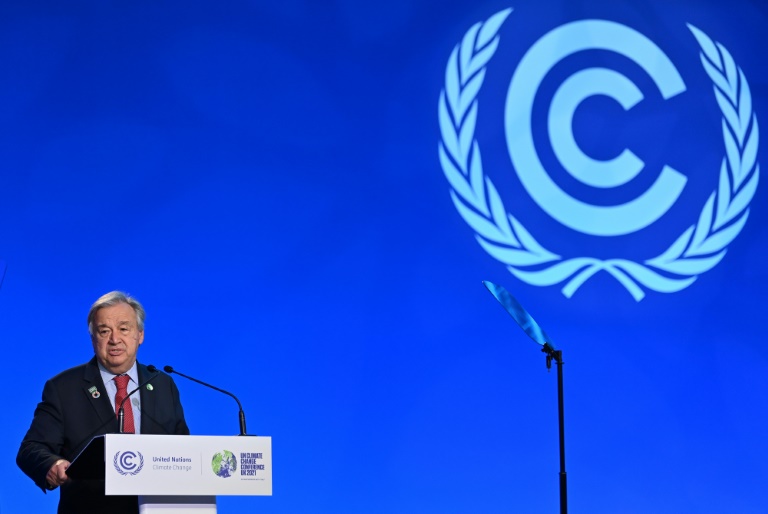
UN chief Antonio Guterres on Wednesday outlined what amounts to a global Marshall Plan for ushering in a world powered by renewable energy rather than coal, gas and oil.

To avoid catastrophic climate change, humanity must “end fossil fuel pollution and accelerate the renewable energy transition, before we incinerate our only home,” he said in prerecorded remarks timed to coincide with the release of a major UN state-of-climate report.

Renewable technologies should be treated as freely available “global public goods”, unconstrained by intellectual property, he said.

One option might be so-called patent pooling, as has been done by major drug companies to speed the delivery of life-saving drugs for HIV/AIDS and tuberculosis, noted a senior UN official who asked not to be named.  

“The Secretary-General believes that the conversation around intellectual property should happen because we are in a crisis,” the UN official said. 

“If we have a ready solution, why not relax intellectual property rules so that solution can help us solve this crisis?”

Guterres singled out battery storage, calling for an international coalition of industry, tech companies and financial institutions, led by governments, to “fast-track innovation and deployment”.

Solar and wind are the fastest growing clean energy technologies, but storing renewable electricity that can only be generated when the sun is shining or the wind blowing has been a persistent bottleneck for even more rapid rollout.

– Not fast enough –

It was unclear whether Guterres envisions a new oversight body or favours working through existing structures, such as the 86-nation International Solar Alliance or the G20 group of major economies.

The UN chief’s five-point plan to “jump-start” a renewables boom also called for scaling-up and diversifying the supply of critical components and raw materials, such as rare Earth metals.

Currently, lithium — crucial to the manufacture of electric vehicle batteries — is sourced from a handful of countries, with China controlling 80 percent of global refining, according to BloombergNEF.

Transitioning to clean energy will also require far greater supplies of copper, silicon, nickel, cobalt and other elements that are scarce and/or in high demand.

Europe alone is estimated to need 35 times more lithium than it uses today over the next three decades.

Expanding renewable capacity is forecast to account for almost 95 percent of the increase in global electricity through 2026, according to the International Energy Agency (IEA). 

But projected growth is not nearly fast enough to ensure the Paris Agreement target of capping global warming at 1.5 degrees Celsius above preindustrial levels.

Currently, solar and wind energy only account for eight percent of global electricity generation. Adding hydro and other renewable sources pushes the total up to 30 percent, with coal and gas still dominant overall.

– $11 million –

Guterres also said governments must cut red tape and streamline approvals for solar and wind projects.

The IEA has identified the issuing of permits and grid integration as major barriers to accelerating renewables deployment. 

“In Europe, it takes eight years for a wind project to be approved,” the UN official said. 

“In the United States, I understand that it can take as much as a decade at the federal level alone, where one needs to go through about 28 federal agencies.”

The UN Secretary-General also called for an end to approximately half-a-trillion dollars in fossil fuel subsidies, roughly two-thirds of which go to consumers and the rest directly to industry.

“Every minute of every day, coal, oil and gas receive roughly $11 million in subsidies,” Guterres said. 

“While people suffer from high prices at the pump, the oil and gas industry is raking in billions from a distorted market,” he added. “This scandal must stop.”

Finally, Guterres challenged private and public finance to scale up investment in solar and wind to at least $4 trillion a year, more than triple current levels.

Development banks and finance institutions should align their lending portfolios with the Paris treaty temperature targets by 2024, he said. 

UK inflation jumps to 40-year peak

Britain’s annual inflation rate surged to a 40-year high last month on rocketing energy costs, official data showed Wednesday, sparking opposition calls for the government to announce an emergency budget to combat a cost-of-living crisis.

Consumer prices index inflation hit 9.0 percent in April from 7.0 percent in March, the Office for National Statistics said in a statement.

The ONS estimated that April was the highest level since 1982, and the fastest rate since the current data series began in 1989.

Nations across the world are plagued by decades-high inflation as the Ukraine conflict pushes up energy and food prices, in turn forcing the Bank of England, the US Federal Reserve and others to ramp up interest rates.

The squeeze on UK household budgets tightened further in April due to tax hikes, while wages are failing to keep pace with inflation.

– ‘Global challenges’ –

“Countries around the world are dealing with rising inflation,” said British finance minister Rishi Sunak.

“Today’s inflation numbers are driven by the energy price cap rise in April, which in turn is driven by higher global energy prices.

“We cannot protect people completely from these global challenges but are providing significant support where we can, and stand ready to take further action.”

The main opposition Labour party, however, wants an emergency budget to help Britons cope with the cost-of-living crunch.

Labour finance spokeswoman Rachel Reeves described the inflation data as “a huge worry for families already stretched”.

“Today, Labour force a vote for an emergency budget and for a plan for growth.”

Labour is also calling for a windfall tax on the energy sector, which has been boosted as gas and oil prices rocketed on supply worries following key producer Russia’s invasion of Ukraine.

– ‘Apocalyptic’ –

Bank of England governor Andrew Bailey on Monday warned of an “apocalyptic” situation surrounding runaway food costs — which he said were fuelled by major wheat and cooking oil producer Ukraine finding itself unable to export its goods.

Addressing British MPs, Bailey spoke also of a “very real income shock” coming from surging energy and food prices.

Britain risks falling into recession with inflation expected to top 10 percent by the end of the year, the BoE warned earlier this month.

It came as the central bank hiked its main interest rate by a quarter-point to one percent to tackle inflation.

That was the fourth straight increase by the BoE, while its key rate now stands at the highest level since 2009.

– Energy cap –

UK consumer prices leapt in April after a cap on domestic gas and electricity was hiked due to spiking wholesale energy costs.

“Inflation rose steeply in April, driven by the sharp climb in electricity and gas prices as the higher price cap came into effect,” added ONS chief economist Grant Fitzner.

“Around three-quarters of the increase in the annual rate this month came from utility bills.”

Official data showed Tuesday that Britain’s unemployment rate has fallen further to a near five-decade low, but the value of wages continues to erode as inflation soars.

The economy shrank in March on fallout from soaring consumer prices, data showed last week, increasing the prospect of the country falling into recession.

Raised rates have lifted borrowing costs for consumers and businesses, further impacting spending.

Sony brings zero-carbon goal forward 10 years to 2040

Japanese giant Sony brought forward its deadline for reaching carbon neutrality by a decade on Wednesday, saying it is now targeting net-zero emissions across its business by 2040.

The electronics and entertainment firm said the decision was taken “as climate change risks become more apparent and serious worldwide, and the transition to a decarbonised society has become an urgent issue”.

Climate campaigners praised the move, but raised doubts over an element of how Sony aims to reach the goal — investing in new technology that removes carbon from the atmosphere or converts it into a less harmful compound.

Sony said it wants its own factories to be carbon neutral by 2030, also a decade earlier than its previous goal, and plans to reach that by increasing use of renewable power and energy-saving.

Eliminating emissions from areas “such as products, supply chains, and logistics”, however, is to be achieved in part by investing in start-ups focused on carbon removal and projects that encourage carbon absorption with so-called augmented ecosystems.

But that technology remains unproven, said Eri Watanabe, senior finance campaigner at Japanese climate group 350.org.

Sony’s announcement “is a positive signal that the company is serious about tackling climate change”, but these removal methods are “unproven, and (it is) uncertain if it can contribute to the decarbonisation pathway”, she said.

She said Sony could influence other Japanese firms to upgrade their climate targets but urged the company not to rely “on unproven technologies to reduce its emissions.”

UN climate experts say humanity has fewer than three years to halt the rise of planet-warming carbon emissions, and less than a decade to slash them by nearly half to have a shot at capping global warming at a target 1.5 degrees Celsius.

Japan, which is highly dependent on imported fossil fuels, aims to become carbon neutral by 2050. The country is the world’s sixth-biggest carbon emitter if the EU is counted as one bloc, according to European Commission data.

Sony brings zero-carbon goal forward 10 years to 2040

Japanese giant Sony brought forward its deadline for reaching carbon neutrality by a decade on Wednesday, saying it is now targeting net-zero emissions across its business by 2040.

The electronics and entertainment firm said the decision was taken “as climate change risks become more apparent and serious worldwide, and the transition to a decarbonised society has become an urgent issue”.

Climate campaigners praised the move, but raised doubts over an element of how Sony aims to reach the goal — investing in new technology that removes carbon from the atmosphere or converts it into a less harmful compound.

Sony said it wants its own factories to be carbon neutral by 2030, also a decade earlier than its previous goal, and plans to reach that by increasing use of renewable power and energy-saving.

Eliminating emissions from areas “such as products, supply chains, and logistics”, however, is to be achieved in part by investing in start-ups focused on carbon removal and projects that encourage carbon absorption with so-called augmented ecosystems.

But that technology remains unproven, said Eri Watanabe, senior finance campaigner at Japanese climate group 350.org.

Sony’s announcement “is a positive signal that the company is serious about tackling climate change”, but these removal methods are “unproven, and (it is) uncertain if it can contribute to the decarbonisation pathway”, she said.

She said Sony could influence other Japanese firms to upgrade their climate targets but urged the company not to rely “on unproven technologies to reduce its emissions.”

UN climate experts say humanity has fewer than three years to halt the rise of planet-warming carbon emissions, and less than a decade to slash them by nearly half to have a shot at capping global warming at a target 1.5 degrees Celsius.

Japan, which is highly dependent on imported fossil fuels, aims to become carbon neutral by 2050. The country is the world’s sixth-biggest carbon emitter if the EU is counted as one bloc, according to European Commission data.

Second endangered cheetah cub dies in Iran: state media

The second of three Asiatic cheetah cubs born in captivity in Iran has died in a blow to conservation efforts for the critically endangered subspecies, state media reported Wednesday.

“The cause of death of the cub is being investigated and the result will be announced after the post mortem,” environment department official Hassan Akbari told state news agency IRNA.

The announcement came just two weeks after a first cub from the litter died.

The cause of death was established as congenital malformation of the left lung, an environment department statement said.

The cubs were born in the Touran Wildlife Refuge by caesarean section on May 1, in what the department said was the first birth of an Asiatic cheetah in captivity.

The world’s fastest land animal, capable of speeds of up to 120 kilometres (75 miles) per hour, cheetahs once stalked habitats from the eastern borders of India to the Atlantic coast of Senegal.

They are still found in parts of southern Africa, but have practically disappeared from North Africa and Asia.

The Asiatic subspecies -– Acinonyx jubatus venaticus — is critically endangered, according to the International Union for Conservation of Nature.

Iran is the last country in the world where the Asiatic cheetah can be found in the wild. Authorities launched a United Nations-supported protection programme in 2001.

In January, deputy environment minister Hassan Akbari said only a dozen individuals were left in the wild — down from an estimated 100 in 2010.

Their situation “is extremely critical”, Akbari said, adding that animals had been lost to drought, hunters and car accidents.

Asian markets mixed after US retail data boosts Wall Street

Asian stocks were mixed Wednesday following a strong start in some markets, which took the lead from Wall Street where traders were cheered by brisk US retail sales data.

The US Federal Reserve’s tightening of monetary policy to contain surging inflation has sent jolts through global markets, deepening the apprehensions of investors already roiled by China’s Covid lockdowns and the Russian invasion of Ukraine.

But there was some good news out of the United States Tuesday, with data showing increased spending by Americans in April. Retail sales rose 0.9 percent — partly boosted by a rebound in auto purchases.

“The economy is slowing but the consumer still looks good and that means the economy is still positioned to avoid a recession,” said Edward Moya of OANDA. 

Industrial production also rose in April — “another sign the economy isn’t falling apart just yet”, he added.

Wall Street closed with gains, with the tech-rich Nasdaq jumping nearly three percent.

Tokyo, Sydney and Singapore rose in Wednesday trade, thanks to the bounce in New York.

By mid-morning, however, Hong Kong and Shanghai dipped into negative territory after a positive start.

The US consumer data added to the boost from China earlier this week, where authorities said Shanghai — the economic engine of the world’s second-largest economy — will “gradually reopen” businesses.

Most of the city’s 25 million people were placed under lockdown for weeks as authorities battled a major Covid outbreak.

Millions were still confined to their homes Wednesday as confusion abounded over official statements about achieving zero Covid cases.

But just the indication of an easing was enough to boost markets, which have been concerned about the impact of China’s lockdowns on the global economy — especially supply chains.

– Fed inflation plans –

Central banks around the world are concerned about skyrocketing prices, and on Tuesday Fed chair Jerome Powell said it needs to see “clear” evidence that inflation is coming down before pulling back on efforts to cool the economy.

He acknowledged that it may be a “bumpy” ride that would inflict some pain.

His comments were in line with market expectations, said Stephen Innes of SPI Asset Management. 

“Still, the debate is evolving among the active trading community from recessionary capitulation mode to one that is short and not a particularly deep recession,” he said. 

“So while this is a tacit acceptance that the Fed is in catch-up mode and is prepared to constrain demand to get inflation down, they are unlikely to do it in a jackhammer fashion.”

– Key figures at around 0245 GMT –

Hong Kong – Hang Seng Index: DOWN 0.7 percent at 20,455.05 

Shanghai – Composite: DOWN 0.4 percent at 3,081.19 

Tokyo – Nikkei 225: UP 0.7 percent at 26,851.15 (break)

Brent North Sea crude: UP 0.5 percent at $112.50 per barrel

West Texas Intermediate: UP 1.1 percent at $113.50 per barrel

Euro/dollar: DOWN at $1.0533 from $1.0550 at 2030 GMT Tuesday

Pound/dollar: DOWN at $1.2476 from $1.2486

Euro/pound: DOWN at 84.43 pence from 84.47 pence 

Dollar/yen: DOWN at 129.18 yen from 129.37 yen

New York – Dow: UP 1.3 percent at 32,654.59 (close)

London – FTSE 100: UP 0.7 percent at 7,518.35 (close)

Pakistan and IMF to meet over release of funds as economy falters

The International Monetary Fund will begin talks with Pakistani officials on Wednesday over the release of crucial funds, a process slowed by concerns about the pace of economic reforms in the South Asian country.

Pakistan has repeatedly sought international support for its economy, which has been hit by crippling national debt, galloping inflation and a plummeting rupee.

The talks will be held in the Qatari capital Doha, Pakistan’s finance ministry said, and are expected to continue into next week. 

A major sticking point is likely to be over costly subsidies — notably for fuel and electricity — and Finance Minister Miftah Ismail said he wants the two sides to “find a middle ground”.

“The government will try to convince the IMF that for political stability purposes it is important to keep at least some of the subsidies,” said economist Shahrukh Wani. 

“The IMF will possibly, rightly, say that these are unsustainable and they should be rolled back to make the trade and budget deficit manageable,” he added.

A six billion dollar IMF bailout package signed by former prime minister Imran Khan in 2019 has never been fully implemented because his government reneged on agreements to cut or end some subsidies and to improve revenue and tax collection.

Islamabad has so far received $3 billion, with the programme due to end later this year.

Officials are seeking an extension to the programme through to June 2023, as well as the release of the next tranche of $1 billion.

Pakistani Prime Minister Shehbaz Sharif, who took power with a coalition that removed Khan in a no-confidence vote last month, has vowed to jumpstart the moribund economy, but analysts say his fragile government has failed to take tough decisions. 

“It’s an administration that has refused to take hard political steps to bring eventual economic relief — but that’s exactly the sacrifice it must make by going to the IMF,” said Michael Kugelman, deputy South Asia director at the Wilson Center in Washington.

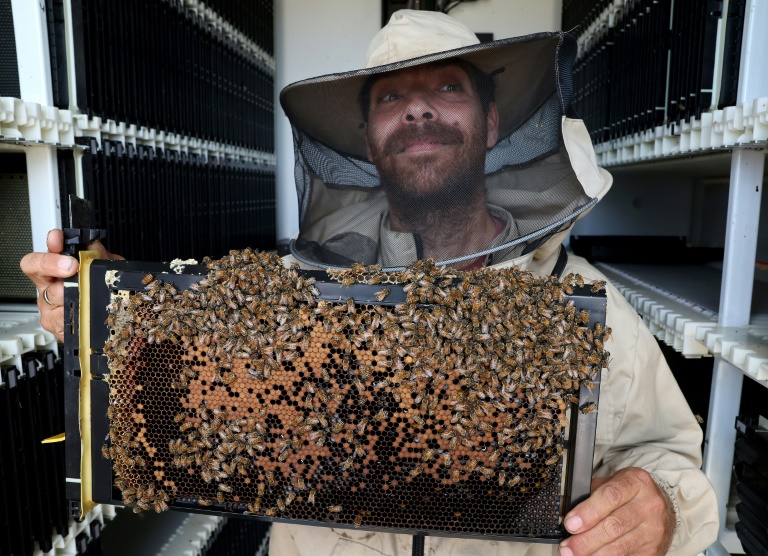
Robot hives in Israel kibbutz hope to keep bees buzzing

They function as normal hives, but apiaries built at a kibbutz in Israel’s Galilee are decked out with high-tech artificial intelligence systems set to ensure longevity for these vital pollinators.

“There are two million bees here,” said Shlomki Frankin as he walks into a 12-square-metre container in Kibbutz Beit Haemek in northern Israel.

Dubbed “Beehome”, the project is the brainchild of an Israeli startup and houses up to 24 hives, explained Frankin, clad in a hat and veil to protect himself from stings.

The 41-year-old told AFP that the hives feature a multi-purpose robot that does everything from monitor the bees to adjust the habitat and provide them with care.

Startup Beewise came up with the idea in an effort to reduce mortality rates in a species that has in the past years seen sharp rates of decline due to environmental threats.

– Artificial intelligence –

“The robot is equipped with sensors that allow it to know what is happening in the hive frames,” said Netaly Harari, director of operations at Beewise.

“Thanks to artificial intelligence, our software knows what the bees need,” she explained in the workshop where the hives are assembled.

The robots can automatically dispense sugar, water and medication.

If a problem comes up, the beekeeper is alerted through an application, allowing for intervention remotely via computer, or in person if necessary.

The hives operate on solar energy, have adjustable temperatures, eliminate pests and can even extract honey automatically using an integrated centrifuge, Harari said.

By the end of May, the startup hopes to be producing its own honey for the first time — the “first honey in the world made with artificial intelligence”, she enthused.

For Frankin, “the robot is a tool for beekeepers, but doesn’t replace them”.

They “save a lot of time”, he continued, because they allow him to “do a lot of simple things remotely”.

About a hundred of these high-tech hives are already functional in Israel, with a dozen others sent to the United States.

Beewise is eyeing a foothold in the European market in two years.

Launched in 2018, the startup has 100 employees and by April had raised about $80 million to develop its exports.

– World Bee Day – 

According to professor Sharoni Shafir, who heads the bee research centre at the Hebrew University of Jerusalem’s Rehovot campus, the technology can help protect increasingly threatened bee colonies.

“Sometimes, a beekeeper takes several months to realise there is a problem,” he told AFP, adding that “with the robot, beekeepers can deal with the problem in real-time, reducing the bees’ mortality rates”.

One in every six species of bees have gone regionally extinct somewhere in the world, with the main drivers thought to be habitat loss and pesticide use, according to a 2019 study. 

Shafir points in particular to the “decline in fields of flowers due to construction, which has reduced the sources and diversity of food for bees”.

Added to that are diseases and pests, such as the varroa destructor, a mite that has a devastating effect on honeybees, the professor added.

“In Israel, between 20 and 30 percent of hives disappear every year,” the entomologist said.

He noted that a significant portion of foods consumed by people are the result of cross-pollination by bees and other insects.

More than 70 percent of crops, including almost all fruits, vegetables, oilseeds, spices, coffee and cocoa are dependent on pollinators.

The United Nations’ Food and Agriculture Organization on May 20 celebrates World Bee Day, which aims to underline the importance of preserving bee species.

“Bees and other pollinators have thrived for millions of years, ensuring food security and nutrition, and maintaining biodiversity and vibrant ecosystems,” FAO has said.

“We depend on bees,” Shafir emphasised.

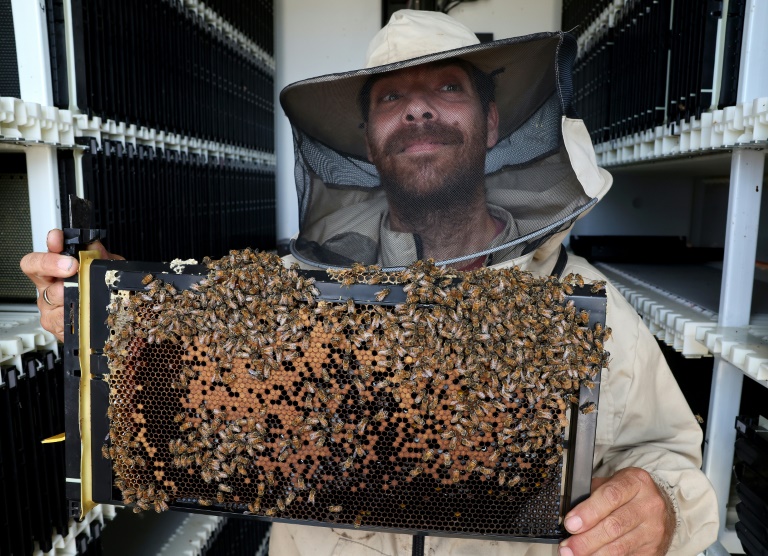
Robot hives in Israel kibbutz hope to keep bees buzzing

They function as normal hives, but apiaries built at a kibbutz in Israel’s Galilee are decked out with high-tech artificial intelligence systems set to ensure longevity for these vital pollinators.

“There are two million bees here,” said Shlomki Frankin as he walks into a 12-square-metre container in Kibbutz Beit Haemek in northern Israel.

Dubbed “Beehome”, the project is the brainchild of an Israeli startup and houses up to 24 hives, explained Frankin, clad in a hat and veil to protect himself from stings.

The 41-year-old told AFP that the hives feature a multi-purpose robot that does everything from monitor the bees to adjust the habitat and provide them with care.

Startup Beewise came up with the idea in an effort to reduce mortality rates in a species that has in the past years seen sharp rates of decline due to environmental threats.

– Artificial intelligence –

“The robot is equipped with sensors that allow it to know what is happening in the hive frames,” said Netaly Harari, director of operations at Beewise.

“Thanks to artificial intelligence, our software knows what the bees need,” she explained in the workshop where the hives are assembled.

The robots can automatically dispense sugar, water and medication.

If a problem comes up, the beekeeper is alerted through an application, allowing for intervention remotely via computer, or in person if necessary.

The hives operate on solar energy, have adjustable temperatures, eliminate pests and can even extract honey automatically using an integrated centrifuge, Harari said.

By the end of May, the startup hopes to be producing its own honey for the first time — the “first honey in the world made with artificial intelligence”, she enthused.

For Frankin, “the robot is a tool for beekeepers, but doesn’t replace them”.

They “save a lot of time”, he continued, because they allow him to “do a lot of simple things remotely”.

About a hundred of these high-tech hives are already functional in Israel, with a dozen others sent to the United States.

Beewise is eyeing a foothold in the European market in two years.

Launched in 2018, the startup has 100 employees and by April had raised about $80 million to develop its exports.

– World Bee Day – 

According to professor Sharoni Shafir, who heads the bee research centre at the Hebrew University of Jerusalem’s Rehovot campus, the technology can help protect increasingly threatened bee colonies.

“Sometimes, a beekeeper takes several months to realise there is a problem,” he told AFP, adding that “with the robot, beekeepers can deal with the problem in real-time, reducing the bees’ mortality rates”.

One in every six species of bees have gone regionally extinct somewhere in the world, with the main drivers thought to be habitat loss and pesticide use, according to a 2019 study. 

Shafir points in particular to the “decline in fields of flowers due to construction, which has reduced the sources and diversity of food for bees”.

Added to that are diseases and pests, such as the varroa destructor, a mite that has a devastating effect on honeybees, the professor added.

“In Israel, between 20 and 30 percent of hives disappear every year,” the entomologist said.

He noted that a significant portion of foods consumed by people are the result of cross-pollination by bees and other insects.

More than 70 percent of crops, including almost all fruits, vegetables, oilseeds, spices, coffee and cocoa are dependent on pollinators.

The United Nations’ Food and Agriculture Organization on May 20 celebrates World Bee Day, which aims to underline the importance of preserving bee species.

“Bees and other pollinators have thrived for millions of years, ensuring food security and nutrition, and maintaining biodiversity and vibrant ecosystems,” FAO has said.

“We depend on bees,” Shafir emphasised.

Close Bitnami banner
Bitnami