AFP

Some Trump China tariffs impose 'more harm on consumers, businesses': Yellen

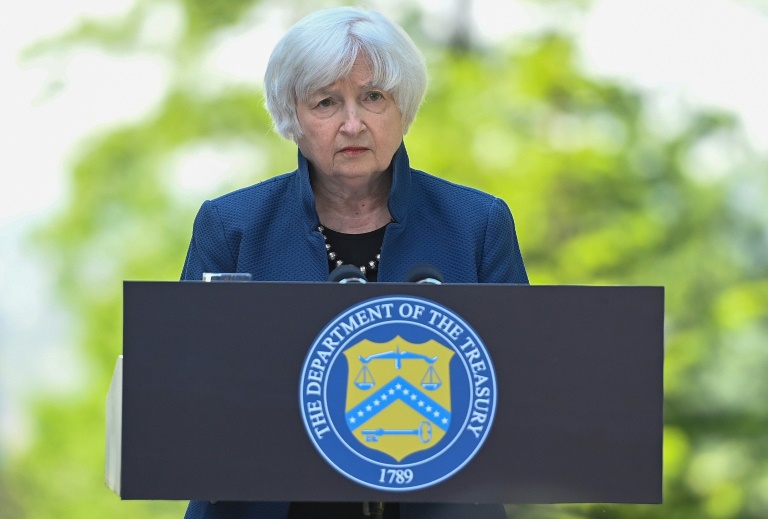
Some of the Trump-era tariffs imposed on China appear to hurt consumers and businesses more than address real issues posed by the Asian giant, US treasury secretary Janet Yellen said Wednesday, as the Biden administration mulls lifting the punitive duties.

American tariffs on hundreds of billions of dollars of Chinese imports are due to expire in July, and President Joe Biden has faced growing calls to get rid of the punitive duties to help combat the highest US inflation in over four decades.

Speaking at a press conference in Germany, Yellen voiced support for such a move.

Some of the tariffs imposed by former president Donald Trump “seem as though they impose more harm on consumers and businesses and aren’t very strategic in the sense of addressing real issues we have with China, whether it concerns supply chain vulnerabilities, national security issues or other unfair trade practices,” she said.

“And so I see a case not only because of inflation, but because there would be benefits to consumers and firms… that some relief could come from cutting some of them,” she told reporters ahead of a G7 finance ministers meeting in Koenigswinter, near Bonn.

“But we’re having these discussions,” she added.

– Political risk –

Biden said earlier this month he was “discussing” lifting trade tariffs on China, but that no decision had been made yet.

Supporters of the step argue that ending the tariffs would cut roaring US inflation by making imports cheaper.

But lifting the measures would likely bring a political risk for the White House, which does not want to be branded weak on China.

The tariffs were first imposed in 2018, eventually ramping up to cover about $350 billion in annual imports from China in retaliation for Beijing’s theft of American intellectual property and forced transfer of technology.

The measures will lapse July 6 unless there is a request to continue them, at which point they would be subject to review.

US trade officials said earlier this month they are reaching out to the public to seek comment on whether to extend the tariffs, including sending letters to 600 firms that expressed support for the measures.

Foreign companies have long complained about Beijing’s failure to protect know-how and patents, including in some cases forcing firms to share information with domestic partners as the price for doing business in the massive Chinese market.

Prior to Trump, US administrations had sought to resolve the issues through dialogue and gentle pressure, but the Republican president pulled out all the stops, sparking retaliation from Beijing on US goods.

Why record wheat prices are a global worry

Consumed daily by billions of people around the world in bread and other flour-based products, wheat is a basic food staple, making current record prices for the cereal a global concern. 

Low rainfall or droughts in major producing countries were already causing worries before Russia’s invasion of Ukraine in February sent markets soaring.

Since then, wheat-exporting powerhouse Ukraine has struggled to sell and sow its crops, putting consumers in poor countries at risk of poverty and even famine

Sebastien Abis, head of the Demeter agricultural think tank in Paris and an expert at the Institute for International and Strategic Relations, explains what’s at stake: 

– Is it possible to replace wheat with something else? –

“It’s very difficult. Wheat is the most important cereal for global food security: it is eaten by billions of humans in the form of bread, flour or semolina. 

“Corn is grown in larger quantities but is mostly used for animal feed or for industrial purposes.

“Beyond its nutritional qualities, wheat is a very social and democratic product, enabling people to make low-cost food — and it is often subsidised.”

– But prices are putting it beyond the reach of consumers in some countries such as Lebanon or Yemen? –

“Yes, because of shortages and because you can’t produce it just anywhere. You can grow it in temperate climates, but there are only a dozen countries that produce a lot and can export it, particularly Russia, Ukraine, the United States, Australia.

“In recent years, the United States has produced less and less because they are switching to corn and soya . After the Soviet period, the two countries that surged ahead were Ukraine and Russia. 

“Ukraine accounted for 12-13 percent of global exports in recent years.”

– Is the lack of Ukrainian production the reason for the current situation? –

“We have at the same time a dreadful geopolitical situation, with multilateralism faltering, to which we must add worrying climatic events, with droughts in the southern Mediterranean basin, worries in the United States and in Europe. 

“India, which had an exceptional harvest last year and reserves that enabled it to sell more on the markets, has been hit with a terrible drought and will not be able to export. 

“Prices that were already high before the war are now exploding: wheat reached 440 euros ($463) a tonne on the Euronext market on Monday.”

– That came after India announced it would no longer export wheat. Why? –

“India had announced a rather ambitious target of exporting 10 million tonnes. It had sold around 3-3.5 million tonnes before it put its export ban in place, so one of the questions is whether it will honour its commitments.

“The situation is tense because there’s no country that can put more than usual into the export market. Perhaps Russia will if it has a good harvest. 

“But even if the war stopped, Ukraine’s production and exports will not bounce back immediately.”

– Have we reached the peak of the crisis, ahead of the harvests in the US and Europe this summer? 

“We have real long-term risks. We still haven’t seen all the shocks, because on global markets for the last two months we’ve been seeing fulfilments of contracts signed before the Russian invasion. We’re now entering the hard part.” 

– What about stocks? – 

“For wheat, we have around 270 million tonnes for a planet that consumes around 800 million a year. Around half are in China which has one year’s consumption in reserve. Excluding China, cereal stocks are at their lowest level in 25 years. 

“We need international solidarity and cooperation. We can’t leave countries to struggle on their own for food security but at the same time you can’t be surprised that some countries are looking out for themselves first and foremost.

“We need to produce everywhere where we can produce, notably in Africa. But for that we need peace and security”. 

Climate change indicators hit record highs in 2021: UN

Four key climate change indicators all set new record highs in 2021, the United Nations said Wednesday, warning that the global energy system was driving humanity towards catastrophe.

Greenhouse gas concentrations, sea level rise, ocean heat and ocean acidification all set new records last year, the UN’s World Meteorological Organization (WMO) said in its “State of the Global Climate in 2021” report.

The annual overview is “a dismal litany of humanity’s failure to tackle climate disruption”, UN chief Antonio Guterres said.

“The global energy system is broken and bringing us ever closer to climate catastrophe.”

The WMO said human activity was causing planetary-scale changes on land, in the ocean and in the atmosphere, with harmful and long-lasting ramifications for ecosystems.

WMO chief Petteri Taalas said the war in Ukraine had been overshadowing climate change, which “is still the biggest challenge we are having as mankind”.

– Record heat –

The report confirmed the past seven years were the top seven hottest years on record.

Back-to-back La Nina events at the start and end of 2021 had a cooling effect on global temperatures last year.

Even so, it was still one of the warmest years ever recorded, with the average global temperature in 2021 about 1.11 degrees Celsius above the pre-industrial level.

The 2015 Paris Agreement on climate change saw countries agree to cap global warming at “well below” 2C above average levels measured between 1850 and 1900 — and 1.5C if possible.

“All major climate indicators are quite frankly heading in the wrong direction and without much greater ambition and urgency, we are about to lose the narrow window of opportunity to keep the 1.5-degree goal alive,” Guterres’ climate action advisor Selwin Hart told a press conference.

Taalas said the climate was changing “before our eyes”.

“The heat trapped by human-induced greenhouse gases will warm the planet for many generations to come. Sea level rise, ocean heat and acidification will continue for hundreds of years unless means to remove carbon from the atmosphere are invented,” he said.

– ‘Consistent picture of warming world’ –

Four key indicators of climate change “build a consistent picture of a warming world that touches all parts of the Earth system”, the report said.

Greenhouse gas concentrations reached a new global high in 2020, when the concentration of carbon dioxide (CO2) reached 413.2 parts per million globally, or 149 percent of the pre-industrial level.

Data indicate they continued to increase in 2021 and early 2022, the report said.

Taalas reiterated Covid-19 lockdowns had had no impact on atmospheric greenhouse gases concentrations.

Global mean sea level reached a new record high in 2021, rising an average of 4.5 millimetres per year throughout 2013 to 2021, the report said.

That is more than double the average annual rise of 2.1 mm per year between 1993 and 2002, with the increase between the two time periods “mostly due to the accelerated loss of ice mass from the ice sheets”, it said.

Taalas said the melting of glaciers would raise sea levels for hundreds or thousands of years to come, due to CO2 concentrations in the atmosphere.

“This is a lost game already,” he said.

– Price of failure –

Ocean heat hit a record high last year, exceeding the 2020 value, the report said. 

And it is expected the upper 2,000 metres of the ocean will continue to warm in the future — “a change which is irreversible on centennial to millennial timescales”, said the WMO.

The ocean absorbs around 23 percent of the annual emissions of human-caused CO2 into the atmosphere. While this slows the rise of atmospheric CO2 concentrations, CO2 reacts with seawater and leads to ocean acidification.

The UN’s Intergovernmental Panel on Climate Change concluded with “very high confidence” that open ocean surface acidity is at the highest “for at least 26,000 years”.

“We should take action now,” Taalas told AFP.

“We are now heading 2.5 to three degrees warming instead of 1.5, which would be best for our future.

“It is better to invest in climate-friendly technologies than to live with the consequences of climate change that are going to be even 20 times more expensive if we fail.”

European and US stocks slide on inflation worries

US and European stock markets slid Wednesday as inflation data and corporate reports stoked investor fears about recession and earnings.

News that UK inflation has spiked to a 40-year peak of nine percent in April helped push London stocks 0.4 percent lower in afternoon trading.

The figure also sent the pound sliding on worries that the cost-of-living crisis will spark a recession in Britain, in line with the Bank of England’s recent forecast.

In the eurozone, Frankfurt shed 0.6 percent and Paris 0.8 percent in value.

On Wall Street, all three major stock indices opened lower on worries high inflation will erode corporate earnings.

– Recession ‘increasingly inevitable’ –

“A recession is looking increasingly inevitable in the UK and other countries… if the inflation data does not improve,” OANDA analyst Craig Erlam told AFP.

“That does not bode well for equity markets.”

The technical definition of a recession is two quarters of economic contraction in a row.

Investors remain on red alert over decades-high inflation, which has surged around the world as Russia’s invasion of Ukraine fuels spiking energy and food prices.

That in turn has sparked interest rate hikes from major central banks including the Bank of England and the US Federal Reserve, as they seek to contain runaway prices.

Concerns that companies will have trouble were raised by the latest earnings from US retailer Target, which saw its profits fail to meet analyst expectations despite higher-than-expected sales.

Target’s “report is a stark example of the profit margin pressures most companies are facing due to high inflation and it has stoked concerns about being stuck in a stagflation environment,” said market analyst Patrick O’Hare at Briefing.com.

Stagflation is when an economy experiences high inflation and little or no growth.

Target’s shares plunged by more than a quarter as trading got underway on Wall Street.

Asian equities traded mixed on Wednesday, despite strong Wall Street gains after brisk US retail sales data, although strong data is likely to invite further interest rate hikes by the Federal Reserve.

The Fed’s monetary policy tightening has sent jolts through markets this year, deepening the apprehension of investors already roiled by China’s Covid-19 lockdowns and Russia’s invasion of Ukraine.

Despite recession concerns, oil prices pushed higher.

“Oil prices are on the rise again as Shanghai takes a big step towards reopening following three days of no new cases in the broader community,” said OANDA’S Erlam.

– Key figures at around 1330 GMT –

London – FTSE 100: DOWN 0.4 percent at 7,485.25 points

Frankfurt – DAX: DOWN 0.6 percent at 14,095.25

Paris – CAC 40: DOWN 0.8 percent at 6,380.63

EURO STOXX 50: DOWN 0.7 percent at 3,616.00

New York – Dow: DOWN 0.9 percent at 32,368.19

Hong Kong – Hang Seng Index: UP 0.2 percent at 20,644.28 (close)

Shanghai – Composite: DOWN 0.3 percent at 3,085.98 (close)

Tokyo – Nikkei 225: UP 0.9 percent at 26,911.20 (close)

Brent North Sea crude: UP 1.0 percent at $113.07 per barrel

West Texas Intermediate: UP 1.4 percent at $113.97 per barrel

Euro/dollar: DOWN at $1.0520 from $1.0550 at 2100 GMT Tuesday

Pound/dollar: DOWN at $1.2407 from $1.2493

Euro/pound: UP at 84.79 pence from 84.45 pence

Dollar/yen: DOWN at 128.74 yen from 129.38 yen

burs-rl/lth

China calls for urgent boost to virus-hit economy

China’s premier called for greater “urgency” in rolling out measures to support the virus-battered economy, state media reported Wednesday, days after data highlighted the stark impact of Covid-19 restrictions.

China — the last major global economy sticking to a rigid zero-Covid policy — is battling an economic slump due to prolonged virus lockdowns that have constricted supply chains, quelled demand and stalled manufacturing.

“All localities and departments should step up their sense of urgency, and new measures that can be used should be used,” Li Keqiang said at a symposium on Wednesday, according to state broadcaster CCTV.

He added that efforts to support the economy should bring it “back to normal quickly” after admitting that indicators have “weakened significantly” since March, with a particular dip in April.

On Monday, data showed retail sales and factory output last month had slumped the most since the start of the pandemic, while unemployment edged back toward its February 2020 peak.

Beijing’s unrelenting approach to Covid-19 outbreaks has snarled supply chains and locked down tens of millions of people, hitting major financial, industrial and tourist hubs.

The country’s borders also remain closed to most foreign travellers and a slew of international sports events have been scrapped over pandemic concerns.

China has targeted full-year growth of around 5.5 percent, but data published in April showed that first-quarter growth slowed to 4.8 percent after the world’s second-biggest economy lost steam in the latter half of last year.

And the economic targets have a political dimension for Chinese leader Xi Jinping, who is eyeing another term in power.

Xi has pinned his legacy to China’s strong economic growth and winning the “battle” against Covid.

But the current outbreak is the country’s worst since the virus emerged in Wuhan in late 2019, and the economy is beginning to weaken. 

– Tech support –

Li also called Wednesday for backing Chinese tech companies’ bids to list domestically and abroad, a day after Communist Party leaders doubled down on support for the tech sector in a rare meeting with executives.

China’s economic slowdown appears to have motivated a softer approach toward the vast, money-spinning tech sector, after an 18-month clampdown driven by fears massive internet companies control too much data and expanded too quickly.

Vice Premier Liu He and other Communist leaders addressed executives, including Robin Li of Baidu — universally used for its search engine and mapping service — and Zhou Hongyi of internet security firm Qihoo 360, state media reported late Tuesday.

Liu offered support for “the sustainable and healthy development of the platform economy and the private economy,” CCTV said.

During the tech crackdown, overseas IPOs from Alibaba’s Ant Group and Didi Chuxing — China’s Uber — were spiked, while millions of dollars of fines over anti-trust and data breaches were ladled out to tech giants. 

Chinese tech shares surged late April after officials pledged support for internet firms at a Politburo meeting.

Tech giants including Alibaba, Tencent and Baidu were marginally lower Wednesday morning, with e-commerce behemoth JD slumping over 4 percent after it recorded a 3 billion yuan ($444 million) loss in first-quarter earnings. 

On Wednesday, Tencent reported record-low quarterly revenue growth at nearly zero, reaching the slowest pace since the company went public in 2004.

Climate change indicators hit record highs in 2021: UN

Four key climate change indicators all set new record highs in 2021, the United Nations said Wednesday, warning that the global energy system was driving humanity towards catastrophe.

Greenhouse gas concentrations, sea level rise, ocean heat and ocean acidification all set new records last year, the UN’s World Meteorological Organization (WMO) said in its “State of the Global Climate in 2021” report.

The annual overview is “a dismal litany of humanity’s failure to tackle climate disruption”, UN chief Antonio Guterres said.

“The global energy system is broken and bringing us ever closer to climate catastrophe.”

The WMO said human activity was causing planetary-scale changes on land, in the ocean and in the atmosphere, with harmful and long-lasting ramifications for ecosystems.

WMO chief Petteri Taalas said the war in Ukraine had been overshadowing climate change, which “is still the biggest challenge we are having as mankind”.

– Record heat –

The report confirmed the past seven years were the top seven hottest years on record.

Back-to-back La Nina events at the start and end of 2021 had a cooling effect on global temperatures last year.

Even so, it was still one of the warmest years ever recorded, with the average global temperature in 2021 about 1.11 degrees Celsius above the pre-industrial level.

The 2015 Paris Agreement on climate change saw countries agree to cap global warming at “well below” 2C above average levels measured between 1850 and 1900 — and 1.5C if possible.

“All major climate indicators are quite frankly heading in the wrong direction and without much greater ambition and urgency, we are about to lose the narrow window of opportunity to keep the 1.5-degree goal alive,” Guterres’ climate action advisor Selwin Hart told a press conference.

Taalas said the climate was changing “before our eyes”.

“The heat trapped by human-induced greenhouse gases will warm the planet for many generations to come. Sea level rise, ocean heat and acidification will continue for hundreds of years unless means to remove carbon from the atmosphere are invented,” he said.

– ‘Consistent picture of warming world’ –

Four key indicators of climate change “build a consistent picture of a warming world that touches all parts of the Earth system”, the report said.

Greenhouse gas concentrations reached a new global high in 2020, when the concentration of carbon dioxide (CO2) reached 413.2 parts per million globally, or 149 percent of the pre-industrial level.

Data indicate they continued to increase in 2021 and early 2022, the report said.

Taalas reiterated Covid-19 lockdowns had had no impact on atmospheric greenhouse gases concentrations.

Global mean sea level reached a new record high in 2021, rising an average of 4.5 millimetres per year throughout 2013 to 2021, the report said.

That is more than double the average annual rise of 2.1 mm per year between 1993 and 2002, with the increase between the two time periods “mostly due to the accelerated loss of ice mass from the ice sheets”, it said.

Taalas said the melting of glaciers would raise sea levels for hundreds or thousands of years to come, due to CO2 concentrations in the atmosphere.

“This is a lost game already,” he said.

– Price of failure –

Ocean heat hit a record high last year, exceeding the 2020 value, the report said. 

And it is expected the upper 2,000 metres of the ocean will continue to warm in the future — “a change which is irreversible on centennial to millennial timescales”, said the WMO.

The ocean absorbs around 23 percent of the annual emissions of human-caused CO2 into the atmosphere. While this slows the rise of atmospheric CO2 concentrations, CO2 reacts with seawater and leads to ocean acidification.

The UN’s Intergovernmental Panel on Climate Change concluded with “very high confidence” that open ocean surface acidity is at the highest “for at least 26,000 years”.

“We should take action now,” Taalas told AFP.

“We are now heading 2.5 to three degrees warming instead of 1.5, which would be best for our future.

“It is better to invest in climate-friendly technologies than to live with the consequences of climate change that are going to be even 20 times more expensive if we fail.”

World's tallest building engulfed as Mideast sandstorms hit UAE

The world’s tallest building disappeared behind a grey layer of dust on Wednesday as sandstorms that have swept the Middle East hit the United Arab Emirates, prompting weather and traffic warnings.

The 828-metre (2,716 ft, 6ins) Burj Khalifa, which towers over Dubai and is usually visible across the busy financial hub, retreated behind a curtain of airborne dirt that shrouded much of the country.

The UAE is just the latest country in the path of sandstorms that have smothered Iraq, Kuwait, Saudi Arabia, Iran and others in recent days, closing airports and schools and sending thousands to hospital with breathing problems.

Capital city Abu Dhabi’s air quality index (AQI) soared into the “hazardous” zone overnight, according to waqi.info and the Plume pollution app.

The Middle East’s sandstorms are becoming more frequent and intense, a trend associated with overgrazing and deforestation, overuse of river water and more dams. 

Experts say the phenomenon could worsen as climate change warps regional weather patterns and drives desertification.

Emirati authorities issued a nationwide warning urging residents to remain vigilant.

“Abu Dhabi Police urges drivers to be cautious due to low visibility during high winds and dust,” the police force tweeted, as residents took to social media to publish photos and videos.   

“Please do not be distracted by taking any videos or using your phone,” it added.

– ‘Hazardous weather’ –

A National Center for Meteorology graphic showed nearly all the country covered by the storm, with the warning: “Be on the alert: hazardous weather events are expected.”

Winds with speeds up to 40 kilometres (25 miles) per hour are blowing the dust, it said, reducing visibility in some areas to less than 2,000 metres (2,200 yards).

However, a Dubai airports spokesman said there was no impact on air traffic. Weather conditions were expected to remain the same for the next few days.

In neighbouring Saudi Arabia, badly hit on Tuesday, conditions eased in the capital Riyadh on Wednesday but continued to restrict visibility in the city centre.

Emergency rooms in Riyadh hospitals received some 1,285 people suffering from respiratory problems over 24 hours from the sandstorm, the state-run Al-Ekhbariya channel reported late on Tuesday.

The Saudi national weather centre reported that dust was also affecting visibility in the west and south, specifically in Assir, Najran, Hael and Medina provinces. Medina is home to Medina city, the second-holiest city in Islam.

The centre predicted another sandstorm would arrive in the kingdom by Sunday.

Pollution behind 1 in 6 global deaths in 2019: study

Pollution caused some 9 million people to die prematurely in 2019, according to a new global report published Wednesday, with experts raising alarm over increasing deaths from breathing outside air and the “horrifying” toll of lead poisoning.    

Human-created waste in the air, water and soil rarely kills people immediately, but causes instead heart disease, cancer, respiratory problems, diarrhoea and other serious illnesses.  

The Lancet Commission on pollution and health said the impact from pollution on global health remains “much greater than that of war, terrorism, malaria, HIV, tuberculosis, drugs and alcohol”. 

Pollution is an “existential threat to human health and planetary health, and jeopardises the sustainability of modern societies,” it added.

In general, the review found, air pollution — accounting for a total of 6.7 million deaths globally in 2019 — was “entwined” with climate change because the main source of both problems is burning fossil fuels and biofuels.  

“If we can’t manage to grow in a clean and green way, we’re doing something terribly wrong,” said the report’s lead author Richard Fuller, of the Global Alliance on Health and Pollution, adding that chemical pollution also harms biodiversity — another major global threat. 

“These things are terribly connected and strategies to deal with one have ripple effects all the way through,” he said.

Overall, one in six premature deaths globally — or nine million — were caused by pollution, a figure unchanged since the last assessment in 2015. 

Researchers noted a reduction in mortality linked to indoor air pollution, unsafe drinking water and inadequate sanitation, with major improvements seen in Africa.  

But early deaths associated with industrialisation — outdoor air and chemical pollution — are on the rise, particularly in southern and eastern Asia. 

Ambient air pollution caused some 4.5 million deaths in 2019, according to the study, published in Lancet Planetary Health, compared with 4.2 million in 2015 and just 2.9 million in 2000. 

Chemical pollution is also increasing, with lead poisoning alone causing 900,000 deaths. Even that, the report warned, is likely a “substantial undercount” in light of new research suggesting there is no safe level of exposure.

– Harmful to children –

Algeria banned lead in petrol in 2021, the last country to do so. 

But people continue to be exposed to the toxic substance, largely due to unregulated recycling of lead-acid batteries and e-waste. Contaminated culinary spices are also a culprit.   

“The fact that lead is getting worse, mostly in poorer countries, and ramping up in terms of the number of deaths, is horrifying,” said Fuller.

Heart disease is the cause of almost all early deaths from exposure to lead, which hardens arteries, said Fuller. 

But elevated lead levels in blood — estimated to affect hundreds of millions of children — also harm brain development and are linked to serious losses of cognitive function. 

The report said lead is also linked to a spike in behavioural disorders and diminished economic productivity, with global economic losses estimated at almost $1 trillion annually. 

In Africa, economic losses from lead-related IQ loss are equivalent to about four percent of gross domestic product, while in Asia it amounts to two percent. 

– Silent killer –

Overall, excess deaths due to pollution have led to economic losses totalling $4.6 trillion in 2019, or around six percent of global economic output, researchers said.

Low- and middle-income countries are by far the most affected, with more than 90 percent of deaths in these regions.

There is also increasing evidence of pollution crossing national boundaries in wind, water and the food chain.  

Wealthier nations that have reduced domestic outdoor air pollution effectively “displace” it overseas to countries with higher levels of manufacturing, the report said.

Prevailing global winds transport air pollution from east Asia to North America, from North America to Europe, and from Europe to the Arctic and central Asia. 

Meanwhile, cereals, seafood, chocolate and vegetables produced for export in developing countries can be contaminated as a result of soil and water polluted with lead, arsenic, cadmium, mercury and pesticides. 

This “increasingly threatens global food safety”, the report said, adding that “toxic metals found in infant formula and baby foods are of particular concern.”

Fuller said the threat of pollution — particularly air and lead pollution — is underappreciated, with more attention focused on the health implications of microplastics. 

“We can show a million people dying from lead pollution right now — more than die from malaria, more than die from HIV — and that’s not even discussed,” he said.

Asian markets mixed after US retail data boosts Wall Street

Asian stocks were mixed Wednesday following a strong start in some markets, which took the lead from Wall Street where traders were cheered by brisk US retail sales data.

The US Federal Reserve’s tightening of monetary policy to contain surging inflation has sent jolts through global markets, deepening the apprehensions of investors already roiled by China’s Covid-19 lockdowns and the Russian invasion of Ukraine.

But there was some good news out of the United States, with data showing increased spending by Americans in April. Retail sales rose 0.9 percent — partly boosted by a rebound in auto purchases.

“The economy is slowing but the consumer still looks good and that means the economy is still positioned to avoid a recession,” said Edward Moya of OANDA. 

Industrial production also rose in April — “another sign the economy isn’t falling apart just yet”, he added.

Wall Street closed with gains, with the tech-rich Nasdaq jumping nearly three percent.

Tokyo, Sydney and Singapore stayed up in Wednesday’s trade thanks to the bounce in New York, while Hong Kong and Shanghai between red and green. 

The US consumer data added to the boost earlier this week from China, where authorities said Shanghai — the economic engine of the world’s second-largest economy — will “gradually reopen” businesses.

Most of the city’s 25 million people were placed under lockdown for weeks as authorities battled a major virus outbreak.

Millions were still confined to their homes Wednesday as confusion abounded over official statements about achieving zero Covid cases.

But just the indication of an easing was enough to cheer markets, which have been rattled by concerns about the impact of China’s lockdowns on the global economy — especially with snarled supply chains.

Communist leaders also held a rare meeting Tuesday with tech executives to express support for a sector Beijing had cracked down on before Covid started inflicting economic wounds. 

“Although investors are aware that there won’t be many punitive measures for tech from now, Covid concerns will continue to depress valuations across the board,” Hou Anyang, fund manager at Frontsea Asset Management, told Bloomberg.

– Fed inflation plans –

Central banks around the world are concerned about skyrocketing prices, and on Tuesday Federal Reserve Chair Jerome Powell said there needs to be “clear” evidence that inflation is coming down before efforts to cool the economy can be pulled back.

He acknowledged that it may be a “bumpy” ride that would inflict some pain.

His comments were in line with market expectations, said Stephen Innes of SPI Asset Management. 

“Still, the debate is evolving among the active trading community from recessionary capitulation mode to one that is short and not a particularly deep recession,” he said. 

“So while this is a tacit acceptance that the Fed is in catch-up mode and is prepared to constrain demand to get inflation down, they are unlikely to do it in a jackhammer fashion.”

Across the Atlantic, Britain’s annual inflation rate surged to a 40-year high at 9.0 percent for April, according to a statement from the Office for National Statistics on Wednesday. 

London slid at the open, while Frankfurt and Paris wavered.

Bank of England governor Andrew Bailey warned earlier in the week of “apocalyptic” food costs fuelled by the war in Ukraine, a major wheat and cooking oil producer.

– Key figures at around 0830 GMT –

Hong Kong – Hang Seng Index: UP 0.2 percent at 20,644.28 (close)

Shanghai – Composite: DOWN 0.3 percent at 3,085.98 (close)

London – FTSE 100: DOWN 0.2 percent at 7,505.88

Tokyo – Nikkei 225: UP 0.9 percent at 26,911.20 (close)

Brent North Sea crude: UP 1.5 percent at $113.57 per barrel

West Texas Intermediate: UP 1.9 percent at $114.52 per barrel

Euro/dollar: DOWN at $1.0497 from $1.0550 at 2030 GMT Tuesday

Pound/dollar: DOWN at $1.2382 from $1.2486

Euro/pound: UP at 84.77 pence from 84.47 pence 

Dollar/yen: DOWN at 129.16 yen from 129.37 yen

New York – Dow: UP 1.3 percent at 32,654.59 (close)

Climate change indicators hit record highs in 2021: UN

Four key climate change indicators all set new record highs in 2021, the United Nations said Wednesday, warning that the global energy system was driving humanity towards catastrophe.

Greenhouse gas concentrations, sea level rise, ocean heat and ocean acidification all set new records last year, the UN’s World Meteorological Organization (WMO) said in its “State of the Global Climate in 2021” report.

The annual overview is “a dismal litany of humanity’s failure to tackle climate disruption”, UN chief Antonio Guterres said.

“The global energy system is broken and bringing us ever closer to climate catastrophe.

“We must end fossil fuel pollution and accelerate the renewable energy transition before we incinerate our only home.”

The WMO said human activity was causing planetary-scale changes on land, in the ocean and in the atmosphere, with harmful and long-lasting ramifications for ecosystems.

– Record heat –

The report confirmed that the past seven years were the top seven hottest years on record.

Back-to-back La Nina events at the start and end of 2021 had a cooling effect on global temperatures last year.

Even so, it was still one of the warmest years ever recorded, with the average global temperature in 2021 about 1.11 degrees Celsius above the pre-industrial level.

The 2015 Paris Agreement on climate change saw countries agree to cap global warming at “well below” 2C above average levels measured between 1850 and 1900 — and 1.5C if possible.

“Our climate is changing before our eyes,” said WMO chief Petteri Taalas.

“The heat trapped by human-induced greenhouse gases will warm the planet for many generations to come. Sea level rise, ocean heat and acidification will continue for hundreds of years unless means to remove carbon from the atmosphere are invented.”

– ‘Consistent picture of warming world’ –

Four key indicators of climate change “build a consistent picture of a warming world that touches all parts of the Earth system”, the report said.

Greenhouse gas concentrations reached a new global high in 2020, when the concentration of carbon dioxide (CO2) reached 413.2 parts per million (ppm) globally, or 149 percent of the pre-industrial level.

Data indicate that they continued to increase in 2021 and early 2022, with monthly average CO2 at Mona Loa in Hawaii reaching 416.45 ppm in April 2020, 419.05 ppm in April 2021, and 420.23 ppm in April 2022, the report said.

Global mean sea level reached a new record high in 2021, rising an average of 4.5 millimetres per year throughout 2013 to 2021, the report said.

GMSL rose by 2.1 mm per year between 1993 and 2002, with the increase between the two time periods “mostly due to the accelerated loss of ice mass from the ice sheets”, it said.

– Signs in the seas –

Ocean heat hit a record high last year, exceeding the 2020 value, the report said. 

And it is expected that the upper 2,000 metres of the ocean will continue to warm in the future — “a change which is irreversible on centennial to millennial timescales”, said the WMO, adding that the warmth was penetrating to ever deeper levels.

The ocean absorbs around 23 percent of the annual emissions of human-caused CO2 into the atmosphere. While this slows the rise of atmospheric CO2 concentrations, CO2 reacts with seawater and leads to ocean acidification.

The UN’s Intergovernmental Panel on Climate Change concluded with “very high confidence” that open ocean surface acidity is at the highest “for at least 26,000 years”.

Meanwhile the report said the Antarctic ozone hole reached an “unusually deep and large” maximum area of 24.8 million square kilometres in 2021, driven by a strong and stable polar vortex.

Guterres proposed five actions to jump-start the transition to renewable energy “before it’s too late”.

Among them, he suggested ending fossil fuel subsidies, tripling investments in renewable energy and making renewable energy technologies, such as battery storage, freely-available global public goods.

“If we act together, the renewable energy transformation can be the peace project of the 21st century,” Guterres said.

Close Bitnami banner
Bitnami