AFP

US consumers remain resilient even as prices rise

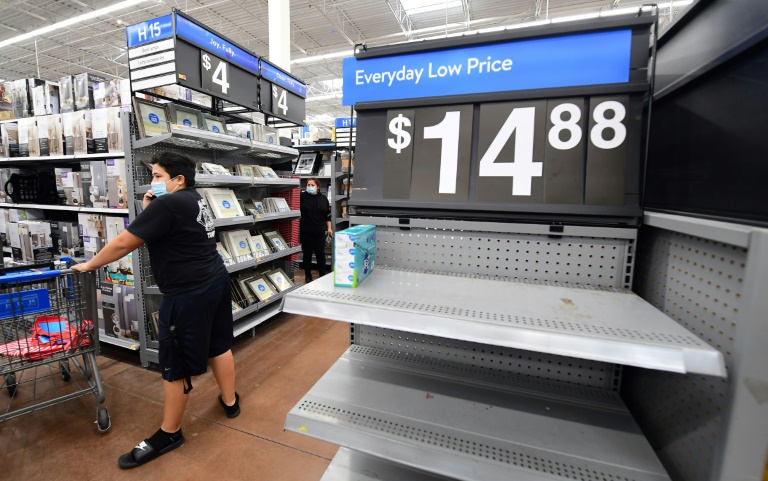
US consumers continued to increase spending in April, remaining resilient in the face of accelerating inflation, but retail giant Walmart still saw a big hit to its bottom line due to rising costs, according to reports released Tuesday.

Home Depot, however, benefitted from the ongoing spending spree, reporting higher profits and a better outlook for the year.

The reports come amid rising fears of recession in the wake of a 40-year peak in inflation that has prompted the Federal Reserve to raise borrowing costs aggressively to cool the economy and tamp down price pressures.

The healthy US consumer has underpinned the strong recovery in the world’s largest economy following the slowdown in the early months of the Covid-19 pandemic, but the surge in demand also has strained supply chains and helped push inflation to its fastest rate since the early 1980s.

Fed Chair Jerome Powell said Tuesday the central bank wants to see slowing growth and “clear” evidence inflation is coming down before it pulls back on efforts to cool the economy, and acknowledged that it may be a “bumpy” ride that would inflict some pain.

Consumers haven’t pulled back yet, and US retail sales rose 0.9 percent in April, boosted by a rebound in auto sales and increases in other categories, including electronics, home furnishings and restaurants, according to Commerce Department data. 

The report “is encouraging because it shows consumers are taking higher prices in stride and remain resilient,” said Jack Kleinhenz, chief economist of the National Retail Federation.

But prices continue to rise, and the cost of gas at the pump hit a record in May as the war in Ukraine pushes oil prices higher.

“Consumers’ tolerance to high inflation will continue to be tested and the renewed spike in gasoline prices, along with tighter financial conditions, will weigh on households’ willingness to spend on big-ticket items,” said Kathy Bostjancic, a chief US economist at Oxford Economics.

The Fed has gone to battle to try to cool price pressures, announcing earlier this month the biggest interest rate increase since 2000.

Powell said reducing inflation is critical, which means bringing down red-hot demand more in line with supply, and additional sharp rate hikes are “on the table” in June and July.

“What we need is to see… growth moving down from the very high levels that we saw last year, moving down to a level that’s still positive,” Powell said at an event with The Wall Street Journal.

And if that doesn’t happen, “then we’ll have to consider moving more aggressively,” he said.

– Labor, fuel costs rise –

Walmart executives pointed to a series of cost hits that converged in the quarter ending April 30, as the retail giant reported a 25 percent drop in profits to $2.1 billion — $1.30 a share, below the $1.48 expected by analysts — as revenues rose 2.4 percent to $141.6 billion.

Walmart raised its full-year sales forecast slightly but lowered its profit forecast. It now expects earnings per share to fall one percent after previously projecting an increase in the mid-single digits.

The company cited higher labor costs and a spike in energy costs when the Russian invasion of Ukraine sent oil prices soaring.

Another obstacle was a March fire that destroyed a warehouse in Indianapolis, Indiana.

Walmart US President John Furner said the company is seeing a “wide range” of responses from shoppers to the rise in prices.

While there is continued strong demand for pricey items such as game consoles and outdoor grills, he said some consumers are moving away from brand names in favor of Walmart’s own branded goods, which are lower-priced. 

“We need to do more to control costs, to make sure we can provide good value for our customers,” Furner said on an earnings conference call.

– Investing in homes –

In contrast, Home Depot raised its outlook after reporting that first-quarter profits rose two percent to $4.2 billion on a four percent increase in revenues, as executives with the home-improvement chain said consumers appeared to take higher prices in stride.

The spending has been propelled by a strong trend toward increased investment as homes increase in value, according to Chief Financial Officer Richard McPhail.

Walmart shares plunged 11.4 percent, while fellow Dow member Home Depot rose 1.7 percent.
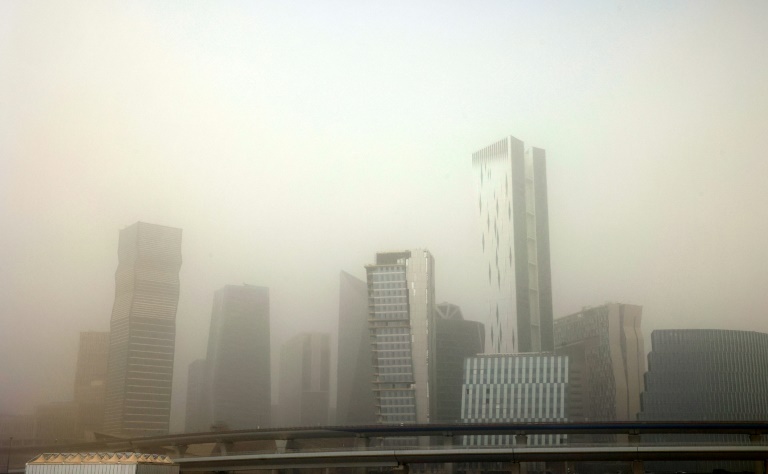
Mideast sandstorms snarl traffic, close schools, harm health

Sandstorms across the Middle East have delayed flights, closed schools and hospitalised thousands — a phenomenon experts say could worsen as climate change warps regional weather patterns. 

Saudi Arabia on Tuesday became the latest country blanketed with dust that slowed traffic and made iconic towers in the capital difficult to see from more than a few hundred metres (yards) away.

Emergency rooms in Riyadh hospitals had received some 1,285 people suffering from respiratory problems over 24 hours as a result of the sandstorm, the state-run Al-Ekhbariya channel reported.

Electronic signs along Riyadh’s highways warned drivers to reduce their speed because of the lower visibility, even as life largely went on as usual in the kingdom. 

The national meteorology centre predicted that “surface dusty winds” originating in the east and bringing a thick grey haze would continue west towards the Muslim holy cities of Mecca and Medina.

Other countries have been grappling with the problem for longer: Neighbouring Iraq has experienced eight sandstorms since mid-April, fuelled by soil degradation, intense droughts and low rainfall linked to climate change. 

The country’s latest sandstorm on Monday enveloped the capital Baghdad in an orange glow, sent at least 4,000 people to hospital with breathing problems and led to the closure of airports, schools and public offices across the country. 

Iran announced that it, too, was closing government offices and schools Tuesday, citing “unhealthy weather” conditions and sandstorms. 

Average airborne concentration of the finest and most hazardous particles (PM2.5) was at 163 microgrammes per cubic metre Tuesday in Tehran, according to a government website.

That is more than six times the World Health Organization’s recommended maximum of 25 microgrammes per cubic metre.

In Kuwait, meanwhile, air traffic at the main airport was suspended for an hour and a half due to a dust storm Monday, and marine traffic in all three ports remained suspended as of Tuesday afternoon. 

Kuwait’s ministry of education said classes were suspended on Tuesday but would resume the following day. 

– Response needed ‘urgently’ –

The Middle East has always been battered by dust and sandstorms, but they have become more frequent and intense in recent years. 

The trend is associated with overgrazing and deforestation, overuse of river water and more dams. 

Unseasonable masses of dry, cold air help explain the recent proliferation of sandstorms in eastern Syria and Iraq and “their transmission to the Arabian Peninsula”, Hassan Abdallah from the WASM meteorological centre in Jordan told AFP. 

By the time the sandstorms reach Saudi Arabia they tend to be less intense, he added. 

Sandstorms are worsening regionally because of factors including low water levels in the Tigris and Euphrates rivers, large fluctuations in annual rainfall and disintegrating soil, he said. 

As for how to mitigate them, Abdallah advised planting more trees and “addressing the low level of the Tigris and Euphrates rivers urgently”.

In central Riyadh on Tuesday, sand layered cars and buildings, and residents struggled to keep it out of their homes. 

“Working outside is very difficult because of the dirt,” a Pakistani construction worker who gave his name as Kalimullah told AFP as he installed tiles. 

“I try to wash my face from time to time,” the 30-year-old added, wrapping a piece of cloth around it to block the sand. 

Saudi office worker Abdullah Al-Otaibi, 39, said he was grateful he works indoors. 

“Dust storms are part of our culture and we are used to it, but some of them are severe,” he said, rubbing his eyes as he hurried inside.

bur-ht-rcb/dm/fz 

Flight data shows China Eastern jet deliberately crashed: report

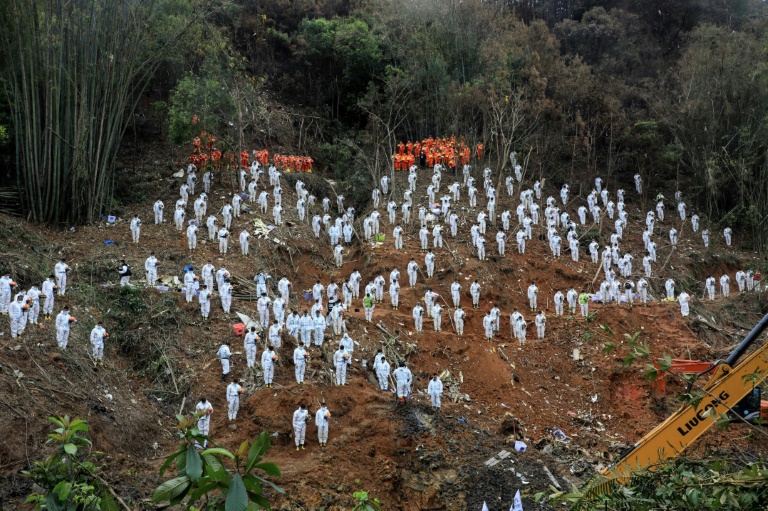
US investigators believe someone on board deliberately crashed a China Eastern flight in March, the Wall Street Journal reported Tuesday, in what was China’s deadliest air disaster in decades.

China Eastern flight MU5375 was travelling from Kunming to Guangzhou on March 21 when it inexplicably plunged from an altitude of 29,000 feet into a mountainside, killing all 132 people on board.

So-called black box flight data recorders recovered from the site were sent to the United States for analysis. 

That data shows that someone — possibly a pilot or someone who had forced their way into the cockpit — input orders to send the Boeing 737-800 into a nosedive, according to Wall Street Journal, which cited people familiar with the probe. 

“The plane did what it was told to do by someone in the cockpit,” the Journal quoted “a person who is familiar with American officials’ preliminary assessment” as saying. 

US officials believe their conclusion is backed up by the fact that Chinese investigators have so far not indicated any problems with the aircraft or flight controls that could have caused the crash and would need to be addressed in future flights, the newspaper said. 

Both the US National Transportation Safety Board and Boeing declined to comment on the investigation to AFP Tuesday. 

According to a report from Boeing, investigators found no evidence of “anything abnormal,” China’s Civil Aviation Administration (CAAC) said in April.

In a statement, the CAAC said staff had met safety requirements before takeoff, the plane was not carrying dangerous goods and did not appear to have run into inclement weather, though the agency said a full investigation could take years.

In the immediate aftermath of the crash, China’s ruling Communist Party moved quickly to control information, revving up its censorship machine as media outlets and local residents raced to the crash site.

It has maintained its tight grip over the narrative, with the preliminary probe leaving key questions unanswered.

After the fatal descent near the southern city of Wuzhou, authorities swiftly cordoned off a huge area and China’s internet regulator announced it had scrubbed vast amounts of “illegal information” on the crash from China’s tightly controlled web.

A social media hashtag bearing the plane’s flight number appeared to be censored.

The crash was China’s deadliest in around 30 years and dented the country’s otherwise enviable flight safety record.

Retail data shows US consumer resilience as costs hit Walmart

Walmart reported a drop in profits Tuesday as higher operating costs dented its bottom line, while April data showed another increase in US consumer spending in spite of rising prices.

Walmart shares tumbled following the report, which comes amid rising recession worries in the wake of a 40-year peak in inflation that has prompted monetary tightening from the Federal Reserve.

Tuesday’s batch of earnings and economic data offered a mixed reading on the US consumer overall, with April retail sales still coming in at a healthy level and Home Depot shares rising following better-than-expected results.

Walmart US President John Furner said the company is seeing a “wide range” of responses from shoppers to the rise in prices.

Furner pointed to continued strong demand for pricey items such as game consoles and outdoor grills. At the same time, other consumers are moving away from brands for lunch meats, dairy and other goods in favor of Walmart’s own branded goods, which are lower-priced. 

“We need to do more to control costs, to make sure we can provide good value for our customers,” Furner said on an earnings conference call.

The healthy US consumer has underpinned the strong recovery in the world’s largest economy following the slowdown during the Covid-19 pandemic, but the surge in demand also has strained supply chains and helped push inflation to its fastest rate since the early 1980s.

US retail sales rose 0.9 percent in April, boosted by a rebound in auto sales and increases in other categories, including electronics, home furnishings and restaurants, according to Commerce Department data. 

“Looking ahead, consumers’ tolerance to high inflation will continue to be tested and the renewed spike in gasoline prices, along with tighter financial conditions, will weigh on households’ willingness to spend on big-ticket items,” said Kathy Bostjancic, a chief US economist at Oxford Economics.

– Labor, fuel costs rise –

Walmart reported a 25 percent drop in profits to $2.1 billion for the quarter ending April 30. That translated into $1.30 per share, below the $1.48 expected by analysts.

Revenues rose 2.4 percent to $141.6 billion.

Walmart raised its full-year sales forecast slightly but lowered its profit forecast. It now expects earnings per share to fall one percent after previously projecting an increase in the mid-single digits.

Executives pointed to a series of cost hits that converged during the period. 

The company was overstaffed for part of the quarter due to the unexpectedly speedy return of workers who were afflicted by the Omicron variant of Covid-19, resulting in higher labor costs.

Walmart was also affected by a spike in energy costs when the Russian invasion of Ukraine sent oil prices soaring.

Another obstacle was a March fire that destroyed a warehouse in Indianapolis, Indiana that employed more than 1,000 people. Nobody was injured in the episode, but Walmart had to replace goods and route items through neighboring infrastructure, adding cost.

Walmart Chief Executive Doug McMillon said the company’s vast array of goods can help in an inflationary environment because it is able to offset higher prices for food and other staples with lower prices elsewhere in the store.

“Customers are even more price sensitive now,” he said. “So when you bring something down in sporting goods or hardware, one of these other category, they notice even more than they would have noticed before and that makes the elasticity impact a bit different than it would be otherwise.”

– Investing in homes –

Walmart’s results stood in contrast to Home Depot, which raised its outlook after reporting that first-quarter profits rose 2 percent to $4.2 billion on a four percent increase in revenues to $38.9 billion.

Executives with the home-improvement chain saw higher sales resulting largely from cost inflation that consumers appeared to take in stride.

Propelling the spending is a strong historic trend that shows increased investment as homes increase in value, according to Chief Financial Officer Richard McPhail, who also said most of the company’s customers already have mortgages and aren’t affected by rising interest rates.

“The homeowner has never had a balance sheet that looks like this,” McPhail said. “They’ve seen the price appreciation and they have the means to spend.”

Walmart shares plunged 11.4 percent to $131.37 in afternoon trading, while fellow Dow member Home Depot rose 1.4 percent to $300.12.

Musk says no Twitter deal without clarity on spam accounts

Billionaire Elon Musk said Tuesday his bid to buy Twitter won’t proceed unless he gets proof of the number of spam accounts plaguing the platform, adding more uncertainty to his roller-coaster pursuit of the social media giant.

This latest twist to his $44 billion move to acquire the key platform sparked speculation over whether the world’s richest person was trying to shrink the price tag or even back away from the deal.

Hours after Musk’s early morning tweet over bots, Twitter insisted the deal push through and without delay.

“Twitter is committed to completing the transaction on the agreed price and terms as promptly as practicable,” the company wrote in a statement accompanying a filing to US regulators.

Musk last week tweeted his bid for the company was “temporarily on hold,” pending questions over its estimates of the number of fake accounts, or bots.

Then early Tuesday he pushed for more information, writing to his almost 94 million followers on the social network: “Yesterday, Twitter’s CEO publicly refused to show proof of <5%.” 

“This deal cannot move forward until he does,” he added.

Twitter chief executive Parag Agrawal has said the platform suspends more than a half-million seemingly bogus accounts daily, usually before they are even seen, and locks millions more weekly that fail checks to make sure they are controlled by humans and not by software.

Internal measures show that fewer than five percent of accounts active on any given day at Twitter are spam, but that analysis cannot be replicated externally due to the need to keep user data private, Agrawal contended.

Musk posted that the real number of bots may be four times what Twitter claims and “could be *much* higher,” and has said he would make getting rid of them a priority if he owned the platform.

“So how do advertisers know what they’re getting for their money?” Musk tweeted in a subsequent response about the need to prove Twitter users are real people.

“This is fundamental to the financial health of Twitter.”

– ‘Under pressure’ –

The process used to estimate how many accounts are bots has been shared with Musk, Agrawal insisted.

According to an estimate published Friday by software firm SparkToro, 19.42 percent of Twitter accounts are fake or spam, but the company acknowledges its methodology for determining bots is likely different from that used by Twitter. 

SparkToro has a tool on its website that shows more than 70 percent of Musk’s followers are fake accounts. 

“It appears the spam/bot issue is cascading and clearly making the Twitter deal a confusing one,” Wedbush analyst Dan Ives said in a note to investors.

“The bot issue at the end of the day… feels more to us like the ‘dog ate the homework’ excuse to bail on the Twitter deal or talk down a lower price.”

Twitter shares “will be under pressure this morning again as the chances of a deal ultimately getting done is not looking good now,” Ives said, adding it is “likely a 60%+ chance from our view Musk ultimately walks from the deal and pays the breakup fee.”

Another tech watcher, Grady Booch, tweeted to Musk that it “Seems like you have buyers remorse”.  

After sliding ahead of the market bell, shares of Twitter were up slightly in Tuesday trading.

Meanwhile in a filing to the Securities and Exchange Commission, Twitter urged its shareholders to vote in favor of Musk’s buyout for $54.20 per share in cash, at an upcoming special meeting.

Musk has described his motivation as stemming from a desire to ensure freedom of speech on the platform and to boost monetization of a website that is massively influential but has struggled to attain profitable growth.

He has also said he favored lifting the ban on Donald Trump, who was kicked off the platform in January 2021 over concerns the ex-president could incite violence.

burs-oho/jm/mlm

UK unveils radical rewrite of EU pact for N. Ireland

The UK government on Tuesday unveiled a plan to drastically overhaul post-Brexit trade rules in Northern Ireland, arguing the changes are needed to end political paralysis in the divided territory.

But the European Union, defending the so-called Northern Ireland Protocol and the integrity of its vast single market, vowed reprisals if Britain pushes ahead with its unilateral plans.

London said it would introduce legislation reforming the protocol “in the coming weeks” — unless Brussels caves on its refusal to renegotiate the pact.

The protocol was agreed as part of Britain’s Brexit divorce deal with the European Union, recognising Northern Ireland’s status as a fragile, post-conflict territory that shares the UK’s new land border with the European Union.

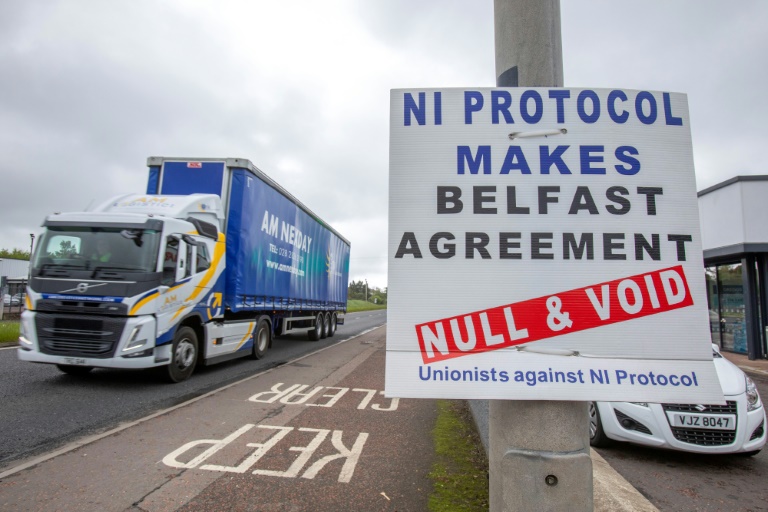
Its requirement for checks on goods arriving from England, Scotland and Wales has infuriated pro-UK unionists in Northern Ireland. 

They claim the protocol is undermining their place within the UK, and are refusing to join a new power-sharing government in Belfast following elections this month.

The UK plan would scrap most of the checks, but the government denied it was trashing international law by abrogating a key element of the Brexit deal agreed by Prime Minister Boris Johnson in 2019.

“I think the higher duty of the UK government in international law is to the (1998) Good Friday Agreement and the peace process,” Johnson told reporters.

“We don’t want to nix it (the protocol), we want to fix it, and we will work with our EU partners to do it,” he said.

– ‘Rogue state’ –

But the EU issued no hint of compromise, after warning that any UK violation of the Brexit pact could see it hit back with swingeing tariffs.

“Unilateral actions contradicting an international agreement are not acceptable,” European Commission Vice-President Maros Sefcovic said.

The UK plan “raises significant concerns”, he added, warning that the EU “will need to respond with all measures at its disposal” if London goes ahead.

Irish Foreign Minister Simon Coveney called the UK step “damaging to trust”.

Johnson, however, said a trade war was unlikely — and the UK can ill-afford one, at a time when its people are grappling with the worst inflationary crisis in a generation.

“But what we have to fix is the problems with the Northern Ireland political situation, where you can’t get the executive up and running,” he said, a day after visiting Belfast for talks with Northern Ireland’s main parties.

The largest pro-British party, the Democratic Unionist Party (DUP), says it will not share power with pro-Irish rivals Sinn Fein until the protocol is reworked.

Its line has hardened since Sinn Fein won a historic victory in elections to the Northern Ireland Assembly two weeks ago, which entitled the party to the role of first minister in a joint regional government with the DUP. 

In the London parliament, DUP leader Jeffrey Donaldson said the UK government’s announcement was a “good start” that could help restore the Belfast executive. But he insisted progress on an actual bill was needed in “days, not weeks”.

For her part, Sinn Fein leader Mary Lou McDonald accused Britain of acting like a “rogue state”.

– US ire – 

Keeping the border open with neighbouring Ireland, an EU member, was mandated in the Good Friday Agreement, given the frontier was a frequent flashpoint during three decades of violence in Northern Ireland until 1998.

But it means checks have to be done elsewhere, to prevent goods getting into the EU single market and customs union by the back door via Northern Ireland.

Under the new plan, the UK intends unilaterally to create a “green channel” for British traders to send goods to Northern Ireland without making any customs declaration to the EU.

The EU would have access to more real-time UK data on the flow of goods, and only businesses intending to trade into the single market via Ireland would be required to make declarations.

The EU would need to trust the UK to monitor the flow, and UK Foreign Secretary Liz Truss vowed “robust penalties” for any companies seeking to abuse the new system. 

The plan would also seek to end oversight of the protocol by the European Court of Justice — another red line for Brussels.

Britain also risks antagonising the United States, which helped broker the Good Friday Agreement.

Democratic Congressman Bill Keating, speaking on Britain’s Times Radio from Washington, said any UK action on the protocol should not resort to “breaking international law”. 

If the bill goes ahead, British hopes for a post-Brexit trade deal with the US “will be scuttled in the process”, he added.

United Airlines says regulators approved return of Boeing 777s

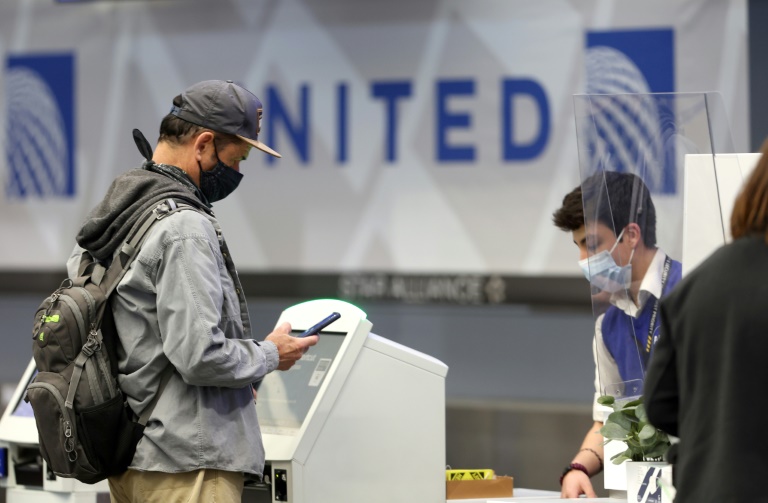
US air safety regulators have cleared United Airlines to resume service on more than 50 Boeing 777 planes that were grounded over engine issues, a United executive said Tuesday.

The news — confirmed by the Federal Aviation Administration — comes as United and other airlines prepare for a heavy summer travel season.

The jets have been grounded since February 2021, when a United Airlines plane scattered debris over suburban Denver after an engine failure. The jet landed safely, but the FAA issued an emergency order requiring inspection of the engines made by Pratt & Whitney.  

On Monday night, the FAA “issued final paperwork” on United’s fleet of 52 Boeing 777 aircraft, accounting for about 10 percent of the carrier’s capacity, said Andrew Nocella, chief commercial officer at United.

“It’s a pretty significant step up change in our capacity,” Nocella said at a Bank of America investor conference.

He said he expects the first 777s to be restored to the flight schedule starting May 26 with most of the planes back in service by July.

In an email to AFP, the FAA said it “approved the service bulletins” to make “necessary changes” to the planes.  

United shares jumped 6.8 percent to $46.50 shortly after midday.

Markets rally eyeing China reopening

Global stock markets rallied Tuesday on hopes that China will ease its weeks-long Covid lockdown and gradually reopen businesses.

European exchanges closed higher and Wall Street’s main indices also rose in mid-day trading, spurred by a nearly one-percent rise in April retail sales.

“We’ve seen a much more positive vibe around European equity markets today, with reports out of Asia suggesting that China might be close to looking to ease some of its Covid restrictions, as case rates come down,” Michael Hewson, chief market analyst at CMC Markets UK, said.

“This hope appears to be helping to power some buying interest, and is also pushing up metals, as well as oil prices, with Brent crude at six-week highs,” he added.

Much of Shanghai, China’s economic hub and a city of 25 million, has been under lockdown since April as Beijing attempts to stamp out an Omicron-fuelled virus surge under its strict zero-Covid policy.

The impact of Beijing’s zero-Covid strategy on the world’s second-largest economy was revealed Monday when official data showed that retail sales and industrial production in April on-year had slumped to their lowest levels in more than two years.

World markets have also been roiled by surging inflation, spiralling oil and wheat prices and Russia’s war in Ukraine — leaving investors jittery.

Wheat prices hit a record high in the European market Tuesday at 434.25 euros after the world’s second producer India announced an export ban due to falling output caused by climate change. 

Oil was another area of concern. 

“Oil prices have hit their highest levels since early March as Europe continues to work towards a Russian embargo and China looks to ease Covid restrictions,” said Craig Erlam, another market analyst at OANDA. 

“The question becomes just how much further they’ll go and how uncomfortable it’s going to get,” he said.

Analyst Fawad Razaqzada at City Index was bullish on the demand for oil despite rising prices.

“Demand did fall briefly when China went into a lockdown but now with Shanghai emerging from lockdowns and other cities are likely to follow suit, demand should remain elevated,” he said.

“Unless the OPEC and its allies ramp up production and fast, it is difficult to see how prices can go down meaningfully,” he added.

The British pound was the best performing G10 currency on Tuesday as traders bet that soaring UK inflation, lifted in part by wage rises, will see more monetary policy tightening by the Bank of England.

There are rising concerns that ongoing rapid interest rate rises by the BoE and other central banks including the Federal Reserve to curb decades-high inflation will push the economy into a downturn.

On the corporate front Tuesday, India’s insurance giant LIC slumped on its market debut following the country’s biggest-ever initial public offering, closing nearly eight percent below the IPO price.

Prime Minister Narendra Modi’s government raised $2.7 billion by selling 3.5 percent of Life Insurance Corporation of India. But it was forced to cut back the offer from a planned five percent after markets turned volatile.

Elsewhere, Elon Musk said his planned purchase of Twitter would not go ahead unless he was assured that fewer than five percent of accounts on the platform were fake.

The Tesla owner has bid $44 billion for the social media platform.

– Key figures at around 1530 GMT –

New York – Dow: UP 0.8 percent at 32,482.75 points 

EURO STOXX 50: UP 1.3 percent at 3,734.36 

London – FTSE 100: UP 0.7 percent at 7,518.35 (close)

Frankfurt – DAX: UP 1.6 percent at 14,185.94 (close)

Paris – CAC 40: UP 1.3 percent at 6,430.19 (close)

Hong Kong – Hang Seng Index: UP 3.3 percent at 20,602.52 (close) 

Shanghai – Composite: UP 0.7 percent at 3,093.70 (close)

Tokyo – Nikkei 225: UP 0.4 percent at 26,659.75 (close)

Brent North Sea crude: UP 0.6 percent at $114.91 per barrel

West Texas Intermediate: UP 0.5 percent at $114.75 per barrel

Euro/dollar: UP 0.9 percent at $1.0532 from $1.0436 at 2030 GMT Monday

Pound/dollar: UP 1.2 percent at $1.2478 from $1.2323

Euro/pound: DOWN at 84.44 pence from 84.67 pence 

Dollar/yen: UP at 129.29 yen from 129.08 yen

UK unveils radical rewrite of EU pact for N. Ireland

The UK government on Tuesday unveiled a plan to drastically overhaul post-Brexit trade rules in Northern Ireland, arguing the changes are needed to end political paralysis in the divided territory.

But the European Union, defending the so-called Northern Ireland Protocol and the integrity of its vast single market, vowed reprisals if Britain pushes ahead with its unilateral plans.

London said it would introduce legislation reforming the protocol “in the coming weeks” — unless Brussels caves on its refusal to renegotiate the pact.

The protocol was agreed as part of Britain’s Brexit divorce deal with the European Union, recognising Northern Ireland’s status as a fragile, post-conflict territory that shares the UK’s new land border with the European Union.

Its requirement for checks on goods arriving from England, Scotland and Wales has infuriated pro-UK unionists in Northern Ireland. 

They claim the protocol is undermining their place within the UK, and are refusing to join a new power-sharing government in Belfast following elections this month.

The UK plan would scrap most of the checks, but the government denied it was trashing international law by abrogating a key element of the Brexit deal agreed by Prime Minister Boris Johnson in 2019.

“I think the higher duty of the UK government in international law is to the (1998) Good Friday Agreement and the peace process,” Johnson told reporters.

“We don’t want to nix it (the protocol), we want to fix it, and we will work with our EU partners to do it,” he said.

– ‘Rogue state’ –

But the EU issued no hint of compromise, after warning that any UK violation of the Brexit pact could see it hit back with swingeing tariffs.

“Unilateral actions contradicting an international agreement are not acceptable,” European Commission Vice-President Maros Sefcovic said.

The UK plan “raises significant concerns”, he added, warning that the EU “will need to respond with all measures at its disposal” if London goes ahead.

Irish Foreign Minister Simon Coveney called the UK step “damaging to trust”.

Johnson, however, said a trade war was unlikely — and the UK can ill-afford one, at a time when its people are grappling with the worst inflationary crisis in a generation.

“But what we have to fix is the problems with the Northern Ireland political situation, where you can’t get the executive up and running,” he said, a day after visiting Belfast for talks with Northern Ireland’s main parties.

The largest pro-British party, the Democratic Unionist Party (DUP), says it will not share power with pro-Irish rivals Sinn Fein until the protocol is reworked.

Its line has hardened since Sinn Fein won a historic victory in elections to the Northern Ireland Assembly two weeks ago, which entitled the party to the role of first minister in a joint regional government with the DUP. 

In the London parliament, DUP leader Jeffrey Donaldson said the UK government’s announcement was a “good start” that could help restore the Belfast executive. But he insisted progress on an actual bill was needed in “days, not weeks”.

For her part, Sinn Fein leader Mary Lou McDonald accused Britain of acting like a “rogue state”.

– US ire – 

Keeping the border open with neighbouring Ireland, an EU member, was mandated in the Good Friday Agreement, given the frontier was a frequent flashpoint during three decades of violence in Northern Ireland until 1998.

But it means checks have to be done elsewhere, to prevent goods getting into the EU single market and customs union by the back door via Northern Ireland.

Under the new plan, the UK intends unilaterally to create a “green channel” for British traders to send goods to Northern Ireland without making any customs declaration to the EU.

The EU would have access to more real-time UK data on the flow of goods, and only businesses intending to trade into the single market via Ireland would be required to make declarations.

The EU would need to trust the UK to monitor the flow, and UK Foreign Secretary Liz Truss vowed “robust penalties” for any companies seeking to abuse the new system. 

The plan would also seek to end oversight of the protocol by the European Court of Justice — another red line for Brussels.

Britain also risks antagonising the United States, which helped broker the Good Friday Agreement.

Democratic Congressman Bill Keating, speaking on Britain’s Times Radio from Washington, said any UK action on the protocol should not resort to “breaking international law”. 

If the bill goes ahead, British hopes for a post-Brexit trade deal with the US “will be scuttled in the process”, he added.

Jamestown, cradle of America, threatened by rising seas

The waters rose overnight and by morning formed a shallow pond over the grassy field covering a cemetery in Jamestown, one of the founding sites of the American nation.

Curators — their feet wet from the water — say it is just the latest in a seemingly endless series of flooding at the first permanent English settlement in North America, a location that was also home to Native American tribes for thousands of years.

Sandbags and tarps provide some protection from the elements, but curators warn that time is running out for Jamestown, which is increasingly under threat from rising sea levels and extreme weather as climate change takes its toll.

“All of the archeological resources that we haven’t had a chance to investigate yet could be destroyed,” said Michael Lavin, director of collections at Jamestown Rediscovery Foundation, the association in charge of the site in the US state of Virginia.

Earlier this month, the National Trust for Historic Preservation, a leading heritage institution, placed Jamestown on its 2022 list of the country’s 11 most endangered historic sites.

– ‘Need to do something’ –

“We need to do something, and we need to do it now,” said Lavin, fording a flooded path to get to his office.

David Givens, director of archeology, has like his colleague worked here for more than 20 years.

“For most of our lives, this is a dry area,” he said.

The flooding today has risen by a meter (yard), a level that will be the norm by the end of the century, according to average projections.

“This is a perfect example of sea level rise, climate change and how it’s affecting us,” said the archeologist.

Sea levels at the mouth of the James River have already risen 18 inches (45 centimeters) since 1927. 

Worries run high, given that the site is a distillation of so much American history: in addition to the English settlers, it was home to native American tribes for 12,000 years and, in 1619, was the first place that African slaves were brought in Britain’s North American territories.

– Bones ‘like sponges’ –

At the foot of the old church, archeologist Caitlin Delmas scrapes at the ground with her trowel, surrounded by the sandbags and tarps that are deployed with each downpour. 

“That’s also a lot of added stress, because you have to make sure that everything’s staying dry,” she said.

In 2013, a study of the bones of a young woman found here made it possible to confirm that she had been the victim of cannibalism during a famine the colonists suffered during the winter of 1609-1610. 

But such rare discoveries may never be made again: Delmas said recently unearthed bones were “like sponges,” and cannot be analyzed due to too much alternation between being dry and wet.

Givens said it is “almost like in war, like a trench and sandbags, because it’s a constant fight for us.”

“Over time, those archaeology sites will be inaccessible, they’ll be eroded from saltwater, inundation,” he said, adding: “That’s I think what scares me most.”

Marcy Rockman, a pioneer in the study of the impact of climate change on cultural resources in US national parks, said cultural heritage sites “have always been affected by storms and wind and rain.”

“But it’s more that those forces are accelerating. They’re intensifying. They’re recombining in new ways. They’re coming at different times of the year” due to climate change, she said.

In the wide estuary facing Jamestown, a handful of barges are bringing blocks of granite, waiting for more favorable weather to come and reinforce the existing sea wall that was built at the beginning of the 20th century to protect the site from the erosion. 

The project, costing more than $2 million, is only a first step: studies are being launched into the flooding, and “it’s going to cost tens of millions of dollars,” said Lavin. 

In Jamestown, the ebb tide has relieved the flooding a little, leaving fish splashing above the old cemetery that has never been properly excavated, and which will soon turn into a swamp if nothing is done. 

“Human remains are our data recorders for the past,” said Givens. “There’s some urgency to studying that.”

Katherine Malone-France, head of conservation at the National Trust for Historic Preservation, said in her Washington office that the clock is ticking.

“We have a five year window at Jamestown to begin to seriously mitigate the impacts of climate change,” she said. “It’s urgent.”

Close Bitnami banner
Bitnami