AFP

Musk sends mixed messages on Twitter deal, pressuring shares

Elon Musk sent mixed messages Friday about his proposed Twitter acquisition, pressuring shares of the microblogging platform amid skepticism on whether the deal will close.

In an early morning tweet, Musk said the $44 billion takeover was “temporarily on hold,” pending questions over the social media company’s estimates of the number of fake accounts or “bots.”

That sent Twitter’s stock plunging 25 percent.

Two hours later, the unpredictable Tesla chief executive added a tweet, saying “Still committed to acquisition.”

Shares recovered a bit, but traded in the red throughout Friday’s session, finishing down nearly 10 percent at $40.72.

While the reliability of user figures is an important benchmark for assessing revenues of Twitter and other social media companies, analysts generally interpreted Musk’s messages as an attempt to pull out of the deal or to try to force a lower price.

“Although we never questioned Musk’s ability to complete such a transaction from a financial perspective, we thought the biggest risk was Elon himself having a change of heart,” CFRA Research’s Angelo Zino said in an analyst’s note.

He said the move gives Musk “leverage” and increases the chance “that he either adjusts his offer price downward or just completely walks away.”

Meanwhile, Chief Executive Parag Agrawal took to the platform to explain moves earlier this week to shake up company leadership and freeze most hiring.

“While I expect the deal to close, we need to be prepared for all scenarios and always do what’s right for Twitter,” Agrawal said. “Im accountable for leading and operating Twitter, and our job is to build a stronger Twitter every day.”

– Skepticism in market –

The chief of SpaceX as well as Tesla, Musk is currently listed by Forbes as the world’s wealthiest person, with a fortune of some $232 billion, much of it in Tesla stock.

Seen by his champions as an iconoclastic genius and by his critics as an erratic megalomaniac, Musk surprised many investors with his pursuit of Twitter.

Musk has described his motivation as stemming from a desire to ensure freedom of speech on the platform and to boost monetization of an Internet site that is influential in media and political circles but has struggled to attain profitable growth.

On Tuesday, Musk said he favored lifting the ban on Donald Trump, who was kicked off the platform in January 2021 shortly after the former US president’s efforts to overturn his election defeat led to the January 6 assault on the US Capitol.

Analysts also have said the site can boost Musk’s other ventures, including Tesla, which so far has grown without following the auto-industry custom of spending heavily on marketing.

But markets have shown skepticism since the April 28 announcement that the Twitter board agreed to sell at $54.20 a share.

The share price has lagged that level, suggesting investors viewed deal closure as not assured, and  has fallen further as the broader tech market retreated this week.

– ‘Horror show’ –

In his first tweet about the deal Friday, Musk linked to an article from May 2 referencing Twitter’s latest filing to US regulators.

The document said an internal review showed Twitter had 229 million “monetizable daily active users” in the first quarter of this year, and just five percent were regarded as false or spam accounts. 

Analyst Dan Ives from Wedbush said the “circus show” was likely to translate into a “Friday 13th horror show.”

“The nature of Musk creating so much uncertainty in a tweet (and not a filing) is very troubling,” he said.

Musk has gotten into hot water with regulators over his tweets in the past, but the Twitter purchase agreement includes a clause specifying that he is free to tweet about the deal provided his posts “do not disparage the company or any of its representatives.”

Market analyst Susannah Streeter of Hargreaves Landsdown said the takeover bid “risks hitting the skids.”

There will be questions “over whether fake accounts are the real reason behind this delaying tactic,” Streeter said, adding that “it may be a strategy to row back on the amount he is prepared to pay to acquire the platform.”

Musk’s potential stewardship of the social media site has hit several bumps since the takeover attempt was made public, and sparked worry from activists, over lifting of the Trump ban as well as the possibility the new owner would open the gates to abusive and misinformative posts.

US media have reported that the transaction is being investigated by regulators, including the Securities and Exchange Commission with which Musk has frequently clashed.

The SEC is probing Musk’s tardy disclosure of his stake in Twitter, according to The Wall Street Journal.


US stocks finish bruising week on positive note

Wall Street stocks rebounded Friday after a bruising week beset with worries over inflation, the Ukraine war and the economic outlook.

Following a strong session in Europe and Asia, Wall Street closed the week robustly, with the tech-rich Nasdaq jumping nearly four percent and the S&P 500 pushing back above 4,000 points.

But even with Friday’s rally, all three major US indices posted losses for the week.

Gregori Volokhine of  Meeschaert Financial Services warned “it will take more than one session” to turn around the market, adding that there was no clear news catalyst for Friday’s gains.

Analysts at Briefing.com said the turnaround was largely due to “a sentiment-driven trade wrapped up in the notion that stocks are deeply oversold and due for a bounce.”

Stocks were under pressure for most of the week as fresh data showing elevated US inflation deepened expectations for aggressive action from the Federal Reserve as it tightens monetary policy.

Some analysts cited receding fears about China Covid-19 restrictions as supportive to stocks.

“Global sentiment seems to be getting some relief as China officials suggested that Covid-related lockdowns — which have been another source of uneasiness — may be set to ease,” analysts at Charles Schwab investment bank said.

Oil prices pushed higher Friday after much volatility, reaching around $110 a barrel yet again, with analysts pointing to hopes for a Chinese recovery in demand and the drag on Russian production from a potential European Union ban on crude imports from the country. 

On the corporate front, Twitter fell nearly 10 percent after Tesla Chief Executive Elon Musk said his purchase of the social media company was “temporarily on hold.” 

Analysts generally interpreted Musk’s messages as an attempt to pull out of the deal or to try to force a lower price.

He later tweeted that he was “still committed to acquisition.”

– Key figures at around 2130 GMT –

New York – Dow: UP 1.5 percent at 32,196.66 (close)

New York – S&P 500: UP 2.4 percent at 4,023.89 (close)

New York – Nasdaq: UP 3.8 percent at 11,805.00 (close)

London – FTSE 100: UP 2.6 percent at 7,418.15 (close)

Frankfurt – DAX: UP 2.1 percent at 14,027.93 (close)

Paris – CAC 40: UP 2.5 percent at 6,362.68 (close)

EURO STOXX 50: UP 2.5 percent at 3,703.42 (close)

Hong Kong – Hang Seng Index: UP 2.7 percent at 19,898.77 (close)

Shanghai – Composite: UP 1.0 percent at 3,084.28 (close)  

Tokyo – Nikkei 225: UP 2.6 percent at 26,427.65 (close)

Brent North Sea crude: UP 3.8 percent at $111.55 per barrel

West Texas Intermediate: UP 4.1 percent at $110.49 per barrel

Euro/dollar: UP at $1.0417 from $1.0380 at 2100 GMT Thursday

Pound/dollar: UP at $1.2262 from $1.2202

Euro/pound: DOWN at 84.92 pence from 85.07 pence

Dollar/yen: DOWN at 129.19 yen from 128.34 yen

Ukraine's key IT sector booming despite Russian invasion

Ukraine’s IT sector is booming despite the Russian invasion. Workers with stickers on their laptops recline on beach chairs outside a warehouse for start-ups in the west Ukraine city of Lviv giving off major Silicon Valley vibes.

But the atmosphere inside is different.

Through the glass doors of the complex, young Ukrainians zig-zag between stacks of bulletproof vests and cardboard boxes filled with helmets ready for the front.

They are part of Ukraine’s burgeoning tech sector which was forced to adapt after Russia’s invasion and has become key to supporting the war effort.

“Most tech companies had developed contingency plans” in case of war said Stepan Veselovskiy, the head of the “IT Cluster Lviv” community.

He told AFP that companies transferred servers to secure locations and established back-up systems outside the country before Russia invaded on February 24.

When Russian bombing started, IT companies shut offices in the capital Kyiv and eastern city of Kharkiv and engineers found refuge in western Ukraine or Poland next door.

Veselovskiy said there were already around 500 tech companies in Lviv before the war but now estimates that 80 percent of the sector is in the western city. 

One is Infopulse, which provides various digital services to mainly European customers.

It brought 300 of its 2,300 employees to Lviv, where it has offices in one of the city’s few buildings equipped with a bunker.

There are bunk beds and stable internet underground so employees to continue working in the event of an air raid.

There are also generators in case Russian forces target power stations and terminals for Elon Musk’s Starlink internet service.

“Even in the most drastic conditions, business can continue,” regional manager Ivan Korzhov said. 

They can even thrive. 

– Tech army –

Since the start of the war, Infopulse has gained four new customers and in April — the second month of the Russian invasion — it created 25 new jobs in Ukraine.

It is not the only tech company in Ukraine to do so. 

Veselovskiy says February — when Russia attacked — was a historically good month for Ukraine’s tech sector and its estimated 200,000 employees. 

“It slowed down a bit in March, but we are very optimistic for the future because the war doesn’t stop us from growing,” he said.

This is a stark contrast to other industries, battered by the invasion. Exports for traditional sectors such as steel and agriculture have collapsed.

But the tech sector, naturally, has not been affected by the destruction of bridges, roads or the blocking of ports. 

It has, according to Veselovskiy, made more than $2 billion since the start of the war and has become the country’s leading exporter. 

“It’s a good thing for Ukraine because we generate income in dollars every month when the country really needs it,” Korzhov said.

“We pay our taxes and give a lot of money” to the government. 

The IT Cluster Kyiv has already allocated $2 million, mainly to buy equipment for Ukrainian soldiers.

That’s how its offices ended up looking like an army depot.

The sector has also offered its brightest to help the military.

Softserve — one of Ukraine’s biggest tech companies — has worked on the military’s websites for free and IT Cluster Kyiv modernised one of the military’s command centres.

Infopulse also participates in a joint project by the Ukrainian army and the ministry of digital transformation.

“Specialists in tech and cybersecurity work with the government on the information front,” its regional manager Korzhov said. 

He then repeated a popular slogan in Ukraine: “We are not waiting for peace, but for victory.”

Musk sends mixed messages on Twitter deal, pressuring shares

Elon Musk sent mixed messages Friday about his proposed Twitter acquisition, sending shares of the microblogging platform lower amid skepticism over whether the deal will close.

In an early morning tweet, Musk said the $44 billion takeover was “temporarily on hold,” pending questions over the social media company’s estimates of the number of fake accounts or “bots.”

That sent Twitter’s stock plunging 25 percent.

Two hours later, the unpredictable Tesla chief executive added a tweet, saying “Still committed to acquisition.”

Shares recovered but around midday were still off 8.2 percent at $41.38.

While the reliability of user figures is an important benchmark for assessing revenues of Twitter and other social media companies, analysts generally interpreted Musk’s messages as an attempt to pull out of the deal or to try to force a lower price.

“Although we never questioned Musk’s ability to complete such a transaction from a financial perspective, we thought the biggest risk was Elon himself having a change of heart,” CFRA Research’s Angelino Zino said an analyst’s note.

He said the move gives Musk “leverage” and increases the chance “that he either adjusts his offer price downward or just completely walks away.”

The chief of SpaceX as well as Tesla, Musk is currently listed by Forbes as the world’s wealthiest person, with a fortune of some $232 billion, much of it in Tesla stock.

Seen by his champions as an iconoclastic genius and by his critics as an erratic megalomaniac, he surprised many investors with his pursuit of Twitter.

Musk has described his motivation as stemming from a desire to ensure freedom of speech on the platform and to boost monetization of an Internet site that is influential in media and political circles but has struggled to attain profitable growth.

On Tuesday, Musk said he favored lifting the ban on Donald Trump, who was kicked off the platform in January 2021 shortly after the former US president’s efforts to overturn his election defeat led to the January 6 assault on the US Capitol.

Analysts also have said the site can boost Musk’s other ventures, including Tesla, which so far has grown without following the auto-industry custom of spending heavily on marketing.

But markets have shown skepticism since the April 28 announcement that the Twitter board agreed to sell at $54.20 a share.

The share price has lagged that level, suggesting investors viewed deal closure as not assured, and  has fallen further as the broader tech market retreated this week.

– ‘Horror show’ –

In his first tweet about the deal Friday, Musk linked to an article from May 2 referencing Twitter’s latest filing to US regulators.

The document said an internal review showed Twitter had 229 million “monetizable daily active users” in the first quarter of this year, and just five percent were regarded as false or spam accounts. 

Analyst Dan Ives from Wedbush said the “circus show” was likely to translate into a “Friday 13th horror show.”

“The nature of Musk creating so much uncertainty in a tweet (and not a filing) is very troubling,” he said.

Musk has gotten into hot water with regulators over his tweets in the past, but the Twitter purchase agreement includes a clause specifying that he is free to tweet about the deal provided his posts “do not disparage the company or any of its representatives.”

Market analyst Susannah Streeter of Hargreaves Landsdown said the takeover bid “risks hitting the skids.”

There will be questions “over whether fake accounts are the real reason behind this delaying tactic,” Streeter said, adding that “it may be a strategy to row back on the amount he is prepared to pay to acquire the platform.”

Musk’s potential stewardship of the social media site has hit several bumps since the takeover attempt was made public, and sparked worry from activists, over lifting of the Trump ban as well as the possibility the new owner would open the gates to abusive and misinformative posts.

US media have reported that the transaction is being investigated by regulators, including the Securities and Exchange Commission with which Musk has frequently clashed.

The SEC is probing Musk’s tardy disclosure of his stake in Twitter, according to the Wall Street Journal.

Stocks bounce after Fed boss calms nerves over rates

Global stock markets rebounded Friday as fears eased about the pace of interest rate rises in the United States that are aimed at bringing down the country’s highest inflation in decades.

Wall Street pushed strongly higher with the Dow climbing 1.6 percent in late morning trading. The tech-heavy Nasdaq jumped 3.6 percent and the S&P rose 2.3 percent.

European equities all closed more than two percent higher following solid gains in Asia. 

“It is largely a sentiment-driven trade wrapped up in the notion that stocks are deeply oversold and due for a bounce,” analysts at Briefing.com said.

Stocks have tumbled for much of this week on fears the Federal Reserve was planning to lift US interest rates by 75 basis points at a single meeting.

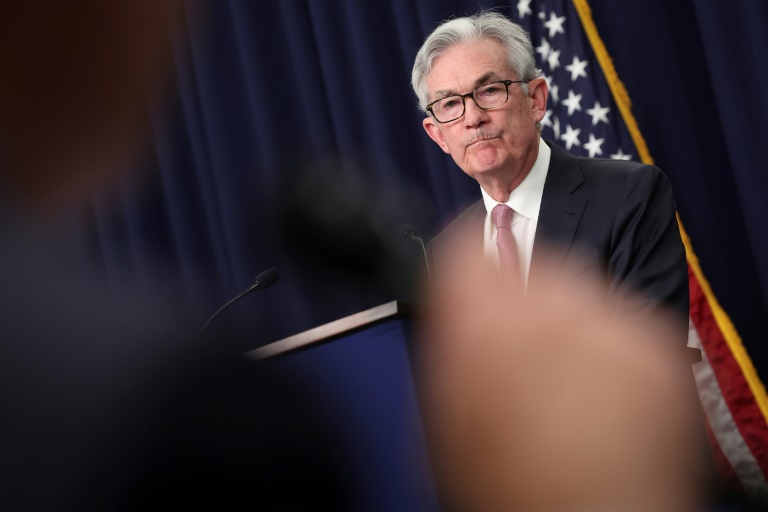
However, equities on Friday staged “a relief rally” after Fed boss Jerome Powell calmed nerves over the potential hefty increase, said Jeffrey Halley, analyst at OANDA trading group. 

“The rally today looks more like a technical rebound after a torrid week than a structural turn in sentiment,” he added.

Investors also sold off stocks as they sought to reduce risk amid the Ukraine war and worried about the economic impact of China’s Covid lockdowns.

Those China worries also eased on Friday.

“Global sentiment seems to be getting some relief as China officials suggested that Covid-related lockdowns — which have been another source of uneasiness — may be set to ease,” analysts at Charles Schwab investment bank said.

Oil prices pushed higher Friday after much volatility, reaching around $110 per barrel yet again,

“Prices appear to be caught in a pincer of concern about slowing demand due to the impact of higher prices, as well as China’s Covid lockdowns and worries about Russian supply and the loss of that due to sanctions,” said analyst Michael Hewson at CMC Markets. 

Meanwhile, the euro struck a new five-year low against the dollar.

Bitcoin held above $30,000, a day after the cryptocurrency slumped under $27,000, its lowest level since late 2020.

Its crash this week was fuelled by the collapse of two so-called “stablecoin” cryptocurrencies — TerraUSD and Tether — which proved to be anything but stable, leaving investors panicked. 

On the corporate front, Twitter’s share price plunged after Elon Musk said he was putting a temporary halt on his much-anticipated $44-billion deal to buy the social media giant.

Its shares slumped more than seven percent and are trading below what Musk has promised to pay for the company’s shares.

Hewson said the announcement fuelled “concerns that Musk may be preparing the ground for backing out of the deal, although he will take a $1bn hit were he to do so.”

– Key figures at around 1530 GMT –

New York – Dow: UP 1.6 percent at 32,230.15 points

EURO STOXX 50: UP 2.5 percent at 3,668.92

London – FTSE 100: UP 2.6 percent at 7,418.15 (close)

Frankfurt – DAX: UP 2.1 percent at 14,027.93 (close)

Paris – CAC 40: UP 2.5 percent at 6,362.68 (close)

Hong Kong – Hang Seng Index: UP 2.7 percent at 19,898.77 (close)

Shanghai – Composite: UP 0.9 percent at 3,084.28 (close)  

Tokyo – Nikkei 225: UP 2.6 percent at 26,427.65 (close)

Brent North Sea crude: UP 3.1 percent at $110.80 per barrel

West Texas Intermediate: UP 3.5 percent at $109.80 per barrel

Euro/dollar: UP at $1.0413 from $1.0382 at 2100 GMT Thursday

Pound/dollar: UP at $1.2238 from $1.2199

Euro/pound: UP at 85.10 pence from 85.08 pence

Dollar/yen: DOWN at 129.20 yen from 129.97 yen

Ukraine's key IT sector booming despite Russian invasion

Ukraine’s IT sector is booming despite the Russian invasion. Workers with stickers on their laptops recline on beach chairs outside a warehouse for start-ups in the east Ukraine city of Lviv giving off major Silicon Valley vibes.

But the atmosphere inside is different.

Through the glass doors of the complex, young Ukrainians zig-zag between stacks of bulletproof vests and cardboard boxes filled with helmets ready for the front.

They are part of Ukraine’s burgeoning tech sector which was forced to adapt after Russia’s invasion and has become key to supporting the war effort.

“Most tech companies had developed contingency plans” in case of war said Stepan Veselovskiy, the head of the “IT Cluster Lviv” community.

He told AFP that companies transferred servers to secure locations and established back-up systems outside the country before Russia invaded on February 24.

When Russian bombing started, IT companies shut offices in the capital Kyiv and eastern city of Kharkiv and engineers found refuge in western Ukraine or Poland next door.

Veselovskiy said there were already around 500 tech companies in Lviv before the war but now estimates that 80 percent of the sector is in the western city. 

One is Infopulse, which provides various digital services to mainly European customers.

It brought 300 of its 2,300 employees to Lviv, where it has offices in one of the city’s few buildings equipped with a bunker.

There are bunk beds and stable internet underground so employees to continue working in the event of an air raid.

There are also generators in case Russian forces target power stations and terminals for Elon Musk’s Starlink internet service.

“Even in the most drastic conditions, business can continue,” regional manager Ivan Korzhov said. 

They can even thrive. 

– Tech army –

Since the start of the war, Infopulse has gained four new customers and in April — the second month of the Russian invasion — it created 25 new jobs in Ukraine.

It is not the only tech company in Ukraine to do so. 

Veselovskiy says February — when Russia attacked — was a historically good month for Ukraine’s tech sector and its estimated 200,000 employees. 

“It slowed down a bit in March, but we are very optimistic for the future because the war doesn’t stop us from growing,” he said.

This is a stark contrast to other industries, battered by the invasion. Exports for traditional sectors such as steel and agriculture have collapsed.

But the tech sector, naturally, has not been affected by the destruction of bridges, roads or the blocking of ports. 

It has, according to Veselovsky, made more than $2 billion since the start of the war and has become the country’s leading exporter. 

“It’s a good thing for Ukraine because we generate income in dollars every month when the country really needs it,” Korzhov said.

“We pay our taxes and give a lof of money” to the government. 

The IT Cluster Kyiv has already allocated $2 million, mainly to buy equipment for Ukrainian soldiers.

That’s how its offices ended up looking like an army depot.

The sector has also offered its brightest to help the military.

Softserve — one of Ukraine’s biggest tech companies — has worked on the military’s websites for free and IT Cluster Kyiv modernised one of the military’s command centres.

Infopulse also participates in a joint project by the Ukrainian army and the ministry of digital transformation.

“Specialists in tech and cybersecurity work with the government on the information front,” its regional manager Korzhov said. 

He then repeated a popular slogan in Ukraine: “We are not waiting for peace, but for victory.”

US baby formula shortage could last for some time: official

The nationwide shortage of baby formula in the United States could last for some time, a top White House economic adviser cautioned on Friday. 

The problem “is not going to solve itself in a day or week,” Brian Deese told CNN. 

US families have grown increasingly desperate for formula amid a perfect storm of supply issues compounded by a massive recall.

While he would not offer a specific timeline, Deese said, “We are looking at every possible angle that we can to try to address this issue.”

The average out-of-stock rate for baby formula last week hit 43 percent, according to Datasembly, which collected information from more than 11,000 retailers.

The scarcity initially was caused by supply chain problems and labor shortages, but the problem has been worsening since February 17 when manufacturer Abbott announced a “voluntary recall” for formula made at its factory in Michigan after the death of two infants,.

That recall included Similac, a brand used by millions of American families.

A subsequent investigation cleared the formula, but production has yet to resume.

“We’ve got to see how this progresses in real time,” Deese said.

It is the latest crisis to confound President Joe Biden’s push to get the US economy on sound footing amid the highest inflation in four decades and the ongoing global supply chain bottlenecks.

The United States produces about 98 percent of the formula it consumes, and the Biden administration plans to increase imports of the powdered milk.

“The most important step that we can take right now is to give retailers more flexibility on the types of formula that they can sell, and consumers more flexibility for the types that they can buy,” Deese said. 

Officials also are working with manufacturers and he noted that domestic output has been recovering. 

Over the past month “there has been more production of formula than there was in the weeks preceding the recall,” Deese said.

South Asia pummelled by heatwave that hits 50C in Pakistan

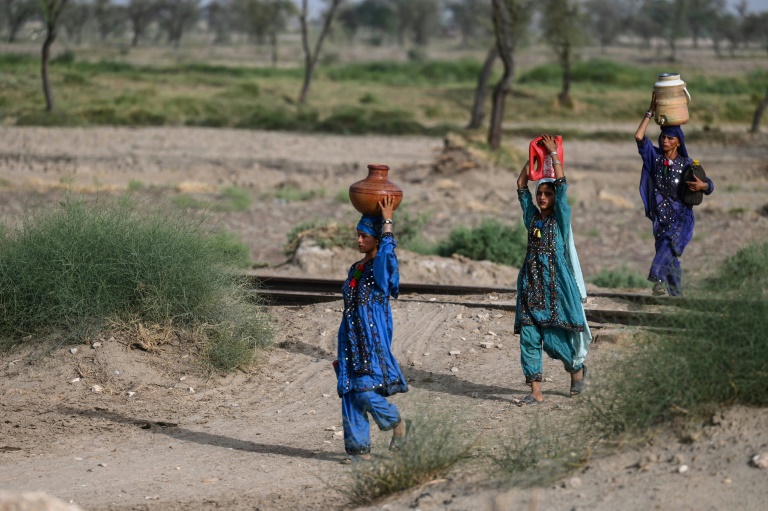
South Asia was in the grip of an extreme heatwave on Friday, with parts of Pakistan reaching a temperature of 50 degrees Celsius as officials warned of acute water shortages and a health threat.

Swathes of Pakistan and neighbouring India have been smothered by high temperatures since April in extreme weather that the World Meteorological Organization has warned is consistent with climate change.

On Friday, the city of Jacobabad in Sindh province hit 50C (122 degrees Fahrenheit), the Pakistan Meteorological Department (PMD) said, with temperatures forecast to remain high until Sunday. 

“It’s like fire burning all around,” said labourer Shafi Mohammad, who is from a village on the outskirts of Jacobabad where residents struggle to find reliable access to drinking water.

Nationwide, the PMD alerted temperatures were between 6C and 9C above normal, with the capital Islamabad — as well as provincial hubs Karachi, Lahore and Peshawar — recording temperatures around 40C on Friday.

“This year we have jumped from winter right into summer,” said PMD chief forecaster Zaheer Ahmad Babar.

Pakistan has endured heightened heatwaves since 2015, he said, especially in upper Sindh province and southern Punjab province.

“The intensity is increasing, and the duration is increasing, and the frequency is increasing,” he told AFP.

Jacobabad nurse Bashir Ahmed says that, for the past six years, heatstroke cases in the city have been diagnosed earlier in the year — starting in May, rather than June or July.

“This is just increasing,” he said.

Far worse may be on the horizon for South Asia as climate change continues apace, top climate scientists have said. 

– ‘Take cover’ –

Punjab province irrigation spokesman Adnan Hassan said the Indus river — Pakistan’s key waterway — had shrunk by 65 per cent “due to a lack of rains and snow” this year.

Sheep have reportedly died from heatstroke and dehydration in the Cholistan Desert of Punjab — Pakistan’s most populous province, which also serves as the national breadbasket.

“There is a real danger of a shortfall in food and crop supply this year in the country should the water shortage persist,” Hassan said.

Pakistan’s climate minister Sherry Rehman this week warned residents in the megacity of Lahore “to take cover for the hottest hours of the day”.

The heatwave has also ravaged India, with temperatures in parts of Rajasthan hitting 48.1C on Thursday and expected to hit 46C in Delhi anytime from Sunday.

Suman Kumari, 19, a student who lives in northwest Delhi, told AFP: “It was so hot today that I felt exhausted and sick while returning from college in a bus. The bus seemed like an oven. With no air conditioning, it was sizzling hot inside,” she said.

Most schools have declared summer holidays from Monday for junior classes.

Heatwaves were also predicted in parts of northwest India including areas of Rajasthan, Madhya Pradesh, Maharashtra and Uttar Pradesh — collectively home to hundreds of millions of people — over the coming days.

But some respite is expected when the southwest monsoon makes its advance into the Andaman Sea and adjoining Bay of Bengal around May 15, said the India Meteorological Department.

As power outages exacerbate heatwaves, India plans to lease abandoned coal pits to private mining companies, a government official said on Friday, in an effort to ramp up production.

Pakistan has also faced severe power outages, with some rural areas getting as few as six hours of electricity a day. 

– Rapid glacier melt –

Home to 220 million — Pakistan says it is responsible for less than one percent of global greenhouse gas emissions.

But it ranks as the nation eighth most affected by extreme weather events, according to a 2021 study by environmental group Germanwatch.

Extreme heat can also trigger cascading disasters that could pummel Pakistan’s generally impoverished population.

The mountainous portions of the country are home to more than 7,000 glaciers, a number larger than any region outside the poles.

Quickly melting glaciers can swell lakes, which then burst their banks and unleash torrents of ice, rock and water in events known as glacial lake outburst floods.

Last weekend a key highway bridge in the Gilgit-Baltistan region was swept away in flash flooding caused by glacier melt.

In April, officials warned there were 33 lakes in Pakistan in danger of unleashing similar dangerous deluges.

Lebanese activists launch mock 'lollar' currency

Lebanese activists Friday rolled out mock banknotes featuring paintings of a gutted central bank or the Beirut port explosion to denounce high-level corruption that has helped to wreck the country.

The collapse of the Lebanese pound and frozen bank accounts have left Lebanon with a confusing currency system, with a multitude of exchange rates applying to various situations in daily life.

The dollars stuck in accounts that citizens can only withdraw in Lebanese pounds at a fraction of their original value are known locally as “lollars”.

With parliamentary elections two days away, the Lebanese Transparency Association (LTA) decided to take the joke to the streets, with a stunt encouraging people to use “lollars” for the day.

The “monetary disobedience” campaign, entitled “Currency of Corruption”, encourages people to print their own “funny money” at home and try to use it as a means of raising awareness.

“We will not adapt to this mockery anymore, we are #NotPayingThePrice,” the LTA said in a statement unveiling the campaign and its hashtag.

The mock banknotes feature paintings by acclaimed Lebanon-based artist Tom Young depicting calamities that have hit Lebanon in recent years, from the deadly August 2020 port blast to forest fires, solid waste pollution and shortages.

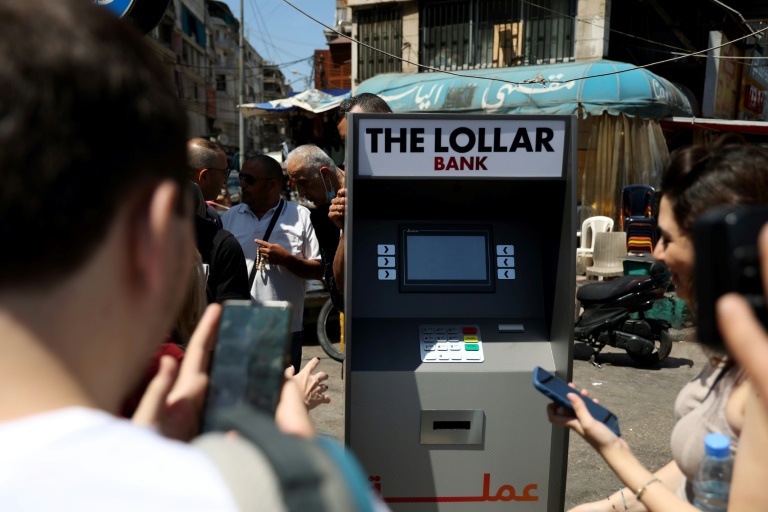
On one of Beirut’s main squares Friday, organisers installed a fake ATM from which passers-by could withdraw “lollars”.

LTA communications officer Hazar Assi said the campaign was aimed at reminding voters that their current plight was to blame on the country’s corrupt hereditary leaders.

“When people vote, they should make a choice based on accountability and rejecting the corruption that is affecting all of our lives,” she said.

Lebanon’s traditional sectarian parties will seek extend their stranglehold on power in parliamentary elections on Sunday but a new generation of independent candidates are hoping for a breakthrough.

The gas 'poker game' between Russia and Europe

The drop in Russian gas flows to the European Union has had no major effect on supplies, but it raises pressure on the region to wean itself from Moscow’s energy.

Here is a look at the issue:

– Heavy dependence –

The EU relies heavily on Russian gas, raising concerns that Moscow could use its export to blackmail the 27-nation bloc.

Last year, the EU received around 155 billion cubic metres of Russian gas, accounting for 45 percent of its imports of the fossil fuel.

While the EU is discussing an embargo on Russian oil, a gas ban is less likely for now as some countries such as Germany, the EU’s economic engine, are heavily reliant on the energy source.

“Of course, the Europeans have been quite bad in this poker game — they showed too openly how scared they were to lose the Russian gas that now, Russia is gaining the upper hand,” said Ipek Ozkardeskaya, analyst at Swissquote Bank.

Ukraine has pleaded with the EU to ban Russian gas, pointing out that it gives Moscow the financial means to press on with its war against its neighbour.

In the first two months following the February 24 invasion, Russia has raked in 63 billion euros ($65.5 billion) in gas exports, including 44 billion euros from the EU, according to the Centre for Research on Energy and Clean Air.

– Low gas flows –

Russian gas flows via Ukraine fell this week.

Ukraine’s pipeline operator GTSOU said it halted gas transport at the Sokhranivka transit point from Wednesday as Russian occupying forces now in control were interfering with operations.

Ukraine urged Russian energy firm Gazprom to increase supplies via another site, Sudzha, but the company said it was impossible to reroute all the supplies through there.

“Roughly one third of Russia’s total Ukrainian transit flows through the Sokhranivka entry point, while the rest (two thirds) passes through the Sudzha station,” said Ole Hvalbye, commodities analyst at SEB bank.

The loss amounts to two percent of Europe’s Russian gas consumption, according to Hvalbye.

“This does not scream crisis, but it is a wake-up call for what is to come,” he said.

Gazprom also announced on Thursday that it would stop sending natural gas via the Polish section of the Yamal-Europe gas pipeline after Moscow imposed retaliatory sanctions against Western energy companies.

The pipeline can carry up to 33 billion cubic meters of gas from fields in Russia’s Yamal peninsula and western Siberia through Belarus and Poland to Germany.

But a market source said the impact is limited as the pipeline had already been carrying low volumes for months.

The move will make “no difference” as long as long-term contracts for Russian gas via other pipelines are fulfilled.

– Russian and Ukrainian intentions –

Some analysts suggest that Ukraine has deliberately disrupted Russian gas flows to Europe in frustration over the EU’s reluctance to impose an embargo on Russia’s energy exports.

Carsten Fritsch, analyst at Commerzbank, said it was “possible” that Ukraine, which relies heavily on Russian oil, is pressuring Hungary to drop its opposition to an EU crude embargo.

While the EU has balked at a gas ban, there are fears that Russia could turn off the taps in retaliation at Western sanctions over the war.

Kaushal Ramesh, senior analyst at the research firm Rystad Energy, said “supplies could be stopped unilaterally by Gazprom”.

“The chances of this happening are slim, but not zero,” Ramesh said.

EU buyers are “not caught completely off guard” as storage levels are currently sufficient to last through “most of 2022, even if Russian flows were to stop instantly”.

But, he added, “the outlook for winter 2022 supply is now a lot more pessimistic”.

– The alternatives –

The EU has set a goal of cutting Russian gas imports by two thirds this year.

Germany says it can make up for the recent drop in Russian deliveries by getting gas from Norway and the Netherlands to stock up before winter.

Europeans are also counting on liquefied natural gas (LNG), which can be shipped by boat from other countries such as Qatar and the United States.

Denmark is looking into possibly raising its own natural gas production in its North Sea fields, while Romania is eyeing legislation to encourage gas extraction in the Black Sea.

Experts say the situation is another argument in favour of speeding up the transition away from fossil fuels.

“The rollout of clean energy solutions alone can lead to a reduction of 101 bcm (101 billion cubic metres of gas), which is equivalent to two thirds of Russian imports, already by 2025,” according to the E3G climate think tank.

The European Biogas Association is also ready to step in, saying it could nearly double its production to 35 billion cubic meters by 2030, equivalent to 20 percent of Russian gas imports.

Close Bitnami banner
Bitnami