AFP

Contemporary art to the metaverse: Takashi Murakami's poppy trip

Takashi Murakami is known for blending pop art and Asian fine arts, but for his latest exhibition in New York, he is moving into the metaverse.

At the show “An Arrow Through History” that opened this week at Manhattan’s Gagosian Gallery, Murakami builds bridges from traditional fine arts to Japanese pop art to buzzy NFTs — the digital tokens that represent original artwork.

Murakami told AFP he is concerned that younger generations are screen-obsessed and “don’t understand the contemporary art history.”

“They can enjoy very few things, but with the plus of augmented reality, maybe the young people open their eyes more and then step into the contemporary art scene,” the 60-year-old Japanese artist said.

Of late, athletes, artists, celebrities and tech stars have been hawking NFTs, which use the same blockchain technology as cryptocurrencies.

“When I work on a creative production, I make no distinction between digital and analog,” Murakami said in a statement from Gagosian. 

“I’m always working in the context of contemporary art, and that context is all about whether I can be involved in events that manage to trigger a cognitive revolution.”

– ‘Into the metaverse’ –

In one piece, Murakami painted thick canvases and wooden structures the blue and white patterns of fish, inspired by Chinese porcelain vases dating back to the Yuan Dynasty (1279-1368).

Using Snapchat and an augmented reality filter, visitors can be immersed in the exhibition room via their phones, standing among digital images of fish that swim among the physically real works of art.

“Japanese culture originally came from the Eurasian continent, and my concept has been to go beyond from there into the metaverse, shooting through the history of art with a single arrow,” Murakami said in the statement.

The metaverse is an immersive virtual reality which is accessible with augmented or virtual reality glasses, and is a concept that has experienced a boost in recent years.

Stuck at home during the coronavirus pandemic, Murakami told AFP that “I was watching the reality in my house, so that was a very monumental moment.”

“For us it was getting super stressful every day, we could not go outside,” he said — but his kids could enjoy VR.

“That meant I had to change the mind, to fit in with the next generation of my kids,” he said. “This is my first answer — the show.”

Murakami is also set to open a special exhibition at The Broad contemporary art museum in Los Angeles, titled “Takashi Murakami: Stepping on the Tail of a Rainbow,” which will include immersive environments and run from May 21 until September 25.

Asian stocks up as investors calm over potential Fed moves

Asian equities were mostly up Friday following a tumultuous trading period on Wall Street, which rebounded at the close after investors calmed down about US policies to counter surging inflation.

World markets have been volatile for much of 2022 owing to China’s Covid-19 lockdowns, Russia’s invasion of Ukraine and surging inflation weighing on consumer sentiment.

The Federal Reserve last week had announced its largest rate hike since 2000 and signalled that similar increases were likely in the coming months — a possibility that sent markets on a rollercoaster. 

“Macro-economic concerns have continued to weigh heavily on the equity markets this week, as stagflation and recession fears continue to dampen investor enthusiasm,” said Lewis Grant of Federated Hermes Limited.

He added that the fears have been echoed in forecasts by major companies, with a large number of firms citing supply chain concerns. 

Wall Street was mixed Thursday after another day of volatile trading, with the Dow falling for the sixth straight session but the Nasdaq mustering a small gain.

The small rebound on the tech-rich Nasdaq came after Fed Reserve chief Jerome Powell — confirmed Thursday by the Senate for a second term — expressed confidence that the economy is strong enough to withstand tighter monetary policies. 

According to Bloomberg, Powell reaffirmed that the Fed was likely to raise rates by a half point but isn’t “actively considering” a 75-basis point move.

In Asia, Hong Kong, Tokyo, Seoul, Singapore and Sydney opened higher on Friday, while Wellington traded in the negatives.

Dread has not only sent traditional markets seesawing, but the cryptocurrency realm also saw great volatility this week. 

Bitcoin tumbled to the lowest level since late 2020, following a dramatic collapse in some so-called stablecoin cryptocurrencies — TerraUSD and Tether.

The two stablecoins — which are supposed to be pegged to the dollar — proved to be anything but, as their values collapse. 

While the digital currency market stabilised by Friday, Stephen Innes of SPI Asset Management said “the 7-day moves in some of the ‘other crypto experiments’ on monster volume are insane and increasingly difficult to watch”.

Bitcoin slumped below $27,000 before recovering, and traded at over $30,000 by mid-Friday.

Oil remained up on Friday, with US benchmark crude WTI trading at more than $107 a barrel.

“As long as the war continues and macro pressures persist, it is likely that both energy names and value stocks will remain relative safe-havens for fully-invested, long-only equity investors,” said Grant of Federated Hermes Limited.

– Key figures at around 0230 GMT –

Hong Kong – Hang Seng Index: UP 1.7 percent at 19,705.86  

Shanghai – Composite: UP 0.3 percent at 3,064.32  

Tokyo – Nikkei 225: UP 2.7 percent at 25,421.84 (break)

Brent North Sea crude: UP 1.4 percent at $108.90 per barrel

West Texas Intermediate: UP 1.2 percent at $107.36 per barrel

Euro/dollar: UP at $1.0387 from $1.0382 at 2100 GMT Thursday

Pound/dollar: DOWN at $1.2212 from $1.2199

Euro/pound: DOWN at 85.06 pence from 85.08 pence

Dollar/yen: DOWN at 128.36 yen from 129.97 yen

New York – Dow: DOWN 0.3 percent at 31,730.30 (close)

London – FTSE 100: DOWN 1.6 percent at 7,233.34 (close)

Rising student debt to worsen money woes of young Britons

Rhiannon Muise graduated from Edge Hill University in northwest England last year with a mountain of student debt, which is growing even larger due to surging inflation.

The 21-year-old dance and drama graduate said it will take a “lifetime” for her to pay back the £45,000 ($55,000) she owes for tuition fees and living expenses, particularly if she stays within her chosen field where salaries can be low.

Muise’s plight echoes that of students across Britain, who are already struggling with a cost-of-living crisis.

Britons heading to university next year face major changes that critics argue will worsen the financial pain.

– Exhausting –

The pressure is “exhausting, especially for someone in their 20s who has just started thinking about their career”, Muise told AFP.

Her current job as Edge Hill student engagement officer pays below the threshold that activates repayments.

UK graduates shoulder more debt than any other developed country, according to House of Commons Library data.

About 1.5 million students borrow nearly £20 billion in loans every year in England alone.

And on average, graduates of 2020 have amassed £45,000 in debt.

Zeno, a 25-year-old student in London who gave only his first name, said he owes just short of £75,000 for his loans.

Unless he “wins the lottery”, he accepts he will probably be paying the money back from his salary for the next 30 years.

– Tuition fees –

University used to be free in the UK, with means-tested grants for the poorest students to cover living costs.

But after the sector was opened up in the 1990s, numbers surged and, despite protests from student bodies, tuition fees have been gradually introduced in the last decade to help universities meet costs.

With education a devolved matter for the governments in Scotland, Wales and Northern Ireland, different tuition fee arrangements are in place across the UK.

Accommodation and living costs are extra.

In England, undergraduate tuition fees are capped at £9,250 a year for UK and Irish students — up from £3,375 in 2011 when the government cut most ongoing direct public funding. 

The cap in Wales is £9,000 and £4,030 in Northern Ireland. 

Scottish students studying in Scotland pay £1,820 but those from the rest of the UK attending universities north of the border with England pay £9,250.

– Inflation worry –

The picture is further complicated by rocketing inflation because the student loan interest rate is linked to the retail price index (RPI).

Loan interest is calculated by adding up to 3.0 percentage points to the RPI rate.

Inflation however soared to 30-year highs this year, particularly on rocketing energy costs and fallout from the Ukraine conflict.

Graduates could therefore pay an interest rate of 12 percent from September — or more if prices rise even higher.

The UK government plays a large part in student financing, providing loans that only demand repayment when a graduate earns above a threshold of £27,295 per year.

What borrowers repay depends on how much they earn. Unlike private lenders, they have up to 30 years to repay. The debt is cancelled after this time.

“This system is more progressive than in the United States, with generous write-offs for lower-paid graduates,” said Nick Hillman, director of the Higher Education Policy Institute in Oxford. 

Current and recent students faced huge upheaval during courses due to coronavirus restrictions, with the pandemic also hitting job opportunities.

A combination of high debt repayments, high cost of living and wages that have failed to keep pace with inflation, add yet more stress.

– Conundrum –

Student finance poses a major conundrum for the public purse because the UK forecasts outstanding loans will top £560 billion by 2050.

From next year, Britain will lower the repayment threshold for new borrowers to £25,000 and lengthen the repayment time from 30 to 40 years.

This will however increase costs for low-earners, while benefiting richer graduates who can pay back more quickly.

The UK government forecasts however that half of new students will repay their loans in full under the new plan.

Student debt has long been a concern in the United States, where the Federal Reserve estimates that it amounts to a staggering $1.76 trillion.

US students on average have outstanding debt of close to $41,000, according to think-tank Education Data Initiative.

President Joe Biden this year extended a moratorium on student loan repayment and interest — and is holding talks over partial debt write-offs.

Biden welcomes Southeast Asian leaders with energy, maritime pledges

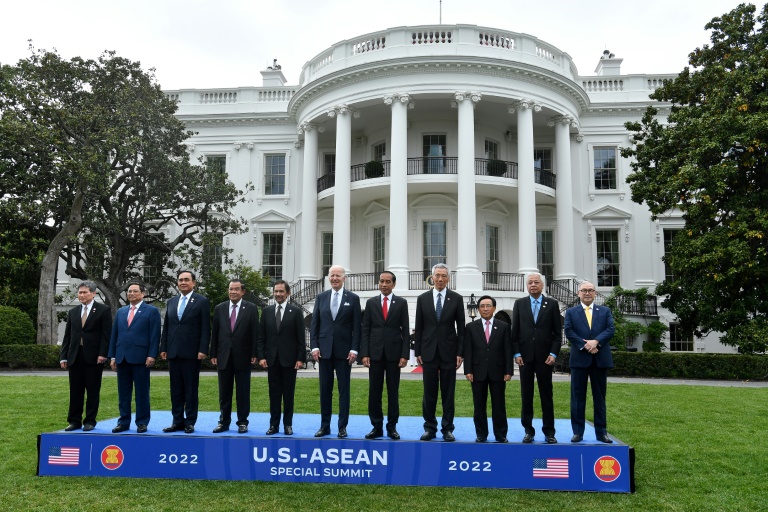
President Joe Biden on Thursday welcomed Southeast Asian leaders to Washington with promises to support clean energy and maritime security, hoping to showcase a US commitment as China makes wide inroads.

Top leaders from eight of the 10 members of the Association of Southeast Asian Nations (ASEAN) flew to Washington for the two-day summit, which opened with a closed-door White House dinner of thyme poached chicken and vanilla ice cream.

The Biden administration, which took office describing China as the top international challenger, is eager to prove it is still prioritizing Asia despite months of intense focus on repelling Russia’s invasion of Ukraine.

The White House announced some $150 million in new initiatives — a modest sum compared with a $40 billion package for Ukraine and with the billions pumped into the region by China, which has also flexed its muscle in the dispute-rife South China Sea.

But the United States said it was working with its private sector and it plans to unveil a broader package, the Indo-Pacific Economic Framework, when Biden travels next week to Tokyo and Seoul.

House Speaker Nancy Pelosi, welcoming ASEAN leaders to lunch earlier in the day, drew a link as she encouraged Southeast Asia to stand firm against Russia’s invasion.

“If left unchecked, we leave the door open to additional aggression, including maritime issues and other issues in the South China Sea,” she said.

– ‘Candor’ over rights –

Pelosi called the summit “another manifestation of America’s commitment to be a strong, reliable partner in Southeast Asia.”

In a contrast to China’s hands-off approach, Pelosi said she believed in “candor” and urged the Southeast Asian leaders to respect human rights, voicing particular concern about LGBTQ people.

“Let me be clear: when we hear about torture of LGBTQ people, that is unacceptable to the American people — and continues to be an obstacle to the full respect in our relationship,” she said.

Pelosi did not single out countries but Brunei and Indonesia’s Aceh province have both triggered uproars with laws that allow for physical punishment over consensual gay sex.

In the biggest chunk of the new funding, the White House said it was committing $60 million to new maritime initiatives that will include the deployment of a Coast Guard cutter and personnel to fight crime including illegal fishing. 

The White House said it was also devoting $40 million to invest in clean energy in the climate change-vulnerable region and was working with the private sector to raise up to $2 billion.

Another initiative — launched as Biden separately held a virtual summit on Covid — includes a project to test for emerging respiratory diseases through a new office in Hanoi of the US Centers for Disease Control.

“I hope this meeting can build a momentum for the return of the US presence in the region,” Indonesian President Joko Widodo told a sideline forum of the US-ASEAN Business Council.

– Meeting Myanmar opposition –

Southeast Asia has often been seen as a victim of its own success, with the United States focused elsewhere for lack of pressing problems in the region.

But in Myanmar, once hailed as a democratic success story, the United States has been ratcheting up pressure since the junta in February last year toppled Aung San Suu Kyi’s elected government.

The United States symbolically represented Myanmar with an empty chair at the summit.

The democratic leadership in exile was invited to Washington and met Deputy Secretary of State Wendy Sherman but did not represent Myanmar in talks.

The Philippines also did not send its leader and was represented by its foreign minister after holding elections on Monday.

Leaders who are participating include Cambodia’s veteran strongman Hun Sen, who is ASEAN’s current chair, and Thai Prime Minister Prayut Chan-O-Cha, the former army chief who led a 2014 coup.

Human Rights Watch said the United States needed to raise democracy in more countries than Myanmar.

“If the US doesn’t publicly raise human rights concerns during meetings, the message will be that human rights abuses are now tolerated in the name of forging alliances to counter China,” said John Sifton, the group’s Asia advocacy director.

Scientists successfully grow plants in soil from the Moon

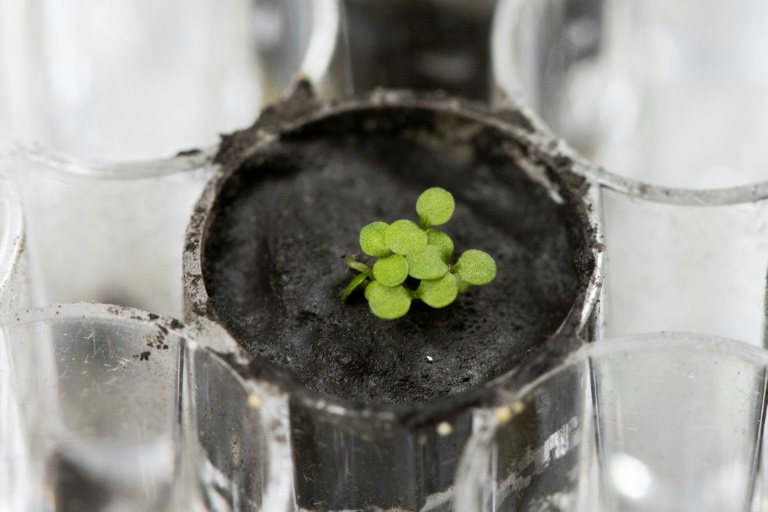
That’s one small pot of soil, one giant leap for man’s knowledge of space agriculture: scientists have for the first time grown plants in lunar soil brought back by astronauts in the Apollo program.

The ground-breaking experiment, detailed in the journal Communications Biology on Thursday, has given researchers hope that it may be possible to one day grow plants directly on the Moon.

That would save future space missions much hassle and expense, facilitating longer and farther trips.

However, according to the study’s University of Florida authors, much remains to be studied on the topic, and they intend to leave no stone unturned.

“This research is critical to NASA’s long-term human exploration goals,” said Bill Nelson, the head of the US space agency. “We’ll need to use resources found on the Moon and Mars to develop food sources for future astronauts living and operating in deep space.”

For their experiment, the researchers used just 12 grams (a few teaspoons) of lunar soil collected from various spots on the Moon during the Apollo 11, 12, and 17 missions.

In tiny thimble-sized pots, they placed about a gram of soil (called “regolith”) and added water, then the seeds. They also fed the plants a nutrient solution every day.

The researchers chose to plant arabidopsis thaliana, a relative of mustard greens, because it grows easily and, most importantly, has been studied extensively. Its genetic code and responses to hostile environments — even in space — are well known.

As a control group, seeds were also planted in soil from Earth as well as samples imitating lunar and Martian soil. 

The result: after two days, everything sprouted, including the lunar samples.

“Every plant — whether in a lunar sample or in a control — looked the same up until about day six,” Anna-Lisa Paul, lead author of the paper, said in a statement.

But after that, differences started to appear: the plants in the lunar samples grew more slowly and had stunted roots.

After 20 days, the scientists harvested all the plants, and ran studies on their DNA.

Their analysis showed that the lunar plants had reacted similarly to those grown in hostile environments, such as soil with too much salt, or heavy metals. 

In the future, scientists want to understand how this environment could be made more hospitable.

NASA is preparing to return to the Moon as part of the Artemis program, with a long-term goal of establishing a lasting human presence on its surface.

Powell wins second term as Fed chief as inflation battle rages

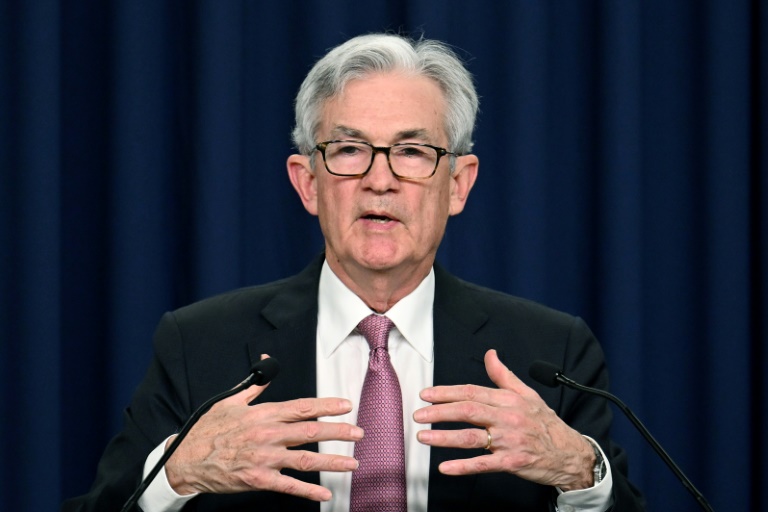
The US Senate on Thursday confirmed Jerome Powell to a second term as head of the Federal Reserve, as the central bank ramps up its fight to crush soaring inflation.

The vote came amid inflation that has hit a 40-year high, fueled by the conflict in Ukraine and sanctions imposed on Russia, as well as Covid-19 restrictions in China that have raised concerns the global supply snarls may worsen.

The Fed chair has said his primary focus is on getting inflation under control, but acknowledged the effort could be painful.

US President Joe Biden, whose popularity has taken a hit from the soaring inflation and record gasoline prices, has repeatedly said that tackling the issue is primarily a job for the Fed.

“I am pleased to see the Senate take a step forward on my agenda to get inflation under control by confirming my nominees to the Fed,” he said in a statement after the vote.

Powell, who first joined the Fed board in 2012, led the central bank as it slashed the benchmark interest rate to zero at the start of the pandemic in March 2020 and pumped money into the financial system to prevent a severe downturn in the world’s largest economy.

Now, he is overseeing efforts to cool price pressures affecting American families.

The Fed last week announced its largest rate hike since 2000 and signaled similar increases were likely in the coming months.

The challenge for Powell and the Fed is to turn down the heat on inflation without tipping the United States into recession.

While he has expressed confidence the economy is strong enough to withstand the tighter monetary policy, Powell said it will be challenging amid the unprecedented global shocks and “may actually depend on factors that we don’t control.”

In an interview with Marketplace on Thursday, he renewed his warning that “the process of getting inflation down to two percent will also include some pain.”

But “the most painful thing would be if we were to fail to deal with it and inflation were to get entrenched in the economy at high levels.”

– Delayed confirmation –

Powell, a Republican, enjoyed broad bipartisan support in the 80-19 vote — but also bipartisan opposition. Six Democrats voted against him, including progressive senators Bernie Sanders and Elizabeth Warren, who established the Consumer Financial Protection Bureau.

“Working families should not bear the cost of fighting inflation,” Warren tweeted after the vote. “As Fed Chair, Jerome Powell must focus on strengthening our economy without slamming the brakes on its growth or hurting families already struggling with higher prices.”

Powell had continued at the helm of the central bank even after his first four-year term officially expired February 4.

His confirmation was delayed by the battle to approve Lisa Cook to join the Fed board — the first Black woman to serve in the post — who was finally confirmed on Tuesday with only Democratic votes.

The Senate late Wednesday also confirmed Philip Jefferson to the board, marking the first time the institution has had more than one Black governor.

With the latest additions, the Fed board will be just one short of its full complement of seven governors. 

In his statement, Biden urged the Senate to confirm his final nominee, Michael Barr, as vice chair for supervision.

The US president’s first pick for the role of top Fed banking cop, Sarah Bloom Raskin, withdrew her name from consideration in March when it became clear she would not have sufficient support due to opposition from Republicans and from a key Democratic lawmaker over her stance on climate change issues in banking supervision.

Cook, a professor of economics and international relations at Michigan State University, and Jefferson, of Davidson College, each have researched inequality in the labor market. 

Powell has repeatedly stressed the importance of ensuring economic opportunities extend to disadvantaged groups — a notable change of focus in an economy where Black workers face far higher unemployment rates than other racial groups.

Jefferson is only the fourth Black man to serve as a Fed governor.

Twitter execs exit, hirings halt as Musk buy looms

Twitter confirmed Thursday that two senior executives are heading for the exit and it has paused most hiring, as Elon Musk stands poised to become the global messaging platform’s new owner.

Kayvon Beykpour, a general manager who leads research, design and engineering at Twitter, is leaving along with head of products Bruce Falck, a Twitter spokesperson told AFP.

Beykpour however said he was ousted from the San Francisco-based tech company.

“The truth is that this isn’t how and when I imagined leaving Twitter, and this wasn’t my decision,” Beykpour, who is on paternity leave, said in a tweet.

Twitter chief Parag Agrawal “asked me to leave after letting me know that he wants to take the team in a different direction,” he added.

Twitter also confirmed that, effective this week, it is pausing all hiring except for business-critical roles.

Musk’s $44-billion deal to buy Twitter was announced last month but still needs the backing of shareholders and regulators.

The takeover is expected to close later in 2022, with Musk — who runs space exploration endeavor SpaceX and electric automaker Tesla — stepping in as its boss at least for a little while. 

Musk is on record saying he would lift the ban Twitter slapped on Donald Trump, contending that kicking the former US president off the platform “alienated a large part of the country.”

Musk’s endorsement of a Trump return triggered fears among activists that Musk would “open the floodgates of hate.”

Trump has stated publicly he would not come back to Twitter if permitted, sticking instead with his own social network, Truth Social, which has failed to gain traction.

Trump was booted from Twitter and other online platforms after supporters, fired up by his tweets and speech alleging election fraud, attacked the US Capitol on January 6, 2021 in a deadly bid to stop Joe Biden from being certified as winner of the presidential election two months earlier.

Musk reasoned that permanent bans at Twitter should be rare, and reserved for accounts that are spam, scams or run by software “bots.”

Activist groups have called on Twitter advertisers to boycott the service if it opens the gates to abusive and misinformative posts with Musk as its owner.

The fate of Twitter’s top attorney, deemed a moral champion of the platform, has been in doubt since Musk tweeted displeasure with content moderation she had carried out.

The lawyer, Vijaya Gadde, has led efforts to battle bullying and posts that could lead to real-world harm such as the US Capitol riot.

She was involved in the decision to ban Trump, and others including removing political advertising from the app.

First image of black hole at Milky Way's centre revealed

An international team of astronomers on Thursday unveiled the first image of a supermassive black hole at the centre of our own Milky Way galaxy — a cosmic body known as Sagittarius A*.

The image — produced by a global team of scientists known as the Event Horizon Telescope (EHT) Collaboration — is the first, direct visual confirmation of the presence of this invisible object, and comes three years after the very first image of a black hole from a distant galaxy.

“For decades, we have known about a compact object that is at the heart of our galaxy that is four million times more massive than our Sun,” Harvard University astronomer Sara Issaoun told a press conference in Garching, Germany, held simultaneously with other media events around the world.

“Today, right this moment, we have direct evidence that this object is a black hole.”

Black holes are regions of space where the pull of gravity is so intense that nothing can escape, including light.

The image thus depicts not the black hole itself, because it is completely dark, but the glowing gas that encircles the phenomenon in a bright ring of bending light.

As seen from Earth, it appears the same size as a donut on the surface of the Moon, Issaoun explained.

“These unprecedented observations have greatly improved our understanding of what happens at the very centre of our galaxy,” EHT project scientist Geoffrey Bower, of Taiwan’s Academia Sinica, said in a statement.

The research results are published in The Astrophysical Journal Letters.

– Virtual telescope –

Sagittarius A* — abbreviated to Sgr A*, and pronounced “sadge-ay-star” — owes its name to its detection in the direction of the constellation Sagittarius. 

Located 27,000 light years from Earth, its existence has been assumed since 1974, with the detection of an unusual radio source at the centre of the galaxy.

In the 1990s, astronomers mapped the orbits of the brightest stars near the centre of the Milky Way, confirming the presence of a supermassive compact object there — work that led to the 2020 Nobel Prize in Physics.

Though the presence of a black hole was thought to be the only plausible explanation, the new image provides the first direct visual proof.

Capturing images of such a faraway object required linking eight giant radio observatories across the planet to form a single “Earth-sized” virtual telescope called the EHT.

“The EHT can see three million times sharper than the human eye,” German scientist Thomas Krichbaum of the Max Planck Institute for Radio Astronomy told reporters.

“So, when you are sitting in a Munich beer garden, for example, one could see the bubbles in a glass of beer in New York.”

The EHT gazed at Sgr A* across multiple nights for many hours in a row — a similar idea to long-exposure photography and the same process used to produce the first image of a black hole, released in 2019. 

That black hole is called M87* because it is in the Messier 87 galaxy.

– Einstein would be ‘ecstatic’ –

The two black holes bear striking similarities, despite the fact that Sgr A* is 2,000 times smaller than M87*.

“Close to the edge of these black holes, they look amazingly similar,” said Sera Markoff, co-chair of the EHT Science Council, and a professor at the University of Amsterdam.

Both behaved as predicted by Einstein’s 1915 theory of General Relativity, which holds that the force of gravity results from the curvature of space and time, and cosmic objects change this geometry.

Despite the fact Sgr A* is much closer to us, imaging it presented unique challenges.

Gas in the vicinity of both black holes moves at the same speed, close to the speed of light. But while it took days and weeks to orbit the larger M87*, it completed rounds of Sgr A* in just minutes.

The brightness and pattern of the gas around Sgr A* changed rapidly as the team observed it, “a bit like trying to take a clear picture of a puppy quickly chasing its tail,” said EHT scientist Chi-kwan Chan of the University of Arizona.

The researchers had to develop complex new tools to account for the moving targets.

The resulting image — the work of more than 300 researchers across 80 countries over a period of five years — is an average of multiple images that revealed the invisible monster lurking at the centre of the galaxy.

“The fact that we’re able to make an image of one, something that should be unseeable… I think that that’s just really exciting,” Katie Bouman, a Caltech professor who played a key role in creating the image, told AFP.

Scientists are now eager to compare the two black holes to test theories about how gasses behave around them — a poorly understood phenomenon thought to play a role in the formation of new stars and galaxies.

Probing black holes — in particular their infinitely small and dense centers known as singularities, where Einstein’s equations break down — could help physicists deepen their understanding of gravity and develop a more advanced theory.

“What about Einstein? Would he smile seeing all these hundreds of scientists still not having proven him wrong?” said Anton Zensus of the Max Planck Institute.

“I rather think that he would be ecstatic seeing all the experimental possibilities we have in this field today.”

US Senate confirms Powell for second term as central bank chief

The US Senate on Thursday confirmed Jerome Powell to a second term as head of the Federal Reserve, as the central bank fights to crush soaring inflation.

The 80-19 vote came amid inflation that has hit a 40-year high, fueled by the conflict in Ukraine and ensuing sanctions imposed on Russia, as well as Covid-19 restrictions in China that have raised concerns the global supply snarls may worsen.

Powell, a Republican who enjoyed broad bipartisan support, had continued at the helm of the central bank although his first four-year term officially expired February 4.

His confirmation was delayed by a drawn-out process to approve Lisa Cook to join the Fed board — the first Black woman to serve in the post — who was finally confirmed on Tuesday with only Democratic votes.

The vote on Powell came the day after the upper house of Congress approved the nomination of Philip Jefferson of Davidson College, marking the first time the Fed board has had more than one Black governor.

US President Joe Biden, whose popularity has taken a hit from the soaring inflation and record gasoline prices, has repeatedly said that tackling the issue is primarily a job for the Fed.

“I am pleased to see the Senate take a step forward on my agenda to get inflation under control by confirming my nominees to the Fed,” he said in a statement after the vote.

– Bringing down inflation –

Powell, who first joined the Fed board in 2012, led the central bank as it slashed the benchmark interest rate to zero at the start of the pandemic in March 2020 and pumped money into the financial system to prevent a severe downturn in the world’s largest economy.

Now he is overseeing efforts to cool price pressures impacting American families.

The Fed last week announced its largest rate hike since 2000 and signaled similar increases were likely in the coming months.

The challenge for Powell and the Fed is to turn down the heat on inflation without tipping the United States into recession, but he has expressed confidence that the economy is strong enough to withstand the tighter monetary policy.

With the latest additions, the Fed board will be just one short of its full complement of seven governors. 

The Senate last month confirmed longtime Fed governor Lael Brainard as vice chair of the board.

In his statement, Biden urged the Senate to confirm his final nominee, Michael Barr, as vice chair for supervision.

The US president’s initial nominee for the role of top Fed banking cop, Sarah Bloom Raskin, withdrew her name from consideration in March when it became clear she would not have sufficient support.

She had previously won bipartisan approval for senior roles at the Fed and Treasury, but faced opposition from Republicans and from a key Democratic lawmaker over her stance on climate change issues in banking supervision.

The Republican opposition in the Senate boycotted a committee vote on her nomination and the four other top Fed positions, which she cited as the main factor in her decision to drop out.

Cook and Jefferson each have researched inequality in the labor market. 

Powell has repeatedly stressed the importance of ensuring economic opportunities extend to disadvantaged groups — a notable change of focus in an economy where Black workers face far higher unemployment rates than other racial groups.

Cook, a professor of economics and international relations at Michigan State University, has focused her research on how discrimination has harmed the American economy and the damage downturns do to the poor.

Jefferson, also an economics professor, is only the fourth Black man to serve as a Fed governor.

Seeing Milky Way's new black hole is 'only the beginning': US researcher

At just 33 years old, Caltech assistant professor Katie Bouman is already a veteran of two major scientific discoveries.

The expert in computational imaging — developing algorithms to observe distant phenomena — helped create the program that led to the release of the first image of a black hole in a distant galaxy in 2019.

She quickly became something of a global science superstar, and was invited to testify before Congress about her work.

Now, she has again played a key role in the creation of a groundbreaking image of the supermassive black hole at the heart of our own Milky Way galaxy — a cosmic body known as Sagittarius A*.

Her working group within the Event Horizon Telescope Collaboration, which revealed the stunning image Thursday, was tasked with piecing it together from the mass of data garnered by telescopes around the world.

Bouman spoke with AFP shortly after the breakthrough announcement.

– How does this discovery compare to 2019? –

“The first one was just so exciting because it was the first one, and just being able to see a black hole for the first time was spectacular. But I think the holy grail of the Event Horizon Telescope has always been to image Sagittarius A*. 

“The reason why is because we have a lot more information from other observations on what we expected Sgr A* to look like. And so being able to see an image of that, it’s much easier for us to see how it matches with what we expected from prior observations and theory. 

“So I think that even though it is the second image that we’re showing, it’s actually a lot more exciting for that reason that we can actually use this to do more tests on our understanding of gravity.”

– Why was it harder to see Sagittarius A*? –

“We collected the data for both M87* and Sgr A* in the same week in 2017, but it took us so much longer to make a picture of Sgr A* than M87*. 

“Sgr A* has a lot of other things that are going on that make it a lot more challenging for us to make an image. We’re actually observing the black hole through the plane of the galaxy. And that means that the gas in the galaxy actually scatters the image. It makes it look like we’re looking at the black hole through, like, a frosted window, like in a shower. That’s one challenge. 

“But I would say the biggest challenge that we face is the fact that the black hole is evolving really quickly. The gas in M87* and Sgr A* is moving at roughly the same speed. But whereas it takes days to weeks to make a full orbit around M87*, for Sgr A*, it’s evolving from minute to minute.”

– Why are black holes so fascinating? – 

“It just breaks with what we’re used to here on Earth, right? Light can’t even escape from it, and it’s bending, it’s warping space-time around it. It’s just this mysterious thing and I think it just captures the imagination.

“What’s cooler than working on black holes — they’re so mysterious, right? And the fact that we’re able to make an image of one, something that should be unseeable… I think that that’s just really exciting.”

– What do you foresee in the future? A film? – 

“I think this is really only the beginning. And now that we know that we have these extreme laboratories of gravity, we can go back and we can improve our instruments and improve our algorithms in order to see more and to extract more science.

“We made our first attempts at making a movie and we made a lot of progress, but we’re not there yet — where we feel we’re confident enough that we feel, this is what Sgr A* looks like from minute to minute. 

“So now we’re going to go back, try to add more telescopes around the world, try to collect more data, so that we can actually show something that we feel really sure about.”

Close Bitnami banner
Bitnami