AFP

New Airbnb feature aims to 'redistribute' tourists from oversold venues

Seeking to address “over-tourism” at popular destinations, Airbnb unveiled Wednesday a new feature that encourages users to search by trip category, not only destination.

The goal is to “redistribute” users away from traveler-jammed venues, such as Venice, Paris or the biggest US cities, Airbnb executives said.

Under the new Airbnb program, consumers can pick from up to 56 categories such as “beach,” “countryside,” “iconic cities” or “design” the latter showcasing homes featured in architectural magazines. Some four million properties are tagged, with more categories to be added over time. 

The revamp is an alternative from the search box long used by Airbnb and other online travel sites where users enter in a destination and travel dates.

Airbnb users will still be able to search the conventional way, but the category option provides an alternative to steer demand away from oversold locales, said Chief Executive Brian Chesky.

“We felt everyone was just going to the same places. They’re just typing in Los Vegas and Orlando and Miami and Rome and Los Angeles and New York,” Chesky said at a briefing unveiling the changes.

“We’re trying to spread everyone out over as many places and as many dates as possible,” said Chesky, who described the plan as “good for Airbnb” but added that it would also “alleviate some of the issue of over-tourism.”

Users can go to the categories tab at the top of their screen, pick dates and then scan through pages of options at different price points in different cities or countries. 

In developing the new feature, Airbnb urged some owners to upgrade their photos so that the property’s profile page for “amazing pools” had a pool and that “skiing” properties were shown with snow, Chesky said

“Over-tourism isn’t too many people in the world traveling… it’s too many people going to the same places at the same time,” said Chesky, who also pointed to Airbnb features for those with flexible time frames away from the most in-demand times.

Responding to a trend of longer stays, Airbnb is tweaking the system to perform “split stays” where users can book two successive trips at once. 

Another change is to allow users three days to rebook or get a refund if a property falls short of what was promised; under the current system, users have just 24 hours to complain.
Companies lawyer up to navigate Russia sanctions

The deployment of unprecedented sanctions against Russia over the Ukraine war has left companies with a complex legal minefield to navigate, prompting them to hire more lawyers to avoid costly missteps.

The European Union alone is inching towards its sixth sanctions package, while the United States, Britain, Japan and even traditionally neutral Switzerland have imposed restrictions on trade with Russia.

Unprecedented in their scale and speed, Western measures against Moscow have ranged from freezing assets to export bans on strategic products like semiconductors and financial sanctions.

Alex Zuck, managing director for product strategy at Moody’s Analytics, said the company in recent weeks had spoken to “hundreds” of compliance executives “struggling with and thinking about the sanctions exposure”.

Some companies have to expand their legal teams in response to the ever-shifting landscape, said a source in the European banking industry.

“There is a layer of complexity exacerbated by the fact that we get new sets of sanctions almost every week,” the source said.

Conforming to the sanctions is even tougher because Russia had been closely integrated into the world economy and was seen as a promising market by many Western businesses.

Those firms are now on a legal “war footing”, said Elodie Valette, a lawyer at Bryan Cave Leighton Paisner, which aids companies in the car manufacturing and energy industries, among others.

“They set up teams which sometimes manage almost only that because, for some, their daily activity was put in a difficult position,” she told AFP.

Suddenly inundated with work, lawyers scrambled to examine the sanctions, categorise them by activity and invite clients to make audits as they found themselves “a little lost” at the start, she added.

“Now the companies are starting to see how they can strengthen their programme for the future,” said Zuck.

“I don’t believe many people think there will be an abrupt end to the sanctions — they are going to last, probably increase.” 

– Tricky task –

The call to economic arms began with the outbreak of war in late February, with the first measures obliging companies to compile an inventory of their Russian partners.

Business relations have to be scrutinised individually and painstakingly, including a review of clients, providers and partners, to see who really lies behind Russian structures.

“You need to go to the IT systems and conduct investigations. Having a name is just the tip of the iceberg, you need to find all the connections and the links,” the banking source said.

Zuck said the task is tricky as the United States and the European Union, for example, have different definitions of the level of control a Russian entity needs to have to trigger sanctions.

The manual approach of asking counterparties to disclose beneficial owners is sometimes “very difficult” due to the opacity of many Russian structures, he added.

“I dont believe many people think there will be an abrupt end to the sanctions. They are going to last, probably increase,” Zuck said.

Banks, especially those with close financial relations with Russia and countries on friendly terms with the Kremlin, are on the frontline of the economic war.

Despite some divergences between US, EU and UK sanctions regimes, the political objectives are the same and banks with the biggest exposure to Russia must reinforce their compliance teams, said the European banking industry source.

Violating sanctions can cost companies dearly. In 2014, the United States ordered French bank BNP Paribas to pay almost $9 billion for violating US embargoes against Iran, Cuba and Sudan.

“Today, everyone wants to apply the sanctions strictly,” said Valette.

ECB signals rate hike as soon as July to combat inflation

European Central Bank chief Christine Lagarde hinted Wednesday at a first interest rate hike in July to tackle soaring inflation, echoing the actions of other major central banks and heralding the end of the eurozone’s cheap money era.

The ECB should end its bond-buying stimulus “early in the third quarter” and could raise interest rates “only a few weeks” later, Lagarde said in a speech in the Slovenian capital Ljubljana. 

The comment is the clearest sign yet from Lagarde that the ECB is ready to move on rates sooner rather later, as the institution trails rate hikes made by the US Federal Reserve and others to tame global inflation.

Any hike would be the ECB’s first in over a decade and would lift rates from their current historically low levels.

These include a minus 0.5 deposit rate which effectively charges banks to park their excess cash at the ECB overnight.

Inflation in the eurozone climbed to 7.5 percent in April, an all-time high for the currency club and well above the ECB’s own two-percent target.

The surge, driven in no small part by steep increases in prices for energy due to the Russian invasion of Ukraine, has strengthened calls for the ECB to follow its peers towards hikes. 

ECB policymakers will decide their course of action in upcoming June 9 and July 21 meetings, with the July date now seen as the most likely opportunity for a rate announcement.

– Rate rise –

At its last meeting in April, the ECB’s governing council resolved to end its vast monthly bond purchases “in the third quarter”.

Over recent years, the scheme has hoovered up billions of euros in government and corporate bonds each month to stoke economic growth and keep credit flowing in the 19-nation currency club.

The ECB should draw a line under it “early” in the third quarter, which starts in July, Lagarde specified on Wednesday.

Ending net purchases under the programme would open the door to an interest rate rise that could follow “only a few weeks” after, she said. 

After the initial move the process of monetary policy “normalisation”, taking interest rates out of negative territory, would be “gradual”.

– July pressure –

“To sum up Lagarde’s speech: first rate hike on July 21,” Carsten Brzeski, head of macro at ING bank, said on Twitter.

Decisions by the Fed and the Bank of England to raise rates aggressively to counter inflation have added to the pressure on the ECB to act.

German central bank president Joachim Nagel said Tuesday he “will advocate a first step normalising ECB interest rates in July”.

The call made by the head of the traditionally conservative Bundesbank has been echoed by other members of the governing council.

On Wednesday, the head of the French central bank Francois Villeroy de Galhau also said the ECB would “progressively raise rates from the summer” to steer inflation towards the ECB’s two-percent target. 

The central bank is set to ratchet up interest rates at a delicate moment for the economy.

The war in Ukraine has both pushed up prices and added to supply chain disruptions, putting further strain on households and businesses.

In response to the invasion, the European Union has sought to reduce its reliance on Russian energy imports and is in discussions over an embargo of Russian oil that would add to the economic stress.

The ECB would raise its rates in July “followed by a return to zero in September” Gilles Moec, chief economist at Axa insurance, told AFP.

But “between the war in Ukraine, a complicated coronavirus situation in China”, which has seen a series of lockdowns and spillovers from rate hikes in the United States, the ECB will not be able to “pursue normalisation easily”, Moec said.

Africa grapples with way forward on cybercrime

Cyber experts are urging Africa to up its game in the face of criminals targeting the continent’s fast-growing internet economy with scams and theft.

Countries south of the Sahara are some of the world’s fastest-growing online markets — which makes them both attractive and vulnerable to cybercrime, say specialists.

“The issue of cybersecurity has to be raised to the core duties of the state,” Chadian economist Succes Masra said at a cyber conference in Abidjan, Ivory Coast’s economic hub, which ended on Tuesday.

“If you do that, you will get follow-through. There’s incomplete awareness about this problem, and we have to speed things up.”

Half a billion people in Africa are connected to the internet, according to Interpol — a figure that in raw numbers places the continent ahead of other regions such as South America or the Middle East.

There is plenty of room for growth, as more than 60 percent of the continent’s population is still offline.

Major attacks on the internet itself are very rare in Africa, the most spectacular being a brief takedown of the web across the West African state of Liberia in 2016.

Instead, say experts, fraud and theft are flourishing, inflicting an estimated economic cost of $4 billion a year.

“Less than five percent of the attacks which we have in Ivory Coast are pure attacks on computer systems,” said Colonel Guelpetchin Ouattara, in charge of the country’s anti-cybercrime unit.

“Ninety-five percent come from online fraud or money transfers via a mobile, video blackmail, etcetera.”

Many Africans use their mobile phones to make instant transfers of money, often through shops, in order to avoid the expense and time of using a bank.

The trends in Africa are a lesson to the continent not to follow other parts of the world in how they tackle online crime, said Ouattara.

“We have to shape our response to the local problem. You can’t compare Africa with other parts of the world which have their own specificities, their own digital environment, their own risks,” he said.

Several countries in Africa have already implemented a strategic plan for cybersecurity, setting up units with specialised investigators and launching awareness campaigns.

– Security ‘reflex’ –

In Ivory Coast, for instance, the Platform for Fighting Cybercrime (PLCC) has 200,000 followers on its Facebook page, where it provides the public with tips and informs them of emerging threats and arrests.

“Digital security has to become a reflex for the public, exactly the same as when you lock your door at night,” said Ouattara.

The software protection market is also booming.

According to the consultancy PWC, sales rose to $2.32 billion in 2020 from $1.33 billion in 2017.

“There’s an awareness and real demand,” said Franck Kie, who organised the Cyber Africa Forum.

Seminars at the two-day event ranged from the risks to Africa’s financial industries and e-commerce, to enhancing data protection and beefing up pan-African cooperation in fighting cybercrime.

Around 20 companies promoted their products or services on the sidelines of the conference.

Templeton Prize-winning physicist pushes back against anti-intellectualism

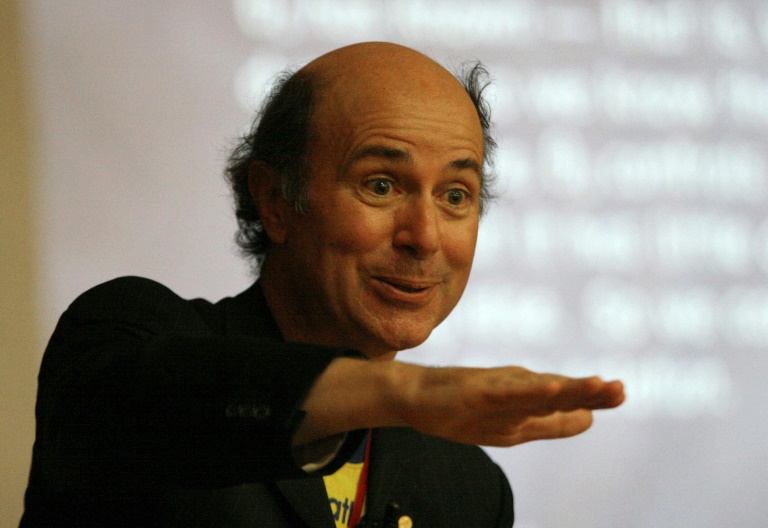
Frank Wilczek, the Nobel-winning theoretical physicist whose research transformed humanity’s understanding of the fundamental forces of nature, was announced Wednesday as the winner of the prestigious 2022 Templeton Prize.

The 70-year-old told AFP he saw the award as a testament to the inspiring power of science, at a time when scientists themselves are increasingly under fire by anti-intellectual elements in society.

“In the United States, where I live, it’s in our face in recent years, and a whole political party is dedicated towards it. It’s very unfortunate,” the MIT professor said.

“These people are saying, ‘Oh, I can find my own information on the internet.’ There wouldn’t be an internet without understanding quantum mechanics and science, and all the hard work that engineers have put into this!”

Such designers and builders of complex systems, Wilczek said, “should get a certain amount of credibility from that: they build bridges that don’t fall down usually, and vaccines that work.”

But he acknowledged some alienation was due to “perceived arrogance” by certain members of the scientific community, who he said must earn their credibility through patience, tolerance and honesty.

Valued at more than $1.3 million, the Templeton Prize is one of the world’s largest annual individual awards, honoring those who explore the deepest questions of the universe and humankind’s place within it. 

Past laureates include Mother Teresa and Jane Goodall.

“Throughout Dr Wilczek’s philosophical reflections, there is a spiritual quality to his ideas,” said Heather Templeton Dill, president of the John Templeton Foundation, in a statement.

“By uncovering a remarkable order in the natural world, Dr. Wilczek has come to appreciate different ways of thinking about reality, and through his written work, he has invited all of us to join him in the quest for understanding.”

– Demystifying dark matter –

Wilczek’s achievements in physics include an explanation for one of the four fundamental forces of nature: the so-called “strong interaction” between elementary particles called quarks — for which he and two others won the 2004 Nobel prize in physics.

He also proposed a leading explanation for dark matter, which is believed to constitute 80 percent of the matter of the universe, though its nature is not yet known.

More than four decades ago, Wilczek suggested that a type of subatomic particle called an “axion” was responsible for the mysterious matter — but it is only recently that experiments have come closer to confirming their existence, thanks to advances in technology.

If these experiments succeed, “we would make our understanding of fundamental laws considerably more beautiful. And it would also confirm that the universe is comprehensible,” he said.

In 2020, French scientists confirmed the existence of another particle that Wilczek named in the 1980s: the “anyon,” which can maintain a form of memory of their interactions with one another.

Microsoft is investing in this curiosity of theoretical physics to develop the next generation of quantum computing, which Wilczek says could revolutionize that nascent field.

“Without denigrating the existing platform (of quantum computing), it’s like having vacuum tubes and then having transistors,” he said, recalling the technology leap responsible for today’s computer chips.

Beyond his research, Wilczek is known for his public engagement through his talks and popular books, including “A Beautiful Question” and “The Lightness of Being,” as well as columns for The Wall Street Journal.

Bridging the gap between science and the public is vital, he said, “especially for scientists who do research that’s curiosity driven and has no obvious applications.”

“What they’re producing is a cultural product, and it should be brought into the culture.”

Solomons PM dismisses concerns over China maritime deal

Solomon Islands’ prime minister dismissed criticism of a new maritime investment deal with China on Wednesday, saying there was nothing “sinister” in the draft agreement.

The new agreement, a copy of which has been leaked to the media, comes after a controversial security pact was signed last month.

The security pact gave Beijing a military foothold in the South Pacific, and sparked alarm in Australia and the United States.

On Wednesday, Solomon Islands Prime Minister Manasseh Sogavare shrugged off criticism about the separate leaked memorandum of understanding on maritime investment, describing it as a “normal bilateral development initiative” that is yet to be formalised.

“There is nothing sinister nor trivial about the Blue Economy Memorandum of Understanding,” his office said in a statement.

A day earlier, Australian Prime Minister Scott Morrison had expressed concern regarding the memorandum, which covers undersea cables, port wharves, shipbuilding and other areas.

Morrison said he was “very concerned, as many other Pacific leaders are, about the interference and intrusion of the Chinese Government into these types of arrangements”.

Solomon Islands’ warming ties with China have been a key issue in Australia’s election campaign since a draft of the Solomons security agreement with China was first leaked on social media in March.

That draft allowed for Chinese naval deployments in the Solomon Islands, eliciting a warning from the United States that it would “respond accordingly” if China installed a military base in the Pacific archipelago. 

In April, Solomon Islands PM Sogavare said that his government would not allow a Chinese military base to be built in his country “under its watch”. 

The latest leaked maritime investment deal, dated just “2022”, covered investment in wharves, shipbuilding and ship repair, offshore gas and oil exploration and other “blue economy” industries.

Sogavare’s Wednesday statement said the memorandum of understanding was a broad document, which would be followed by a more detailed agreement.

It was this big! Cambodian fishermen hook giant endangered stingray

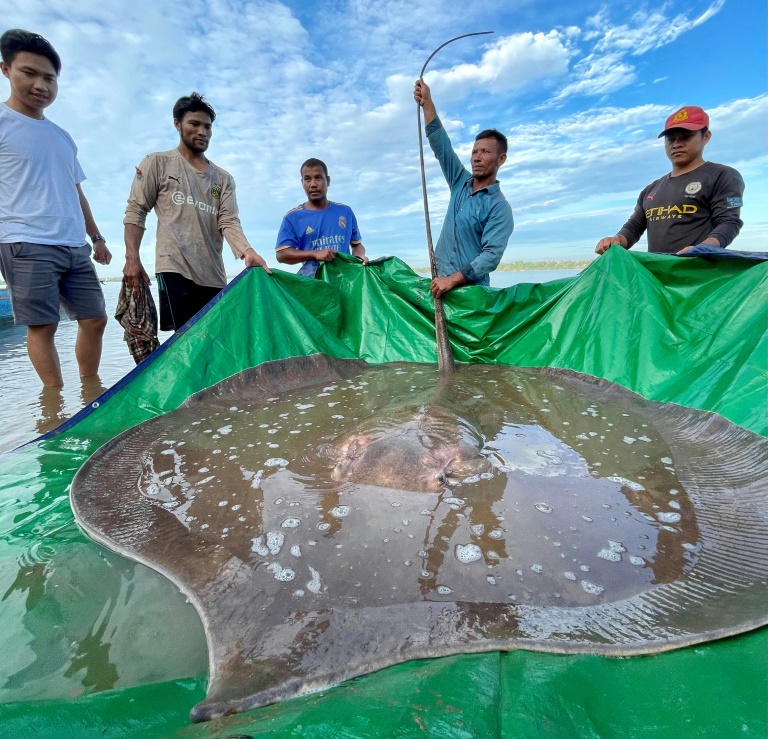
Cambodian fishermen on the Mekong River got a shock when they inadvertently hooked an endangered giant freshwater stingray four metres long and weighing 180 kilos, scientists said on Wednesday.

The female leviathan, one of Southeast Asia’s largest and rarest species of fish, was caught by accident last week in Stung Treng province when it swallowed a smaller fish that had taken a baited hook.

An international team of experts on the US-funded Wonders of the Mekong project worked with the fishermen to unhook the ray before weighing and measuring it and returning it unharmed to the river.

The giant Mekong is a crucial habitat for a vast array of species large and small, but project leader Zeb Hogan, a fish biologist from the University of Nevada, said the river’s underwater ecosystem was poorly understood.

“They are unseen worlds, underappreciated and out of sight,” he said in a statement issued by his university.

More than 1,000 fish species call the Mekong home and the stingray is not the only giant lurking in the muddy waters — the giant catfish and giant barb also reach up to three metres long and 270 kilos in weight.

The study group said in the statement that the remote location where the ray was caught has pools up to 80 metres deep and could harbour even bigger specimens.

But they also warned that underwater video footage showed plastic waste even in the deepest stretches of the Mekong, along with “ghost nets” — abandoned by fishers but still able to snare fish. 

Environmentalists have long voiced concerns about dam building along the Mekong River that will destroy fish stocks

The famous waterway starts in China and twists south through parts of Thailand, Laos, Myanmar, Cambodia and Vietnam, feeding 60 million people through its basin and tributaries.

'The Rock' diamond goes under the hammer

“The Rock”, the biggest white diamond ever to be sold at auction, will go under the hammer in Geneva on Wednesday and could fetch up to $30 million — or more.

The 228.31-carat stone, larger than a golf ball, is “a truly exceptional pear-shaped diamond”, said Max Fawcett, head of the jewels department at Christie’s auction house in Geneva.

It is “the largest white diamond ever to be offered at auction”, he told AFP at a preview.

The Magnificent Jewels auction at the luxury Hotel des Bergues in Geneva begins at 1400 GMT. 

The Rock, currently in the hands of an unnamed owner from North America, is lot 26 in the sale and could break records at the sale. 

“It’s perfectly symmetrical and is estimated at $20 to $30 million — and I expect there to be fireworks” at the auction, Fawcett said.

The equivalent in euros is 19 to 28 million.

The expert said that there were only a handful of diamonds of similar size and quality to The Rock. The Christie’s record for a similar white diamond is $33.7 million, fetched in Geneva in 2017 for a 163.41-carat gem.

The large diamond was extracted from a mine in South Africa in the early 2000s and has been shown in Dubai, Taipei and New York ahead of the sale in Geneva.

– Red Cross gem –

The Rock is up for grabs alongside a historic intense yellow diamond associated for more than a century with the Red Cross, which will receive some of the profits from its sale.

The Red Cross Diamond is a cushion-shaped, 205.07-carat canary yellow jewel, which has a price estimate of seven to 10 million Swiss francs ($7.09 to $10.13 million).

“I expect that it will achieve much more on the day of sale,” said Fawcett.

A large chunk of the proceeds will be donated to the International Committee of the Red Cross, which is headquartered in Geneva.

The original rough stone was found in 1901 in a De Beers company mine in South Africa and is said to have weighed around 375 carats.

As well as ranking among the largest diamonds in the world, a striking feature is its pavilion, which naturally bears the shape of a Maltese cross.

The stone was first put up for sale on April 10, 1918 at Christie’s in London. It was offered by the Diamond Syndicate in aid of the British Red Cross Society and the Order of St John.

The Red Cross Diamond fetched £10,000 — approximately £600,000 ($740,000) in today’s money. It was bought by the London jewellers S.J. Phillips.

It was sold again by Christie’s in Geneva in 1973, fetching 1.8 million Swiss francs, and is now being offered by the auction house for a third time.

– Russia restrictions –

Several other diamond rings, necklaces and bracelets could fetch over $1 million at the auction.

Also being sold is a tiara that belonged to princess Irma of Furstenberg (1867-1948), a member of one of the most pre-eminent aristocratic families in the Habsburg Empire.

It is estimated to go for 400,000 to 600,000 Swiss francs.

“The diamond market at the moment is very, very strong,” said Fawcett.

He said rising demand, supply constraints due to “geopolitical issues” and inflationary pressure on commodities, including precious stones, was pushing the market to highs not seen since its 2013-2014 peak.

The Russian invasion in Ukraine has had a major impact.

More than 40 percent of the world’s diamonds are mined in Russia, including the famous Alrosa mine, but international markets no longer have access to Russian gems, said Fawcett.

The supply constraint has created major price hikes and with the sanctions imposed on Moscow following the February 24 invasion, “prices will only continue to increase”, he said.

Every heatwave enhanced by climate change: experts

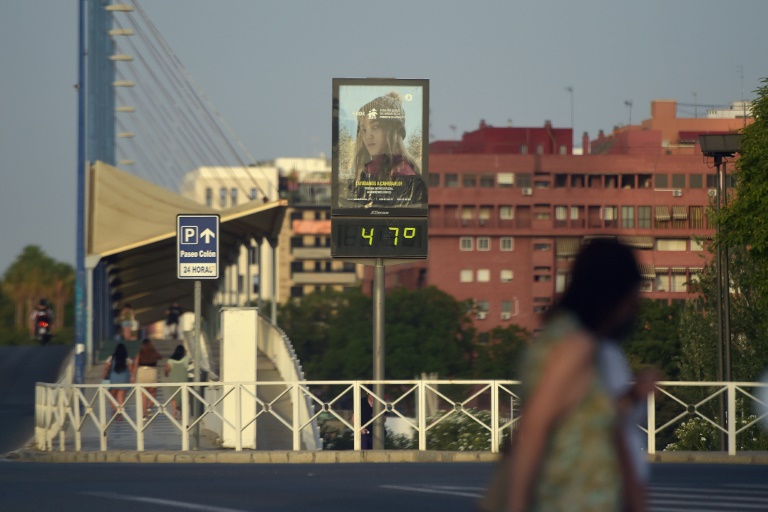
All heatwaves today bear the unmistakable and measurable fingerprint of global warming, top experts on quantifying the impact of climate change on extreme weather said Wednesday.

Burning fossil fuels and destroying forests have released enough greenhouse gases into the atmosphere to also boost the frequency and intensity of many floods, droughts, wildfires and tropical storms, they detailed in a state-of-science report.

“There is no doubt that climate change is a huge game changer when it comes to extreme heat,” Friederike Otto, a scientist at Imperial College London’s Grantham Institute, told AFP.

Extreme hot spells such as the heatwave that gripped South Asia in March and April are already the most deadly of extreme events, she added.  

“Every heatwave in the world is now made stronger and more likely to happen because of human-caused climate change,” Otto and co-author Ben Clarke of the University of Oxford said in the report, presented as a briefing paper for the news media.

Evidence of global warming’s impact on extreme weather has been mounting for decades, but only recently has it been possible to answer the most obvious of questions: To what extent was a particular event caused by climate change?

The most scientists could say before is that an unusually severe hurricane, flood or heatwave was consistent with general predictions of how global warming would eventually influence weather.

News media, meanwhile, sometimes left climate change out of the picture altogether or, at the other extreme, mistakenly attributed a weather disaster entirely to rising temperatures.

With more data and better tools, however, Otto and other pioneers of a field known as event attribution science have been able to calculate — sometimes in near realtime — how much more likely or intense a particular storm or hot spell has become due to global warming.

– Courtroom evidence –

Otto and colleagues in the World Weather Attribution (WWA) consortium, for example, concluded that the heatwave that gripped western North America last June — sending temperatures in Canada to a record 49.6 C (121 F) — would have been “virtually impossible” without human-induced climate change.

A heatwave that scorched India and Pakistan last month is still under review, Otto told AFP, but the larger picture is frighteningly clear.

“What we see right now in terms of extreme heat will be very normal, if not cool, in a 2-degree to 3-degree Celsius world,” she said, referring to average global temperatures above preindustrial levels.

The world has warmed nearly 1.2C so far. 

That increase made record-setting rainfall and flooding last July in Germany and Belgium that left more than 200 dead up to nine times more likely, the WWA found. 

But global warming is not always to blame.

A two-year drought in southern Madagascar leading to near famine conditions attributed by the UN to climate change was in fact a product of natural variability in the weather, experts reported.  

Quantifying the impact of global warming on extreme weather events using peer-reviewed methods has real-world policy implications.

Attribution studies, for example, have been used as evidence in landmark climate litigation in the United States, Australia and Europe.

In one case set to resume later this month, Saul Luciano Lliuya v. RWE AG, a Peruvian farmer is suing the German energy giant for the costs of preventing harmful flooding from a glacial lake destabilised by climate change. 

A scientific assessment entered into evidence concluded that human-caused global warming is directly responsible for creating a “critical threat” of a devastating outburst, putting a city of some 120,000 people in the path of potential floodwaters.

Malaysia central bank hikes interest rate to tame inflation

Malaysia’s central bank raised its key interest rate on Wednesday for the first time since 2020, in a surprise move aimed at taming inflation.

Bank Negara Malaysia joins other central banks around the world in tightening monetary policy as the cost of everyday goods is pushed higher by supply chain problems and surging commodity prices.

The bank lifted its main rate 25 basis points to two percent, despite most economists having predicted no change until later in the year.

It was the first hike since July 2020, when rates were slashed to a historic low to combat the impact of the coronavirus pandemic. 

“Inflationary pressures have increased sharply due to a rise in commodity prices, strained supply chains and strong demand conditions, particularly in the US,” the central bank said in a statement. 

With life returning to normal as the pandemic abates, the Malaysian economy is now on a “firmer footing”, giving policymakers room to start tightening policy to head off inflation, it said. 

Malaysia’s headline inflation was 2.2 percent in March, lower than in many other countries, but food inflation jumped four percent and economists expect further increases.

Fears are growing that inflation could accelerate further worldwide as China’s pandemic lockdowns heighten pressure on global supply chains and the Ukraine war pushes up commodity prices.

Close Bitnami banner
Bitnami