AFP

Asian stocks open mixed as investors fret over oil prices

Asian stocks opened mixed on Wednesday, following a volatile day on Wall Street that had investors concerned about surging inflation and sent global oil prices retreating. 

Equities have been on a roller coaster ride in recent weeks, fuelled by inflationary pressures, Russia’s war in Ukraine and concerns about China’s Covid-19 lockdowns affecting the global supply chain. 

The mainland’s sinking April exports — the lowest in almost two years — have not reassured global investors, and on Tuesday it reported that its consumer inflation had risen at its quickest pace in nearly half a year.

But while the tea leaves remain far from clear for market readers, many are preparing for the worst.

“Equity investors are positioning for a recession; that pressure will remain acute until they see calming in rate volatility,” said Stephen Innes of SPI Asset Management. 

“The market seems to be fighting too many things to find its footing… The unavoidable growth concerns related to China are leaving a colossal contagion footprint across a plethora of global assets.”

Millions across China — particularly in its economic engine Shanghai — have been under a Covid-spurred lockdown for weeks, while restrictions have crept up in the capital Beijing. 

The World Health Organization on Tuesday said Beijing’s zero-Covid strategy is not sustainable given the behavior of recent ultra-contagious variants.

But it is also wreaking havoc on the political and economic fronts, stopping up ports and factories, while inciting rare outrage from residents forced to stay at home with no end in sight.

In New York, the Dow fell for the fourth straight day at Tuesday’s close, while the broader S&P 500 edged back up above 4,000 points and Nasdaq jumped one percent. 

European markets were more positive — London, Paris and Frankfurt ended on slight gains. 

But Asia’s equities on Tuesday showed deep uncertainty, with Tokyo, Hong Kong and Korea opening slightly up, while Singapore, Sydney and Seoul volleyed in the negatives. 

Crude was sent on a ride, with benchmark US crude contract WTI falling below $100 a barrel on Tuesday. By Wednesday morning, it crept up to about $101. 

Despite it being a temporary dip, “energy traders won’t forget how tight the oil market is”, said Edward Moya, senior market analyst at OANDA. 

“Everything in the past 48 hours seems to have turned bearish for oil prices as EU sanctions on Russian energy have completely stalled and as the US dollar rallies over economic growth concerns.”

– Key figures at around 0230 GMT –

Hong Kong – Hang Seng Index: UP 0.8 percent at 19,801.05   

Shanghai – Composite: UP 1.2 percent at 3,073.11

Tokyo – Nikkei 225: UP 0.3 percent at 26,249.83 (break)

Brent North Sea crude: UP 1.5 percent at $104.03 per barrel

West Texas Intermediate: UP 1.5 percent at $101.22 per barrel

Euro/dollar: DOWN at $1.0534 from $1.0534 on Tuesday 

Pound/dollar: FLAT at $1.2319 from $1.2332

Euro/pound: DOWN at 85.41 pence from 85.49 pence

Dollar/yen: DOWN at 130.34 yen from 130.41 yen

New York – Dow: DOWN 0.3 percent at 32,160.74 (close)

London – FTSE 100: UP 0.4 percent at 7,243.22 (close) 
Ukraine war revives France-Spain MidCat gas pipeline project

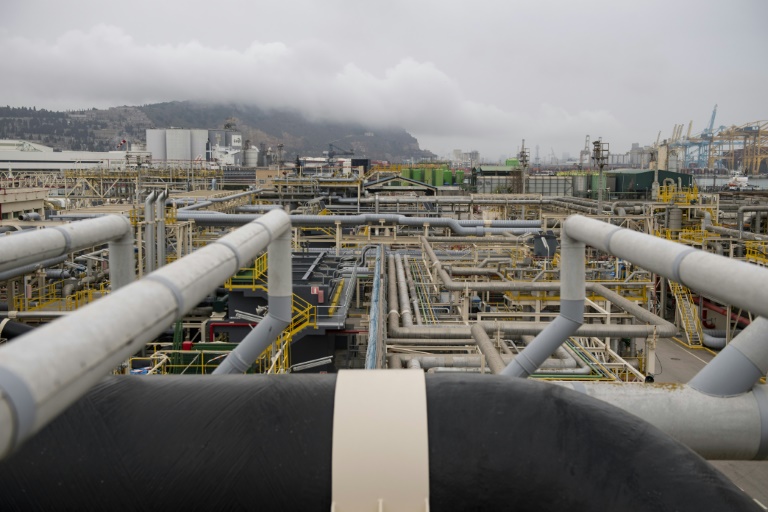
Since Russia invaded Ukraine, Madrid has revived calls to build a huge gas pipeline between Spain and France dubbed MidCat that would boost Europe’s energy independence from Russia.

What is MidCat?

Initially launched in 2003, the 190-kilometre (120-mile) Midi-Catalonia (MidCat) pipeline would pump gas across the Pyrenees from Hostalric just north of Barcelona to Barbaira in southern France.

Its aim was to transport gas from Algeria through Spain to the rest of the European Union. There are currently only two small gas pipelines linking Spain and France.

But following several years of work, the project was abandoned in 2019 after energy regulators from both countries rejected it amid questions over its environmental impact and profitability.

Why restart it?

Since Russia invaded Ukraine in February, the EU has vowed to end its dependence on gas from Russia, which currently supplies nearly 40 percent of the bloc’s gas needs.

A 750-kilometre deepwater pipeline called Medgaz already links gas-rich Algeria with southern Spain.

A second underwater pipeline, called GME links Spain to Algeria via Morocco but Algiers in November shut supply through it due to a diplomatic conflict with Rabat.

Spain also has six terminals for regasifying and storing liquefied natural gas (LNG) transported by sea, the largest network in Europe.

Gas which arrives in Spain by sea and pipeline from Algeria could then be sent on to the rest of Europe though MidCat.

The MidCat pipeline is “crucial” to reduce the EU’s reliance on fossil fuels and “end the Kremlin’s blackmail”, EU commission chief Ursula von der Leyen said Friday in Barcelona in a reference to Russia’s threats to halt its gas supplies to the bloc.

What are the obstacles?

The MidCat pipeline faces several hurdles, starting with its huge price tag estimated in 2018 at 440 million euros ($460 million). It would also take three to four years to complete.

“MidCat cannot be approached as a short-term solution,” France’s ambassador to Spain, Jean-Michel Casa, said during an interview with Barcelona-based daily newspaper La Vanguadia in March.

In addition, there is a lack of connections between France and Germany, the country which is most interested in finding alternatives to Russian gas.

It would be “much simpler to bring gas directly by boat to Germany,” said Thierry Bros, an energy expert at the Science Po university in Paris.

“This would of course require building gas terminals in Germany” but their cost would not be higher than building MidCat, he told AFP.

What support?

Despite the debate over its usefulness, MidCat enjoys significant support, especially in Spain where the authorities are pushing for Brussels to declare the project to be of “community interest”.

France has so far been more reserved but according to Madrid this position is changing.

There is a new “perception of the risks and opportunities” that MidCat brings, Spanish Energy Minister Teresa Ribera said, adding Paris “has understood” that Midcat “must” be built.

There are also questions over the financing for the project.

Madrid argues Brussels should foot the bill, not Spanish taxpayers, because the project would benefit the entire EU.

But the European commission has not yet committed to funding it.

Spain also wants the pipeline to be compatible with the transport of green hydrogen, in the hopes this will boost its appeal to Brussels which has made financing renewable energy projects a priority.

US inflation may have peaked, but pain continues

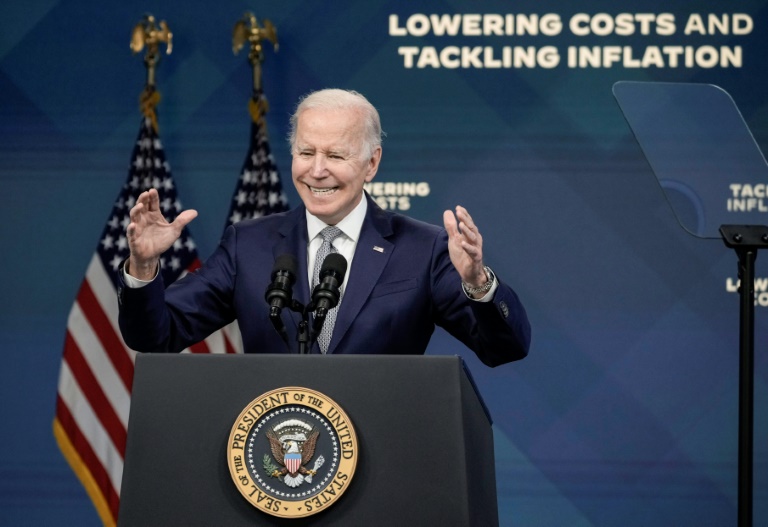
With surging prices undermining wage gains and hurting American families, US President Joe Biden said Tuesday that fighting inflation is his top priority, but he may have limited tools to tackle the issue.

Biden, whose popularity has taken a hit amid the highest inflation in four decades, spoke on the eve of the release of the latest consumer price data, in an effort to get out ahead of more damaging news.

The flare-up in inflation means Americans are paying more for homes, cars and food, and for gasoline, which hit a record on Tuesday.

While economists believe the surge may have peaked in March, the pain is likely to last for months.

“I want every American to know that I’m taking inflation very seriously, and it’s my top domestic priority,” Biden said at the White House.

“I know that families all across America are hurting because of inflation.”

The US president put much of the blame for the recent spike on Russian leader Vladimir Putin and his invasion of Ukraine.

The attack in late February caused a sharp spike in energy prices, and pushed food prices higher as well.

“I know you’ve got to be frustrated… believe me, I understand the frustration,” Biden said, addressing Americans directly.

The Democrat called out opposition Republicans for their “extreme agenda,” and for slowing his efforts to manage stresses hitting the economy.

– Hot US economy –

The world’s largest economy has come roaring back from the economic damage inflicted by the Covid-19 pandemic, helped by bargain borrowing costs and massive government stimulus measures.

But with the pandemic still gripping other parts of the world, global supply chain snarls drove up prices for cars and other products, while a flood of new homebuyers caused housing prices to soar.

Meanwhile, the conflict in Ukraine sent global oil prices above $100 a barrel. 

US consumer prices jumped 8.5 percent in the 12 months that ended in March, and though economists think that may have been the peak, the rate is likely to remain high for months to come.

The Labor Department is set to release the April CPI data on Wednesday, which economists project will show a much more modest monthly increase, slowing the torrid annual pace.

Biden assured Americans that the Federal Reserve is acting to tamp down inflationary pressures.

The US central bank last week announced the biggest increase in the benchmark lending rate since 2000, the second hike since March, with more increases ahead.

New York Fed President John Williams on Tuesday said policymakers will move “expeditiously” to “turn down the heat” on the economy.

And he said the Fed has the tools to do so without causing an economic downturn.

“Although the task is difficult, it is not insurmountable,” he said.

– Ending China tariffs –

Addressing another politically sensitive aspect of the inflation puzzle, Biden said he was considering lifting tariffs on Chinese goods imposed by his predecessor Donald Trump.

“We’re discussing that right now,” he told reporters, adding that “no decision has been made on it.”

Biden is under pressure from some quarters to remove the tariffs in a bid to cut the roaring inflation by making US imports cheaper.

Jason Furman, a former White House economic advisor under Barack Obama, said removing the tariffs is one of the few things Biden can do to directly address inflation.

“This would be the biggest step he could take,” Furman said on MSNBC.

Trump imposed the tariffs to punish allegedly unfair trade practices by Beijing. Lifting the measures would likely bring a political risk for the White House, which does not want to be branded as weak on China.

Final refrain for iPod as Apple stops production

Apple on Tuesday put out word it is no longer making iPods, the trend-setting MP3 players that transformed how people get music and gave rise to the iPhone.

Late Apple co-founder Steve Jobs introduced the devices nearly 21 years ago with his legendary showmanship flare, and the small, easy to operate players helped the company revolutionize how music was sold.

It packed “a mind-blowing 1,000 songs” the company said at the time, and together with Apple’s iTunes shop established a new distribution model for the music industry.

Buying complete albums on vinyl gave way to paying 99 cents a piece for selected digital songs.

Industry trackers and California-based Apple itself have long acknowledged that the do-it-all iPhone would eat away at sales of one-trick devices such as iPod MP3 players.

The trend toward streaming music services, including one by Apple, has made devices designed just for carrying digital tunes around less enticing for consumers.

Apple said in a blog post that the current generation of iPods will only be available as long as current supplies last.

“Music has always been part of our core at Apple, and bringing it to hundreds of millions of users in the way iPod did impacted more than just the music industry,” said Apple senior vice president of Worldwide Marketing Greg Joswiak.

“It also redefined how music is discovered, listened to, and shared.”

Joswiak said that the “spirit of iPod” lives on in its lineup of products including iPhone, iPad, Apple TV, and its HomePod smart speaker.

“Since its introduction over 20 years ago, iPod has captivated users all over the world who love the ability to take their music with them on the go,” Apple said in a blog post.

“Today, the experience of taking one’s music library out into the world has been integrated across Apple’s product line – from iPhone and Apple Watch to iPad and Mac.”

In addition, the Apple Music subscription service provides streaming access to more than 90 million songs, the Silicon Valley giant said.

The iPod endured despite analyst worries that the release of the iPhone in 2007 would destroy demand, since the smartphones provided much more than just digital music.

News of the end of the line for iPod prompted a flurry of sad, nostalgic posts on Twitter.

“Damn… low-key a little sad to see that Apple has officially discontinued the iPod from today,” said a tweet fire off from the verified @MrDalekJD account of a UK Gaming YouTuber.

“This thing changed the music game forever. RIP.”

Elon Musk says he would lift Twitter ban on Trump

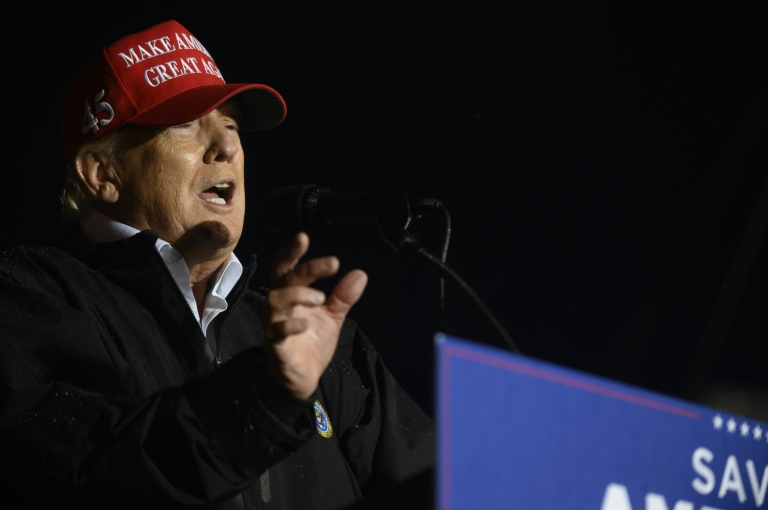
Elon Musk on said Tuesday that as owner of Twitter he would lift the ban on Donald Trump, contending that kicking the former US president off the platform “alienated a large part of the country.”

Musk’s endorsement of a Trump return to the global messaging platform triggered fears among activists that Musk would “open the floodgates of hate.”

“I would reverse the permanent ban,” the billionaire said at a Financial Times conference, noting that he doesn’t own Twitter yet, so “this is not like a thing that will definitely happen.”

Trump has stated publicly that he would not come back to Twitter if permitted, opting instead to stick with his own social network, which has failed to gain traction.

The Tesla chief’s $44-billion deal to buy Twitter must still get the backing of shareholders and regulators, but he has voiced enthusiasm for less content moderation and “time-outs” instead of bans.

Trump was booted from Twitter and other online platforms after supporters fired up by his tweets and speech alleging election fraud attacked the US Capitol on January 6, 2021 in a deadly bid to stop Joe Biden from being certified as the victor in the US presidential election.

“I think that was a mistake because it alienated a large part of the country, and did not ultimately result in Donald Trump not having a voice,” Musk said.

Musk maintained that permanent bans undermine trust in Twitter as an online town square where everyone can be heard.

“Elon Musk would open the floodgates of hate and disinformation on Twitter,” said Media Matters for America president Angelo Carusone.

“Whether Elon Musk is a fully red-pilled right-wing radical or just someone very interested in enabling right-wing extremists, the result is the same.”

The American Civil Liberties Union (ACLU), however, backed Musk’s perspective.

“Elon Musk’s decision to re-platform President Trump is the right call,” said organization director Anthony Romero.

“Like it or not, president Trump is one of the most important political figures in this country, and the public has a strong interest in hearing his speech.”

Romero pointed out that some of Trump’s controversy causing tweets have wound up being evidence in lawsuits against the former president by the ACLU and others.

Musk reasoned that permanent bans at Twitter should be rare, and reserved for accounts that are spam, scams or run by software “bots.”

“That doesn’t mean that somebody gets to say whatever they want to say,” Musk said.

“If they say something that is illegal or otherwise just destructive to the world, then there should be a perhaps a timeout, a temporary suspension, or that particular tweet should be made invisible or have very limited attraction.”

– Ad boycott? –

Activist groups have called on Twitter advertisers to boycott the service if it opens the gates to abusive and misinformative posts with Musk as its owner.

“Under Musk’s management, Twitter risks becoming a cesspool of misinformation, with your brand attached,” said an open letter signed by more than two dozen groups including Media Matters, Access Now and Ultraviolet.

Twitter makes most of its revenue from ads, and that could be jeopardized by advertisers’ reaction to content posted on the platform, the San Francisco-based tech firm said in a filing with US regulators.

“We believe that our long-term success depends on our ability to improve the health of the public conversation on Twitter,” the company said in a regulatory filing.

Efforts toward that goal include fighting abuse, harassment, and spam, Twitter told regulators.

“Elon Musk owes the world a better explanation of how the platform will deal with the likes of Trump than an edict that his ouster was wrong because it proved unpopular in some places,” said Suzanne Nossel, chief of human rights nonprofit PEN America.

The Knight Foundation said that a survey it commissioned found that only 41 percent of adults in the United States believe Trump was deprived of free expression rights by social media platforms that banned him.

“People died because of Donald Trump’s Twitter account,” said Muslim Advocates senior policy counsel Sumayyah Waheed.

“I’m terrified of what else would be allowed under Musk’s watch.”

'A chance to survive': Ukraine's fortress steel mills

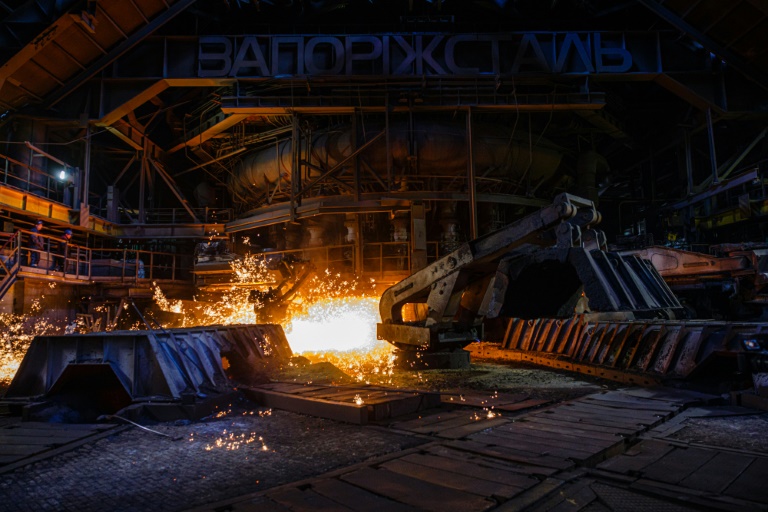
Food and water stockpiles, generators, toilets, stacks of mattresses and even wood-burning stoves in bunkers deep underground — the Soviets built this Ukrainian steelworks with war in mind.

A sister plant of the Azovstal mill that’s the last redoubt of Ukrainian forces in the port city of Mariupol, the Zaporizhstal factory shows how these Stalin-era sites are designed to defy Russia’s invasion.

“We can stay in the shelters for a long time,” said Zaporizhstal employee Ihor Buhlayev, 20, in his hooded silver safety gear as molten metal flowed and sparked behind him. “I think it will give us the chance to survive.”

Buhlayev’s workplace in the southern city of Zaporizhzhia was not taken in Russia’s internationally condemned attack, though the plant had to halt operations as the front drew dangerously closer.

The bunkers underneath the giant Azovstal and Zaporizhstal plants were built in the early 1930s, when the world recovered from one war while plodding towards another, and they are intended to shelter thousands of workers.

Both plants are under Metinvest Holding, which is controlled by Ukraine’s richest man Rinat Akhmetov.

There are 16 bunkers at the Zaporizhstal works, and the one AFP visited was about 10 metres (about 30 feet) underground and protected by a roughly 10 centimetre-thick blast door.

The long, brightly lit room has rows of wooden benches and is supposed to be able to hold 600 people.

Tanks of water can flush the toilets, emergency food and bottled water are stacked in a storage room, and there are chest-high stacks of firewood for the oil barrel-sized metal stove.

– Another kind of war –

The bunkers under Azovstal sheltered hundreds of civilians, many of whom left the site in an international rescue operation, and still offer refuge for the holdout forces resisting full Russian control of Mariupol.

“God forbid we find ourselves in a situation like our colleagues from Azovstal, metalworkers like us, who ended up staying for so long (in the shelter)… I wouldn’t wish that on anyone,” Alexander Lotenkov, communications department head, said inside the bunker.

Above that shelter, the roughly 5.5-square-kilometre site has about half the footprint of Azovstal but is still massive and the only way to efficiently get between its units is on a vehicle with wheels.

The size of the site is one thing, but the sheer number of places to hide among rows of buildings and tunnels below the site, as well as observation posts from its tall structures, is another.

But war, in this case, has not been good for business.

Reduced operations have been back up and running since the beginning of April, the same period when the Russians were forced by fierce Ukrainian resistance to retreat from areas around Kyiv.

Some good news came this week with an American announcement to suspend tariffs on Ukraine-made steel, but the situation is still dire.

Ukraine accounts for only about one percent of US steel imports, according to American authorities, who had imposed the 25 percent protective tariff, and logistics is a major challenge for Ukrainian exporters with the usual transport routes shattered by the war.

“We won’t be able to compete with other producers, because their logistic expenses are lower and for us to export to the US we need now to get our production from Zaporizhzhia to Poland,” the site’s general director Alexander Mironenko told AFP.

Steel exports have plunged to a fraction of their pre-war levels and getting back up to speed and to market will be key for the Ukrainian economy.

“It was one of the primary export-oriented industries in Ukraine and around 50 percent of foreign currency income was generated by the metallurgical and mining sectors of Ukraine,” Mironenko added. 

Global stocks end mostly up as demand worries weigh on oil prices

European and US stocks mostly rose Tuesday, partially rebounding from the prior session’s rout, while oil prices continued to retreat on worries slowing global growth will dent demand.

A volatile day on Wall Street ended with two of the three major equity indices in positive territory amid talk that stocks may be oversold as concerns about inflation, tightening monetary policy and the war in Ukraine that have weighed on markets for much of 2022. 

“The big question” is whether the market is at the end of the sell-off “or the beginning of a recovery,” said Quincy Krosby, chief equity strategist of LPL Financial.

“Statistically, we probably have more to go on the downside.”

While the Dow fell for the fourth straight day, the broader S&P 500 edged back up above 4,000 points and the Nasdaq jumped one percent. 

London ended the day with a gain of 0.4 percent, Paris added 0.5 percent and Frankfurt rose 1.2 percent.

“European markets have seen a modest rebound from yesterday’s two-month lows, after the carnage of the last three days, as investors look for signs of a possible base,” said market analyst Michael Hewson at CMC Markets UK.

Between rising prices eating into the disposable income of consumers and higher borrowing costs, investors have been increasingly concerned about the possibility of recession.

“There’s clearly a huge amount of worry about a recession in the markets at the minute as central banks continue to aggressively tighten against the backdrop of a slowing economy and a cost-of-living crisis,” said Craig Erlam, senior market analyst at online trading platform OANDA.

Asian equities mostly sank following sharp losses on Wall Street on Monday.

Oil prices also resumed their slide lower with the benchmark US crude contract, WTI, falling under $100 a barrel.

“This week’s oil price weakness has been largely driven by reports that the EU is having difficulty in reaching a consensus on its Russian oil ban,” Hewson said.

“Yesterday’s weak China trade numbers have also weighed into the overall calculus, as concerns grow over Chinese demand, with the major cities of Beijing and Shanghai on the receiving end of new restrictions.”

Meanwhile, Bitcoin on Tuesday slumped briefly under $30,000, reaching a 10-month low.

The volatile cryptocurrency has lost more than half its value since a November surge saw it reach a record high of nearly $69,000.

– Key figures at around 1630 GMT –

New York – Dow: DOWN 0.3 percent at 32,160,74 (close)

New York – S&P 500: UP 0.3 percent at 4,001.05 (close)

New York – Nasdaq: UP 1.0 percent at 11,737.67 (close)

London – FTSE 100: UP 0.4 percent at 7,243.22 (close) 
Frankfurt – DAX: UP 1.2 percent at 13,534.74 (close)

Paris – CAC 40: UP 0.5 percent at 6,116.91 (close)

EURO STOXX 50: UP 0.8 percent at 3,554.80 (close)

Hong Kong – Hang Seng Index: DOWN 1.8 percent at 19,633.69 (close)  

Shanghai – Composite: UP 1.1 percent at 3,035.84 (close)

Tokyo – Nikkei 225: DOWN 0.6 percent at 26,167.10 (close)

Brent North Sea crude: DOWN 3.3 percent at $102.46 per barrel

West Texas Intermediate: DOWN 3.2 percent at $99.76 per barrel

Euro/dollar: DOWN at $1.0534 from $1.0561 on Monday 

Pound/dollar: DOWN at $1.2319 from $1.2332

Euro/pound: DOWN at 85.49 pence from 85.64 pence

Dollar/yen: UP at 130.41 yen from 130.29 yen

burs-jmb/hs

Elon Musk says he would lift Twitter ban on Trump

Elon Musk on Tuesday said that as owner of Twitter he would lift the ban on Donald Trump, contending that kicking the former US president off the platform “alienated a large part of the country.”

Musk’s endorsement of a Trump return to the global messaging platform quickly triggered fears among activists that Musk would “open the floodgates of hate.”

“I would reverse the permanent ban,” the billionaire said at a Financial Times conference, noting that he doesn’t own Twitter yet, so “this is not like a thing that will definitely happen.”

The Tesla chief’s $44-billion deal to buy Twitter must still get the backing of shareholders and regulators, but he has voiced enthusiasm for less content moderation and “time-outs” instead of bans.

“I do think that it was not correct to ban Donald Trump,” Musk said.

“I think that was a mistake because it alienated a large part of the country, and did not ultimately result in Donald Trump not having a voice.”

Trump was booted from Twitter and other online platforms after supporters fired up by his tweets and speech alleging election fraud attacked the US Capitol on January 6, 2021 in a deadly bid to stop Joe Biden from being certified as the victor in the US presidential election.

“Elon Musk would open the floodgates of hate and disinformation on Twitter,” said Media Matters for America president Angelo Carusone.

“Whether Elon Musk is a fully red-pilled right-wing radical or just someone very interested in enabling right-wing extremists, the result is the same.”

Backing off on fighting misinformation and extremists on Twitter would put pressure on other social networks to do likewise in a race to the bottom, Carusone contended.

Musk reasoned that permanent bans at Twitter should be rare, and reserved for accounts that are spam, scams or run by software “bots.”

“That doesn’t mean that somebody gets to say whatever they want to say,” Musk said.

“If they say something that is illegal or otherwise just destructive to the world, then there should be a perhaps a timeout, a temporary suspension, or that particular tweet should be made invisible or have very limited attraction.”

Musk maintained that permanent bans undermine trust in Twitter as an online town square where everyone can be heard.

Trump has stated publicly that he would not come back to Twitter if permitted, opting instead to stick with his own social network, which has failed to gain traction.

– Ad boycott? –

Activist groups have called on Twitter advertisers to boycott the service if it opens the gates to abusive and misinformative posts with Musk as its owner.

“Under Musk’s management, Twitter risks becoming a cesspool of misinformation, with your brand attached,” said an open letter signed by more than two dozen groups including Media Matters, Access Now and Ultraviolet.

Twitter makes most of its revenue from ads, and that could be jeopardized by advertisers’ reaction to content posted on the platform, the San Francisco-based tech firm said in a filing with US regulators.

While Musk has not revealed nitty-gritty details of how he would run the business side of Twitter, he has expressed a preference for making money from subscriptions.

As of the end of March, an average 229 million people used Twitter daily, the company said in a regulatory filing.

“We believe that our long-term success depends on our ability to improve the health of the public conversation on Twitter,” the company said in the filing.

Efforts toward that goal include fighting abuse, harassment, and spam, Twitter told regulators.

“Elon Musk owes the world a better explanation of how the platform will deal with the likes of Trump than an edict that his ouster was wrong because it proved unpopular in some places,” said Suzanne Nossel, chief of human rights nonprofit PEN America.

La Liga post losses of €892m for pandemic-hit 2020/21 season

La Liga posted losses of 892 million euros for the pandemic-hit 2020-21 season, with Barcelona accounting for more than half of the shortfall, according to figures announced by the Spanish league on Tuesday.

Barca were responsible for 56 per cent of La Liga’s net pre-tax losses during that season as Spanish clubs suffered the financial consequences of empty stadiums and reduced matchday income.

Less transfer activity, compressed television schedules and a drop-off in commercial income also had a significant impact, the league said.

La Liga clubs posted total revenues of 3.818 billion euros (4.022 billion dollars) for 2020/21, which represented a 24.1 per cent decrease on the 2019/20 season, which was also hit by the Covid-19 pandemic, but only in the last few months.

Matchday income and player sales were down 53 per cent and 52 per cent respectively in 2020/21.

It is the first time La Liga has made a loss since 2012 but the league expects to recover completely in the next two seasons.

“The high financial solvency and responsibility of most clubs has helped Spanish professional football overcome this crisis,” the league said in a statement. “A strong recovery is expected in the 2021/22 season while in 2023/24 full normality should be achieved.”

La Liga’s losses were exacerbated by Barcelona’s dreadful financial situation, which led to the resignation of the club’s president Josep Maria Bartomeu in October 2020 and Lionel Messi leaving for free in August last year.

Bartomeu’s successor, Joan Laporta, said last September the club was 1.35 billion euros in debt and that salaries represented 103 per cent of its total income.

Barca have so far resisted signing up to the deal agreed by La Liga with private equity fund CVC, which will invest almost 2 billion euros in Spanish football and its clubs, in return for an 8.2 per cent share in a company that will manage the league’s broadcasting rights for the next 50 years.

Five clubs have rejected the deal, including Barcelona and Real Madrid, who remain committed to launching a European Super League because of the potential financial rewards.

La Liga said its losses in 2020/21 represented a “softer reduction in relative terms than what was experienced by European professional football as a whole”.

“According to UEFA…including player transfer revenue, the total revenue decrease in European professional football as a whole amounts to more than €10 billion,” the statement added.

Rising US inflation is main economic, political challenge for Biden

With surging prices undermining wage gains and hurting American families, US President Joe Biden said Tuesday fighting inflation is his top priority, but he may have limited tools to tackle the issue.

Biden, whose popularity has taken a hit amid the highest inflation in four decades, highlighted his efforts to combat the flare-up in prices while drawing a stark contrast with policies proposed by opposition Republicans.

“I want every American to know that I’m taking inflation very seriously, and it’s my top domestic priority,” Biden said at the White House.

“I know that families all across America are hurting because of inflation.”

The US president put much of the blame for the recent spike on Russian leader Vladimir Putin and his invasion of Ukraine

The attack in late February caused a sharp spike in energy prices, and then began pushing food prices higher, as well.

“I know you’ve got to be frustrated… believe me, I understand the frustration,” the Democrat said, addressing Americans directly.

Calling out Republicans’ “extreme agenda,” Biden said that “they’ve done everything to slow down” his attempts to manage economic stresses.

– Hot US economy –

Biden assured Americans that the Federal Reserve is acting to tamp down the inflation pressures, which he called the “top challenge” facing the economy.

The US central bank last week announced the biggest increase in the benchmark lending rate since 2000, the second hike since March as it moves to quickly pull back on stimulus put in place during the pandemic.

The world’s largest economy came roaring back from the economic damage inflicted by the Covid-19 pandemic, helped by bargain borrowing costs and massive government stimulus.

But with the pandemic still gripping other parts of the world, global supply chain snarls caused prices to surge for automobiles and other products, while housing prices soared amid a flood of new buyers.

And the conflict in Ukraine sent global oil prices above $100 a barrel. 

US prices at the pump hit a new record on Tuesday, rising to an average $4.374 a gallon, topping the previous record set March 11, according to AAA.

A year ago, the price averaged $2.967.

US consumer prices jumped 8.5 percent in the 12 months that ended in March, and though economists think that may have been the peak, the rate is likely to remain high for months to come.

The Labor Department is set to release the April CPI data on Wednesday, which economists project will show a much more modest monthly increase, slowing the torrid annual pace.

Republicans have blamed Biden, saying his programs injecting billions of dollars into the US economy at the height of the pandemic spurred the inflationary cycle.

The White House says those packages effectively saved the country from a disastrous recession.

Addressing another politically sensitive aspect of the inflation puzzle, Biden said he was considering lifting trade tariffs imposed by his predecessor Donald Trump on China.

“We’re discussing that right now,” he told reporters, adding that “no decision has been made on it.”

Biden is under pressure from some quarters to remove the tariffs in a bid to cut the roaring inflation by making US imports cheaper.

Trump imposed the tariffs to punish allegedly unfair trade practices by Beijing. Lifting the measures would likely bring a political risk for the White House, which does not want to be branded as weak on China.

But Jason Furman, a former White House economic advisor under Barack Obama, said removing the tariffs is one of the few things Biden can do to directly address inflation.

“This would be the biggest step he could take,” Furman said on MSNBC.

Close Bitnami banner
Bitnami