AFP

Workers at New York Apple store launch union campaign

Workers at Apple’s Grand Central Station store announced Monday they are organizing to establish a union, in what would be a first at one of the tech giant’s retail locations in the United States.

The effort, calling itself “Fruit Stand Workers United,” aims to garner signatures from at least 30 percent of the New York store, the minimum needed to qualify for a unionization election.

The campaign is connected to Workers United, an affiliate of the national Service Employees International Union, which was established in 2009 from several earlier unions. 

“Grand Central is an extraordinary store with unique working conditions that make a union necessary to ensure our team has the best possible standards of living,” the workers said on the campaign website for the prospective union.

They described themselves as working in “extraordinary times with the ongoing Covid-19 pandemic and once-in-a-generation consumer price inflation,” though their website did not disclose the name of staff members leading the effort.

The Apple effort comes as a Starbucks unionization drive backed by Workers United has spread nationally after election victories last year in New York. 

Amazon is also facing a growing challenge from unions after an upstart campaign won an election at a warehouse in nearby Staten Island earlier this month.

Employees working in at least three other Apple stores are also attempting to organize, according to The Washington Post.

Apple did not immediately respond to a request for comment from AFP.

Sri Lanka leader trims cabinet of relatives ahead of IMF talks

Sri Lanka’s embattled leader dropped two of his brothers and a nephew from his cabinet Monday, acknowledging public anger over the ruling family’s mismanagement of a crippling economic crisis that has prompted calls for his resignation.

President Gotabaya Rajapaksa has presided over the island nation’s most painful downturn in memory and his government is preparing for imminent bailout talks with the International Monetary Fund.

Dozens of ruling party lawmakers have turned against the administration and opposition parties have rebuffed invitations to join a unity government.

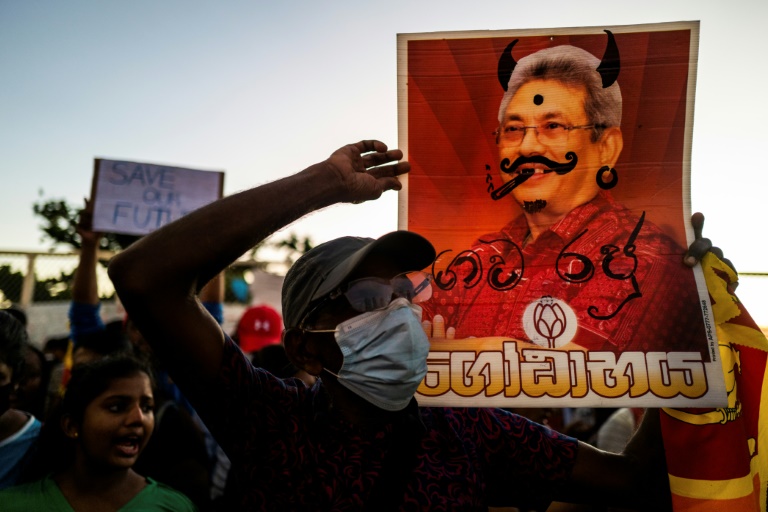
Huge protests have mobilised against Rajapaksa, including tens of thousands of people camped outside his seafront office for more than a week, though the leader has so far resisted pressure to stand down.

“People are suffering because of the economic crisis and I deeply regret it,” the president said in an address to his new cabinet, conceding that Sri Lanka should have gone to the IMF “much earlier”.

He also admitted the government had made a “mistake” in banning agrochemicals last year, a move made to conserve dwindling foreign exchange reserves that had a devastating effect on farm yields. 

The new lineup retains Prime Minister Mahinda Rajapaksa, Gotabaya’s older brother and the head of Sri Lanka’s ruling clan, while leaving out eldest sibling Chamal and younger brother Basil, the former finance minister. 

Mahinda’s eldest son Namal, who ran the sports ministry and had been touted as a future leader before the crisis, was also dropped.

– Austerity cabinet –

The 21-member cabinet is seven people fewer than its predecessor, which resigned en masse two weeks ago in response to public outrage over nepotism and corruption.

Ministers are entitled to several SUVs, a large contingent of bodyguards and unlimited fuel, as well as state housing and entertainment allowances.

Rajapaksa asked his new ministers not to avail themselves of the perks that are usually available to them and urged them to tackle corruption and waste.

New finance minister Ali Sabry led a delegation to Washington over the weekend to open talks with the International Monetary Fund from Tuesday, officials said.

Sri Lanka is seeking three to four billion dollars from the IMF to overcome its balance-of-payments crisis and boost depleted reserves.

Alongside the acute shortages, Sri Lanka is also facing record inflation and lengthy electricity blackouts, as the government has run out of foreign currency to import fuel.

Lanka IOC, a petrol retailer which accounts for a third of the local market, announced yet another steep hike in fuel costs on Monday to account for the collapse in value of the local currency. 

The cost of diesel, the fuel most commonly used for public transport, has risen by 138 percent since the start of the year while petrol prices have nearly doubled. 

The government last week announced a default on Sri Lanka’s $51 billion foreign debt and the Colombo Stock Exchange has suspended trading to prevent an anticipated market collapse.

Rajapaksa’s parliamentary majority has been thrown into question after former allies deserted the ruling coalition.

The opposition has said it will attempt to topple the government through a no-confidence vote in the coming weeks.

Monday marked the tenth straight day of protests outside Rajapaksa’s office, with demonstrators establishing a protest camp that they say will continue until the leader stands aside.

Activists shone digital projections on the office denouncing corruption and demanding the president “go home”, prompting police to hold up large screens to block the light beams. 

Mexico president decries 'treason' after power reforms defeated

Mexican lawmakers rejected constitutional electricity reforms at the center of diplomatic tensions with the United States, in a blow to President Andres Manuel Lopez Obrador, who accused his opponents Monday of betraying the nation.

Lopez Obrador promoted the changes to strengthen the state-owned electricity provider and roll back the effects of liberalization under previous governments that he says benefited private companies.

But his plans alarmed the United States and Canada, prompting warnings that Mexico is in danger of violating its trade commitments by favoring state-run entities heavily dependent on fossil fuels.

After a marathon session in the lower house of Congress on Easter Sunday, the president’s Morena party failed to secure the two-thirds majority needed to amend the constitution.

An angry Lopez Obrador denounced “an act of treason against Mexico by a group of legislators who, instead of defending the interests of the people and the nation, decided to be outspoken defenders of foreign companies.”

There were 275 votes in favor and 223 against the bill, with no abstentions, the president of the lower house, Sergio Gutierrez, announced.

Gutierrez had earlier accused the opposition of wanting to remain “imperialist lackeys” at the service of foreign companies.

But Jorge Romero of the conservative National Action Party argued that the bill would put the country “back 50 years” in efforts to protect the environment.

Although Lopez Obrador remains popular, with an approval rating of nearly 60 percent, his Morena party and its allies lost its absolute majority in the lower house in legislative elections last year.

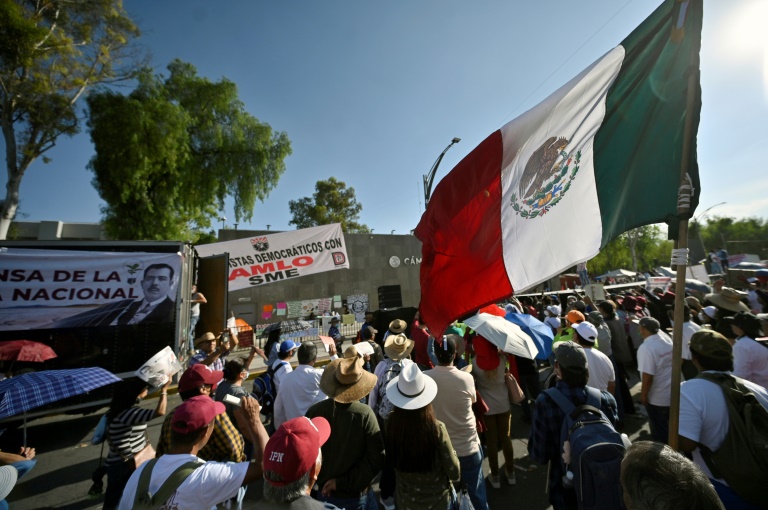
Earlier during the debate, his supporters held a rally outside the Chamber of Deputies calling for the reforms to be passed, with one carrying a sign that said “Don’t sell out the nation.” 

– ‘Big defeat’ –

The bill’s failure represents “a big defeat for Morena and Lopez Obrador because it is one of the central axes of their project to nationalize energy,” Jose Antonio Crespo, a political analyst at the Center for Research and Teaching in Economics, told AFP.

Washington had warned that Mexico’s reforms risk bringing “endless litigation” that would impede investment and undermine joint efforts to fight climate change.

“Mexico’s energy policies damage the environment, US business and investor interests in multiple sectors, and hamper joint efforts to mitigate climate change,” US Trade Representative Katherine Tai said last month according to her office.

Canada and Spain are also concerned about the consequences for their energy companies that have invested in Mexico.

The changes would have ensured that the state-owned Federal Electricity Commission (CFE) has at least 54 percent of the electricity market — a move the government says is needed to prevent soaring power prices.

The bill also envisaged a move towards a state monopoly in the mining of lithium, a vital component in electric car batteries. 

With defeat looming, Lopez Obrador submitted separate legislation Sunday to incorporate the lithium industry reforms into a mining law, which requires only a simple majority to pass since it is not a constitutional amendment.

The failure of the constitutional reform bill does not necessarily mean the end of Lopez Obrador’s electricity industry changes either.

Mexico’s Supreme Court this month endorsed a reform aimed at strengthening the CFE that was approved by Congress in 2021 but has become bogged down in legal challenges. 

World Bank planning new $170 bn crisis fund: Malpass

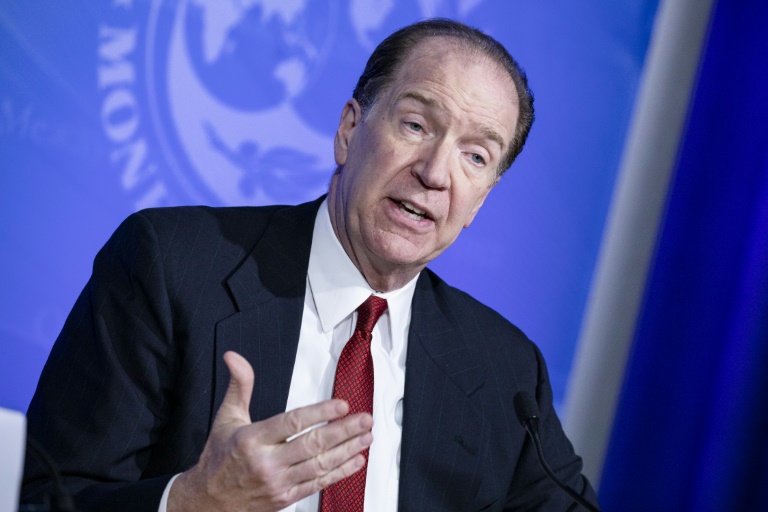
The World Bank is seeking to create a $170 billion emergency fund to help the poorest nations being buffeted by multiple crises, the bank’s President David Malpass said Monday.

The “crisis response envelope” will continue the work begun during the Covid-19 pandemic, and help countries deal with surging inflation, which was made worse by the Russian invasion of Ukraine as well as the “severe financial stress” caused by high debt levels, he said.

“This is a continued massive crisis response,” Malpass told reporters.

High debt and inflation “are two big problems facing global growth,” he said.

“I’m deeply concerned about developing countries. They’re facing sudden price increases for energy, fertilizer and food.”

The Washington-based development lender last week downgraded its forecast for global growth this year, and the IMF is expected to do the same when it releases its updated forecasts on Tuesday.

Speaking ahead of this week’s spring meetings of the IMF and World Bank, Malpass said the 15-month aid fund would run through June 2023 and build on the $157 billion Covid-response fund, which expired in June 2021.

“We expect to commit around $50 billion of this amount in the next three months,” he said, adding that he plans to discuss the fund with the bank board in coming weeks.

Malpass repeated his concern for poor countries facing high debt levels, noting that 60 percent of low-income countries already face debt distress or are at high risk.

He has recommended improvements in the G20 Common Framework adopted last year, which was meant to offer a path to restructure large debt loads, but has not yet produced results.

A key hurdle is the lack of information on the size of debt owed to China, as well as some other lenders, by private companies as well as governments.

G20 finance ministers will meet on Wednesday on the spring meetings’ sidelines.

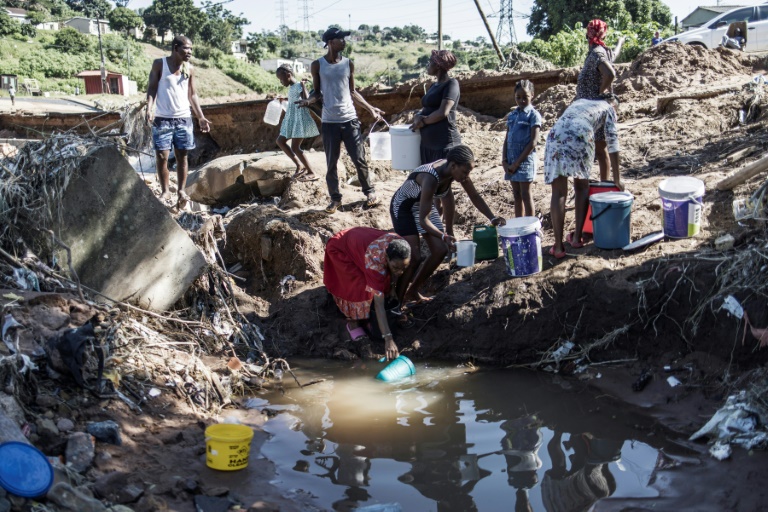
What's behind South Africa's flood disaster

South Africa, the continent’s most industrialised country, has largely escaped the tropical cyclones that regularly hit its neighbours.

But last week, storms pummelled the east coast city of Durban, triggering heavy floods and landslides that killed more than 440.

Here are the main questions behind the floods and devastation.

– Did climate change play a role – 

Meteorologists say the storms were not tropical.

Instead, the rains were part of a normal South African weather system called a “cut-off low” which can bring heavy rain and cold weather.

“Cut-off low pressure systems are common. Their frequency becomes high during autumn and spring seasons, and they are differing in strength,” said Puseletso Mofokeng with the South African Weather Service.

Some of these systems are very intense, causing heavy rain, hail, strong and potentially damaging winds and heavy snowfall.

A cut-off low in April 2019 killed 85 people in Eastern Cape and KwaZulu-Natal provinces.

If the storm system itself is a known phenomenon, the difference this time was the intensity of the the deluge.

Here, experts point the finger at climate change — warmer seas charge the atmosphere with more moisture, which then gets dumped as rainfall.

“We’ve seen in Durban three (severe) floods in less than 10 years. Does it have to do with climate change? Definitely,” said Mary Galvin of the University of Johannesburg.

“We are feeling the impact of what will certainly be unpredictable, more frequent, severe and extreme weather events.”

A recent UN report says what was once considered a one-in-a-hundred-year flood event could end up happening several times a year by 2050.

– Why is Durban prone to floods? –

Durban experiences floods every year, but not as severe as these. 

The city is built on a hilly area with many gorges and ravines — a topography that University of KwaZulu-Natal urban planner Hope Magidimisha-Chipungu says is conducive to floods.

If the soil is not properly “stabilised in the hilly areas, it’s obvious you were going to have landslides,” she said.

Some have suggested Durban’s storm-water drainage system may not have been well maintained, which authorities of the 187-year-old city dispute.

Durban city is not alone in experiencing extreme weather conditions in South Africa.

Along the west coast, Cape Town almost ran out of water in a 2018 drought.

“Climate predictions and all models show wet areas will get wetter and dry areas will get dryer. So Durban… unfortunately will be wetter,” said Galvin.

– What about planning? –

Durban is one of South Africa’s fastest-growing cities, with economic growth outpacing the national average by 2015. 

Massive, unplanned migration created housing shortages, which resulted in the mushrooming of shack dwellings, locally called informal settlements. 

“The ways in which South African cities were designed were very exclusionary in nature,” said planner Magidimisha-Chipungu.

“The spatial planning and the apartheid legacy (placed) the urban poor in the periphery and in the low-lying areas” along riverbanks, she said.

Around a quarter of the metro’s 3.9 million people live in 550 informal settlements around the city. At least 164 of them were built on floodplains, according to Galvin. 

A host of recent crises have further sapped resources — the coronavirus pandemic, massive unemployment and riots and looting that erupted last year.

It’s “like the seven plagues” happening in succession, said Galvin.

Sri Lanka leader trims cabinet of relatives ahead of IMF talks

Sri Lanka’s embattled leader dropped two of his brothers and a nephew from his cabinet Monday, following public anger over the ruling family’s mismanagement of a crippling economic crisis and calls for his resignation.

President Gotabaya Rajapaksa has presided over the island nation’s most painful downturn in memory and his government is preparing for imminent bailout talks with the International Monetary Fund.

Dozens of lawmakers have turned against the administration and opposition parties have rebuffed invitations to join a unity government from the president, who insists he will remain in office to guide Sri Lanka through the crisis.

Huge protests have nonetheless demanded Rajapaksa stand down, including tens of thousands of people camped outside his seafront office for more than a week. 

The new cabinet retains Prime Minister Mahinda Rajapaksa, Gotabaya’s older brother and the head of Sri Lanka’s ruling clan, while leaving out eldest sibling Chamal and younger brother Basil, the former finance minister. 

Mahinda’s eldest son Namal, who ran the sports ministry and had been touted as a future leader before the crisis, was also dropped.

The 21-member cabinet is seven people fewer than its predecessor, which resigned en masse two weeks ago in response to public outrage over nepotism and corruption.

Ministers are entitled to several SUVs, a large contingent of bodyguards and unlimited fuel, as well as state housing and entertainment allowances.

New finance minister Ali Sabry led a delegation to Washington over the weekend to open talks with the International Monetary Fund from Tuesday, officials said.

Sri Lanka is seeking three to four billion dollars from the IMF to overcome its balance-of-payments crisis and boost depleted reserves.

– Fuel costs jump again –

Alongside the acute shortages, Sri Lanka is also facing record inflation and lengthy electricity blackouts, as the government has run out of foreign currency to import fuel.

Lanka IOC, a petrol retailer which accounts for a third of the local market, announced yet another steep hike in fuel costs on Monday to account for the collapse in value of the local currency. 

The cost of diesel, the fuel most commonly used for public transport, has risen by 138 percent since the start of the year while petrol prices have nearly doubled. 

The government last week announced a default on Sri Lanka’s $51 billion foreign debt and the Colombo Stock Exchange has suspended trading to prevent an anticipated market collapse.

Rajapaksa’s parliamentary majority has been thrown into question after former allies deserted the ruling coalition.

The opposition has said it will attempt to topple the government through a no-confidence vote in the coming weeks.

Monday marked the tenth straight day of protests outside Rajapaksa’s office, with demonstrators establishing a protest camp that they say will continue until the leader stands aside.

Activists shone digital projections on the office denouncing corruption and demanding the president “go home”, prompting police to hold up large screens to block the light beams. 

Asian markets slide on inflation, Covid fears

Asian stocks closed lower on Monday in cautious trade, as figures showed China’s economic growth accelerated in the first quarter of the year, but the government warned of “significant challenges” ahead.

Tokyo’s benchmark Nikkei 225 ended down more than one percent and Shanghai posted small losses, while Hong Kong and Sydney were closed for holidays.

Shanghai reported its first Covid-19 deaths since the start of its weeks-long lockdown.

China’s largest city and economic powerhouse has stewed under a patchwork of restrictions this year amid the country’s worst Covid-19 outbreak since the start of the pandemic.

The country reported first-quarter economic growth of 4.8 percent, the National Bureau of Statistics said, as the pandemic threatens Beijing’s ambitious annual growth target.

That figure was up from 4.0 percent in the final months of 2021.

The world’s second-biggest economy was already losing steam in the latter half of last year as it endured a property slump and regulatory crackdowns.

“We must be aware that with the domestic and international environment becoming increasingly complicated and uncertain, economic development is facing significant difficulties and challenges,” said NBS spokesman Fu Linghui.

“Overall, the data suggest that China started the year well, but as the quarter has moved on, the headwinds have gotten stronger,” said Jeffrey Halley, senior market analyst with OANDA.

“A slowing property market, sweeping Covid restrictions, the Ukraine invasion pushing up base commodity and energy prices, and a central bank still intent on deleveraging sectors of the economy, have all combined to weigh on China’s growth.

“About the only thing missing is a meaningful rise in inflation, which is some small sliver of comfort.”

Oil prices, which have been elevated since Russia’s February invasion of Ukraine, were up again, with Brent Crude topping $111 a barrel.

Stephen Innes of SPI Asset Management said the rise was “likely to fuel inflation fears and rate hike jitters around the meaningful Fed action required to snuff those fears out”.

Russia is a major global oil and gas supplier, and — along with Ukraine — is also a key player in the grain sector.

The conflict has shaken markets for these commodities, and the impact has been felt from the Middle East to South America.

The war has sent oil prices soaring, with reports swirling about further energy sanctions on Russia.

Central banks in several major economies including the United States, Canada and Britain have already started raising interest rates to contain prices, but the European Central Bank on Thursday kept its stimulus plans and rates unchanged.

– Key figures around 0730 GMT –

Tokyo – Nikkei 225: DOWN 1.08 percent at 26,799.71 (close)

Shanghai – Composite: DOWN 0.49 percent at 3,195.52 (close)

Hong Kong – Hang Seng Index: Closed for a holiday

Euro/dollar: UP at $1.0802 from $1.0798

Pound/dollar: DOWN at $1.3023 from $1.3037

Euro/pound: UP at 82.95 pence from 82.83 pence

Dollar/yen: UP at 126.54 yen from 126.53 yen

Brent North Sea crude: UP 0.04 percent at $111.75 per barrel

West Texas Intermediate: UP 0.05 percent at $106.90 per barrel

New York – Dow: DOWN 0.3 percent at 34,451.23 (close)

London – FTSE 100: UP 0.5 percent at 7,616.38 (close)

China economy accelerates in Q1 but virus stalks outlook

China’s economic growth accelerated in the first quarter of the year to 4.8 percent, official data showed Monday, but the government warned of “significant challenges” ahead while massive Covid-19 lockdowns started to bite.

The world’s second-biggest economy had lost steam in the latter half of last year with a property slump and regulatory crackdowns, pulling down growth.

But it exceeded expectations in the first three months of 2022, growing 4.8 percent on-year, the National Bureau of Statistics (NBS) said, with Lunar New Year spending and factory production cajoling growth.

The weeks ahead, however, appear treacherous for the economy with Beijing’s unrelenting zero-Covid approach to outbreaks clogging supply chains and locking down tens of millions of people — including in the economic dynamos of Shanghai and Shenzhen as well as the northeastern grain basket of Jilin.

Virus restrictions in March have already gouged at retail sales, as consumers shied away from shopping, and drove up unemployment.

“With the domestic and international environment becoming increasingly complicated and uncertain, economic development is facing significant difficulties and challenges,” NBS spokesman Fu Linghui said on Monday.

The pandemic rebound — as well as the sanctions binding Russia’s economy — ups the ante on officials to deliver Beijing’s full-year growth target of around 5.5 percent.

The target comes in a pivotal political year for President Xi Jinping who is eyeing another term in power at the Party Congress to be held this autumn.

The current virus outbreak is the worst since the peak of the first wave which emerged in Wuhan in late 2019, and the economy is beginning to weaken. 

Industrial production growth eased to 5.0 percent in March, NBS data showed, down from the January-February period.

Meanwhile, retail sales sank 3.5 percent and the urban unemployment rate ticked up to a 22-month high of 5.8 percent last month.

“March activity data suggests that China’s economy slowed, especially in household consumption,” Tommy Wu, lead China economist at Oxford Economics, said in a note.

– ‘Worse to come’ –

China’s government is trying to balance “minimising disruption against controlling the latest wave of Covid infections”, Wu said, but he warned of a drag on economic activity into May or beyond.

Last week, carmakers including XPeng and Volkswagen warned of severe disruptions to supply chains and possibly even a halt on production completely if the lockdown on Shanghai’s 25 million inhabitants persisted.

Already, goods are piling up at the world’s busiest container port in Shanghai, prompting shipping giant Maersk to say it will stop taking new bookings for refrigerated containers into the city.

“Further impacts from lockdowns are imminent,” said Iris Pang, chief economist for Greater China at ING.

As Shanghai struggles to rein in an outbreak that has seen tens of thousands of daily cases, Pang said other cities may attempt to replicate Shenzhen’s success in reopening swiftly by resorting to strict measures with just a few Covid patients.

The southern tech powerhouse went into full lockdown for almost a week in March, but has since eased restrictions.

Julian Evans-Pritchard of Capital Economics cautioned that “the worst is still to come”.

Fu of the NBS warned of high commodity prices on Monday with the Russia-Ukraine conflict leading to a decline in the availability of commodities such as corn and wheat.

Although China’s central bank has announced a reserve ratio cut, lowering the amount of cash banks must hold in a push to support small businesses, experts say officials were taking a restrained approach to stimulus.

But economists expect officials will eventually publish a growth figure consistent with official targets, as part of doubts that the numbers may be massaged for political reasons.

Sri Lanka fuel prices up ahead of IMF talks

A key fuel retailer in Sri Lanka raised prices by up to 35 percent on Monday as the cash-strapped government was set to open crucial bailout talks with the International Monetary Fund.

Sri Lanka is in the grip of its worst economic crisis since independence from Britain in 1948. It has led to shortages of fuel, food and essential medicines.

Lanka IOC, a fuel retailer which accounts for a third of the local market, said it raised the diesel price by 75 rupees to 327 a litre while petrol was increased by 35 rupees to 367 rupees ($1.20).

The state-run Ceylon Petroleum Corporation, which accounts for two-thirds of the market and imposed fuel rationing last week, did not immediately raise its prices, but most of its pumping stations were without fuel.

Lanka IOC, a local unit of the Indian Oil Corporation, said the sharp depreciation of the local currency forced it to carry out the latest revision, three weeks after a 20 percent hike.

Since the start of the year, petrol prices have increased by 90 percent while diesel — commonly used for public transport — has gone up by 138 percent.

“The rupee devaluation by more than 60 percent during last one month compelled Lanka IOC to again increase its retail selling prices with effect from today,” the company said.

The increase came as Sri Lanka’s new finance minister Ali Sabry led a delegation to Washington seeking between $3 billion and $4 billion from the IMF to overcome the balance-of-payments crisis and boost depleted reserves.

The government last week announced a sovereign default on its huge foreign debt and the Colombo Stock Exchange announced trading would be halted for five days from Monday amid fears of a market collapse.

Sri Lanka was in a deep economic crisis when the Covid-19 pandemic hit, reducing foreign-worker remittances and crippling the lucrative tourism sector — a key source of dollars for the economy.

The government imposed a broad import ban in March 2020 to save foreign currency. It is now facing record inflation.

China economy grows 4.8% in first quarter as virus bites

China’s economy grew 4.8 percent in the first quarter, the National Bureau of Statistics said Monday, warning of “significant challenges” ahead as a resurgence of the coronavirus threatens Beijing’s ambitious annual target.

The world’s second-biggest economy was already losing steam in the latter half of last year with a property slump and regulatory crackdowns.

But Beijing’s unrelenting zero-Covid approach to outbreaks in multiple cities this year has clogged supply chains and locked down tens of millions of people — including in the economic dynamos of Shanghai and Shenzhen as well as the northeastern grain basket of Jilin.

China’s gross domestic product growth was 4.8 percent on-year in the first quarter, said the NBS on Monday, a figure that beat analysts’ expectations and up on 4.0 percent in the final months of 2021.

But the data does not entirely take in the gnawing impact of the lockdown in Shanghai, which has left millions stuck at home for several weeks.

Virus restrictions hitting key cities in March also gouged at retail sales, driving up the unemployment rate.

It ups the ante on officials to meet the country’s full-year growth target of around 5.5 percent, in a pivotal political period for President Xi Jinping who is eyeing another term in power at the Party Congress to be held later this year.

“With the domestic and international environment becoming increasingly complicated and uncertain, economic development is facing significant difficulties and challenges,” said NBS spokesman Fu Linghui on Monday.

While China saw an uptick in manufacturing growth earlier this year — with a shot in the arm from spending during the Lunar New Year holiday — curbs on movement struck several parts of the country during March, disrupting businesses and keeping consumers at home.

Industrial production growth eased to 5.0 percent in March, NBS data showed, down from the January-February period.

Meanwhile, retail sales sank 3.5 percent and the urban unemployment rate ticked up to 5.8 percent last month.

“March activity data suggests that China’s economy slowed, especially in household consumption,” Tommy Wu, lead China economist at Oxford Economics, said in a note.

China’s central government is trying to balance “minimising disruption against controlling the latest wave of Covid infections”, he added, but warned of a drag on economic activity into May, if not longer.

Last week, carmakers including XPeng and Volkswagen warned of severe disruptions to supply chains and possibly even a halt on production completely if the lockdown on Shanghai’s 25 million inhabitants persisted.

Major cities struck by Covid outbreaks include southern tech powerhouse Shenzhen, which went into full lockdown for almost a week in March, although it has since been reopened.

On Monday, Shanghai reported its first Covid deaths since the start of its lockdown — all elderly patients — on top of over 22,000 new positive cases.

Close Bitnami banner
Bitnami