AFP

California start-up sends tiny robots on voyage into brains

Sending miniature robots deep inside the human skull to treat brain disorders has long been the stuff of science fiction — but it could soon become reality, according to a California start-up.

Bionaut Labs plans its first clinical trials on humans in just two years for its tiny injectable robots, which can be carefully guided through the brain using magnets.

“The idea of the micro robot came about way before I was born,” said co-founder and CEO Michael Shpigelmacher.

“One of the most famous examples is a book by Isaac Asimov and a film called ‘Fantastic Voyage,’ where a crew of scientists goes inside a miniaturized spaceship into the brain, to treat a blood clot.”

Just as cellphones now contain extremely powerful components that are smaller than a grain of rice, the tech behind micro-robots “that used to be science fiction in the 1950s and 60s” is now “science fact,” said Shpigelmacher. 

“We want to take that old idea and turn it into reality,” the 43-year-old scientist told AFP during a tour of his company’s Los Angeles research and development center.

Working with Germany’s prestigious Max Planck research institutes, Bionaut Labs settled on using magnetic energy to propel the robots — rather than optical or ultrasonic techniques — because it does not harm the human body.

Magnetic coils placed outside the patient’s skull are linked up to a computer that can remotely and delicately maneuver the micro-robot into the affected part of the brain, before removing it via the same route.

The entire apparatus is easily transportable, unlike an MRI, and uses 10 to 100 times less electricity.

– ‘You’re stuck’ –

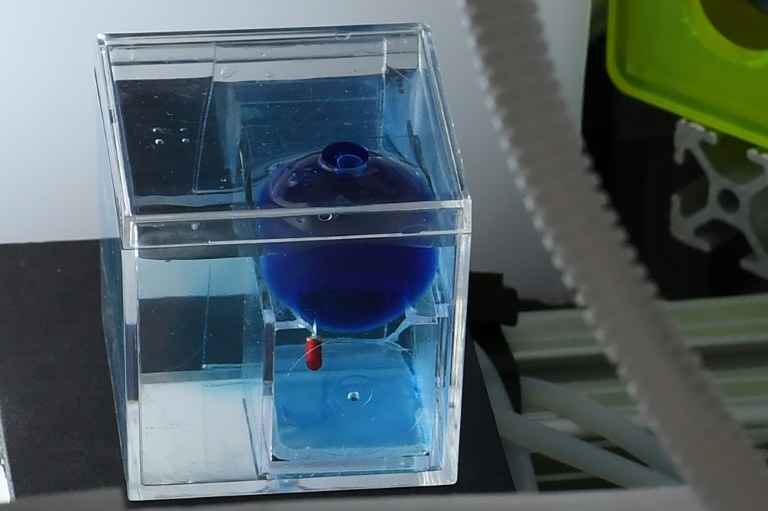
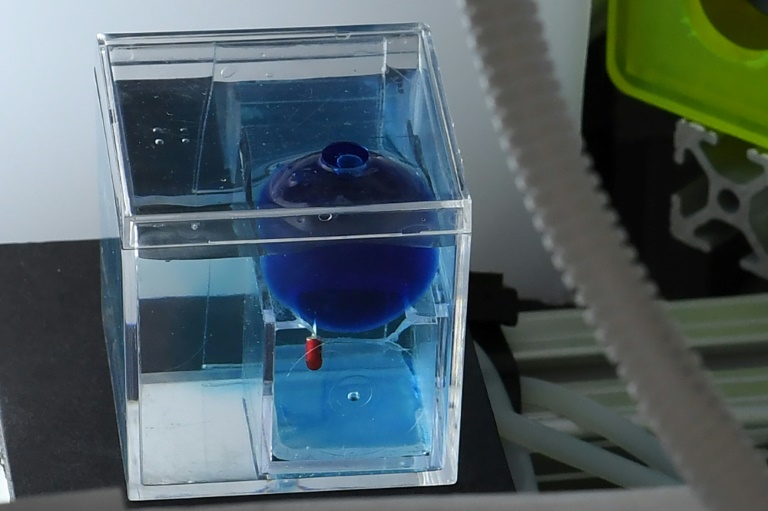
In a simulation watched by AFP, the robot — a metal cylinder just a few millimeters long, in the shape of a tiny bullet — slowly follows a pre-programed trajectory through a gel-filled container, which emulates the density of the human brain.

Once it nears a pouch filled with blue liquid, the robot is swiftly propelled like a rocket and pierces the sack with its pointed end, allowing liquid to flow out.

Inventors hope to use the robot to pierce fluid-filled cysts within the brain when clinical trials begin in two years.

If successful, the process could be used to treat Dandy-Walker Syndrome, a rare brain malformation affecting children.

Sufferers of the congenital ailment can experience cysts the size of a golf ball, which swell and increase pressure on the brain, triggering a host of dangerous neurological conditions.

Bionaut Labs has already tested its robots on large animals such as sheep and pigs, and “the data shows that the technology is safe for us” human beings, said Shpigelmacher.

If approved, the robots could offer key advantages over existing treatments for brain disorders.

“Today, most brain surgery and brain intervention is limited to straight lines — if you don’t have a straight line to the target, you’re stuck, you’re not going to get there,” said Shpigelmacher.

Micro-robotic tech “allows you to reach targets you were not able to reach, and reaching them repeatedly in the safest trajectory possible,” he added.

– ‘Heating up’ –

The US Food and Drug Administration (FDA) last year granted Bionaut Labs approvals that pave the way for clinical trials to treat Dandy-Walker Syndrome, as well as malignant gliomas — cancerous brain tumors often considered to be inoperable.

In the latter case, the micro-robots will be used to inject anti-cancer drugs directly into brain tumors in a “surgical strike.”

Existing treatment methods involve bombarding the whole body with drugs, leading to potential severe side effects and loss of effectiveness, said Shpigelmacher.

The micro-robots can also take measurements and collect tissue samples while inside the brain.

Bionaut Labs — which has around 30 employees — has held discussions with partners for the use of its tech to treat other conditions affecting the brain including Parkinson’s, epilepsy or strokes.

“To the best of my knowledge, we are the first commercial effort” to design a product of this type with “a clear path to the clinic trials,” said Shpigelmacher.

“But I don’t think that we will be the only one… This area is heating up.”

NFT of first-ever tweet a dud in online auction

An NFT of the first tweet ever posted on Twitter was struggling to attract bidders on Thursday, with the highest offer so far just shy of $10,000 — a year after it was bought for $2.9 million.

In what could signal waning interest in non-fungible tokens (NFTs) hawked by athletes, artists, celebrities and tech stars, the famed inaugural Twitter post authored by co-founder Jack Dorsey seemed headed for an epic fail.

It has spent more than a week on the auction block at NFT marketplace OpenSea. The top offer was in the cryptocurrency Ether, its current value translating to just under $10,000, according to the website.

The historic first tweet from the account of @Jack reads “just setting up my twttr.”

Malaysia-based entrepreneur Sina Estavi bought the tweet as an authenticated virtual object known as an NFT for $2.9 million early last year, but put it up for auction last week hoping to get some $48 million for it and give a chunk of the money to charity.

Dorsey had originally sold his tweet as an NFT in Ether.

Blockchain technology used in making the tokens allows people to own virtual objects with provable authenticity.

Estavi is among the early players in the NFT market, and is chief executive of blockchain platform Bridge Oracle.

The NFT trend includes a digital work by US artist Beeple selling for $69.3 million at a Christie’s auction.

Euro hits two-year low as ECB holds fire

The euro slumped to a near two-year low on Thursday after the European Central Bank remained vague about when it will raise interest rates in the face of soaring inflation.

Meanwhile oil prices, whose recent surge has contributed to inflation around the globe reaching the highest levels in decades, came off the boil.

The ECB stood still in the face of record eurozone inflation, keeping its stimulus plans and rates unchanged, as the war in Ukraine cast a pall over the eurozone economy.

Meeting for the second time since the outbreak of the conflict, the bank’s 25-member governing council stuck to a plan that “should” see its bond-buying scheme come to an end in the third quarter.

An interest rate hike would follow “some time” after the stimulus programme comes to an end, and any increases “will be gradual”. 

The decision leaves the ECB further out of step with many of its peers. Central banks such as the Bank of England, US Federal Reserve and the Bank of Canada have already triggered their first interest rate rises in response to soaring inflation.

The euro took a knock after the ECB’s decision, slipping under $1.08 for the first time since May 2020, falling as low as $1.0758.

The ECB “continues to show little sign of looking to hike rates after leaving rates unchanged at their policy meeting today, while being even handed over the risks facing the eurozone economy,” said market analyst Michael Hewson at CMC Markets UK. 

The ECB’s provided a boost for eurozone stocks, however, which moved into positive territory and ended the day higher.

– Musk Twitter bid –

Wall Street was mixed, with another major bank reporting a big fall in profits and setting aside money due to Russia’s invasion of Ukraine.

Citigroup said its first quarter profits tumbled 46 percent to $4.3 billion, in a similar performance to JPMorgan Chase which reported Wednesday a sharp drop in profits and warned of downside risks from the Ukraine war and surging inflation.

Its shares nevertheless rose 2.1 percent in late morning trading.

Elsewhere on the corporate front, Tesla chief Elon Musk launched a hostile takeover bid for Twitter, offering to buy 100 percent of its stock and take it private, according to a stock exchange filing.

Musk offered $54.20 a share, but the company’s share price was up by around 0.4 percent to $46.03 in late morning trading.

The reaction “appears to suggest little enthusiasm on the part of investors” said Hewson at CMC Markets.

While this may indicate they believe Musk is not serious, Hewson said the share price would likely take a hit if he is rebuffed and dumps his holding. 

“Given the recent share price performance of Twitter they ought to be ripping his arm off, because it’s unlikely they will get a better offer from anybody else,” he said.   

Despite falling Thursday, both main oil contracts stayed firmly above the $100 per barrel mark, with fears swirling about global supply constraints over the invasion of Ukraine by Russia — a major producer of oil and gas.

– Key figures around 1530 GMT –

New York – Dow: UP 0.4 percent at 34,701.82 points

Frankfurt – DAX: UP 0.6 percent at 14,163.8 (close)

Paris – CAC 40: UP 0.7 percent at 6,589.35 (close)

London – FTSE 100: UP 0.5 percent at 7,616.38 (close)

EURO STOXX 50: UP 0.6 percent at 3,785.46

Tokyo – Nikkei 225: UP 1.2 percent at 27,172.00 (close)

Hong Kong – Hang Seng: UP 0.7 percent at 21,518.08 (close)

Shanghai – Composite: UP 1.2 percent at 3,225.64 (close)

Brent North Sea crude: DOWN 0.9 percent at $107.85 per barrel

West Texas Intermediate: DOWN 1.1 percent at $103.13 per barrel

Euro/dollar – DOWN at $1.0803 from $1.0894 at 2100 GMT

Pound/dollar – DOWN at $1.3060 from $1.3109

Euro/pound – DOWN at 82.72 pence from 83.03 pence

Dollar/yen – UP at 125.95 from 125.59

Mystery sarcophagus found in Notre-Dame to be opened

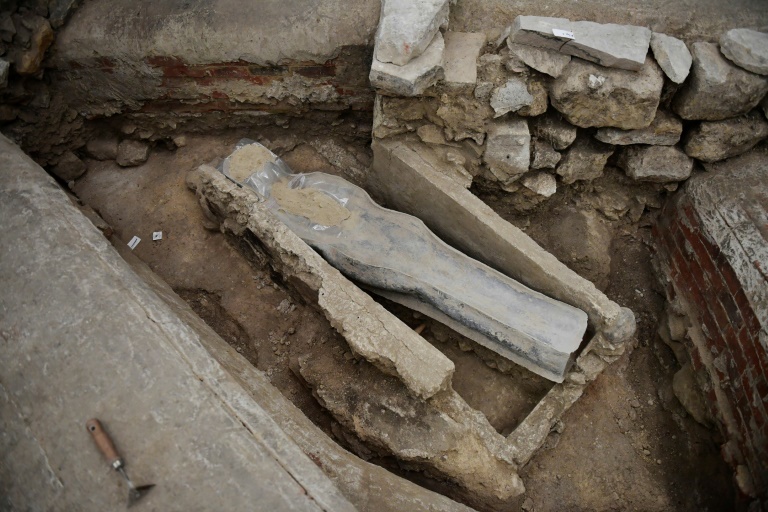
A mysterious leaden sarcophagus discovered in the bowels of Paris’ Notre-Dame cathedral after it was devastated by a fire will soon be opened and its secrets revealed, French archaeologists said Thursday.

The announcement came just a day before the third anniversary of the inferno that engulfed the 12th century Gothic landmark, which shocked the world and led to a massive reconstruction project.

During preparatory work to rebuild the church’s ancient spire last month, workers found the well-preserved sarcophagus buried 20 metres (65 feet) underground, lying among the brick pipes of a 19th century heating system.

But it is believed to be much older — possibly from the 14th century.

Scientists have already peeked into the sarcophagus using an endoscopic camera, revealing the upper part of a skeleton, a pillow of leaves, fabric and as-yet unidentified objects.

The sarcophagus was extracted from the cathedral on Tuesday, France’s INRAP national archaeological research institute said during a press conference.

It is currently being held in a secure location and will be sent “very soon” to the Institute of Forensic Medicine in the southwestern city of Toulouse. 

Forensic experts and scientists will then open the sarcophagus and study its contents, to identify the skeleton’s gender and former state of health, lead archaeologist Christophe Besnier said, adding that carbon dating technology could be used.

Noting that it was found under a mound of earth that had furniture from the 14th century, Besnier said “if it turns out that it is in fact a sarcophagus from the Middle Ages, we are dealing with an extremely rare burial practice”.

They also hope to determine the social rank of the deceased. Given the place and style of burial, they were presumably among the elite of their time.

However, INRAP head Dominique Garcia emphasised that the body will be examined “in compliance” with French laws regarding human remains.

“A human body is not an archaeological object,” he said. “As human remains, the civil code applies and archaeologists will study it as such.”

Once they are done studying the sarcophagus, it will be returned “not as an archaeological object but as an anthropological asset,” Garcia added.

And could Notre-Dame, this unknown person’s home for so many centuries, serve as their final resting place?

INRAP said the possibility of “re-internment” in the cathedral was being studied. 

ECB sticks to the plan as inflation, Ukraine shake eurozone

The European Central Bank on Thursday stood still in the face of record inflation, keeping its stimulus plans and rates unchanged, as the war in Ukraine cast a pall over the eurozone economy.

Meeting for the second time since the outbreak of the conflict, the bank’s 25-member governing council stuck to a plan that “should” see its bond-buying scheme come to an end in the third quarter, it said. 

An interest rate hike would follow “some time” after the stimulus programme comes to an end — a delay the ECB’s President Christine Lagarde stressed could be “between a week and several months”.

Governors would “assess exactly the timing of the conclusion of our net asset purchases” at the bank’s next meeting in June with the help of new forecasts, Lagarde said.

The decision to stick to its plan leaves the ECB further out of step with many of its peers. 

Central banks such as the Bank of England, US Federal Reserve and the Bank of Canada have already triggered their first interest rate rises in response to soaring inflation.

Calls for the ECB to follow suit as soon as possible from within the governing council have grown stronger as price rises in the eurozone have taken off. 

Year-on-year inflation hit 7.5 percent in March, an all-time high for the currency bloc and well above the bank’s own two-percent target.

The surge owes a great deal to the take off in prices for energy, commodities and food as a result of Russia’s invasion of Ukraine. 

At the same time, high energy costs, added disruptions to supply chains and weaker confidence were “severely affecting” the eurozone economy, Lagarde said in a press conference.

The former French finance minister last week tested positive for Covid and had to dial into the press conference via video link.

– ‘Europe is different’ –

Lagarde conceded that the bank’s forecasts had been “wrong in the past”, as calls increased for the central banks to get out ahead of the inflation wave by raising interest rates.

Minutes from the last ECB meeting in March revealed that many members of the governing council wanted “immediate further steps”.

Central bankers use rate rises as a tool to try and tame inflation, but pulling the trigger too soon risks hurting economic growth.

Any hike would be the ECB’s first in over a decade and would lift rates from their current historic low levels.

The Frankfurt-based institution even set a negative deposit rate of minus 0.5 percent, meaning banks pay to park excess cash at the ECB.

The ECB’s straightforward reiteration of its stimulus planned showed a “somewhat strengthened” commitment to end its bond-buying scheme in the third quarter, said Carsten Brzeski, head of macro at ING bank.

But the status quo stance showed that “Europe is different and the ECB is different” to other countries and central banks, Brzeski said.

The ECB’s gradual plan would see it put an “end to the era of negative interest rates before the end of the year”, he predicted.

– Gas boycott –

Comparing the eurozone with the United States and the policies of the Fed was like “apples and oranges”, Lagarde said.

Just as the risks from the pandemic “have declined”, the European economy will “be more exposed and will suffer more consequences” from the war in Ukraine, she said.

The impact “will depend on how the conflict evolves, on the effect of current sanctions and on possible further measures,” Lagarde said.

Looming over the outlook was the possibility of a stop to supplies of Russian gas, which many eurozone countries rely on heavily to meet their energy needs.

“An abrupt boycott would have a significant impact,” Lagarde said.

While the ECB’s bond-buying stimulus is being phased out, the advent of a fresh crisis has some speculating about the possibility of the bank designing a new tool to contain the impact of the war.

Questioned on the subject, Lagarde simply said the ECB would stay flexible and act “promptly” if new risks emerged and some countries found it harder to finance their response.

Elon Musk, tech visionary in the spotlight

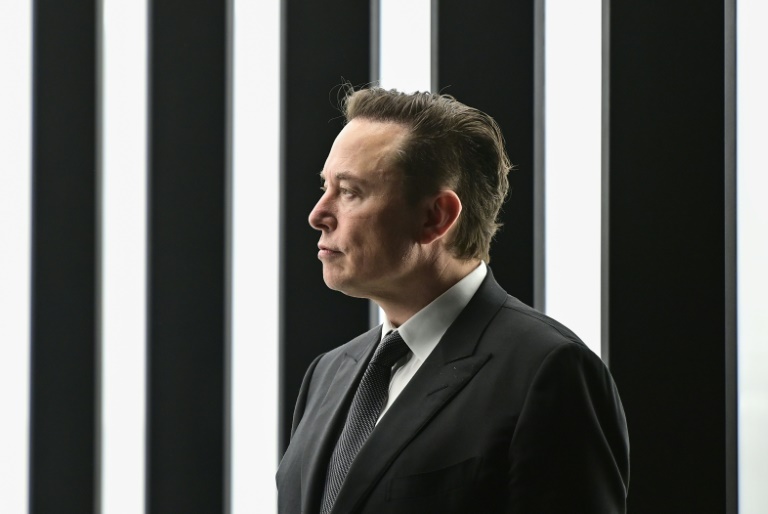
Space conquest: check. Disrupt the auto industry: check. Take over Twitter? Why not. From eccentric entrepreneur to the world’s richest man, Elon Musk likes to dream big — and these days, he is everywhere you look.

Two decades after banking his first millions, the South-African born Musk last year became the world’s richest person — wresting the title from Amazon’s Jeff Bezos — following the meteoric rise of Tesla, his electric automaker founded in 2003.

The billionaire’s latest big splash: a bid announced Thursday to take over Twitter, capping a rollercoaster fortnight of announcements and counter-announcements — which Musk punctuated, characteristically, by gleefully firing tweets at the platform.

Just a week earlier, the 50-year-old was making headlines as Tesla cut the ribbon on a “gigafactory” the size of 100 soccer fields in Texas, where the firm is now based and Musk himself has relocated from California.

At the same time, his space transport firm SpaceX was breaking yet another boundary as a partner in a three-way venture to send the first fully private mission to the International Space Station.

Musk also makes news of a less flattering kind: Tesla has faced a series of lawsuits alleging discrimination and harassment against Black workers as well as sexual harassment.

In parallel with the whiplash-inducing stream of business news, Musk’s controversy-courting persona — with an unrestrained Twitter style and penchant for living by his own rules in the private sphere too — keeps the gossip press busy.

It recently emerged Musk had had a second child with his on-again off-again partner, the musician Grimes: a girl they named Exa Dark Sideræl Musk — although the parents will mostly call her Y.

He is even expected to make an appearance — in person or not — at the celebrity defamation trial pitting Johnny Depp against his ex-wife Amber Heard, who formerly dated Musk.

But one way or another, Musk has become one of the most ubiquitous figures of the era. So how did he get where he is today?

– To Mars… and beyond? –

Born in Pretoria, on June 28, 1971, the son of an engineer father and a Canadian-born model mother, Musk left South Africa in his late teens to attend Queen’s University in Ontario.

He transferred to the University of Pennsylvania after two years and earned bachelor’s degrees in physics and business.

After graduating from the prestigious Ivy League school, Musk abandoned plans to pursue further studies at Stanford University.

Instead, he dropped out and started Zip2, a company that made online publishing software for the media industry.

He banked his first millions before the age of 30 when he sold Zip2 to US computer maker Compaq for more than $300 million in 1999.

Musk’s next company, X.com, eventually merged with PayPal, the online payments firm bought by internet auction giant eBay for $1.5 billion in 2002.

After leaving PayPal, Musk embarked on a series of ever more ambitious ventures.

He founded SpaceX in 2002 — now serving as its chief executive officer and chief technology officer — and became the chairman of electric carmaker Tesla in 2004.

After some early crashes and near-misses, SpaceX perfected the art of landing booster engines on solid ground and ocean platforms, rendering them reusable, and late last year sent four tourists into space, on the first ever orbital mission with no professional astronauts on board.

Musk’s jokingly-named The Boring Company is touting an ultra-fast “Hyperloop” rail transport system that would transport people at near supersonic speeds.

And Musk has said he wants to make humans an “interplanetary species” by establishing a colony of people living on the Mars.

To this end, SpaceX is developing a prototype rocket, Starship, which it envisages carrying crew and cargo to the Moon, Mars and beyond — with Musk saying he feels “confident” of an orbital test this year.

Musk, who holds US, Canadian and South African citizenship, has been married and divorced three times — once to the Canadian author Justine Wilson and twice to actress Talulah Riley. He has seven children. An eighth child died in infancy.

Forbes estimates Musk’s current net worth at $265 billion.

Crises slowing economic growth worldwide: IMF chief

The war in Ukraine has undercut the global recovery, slowing expected economic growth in most countries in the world, IMF Managing Director Kristalina Georgieva said Thursday.

And beyond the humanitarian tragedy and economic crises, the war has exposed fractures in the international system at a time when global cooperation is the only solution, she said. 

The war hit as the world was struggling to recover from the ongoing impact of the Covid-19 pandemic, and has caused an acceleration of inflation that endangers the gains of the past two years.

“To put it simply: we are facing a crisis on top of a crisis,” Georgieva said in a speech ahead of the spring meetings of the IMF and World Bank.

“The economic consequences from the war spread fast and far, to neighbors and beyond, hitting hardest the world’s most vulnerable people,” she said.

Families already were struggling with higher energy and food prices and “the war has made this much worse.”

The IMF is due to release its updated economic forecasts on Tuesday, which Georgieva said will further downgrade the estimate for global growth that was cut to 4.4 percent in January.

“Since then, the outlook has deteriorated substantially, largely because of the war and its repercussions,” she said, and 143 countries will suffer downgrades.

While most will still achieve positive growth, the future is “extraordinarily uncertain,” and she warned of a deep divide between rich and poor countries.

– ‘Clear and present danger’ –

After a decade of low inflation, prices worldwide have surged amid strong demand for goods that outstripped supply as economies began to return to normal, but the Russian invasion of Ukraine in late February and the sanctions imposed on Moscow pushed fuel and food prices up sharply.

Ukraine and Russia are major grain producers, and Russia also is a key source of energy for Europe.

“The root cause of what we face today is the war and it is the war that must end,” Georgieva said in a discussion following her speech to the Carnegie Endowment for International Peace.

Inflation, which has hit a four-decade high the United States, “has become a clear and present danger,” she said, noting the trend will likely last longer than expected.

“This is a massive setback for the global recovery,” she said.

It also complicates policymaking: major central banks are raising interest rates to contain prices, but that increases borrowing costs for emerging markets and developing nations, which face high debt burdens.

“This is the most universally complex policy environment of our lifetime,” she said.

– ‘Fragmentation’ –

Ending the war and the pandemic are top priorities, but can only be addressed through international cooperation, said Georgieva, who warned of the growing “fragmentation of the world economy into geopolitical blocs.”

The IMF leader, who grew up in Cold War-era Bulgaria, lamented, “I have never thought that I would live to see another war in Europe of the magnitude of the tragedy that is happening in Ukraine.”

She noted that the end of the Cold War ushered in “a new era of rapidly increasing prosperity… because of an integrated global economy.”

Fractures in that system impair the ability to address the current crises and future challenges, but also could cause a “tectonic shift” that would reshape global supply chains.

“The threat to our collective prosperity from a breakdown in global cooperation cannot be overstated,” she said.

Iraqis queue for fuel as stations protest government

Motorists in Iraq formed long queues for fuel Thursday after some owners of filling stations shut off their pumps to protest government policies on fuel distribution and pricing.

Some government-run fuel stations have been ordered to operate around the clock to meet demand, the official news agency INA reported.

Dozens of vehicles were lined up at stations that remained open.

Some owners of petrol stations have denounced the method of fuel distribution imposed by the authorities, complaining they end up paying more for the quantity of fuel they receive from the government than what they say it is worth.

Iraq is the second largest producer in the Organization of the Petroleum Exporting Countries (OPEC), and oil provides more than 90 percent of its income.

But the country, with a population of about 41 million, is also grappling with a major energy crisis and regular power cuts.

In recent days, private stations had already suspended their activities in the southern city of Najaf, according to INA.

The government has played down the problem, saying it is limited to “certain stations” in the capital Baghdad and the central and southern provinces, said Ihsan Mussa Ghanem, deputy head of the Iraqi agency in charge of distributing petroleum products.

In a statement, his agency said the owners of the closed stations were “manufacturing crises and obstructing the distribution of gasoline to citizens”.

Owners do not have the right to stop supplies, it said, and “inspection committees will identify all stations that contravene instructions.” 

Those that have shut their pumps face having their licenses suspended and supplies of oil stopped, the statement said.

Former UK Coca-Cola boss caught taking £1.5m in bribes

A former Coca-Cola boss in the UK on Thursday avoided jail despite taking more than £1.5 million ($1.95 million, 1.8 million euros) in bribes in return for channeling lucrative contracts to favoured companies.

Noel Corry, 56, provided companies with confidential information to give them an advantage over rivals when bidding for electrical services contracts for bottling plants in the UK.

In return, he received payments through “bogus” contracts for work at Coca-Cola Enterprises that was never carried out, or overpaying for work done and pocketing the difference, prosecutors said.

At London’s Southwark Crown Court on Thursday, he was given a 20-month suspended sentence, while two directors of the other companies involved in the scheme, which ran between 2004 and 2013, were each given a 12-month suspended sentence.

“Corry had established a corrupt culture in the procurement exercise, awarding contracts to those companies whose senior managers were prepared to bribe him for doing so,” said Alistair Dickson of the Crown Prosecution Service. 

“Coca-Cola Enterprises were wholly unaware of Corry’s corrupt actions to enrich himself.

Citigroup sets aside $1.9 bn for Russia as US banks report mixed results

Citigroup said Thursday it set aside $1.9 billion in reserves due to Russia’s invasion of Ukraine as large US banks reported mixed results amid a backdrop of geopolitical upheaval and fast-changing monetary policy.

About $1 billion in the Citi reserves are for direct exposure to Russia, while the $900 million relate to broader economic risks following the invasion, Citi Chief Financial Officer Mark Mason said on a conference call with reporters.

Since the end of 2021, Citi has reduced its overall exposure to Russia from $9.8 billion to $7.8 billion, Mason said.

Citi was one of several banks to report lower quarterly earnings compared with the year-ago period, when results were boosted by the release of reserves taken at the outset of the Covid-19 pandemic. 

Both Goldman Sachs and Wells Fargo also reported lower profits. Bankers have said US consumers remain on solid footing, but have cited inflation and the Russian invasion of Ukraine as worrisome factors that will likely slow the economy and could ultimately result in a recession.

“There’s somewhat of a wait and see how some of this plays out,” Mason said of the overall environment.

“Clients are worried about inflation,” Mason said. “They’re looking at the impacts from rising rates,” he added, noting that supply chain woes exacerbated by the Russian invasion.

Citi reported a 46 percent decline in first-quarter profits to $4.3 billion, while revenues dipped two percent to $19.2 billion.

Citigroup’s earnings were also dragged lower by increased expenses, while its banking operations had a mixed performance.

Chief Executive Jane Fraser cited a difficult geopolitical and macro environment as a factor in weaker investment banking results, while pointing to trade loans and cross-border transactions as areas of strength.

Citi also scored higher net interest income, benefiting from the Federal Reserve’s shift in monetary policy.

At Goldman Sachs, profits came in $3.8 billion, down 43 percent from the year-ago period on a 27 percent drop in revenues to $12.9 billion.

Goldman sustained a big drop in revenues from asset management and equity and debt underwriting, offset by a strong activity in some trading divisions amid market volatility.

Wells Fargo, meanwhile, reported profits of $3.7 billion, down 20.8 percent from the 2021 period. Revenues fell 5.1 percent to $17.6 billion.

Wells Fargo reported broad-based loan growth, but suffered a big drop in mortgage banking income, reflecting a rising interest rate environment.

Thursday’s deluge of earnings reports comes a day after JPMorgan Chase also reported lower profits. Bankers have said the US economy remains on solid footing, while warning of increased recession risk due to the Ukraine invasion, rising inflation and uncertainty connected to the shift in Fed interest rate policy.

Wells Fargo Chief Executive Charlie Scharf echoed that tone.

“Our internal indicators continue to point towards the strength of our customers’ financial position, but the Federal Reserve has made it clear that it will take actions necessary to reduce inflation and this will certainly reduce economic growth,” Scharf said. “In addition, the war in Ukraine adds additional risk to the downside.”

Shares of Citi rose 2.2 percent to $51.23 in morning trading, while Goldman Sachs gained 0.5 percent to $323.48. Wells Fargo slumped 5.5 percent to $45.86 

Close Bitnami banner
Bitnami