AFP

Pfizer to seek US authorization for third Covid shot in children

Pfizer and BioNTech on Thursday announced positive results from a clinical trial on the safety and immune response of a third dose of their Covid vaccine in children aged five through 11, adding they would soon seek regulatory authorization.

Third doses of the vaccine are recommended for those aged 12 and up, and a fourth dose was recently recommended for people over 50. 

Younger children — except for those with immune compromising conditions — have not been eligible for the third, making them more susceptible to infection from Omicron and its BA.2 subvariant.

BA.2 is now the globally dominant strain, and is behind a current spike in cases in the northeastern United States.

In the phase 2/3 trial, the companies analyzed data from 140 children aged five through 11, approximately six months after the second dose.

The dosage in this group is 10 micrograms, which was selected for safety reasons as children are more susceptible to side effects. The dose for those 12 and up is 30 micrograms.

Across the 140 children analyzed, the third dose was well tolerated, revealing no new safety concerns.

They also analyzed blood sera from a group of 30 individuals, finding that a third dose caused a 36-fold increase in levels of infection-blocking neutralizing antibodies against Omicron, compared to two doses.

Pfizer and BioNTech plan to soon submit the data to the US Food and Drug Administration (FDA), the European Medicines Agency and other regulatory agencies.

Most countries, including the United States, haven’t yet authorized Covid vaccines for infants and very young children.

Last month, Moderna said it was pursuing approval for its vaccine in children aged six months through five years, using a two-dose regimen.

Pfizer’s vaccine for this group was meant to be considered by the FDA in February but the agency postponed the meeting, because it wanted more data on how it would perform with three doses.

Green eggs and scam: Cuckoo finch's long con may be up

For two million years African cuckoo finches have been tricking other birds into raising their young by mimicking the colour of their eggs, but new research suggests the tables may be turning in this evolutionary scam.

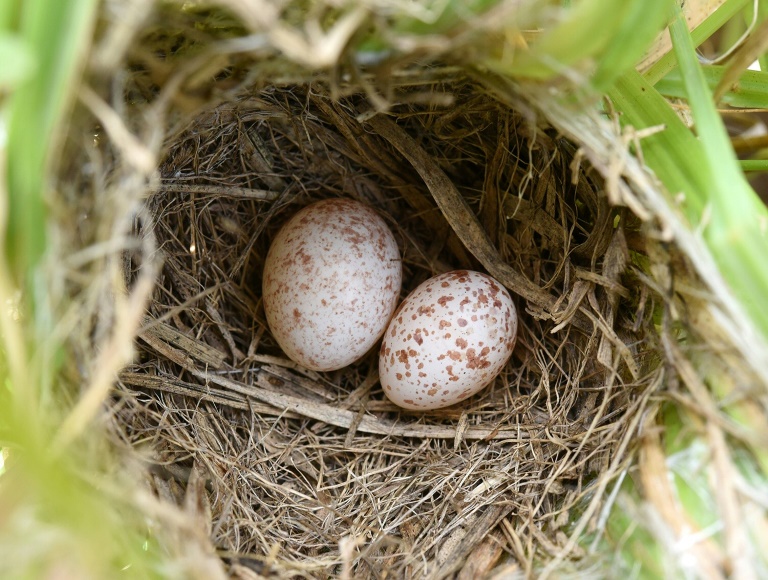
The cute yellow appearance of the cuckoo finch belies its nefarious nature: it smuggles its forged eggs into foreign nests, where unwitting foster parents treat them like their very own.

The cuckoo finch eggs then hatch a little earlier than the others in the nest, allowing them to grow quicker and beg more loudly for food than the host chicks — which starve to death as their confused parents prioritise the imposter.

Aiming to save their young from this grisly fate, birds like the African tawny-flanked prinia, a common victim of the ruse, have evolved ever more colourful and elaborate patterns for their eggs to avoid falling for counterfeits.

But the wily cuckoo finch has responded in kind, evolving the ability to copy a variety of egg colours and signatures of several different bird species.

Way back in 1933, British geneticist Reginald Punnett hypothesised that cuckoo finches inherited this remarkable talent of mimicry from their mothers.

His theory has been proved for the first time by a study published in the PNAS science journal this week, which confirmed that the skill is inherited via the W chromosome which only female birds have — similar to how only human males have the Y chromosome.

However the study said that “in this particular arms race, played out in grasslands of central Africa, natural selection has shaped a genetic architecture that appears to be a double-edged sword.”

Studying the DNA samples of 196 cuckoo finches from 141 nests of four grass-warbler species in Zambia, the researchers found that the long-term dupes have evolved new ways to sniff out the cuckoo finch’s deceptions.

– The uncrackable green egg –

Claire Spottiswoode, an evolutionary biologist of the University of Cambridge and University of Cape Town who led the research, gave the example of the olive-green egg, laid by the tawny-flanked prinia.

A single female cuckoo finch cannot produce an infinite variety of differently coloured eggs, she said.

It can only mimic the egg of the bird that raised it — the cuckoo finch is “imprinted” with how to target its future victims from the shells of its foster siblings.

This means that different cuckoo finches can lay blue or white eggs, while others can produce them in red and white — but because the skill is inherited via the female chromosome, they can never combine those pigments to make that olive green.

“Maternal inheritance is the reason why they’re unable to mimic that particular deep olive green colour,” Spottiswoode told AFP.

That puts the cuckoo finch at a evolutionary disadvantage — their rivals the prinias can inherit the genetic talents of both parents to make increasingly complicated eggs.

“We may see the emergence of unforgeable egg signatures which could force cuckoo finches to switch to other naive host species,” Spottiswoode said.

Even now cuckoo finches “make a lot of mistakes” she said, and once prinias spot a forgery they spear the egg and throw it out of the nest.

But if an egg avoids detection long enough to hatch, the parents lose all ability to detect the much larger fraud in their nest.

“It’s really remarkable how you have this beautiful adaptation at the egg stage, then at the chick stage the hosts seem to be completely stupid and raise a chick that looks completely unlike their own,” Spottiswoode said.

Death toll from Philippines landslides, floods hits 148

The death toll from landslides and flooding in the Philippines triggered by tropical storm Megi rose to 148 on Thursday, official figures showed, as more bodies were found in mud-caked villages.

Scores of people are still missing and feared dead after the strongest storm to strike the archipelago nation this year dumped heavy rain over several days, forcing tens of thousands into evacuation centres.

In the central province of Leyte — the worst affected by Megi — devastating landslides smashed farming and fishing communities, wiping out houses and transforming the landscape.

The disaster-prone region is regularly ravaged by storms — including a direct hit from Super Typhoon Haiyan in 2013 — with scientists warning they are becoming more powerful as the world gets warmer because of climate change.

Emergency personnel in Abuyog municipality have retrieved dozens of bodies from the coastal village of Pilar, which was destroyed by a landslide on Tuesday.

At least 42 people died in landslides that hit three villages in the municipality, police said. Another person drowned.  

Most of those deaths were in Pilar, with at least 28 bodies brought by boat to a sandy lot near the municipal government building after roads leading to the settlement were cut off by landslides.

More than 100 remained missing, and Abuyog Mayor Lemuel Traya told AFP there was little hope of finding anyone else alive.

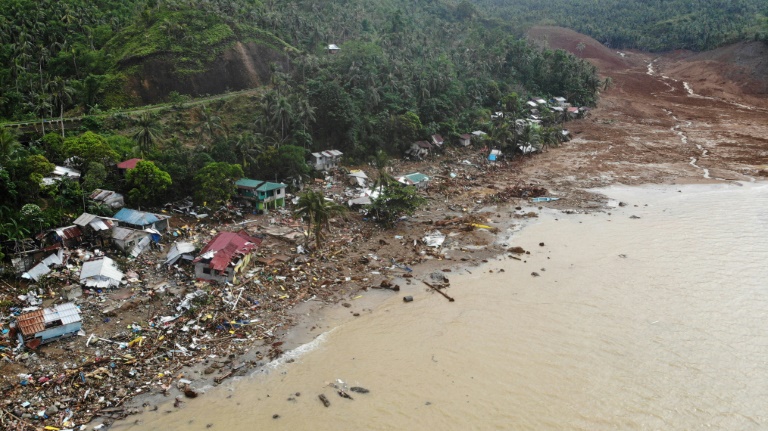
An aerial photo showed a wide stretch of mud and earth that had swept down a mountain to the sea, crushing everything in its path.

The wreckage of houses and debris was scattered along the shore.

Bad weather and thick mud had complicated retrieval efforts in Pilar, where the ground was unstable. Searchers were also combing the coastline after some bodies were swept kilometres away by ocean currents.

“This will not end soon, it could go on for days,” Traya warned. 

Many of those who died had hiked to higher ground to avoid flash floods, villagers told AFP. 

“It sounded like a helicopter,” said Pilar councillor Anacleta Canuto, 44, describing the noise made by the landslide.

Canuto, her husband and their two children survived, but they lost at least nine relatives.

Pilar fisherman Santiago Dahonog, 38, said he rushed into the sea with two siblings and a nephew as the landslide hurtled towards them.

“We got out of the house, ran to the water and started swimming,” he told AFP. “I was the only survivor.” 

– Scores missing in Baybay –

Another 101 people were killed and dozens injured in vegetable, rice and coconut-growing villages around Baybay City at the weekend, local authorities said. At least 103 are still missing.

The hardest hit was Kantagnos, where 42 people died and 93 have not been found. 

In the nearby village of Bunga, 17 people perished when sodden soil shot down a hill and slammed into the riverside community. Only a few rooftops are visible in the mud, which has started to smell of rotting flesh. 

Three people also drowned on the main southern island of Mindanao, and one person died in the central province of Iloilo, the national disaster agency said in its latest update.

Another three deaths previously reported in the central province of Negros Oriental were dropped from the tally after they were found to be unrelated to the storm. 

Megi struck at the beginning of Holy Week, one of the most important holidays in the mainly Catholic nation, when thousands travel to visit relatives.

It came four months after a super typhoon devastated swathes of the country, killing more than 400 and leaving hundreds of thousands homeless.

The Philippines — ranked among the most vulnerable nations to the impacts of climate change — is hit by an average of 20 storms every year.

Eurozone stocks rise, euro slides as ECB holds fire

Eurozone stock markets rose Thursday while the euro slid as the European Central Bank remained vague about when it will raise interest rates in the face of soaring inflation.

Meanwhile oil prices, whose recent surge has contributed to inflation around the globe reaching the highest levels in decades, came off the boil.

The ECB stood still in the face of record inflation, keeping its stimulus plans and rates unchanged, as the war in Ukraine cast a pall over the eurozone economy.

Meeting for the second time since the outbreak of the conflict, the bank’s 25-member governing council stuck to a plan that “should” see its bond-buying scheme come to an end in the third quarter. 

An interest rate hike would follow “some time” after the stimulus programme comes to an end, and any increases “will be gradual”. 

The decision leaves the ECB further out of step with many of its peers. Central banks such as the Bank of England, US Federal Reserve and the Bank of Canada have already triggered their first interest rate rises in response to soaring inflation.

Prices were already soaring in major economies when Russia’s invasion in late February sent shockwaves through the global energy, food and commodity markets.

Data this week from the United States — the world’s biggest economy — showed inflation at a level not seen in 40 years.

The euro took a knock after the ECB’s decision, losing ground against the dollar and pound.

However, eurozone stocks rose, with Frankfurt and Paris both rising 0.8 percent in afternoon trading.

Wall Street opened higher although another major bank reported a big fall in profits and set aside money due to Russia’s invasion of Ukraine.

Citigroup said its first quarter profits tumbled 46 percent to $4.3 billion, in a similar performance to JPMorgan Chase which reported Wednesday a sharp drop in profits and warned of downside risks from the Ukraine war and surging inflation.

Citigroup said it set aside $1.9 billion in reserves due to Russia’s invasion of Ukraine.

Elsewhere on the corporate front, Tesla chief Elon Musk launched a hostile takeover bid for Twitter, offering to buy 100 percent of its stock and take it private, according to a stock exchange filing.

Musk offered $54.20 a share, but the company’s share price only rose by around 2.4 percent to $46.90 after 10 minutes of trading.

Despite falling Thursday, both main oil contracts stayed firmly above the $100 per barrel mark, with fears swirling about global supply constraints over the invasion of Ukraine by Russia — a major producer of oil and gas.

– Key figures around 1330 GMT –

Frankfurt – DAX: UP 0.8 percent at 14,185.2 points

Paris – CAC 40: UP 0.8 percent at 6,594.80

EURO STOXX 50: UP 0.7 percent at 3,785.59

London – FTSE 100: UP 0.5 percent at 7,619.60 

New York – Dow: UP 0.5 percent at 34,735.73

Tokyo – Nikkei 225: UP 1.2 percent at 27,172.00 (close)

Hong Kong – Hang Seng: UP 0.7 percent at 21,518.08 (close)

Shanghai – Composite: UP 1.2 percent at 3,225.64 (close)

Brent North Sea crude: DOWN 1.3 percent at 107.44 per barrel

West Texas Intermediate: DOWN 1.5 percent at 102.80 per barrel

Euro/dollar – DOWN at $1.0829 from $1.0894 at 2100 GMT

Pound/dollar – DOWN at $1.3085 from $1.3109

Euro/pound – DOWN at 82.78 pence from 83.03 pence

Dollar/yen – DOWN at 125.53 from 125.59

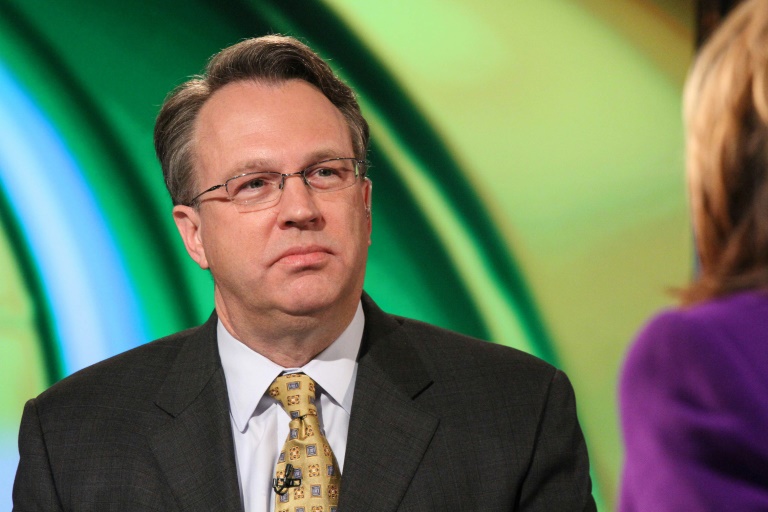
Fed can achieve economic 'soft landing,' but it won't be easy: Williams

The US central bank can bring inflation down by raising interest rates without jeopardizing growth in the world’s largest economy, although it will be a challenge, a top Federal Reserve official said Thursday.

“I think we can achieve a soft landing,” New York Fed President John Williams said in an interview with Bloomberg.

A wave of price increases caused by high demand and supply chain challenges was made worse by the Russian invasion of Ukraine, which hit food and fuel prices, sending US inflation to its highest level in four decades.

But Williams said Fed interest rate hikes are “really well suited” for addressing the imbalances between supply and demand in the US economy without causing a downturn.

The Fed can “just take the froth… out of the economy” to put it on sustainable footing.

But he acknowledged that “it’s not going to be easy,” given the “unique set of circumstances” facing the economy due to the ongoing challenges of the pandemic and the Russian invasion of Ukraine.

Williams serves as vice chair of the Fed’s policy-setting committee, which last month raised the benchmark lending rate for the first time since cutting it to zero at the start of the pandemic in early 2020.

Since then, a steady stream of central bankers have signaled plans for aggressive rate hikes to try to douse the inflation fires, with multiple half-point rate hikes likely starting at the May 3-4 meeting. The Fed also intends to reduce its massive bond holdings, which also should have the effect of tightening policy.

The actions already have had an impact on financial conditions, Williams said, which is “positioning policy well to get the supply and demand back into balance and set us up for bringing inflation down over the next couple of years.”

ECB sticks to the plan as inflation, Ukraine shake eurozone

The European Central Bank on Thursday stood still in the face of record inflation, keeping its stimulus plans and rates unchanged, as the war in Ukraine cast a pall over the eurozone economy.

Meeting for the second time since the outbreak of the conflict, the bank’s 25-member governing council stuck to a plan that “should” see its bond-buying scheme come to an end in the third quarter, it said. 

An interest rate hike would follow “some time” after the stimulus programme comes to an end — a delay the ECB’s President Christine Lagarde stressed could be “between a week and several months” — while any increases “will be gradual”.

The decision leaves the ECB further out of step with many of its peers. 

Central banks such as the Bank of England, US Federal Reserve and the Bank of Canada have already triggered their first interest rate rises in response to soaring inflation.

Calls for the ECB to follow suit as soon as possible from within the governing council have grown stronger as price rises in the eurozone have taken off. 

Year-on-year inflation hit 7.5 percent in March, an all-time high for the currency bloc and well above the bank’s own two-percent target.

The surge owes a great deal to the take off in prices for energy, commodities and food as a result of Russia’s invasion of Ukraine. 

At the same time, high energy costs, added disruptions to supply chains and weaker confidence were “severely affecting” the eurozone economy, Lagarde said in a press conference.

The former French finance minister is still testing positive for Covid and had to dial into the press conference via video link.

– ‘Europe is different’ –

The outbreak of the war and the unexpected bound in prices dealt a blow to the ECB’s best-laid plans. 

Lagarde conceded that the bank’s forecasts had been “wrong in the past”, as calls increased for the banks to get out ahead of the inflation wave by raising interest rates.

Minutes from the last ECB meeting in March revealed that many members of the governing council wanted “immediate further steps”.

Central bankers use rate rises as a tool to try and tame inflation, but pulling the trigger too soon risks hurting economic growth.

Any hike would be the ECB’s first in over a decade and would lift rates from their current historic low levels.

The Frankfurt-based institution even set a negative deposit rate of minus 0.5 percent, meaning banks pay to park excess cash at the ECB.

The ECB’s straightforward reiteration of its stimulus planned showed a “somewhat strengthened” commitment to end its bond-buying scheme in the third quarter, said Carsten Brzeski, head of macro at ING bank.

But the status quo stance showed that “Europe is different and the ECB is different” to other countries and central banks, Brzeski said.

The ECB’s gradual plan would see it put an “end to the era of negative interest rates before the end of the year”, he predicted.

– Gas boycott –

Comparing the eurozone with the United States and the policies of the Fed was like “apples and oranges”, Lagarde said.

Just as the risks from the pandemic “have declined”, the European economy will “be more exposed and will suffer more consequences” from the war in Ukraine, she said.

The impact “will depend on how the conflict evolves, on the effect of current sanctions and on possible further measures,” Lagarde said.

Looming over the outlook was the possibility of stop to supplies of Russian gas, which many eurozone countries rely on heavily on the fuel to match their energy needs.

“An abrupt boycott would have a significant impact,” Lagarde said.

While the ECB’s bond-buying stimulus is being phased out, the advent of a fresh crisis has some speculating about the possibility of the bank designing a new tool to contain the impact of the war.

Questioned on the subject, Lagarde simply said the ECB would stay flexible and act “promptly” if new risks emerged and some countries found it harder to finance their response.

Bankrupt Sri Lanka looks to expand airline fleet

Cash-strapped Sri Lanka’s loss-making national carrier revealed plans Thursday to lease up to 21 aircraft, just two days after the government announced a default on its $51 billion foreign debt.

The island nation is in the grip of its most painful economic downturn since independence in 1948, with severe shortages of essential goods and regular blackouts causing widespread misery. 

Huge protests have called for the resignation of the government, which has begged Sri Lankans abroad to send cash home to help pay for essential imports.

Despite the crisis, state-owned Sri Lankan Airlines has unveiled plans to expand its fleet from 24 to 35 planes in the next three years and replace some of its ageing jets.

“Sri Lankan Airlines has issued four requests for proposal to lease up to 21 aircraft to support its long-term business strategy,” it said in a brief statement.

The announcement came after the government suspended repayment of all its foreign borrowings, ahead of negotiations for a debt restructure with the International Monetary Fund next week.

The national carrier did not say how it planned to finance the leases, with its balance sheet showing a $1.7 billion debt and a carried forward loss of $1.56 billion in March 2020. 

It also came the same day international ratings agency Fitch downgraded $175 million in bonds issued by the airline from C to CC, suggesting the carrier was “near default”.

Fitch said the airline’s new rating, on debt due in June 2024, was in line with Sri Lanka’s default announcement.

The IMF has repeatedly urged Sri Lanka to privatise the airline, saying it was a white elephant the country cannot afford.

The airline was profitable before the government cancelled a management agreement with Emirates of Dubai in 2008, following a personal dispute with current Prime Minister Mahinda Rajapaksa.

The carrier had refused to bump fare-paying passengers and give their seats to members of Rajapaksa’s family, who were returning from a holiday in London.

Rajapaksa removed the Emirates-appointed chief executive of Sri Lankan Airlines and made his brother-in-law Nishantha Wickremasinghe head of the company.

An earlier plan to lease eight Airbus A350 jets during Rajapaksa’s tenure is subject to an ongoing criminal investigation. 

The airline’s then-chief executive Kapila Chandrasena and his wife were arrested two years ago after an international investigation found they received at least $2 million in kickbacks over the order. 

Turkey again refuses to raise rates to fight record inflation

Turkey’s central bank on Thursday brushed aside an inflation reading that has soared past 60 percent and kept its benchmark interest rate steady for the fourth month in a row.

The widely-anticipated decision reflects President Recep Tayyip Erdogan’s unorthodox conviction that high interest rates cause inflation rather than slow it down.

But it means that Turkey will continue to rely on expensive economic support measures that could further deplete state coffers and inhibit foreign investors from returning to the once-promising emerging market.

“It would probably take the emergence of severe strains in the banking sector to bring an interest rate hike on to the agenda,” analyst Jason Tuvey of Capital Economics remarked.

The central bank said its decision to hold the main interest rate at 14 percent was driven by expectations of the “disinflation process” starting soon.

Russia’s invasion of Ukraine and the aftereffects of the coronavirus pandemic have sparked energy price spikes and production bottlenecks that pushed US and European cost of living increases to their highest levels in more than 20 years.

But Turkey’s annual inflation rate of 61.1 percent — the highest since Erdogan’s ruling party stormed to power in 2002 — is largely disconnected from most global factors.

Turkey entered an economic tailspin when Erdogan put pressure on the nominally independent central bank to start slashing interest rates last year.

The powerful Turkish leader believes relatively cheap borrowing costs will propel the economy to sustainable growth that supports long-term employment and helps his re-election chances next year.

But the policy pushed people’s return on bank deposits far below the rate at which the lira was losing value against the dollar.

That forced Turks to start converting their liras into dollars at an even greater pace.

The Turkish currency lost 44 percent of its value against the dollar last year and another nine percent since the start of January.

Erdogan’s government has responded by using state banks to buy up liras in a bid to cut the currency’s losses.

The government has also forced exporters to sell a quarter of their foreign currency earnings to the central bank to help buffer its reserves.

Turkish media reported this week that this rate could soon be raised to at least 40 percent.

Erdogan has also shifted Turkey’s geopolitical alignment and tried to reform broken alliances with cash-rich Gulf states.

“Erdogan strategy is I think clear — try and make friends with everyone internationally so as to secure bilateral external financing to sustain the current FX/rates mix until elections by June 2023,” analyst Timothy Ash of BlueBay Asset Management said.

Elon Musk launches hostile takeover bid for Twitter

Tesla chief Elon Musk has launched a hostile takeover bid for Twitter, insisting it was a “best and final offer” and that he was the only person capable of unlocking the full potential of the platform.

Musk offered $54.20 a share, which values the social media firm at $43.4 billion, in a filing dated Wednesday April 13 with the Securities and Exchange Commission.

Twitter’s board said it would carefully review what it termed Musk’s “unsolicited, non-binding” offer and decide on a course of action that was “in the best interest of the Company and all Twitter stockholders.”

Musk’s latest move toward Twitter comes just days after he turned down a seat on the board following his acquisition of a 9.2 percent stake in the microblogging platform.

“I invested in Twitter as I believe in its potential to be the platform for free speech around the globe, and I believe free speech is a societal imperative for a functioning democracy,” Musk said in his filing.

“However, since making my investment I now realize the company will neither thrive nor serve this societal imperative in its current form,” he said.

“Twitter needs to be transformed as a private company. As a result, I am offering to buy 100% of Twitter for $54.20 per share in cash, a 54% premium over the day before I began investing in Twitter.”

– ‘Popcorn time’ –

Musk, Twitter’s biggest shareholder, said his “offer is my best and final offer” and he would reconsider his position as a shareholder if it was rejected.

“Twitter has extraordinary potential. I will unlock it,” he said.

Wedbush analysts said the Twitter board would likely be forced to accept the bid or seek another buyer. 

“It’s get out the popcorn time as we expect many twists and turns in the weeks ahead as Twitter and Musk walk down this marriage path,” the analysis said, with a host of questions likely to swirl around issues of financing, regulatory aspects and balancing Musk’s time between his many companies.

Currently the world’s richest man, and with more than 80 million followers on the microblogging platform, Musk last week disclosed a purchase of 73.5 million shares — or 9.2 percent — of Twitter’s common stock. His announcement sent Twitter shares soaring more than 25 percent.

He was offered a seat on the board but turned it down at the weekend.

Musk’s move comes after he tweeted Saturday asking whether the social media network was “dying” and to call out users such as singer Justin Bieber, who are highly followed but rarely post.

“Most of these ‘top’ accounts tweet rarely and post very little content,” the Tesla boss wrote, captioning a list of the 10 profiles with the most followers — which includes himself at number eight, with 81 million followers.

In other weekend tweets, Musk posted joke polls on whether to drop the “w” from Twitter’s name and on converting its San Francisco headquarters to a homeless shelter “since no one shows up anyway.”

He also suggested removing ads, Twitter’s main source of revenue.

The billionaire tech entrepreneur is a frequent Twitter user, regularly mixing in inflammatory and controversial statements about issues or other public figures with remarks that are whimsical or business-focused. 

He has also sparred repeatedly with federal securities regulators, who cracked down on his social media use after a purported effort to take Tesla private in 2018 fell apart.

Crane ship nearly topples after Norway lifting accident

A huge crane ship was left listing outside the harbour of Stavanger in southwestern Norway on Thursday after a steel wire snapped during a loading operation, police said.

The Saipem 7000, operated by Italian oil services company Saipem, ended up tilting sharply, according to witness photos released by the Norwegian media, but no injuries were reported among the 275-strong crew.

The huge specialised vessel, which police say suffered significant material damage, was brought upright according to live footage from public broadcaster NRK.

The accident occurred during a lift at around 10 am (0800 GMT) in a fjord adjacent to Stavanger, a hub of Norway’s offshore oil industry, police said.

“A steel wire snapped during a loading operation,” Brit Randulff, police superintendent, told AFP.

“Witnesses heard a loud bang, but there was no indication of an explosion,” she added when asked about initial media reports mentioning an explosion.

“No people were hurt, but there was damage to the ship and there is a barge that tipped over and is floating upside down,” Randulff said.

Built in Italy in the 1980s, the specialised vessel, one of the largest in the world, can be partially submerged to lay pipelines and lines for the oil industry.

Close Bitnami banner
Bitnami