AFP

Yen drops to 20-year low against dollar

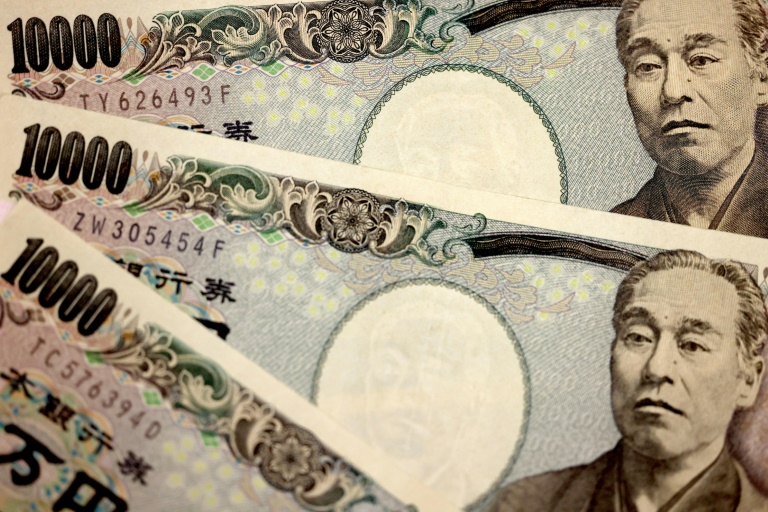
The yen hit its lowest level against the dollar in two decades on Wednesday, extending recent falls as the gap widens between Japan’s ultra-loose monetary policy and Fed tightening.

Despite being traditionally considered a safe-haven currency, uncertainty fuelled by Russia’s war in Ukraine has not caused the yen to strengthen.

Instead, moves by the US Federal Reserve towards a more aggressive policy and the shock of rising oil prices in Japan — a major importer of fossil fuels — have pushed the currency lower, analysts say.

One dollar bought 126 yen at around 0630 GMT on Wednesday, the lowest rate since 2002.

“The Japanese yen has been one of the weakest currencies anywhere in the world this year,” Dutch banking group ING said in a recent commentary.

“Driving the rally has been the perfect storm of a hawkish Federal Reserve, a dovish Bank of Japan (BoJ), and Japan’s negative terms of trade shock as a major fossil fuel importer.”

The yen had already lost 10 percent of its value against the dollar in 2021 after four years of steady strengthening.

The US central bank has taken a hawkish tone as it embarks on an aggressive tightening path, pushing up American treasury yields which have strengthened the dollar against the yen.

Earlier on Wednesday, Bank of Japan governor Haruhiko Kuroda said the bank would maintain its monetary easing policies in a bid to reach its long-held two-percent inflation target.

“Given the economy and price situation, the Bank of Japan will seek to realise its two-percent inflation target… by resiliently continuing its current powerful monetary easing,” he said.

Swiss Bank UBS said a weaker yen would likely hit Japanese households’ purchasing power and domestic-oriented small businesses who will face higher import costs.

“The government is offering fiscal supports and most likely will expand the supports. We think the JPY purchase intervention is possible if the pace of depreciation is regarded as too fast,” it said in a note.

“We cannot completely deny the possibility of the BoJ adjusting policy to cope with public criticism” on the yen’s depreciation, UBS added, noting that the bank under Kuroda “has been quite flexible and pragmatic in the past”.

Prime Minister Fumio Kishida did not comment directly on the yen’s fall when asked on Tuesday, but emphasised the importance of stability in foreign exchange rates.

“I will refrain from commenting on the level of exchange rates, but their stability is important and I think rapid fluctuations are undesirable,” he said.

UK inflation strikes 30-year high

Britain’s annual inflation rate soared to the highest level in three decades last month as energy prices rocket, official data showed Wednesday, worsening a cost-of-living crisis.

Inflation surged to 7.0 percent in March from 6.2 percent in February, the Office for National Statistics said in a statement.

“Broad-based price rises saw annual inflation increase sharply again in March,” said ONS chief economist Grant Fitzner. 

“Amongst the largest increases were petrol costs.”

Prices of restaurant meals and hotel rooms also rose steeply last month after falling a year earlier during a pandemic lockdown in the UK.

Costs are surging worldwide as economies reopen from pandemic lockdowns and on fallout from the war in Ukraine.

US inflation rose by a huge 8.5 percent over the 12 months to March, the biggest jump in four decades, official data showed Tuesday.

Sharp price rises across the board are forcing central banks around the world to hike interest rates, curbing economic growth recovery.

European Central Bank governors meet Thursday to ponder record-high inflation in the eurozone and fresh economic uncertainty caused by the war in Ukraine, with policymakers signalling a willingness to take action sooner rather than later.

The US Federal Reserve and the Bank of England have already announced their first rate hikes to combat price pressures, leaving the ECB looking out of step.

– ‘Worrying time’ –

The Bank of England has predicted that UK annual inflation could reach double figures by the end of the year.

“We’re seeing rising costs caused by global pressures in our supply chains and energy markets which could be exacerbated further by Russian aggression in Ukraine,” Britain’s finance minister Rishi Sunak said Wednesday.

“I know this is a worrying time for many families,” added the embattled chancellor of the exchequer.

Sunak, along with Prime Minister Boris Johnson, confirmed Tuesday that they had been fined for breaching Covid-19 lockdown laws.

British cost-of-living is set to soar even higher owing to an April tax hike on UK workers and businesses and a fresh surge in domestic energy bills that kicked in this month.

“Soaring energy and fuel prices were the main drivers of the rise in (UK) inflation in March, but we are paying more for everything,” Myron Jobson, senior personal finance analyst at Interactive Investor, said following Wednesday’s data.

“Supply shortages and production bottlenecks owing to the pandemic have forced firms to raise their prices of late,” while Russia’s invasion of Ukraine “has made the outlook for inflation worse”, he added.

China's imports fall as Covid outbreaks, lockdowns hit demand

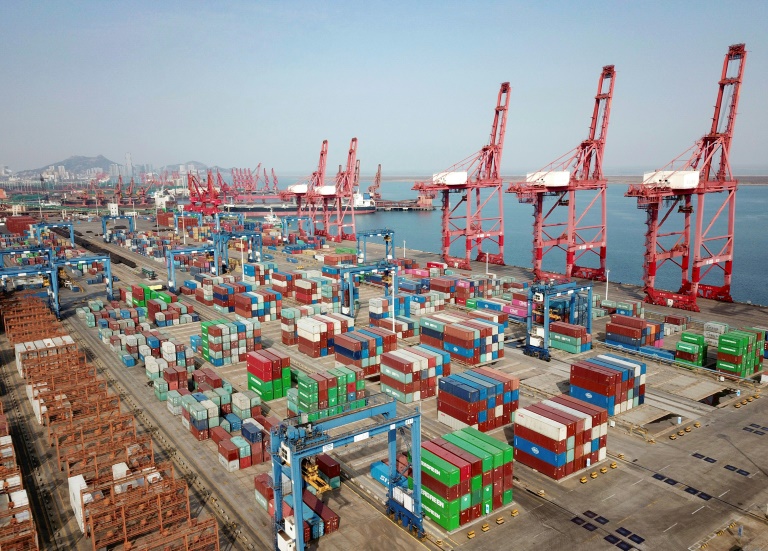
China’s imports shrank on-year in March for the first time in nearly two years, official data showed Wednesday, hit by coronavirus lockdowns and weakening consumer demand.

The world’s second-largest economy has stuck to a strict zero-Covid strategy as it tries to contain outbreaks fuelled by the Omicron variant in recent months.

The economic costs, however, have mounted — the waves of infections and resulting lockdowns have kept consumers at home, halted business operations and snarled supply chains.

Imports dropped 0.1 percent from a year ago, according to data from China’s Customs Administration — the first such decline since August 2020, in the early phase of the pandemic.

The figure was much lower than the forecast from a Bloomberg poll of economists, and a far cry from the 15.5 percent growth for the first two months this year.

“Some unexpected factors in the international and domestic environment have gone beyond our anticipation,” Customs Administration spokesman Li Kuiwen told reporters.

“Achieving the goal of stabilising foreign trade will require greater effort.”

China’s export growth slowed as well in March to 14.7 percent, down from 16.3 percent in the first two months.

While Li did not specify external factors, the drop in exports came during a period where Russia’s invasion of Ukraine and the shockwaves from it have hurt business sentiment and consumer confidence globally.

“The March trade data highlighted the impact of pandemic-related disruptions on economic activity and consumer spending,” said Rajiv Biswas, Asia-Pacific chief economist at S&P Global Market Intelligence.

He added that recent lockdowns in major cities such as Shanghai and Shenzhen “hit consumer spending hard”, while the temporary shutdown of manufacturing plants impacted demand for imported raw materials.

China’s balance of trade in March was $47.4 billion.

European demand for Chinese exports could be “a key risk”, Biswas said, given that “macroeconomic shocks from the Russia-Ukraine war, notably higher oil and gas prices and rising inflation pressures, are resulting in a downgraded EU GDP growth outlook in 2022”.

Customs spokesman Li said that in the first quarter, exports of mechanical and electronic products rose 9.8 percent from a year ago, with increases in solar cells, lithium batteries and automobiles.

“The largest declines in outbound shipments were of electronics, furniture and recreational products, pointing to an unwinding of pandemic-linked demand for these goods,” Julian Evans-Pritchard, senior China economist at Capital Economics.

Endangered pangolins get fresh chance in S.African clinic

The hospital room is air-cooled to feel like a pangolin’s burrow. The patient, Lumbi, is syringe-fed with a protein-packed smoothie, given a daily dose of medicine and has his vital signs checked.

Lumbi is being treated for a blood parasite after he was rescued from traffickers during a police sting in South Africa’s northern Limpopo province late last year.

He and several other pangolins in the room are patients of Johannesburg Wildlife Veterinary Hospital, founded in 2016 to treat and rehabilitate indigenous wildlife.

They were confiscated from poachers in South Africa and neighbouring countries, including Namibia, Mozambique and Zimbabwe.

Many pangolins are in a horrendous state when they are rescued and need of medical care, after being kept in sacks and car boots for weeks with no food or water.

“It’s like an ICU (intensive care unit) for pangolins,” said Nicci Wright, the wildlife rehabilitation specialist attending to Lumbi.

The pangolins are kept at a secret site during treatment, which takes anything from weeks to months, before they can be released back into the wild.

Although pangolins have existed for around 80 million years, medically little is known about them. 

– Pangolins ‘are like people’ –

“They are so different to other animals. They really are,” said Wright, who has been working with pangolins since 2008.

Sometimes vets have to fiddle with various treatment regimes to provide the appropriate medication.

“The actual veterinary medicine and rehabilitation process hasn’t been well documented and very little is actually know about the African species,” said Wright. 

Vets administer standard treatments used on other mammals such as cats and dogs. Often they work.

“Sometimes to you just have to take a chance, and so far we have taken chances and we have been very successful and they have responded very well,” said vet Kelsey Skinner.

“It’s just a leap of faith every time you try something,” said Skinner, 30, after giving Lumbi his daily dose of meds.

Having cared for sick pangolins for several years, Skinner discovered that, like people, they have different personalities.

The scaly-skinned, insect-eating mammals are solitary, nocturnal animals.

“They are like people. They have just the most unique little personalities. 

“Some of them are shy. They don’t want to be touched. Others are very out there and play a lot in the mud. They are comedians,” she said.

“The level of personalities is like dealing with a whole lot of different people. Everyone is just so unique.”

– The most trafficked mammals –

Pangolins are believed to be the most trafficked mammals on earth. They’re prized for their scales — made of keratin, like human nails — which are used in Asia for their supposed medicinal properties.

Only found in the wild in Asia and Africa, their numbers are plummeting under pressure from poaching. Some species are listed by wildlife watchdogs as critically endangered.

It’s not known how many pangolins are left on the planet. 

The ward that now cares for Lumbi was also home, until recently, to a pangolin named Steve. Last month, Steve was released back into the wild, where he belongs, after making a full recovery.

Gareth Thomas is a volunteer pangolin walker who walked Steve weekly during the seven months of preparation for his release. 

“I’ve been with him since day one. I was there when he got pulled out of the box from the poachers,” he said during one of their final walks before the release.

After a six-hour drive, Steve was set free into the vast 23,000-hectare Manyoni Game Reserve in southern KwaZulu-Natal province.

Pangolin monitor Donald Davies from Zululand Conservation Trust offloaded a specially designed crate from the van, with Steve inside and opened it.

With two telemetry devices attached to his scales, the pangolin cautiously stepped out, sniffing around and casually walking away to find ants for an afternoon grub.

“He has all the skills he needs to survive in the wild now,” said Davies.

Freeing them into the wild is a crucial process to ensure the endangered mammals survive after the huge investment poured into their treatment and rehabilitation.

“The release process is one of the most important, because it has to be done correctly,” said Wright.  

The gentle creatures can only be released into a relatively safe area, such as a well-patrolled private game reserve, to avoid them falling into the poachers’ clutches again.

And, in addition, the habitat has to be right. “We need to be absolutely sure they are finding the right food, they are finding the burrows. Otherwise they will simply die”.

iPhone maker Pegatron halts Shanghai production over Covid

Key iPhone maker Pegatron has halted operations at two subsidiaries in the Chinese cities of Shanghai and Kunshan, as global supply chains feel the pinch of Beijing’s strict zero-Covid measures.

The business hub of Shanghai has become the heart of China’s biggest Covid-19 outbreak since the virus surfaced more than two years ago.

The city of 25 million has remained almost entirely locked down since the start of the month.

“We have temporarily suspended work,” said Pegatron in a filing to the Taiwan Stock Exchange on Tuesday.

The Taiwanese firm said it “actively cooperates with local authorities” and would try to resume operations as soon as possible.

The suspensions apply to two of its subsidiaries, in Shanghai and nearby Kunshan city.

Stay-at-home orders and stringent testing rules have strained supply chains in and around Shanghai, home to the world’s busiest container port and a critical gateway for foreign trade.

China reported nearly 28,000 local virus cases on Wednesday, the vast majority in Shanghai.

Many factories have been forced to halt operations as virus cases have surged, while some staff have been living in their workplaces as businesses struggle to operate.

Pegatron’s suspensions mark the latest blow to Apple, which has seen disruptions at other suppliers’ assembly lines in recent months as Chinese cities struggle to curb virus outbreaks.

In March, another major supplier Foxconn halted operations in the Chinese tech hub of Shenzhen.

Foxconn has “resumed fundamental operations” in Shenzhen as of late March, the company said.

Chinese authorities have struggled to maintain the flow of goods across the country as tough virus controls slow movement.

A Transport Ministry circular issued late Tuesday barred the “blocking of road transportation” vehicles and personnel, ordering more efficient Covid-19 screening along transport routes.

Anxious about the spring farming season and food supplies, officials in virus-hit areas such as the northeastern province of Jilin have also issued travel passes to let agricultural workers return to farmland on chartered buses.

“The Chinese economy has been facing a rising risk of recession since mid-March”, Nomura analysts warned this week, citing severe disruptions to the delivery of exports, with coastal areas hit hard by controls to rein in the virus.

Lost golden toad heralds climate's massive extinction threat

Those lucky enough to have seen them will never forget.

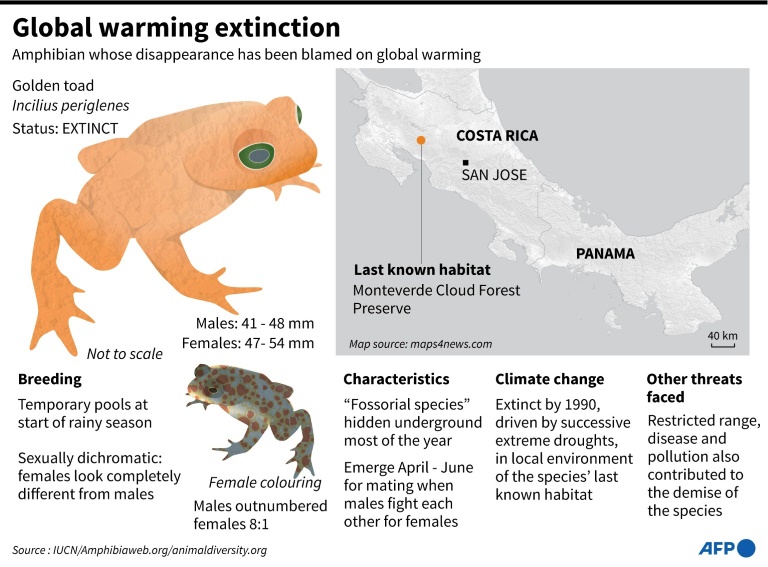
For just a few days every year, the elfin cloud forest of Costa Rica came alive with crowds of golden toads the length of a child’s thumb, emerging from the undergrowth to mate at rain-swelled pools.  

In this mysterious woodland the cloud drapes over mountain ridges and “the trees are dwarfed and wind-sculpted, gnarled and heavily laden with mosses,” said J Alan Pounds, an ecologist at the Monteverde Cloud Forest Preserve in Costa Rica.

“The soils are very dark and so golden toads would stand out like animal figurines. It was quite a spectacle.” 

Then in 1990, they were gone. 

The golden toad was the first species where climate change has been identified as a key driver of extinction.

Its fate could be just the beginning. 

For years, researchers have warned that the world is facing both a climate and a biodiversity crisis. Increasingly they say they are connected.

– One in 10 face extinction –

Even if warming is capped at the ambitious target of 1.5 degrees Celsius above pre-industrial levels, the UN’s Intergovernmental Panel on Climate Change says nearly one in 10 of all species face an extinction threat.

The golden toad was only found in Monteverde’s highland forest. So when trouble hit, the species was completely wiped out. 

“It was pretty clear about 99 percent of the population declined within a single year,” said Pounds, whose research into the disappearance of the golden toad was cited in the IPCC’s February report on climate impacts. 

Climate change was barely on the research radar when Pounds first arrived in Costa Rica in the early 1980s to study amphibians.

But global warming was already beginning to take its toll. 

After the disappearance of the golden toad, the Monteverde harlequin frog and others, researchers compared datasets on temperature and weather patterns with those on local species. 

They found not only the signature of the periodic El Nino weather phenomenon, but also trends linked to changes in climate.  

– Climate ‘trigger’ – 

The die-offs occurred after unusually warm and dry periods.

Pounds and his colleagues linked the declines to chytridiomycosis infection, but concluded that disease was only the “bullet — climate change was pulling the trigger.

“We hypothesised that climate change and resultant extreme events were somehow loading the dice for these kinds of outbreaks,” Pounds told AFP.

It was not an isolated incident. 

The expansion of the chytrid fungus globally, along with local climate change “is implicated in the extinction of a wide range of tropical amphibians,” according to the IPCC. 

The fingerprints of global warming have since been seen in other disappearances. 

The Bramble Cay melomys, a small rodent living on a low-lying island in the Torres Strait, was last seen in 2009.  

The only mammal endemic to the Great Barrier Reef, its populations were battered by sea-level rise, increased storm surges and tropical cyclones — all made worse by climate change.

Vegetation that provided its food plummeted from 11 plant species in 1998 to just two in 2014. It was recently declared extinct. 

Today, climate change is listed as a direct threat to 11,475 species assessed by the International Union for Conservation of Nature. Around 5,775 are at risk of extinction.

– #MeToo for species –

The main reason why climate change is increasingly cited as a threat to so many species is that its impacts are becoming more obvious, said Wendy Foden, the head of the IUCN’s climate change specialist group.

But there is also a growing understanding of the enormous variety of effects. 

Beyond extreme weather, warming can also cause species to move, change behaviour or even skew to having more male or female offspring. 

And that’s on top of other human threats like poaching, deforestation, overfishing and pollution. 

In 2019, a report by UN biodiversity report experts said one million species could disappear in the coming decades, raising fears that the world is entering a sixth era of mass extinction.

“It’s absolutely terrifying,” said Foden, adding that warnings of catastrophic biodiversity loss have often been overlooked.  

“We need a #MeToo movement for species, a whole wake up on what we are doing.” 

Almost 200 countries are currently locked in global biodiversity talks to try to safeguard nature, including a key milestone of 30 percent of Earth’s surface protected by 2030.

But Foden said the threat of climate change means that the response will have to go beyond traditional conservation. 

“That can’t happen anymore, even in the most remote wilderness, climate change will affect it,” Foden said. 

In some cases, people will need to choose which species to save. 

Take the endangered African penguin in South Africa, which Foden wrote about for the IPCC report on climate impacts. 

Forced to nest in the open after humans mined their guano nesting sites, the adults now have to swim ever further to find fish, likely because of a combination of overfishing and climate change. Meanwhile, the chicks in exposed nests can die from heat stress. 

“We are down to the last 7,000 breeding pairs. At this point, every penguin counts,” Foden said. 

– Cloudless forest –

In Monteverde, even the clouds have changed.  

While rainfall has increased somewhat over the past 50 years, Pounds said it has become much more variable.  

In the 1970,s the forest saw around 25 dry days a year on average — in the last decade it has been more like 115.  

The mist that used to keep the forest wet during the dry season has reduced by around 70 percent.

Pounds said sometimes tourists in the area stop him and ask directions to the Cloud Forest. 

“And I say: ‘You’re in it,'” he said.

“It often feels more like a dust forest than a cloud forest.”

Researchers have also seen steep declines in frogs, snakes and lizards and changes in the bird populations. Some have moved uphill to cooler areas, others have vanished from the area completely.

As for the golden toad, last year a team from the Monteverde Conservation League, supported by the conservation group Re:wild, launched an expedition to look for the golden toad in its historic habitat in the Children’s Eternal Rainforest, after tantalising rumours of sightings. 

But in vain.

Meanwhile, Pounds and his colleagues continue to keep an eye out for the golden toad during the rainy season. 

“We haven’t completely given up,” he said. 

“But with each passing year, it looks less likely that they’re going to reappear.”

Asian stocks mostly up despite red-hot US inflation

Asian markets mostly started Wednesday with gains, despite a day of losses on Wall Street and across Europe sparked by data showing red-hot US inflation.

Hong Kong and Shanghai bucked the trend though, posting slight losses in morning trade.

The US consumer price index surged 8.5 percent in March compared with a year ago, the biggest jump since December 1981. CPI climbed 1.2 percent over February’s level.

The report was the first to fully encompass the shock caused by Russia’s invasion of Ukraine and Western sanctions against Moscow, which have caused energy and food prices to spike worldwide.

Though the Federal Reserve was poised to raise interest rates quickly to tamp down inflation pressures, the effects will not be immediate.

But Tokyo shrugged off the gloom, with the benchmark Nikkei 225 up by about 1.5 percent.

Shares in Seoul and Sydney were also up, while Mumbai was down.

“Yes, US inflation was hot -– it’s hottest in 40 years. But we’re getting used to these extreme headline prints now, to the point that markets looked past the whopping 8.5 percent y/y print in favour of core CPI only rising 0.3 percent compared to 0.5 percent expected,” said Matthew Simpson, senior market analyst at City Index.

“Besides, now high levels of inflation are no longer new news, the focus is now shifting to its trajectory and how long it may take to tail off.”

“We’re hopeful that this is where (inflation is) going to peak,” Ann Miletti, head of active equity at Allspring Global Investments, told Bloomberg Television.

But she added that markets continued to face the threat of rising rates and the impact of Covid-19 lockdowns in China, which have snarled supply chains.

Both major crude oil contracts were back over $100 per barrel, with Brent topping $105, after Russian President Vladimir Putin vowed to continue the invasion of Ukraine and China partially eased Covid-related curbs.

“Oil seems to be the primary benefactor of Ukraine vs Russia conflict dragging out longer,” noted Stephen Innes of SPI Asset Management.

– Key figures around 0230 GMT –

Tokyo – Nikkei 225: UP 1.6 percent at 26,755.05 (break)

Hong Kong – Hang Seng Index: DOWN 0.18 percent at 21,281.78

Shanghai – Composite: DOWN 0.32 percent at 3,202.98

Brent North Sea crude: UP 0.56 percent at $105.23 per barrel

West Texas Intermediate: UP 0.53 percent at $101.13 per barrel

Euro/dollar: DOWN at $1.0832 from $1.0864

Pound/dollar: UP at $1.3007 from $1.3006

Euro/pound: DOWN at 83.28 pence from 83.53 pence

Dollar/yen: UP at 125.63 yen from 125.61 yen

New York – Dow: DOWN 0.3 percent at 34,220.36 (close)

London – FTSE 100: DOWN 0.6 percent at 7,576.66 (close)

— Bloomberg News contributed to this report —

US crypto expert jailed 63 months for helping N.Korea

A US cryptocurrency expert was sentenced Tuesday to 63 months in prison for advising North Korea on how to create cryptocurrency services and blockchain technology to circumvent US sanctions over its nuclear program, court officials in New York said.

Virgil Griffith, 39, had pleaded guilty to conspiring to violate US law, in a bid to reduce the sentence for a crime that can carry up to 20 years behind bars. 

Prosecutor Damian Williams said “there is no question North Korea poses a national security threat to our nation, and the regime has shown time and again it will stop at nothing to ignore our laws for its own benefit. 

He said that Griffith had “admitted in court he took actions to evade sanctions, which are in place to prevent (North Korea) from building a nuclear weapon.”

In April 2019 Griffith gave a presentation in Pyongyang, the North Korean capital, on cryptocurrency and blockchain technology. He was arrested at Los Angeles airport in November the same year. 

At the conference, Griffith provided information on how North Korea could use the technology to launder money and evade sanctions, including through “smart contracts,” according to the court.

The prosecution said that after the presentation, Griffith “pursued plans to facilitate the exchange of cryptocurrency between the Democratic People’s Republic of Korea and South Korea, despite knowing that assisting with such an exchange would violate sanctions against the DPRK.”

The United States prohibits the export of goods, services or technology to North Korea without special permission from the Treasury Department’s Office of Foreign Assets Control.

In addition to 63 months in jail, Griffith will spend three years on probation. 

Griffith holds a doctorate from the California Institute of Technology and has also worked on Ethereum, a Singapore-based global platform with blockchain technology for business and financial use, which has a cryptocurrency named after it.

Driverless car stopped in San Francisco puzzles cops

San Francisco police faced an unprecedented problem recently when an officer stopped a car that was driving at night with no headlights on, only to discover there was no one inside. 

The vehicle, it turned out, was a self-driving car, and the police officer’s encounter was captured on film by a passerby, who posted the footage on social media.

The clip, showing bemused officers circling the vehicle and peering through its window for several minutes, has been shared so widely that Cruise, the company that owns the vehicle, reacted on Twitter to explain what had happened.

It said the self-driving car “yielded to the police vehicle, then pulled over to the nearest safe location for the traffic stop, as intended. An officer contacted Cruise personnel and no citation was issued.”

In the footage, as the police are inspecting the parked vehicle, someone can be heard exclaiming, “There’s no one in it, it’s crazy!”

A police spokesperson said that after the police had stopped the car, a maintenance team had taken control of it.

Cruise explained that the headlights were turned off due to human error.

Founded in 2013, Cruise has developed software that allows cars to drive themselves completely autonomously. 

The US manufacturer General Motors owns the majority of shares in the company, valued at more than $30 billion thanks to investments by giants such as Microsoft, Honda and Walmart. 

Since February, Cruise has passed a key threshold in offering individuals the chance to book free trips in the streets of San Francisco in its driverless cars. 

Residents of the Californian city also regularly come across robo-taxis from Waymo, Google’s self-driving subsidiary. 

These camera-clad vehicles take passengers wherever they want, with a driver who is present but does not touch the steering wheel or the pedals.

For Biden's battered approval, 'nothing else matters' like inflation

Historically low joblessness is the kind of thing American leaders dream of, but President Joe Biden also has nightmarishly high inflation that supporters and opponents alike believe may cost his Democratic Party dearly.

Biden’s popularity has sunk in recent months even as the unemployment rate has ticked progressively lower amid booming job creation, which experts attribute to record-high price increases the US economy has weathered as it recovers from the pandemic. 

“Politically speaking, nothing else matters,” said Charlie Cook, a longtime political analyst and founder of the Cook Political Report.

Job growth is a traditional metric of presidential success, and the White House has attempted to focus the public’s attention on the progress made in the labor market, where new applications for jobless aid are at more than half-century lows and the unemployment rate is almost back to where it was before Covid-19 broke out.

But Cook said the spike in consumer prices to levels not seen since 1981 has undercut those arguments because while some voters may benefit from the strengthening jobs market, everyone experiences higher prices for gasoline, food and other necessities.

Biden’s approval ratings are now hovering around 42.2 percent, according to poll aggregator FiveThirtyEight, and with midterm elections in seven months, even Biden’s allies worry that his Democratic party will lose its narrow control of one, or perhaps both, houses of Congress.

“High prices are preventing Americans from feeling the Biden boom,” said Will Marshall, president of the center-left Progressive Policy Institute.

– Losing, not gaining, jobs –

Biden took office at a time when unemployment was on a downward trajectory after spiking to 14.7 percent in 2020 as businesses laid off workers en masse after the pandemic arrived on American shores.

Throughout his presidency, it has fallen steadily to hit 3.6 percent last month, a hair above its pre-pandemic level.

But consumer prices have shot up, jumping by 8.5 percent over the 12 months to March, and polls indicate Americans are pointing the finger at Biden.

Nearly two-thirds of voters disapprove of Biden’s handling of the economy, according to a poll by the Associated Press and NORC Center for Public Affairs Research released late last month, while progressive data firm Navigator Research found more Americans believe the economy is losing jobs than gaining them.

The high inflation rate is a consequence of a collision between global shortages and shipping delays, the Federal Reserve’s low interest rate policies and shocks to commodity markets caused by Russia’s invasion of Ukraine that have sent gas prices soaring.

Another factor is pandemic rescue bills Congress approved under Biden and his Republican predecessor Donald Trump that fattened Americans’ wallets and drove them to buy scarce goods.

While economists debate how much of an effect these policies have had on inflation, Marshall acknowledged missteps in Biden’s congressional priorities as prices rose last year and his administration was reeling from the chaotic withdrawal of US troops from Afghanistan.

The president won bipartisan support for a $1 trillion overhaul to the nation’s infrastructure, but delayed that bill’s passage while trying to unite Democratic lawmakers around Build Back Better, his signature proposal to overhaul the country’s social services, which ultimately failed.

“I think people mistakenly thought, well, this is a second coming of the New Deal,” Marshall told AFP, referring to a 1930s-era Democratic expansion of government in response to the Depression. “I think they overreached.”

– Can he come back? –

Douglas Holtz-Eakin, who served as an economist in Republican former president George W. Bush’s administration, said Democrats might have been worse off if they passed Build Back Better, because voters would have linked its high price tag to inflation.

“I think they benefited more from its failure than it cost them,” said Holtz-Eakin, now the president of the American Action Forum.

Biden’s Democrats control Congress, but only by the thinnest majorities — 12 seats in the House and one vote in the Senate — which he argued does not give them a mandate to enact major legislation.

“They mistakenly think they have to do something. They don’t, they should get out of the way, let the Fed take care of inflation, let the private sector take care of growth,” Holtz-Eakin said.

The Federal Reserve is in the process of raising interest rates, and many economists believe the inflation spike will flatten as the year progresses.

But whether it comes soon enough for Biden remains to be seen. 

It is common for a president’s party to lose ground in the midterm congressional elections, and his two predecessors in the White House were mauled in when their parties lost control of the House — a fate Cook warned Biden appears on course to meet.

“Are we really going to see a meaningful reduction in inflation between now and the time voting starts between late September and October?” he asked. “I don’t think it’s realistic at all.”

Close Bitnami banner
Bitnami