AFP

Brazil's Lula slams Bolsonaro indigenous policies

Brazilian ex-president Luiz Inacio Lula da Silva vowed Tuesday to undo current President Jair Bolsonaro’s policies on indigenous people if elected, branding his rival a “fascist” aligned with “those who want to kill our forests.”

Speaking at a protest by thousands of indigenous people who are camping out in the capital, Brasilia, to protest Bolsonaro’s policies, Lula drew loud cheers with a promise to create a ministry of indigenous affairs if he wins Brazil’s October presidential elections.

“And one of you will have to run it, not a white person like me,” he said, wearing a beaded necklace with a colorful macaw emblem.

If elected for a new term, he said, “we’ll need to hold a ‘revocation day,’ where everything (Bolsonaro) decreed to hinder (indigenous rights) will be immediately revoked.

“We can’t allow everything you’ve fought for to be taken from you by decree and handed over to those who want to kill our forests and wildlife,” he said.

The leftist ex-steelworker, who led Brazil from 2003 to 2010, currently leads Bolsonaro in pre-election polls.

The far-right incumbent has drawn protests from indigenous groups and environmentalists for pushing legislation that would dramatically reduce the creation of new indigenous reservations and open up existing ones to mining.

A series of studies have shown protecting indigenous lands is one of the best ways to preserve forests, vital resources in the race to curb climate change.

Under Bolsonaro, who took office in 2019 with solid backing from Brazil’s powerful agribusiness sector, deforestation has surged in the crucial Amazon rainforest, home to the majority of Brazil’s 900,000 indigenous people.

There were chants of “Get out, Bolsonaro!” as Lula arrived to speak at the indigenous camp, which opened last week just up the road from the presidential palace and Congress.

Ukraine crisis pushes US inflation to new four-decade high

Americans paid more for gasoline, food and other essentials last month amid an ongoing wave of record inflation made worse by Russia’s invasion of Ukraine, according to government data released Tuesday.

The consumer price index (CPI) climbed 8.5 percent over the 12 months to March, the biggest jump since December 1981 and a sign of the pressure President Joe Biden’s administration is under even as it looks for more ways to punish Moscow for the attack on its neighbor.

The inflation surge has dragged Biden’s approval lower since it began last year, and the president sought to pin the blame on Russian President Vladimir Putin and the invasion’s disruptions to global energy markets.

“Seventy percent of the increase in prices in March came from Putin’s price hike in gasoline,” Biden argued during a speech in Iowa, though the Labor Department said it accounted for closer to half.

Prices began rising last year as the economy recovered from the Covid-19 pandemic, and while the latest report showed costs hitting new heights for many items, it also contained signs the spike may be leveling off.

Compared to February, prices rose 1.2 percent, in line with analysts’ forecasts, but “core” prices, which exclude volatile food and energy sectors, rose 0.3 percent rise, less than expected.

“The Russia-Ukraine war has added further fuel to the blazing rate of inflation via higher energy, food, and commodity prices that are turbo charged by a worsening in supply chain problems,” Kathy Bostjancic of Oxford Economics said.

The potency of the ongoing price jumps bolstered the case that the Federal Reserve will take aggressive action at its policy meeting next month, likely raising the key lending rate by half a percentage point as opposed to the quarter-point increase last month.

“With labor shortages pressuring firms to raise wages, we are in the midst of a wage-price inflation cycle that will require extreme action on the part of the Fed to rid the economy of the spreading inflation threat,” economist Joel Naroff said.

– Real pain –

A collision of factors has fueled the inflation surge, including business’ struggles to find enough workers and supplies, the Fed’s low interest rate policies, and congressionally approved stimulus measures that drove up demand among American consumers.

In response, the White House has scrambled to offer relief, including by releasing strategic oil supplies to lower prices at the pump and waiving a prohibition on selling a lower-price gasoline blend during the summer months, which Biden promoted during his visit to Iowa.

But the most potent actor in Washington against inflation is the Fed. 

Though rate hikes are expected to lower prices in the months to come, central bank Governor Lael Brainard said Tuesday that the fallout from the war in Ukraine “probably skews risks to the upside in inflation.” 

A new pandemic lockdown in China also “has the potential to lengthen out some of those constraints that we’ve seen in supply chains,” Brainard said in a discussion following the data’s release.

The Labor Department data showed Americans are facing real financial pain when they go to purchase must-have items.

Prices for shelter, the category including rents, rose 0.5 percent, while food prices rose one percent overall. 

Prices for groceries were up 1.5 percent in the month, and 10 percent over the past year — the largest such increase since March 1981, according to the data.

– Used cars reverse –

However, prices for used cars, which were one of the first items to surge last year, declined 3.8 percent last month, pushing core CPI lower. New car prices rose only 0.2 percent after seeing monthly gains of more than one percent in the latter months of 2021.

But considering how high prices have risen for other categories, Naroff said some on the Fed’s policy setting committee may advocate for an even more forceful 0.75 point rate increase next month — and that would not necessarily bring prices down quickly.

“The ability of any Fed to sharply raise rates to slow extremely high inflation, while not driving the economy into a recession, is limited, especially given factors such as war that are out of its control,” he said in a note. 

“We are talking about art here, not science, and there is little history of this Fed painting pretty pictures.”

US stocks fall on latest hot inflation report; oil prices rise

Equity markets in Europe and New York fell Tuesday following another report showing red-hot US inflation, while oil prices pushed higher.

The consumer price index surged 8.5 percent in March compared with a year ago, the biggest jump since December 1981. CPI climbed 1.2 percent over February’s level.

The report was the first to fully encompass the shock caused by Russia’s invasion of Ukraine and Western sanctions against Moscow, which have caused energy and food prices to spike worldwide.

Higher prices for food, shelter and fuel are “likely forcing some people to do without,” said economist Joel Naroff.

Though the Federal Reserve is poised to raise interest rates quickly to tamp down inflation pressures, the effects would not be immediate.

“Inflation should moderate, if only because some of the biggest increases are behind us. But there is a difference between decelerating and low,” Naroff said. 

“Since monetary (policy) works with a lag, don’t expect major progress on the inflation front even if the Fed acts aggressively.”

US equities initially climbed on the inflation data, with some analysts appearing to view the report as corroborating “peak inflation” narrative based on the idea that pricing pressures will soon ease.

But stocks lost steam later in the session, with the S&P 500 finishing 0.3 percent lower. Some analysts pointed to nervousness heading into the earnings season.

Shares of large banks fell more than one percent ahead of quarterly results, which kick off Wednesday morning with JPMorgan Chase.

Analysts expect banks to report lower earnings compared with last year, when profits from were lifted by the release of funds set aside early in the pandemic in case of bad loans.

Meanwhile, European markets fell, with London’s FTSE 100 ending the day down 0.6 percent. Frankfurt off 0.5 percent and Paris shedding 0.3 percent.

Oil prices advanced more than six percent, lifting US benchmark West Texas Intermediate back above $100 a barrel.

“The crude correction ended now that the market has mostly priced in the strategic petroleum release plan, China is beginning to lift some of their lockdowns and as negotiations between Russia and Ukraine appear to have hit a dead-end,” said Oanda’s Edward Moya. 

“The energy market expects to remain very tight from the summer and if geopolitical risks remain elevated, $100 oil should easily hold.”

– Key figures around 2040 GMT –

New York – Dow: DOWN 0.3 percent at 34,220.36 (close)

New York – S&P 500: DOWN 0.3 percent at 4,397.45 (close)

New York – Nasdaq: DOWN 0.3 percent at 13,371.57 (close)

London – FTSE 100: DOWN 0.6 percent at 7,576.66 (close)

Paris – CAC 40: DOWN 0.3 percent at 6,537.41 (close)

Frankfurt – DAX: DOWN 0.5 percent at 14,124.95 (close)

EURO STOXX 50: DOWN 0.2 percent at 3,831.47 (close)

Tokyo – Nikkei 225: DOWN 1.8 percent at 26,334.98 (close)

Hong Kong – Hang Seng Index: UP 0.5 percent at 21,319.13 (close)

Shanghai – Composite: UP 1.5 percent at 3,213.33 (close)

Brent North Sea crude: UP 6.3 percent at $104.64 per barrel

West Texas Intermediate: UP 6.7 percent at $100.60 per barrel

Euro/dollar: DOWN at $1.0832 from $1.0884 late Monday

Dollar/yen: DOWN at 125.33 yen from 125.37 yen

Pound/dollar: DOWN at $1.3002 from $1.3030

Euro/pound: DOWN at 83.28 pence from 83.53 pence

burs-jmb 

Ukraine crisis pushes US inflation to new four-decade high

Americans paid more for gasoline, food and other essentials last month amid an ongoing wave of record inflation made worse by Russia’s invasion of Ukraine, according to government data released Tuesday.

The consumer price index (CPI) climbed 8.5 percent over the 12 months to March, the biggest jump since December 1981, which adds pressure to President Joe Biden’s administration even as it looks for more ways to punish Moscow for the attack on its neighbor.

Prices have surged across the world’s largest economy as it tries to recover from the Covid-19 pandemic, dragging Biden’s approval ratings lower, though the Labor Department’s March data contained signs the spike may be leveling off.

“The Russia-Ukraine war has added further fuel to the blazing rate of inflation via higher energy, food, and commodity prices that are turbo charged by a worsening in supply chain problems,” Kathy Bostjancic of Oxford Economics said.

Compared to February, prices rose 1.2 percent, in line with analysts’ forecasts, but if there were signs of deceleration to be found, they were in the lower-than-expected 0.3 percent rise in “core” prices, which exclude volatile food and energy sectors.

The potency of the ongoing price jumps bolstered the case that the Federal Reserve will take aggressive action at its policy meeting next month, likely raising the key lending rate by half a percentage point as opposed to the quarter-point increase last month.

“With labor shortages pressuring firms to raise wages, we are in the midst of a wage-price inflation cycle that will require extreme action on the part of the Fed to rid the economy of the spreading inflation threat,” economist Joel Naroff said.

– Real pain –

While the US economy has bounced back strongly from the mass layoffs that marked the early weeks of the pandemic, inflation has bedeviled the recovery since last year, as businesses struggled to find enough workers and supplies, the Fed kept interest rates low, and Congress approved stimulus measures that drove up demand among American consumers.

Biden’s public support has dropped as prices have increased, leaving the White House scrambling to offer relief, including by releasing strategic oil supplies to lower prices at the pump and waiving a prohibition on selling a lower-price gasoline blend during the summer months, a measure announced just before the data was released on Tuesday.

But the most potent actor in Washington against inflation is the Fed. 

Though rate hikes are expected to lower prices in the months to come, central bank Governor Lael Brainard said Tuesday that the fallout from the war in Ukraine “probably skews risks to the upside in inflation” 

And a new pandemic lockdown in China “has the potential to lengthen out some of those constraints that we’ve seen in supply chains,” Brainard said in a discussion after the data was released.

The Labor Department data showed Americans are facing real financial pain when they go to purchase must-have items.

Gasoline prices rose 18.3 percent last month, accounting for half the overall increase in CPI, while prices for shelter, the category including rents, rose 0.5 percent.

Food prices rose one percent overall, while prices for groceries were up 1.5 percent in the month, and 10 percent over the past year — the largest such increase since March 1981, according to the data.

– Used cars reverse –

However, prices for used cars, which were one of the first items to surge last year, declined 3.8 percent last month, pushing core CPI lower. New car prices rose only 0.2 percent after seeing monthly gains of more than one percent in the latter months of 2021.

Dan Alpert of Westwood Capital tweeted that the data showed signs of deflation “in those things that went bonkers during 2020: transportation, electronics, recreation and leisure. Supply chains are reopened for the most part and demand is becoming sated.”

But considering how high prices have risen for other categories, Naroff said some on the Fed’s policy setting committee may advocate for an even more forceful 0.75 point rate increase next month — and even that would not necessarily bring prices down quickly.

“The ability of any Fed to sharply raise rates to slow extremely high inflation, while not driving the economy into a recession, is limited, especially given factors such as war that are out of its control,” he said in a note. 

“We are talking about art here, not science, and there is little history of this Fed painting pretty pictures.”

Boeing cuts its order book following Ukraine invasion

Boeing has removed orders for 141 jets from its backlog, mostly due to sanctions placed on Russia in the aftermath of the Ukraine invasion, officials from the plane manufacturer said Tuesday.

Most of the planes stripped from Boeing’s official tally were 737 models, with about two-thirds coming as “a result of geopolitical events,” a Boeing spokesperson said. 

The removal of the Russian jets from Boeing’s backlog comes as the company also again reported no deliveries from its 787 Dreamliner for the first quarter.

On the positive side, the company added a net of 145 new jet orders during the quarter as more people traveled and global economies recovered from the worst of the pandemic.

Boeing now holds orders for 4,231 new planes, down from 4,375, according to an update for March orders and deliveries.

The Commerce Department on April 7 announced that Russian state airline Aeroflot, Azur Air and Utair were barred from receiving American goods for the next 180 days.

The move was part of a series of steps by Washington and other Western governments in response to Moscow’s invasion of Ukraine.

In the first quarter, Boeing reported 95 commercial deliveries compared with 77 in the year-ago period. The biggest jump was for the 737, reflecting Boeing’s resumption of deliveries for the 737 MAX following a lengthy grounding.

Deliveries of the 787 have been halted since May as Boeing works to satisfy demands to address quality and manufacturing problems flagged by the Federal Aviation Administration.

Stocks mixed as US inflation jumps to four-decade high

Stock markets diverged on Tuesday as investors digested official data showing US inflation hit a four-decade high in March, raising expectations the  Federal Reserve will act more aggressively to tame prices.

Oil prices, meanwhile, surged as Shanghai began to ease Covid restrictions and the OPEC group of crude-producing nations lowered its forecast for global demand this year, citing the Ukraine war’s impact on the world economy. 

Inflation had already been rising worldwide in recent months as economies emerge from Covid lockdowns, but Russia’s invasion of Ukraine and sanctions against Moscow have pushed energy and food prices even higher worldwide.

US inflation continued to surge in March, sending the consumer price index (CPI) up 8.5 percent over the past 12 months, its largest increase since 1981, according to the US Labor Department.

Wall Street stocks advanced nevertheless, with the Dow Jones Industrial Average rising 0.8 percent, the S&P 500 gaining 1.0 percent and the tech-heavy Nasdaq up 1.5 percent.

European markets fell, with London’s FTSE 100 ending the day down 0.6 percent. Frankfurt fell 0.5 percent and Paris shed 0.3 percent.

Analysts said investors may see the March inflation reading as a sign that the CPI had reached its peak.

“The latest US CPI numbers raised the hope that the surge in price pressures we’ve been seeing over the last 6 months might be starting to show signs of topping out,” said Michael Hewson at CMC Markets UK. 

The headline 8.5 percent figure was higher than expected, the core figure which excludes volatile energy prices, came in lower than expected at 6.5 percent. 

“There had been a widespread expectation that they could well have been a lot worse, and this has prompted some paring back in US yields, which in turn has supported a rebound in stock markets,” said Hewson.

The Fed last month raised interest rates by a quarter point in the first of a series of increases, and since then a chorus of officials — including Fed Chair Jerome Powell — have signalled their openness to half-point rate increases, a more aggressive measure.

– Oil prices surge –

On the oil market, meanwhile, the price of Brent North Sea crude, the international benchmark, surged 6.7 percent to $105.10 per barrel while US contract, WTI, jumped 6.9 percent to $100.77.

Prices had fallen on Monday on fears about the impact of Covid lockdowns in China, the world’s biggest crude consumer.

But they rebounded on Tuesday after OPEC said in a report lowered its demand forecast to 3.7 million barrels per day, a reduction of 500,000 barrels per day, as it said the Ukraine conflict would dent global economic growth.

Craig Erlam at OANDA said that in its report pushed back against calls by the West for it to utilise its spare capacity to replace Russian oil, saying it wasn’t possible. 

“While the EU is continuing to push for higher output which would enable it to consider sanctions on Russian oil without severe economic damage at home — with current prices already causing problems — it seems it’s not going to be aided by the group that remains Russia’s ally in the OPEC+ alliance,” he wrote in a note to clients.

“With that in mind, the brief flirtation with double-digit oil may already be at an end for now,” Erlam added.

– Key figures around 1530 GMT –

New York – Dow: UP 0.8 percent at 34,566.61 points

EURO STOXX 50: DOWN 0.2 percent at 3,831.62

London – FTSE 100: DOWN 0.6 percent at 7,576.66 (close)

Paris – CAC 40: DOWN 0.3 percent at 6,537.41 (close)

Frankfurt – DAX: DOWN 0.5 percent at 14,124.95 (close)

Tokyo – Nikkei 225: DOWN 1.81 percent at 26,334.98 (close)

Hong Kong – Hang Seng Index: UP 0.52 percent at 21,319.13 (close)

Shanghai – Composite: UP 1.46 percent at 3,213.33 (close)

Brent North Sea crude: UP 6.7 percent at $105.10 per barrel

West Texas Intermediate: UP 6.9 percent at $100.77

Euro/dollar: DOWN at $1.0863 from $1.0884 late Monday

Dollar/yen: DOWN at 125.16 yen from 125.37 yen

Pound/dollar: UP at $1.3037 from $1.3030

Euro/pound: DOWN at 83.32 pence from 83.53 pence

burs-rl/ach 

Apple chief Cook takes App Store battle to Washington

Apple head Tim Cook attacked moves to regulate his company’s App Store in a rare speech in Washington on Tuesday, arguing that new rules could threaten iPhone users’ privacy.

Cook put forth the Silicon Valley giant’s perspective as momentum gathered for legislation that could weaken Apple’s app market dominance, which critics have said amounts to a monopoly.

“We are deeply concerned about regulations that would undermine privacy and security in service of some other aim,” Cook told an International Association of Privacy Professionals gathering.

“Proponents of these regulations argue that no harm would be done by simply giving people a choice, but taking away a more secure option will leave users with less choice, not more,” he added.

At issue is efforts by policy makers in the United States and elsewhere to force Apple to let apps onto the iPhone from places other than the App Store, which is currently the only gateway onto the firm’s billions of devices in circulation.

Apple and Google hold a dominant position in the market, with their operating systems running on the overwhelming majority of the world’s smartphones.

Apple has clashed in court with Fortnite creator Epic Games, which has sought to break Apple’s grip on the App Store, accusing the iPhone maker of operating a monopoly in its shop for digital goods or services.

A federal judge in November ordered Apple to loosen control of its App Store payment options, but said Epic had failed to prove that antitrust violations had taken place.

Apple has also recently sparred with regulators in Europe.

Letting iPhone users “sideload” apps from digital shops other than the App Store would bypass Apple vetting for malicious code or data collecting features, Cook said.

“That means data hungry companies would be able to avoid our privacy rules, and once again track our users against their will,” Cook added.

Critics have countered that Apple uses the App Store to its advantage, taking a bite out of financial transactions and keeping app makers under its thumb.

“If we are forced to let unvetted apps on the iPhone, the unintended consequences will be profound,” Cook argued. “We will continue to make our voices heard on this issue.”

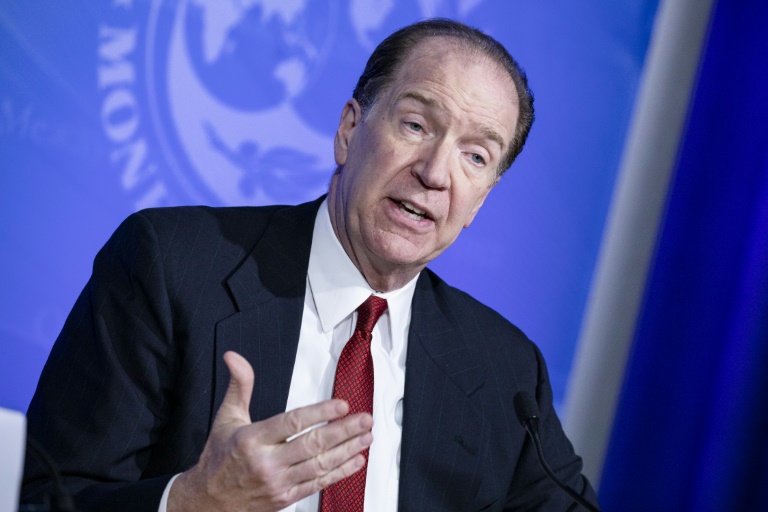
Ukraine war fuels 'overlapping crises': World Bank's Malpass

The Russian war on Ukraine has set off a chain reaction in the global economy, pushing energy and food prices higher, exacerbating debt concerns and potentially worsening poverty and hunger, World Bank President David Malpass said Tuesday.

Faced with these “overlapping crises,” the leader of the development lender urged advanced nations to keep markets open, removing trade barriers and reversing policies that concentrate wealth.

The war came as the global economy was trying to right itself following the Covid-19 pandemic, while navigating supply chain snarls that created shortages and a surge in inflation that has sparked unrest in some countries. 

New lockdowns in China have added further uncertainty to the recovery.

“Never have so many countries experienced a recession at once, suffering lost capital, jobs, and livelihoods. At the same time, inflation continues to accelerate,” Malpass said during an event at the Warsaw School of Economics.

Beyond the immediate humanitarian crisis caused by the war, “Supply constraints and disruptions have fueled price increases and worsened inequality around the globe.”

Ukraine is a key source of grain while Russia is a major producer of energy and fertilizer needed for agriculture, and the war is “creating sudden shortages of energy, fertilizer, and food, pitting people against each other and their governments,” Malpass said.

An “intense drought” in South America is making the food situation worse, he added.

“For every one percentage point increase in food prices, 10 million people are expected to fall into extreme poverty,” he said, noting, “Malnutrition is expected to grow.”

– Debt crisis –

The World Bank on Sunday issued a grim outlook for Ukraine, projecting the economy would collapse, with GDP dropping more than 45 percent this year, while Russia will see an 11.2 percent decline.

But Malpass said countries far beyond the region are feeling the conflict’s pain.

Protestors in Peru have taken to the streets to demand government action, as did people in Sri Lanka, where the government on Tuesday announced it was defaulting on its $51 billion in foreign debt.

Malpass has been sounding the warning about the growing debt burden in developing nations, and said the total “has risen sharply to a 50-year high.” 

“Most emerging market and developing economies are ill-prepared to face the coming debt shock,” he warned.

The World Bank chief called on advanced countries to keep their markets open to help those countries.

“Most of the trade barriers protect the privileged at the expense of the rest of society, worsening inequality,” he said.

Policies such as quotas on sugar imports, subsidies for corn production or domestic content requirements “cause asymmetrical damage to the poor.”

– Rebuilding Ukraine –

He also noted that “rapid addition of major new energy production in other parts of the world will be a necessary ingredient for global recovery and energy security in Europe.”

Speaking ahead of the World Bank and International Monetary Fund’s annual meetings next week, Malpass pledged to help Ukraine rebuild following the war.

The two global lenders have quickly rolled out aid for the country, and Malpass said the bank has secured donor support for $1 billion in funding under the concessional lending arm as part of a $3 billion package, as well as $100 million for Moldova, which the board will now consider.

That is part of facility to help Kyiv keep critical services running, including paying wages for hospital workers and pensions, he said.

Malpass also praised Poland for welcoming the flood of refugees that has driven four million fleeing into neighboring countries.

Search for survivors in Philippine villages hit by landslides

Rescuers hampered by mud and rain on Tuesday used their bare hands and shovels to search for survivors of landslides that smashed into villages in the central Philippines, as the death toll from tropical storm Megi rose to 42. 

Tens of thousands fled their homes as the storm pummelled the disaster-prone region in recent days, dumping heavy rain that flooded houses, severed roads and knocked out power.

At least 36 people died and 27 were missing after landslides slammed into multiple villages around Baybay City in Leyte province — the hardest hit by the storm — local authorities said. Just over 100 people were injured. 

Three people were also killed in the central province of Negros Oriental and three on the main southern island of Mindanao, according to the national disaster agency.

The death toll is expected to rise.

Rescue efforts continued under the cover of nightfall Tuesday in Leyte province’s Pilar village, after an avalanche of mud and earth pushed most of the houses of about 400 residents into the sea.

“The initial estimate is that 80 percent of the houses were washed out,” Reinz Corbeza, a civil defence official of Abuyog municipality — which includes Pilar — told AFP.

He added that about 50 people had survived or been rescued by boat after roads to Pilar were cut off by landslides.

Most of the confirmed deaths in Leyte were in the mountainous village of Mailhi, near Baybay City, where 14 bodies were found after a “mudflash” buried homes, Army Captain Kaharudin Cadil told AFP.

“It’s supposed to be the dry season but maybe climate change has upended that,” said Marissa Miguel Cano, public information officer for Baybay City.

Cano said the hilly region of corn, rice and coconut farms was prone to landslides, but they were usually small and not fatal. 

– ‘Mudflash’ burying homes –

Drone footage showed a wide stretch of mud that had swept down a hill of coconut trees and engulfed Bunga, another community devastated by the storm.

At least seven people had been killed and 21 villagers were missing in Bunga, which was reduced to a few rooftops poking through the mud. 

Apple Sheena Bayno was forced to flee after her house in Baybay City flooded. She told AFP her family was still recovering from a super typhoon in December. 

“We’re still fixing our house and yet it’s being hit again,” she said.

Rescue efforts were also focused on the nearby village of Kantagnos, which an official said had been hit by two landslides.

Kantagnos resident Daniel Racaza, 26, said he was asleep when a wave of mud and water swept over the riverside community.

He managed to escape with his boyfriend and 16 relatives, but an aunt was caught in the torrent. 

“I only managed to save my cellphone and we have nothing to go back to,” Racaza told AFP by telephone from a high school where they are sheltering.

Some other residents also fled in time or were pulled out of the mud alive, but four villagers have been confirmed dead and many are still feared trapped.

A Philippine Coast Guard video on Facebook showed six rescuers carrying a mud-caked woman on a stretcher, while other victims were piggybacked to safety.

“We’re looking for many people, there are 210 households there,” Baybay City Mayor Jose Carlos Cari told local broadcaster DZMM Teleradyo.  

– First major storm of 2022 –

The military has joined coast guard, police and fire protection personnel in the search and rescue efforts, which have been hampered by bad weather 

National disaster agency spokesman Mark Timbal said landslides around Baybay City had reached settlements “outside the danger zone”, catching many residents by surprise. 

Megi is the first major storm to hit the country this year.  

Whipping up seas, it forced dozens of ports to suspend operations and stranded more than 9,000 people at the start of Holy Week, one of the busiest travel periods of the year.

The storm comes four months after super typhoon Rai devastated swathes of the archipelago nation, killing more than 400 and leaving hundreds of thousands homeless.

Scientists have long warned typhoons are strengthening more rapidly as the world becomes warmer due to climate change.

The Philippines — ranked among the most vulnerable nations to its impacts — is hit by an average of 20 storms every year.

Ukraine crisis pushes US inflation to new four-decade high

Americans paid more for gasoline, food and other essentials last month amid an ongoing wave of record inflation that Russia’s invasion of Ukraine made worse, according to government data released Tuesday.

The Labor Department’s consumer price index (CPI) climbed 8.5 percent over the 12 months to March, a rate — not seen since December 1981 — that added pressure to President Joe Biden’s administration even as it looks for ways to punish Moscow for the attack on its neighbor.

Prices have surged across the world’s largest economy as it tries to recover from the Covid-19 pandemic, dragging Biden’s approval ratings lower, though the March data contained signs that the spike was rounding off.

“The Russia-Ukraine war has added further fuel to the blazing rate of inflation via higher energy, food, and commodity prices that are turbo charged by a worsening in supply chain problems,” Kathy Bostjancic of Oxford Economics said.

Compared to February, prices rose 1.2 percent, within analysts’ forecasts, but if there was good news to be found in the data, it was in “core” prices, which exclude the volatile food and energy sectors. These increased 0.3 percent last month, less than economists anticipated.

The data nonetheless underscored the potency of the price jumps and bolstered the case that the Federal Reserve will take aggressive action at its policy meeting next month, likely raising rates by half a percentage point as opposed to the quarter-point increase agreed to last month.

“With labor shortages pressuring firms to raise wages, we are in the midst of a wage-price inflation cycle that will require extreme action on the part of the Fed to rid the economy of the spreading inflation threat,” economist Joel Naroff said.

– Real pain –

While the US economy has bounced back strongly from the mass layoffs that marked the pandemic’s start, inflation began bedeviling the recovery last year, as businesses struggled to find enough workers and supplies, the Fed kept interest rates low, and Congress approved stimulus measures that drove up demand among American consumers.

Biden’s public support has dropped as prices have increased, leaving the White House scrambling to offer relief, including by releasing strategic oil supplies to lower prices at the pump and, before the data’s release on Tuesday, waiving a prohibition on selling a lower-price gasoline blend during the summer months.

But the most potent actor in Washington against inflation is the Fed, and their rate increases are indeed expected to lower prices in the months to come, though economists warn the tightening could also cause a recession.

Until then, the Labor Department data showed Americans are facing real financial pain when they go to purchase things they cannot avoid.

Gasoline prices rose 18.3 percent last month, accounting for half the overall increase in CPI. Prices for shelter, the category including rents, rose 0.5 percent.

Food prices rose one percent overall, while prices for groceries were up 1.5 percent in the month, and 10 percent over the past year — the largest such increase since March 1981, according to the data.

– Used cars reverse –

However prices for used cars, which were one of the first items to surge last year, declined 3.8 percent last month, pushing core CPI lower, while new car prices rose only 0.2 percent after seeing monthly gains of more than one percent in the latter months of 2021.

Dan Alpert of Westwood Capital said the data showed signs of deflation “in those things that went bonkers during 2020: transportation, electronics, recreation and leisure. Supply chains are reopened for the most part and demand is becoming sated.”

But considering how high prices have risen elsewhere in the data, Naroff said some on the Fed’s policy setting committee may advocate for an even more forceful 0.75 point rate increase next month — and that won’t necessarily bring prices down quickly.

“The ability of any Fed to sharply raise rates to slow extremely high inflation, while not driving the economy into a recession, is limited, especially given factors such as war that are out of its control,” he said in a note. 

“We are talking about art here, not science, and there is little history of this Fed painting pretty pictures.”

Close Bitnami banner
Bitnami