AFP

First private mission readies for launch to ISS

The first fully private mission to the International Space Station is set to blast off Friday with a four-member crew from startup company Axiom Space.

The partnership has been hailed by NASA, which sees it as a key step in its goal to commercialize the region of space known as “low Earth orbit,” leaving the agency to focus on more ambitious endeavors deeper into the cosmos.

Takeoff is set for 11:17 am (1517 GMT) from the Kennedy Space Center in Florida on a SpaceX rocket.

Commanding the Axiom-1 mission will be former NASA astronaut Michael Lopez-Alegria, a dual citizen of the United States and Spain.

He is joined by three paying crewmates: American real estate investor Larry Connor, Canadian businessman Mark Pathy, and Israeli former fighter pilot and entrepreneur Eytan Stibbe.

The widely reported price for tickets — which includes eight days on the outpost — is $55 million. 

But unlike the recent, attention-grabbing suborbital flights carried out by Blue Origin and Virgin Galactic, Axiom says its mission shouldn’t be considered tourism. 

On board the ISS, which orbits 250 miles (400 kilometers) above sea level, the quartet will carry out scientific research projects, including on aging in space, experiments with stem cells, and a technology demonstration of a self-assembling spacecraft.

“The distinction is that our guys aren’t going up there and floating around for eight days taking pictures and looking out of the cupola,” Derek Hassmann, operations director of Axiom Space, told reporters at a pre-launch briefing. 

“I mean we have a very intensive and research-oriented timeline plan for them.”

In addition, crewmember Stibbe plans to carry out a tribute to his friend Ilan Ramon, Israel’s first astronaut, who died in the 2003 Space Shuttle Columbia disaster when the spaceship disintegrated upon reentry.

Surviving pages from Ramon’s space diary, as well as mementos from his children, will be brought to the station by Stibbe.

The Axiom crew will live and work alongside the station’s regular crew: currently three Americans and a German on the US side, and three Russians on the Russian side.

The company has partnered for a total of four missions with SpaceX, and NASA has already approved in principle the second, Ax-2.

Axiom sees the voyages as the first steps of a grander goal: to build its own private space station. The first module is due to launch in September 2024, president and CEO Michael Suffredini said. 

The plan is for it to initially be attached to the ISS, before eventually flying autonomously when the latter retires and is deorbited sometime after 2030.
Kenyans heal devastated land with the power of mangroves

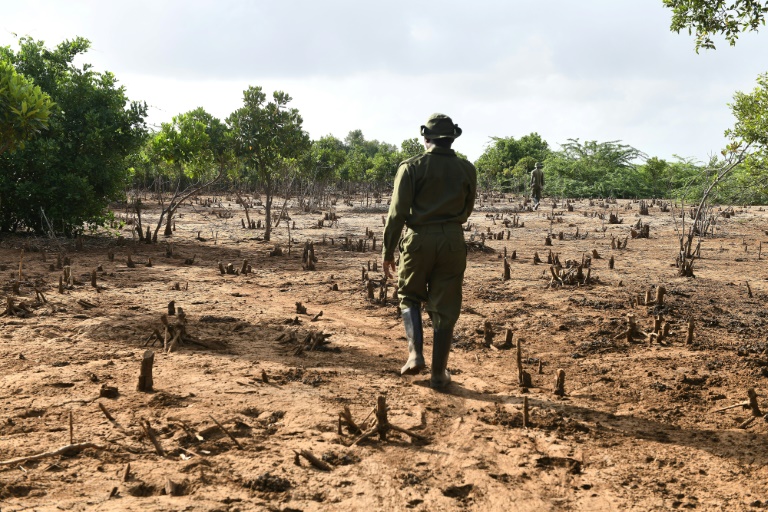
Along a riverbank scarred by logging, Joseph Mwandenge Mangi points out a solitary mangrove tree, a species once abundant in the forest where the mighty Sabaki River meets the sea.

“This is the last one. There are no more left,” said the 42-year-old Kenyan, who grew up on the estuary and possesses a seemingly encyclopedic knowledge of its flora and fauna.

The surviving tree is a sombre reminder for local communities working to restore this critical ecosystem to health, and make amends for the plunder of the past.

For generations villagers living near the Sabaki estuary had relied on its natural bounty for lumber and firewood, fresh water, seafood, farming land, and plants for traditional medicine.

Sustainably nurtured, the coastal wetland is also a resilient ally in the face of a changing climate — storing carbon, filtering water pollution, and protecting against extreme weather and rising sea levels.

But years of unchecked exploitation inflicted terrible damage on the mangroves, mudflats, freshwater pools and sandy dunes at the mouth of Kenya’s second-longest river.

Mangrove wood — harvested sustainably for centuries to build traditional Swahili homes — was chopped down to feed construction in fast-growing coastal towns like nearby Malindi, a popular tourism hub.

Locals overfished the river, using mosquito nets that trapped even the smallest of sea life. 

Fertile soils were uprooted and washed downstream into the Indian Ocean, further reducing fish in the Sabaki and killing coral reefs offshore.

“The landscape has changed. Back in the day, we used to have a huge forest with elephants and monkeys,” said Francis Nyale, a 68-year-old village elder, standing among a clearing of gnarled mangrove stumps.

– Climate ally –

But one tree at a time, local villagers are bringing the estuary back to life.

Further down the Sabaki, where its brown waters meet the blue ocean, and swarms of migratory birds flock overhead, a team of volunteers plant mangrove saplings along the riverbank. 

They’ve planted tens of thousands in recent years, reclaiming cleared land and aiding significant forest regrowth, said Francis Kagema, coast regional coordinator from conservation group Nature Kenya.

There are early signs that their efforts are paying off.

Crouched in a grove of older trees, Kagema spotted clusters of tiny green shoots bursting out of the dark soil — evidence of natural regeneration, an ecosystem on the mend.

“The world is changing, a lot. But for the mangroves, their ability to bounce back… and colonise the areas they used to be in the past, is quite encouraging,” he said.

These remarkable trees also deliver for the planet many times over — mangroves can absorb five times more carbon than forests on land, and act as a barrier against storm surges and coastal erosion.

Protecting mangroves is 1,000 times cheaper per kilometre than building seawalls against ocean rises, according to the UN Environment Programme (UNEP), which sponsors the Sabaki restoration project.

“Healthy wetlands –- critical for climate mitigation, adaptation, biodiversity, and human health and prosperity –- punch above their weight in terms of benefits,” said Leticia Carvalho, UNEP’s principal coordinator for marine and freshwater.

– ‘Our trees, our heritage’ – 

For local communities, there are economic benefits in rehabilitating nature.

UNEP estimates that a single hectare of mangrove forest can deliver anywhere between $33,000 and $57,000 per year economically.

In Sabaki, local guides are supplementing their income by leading visitors and school groups to see the hippos and birdlife that call the estuary home.

Work is under way to improve tourist facilities, expand traditional beekeeping in the forest, and open a nursery for plant saplings.

Convincing the Sabaki’s four villages that there is value in conservation requires careful diplomacy and a local touch, said Mangi, who leads a community group restoring the estuary.

They are working with fishermen to abandon unsustainable practices, and volunteer rangers who catch loggers in the estuary handle offences in-house to keep everyone on side.

“We don’t take them to the police. We talk to them. We want them to understand that please, there is something good in these trees (rather) than cutting,” said Mangi.

Jared Bosire, from the Nairobi Convention, a regional environmental partnership for the Western Indian Ocean, said the Sabaki community was demonstrating how local approaches to conservation could prove mutually advantageous.

“The hope is there will be lessons learned that could be replicated in other areas,” said Bosire, the Convention’s project manager.

More than 80 percent of mangroves have already been lost along western parts of the Indian Ocean. 

For Mangi, there would be no community without them: “If we don’t have these trees, we lose our heritage.”

Colombian flooding kills 12, two missing: authorities

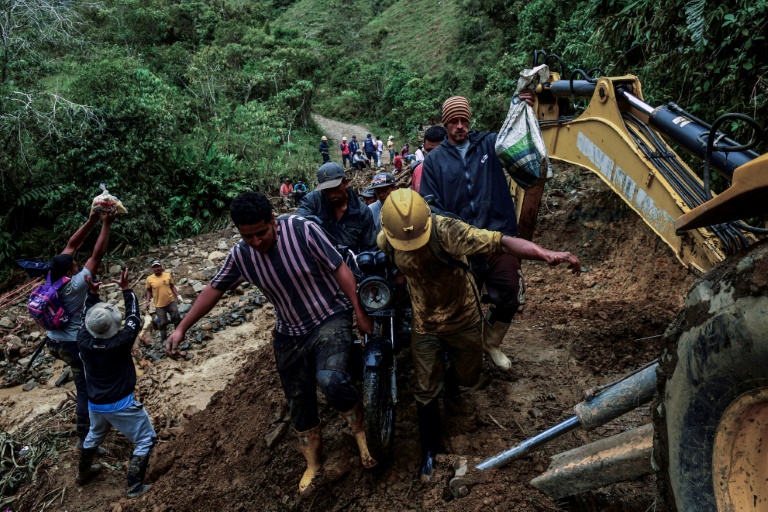
Torrential rains and flooding have killed at least 12 people at a mining camp in mountainous northwest Colombia, with another two reported missing and more damage expected, authorities said Thursday.

The flooding at Abriaqui in the Antioquia department surprised a group of miners as they were eating dinner on Wednesday evening, Mayor Hector Urrego told local television.

“The guys were at dinner, some were preparing to rest, others were leaving work when the flood arrived” at the El Porvenir gold mine, he said.

“We have twelve lifeless bodies (…) and there are still two missing,” he added. 

The flooding destroyed one level of the mining camp as well as part of a plant, according to the Antioquia government.

The effort to recover the missing was delayed until Friday morning due to inclement weather, rescue officials said.

Urrego added that 20 families were evacuated from a nearby town due to the risk of further flooding, with various rivers around Abriaqui threatening to burst their banks.

Several rural roads were made impassable by landslides.

“A team of professionals are heading to the area to support response efforts,” said the provincial disaster management agency DAGRAN.

President Ivan Duque expressed “solidarity with the families of the victims” on Twitter.

“Relief agencies are working… in search operations for the disappeared,” the president said.

So far this rainy season, 17 people have died in floods in Antioquia, according to local authorities.

Hours before the Abriaqui flood, a woman was killed in a landslide triggered by heavy rains in the neighboring town of Barbosa.

In February, at least 14 people died and 34 were injured in a mudslide triggered by heavy rains in the central-west Risaralda province.

Tesla inaugurates huge Texas plant with 'Cyber Rodeo'

Tesla welcomed throngs of electric car lovers to Texas Thursday for a huge party dubbed a “cyber rodeo” to inaugurate a manufacturing plant the size of 100 soccer fields.

Photos and videos flooded Twitter as guests explored the cavernous factory plant decked out in a distinctive nightclub look.

Visitors mingled under red and blue lights while production machinery and Tesla models were displayed like museum artwork. Outside, cars were parked in the pattern of the Texas flag.

Bulldozers were still at work near the so-called “gigafactory,” which signs indicated was constructed with more steel than New York City’s famed Empire State Building.

“It’s the equivalent to three Pentagons,” Tesla’s colorful but controversial founder and chief executive Elon Musk proudly told a cheering crowd inside the factory.

“This is the most advanced car factory the Earth has ever seen; raw materials in one side, cars out the other side.”

Musk drove on stage in the first production model Tesla ever built and stepped out dressed in black complete with a cowboy hat and sunglasses.

He said ramping up production of existing models was going to be Tesla’s priority this year.

“We are going to move to just truly massive scale,” Musk said.

“That has to happen in order to transition the world to sustainable energy.”

– Farewell Silicon Valley –

The move to a US state known for conservative Republican politics is seen by some as Musk stepping away from the liberal Silicon Valley culture in which he made his fortune.

The South African-born serial entrepreneur is now ranked the world’s richest man. He founded Tesla in Silicon Valley in 2003, but shifted its headquarters to Texas late last year.

Musk has clashed with California regulators, particularly when health precautions mandated at the height of the pandemic closed Tesla’s Fremont plant.

California is also investigating whether discrimination took place at Tesla’s plant there.

Musk told the crowd that Tesla was continuing to expand in California, but was running out of room there.

“We needed a place where we could be really big, and there is no place like Texas,” Musk said.

It remains to be seen how Musk will navigate conservative policies in Texas, such as the state’s restrictive new abortion law and limits on seeking health services for transgender children.

Part of the Texas allure is a lack of corporate or personal income taxes. Tesla received more than $60 million in tax breaks to build the factory.

While Musk has spoken of a desire for a shift away from climate-wrecking fossil fuels, Texas is known for oil rigs and gas-guzzling cars and trucks.

“I think he is having a bit of an identity crisis and forgotten who his customer is, and it is going to come back to bite him,” tech analyst Rob Enderle said of Musk.

“He is drifting to the right; what he doesn’t seem to remember is that most of the people who buy electric cars are the liberals.”

– Cybertruck –

Giga Texas, as the plant is also called, has been in operation since late last year. It is the fifth and largest gigafactory cranking out battery packs and vehicles for Tesla.

Since starting with a car plant in Silicon Valley, Tesla has gone global with mega-factories in Berlin and Shanghai as well as in US states New York and Nevada.

The Austin plant will produce Model 3 and Y cars and eventually a Cybertruck pickup and a semi for hauling cargo trailers set to go into production next year, according to Edmunds analyst Jessica Caldwell.

Pickup trucks are a hot item in the United States, and having a winning electric model is seen as key in the market.

Electric truck maker Rivian has already started deliveries.

“Rivian right now is the must-have truck,” analyst Enderle said.

“The fact that Rivian was able to get a truck out faster than Tesla points to a problem with Tesla.”

Tesla demand is outstripping supply to the point that some Model Y and 3 cars are being delivered months late in parts of the world, according to Wedbush analyst Dan Ives.

“The solution is mainly in Austin and Berlin,” Ives said.

Tesla “has a shot” at beginning production of its Optimus humanoid robot in Austin next year, according to Musk.

The robot will do anything people don’t want to do, he contended.

“We are also going to make sure it’s safe, no ‘Terminator’ stuff,” he quipped, referring to the hit action film about a killer cyborg.

US bans exports to three Russian airlines for sanctions violations

The US government has banned exports to Russian state airline Aeroflot as well as two other carriers for flying aircraft in violation of sanctions, the Commerce Department said Thursday.

Washington warned last month that the carriers had gone against penalties imposed on Moscow over its invasion of Ukraine by flying Boeing aircraft, as had billionaire Chelsea football club owner Roman Abramovich for his use of a Gulfstream jet.

The Commerce Department cited the warning in announcing that Aeroflot as well as Azur Air and Utair were banned from receiving American goods for the next 180 days.

“We are cutting off not only their ability to access items from the United States but also re-exports of US-origin items from abroad,” Commerce Secretary Gina Raimondo said in a statement.

“Any companies that flout our export controls, specifically those who do so to the benefit of Vladimir Putin and the detriment of the Ukrainian people, will feel the full force of the department’s enforcement.”

Commerce announced no action against Abramovich, who has been participating on the Russian side in peace talks with Ukraine held in Turkey.

The statement said the sanctioned airlines had operated flights within Russia as well as to countries including China, Vietnam, Turkey, India and the United Arab Emirates without seeking US permission as the sanctions require.

Separately the US Treasury Department announced sanctions against one of the world’s largest diamond mining companies, the Russian state-owned Alrosa.

The State Department also blacklisted state-owned United Shipbuilding Corporation (USC) as well as its subsidiaries and board members.

Asian markets struggle to track Wall St on hawkish Fed

Asian markets limped into the weekend Friday at the end of a tough week dominated by the Federal Reserve’s hawkish tone that has set up an aggressive tightening of monetary policy, while oil drifted after another series of losses.

The region struggled to take a lead from Wall Street, which recovered from steep intraday losses to end on a positive note, having plunged in previous sessions as traders fretted over the prospect of higher interest rates.

While the Fed has made clear it intends to act more decisively to rein in 40-year-high inflation by ramping up borrowing costs and offloading bond holdings, analysts suggested the better clarity on policy was welcome.

The Fed’s desire to tighten up has sent the dollar rallying against most other major currencies and particularly the euro, which has been weighed by European officials’ reticence to move as aggressively on prices. The single currency is sitting around a one-month low.

Markets have come under huge pressure this year as the end of ultra-cheap central bank cash, a Covid-fuelled slowdown in China’s economic activity, the war in Ukraine and soaring inflation come together in a perfect storm.

Still, all three indexes on Wall Street ended slightly higher, having bounced back from heavy losses earlier in the day thanks to bargain-buying, while some observers suggested recent selling may have gone too far.

But Asia was unable to take up the reins.

Tokyo, Hong Kong, Shanghai, Seoul, Singapore, Bangkok and Wellington were in the red, though Sydney, Taipei, Manila and Jakarta edged up.

Crude prices were barely moved in early Asian business at the end of another tough week after the United States and allies pledged to release more than 200 million barrels over the coming months to offset the loss of Russian supplies.

The decision comes on top of concerns about demand from China owing to lockdowns and other strict containment measures across the country including the biggest city Shanghai.

Still, there is a feeling that the war in Ukraine, and any possible further sanctions on Russia, could send the oil market higher again.

“I still think… the sentiment-driven sell-off will give way, and fundamentals will reassert themselves, especially as more market participants start fretting about how will the US administration replenish the SPR drawdown,” said SPI Asset Management’s Stephen Innes.

“Oil prices remain volatile amid concerns over Russian supply against the backdrop of slowing demand in China and a likely depressed US summer driving season due to higher prices at the pump.”

He added that “deficits are likely to persist but only moderated by the accelerated strategic stock release from May to November and weaker demand growth”.

– Key figures around 0230 GMT –

Tokyo – Nikkei 225: DOWN 0.3 percent at 26,820.37 (break)

Hong Kong – Hang Seng Index: DOWN 0.8 percent at 21,642.40

Shanghai – Composite: DOWN 0.7 percent at 3,215.43

Brent North Sea crude: FLAT at $100.56 per barrel

West Texas Intermediate: UP 0.1 percent at $96.15 per barrel

Euro/dollar: DOWN at $1.0863 from $1.0880 late Thursday

Pound/dollar: DOWN at $1.3069 from $1.3071

Euro/pound: DOWN at 83.12 pence from 83.17 pence

Dollar/yen: DOWN at 123.85 yen from 123.95 yen

New York – Dow: UP 0.3 percent at 34,583.57 (close)

London – FTSE 100: DOWN 0.5 percent at 7,551.81 (close)

The struggle to save Cuban sugar from bitter end

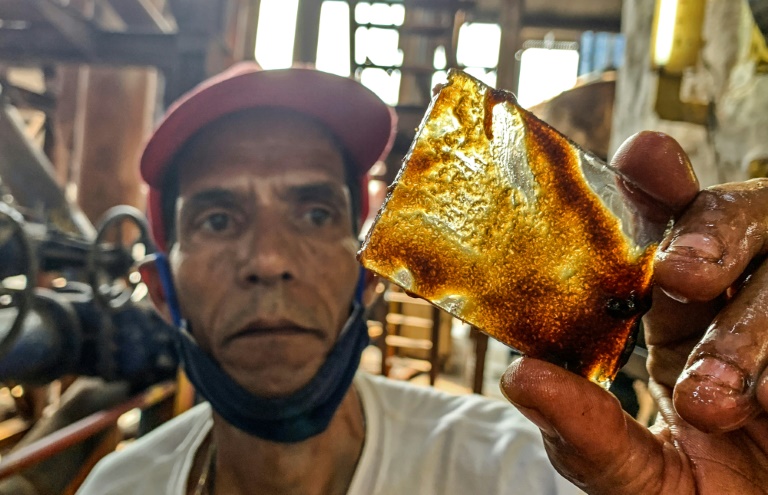
A whistle reverberates through a sugar factory in central Cuba to signal the resumption of milling at midday after an hours-long halt when the raw cane ran out.

It is cane harvest time in Cuba — once the world’s top sugar exporter but now reliant on imports. 

A critical shortage of harvesters and trucks to deliver the cane to factories has hamstrung production even as the government scrambles to revive the once-vibrant industry.

Cuba’s 2020-21 harvest yielded 800,000 tons of the sweet stuff, according to official figures.

This was just 10 percent of peak production some three decades ago and the worst outcome in 130 years for an industry that was once Cuba’s economic motor and a huge source of national pride.

“This is a war without end,” Lazaro Manuel Torres, boss of the Antonio Sanchez mill in Cuba’s central Cienfuegos province, told AFP.

“From the moment you wake up, you run into a mountain” of problems, said Torres, watching with obvious relief as a column of white smoke billowed from the chimney after the restart. 

– Just 56 mills left –

Until 1989, Cuba was the world’s biggest sugar exporter.

The United States was its major client until 1960 — two years before Washington imposed crippling sanctions on the communist island nation.

The Soviet Union, a political ally, then became an important buyer and was given preferential rates. 

Sugar was at the heart of Cuba’s plans for a prosperous future, with Fidel Castro leading a drive in the 1970s — complete with propaganda photos of him wielding a machete in the sugar plantations — to push the country’s output to 10 million tons per year. 

The goal was never achieved. 

The fall of the communist bloc in 1991 marked the beginning of the end for Cuba’s sugar industry — exacerbated by sanctions, a steep drop in prices and a lack of investment that saw 100 mills disappear.

Just 56 are left today.

Cuba now needs to import sugar to meet local demand and its export commitments.

“We have been in decline since 2017,” Noel Casanas, vice director of state-owned sugar producer AZCUBA, told AFP.

“If the situation continues, it is true that (the industry) will disappear.”

Sugar is still an important income generator for 50 of Cuba’s 169 municipalities, or some 1.2 million of the country’s 11.2 million inhabitants, he said.

– ‘Practically a corpse’ –

In December, the government approved dozens of measures in a bid to resuscitate sugar.

It doubled the price paid to cane producers, authorized the free hiring and firing of labor, and gave factories more decision-making autonomy in a country where just about everything is state-run.

“I don’t think these measures can revive an industry that is already practically a corpse,” said economist Emilio Morales of the Miami-based Havana Consulting Group.  

Casanas conceded production faces “limitations of all kinds” — critically a lack of foreign investment due to the strengthening of US sanctions since the presidency of Donald Trump.

Since the cane harvest opened in December, Antonio Sanchez has not managed to exceed 65 percent of milling capacity, set at 20,000 tons for this year’s harvest.

The problem has not been a lack of fuel or raw product, this time, but a shortage of harvesters and delivery trucks.

There are not enough spare parts, even tires, for vehicles in Cuba and producers such as Torres cannot afford to buy the limited components that are available.

“If you don’t have harvesters, if you do not have trucks, you cannot mill,” he lamented. 

Sugar producers in Cuba are also hard hit by a lack of fertilizers and pesticides.

For now, the government’s measures have managed to slow an exodus of sugar workers, industry bosses told AFP.

“We cannot complain, we are doing quite well — up to 700 pesos (about $29) a day,” said farmer Livan Hernandez. 

The average monthly Cuban salary is about $162.

Casanas said what is needed is foreign investment and expanding the industry into highly lucrative sugar derivatives such as bioethanol.

Sugar “is no longer the locomotive (of the Cuban economy) nor will it be,” he said.

But “it continues to be a strategic sector… that must be developed.”

Toshiba pauses spin-off plan, weighs going private

Troubled Japanese conglomerate Toshiba has said it is suspending its plan to split into two after last month’s shareholder vote against the idea and will now weigh the possibility of going private.

The firm announced in a statement Thursday that its management team will lead discussions with private equity funds and other possible investors on potential offers.

A newly formed special committee will also “identify the privatisation offer that is best for our diverse stakeholders” and report back before Toshiba’s annual shareholders’ meeting in June.

The management team will separately develop a new business plan, which will also be announced before the meeting, Toshiba said.

The decision comes after shareholders, in a non-binding decision, voted against a proposal to split the company into two.

It was the latest setback for the engineering giant, which was once a symbol of Japan’s tech and business prowess but has faced a series of scandals, financial troubles and shock high-level resignations in recent years.

The plan had already been revised once after an initial proposal to break up the company into three met stiff resistance.

Several major shareholders argued that a spin-off would only add to Toshiba’s woes by creating more managerial posts at smaller units, rather than improving the firm’s governance.

And some want a buyout instead, following an abandoned takeover offer last year from private equity fund CVC Capital Partners.

Bain Capital has said it is examining a bid for Toshiba, and the private equity firm has already received backing from one key shareholder.

It could face hurdles though given the national security implications of some of Toshiba’s businesses.

Amazon to fight union's win in NY labor election

Amazon told a federal agency it will file “substantial” objections to last week’s worker election in New York that established the company’s first union in the United States, according to a filing released Thursday.

In a letter to the National Labor Relations Board (NLRB), the retail giant requested more time to compile and present evidence about alleged problematic election conduct on the part of the union and the board’s officials. 

“This election involves more than 8,300 eligible voters, and voting spanned over 50 polling hours,” Amazon attorneys with the firm Hunton Andrews Kurth said in a motion to the NLRB. 

“It is simply infeasible for Amazon to sufficiently investigate the myriad of objectionable conduct within five business days.”

The NLRB granted Amazon until April 22 to present proof, but the company still must file its objections by Friday night, an official said.

On April 1, more than 55 percent of the votes at the Staten Island, New York JFK8 warehouse sided with Amazon Labor Union (ALU), handing the bootstrap labor organization a surprise victory that has cheered the American labor movement and drew kudos from President Joe Biden.

The filing accuses union backers of intimidating workers, and said the NLRB administration of the vote led to “inordinately” long wait times that depressed turnout.

But the document did not provide evidence of these allegations, saying the company needed more time “to further compile, review and outline evidence” to support the claims.

Eric Milner, an attorney representing ALU, dismissed as “absurd” Amazon’s complaints.

“The employees have spoken and their voices have been heard,” Milner told AFP. 

“Amazon is choosing to ignore that, and instead engage in stalling tactics to avoid the inevitable; coming to the bargaining table and negotiating for a contract on behalf of the fulfillment center associates at JFK8.”

Meanwhile, organizers of an effort to form a union at an Amazon warehouse in the Alabama city of Bessemer on Thursday accused the company of interfering with a vote there that was still up in the air.

The vote is a redo of a 2021 ballot thrown out by federal officials in which 993 workers cast ballots against the labor group, compared with 875 employees in favor.

But there were 416 “challenged” ballots, according to the NLRB, meaning the number of votes still to be settled is big enough to potentially decide the final result.

The Retail, Wholesale and Department Store Union backing the Bessemer campaign asked the labor board for a hearing to decide whether Amazon “created an atmosphere of confusion, coercion and/or fear of reprisals and thus interfered with the employees’ freedom of choice.”

If that is found to be true, the results of the Bessemer vote should be put aside, union officials argued.

Canada budget amps military spending in response to Ukraine war

Canada’s finance minister, in response to Russia’s invasion of Ukraine, shelled out more money for the military in a budget Thursday that also aims to tackle soaring costs of living and a housing crisis.

But the additional Can$8 billion (US$6.4 billion) earmarked for defense over five years falls far short of a NATO target of spending two percent of GDP.

In a speech to parliament, Finance Minister Chrystia Freeland said: “Putin’s invasion of Ukraine has reminded us that our own peaceful democracy — like all the democracies of the world — depends ultimately on the defence of hard power.”

“We know that freedom does not come for free, and that peace is guaranteed only by our readiness to fight for it,” she said. “That is why this budget makes an immediate, additional investment in our armed forces.”

According to NATO, Canada currently spends 1.36 percent of GDP on the military, which is down slightly from just a few years ago.

To meet the two percent NATO target, Ottawa would have to set aside tens of billions of dollars more each year, according to parliament’s independent fiscal watchdog and other experts.

Freeland suggested Ottawa could still close that NATO gap soon, proposing “a swift defence policy review to equip Canada for a world that has become more dangerous.”

Canada, with one of the largest Ukrainian diasporas in the world, also announced an additional Can$1 billion in loans through the International Monetary Fund and Can$500 million in military aid for Ukraine this year.

The budget is the first since Prime Minster Justin Trudeau’s Liberals won a third term in elections last September. 

With support from a small leftist faction the minority government is expected to pass it in a soon-to-be held vote in the House of Commons.

– Slashing spending –

The budget will see spending slashed by Can$131 billion after the government doled out significant pandemic aid over the past two years that pushed the debt to a record Can$1.16 trillion this year.

At the same time, Freeland said she recognizes that Canadians are struggling with higher costs for almost everything and so the government is rolling out targeted measures to mitigate the impacts of inflation.

Notably, Ottawa aims to double the number of new homes built over the next decade to ease a supply crunch and soaring prices, as well as ban foreign investment in an overheated housing market. 

It also earmarked billions of dollars for a new dental care program, coming on the heels of a new national childcare program.

And Ottawa is setting up a fund to attract private foreign investment in Canada’s transition away from fossil fuels, raising taxes on banks and insurance companies, and supporting domestic exploration for critical minerals used to make electric vehicle batteries and semi-conductors.

After what Freeland described as having “teetered on the brink” in 2020 when the pandemic hit, the Canadian economy has rebounded strongly.

It has recovered 112 percent of the jobs lost in those early months, and the unemployment rate — at 5.5 percent — is now just shy of a pre-pandemic low, while economic growth is “1.2 percent above where it was before the pandemic,” she noted.

Private sector economists surveyed by Ottawa forecast slightly slower growth of 3.9 percent in 2022 and 3.1 percent next year. 

“After wave after wave and lockdown after lockdown, our economy has not just recovered, it is booming,” Freeland said.

But getting through the last two years came at a “significant cost” and now the government must reduce spending as it reaches for an eventual balanced budget, she said.

“We are absolutely determined that our debt-to-GDP ratio must continue to decline,” the minister said. 

“Our pandemic deficits are and must continue to be reduced. The extraordinary debts we incurred to keep Canadians safe and solvent must be paid down.”

The budget deficit is expected to fall from Can$113.8 billion in 2021-2022 to Can$52.8 billion in 2022-2023. 

The debt-to-GDP ratio, meanwhile, is forecast to fall from 46.5 percent in 2021-2022 to 45.1 percent in 2022-2023.

Close Bitnami banner
Bitnami