AFP

Asian markets track Wall St gains, traders wary of hawkish Fed

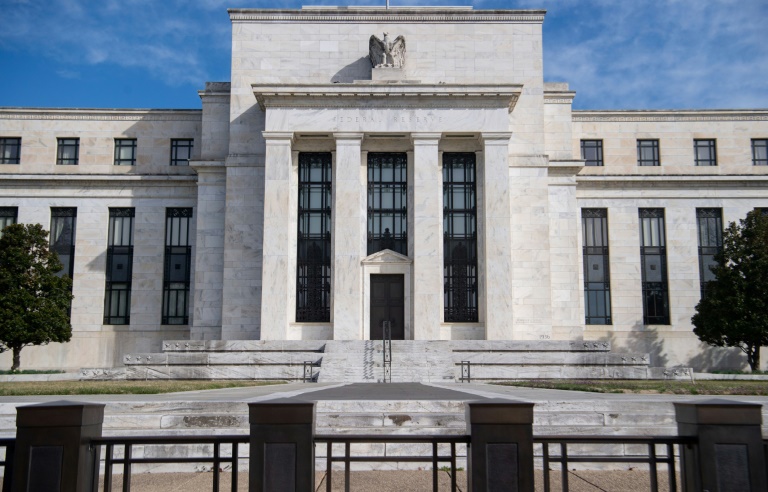
Asian markets mostly rose Friday after a tough week dominated by the US Federal Reserve’s hawkish tone that has set it on an aggressive tightening path, while oil ticked higher after another series of losses.

After a slow start, the region managed to take the lead from Wall Street, which recovered from steep intra-day losses to end on a positive note, having plunged in previous sessions as traders fretted over the prospect of higher interest rates.

While the Fed has made clear it intends to act more decisively to rein in 40-year-high inflation by ramping up borrowing costs and offloading bond holdings, analysts suggested that better clarity on policy was welcome.

The Fed’s desire to tighten has sent the dollar rallying against most other major currencies, particularly the euro, which has been weighed by European officials’ reticence to move as aggressively on prices. The euro is sitting around a one-month low.

Markets have come under huge pressure this year as the end of ultra-cheap central bank cash, a Covid-fuelled slowdown in China’s economic activity, the war in Ukraine and soaring inflation come together in a perfect storm.

Highlighting the difficult task central banks will have in fighting inflation, the UN’s Food and Agriculture Organization said Friday that world food prices hit their “highest levels ever” in March as Russia’s invasion of Ukraine disrupted wheat and coarse grain exports.

Still, all three indexes on Wall Street ended slightly higher, having bounced back from heavy losses thanks to bargain-buying, while some observers suggested recent selling may have gone too far.

Asia saw a tepid start but most markets enjoyed mild gains towards the end of the day.

Tokyo, Hong Kong, Shanghai, Sydney, Seoul, Taipei, Mumbai, Manila, Jakarta and Bangkok all rose, though Singapore and Wellington were lower.

London, Paris and Frankfurt rallied in the morning, while US futures were also well up.

– Crude concerns –

Still, OANDA’s Jeffrey Halley warned traders were “growing warier about China as the Shanghai lockdown drags on” owing to the fast-spreading Omicron virus variant.

“China’s Covid-zero policy continues to be its Achilles heel, although there are plenty of other reasons to be a little cautious,” he said in a note.

“A serious spread outside of its finance and commercial centre to other large cities will be a big headwind for China’s growth, China stocks, and by default eventually, much of Asia.”

Crude prices edged up having also endured a downcast week after the United States and allies pledged to release more than 200 million barrels over the coming months to offset the loss of Russian supplies.

The decision comes on top of concerns about demand from China owing to the lockdowns.

Still, there is a feeling that the war in Ukraine, and any possible further sanctions on Russia, could send the oil market higher again.

“I still think… the sentiment-driven sell-off will give way, and fundamentals will reassert themselves, especially as more market participants start fretting about how will the US administration replenish the SPR drawdown,” said SPI Asset Management’s Stephen Innes.

“Oil prices remain volatile amid concerns over Russian supply against the backdrop of slowing demand in China and a likely depressed US summer driving season due to higher prices at the pump.”

He added that “deficits are likely to persist but only moderated by the accelerated strategic stock release from May to November and weaker demand growth”.

– Key figures around 0810 GMT –

Tokyo – Nikkei 225: UP 0.4 percent at 26,985.80 (close)

Hong Kong – Hang Seng Index: UP 0.3 percent at 21,872.01 (close)

Shanghai – Composite: UP 0.5 percent at 3,251.85 (close)

London – FTSE 100: UP 1.0 percent at 7,625.18

Brent North Sea crude: UP 0.1 at $100.71 per barrel

West Texas Intermediate: UP 0.2 percent at $96.26 per barrel

Euro/dollar: DOWN at $1.0858 from $1.0880 late Thursday

Pound/dollar: DOWN at $1.3035 from $1.3071

Euro/pound: UP at 83.29 pence from 83.17 pence

Dollar/yen: UP at 124.11 yen from 123.95 yen

New York – Dow: UP 0.3 percent at 34,583.57 (close)
Asian markets struggle to track Wall St on hawkish Fed

Asian markets mostly rose Friday after a tough week dominated by the Federal Reserve’s hawkish tone that has set it on an aggressive tightening path, while oil bounced back after another series of losses.

After a slow start, the region managed to take the lead from Wall Street, which recovered from steep intra-day losses to end on a positive note, having plunged in previous sessions as traders fretted over the prospect of higher interest rates.

While the Fed has made clear it intends to act more decisively to rein in 40-year-high inflation by ramping up borrowing costs and offloading bond holdings, analysts suggested that better clarity on policy was welcome.

The Fed’s desire to tighten up has sent the dollar rallying against most other major currencies and particularly the euro, which has been weighed by European officials’ reticence to move as aggressively on prices. The single currency is sitting around a one-month low.

Markets have come under huge pressure this year as the end of ultra-cheap central bank cash, a Covid-fuelled slowdown in China’s economic activity, the war in Ukraine and soaring inflation come together in a perfect storm.

Still, all three indexes on Wall Street ended slightly higher, having bounced back from heavy losses earlier in the day thanks to bargain-buying, while some observers suggested recent selling may have gone too far.

Asia saw a tepid start but most markets enjoyed mild gains towards the end of the day.

Tokyo, Shanghai, Sydney, Seoul, Taipei, Mumbai, Manila, Jakarta and Bangkok all rose, though Hong Kong was weighed by losses in the tech sector while Singapore and Wellington were also lower.

London, Paris and Frankfurt rallied at the open, while US futures were also up.

Still, OANDA’s Jeffrey Halley warned traders were “growing warier about China as the Shanghai lockdown drags on” owing to the fast-spreading Omicron virus variant.

“China’s Covid-zero policy continues to be its Achilles heel, although there are plenty of other reasons to be a little cautious,” he said in a note.

“A serious spread outside of its finance and commercial centre to other large cities will be a big headwind for China’s growth, China stocks, and by default eventually, much of Asia.”

Crude prices climbed nearly one percent having also endured a downcast week after the United States and allies pledged to release more than 200 million barrels over the coming months to offset the loss of Russian supplies.

The decision comes on top of concerns about demand from China owing to the lockdowns.

Still, there is a feeling that the war in Ukraine, and any possible further sanctions on Russia, could send the oil market higher again.

“I still think… the sentiment-driven sell-off will give way, and fundamentals will reassert themselves, especially as more market participants start fretting about how will the US administration replenish the SPR drawdown,” said SPI Asset Management’s Stephen Innes.

“Oil prices remain volatile amid concerns over Russian supply against the backdrop of slowing demand in China and a likely depressed US summer driving season due to higher prices at the pump.”

He added that “deficits are likely to persist but only moderated by the accelerated strategic stock release from May to November and weaker demand growth”.

– Key figures around 0720 GMT –

Tokyo – Nikkei 225: UP 0.4 percent at 26,985.80 (close)

Hong Kong – Hang Seng Index: DOWN 0.1 percent at 21,797.11

Shanghai – Composite: UP 0.5 percent at 3,251.85 (close)

London – FTSE 100: UP 0.8 percent at 7,615.04

Brent North Sea crude: UP 0.9 at $101.48 per barrel

West Texas Intermediate: UP 0.9 percent at $96.89 per barrel

Euro/dollar: DOWN at $1.0859 from $1.0880 late Thursday

Pound/dollar: DOWN at $1.3044 from $1.3071

Euro/pound: UP at 83.24 pence from 83.17 pence

Dollar/yen: DOWN at 124.10 yen from 123.95 yen

New York – Dow: UP 0.3 percent at 34,583.57 (close)

Shanghai lockdown snarls world's busiest port and China supply chains

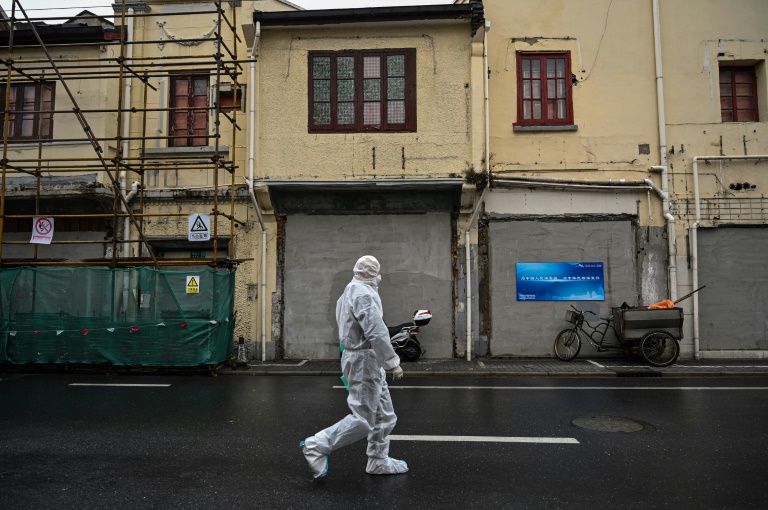
Shanghai’s grinding coronavirus lockdown is slowly clogging China’s supply chains, as delays hit the world’s busiest container port where staff are tangled in a morass of Covid controls.

Beijing has refused to tack away from its strict zero-Covid strategy that has protected its public health system through the pandemic but at a mounting economic cost.

China’s financial hub Shanghai — home to multinational firms and its busiest port — has been sealed off almost entirely for a week following an outbreak fuelled by the Omicron virus variant.

That has forced many companies to halt production and slow new projects, factories told AFP, while those still operating are struggling with a shortage of truck drivers on top of onerous permit and Covid testing requirements.

At Shanghai’s port, the lack of drivers and other workers means getting goods in and out is increasingly hard.

The docks are working normally with a “single-digit” number of vessels waiting to berth, Shanghai International Port Group said this week.

“But the fact is… due to restrictions caused for truck drivers, it is not really operating,” Bettina Schoen-Behanzin, vice president of the EU Chamber of Commerce’s Shanghai Chapter, told AFP.

“The figure I heard is that… week-on-week volumes at the Shanghai port are down by 40 percent. So that’s really enormous.”

Shortages are starting to bite across China’s vast consumer economy, where online shopping platforms such as Taobao face delivery delays, especially of imported goods.

Covid curbs in a number of cities have forced factories to find new suppliers.

But the impact may soon also be felt outside China if lockdowns persist.

Shanghai is the world’s number one container port, a spinal point in the global supply chain and a key gateway for foreign trade.

It handles around 17 percent of China’s total port volume and shipped 47 million TEU — the standard measurement for cargo, meaning Twenty-foot Equivalent Unit — in 2021.

– Factories can’t work from home  –

Chinese manufacturers say lockdowns, no matter how flexible or targeted, pile pressure on their business.

“Not many roles allow working from home,” said Jason Lee, founder of wheelchair producer Megalicht Tech, whose factory in Shanghai’s Puxi area has suspended production.

“People can’t enter the factory… and because our raw materials come from other provinces or cities, these can’t enter Shanghai either,” he said.

A Shanghai-based clothing exporter surnamed Zheng said his biggest problem was that he could not send samples to clients.

“Deliveries can neither leave nor enter,” he said

Experts say the outbreak is currently nibbling at growth, but could soon take a big bite.

Nomura economists estimate that 23 cities accounting for 22 percent of China’s GDP have rolled out full or partial lockdowns.

“The costs of the zero-Covid strategy will rise significantly as its benefits decline, especially as exports are hit by the ongoing lockdowns,” Nomura chief China economist Lu Ting told AFP.

That will challenge Beijing’s 2022 GDP growth target of around 5.5 percent, he added.

– Adapting to survive –

For now, companies are adapting to try and handle the restrictions.

“Our main business activity is down by over 50 percent,” said Gao Yongkang, general manager of Qifeng Technology in eastern China’s Quanzhou city.

The company has been unable to transport textile materials to regular clients because of the Covid curbs, and has instead pivoted to supplying the booming market for protective gear.

Meanwhile, those who cannot reach their original suppliers are scouring for new ones.

“The costs are a little higher and it’s slightly less efficient but we can fulfil our regular needs,” said Shen Shengyuan, deputy general manager of diaper-producer New Yifa Group.

In a nod to struggling industries, Premier Li Keqiang this week announced a temporary deferment of old-age insurance premiums for sectors such as catering, retail and civil aviation.

But industry groups say hard lockdowns on major cities such as Shanghai are unsustainable, especially with many Omicron cases presenting light or no symptoms.

“Does the zero-Covid strategy still work in the current environment,” said Eric Zheng, American Chamber of Commerce president in Shanghai. 

“That’s a big question, particularly when you try to balance the economic cost.”

Ukrainian scientists feel helpless at Antarctic base as war rages

For a dozen Ukrainian scientists thousands of kilometers from home at the Vernadsky Antarctic base, the biting cold hurts less than the feeling of helplessness over the war in their homeland.

They spend their days measuring, observing, analyzing and doing their jobs as best they can as a way of coping with the situation.

“At the beginning, we didn’t sleep for a few days. The whole time we were following news about our home cities,” meteorologist Anastasiia Chyhareva, 26, told AFP in messages sent from the base.

Once the invasion was in full swing, the scientists started waking at 2:00 am — 7:00 am in Ukraine — to check in on family and see how their night went.

“Now, we’re used to it… used to checking news in the morning and before going to bed, in every free minute.”

The Ukrainian base is situated on Galindez island, some 1,200 kilometers (745 miles) from Tierra del Fuego in the far south of Argentina.

It is occupied all year round by a dozen people who have to endure temperatures that drop to -20 degrees Celsius (-4 degrees Fahrenheit) in winter.

The scientists’ duties include observing meteorological, geophysical, geological and biological conditions, unless the weather forces them to shelter at the base.

“My first impression was like all these things happened in another universe, not our world,” said geophysicist Oleksandr Koslokov, whose family lived in war-torn Kharkiv, a heavily targeted city just 40 kilometers from the Russian border.

“I started advising my family on what to do. I had no time to reflect. I had to help my family to survive and to escape from my city… before it became a burning and unpredictable hell. 

“My wife heard and felt the explosions of cruise missiles 10 minutes after (Russian President Vladimir) Putin started this stupid and criminal war.”

Since then, his family has fled to Germany.

– ‘Our part of the war’ –

At the base, which is named after a Soviet mineralogist and geochemist with Russian and Ukrainian roots, the scientists try to live as normal a life as possible. Sunday is a day off and Saturday night everyone has dinner together before playing board games and musical instruments.

“It is hard to be so far away from my family and have no possibility to support them,” said biologist Artem Dzhulai, 34.

“At the station now, there is a wide range of feelings — from sadness due to anxiety for relatives and friends, to high spirits, due to pride in our army and the people who are bravely fighting for the right to live in a free country,” said marine biologist Oksana Savenko, who is studying humpback whales.

Giving practical advice, moral support, donating to the Ukrainian army, signing a petition, creating online lectures to divert Ukrainian children’s attention from the war: the scientists are trying every means available to help in some way.

“It is our part of the war” effort, said Chyhareva.

Ukrainians “try to help each other, they try to help our compatriots, they try to help our army,” said another scientist who requested to remain anonymous.

– ‘Don’t forget us’ –

Dzhulai still remains bitter over the West’s response the last time Russia invaded Ukraine, annexing Crimea in 2014.

“All democratic countries were indifferent to that act of violence,” he said.

“Probably, they hoped that they will not be affected by someone else’s grief… but everything can change if evil is not stopped and punished. 

“A lot of children in Ukraine died because of the indifference of Europe and the US.”

There is fear that the same could happen again.

“Please, don’t forget about us after one month, don’t be tired of Ukraine and our problems,” said Chyhareva.

This team will be replaced later this month, and with their homeland in flames, the departing scientists face an uncertain future.

“I don’t have any real plans,” said Chychareva, who just hopes to go “back to Ukraine as soon as it will be possible.”

“My university in Kharkiv where I studied was destroyed … my research institute and scientific equipment in Ukraine are destroyed,” said Koslokov.

He said he would likely try to continue doing science in Europe or America, adding “time will tell.”

First private mission readies for launch to ISS

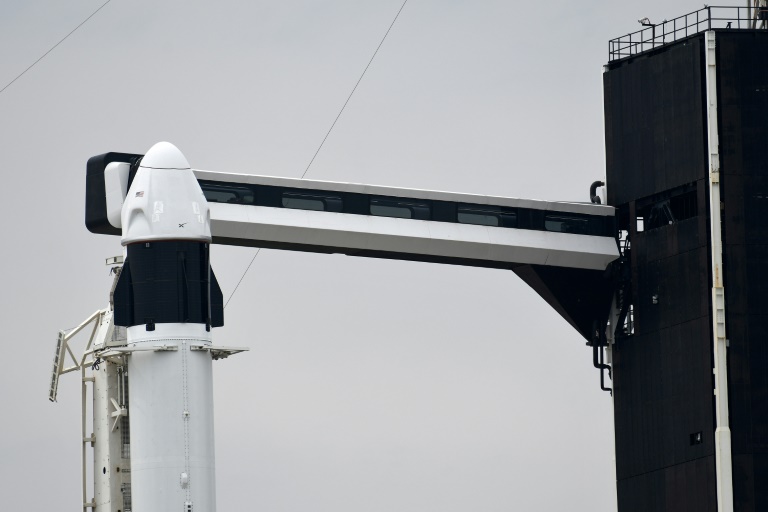
The first fully private mission to the International Space Station is set to blast off Friday with a four-member crew from startup company Axiom Space.

The partnership has been hailed by NASA, which sees it as a key step in its goal to commercialize the region of space known as “low Earth orbit,” leaving the agency to focus on more ambitious endeavors deeper into the cosmos.

Takeoff is set for 11:17 am (1517 GMT) from the Kennedy Space Center in Florida on a SpaceX rocket.

Commanding the Axiom-1 mission will be former NASA astronaut Michael Lopez-Alegria, a dual citizen of the United States and Spain.

He is joined by three paying crewmates: American real estate investor Larry Connor, Canadian businessman Mark Pathy, and Israeli former fighter pilot and entrepreneur Eytan Stibbe.

The widely reported price for tickets — which includes eight days on the outpost — is $55 million. 

But unlike the recent, attention-grabbing suborbital flights carried out by Blue Origin and Virgin Galactic, Axiom says its mission shouldn’t be considered tourism. 

On board the ISS, which orbits 250 miles (400 kilometers) above sea level, the quartet will carry out scientific research projects, including on aging in space, experiments with stem cells, and a technology demonstration of a self-assembling spacecraft.

“The distinction is that our guys aren’t going up there and floating around for eight days taking pictures and looking out of the cupola,” Derek Hassmann, operations director of Axiom Space, told reporters at a pre-launch briefing. 

“I mean we have a very intensive and research-oriented timeline plan for them.”

In addition, crewmember Stibbe plans to carry out a tribute to his friend Ilan Ramon, Israel’s first astronaut, who died in the 2003 Space Shuttle Columbia disaster when the spaceship disintegrated upon reentry.

Surviving pages from Ramon’s space diary, as well as mementos from his children, will be brought to the station by Stibbe.

The Axiom crew will live and work alongside the station’s regular crew: currently three Americans and a German on the US side, and three Russians on the Russian side.

The company has partnered for a total of four missions with SpaceX, and NASA has already approved in principle the second, Ax-2.

Axiom sees the voyages as the first steps of a grander goal: to build its own private space station. The first module is due to launch in September 2024, president and CEO Michael Suffredini said. 

The plan is for it to initially be attached to the ISS, before eventually flying autonomously when the latter retires and is deorbited sometime after 2030.

Kenyans heal devastated land with the power of mangroves

Along a riverbank scarred by logging, Joseph Mwandenge Mangi points out a solitary mangrove tree, a species once abundant in the forest where the mighty Sabaki River meets the sea.

“This is the last one. There are no more left,” said the 42-year-old Kenyan, who grew up on the estuary and possesses a seemingly encyclopedic knowledge of its flora and fauna.

The surviving tree is a sombre reminder for local communities working to restore this critical ecosystem to health, and make amends for the plunder of the past.

For generations villagers living near the Sabaki estuary had relied on its natural bounty for lumber and firewood, fresh water, seafood, farming land, and plants for traditional medicine.

Sustainably nurtured, the coastal wetland is also a resilient ally in the face of a changing climate — storing carbon, filtering water pollution, and protecting against extreme weather and rising sea levels.

But years of unchecked exploitation inflicted terrible damage on the mangroves, mudflats, freshwater pools and sandy dunes at the mouth of Kenya’s second-longest river.

Mangrove wood — harvested sustainably for centuries to build traditional Swahili homes — was chopped down to feed construction in fast-growing coastal towns like nearby Malindi, a popular tourism hub.

Locals overfished the river, using mosquito nets that trapped even the smallest of sea life. 

Fertile soils were uprooted and washed downstream into the Indian Ocean, further reducing fish in the Sabaki and killing coral reefs offshore.

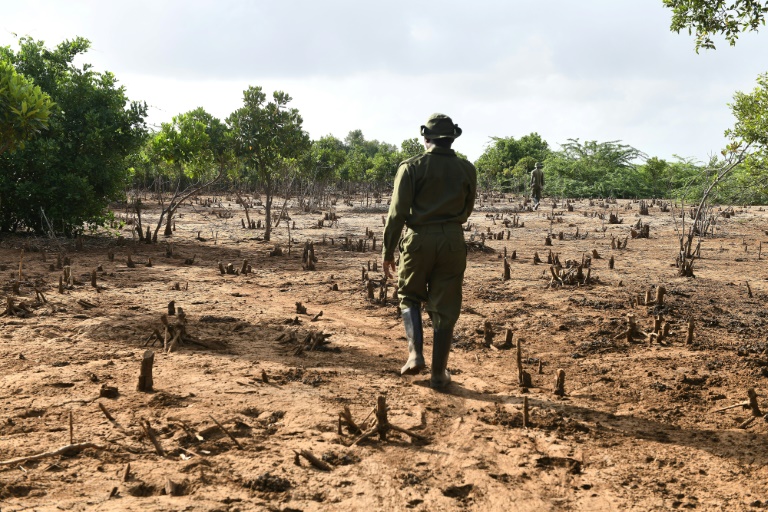
“The landscape has changed. Back in the day, we used to have a huge forest with elephants and monkeys,” said Francis Nyale, a 68-year-old village elder, standing among a clearing of gnarled mangrove stumps.

– Climate ally –

But one tree at a time, local villagers are bringing the estuary back to life.

Further down the Sabaki, where its brown waters meet the blue ocean, and swarms of migratory birds flock overhead, a team of volunteers plant mangrove saplings along the riverbank. 

They’ve planted tens of thousands in recent years, reclaiming cleared land and aiding significant forest regrowth, said Francis Kagema, coast regional coordinator from conservation group Nature Kenya.

There are early signs that their efforts are paying off.

Crouched in a grove of older trees, Kagema spotted clusters of tiny green shoots bursting out of the dark soil — evidence of natural regeneration, an ecosystem on the mend.

“The world is changing, a lot. But for the mangroves, their ability to bounce back… and colonise the areas they used to be in the past, is quite encouraging,” he said.

These remarkable trees also deliver for the planet many times over — mangroves can absorb five times more carbon than forests on land, and act as a barrier against storm surges and coastal erosion.

Protecting mangroves is 1,000 times cheaper per kilometre than building seawalls against ocean rises, according to the UN Environment Programme (UNEP), which sponsors the Sabaki restoration project.

“Healthy wetlands –- critical for climate mitigation, adaptation, biodiversity, and human health and prosperity –- punch above their weight in terms of benefits,” said Leticia Carvalho, UNEP’s principal coordinator for marine and freshwater.

– ‘Our trees, our heritage’ – 

For local communities, there are economic benefits in rehabilitating nature.

UNEP estimates that a single hectare of mangrove forest can deliver anywhere between $33,000 and $57,000 per year economically.

In Sabaki, local guides are supplementing their income by leading visitors and school groups to see the hippos and birdlife that call the estuary home.

Work is under way to improve tourist facilities, expand traditional beekeeping in the forest, and open a nursery for plant saplings.

Convincing the Sabaki’s four villages that there is value in conservation requires careful diplomacy and a local touch, said Mangi, who leads a community group restoring the estuary.

They are working with fishermen to abandon unsustainable practices, and volunteer rangers who catch loggers in the estuary handle offences in-house to keep everyone on side.

“We don’t take them to the police. We talk to them. We want them to understand that please, there is something good in these trees (rather) than cutting,” said Mangi.

Jared Bosire, from the Nairobi Convention, a regional environmental partnership for the Western Indian Ocean, said the Sabaki community was demonstrating how local approaches to conservation could prove mutually advantageous.

“The hope is there will be lessons learned that could be replicated in other areas,” said Bosire, the Convention’s project manager.

More than 80 percent of mangroves have already been lost along western parts of the Indian Ocean. 

For Mangi, there would be no community without them: “If we don’t have these trees, we lose our heritage.”

Colombian flooding kills 12, two missing: authorities

Torrential rains and flooding have killed at least 12 people at a mining camp in mountainous northwest Colombia, with another two reported missing and more damage expected, authorities said Thursday.

The flooding at Abriaqui in the Antioquia department surprised a group of miners as they were eating dinner on Wednesday evening, Mayor Hector Urrego told local television.

“The guys were at dinner, some were preparing to rest, others were leaving work when the flood arrived” at the El Porvenir gold mine, he said.

“We have twelve lifeless bodies (…) and there are still two missing,” he added. 

The flooding destroyed one level of the mining camp as well as part of a plant, according to the Antioquia government.

The effort to recover the missing was delayed until Friday morning due to inclement weather, rescue officials said.

Urrego added that 20 families were evacuated from a nearby town due to the risk of further flooding, with various rivers around Abriaqui threatening to burst their banks.

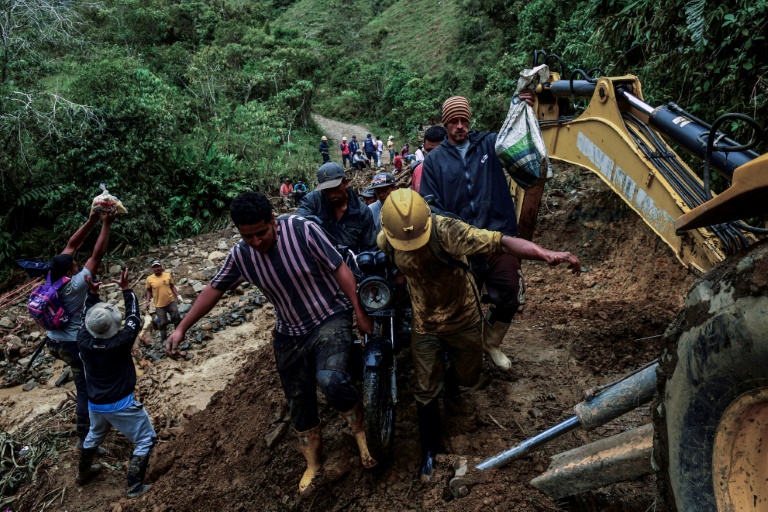
Several rural roads were made impassable by landslides.

“A team of professionals are heading to the area to support response efforts,” said the provincial disaster management agency DAGRAN.

President Ivan Duque expressed “solidarity with the families of the victims” on Twitter.

“Relief agencies are working… in search operations for the disappeared,” the president said.

So far this rainy season, 17 people have died in floods in Antioquia, according to local authorities.

Hours before the Abriaqui flood, a woman was killed in a landslide triggered by heavy rains in the neighboring town of Barbosa.

In February, at least 14 people died and 34 were injured in a mudslide triggered by heavy rains in the central-west Risaralda province.

Tesla inaugurates huge Texas plant with 'Cyber Rodeo'

Tesla welcomed throngs of electric car lovers to Texas Thursday for a huge party dubbed a “cyber rodeo” to inaugurate a manufacturing plant the size of 100 soccer fields.

Photos and videos flooded Twitter as guests explored the cavernous factory plant decked out in a distinctive nightclub look.

Visitors mingled under red and blue lights while production machinery and Tesla models were displayed like museum artwork. Outside, cars were parked in the pattern of the Texas flag.

Bulldozers were still at work near the so-called “gigafactory,” which signs indicated was constructed with more steel than New York City’s famed Empire State Building.

“It’s the equivalent to three Pentagons,” Tesla’s colorful but controversial founder and chief executive Elon Musk proudly told a cheering crowd inside the factory.

“This is the most advanced car factory the Earth has ever seen; raw materials in one side, cars out the other side.”

Musk drove on stage in the first production model Tesla ever built and stepped out dressed in black complete with a cowboy hat and sunglasses.

He said ramping up production of existing models was going to be Tesla’s priority this year.

“We are going to move to just truly massive scale,” Musk said.

“That has to happen in order to transition the world to sustainable energy.”

– Farewell Silicon Valley –

The move to a US state known for conservative Republican politics is seen by some as Musk stepping away from the liberal Silicon Valley culture in which he made his fortune.

The South African-born serial entrepreneur is now ranked the world’s richest man. He founded Tesla in Silicon Valley in 2003, but shifted its headquarters to Texas late last year.

Musk has clashed with California regulators, particularly when health precautions mandated at the height of the pandemic closed Tesla’s Fremont plant.

California is also investigating whether discrimination took place at Tesla’s plant there.

Musk told the crowd that Tesla was continuing to expand in California, but was running out of room there.

“We needed a place where we could be really big, and there is no place like Texas,” Musk said.

It remains to be seen how Musk will navigate conservative policies in Texas, such as the state’s restrictive new abortion law and limits on seeking health services for transgender children.

Part of the Texas allure is a lack of corporate or personal income taxes. Tesla received more than $60 million in tax breaks to build the factory.

While Musk has spoken of a desire for a shift away from climate-wrecking fossil fuels, Texas is known for oil rigs and gas-guzzling cars and trucks.

“I think he is having a bit of an identity crisis and forgotten who his customer is, and it is going to come back to bite him,” tech analyst Rob Enderle said of Musk.

“He is drifting to the right; what he doesn’t seem to remember is that most of the people who buy electric cars are the liberals.”

– Cybertruck –

Giga Texas, as the plant is also called, has been in operation since late last year. It is the fifth and largest gigafactory cranking out battery packs and vehicles for Tesla.

Since starting with a car plant in Silicon Valley, Tesla has gone global with mega-factories in Berlin and Shanghai as well as in US states New York and Nevada.

The Austin plant will produce Model 3 and Y cars and eventually a Cybertruck pickup and a semi for hauling cargo trailers set to go into production next year, according to Edmunds analyst Jessica Caldwell.

Pickup trucks are a hot item in the United States, and having a winning electric model is seen as key in the market.

Electric truck maker Rivian has already started deliveries.

“Rivian right now is the must-have truck,” analyst Enderle said.

“The fact that Rivian was able to get a truck out faster than Tesla points to a problem with Tesla.”

Tesla demand is outstripping supply to the point that some Model Y and 3 cars are being delivered months late in parts of the world, according to Wedbush analyst Dan Ives.

“The solution is mainly in Austin and Berlin,” Ives said.

Tesla “has a shot” at beginning production of its Optimus humanoid robot in Austin next year, according to Musk.

The robot will do anything people don’t want to do, he contended.

“We are also going to make sure it’s safe, no ‘Terminator’ stuff,” he quipped, referring to the hit action film about a killer cyborg.

US bans exports to three Russian airlines for sanctions violations

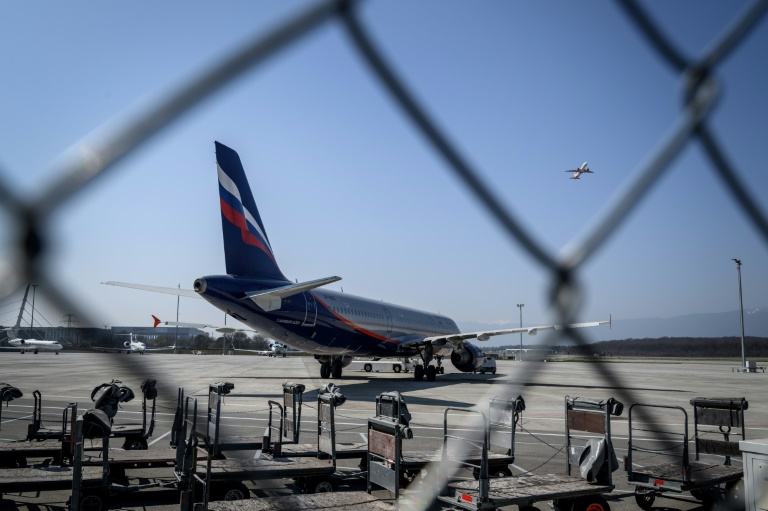
The US government has banned exports to Russian state airline Aeroflot as well as two other carriers for flying aircraft in violation of sanctions, the Commerce Department said Thursday.

Washington warned last month that the carriers had gone against penalties imposed on Moscow over its invasion of Ukraine by flying Boeing aircraft, as had billionaire Chelsea football club owner Roman Abramovich for his use of a Gulfstream jet.

The Commerce Department cited the warning in announcing that Aeroflot as well as Azur Air and Utair were banned from receiving American goods for the next 180 days.

“We are cutting off not only their ability to access items from the United States but also re-exports of US-origin items from abroad,” Commerce Secretary Gina Raimondo said in a statement.

“Any companies that flout our export controls, specifically those who do so to the benefit of Vladimir Putin and the detriment of the Ukrainian people, will feel the full force of the department’s enforcement.”

Commerce announced no action against Abramovich, who has been participating on the Russian side in peace talks with Ukraine held in Turkey.

The statement said the sanctioned airlines had operated flights within Russia as well as to countries including China, Vietnam, Turkey, India and the United Arab Emirates without seeking US permission as the sanctions require.

Separately the US Treasury Department announced sanctions against one of the world’s largest diamond mining companies, the Russian state-owned Alrosa.

The State Department also blacklisted state-owned United Shipbuilding Corporation (USC) as well as its subsidiaries and board members.

Asian markets struggle to track Wall St on hawkish Fed

Asian markets limped into the weekend Friday at the end of a tough week dominated by the Federal Reserve’s hawkish tone that has set up an aggressive tightening of monetary policy, while oil drifted after another series of losses.

The region struggled to take a lead from Wall Street, which recovered from steep intraday losses to end on a positive note, having plunged in previous sessions as traders fretted over the prospect of higher interest rates.

While the Fed has made clear it intends to act more decisively to rein in 40-year-high inflation by ramping up borrowing costs and offloading bond holdings, analysts suggested the better clarity on policy was welcome.

The Fed’s desire to tighten up has sent the dollar rallying against most other major currencies and particularly the euro, which has been weighed by European officials’ reticence to move as aggressively on prices. The single currency is sitting around a one-month low.

Markets have come under huge pressure this year as the end of ultra-cheap central bank cash, a Covid-fuelled slowdown in China’s economic activity, the war in Ukraine and soaring inflation come together in a perfect storm.

Still, all three indexes on Wall Street ended slightly higher, having bounced back from heavy losses earlier in the day thanks to bargain-buying, while some observers suggested recent selling may have gone too far.

But Asia was unable to take up the reins.

Tokyo, Hong Kong, Shanghai, Seoul, Singapore, Bangkok and Wellington were in the red, though Sydney, Taipei, Manila and Jakarta edged up.

Crude prices were barely moved in early Asian business at the end of another tough week after the United States and allies pledged to release more than 200 million barrels over the coming months to offset the loss of Russian supplies.

The decision comes on top of concerns about demand from China owing to lockdowns and other strict containment measures across the country including the biggest city Shanghai.

Still, there is a feeling that the war in Ukraine, and any possible further sanctions on Russia, could send the oil market higher again.

“I still think… the sentiment-driven sell-off will give way, and fundamentals will reassert themselves, especially as more market participants start fretting about how will the US administration replenish the SPR drawdown,” said SPI Asset Management’s Stephen Innes.

“Oil prices remain volatile amid concerns over Russian supply against the backdrop of slowing demand in China and a likely depressed US summer driving season due to higher prices at the pump.”

He added that “deficits are likely to persist but only moderated by the accelerated strategic stock release from May to November and weaker demand growth”.

– Key figures around 0230 GMT –

Tokyo – Nikkei 225: DOWN 0.3 percent at 26,820.37 (break)

Hong Kong – Hang Seng Index: DOWN 0.8 percent at 21,642.40

Shanghai – Composite: DOWN 0.7 percent at 3,215.43

Brent North Sea crude: FLAT at $100.56 per barrel

West Texas Intermediate: UP 0.1 percent at $96.15 per barrel

Euro/dollar: DOWN at $1.0863 from $1.0880 late Thursday

Pound/dollar: DOWN at $1.3069 from $1.3071

Euro/pound: DOWN at 83.12 pence from 83.17 pence

Dollar/yen: DOWN at 123.85 yen from 123.95 yen

New York – Dow: UP 0.3 percent at 34,583.57 (close)
London – FTSE 100: DOWN 0.5 percent at 7,551.81 (close)

Close Bitnami banner
Bitnami