AFP

Advocacy groups ask US to crack down on gun industry ads

Likening “unfair and deceptive” firearms advertising to that of tobacco products, gun safety advocates Thursday asked US regulators to crack down on the industry.

A coalition of three groups asked the Federal Trade Commission (FTC), which regulates advertising, to “investigate and regulate the gun industry’s unfair and deceptive advertising,” according to their 40-page petition.

“The FTC is failing consumers, failing our democracy, and failing the millions of Americans who have lost their lives or their loved ones to gun violence,” the petition said.

“No industry — regardless of its political clout -— should be immune from scrutiny of its marketing and advertising.”

The effort, brought by the Giffords Law Center, Brady United and the March for our Lives, revives a 1996 appeal by Brady to the same agency that the groups said resulted in no public action.

An FTC spokesman said the agency had no comment on the petition. 

The groups cite data showing a shift in gun industry marketing from an emphasis on hunting and sports shooting in the decades through the early 2000s to an overwhelming focus on self-defense themes over the last decade.

These messages have been compounded by the heavy presence of arms companies like Remington, Smith & Wesson and Beretta on social media. 

“If the gun industry’s primary message were true — if guns actually made Americans safer -— then, as gun ownership has increased, violence should have decreased, making America an extraordinarily safe nation,” said the petition.

“But the horrifying reality shows the opposite,” the document said, citing mass shootings and data showing a gradual rise in firearms deaths.

Despite federal and state minimum age requirements to purchase or posses firearms, “the gun industry places no age-verification restrictions on its online content or advertising, making it an outlier among industries selling inherently dangerous products” such as alcohol and tobacco, the petition said.

The FTC did not immediately respond to a request for comment.

US bans exports to three Russian airlines for sanctions violations

The US government has banned exports to Russia’s state airline Aeroflot as well as two other carriers for flying aircraft in violation of sanctions, the Commerce Department said Thursday.

Washington warned last month that the carriers had gone against penalties imposed on Moscow over its invasion of Ukraine by flying Boeing aircraft, as had billionaire Chelsea football club owner Roman Abramovich for his use of a Gulfstream jet.

The Commerce Department cited the warning in announcing that Aeroflot as well as Azur Air and Utair are banned from receiving American goods for the next 180 days.

“We are cutting off not only their ability to access items from the United States but also reexports of US-origin items from abroad,” Commerce Secretary Gina Raimondo said in a statement.

“Any companies that flout our export controls, specifically those who do so to the benefit of Vladimir Putin and the detriment of the Ukrainian people, will feel the full force of the department’s enforcement.”

Commerce announced no action against Abramovich, who has been participating on the Russian side in peace talks with Ukraine held in Turkey.

The statement said the sanctioned airlines had operated flights within Russia as well as to countries including China, Vietnam, Turkey, India and the United Arab Emirates without seeking US permission, as the sanctions require.

ECB members divided over inflation response: minutes

European Central Bank policymakers disagreed last month on how to respond to runaway inflation and economic uncertainty caused by the Ukraine war, minutes from their meeting showed on Thursday.

The revelation comes as markets are looking for signs that the ECB could soon announce the first interest rate hike in over a decade.

“A large number of members held the view that the current high level of inflation and its persistence called for immediate further steps towards monetary policy normalisation,” the minutes read.

The ECB’s governing council played it safe at the March meeting, agreeing to wind down monthly bond purchases at an accelerated pace in the second quarter, while keeping the end date of the stimulus scheme flexible.

An interest rate hike would follow “some time” after the end of the bond-buying scheme, it said.

But the minutes revealed that some governors wanted to go further to combat inflation, as the war in Ukraine further pushes up prices for energy, food and raw materials.

“Among those calling for action at the present meeting, some members preferred to set a firm end date for (bond) purchases during the summer,” the text read.

“This could clear the way for a possible rate rise in the third quarter of this year in the light of the deterioration in the inflation outlook.”

Other members meanwhile preferred a “wait-and-see approach” given the “exceptionally high uncertainty” created by Russia’s invasion of Ukraine and Western sanctions against Moscow.

The minutes show that the ECB “has become more hawkish”, said ING bank economist Carsten Brzeski, using a term describing those advocating for a tightening of monetary conditions.

– ‘Doubts’ –

The ECB has for years maintained an ultra-loose monetary policy, pushing interest rates to record lows and hoovering up billions of euros in bonds each months to keep credit flowing in the eurozone.

Like other central banks, it now faces the challenge of scaling back stimulus to stem inflation without hurting economic growth, a task made more complicated by the return of war to Europe.

ECB president Christine Lagarde warned last week that a prolonged Ukraine conflict would keep energy prices and the cost of living spiralling, blighting a post-Covid recovery.

Eurozone inflation jumped to a record high of 7.5 percent in March, well past the ECB’s two-percent target.

The ECB expects inflation to come down to 1.9 percent by 2024 once the energy shock wears off, although the minutes reflected “doubts” about the forecast.

The US Federal Reserve last month announced its first interest rate rise since 2018, with further hikes expected.

Stopped press: Algeria billionaire to shut Liberte newspaper

Algeria’s French-language newspaper Liberte will run its final edition next week, the newspaper announced Thursday, criticising the decision by its owner, the country’s richest man.

“After 30 years in existence, Liberte is being extinguished,” it said in an editorial.

The closure adds to an already difficult climate for journalism in Algeria, which is ranked one of the world’s worst countries for press freedom.

Liberte’s final press run will occur next Thursday, said the paper whose motto is: “The right to know and the duty to inform.”

“In just a few days, newspaper vendors, readers, advertisers and the institutions of the republic will be orphaned by a newspaper that had made its name as a reference for all viewpoints,” it wrote.

Algerian intellectuals and public figures had signed a petition urging its owner Issad Rebrab to change his mind, but to no avail.

An appeal by the newspaper’s journalists also fell on deaf ears. 

They had written Sunday that they did not understand why the newspaper was to be closed.

“The publishing company still has sufficient financial resources to allow it to continue to exist,” they wrote.

Forbes reported Thursday that Rebrab and his family “are the world’s second-richest Arabs, worth $5.1 billion.”

Rebrab is the founder of Cevital, which owns one of the world’s biggest sugar refineries.

Liberte’s closure is “a victory for silence over speech and for violence over debate”, Algerian novelist Kamel Daoud wrote Thursday in the newspaper. 

Algerian media went through something of a golden age after protests against the country’s one-party system in 1988, but several titles have closed since the turn of the millennium, mostly due to falling sales and advertising revenue.

Many cities in Algeria, Africa’s biggest country by surface area, lack access to hard copies of newspapers, meaning free news websites have largely taken their place.

Several journalists are in prison or facing trial, notably for defamation of political figures or because of social media posts.

The country ranks 146th out of 180 on the Reporters Without Borders (RSF) Press Freedom Index.

Greece to double coal output to reduce Russian gas use

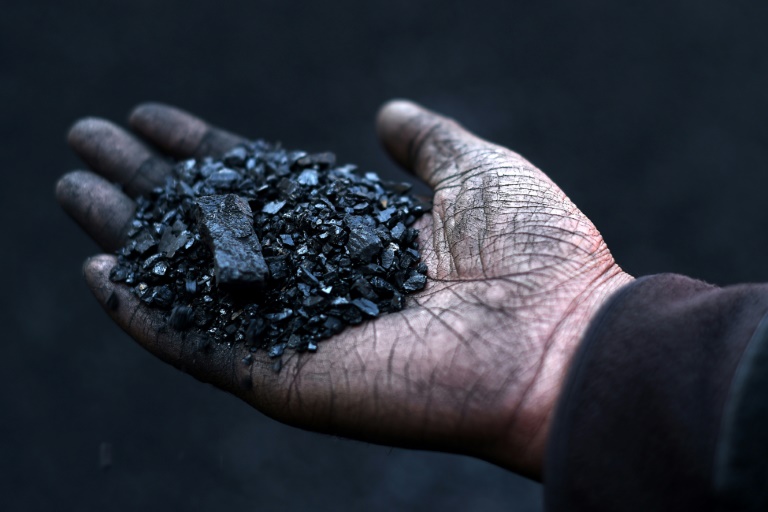
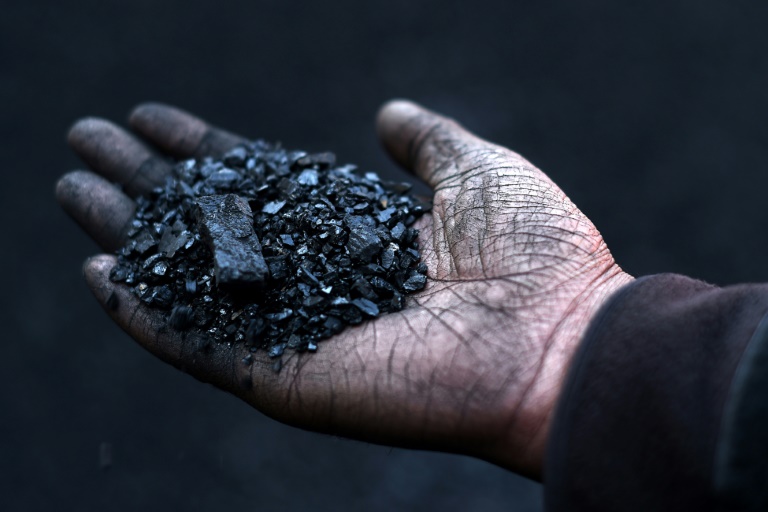
Greece’s government said Thursday it plans to double production of lignite, or brown coal, in the coming two years despite the pollution it causes as Athens aims to reduce its dependence upon Russian gas.

Greece depends upon Russia for 40 percent of its natural gas and since Moscow invaded Ukraine in February it has been searching for alternatives to ensure normal supplies.

“Lignite is polluting and in normal circumstances, natural gas is cheaper,” government spokesman Giannis Ekonomou said.

But given the conflict in Ukraine and the needed to diversify energy supplies, Ekonomou said increased brown coal production would be “necessary” for the next two years.

European countries have been seeking to reduce their use of brown coal to meet their climate pledges. Natural gas produces less emissions and has often been a relatively inexpensive alternative.

However, gas prices have surged this heating season as Russia reduced its sales on the European spot market, and deliveries under long-term contracts could be impacted by Western sanctions over Ukraine or Russian counter-sanctions.

Prime Minister Kyriakos Mitsotakis said Wednesday at the inauguration of a solar panel park that Greece’s energy policy needs to be flexible given the current circumstances.

But he also said that “in no case” would it affect the government’s objectives to reduce carbon emissions by 55 percent by 2030 and reach carbon neutrality by 2050.

Yet the increased coal production is a tacit abandonment of the goal to close the coal power plants by next year.

“It is an admission of failure,” said the Kinal socialist party.

Greece to double coal output to reduce Russian gas use

Greece’s government said Thursday it plans to double production of lignite, or brown coal, in the coming two years despite the pollution it causes as Athens aims to reduce its dependence upon Russian gas.

Greece depends upon Russia for 40 percent of its natural gas and since Moscow invaded Ukraine in February it has been searching for alternatives to ensure normal supplies.

“Lignite is polluting and in normal circumstances, natural gas is cheaper,” government spokesman Giannis Ekonomou said.

But given the conflict in Ukraine and the needed to diversify energy supplies, Ekonomou said increased brown coal production would be “necessary” for the next two years.

European countries have been seeking to reduce their use of brown coal to meet their climate pledges. Natural gas produces less emissions and has often been a relatively inexpensive alternative.

However, gas prices have surged this heating season as Russia reduced its sales on the European spot market, and deliveries under long-term contracts could be impacted by Western sanctions over Ukraine or Russian counter-sanctions.

Prime Minister Kyriakos Mitsotakis said Wednesday at the inauguration of a solar panel park that Greece’s energy policy needs to be flexible given the current circumstances.

But he also said that “in no case” would it affect the government’s objectives to reduce carbon emissions by 55 percent by 2030 and reach carbon neutrality by 2050.

Yet the increased coal production is a tacit abandonment of the goal to close the coal power plants by next year.

“It is an admission of failure,” said the Kinal socialist party.

UK denies climate retreat despite rethink on fossil fuels

Britain insisted Thursday it was sticking to its climate change goals despite announcing plans to drill for more North Sea fossil fuels as a way of preventing energy “blackmail” by Russia.

After weeks of cabinet infighting, the government finally released a long-promised energy strategy as Britons struggle with soaring prices, following Western sanctions against Russia over Ukraine.

The plan envisions eight new nuclear stations, a five-fold increase in solar generation and enough electricity from offshore wind to power every UK home by 2030.

But to the dismay of environmentalists, the politically charged issue of onshore wind turbines — cheaper and quicker to build than offshore — was left on the back burner. 

And campaign groups said plans to offer new licences to drill for North Sea oil and gas made a mockery of Prime Minister Boris Johnson’s legally enshrined commitment to make Britain carbon net zero by 2050.

Johnson, however, said he was taking a “sensible and pragmatic view” on hydrocarbons “in the interim to the transition to net zero” — a goal that he had proclaimed at November’s COP26 climate summit in Scotland.

“This is about tackling the mistakes of the past and making sure that we are set well for the future,” he told reporters.

“And we are never again subject to the vagaries of the global oil and gas prices and we can’t be subject to blackmail, as it were, from people such as Vladimir Putin, we have energy security here in the UK.”

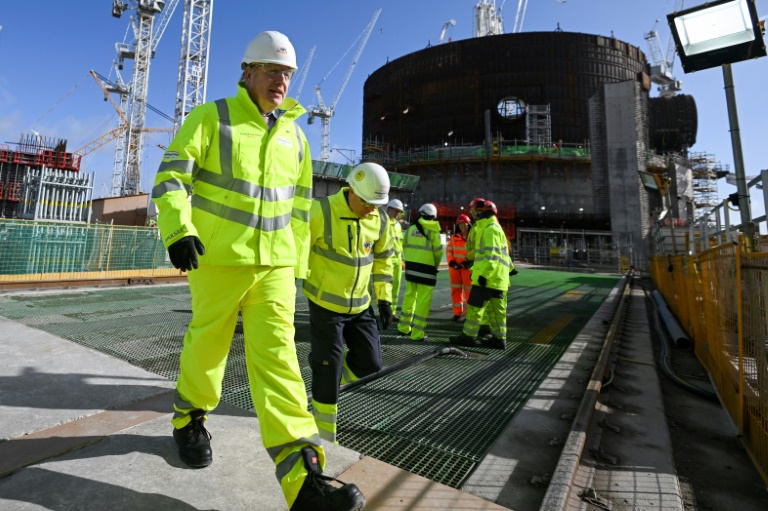
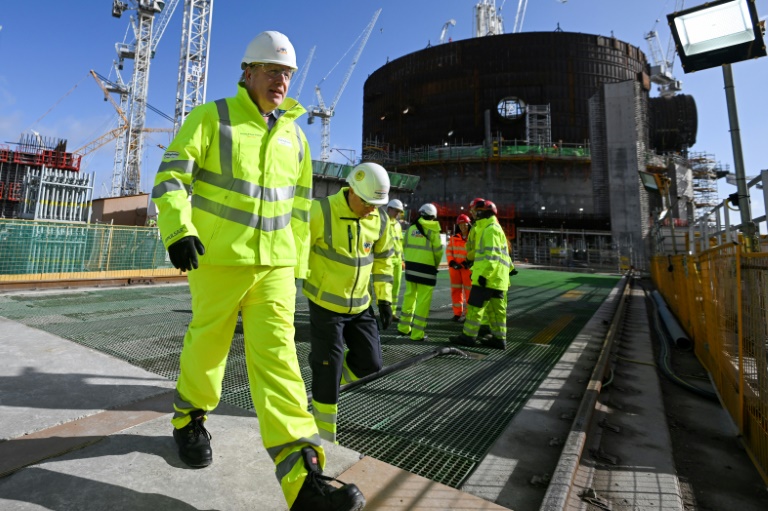
The prime minister was speaking on a visit to a giant nuclear plant under construction at Hinkley Point in southwest England — which is years overdue and billions over budget.

Johnson vowed that “instead of a new reactor every decade, we will have a new reactor every year” — including both large plants and smaller “modular” ones, although these have yet to be tested at industrial scale.

If all the bets come off, according to the strategy, Britain could derive 95 percent of its electricity from low-carbon sources by 2030.

The government acknowledges that the strategy will do little to curb household energy bills in the near term, which Johnson said had “absolutely soared” after the Russian president’s invasion of Ukraine.

Rebecca Newsom, head of politics at Greenpeace UK, said: “This strategy comprehensively fails to stand up to Putin’s violence, to take the sting out of soaring energy bills, or take control of the spiralling climate crisis.”

– ‘Madness’ –

The government plan flagged a new competition to find UK manufacturers of electric heat pumps — which are much more efficient than gas-fired household boilers, but also much more expensive.

Otherwise, as critics noted, it had nothing to say about cutting down on energy wastage and improving efficiency in homes, after the finance ministry reportedly vetoed new spending on that front.

“The first line of any new energy policy in the UK should read ‘insulate, insulate, insulate’,” commented Jon Gluyas, director of the Durham Energy Institute.

Instead, he said, the strategy was “an uninspiring mix of more of the same and … does very little to meet the nation’s zero-carbon mantra shouted so loudly at COP26”.

United Nations secretary-general Antonio Guterres, marking the launch Monday of the latest UN report on climate change, said it was “moral and economic madness” to invest any more in fossil fuels.

The 3,000-page report warned that countries risk ending up with trillions in worthless assets such as offshore platforms and pipelines when demand for fossil fuels wanes in coming decades.

For the UK government, however, political pressure to tackle the energy crisis has been heating up ahead of nationwide local elections on May 5.

Ed Miliband, climate spokesman for the opposition Labour party, said Conservative backbenchers opposed to onshore turbines in rural England were “holding the government’s energy policy to ransom”.

“And people are paying higher bills as a result,” he told BBC radio.

UK denies climate retreat despite rethink on fossil fuels

Britain insisted Thursday it was sticking to its climate change goals despite announcing plans to drill for more North Sea fossil fuels as a way of preventing energy “blackmail” by Russia.

After weeks of cabinet infighting, the government finally released a long-promised energy strategy as Britons struggle with soaring prices, following Western sanctions against Russia over Ukraine.

The plan envisions eight new nuclear stations, a five-fold increase in solar generation and enough electricity from offshore wind to power every UK home by 2030.

But to the dismay of environmentalists, the politically charged issue of onshore wind turbines — cheaper and quicker to build than offshore — was left on the back burner. 

And campaign groups said plans to offer new licences to drill for North Sea oil and gas made a mockery of Prime Minister Boris Johnson’s legally enshrined commitment to make Britain carbon net zero by 2050.

Johnson, however, said he was taking a “sensible and pragmatic view” on hydrocarbons “in the interim to the transition to net zero” — a goal that he had proclaimed at November’s COP26 climate summit in Scotland.

“This is about tackling the mistakes of the past and making sure that we are set well for the future,” he told reporters.

“And we are never again subject to the vagaries of the global oil and gas prices and we can’t be subject to blackmail, as it were, from people such as Vladimir Putin, we have energy security here in the UK.”

The prime minister was speaking on a visit to a giant nuclear plant under construction at Hinkley Point in southwest England — which is years overdue and billions over budget.

Johnson vowed that “instead of a new reactor every decade, we will have a new reactor every year” — including both large plants and smaller “modular” ones, although these have yet to be tested at industrial scale.

If all the bets come off, according to the strategy, Britain could derive 95 percent of its electricity from low-carbon sources by 2030.

The government acknowledges that the strategy will do little to curb household energy bills in the near term, which Johnson said had “absolutely soared” after the Russian president’s invasion of Ukraine.

Rebecca Newsom, head of politics at Greenpeace UK, said: “This strategy comprehensively fails to stand up to Putin’s violence, to take the sting out of soaring energy bills, or take control of the spiralling climate crisis.”

– ‘Madness’ –

The government plan flagged a new competition to find UK manufacturers of electric heat pumps — which are much more efficient than gas-fired household boilers, but also much more expensive.

Otherwise, as critics noted, it had nothing to say about cutting down on energy wastage and improving efficiency in homes, after the finance ministry reportedly vetoed new spending on that front.

“The first line of any new energy policy in the UK should read ‘insulate, insulate, insulate’,” commented Jon Gluyas, director of the Durham Energy Institute.

Instead, he said, the strategy was “an uninspiring mix of more of the same and … does very little to meet the nation’s zero-carbon mantra shouted so loudly at COP26”.

United Nations secretary-general Antonio Guterres, marking the launch Monday of the latest UN report on climate change, said it was “moral and economic madness” to invest any more in fossil fuels.

The 3,000-page report warned that countries risk ending up with trillions in worthless assets such as offshore platforms and pipelines when demand for fossil fuels wanes in coming decades.

For the UK government, however, political pressure to tackle the energy crisis has been heating up ahead of nationwide local elections on May 5.

Ed Miliband, climate spokesman for the opposition Labour party, said Conservative backbenchers opposed to onshore turbines in rural England were “holding the government’s energy policy to ransom”.

“And people are paying higher bills as a result,” he told BBC radio.

Eurozone stocks climb but London slips

Eurozone stocks rose Thursday but London drooped as investors digested news that the Federal Reserve held off from a bigger interest rate hike last month owing to Ukraine turmoil, dealers said.

Asian equities closed lower as investors examined minutes from the US central bank’s March monetary policy gathering.

Oil prices recovered some of the previous day’s heavy losses that had been triggered by concerns about weaker demand because of economic slowdown.

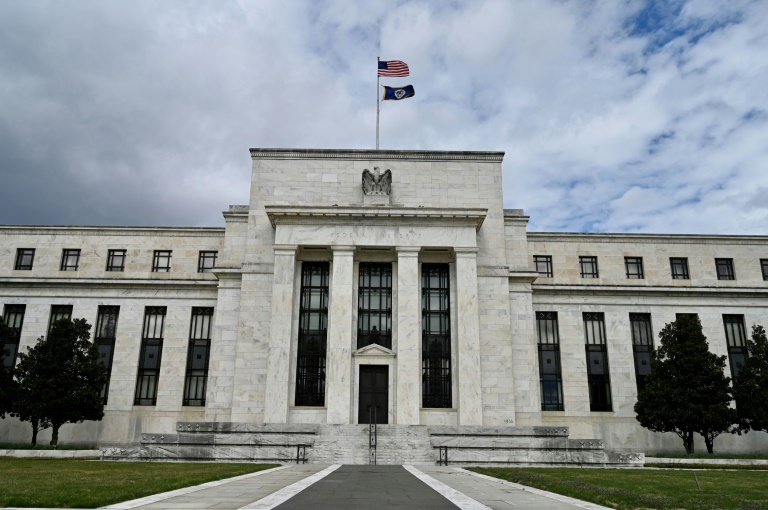
The Fed in March opted to raise US borrowing costs rates by a quarter percentage point, mindful of “greater near-term uncertainty associated with Russia’s invasion of Ukraine”.

Some policymakers had been in favour of lifting rates half a percentage point.

“As suspected, the war in Ukraine did temper the Federal Reserve’s decision to hike rates at its meeting in March,” said CMC Markets chief analyst Michael Hewson.

“However, an abundance of caution prompted them to stay their hand until events became clearer knowing that they had the option to go harder and faster later on.”

– Inflation fight –

The prospect of rates rising at a quicker pace over the coming months has added to a wave of uncertainty across trading floors.

Central banks across the world are under fierce pressure to tackle runaway inflation, which has soared further on a Ukraine-driven spike in commodities like gas, oil and wheat.

March was the first Fed hike since it slashed US rates to zero when the Covid-19 pandemic broke out two years ago.

While current US data points to a healthy economy, commentators warn of possible hard times ahead.

Wall Street tumbled for the second day in a row on Wednesday, with the Nasdaq again losing more than two percent, as tech firms are more susceptible to higher rates.

In London on Thursday, shares in gambling group 888 surged 21 percent on the British capital’s second-tier FTSE 250 index after the company won a discount on its planned purchase of the non-US operations belonging to rival William Hill.

– Key figures around 1115 GMT –

London – FTSE 100: DOWN 0.1 percent at 7,581.52 points

Frankfurt – DAX: UP 0.7 percent at 14,250.18

Paris – CAC 40: UP 0.9 percent at 6,554.65

EURO STOXX 50: UP 0.9 percent at 3,859.29

Tokyo – Nikkei 225: DOWN 1.7 percent at 26,888.57 (close)

Hong Kong – Hang Seng Index: DOWN 1.2 percent at 21,808.98 (close)

Shanghai – Composite: DOWN 1.4 percent at 3,236.70 (close)

New York – Dow: DOWN 0.4 percent at 34,496.51 (close)

Brent North Sea crude: UP 1.2 percent at $102.27 per barrel

West Texas Intermediate: UP 1.1 percent at $97.26 per barrel

Euro/dollar: DOWN at $1.0889 from $1.0896 late Wednesday

Pound/dollar: UP at $1.3072 from $1.3069

Euro/pound: DOWN at 83.30 pence from 83.37 pence

Dollar/yen: DOWN at 123.73 yen from 123.80 yen

burs-rfj/bcp/lth

Pakistan rupee nosedives against dollar as political crisis rocks confidence

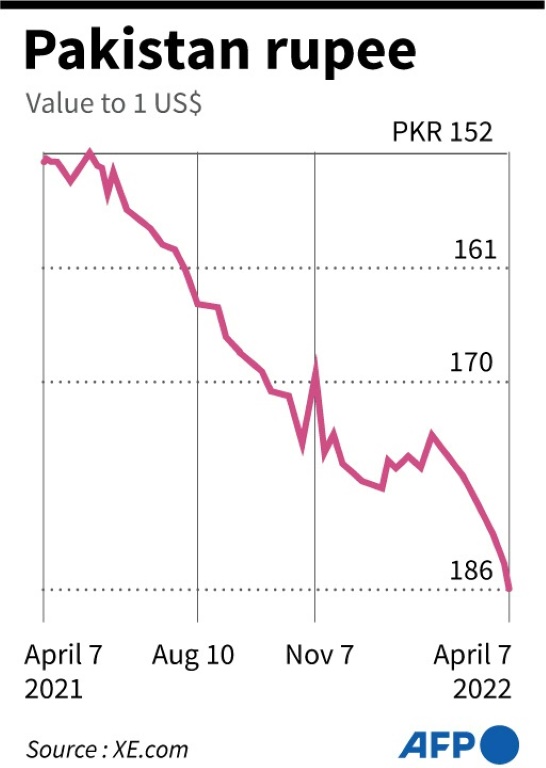
The Pakistan rupee dropped to a historic low of 191 rupees to the dollar Thursday as an ongoing political crisis rocked confidence in the currency.

The rupee has been declining for months, but the fall became precipitous in March when opposition parties tabled a no-confidence motion against Prime Minister Imran Khan that led to the dissolution of the national assembly last week.

The rupee has lost over six percent in a month, and on the open market Thursday was at 191 — and 189 at the interbank rate.

“The political mess has ensued from uncertainty and this badly reflects on the rupee,” said Mohammad Sohail, chief of Topline Securities, a Karachi based brokerage and economic research house.

Pakistan’s supreme court was sitting Thursday to rule on the legality of political manoeuvres that led Khan to dissolve the national assembly.

Pakistan’s foreign exchange reserves, which rely on remittances from the diaspora, have failed to stop a growing trade deficit.

Reserves have fallen to $12 billion from $16 billion since March as the deficit hit 70 percent for the nine months of the fiscal year spanning 2021-22.

Since July 2021, the rupee has lost 18 percent of its value against the dollar.

Relations with the United States and International Monetary Fund (IMF) are also critical factors.

The IMF has approved a $6 billion bailout package for Pakistan to support its balance of payment issue in 2019.

Half was disbursed, but the rest is being renegotiated.

Close Bitnami banner
Bitnami