AFP

'Amazon, here we come': Biden cheers US union drive

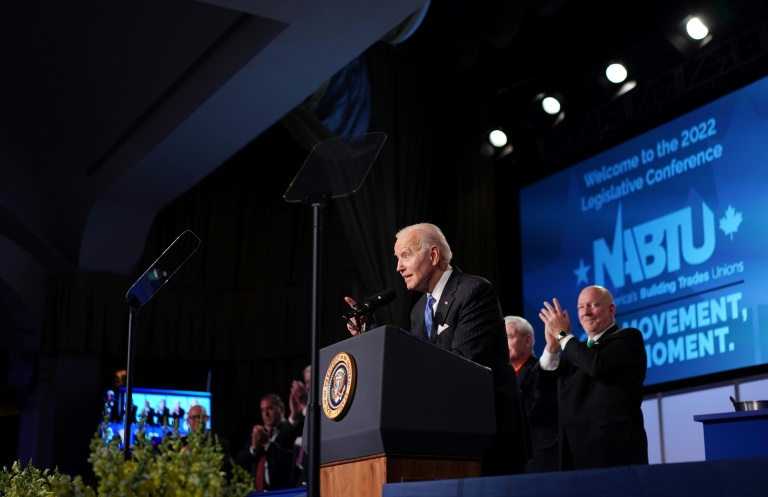
President Joe Biden sang praises for organized labor once again Wednesday, hailing last week’s triumph by union backers at Amazon as a sign of what is possible throughout the United States.

“That’s what unions are about in my view, by providing dignity and respect for people who” work hard, the US president said during a speech to a construction workers union.

The Democratic president, a self-professed “union guy,” alluded to his White House task force on union organizing to “make sure the choice to join a union belongs to workers alone,” Biden said.

“By the way: Amazon, here we come!”

The remarks came after Friday’s landmark ballot in which workers at a New York warehouse voted to establish the first  US union at Amazon.

Many US Fed officials support future half-point increase: minutes

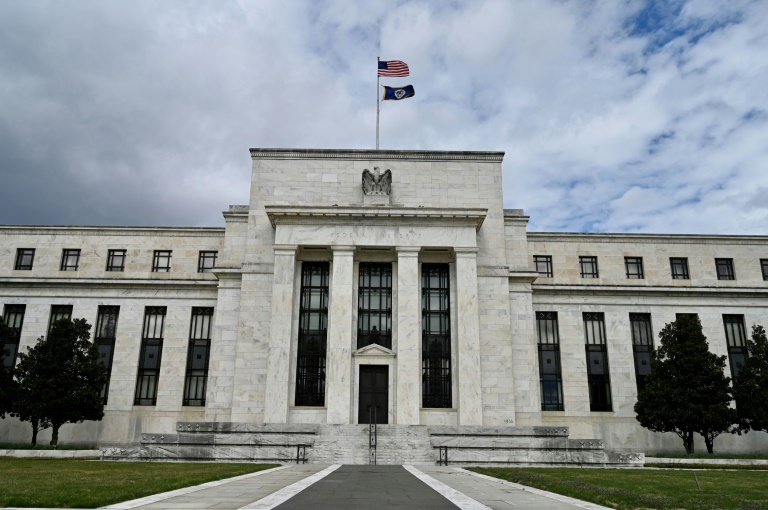
At their March policy meeting, several US Federal Reserve officials supported raising interest rates by half a percentage point in the future to combat inflation, minutes released Wednesday said.

“Many participants noted that one or more 50 basis point increases in the target range could be appropriate at future meetings, particularly if inflation pressures remained elevated or intensified,” according to minutes from the Federal Open Market Committee’s (FOMC) March 15-16 gathering.

Fed officials at that meeting decided to raise interest rates by a quarter percentage point, their first increase since slashing the rate to zero when Covid-19 broke out two years ago.

The central bank is under pressure to curb inflation, which has climbed to levels not seen since the 1980s in the United States, without tightening conditions so much they damage the economy’s recovery.

A half percentage point rate increase would represent a more forceful response to the inflation wave, and the minutes said many participants at last month’s meeting “would have preferred a 50 basis point increase in the target range for the federal funds rate.”

“A number of these participants indicated, however, that, in light of greater near-term uncertainty associated with Russia’s invasion of Ukraine, they judged that a 25 basis point increase would be appropriate at this meeting,” the minutes said.

Officials also believed “that the committee’s previous communications had already contributed to a tightening of financial conditions, as evident in the notable increase in longer-term interest rates over recent months,” according to the minutes.

Meeting participants wanted to “expeditiously” move towards neutral monetary policy — a term indicating a balance between restriction and accommodation for the economy — but “depending on economic and financial developments, a move to a tighter policy stance could be warranted.”

Fed Chair Jerome Powell and other central bank leaders have signaled they will soon take further action to tighten policy by beginning the process of reducing the Fed’s stockpile of trillions of dollars in bonds and other securities, many of which were accumulated during the pandemic to support the economy.

The minutes said officials believe it is appropriate to begin the process of balance sheet runoff “at a coming meeting, possibly as soon as” the upcoming May 3-4 meeting.

Officials were leaning towards reducing their holdings by $60 billion per month for US Treasury securities and $35 billion for mortgage-backed securities, and phasing in the reductions over three months, the minutes said.

Lots of low- and no-cost ways to halt global warming

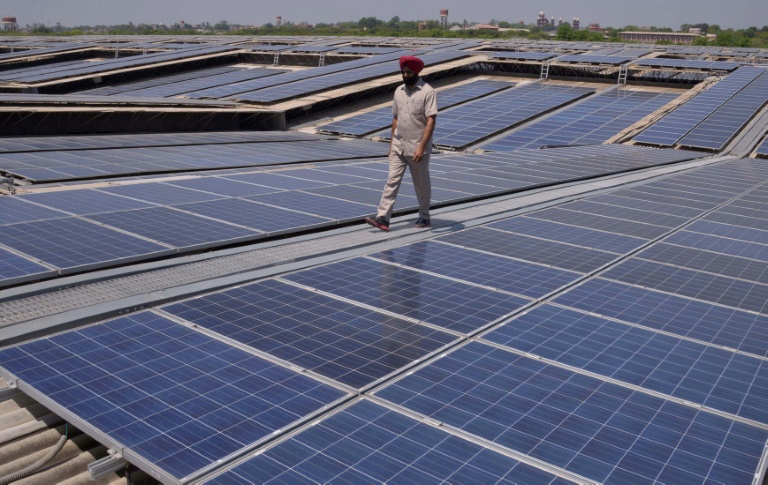
Not only do we have the tools to slash emissions and curb global warming by 2030, but half of available carbon-cutting options are cost-free or very cheap, UN climate experts say.

There is no silver bullet, but a mosaic of actions — from ramping up solar and wind technology, to economy-wide energy efficiencies — were identified by the UN’s Intergovernmental Panel on Climate Change (IPCC) as low hanging fruit. 

The IPCC said humanity has less than three years to halt the rise of planet-warming carbon emissions, and less than a decade to slash them by 43 percent from 2019 levels to give us a shot at capping global warming at 1.5 degrees Celsius.      

But current policies support continued fossil fuel use and are taking the world in the wrong direction, the IPCC said, in a flagship report on how to avoid catastrophic warming, published on Monday.

Despite the tight timeline, the IPCC said the existing carbon-cutting potential across sectors “is sufficient to reduce global greenhouse gas emissions to half of the current level or less”. 

While this requires taking action across a wide range of options, the report said that measures that are low-cost “make up more than half of this potential and are available for all sectors”. 

“The market benefits of some options exceed their costs,” it added.

– Wind and solar – 

In 2019, total emissions were 59 billion tonnes, or gigatonnes, of CO2 or its equivalent in other greenhouse gases. 

The range of options identified would enable a reduction in emissions of 31 to 44 gigatonnes by 2030. 

There are four key areas where the total potential for carbon reduction is highest between now and the end of the decade — solar and wind energy, reductions in deforestation, and restoration of forests and other ecosystems. 

Of those, solar and wind are also among the cheapest options available thanks to the steep drop in the unit costs of these technologies — down 85 and 55 percent respectively between 2010 and 2019, according to the report. 

This “demonstrates that with the right policy incentives and economic frameworks, climate change mitigation can be financed at scale and relatively quickly,” said Michael Wilkins, head of the Centre For Climate Finance And Investment at Imperial College Business School. 

More investment in solar could see an emissions reduction of between two and seven gigatonnes of CO2 equivalent by 2030. Wind energy could save between 2.1 and 5.6 gigatonnes. 

Most of that potential, according to the report, would have essentially negative lifetime costs because they are cheaper than fossil fuel alternatives. 

The reduction of methane emissions in the production of fossil energies is also mostly low cost.

Other energy generation options have a lower overall potential, with a higher cost, such as nuclear power and hydroelectricity.

– Food and forests –

Protecting and restoring natural habitats is the second most significant area for reducing CO2 emissions.  

Forests are crucial for absorbing CO2 generated by human activities, and the IPCC found that limiting deforestation and the destruction of grasslands could reduce net emissions between three and almost eight gigatonnes, largely at a low cost. 

Restoring these types of ecosystems would save one to five gigatonnes. But action in this category would be at the more expensive end of the range considered by the IPCC. 

Shifting to “sustainable” diets and reducing waste food could save more than two gigatonnes, the IPCC said, but it did not give a cost estimate because of wide global variability and a lack of data. 

– ‘Fair balance’ –

The transport sector is notable for the fact that no single option has a particularly large potential to reduce emissions.  

But almost all of the potential measures — switching to public transport and bicycles, fuel efficiency in road vehicles, shipping and aviation — are associated with negative costs. 

In the construction sector, reduction in energy demand and efficiencies in things like lighting are seen as the lowest cost options, albeit with limited potential. 

The construction of new highly energy efficient buildings have the greatest potential (between less than one and more than two gigatonnes), although costs are towards the higher end.

In industry, meanwhile, most of the options — beyond improving energy efficiency and cutting other greenhouse gas emissions — are associated with higher costs. 

But the sector still has significant potential for reducing emissions, in particular the switch to less carbon-intensive energy sources.

“The costs of climate protection are economically absolutely feasible when examined on a global scale and over generations,” said Elmar Kriegler, of the Potsdam Institute for Climate Impact Research, who was one of the IPCC authors. 

But, he said, costs vary significantly from region to region, with developing countries facing a relatively higher price tag to move away from fossil fuels.   

“That is why a fair balance is crucial, not only within individual countries but also internationally. Because one thing is clear: The benefits of climate protection clearly exceed its costs,” he added.

New Tesla factory another win for business-friendly Texas

Tesla’s unveiling this week of a new auto factory in Austin has highlighted corporate America’s growing affinity for Texas compared with California and other states seen as less business-friendly.

The state, bigger than France in land mass and second among US states to California in population, has become the location of choice for Tesla CEO Elon Musk’s new “Gigafactory.”

The new factory will be officially presented at what Musk has dubbed a “Cyber Rodeo” on Thursday, with up to 15,000 visitors.

Last year, Tesla moved its corporate headquarters from Silicon Valley to Austin. And Tesla is far from alone in picking the Lone Star state as its corporate seat.

Texas Governor Greg Abbott has spoken of the state’s commitment to “economic liberty.” In practice that means Texas is one of just a handful of US states with no individual income tax, or a corporate income tax.

The state also is aggressive about offering subsidies to attract businesses and new jobs.

– The ‘new California’ –

In a country often described as riven between red (conservative) and blue (progressive) ideologies, Texas and California are in many ways prototypical of a divided country.

Texas has pushed ahead with myriad hardline policies on divisive social issues. 

These include heavy restrictions on abortion rights and on parents who seek health services for transgender children — policies that led New York Times columnist Frank Bruni to recently question  whether Texas was the most “meanspirited” state in the nation.

Despite these controversies, big business has continued to flock to Texas.

The state has long prospered from its legacy as a petroleum powerhouse, but the Austin area has become a major center for technology, while Houston is known as a biomedical center and as home to a major NASA site.

Lee Ohanian and Joseph Vranich of the Hoover Institution, a conservative think tank at Stanford University, have hailed the Texas model of lower taxes and limited regulation in comparison with the California approach.

“Texas has become the new California, and California is becoming the new Rust Belt, losing businesses and people to states that offer more opportunities and a better, more affordable life,” they wrote in an August 2021 column that noted that Texas has now seven times the number of capital investment projects compared with California. 

The state is home to dozens of Fortune 500 companies, including others that have, like Texas, relocated to the Lone Star State. These include Oracle and Hewlett Packard, which moved in 2020.

Other companies that are based in other states are also picking Texas as home to key operations.

Aerospace giant Boeing, which is based in Chicago, is considering relocating some of its remanufacturing capacity from Seattle to Texas, an industrial source told AFP.

– Human capital –

Beyond its business climate, Texas is home to several top schools, including Rice University in Houston and the University of Texas at Austin, both ongoing sources of young, diverse and skilled labor.

Moreover, Texas’ greater affordability in terms of lower rental costs, accessible cost of living and more physical space makes the state an appealing option for recent graduates.

In the third quarter of 2021, the median price for a home  was $233,593 in Austin and $274,136 in Dallas. That compared with $1.2 million in San Francisco and $647,605 in Westchester County, New York, according to National Association of Realtors.

“Why Texas?” asked Abbott in a recent fireside chat.

“From education, agriculture, space, technology, and more, Texas offers everything families, growing businesses, and individuals need to succeed,” Abbott said, pointing to attributes that include “our world-class business climate and diverse workforce that make Texas the best place to live, work, and raise a family.”

Russia says paid dollar debt in rubles amid default fears

Russia said Wednesday it had been forced to make foreign debt payments on dollar-denominated bonds in rubles, raising the prospect of a potential default amid unprecedented Western sanctions over the Ukraine conflict.

The announcement came on the 42nd day of Russia’s military campaign in pro-Western Ukraine, with thousands killed and more than 11 million having fled their homes or the country in the worst refugee crisis in Europe since World War II.

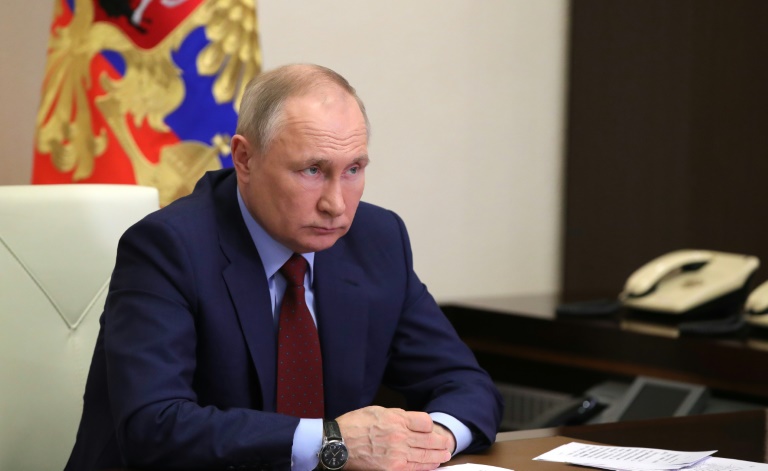
The West has pummelled Russia with debilitating sanctions since President Vladimir Putin sent troops into Ukraine on February 24.

On Wednesday, the United States announced sanctions against Putin’s two adult daughters and “full blocking” sanctions on Russia’s largest public and private financial institutions, Sberbank and Alfa Bank. It also said all new US investment in Russia was now prohibited.

The Russian finance ministry said earlier in the day that it had been forced to repay $649.2 million to foreign debt-holders in rubles after a correspondent bank refused to execute payment instructions.

Ratings agencies have downgraded Russia and warned that payments of dollar-denominated debt in local currency would constitute a sovereign default, the country’s first in decades.

The United States this week barred Russia from making debt payments using funds held at American banks, ramping up the economic pain in Moscow.

“A foreign correspondent bank refused to execute instructions for the payment” of debt on two eurobonds on April 4, the Russian finance ministry said.

“In order to fulfil the state debt obligations,” the ministry said it “was forced to call upon a Russian financial institution to make the necessary payments”.

The finance ministry did not specify whether the ruble payment had been accepted. 

“If Russia attempts to transfer payment in rubles –- as it has warned in the past –- via a special payment procedure set up in mid-March for bonds that do not have a ruble repayment clause, this will constitute default,” said Elina Ribakova, deputy chief economist at the Institute of International Finance, a US-headquartered financial industry association.

– ‘Putin impoverishing Russia’ –

The Kremlin denied suggestions that Russia could default on foreign debt payments.

“Russia has all the necessary resources to service its debts,” Kremlin spokesman Dmitry Peskov told reporters. 

“There are no grounds for a real default.”

Timothy Ash, an emerging markets strategist at BlueBay Asset Management, said, however, that it was hard to see Russia avoiding a sovereign default. 

“Putin is impoverishing Russia for years to come,” he said in a note to clients.

“Default might not crash Russian markets and the economy immediately but will have devastating longer term consequences.”

Russia last missed payments on domestic, ruble-denominated debt in 1998, but last defaulted on its foreign currency debt in 1918 under Bolshevik leader Vladimir Lenin. 

In recent years, Moscow amassed about $600 billion in foreign currency reserves, including gold, largely from oil and natural gas sales.

The government has about $40 billion in dollar- or euro-denominated debt, though only half of that is held by foreign creditors.

– ‘Eye-popping’ price hikes –

The sanctions also sparked an exodus from Russia of hundreds of foreign companies.

US officials expect the sanctions to plunge Russia, which has heavily relied on imports of manufacturing equipment and consumer goods, into deep recession.

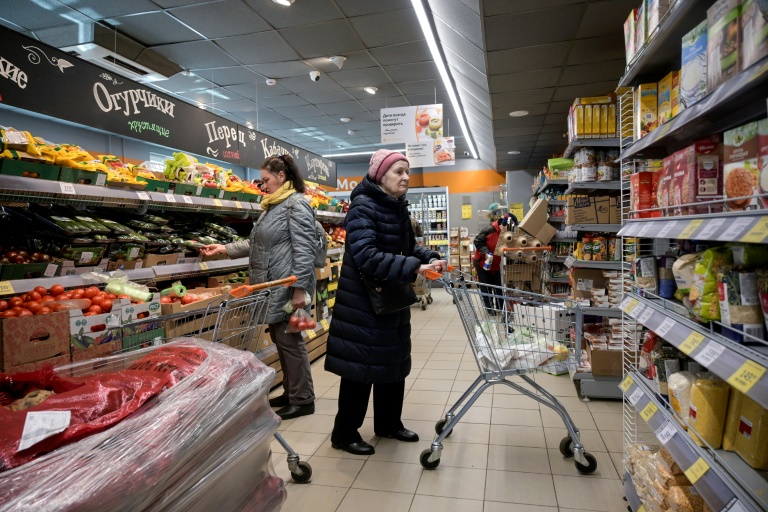
Ordinary Russians have been bracing for tough times, stocking up on food and other supplies as inflation soars.

Prices for consumer goods have risen on average of almost 10 percent since the start of the year, the national statistics agency Rosstat said Wednesday, while for some items it is much higher.

Olesya Ogiyeva, a 42-year-old factory worker in Russia’s second largest city of Saint Petersburg, complained recent price hikes were “eye-popping.”

“You come home, take out your purchases and realise that you’ve basically bought nothing, because everything is very expensive,” she told AFP.

New car sales sank almost 63 percent in Russia in March year-on-year, the Association of European Businesses reported Wednesday. 

Rosstat said prices for new cars of foreign makes rose over 30 percent since the end of last year, while Russian-make cars rose over 20 percent.

Andrei Yakovlev, director of the Institute for Industrial and Market Studies at Moscow’s Higher School of Economics, said the worst economic impact of the sanctions was still to come.

“Disruption to component supplies across all industries will begin in about a month or a month and a half,” Yakovlev told AFP. 

“It is possible that a large number of enterprises will stop working because of this in May,” he said, adding that eventually tens or even hundreds of thousands of people will stop receiving wages.

Number of spider species creeps up to 50,000

There are now 50,000 known different species of spider crawling the Earth, the World Spider Catalog announced Wednesday — and there might be another 50,000 out there.

The WSC, based at the Natural History Museum of Bern in the Swiss capital, said the 50,000th spider registered is the Guriurius minuano, which belongs to the Salticidae family of jumping spiders and hunts its prey on shrubs and trees in southern Brazil, Uruguay, and around Buenos Aires.

It was described by the arachnologist Kimberly S. Marta and her colleagues from Brazil and is named after the now-extinct Minuane people who lived in the area.

The first scientific description of a spider was in 1757 and while it has taken 265 years to reach 50,000, the rate of discovery is steadily increasing, and it is thought it could take less than 100 years to discover the same number again.

“We estimate that there are still approximately 50,000 more spider species out there to discover,” said the WSC’s publishers.

The spider catalogue is freely available on the museum’s website.

“Spiders are the most important predators in Earth’s terrestrial habitats, and their ecological significance should not be underestimated,” the museum said.

“Consuming some 400 to 800 million tonnes of insects every year, they are the most important regulators of insect populations. Accordingly, they are also of fundamental importance to humans.”

World stock markets beat retreat with all eyes on Fed

Global equities sank Wednesday on bets the US Federal Reserve will act more aggressively to bring inflation under control.

Asian and European bourses retreated, and Wall Street was also trading lower, extending heavy falls in US stocks a day earlier.

The euro hit a one-month dollar low ahead of the release due Wednesday of the minutes from the Fed’s latest policy meeting.

The minutes from the Fed’s March meeting will be pored over for insights into the thinking of US central bankers, in light of the Ukraine war and recent data suggesting the world’s top economy remains resilient.

“The markets remain unnerved by the economic implications of a highly aggressive Fed and a potential policy mistake,” analysts from Charles Schwab said in a note.

London stocks slid also as UK businesses and individuals saw a major tax hike kick in, worsening Britain’s cost-of-living crisis as domestic energy bills rocket.

– ‘Significant headwinds’ –

“Investor confidence might have improved from the low point in early March when the Ukraine war was unfolding,” said AJ Bell investment director Russ Mould. 

“However, there remain significant headwinds for equities and the latest trouble spot is what the Federal Reserve might do to curb inflation.”

Investors are fretting also over how quickly officials will withdraw their vast pandemic-era financial support.

After last month’s 0.25-percentage-point hike in US interest rates, the focus is now on its plans for May’s meeting, with expectations growing that the Fed will announce a 0.50-point lift followed by several more before the end of the year.

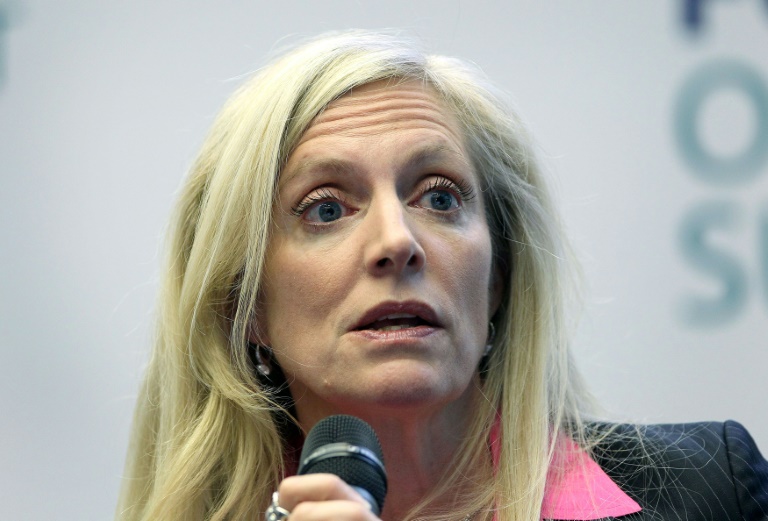
Fed governor Lael Brainard, who is considered a dove, on Tuesday spooked traders by saying bringing US inflation down from 40-year highs was of “paramount importance” and that the bank was “prepared to take stronger action” if warranted.

Brainard also said bank policymakers were ready to start reducing its vast bond holdings, which have helped keep borrowing costs down.

“It’s an ugly affair right now, because the increased chatter from Fed officials about perhaps needing to be more aggressive with the policy stance shows that the Fed is recognising it is behind the inflation curve and now risks making a policy mistake trying to catch up,” said Patrick O’Hare from Briefing.com.

– Oil rebounds –

Oil prices dropped after rebounding earlier when European Council chief Charles Michel told the European Parliament that it must impose oil and gas sanctions on Russia “sooner or later”.

Crude futures had slid the previous day on the European Union’s decision not to include Russian oil in a fresh round of sanctions.

Britain slapped new sanctions on Russia Wednesday over its invasion of Ukraine, targeting two banks and eliminating all Russian oil and coal imports by the end of the year.

The White House also announced sanctions targeting Russia’s top public and private banks and two daughters of President Vladimir Putin.

– Key figures around 1605 GMT –

London – FTSE 100: DOWN 0.3 percent at 7,587.70 points (close)

Frankfurt – DAX: DOWN 1.9 percent at 14,151.69 (close) 

Paris – CAC 40: DOWN 2.2 percent at 6,498.83  (close) 

EURO STOXX 50: DOWN 2.4 percent at 3,824.69

New York – Dow: DOWN 0.6 percent at 34,434.41 

Tokyo – Nikkei 225: DOWN 1.9 percent at 27,080.52 (close)

Hong Kong – Hang Seng Index: DOWN 1.3 percent at 22,219.85 (close)

Shanghai – Composite: FLAT at 3,283.43 (close)

Brent North Sea crude: DOWN 2.6 percent at $103.86 per barrel

West Texas Intermediate: DOWN 2.8 percent at $99.11 per barrel

Euro/dollar: UP at $1.0913 from $1.0905 late Tuesday

Pound/dollar: UP at $1.3086 from $1.3074

Euro/pound: DOWN at 83.40 pence from 83.41 pence

Dollar/yen: UP at 123.73  yen from 123.60 yen

burs-rfj-kjm/har

US slaps sanctions on Putin's daughters, Russia's biggest banks

The White House announced sanctions Wednesday targeting Russia’s top public and private banks and two daughters of Vladimir Putin, adding pressure on the country’s economy and its elite over the invasion of Ukraine.

The new sanctions targeted Maria Vorontsova and Katerina Tikhonova, two adult daughters of Putin’s with his former wife Lyudmila Shkrebneva.

Also hit with new sanctions were the wife and daughter of Russian Foreign Minister Sergei Lavrov and members of Russia’s Security Council, including former president and prime minister Dmitry Medvedev and Prime Minister Mikhail Mishustin.

“These individuals have enriched themselves at the expense of the Russian people. Some of them are responsible for providing the support necessary to underpin Putin’s war on Ukraine,” the White House said in a statement.

“We believe that many of Putin’s assets are hidden with family members, and that’s why we’re targeting them,” a senior US official told reporters, referring to the two daughters.

The White House also declared “full blocking” sanctions on Russia’s largest public and private financial institutions, Sberbank and Alfa Bank, and said all new US investment in Russia was now prohibited.

And it said that new sanctions would be announced Thursday on key Russian state enterprises, aiming to hamper their ability to trade and move money through the global financial system.

President Joe Biden tied the escalation of sanctions directly to the evidence that has mounted that Russian forces deliberately murdered civilians in Bucha, a town outside Kyiv.

“I made clear that Russia would pay a severe and immediate price for its atrocities in Bucha,” Biden tweeted.

– Energy transactions protected – 

The new sanctions were being coordinated with US allies in Europe and elsewhere, aiming to further damage the Russian economy in order to pressure Putin to stop the war.

“Today, in alignment with G7 allies and partners, we are intensifying the most severe sanctions ever levied on a major economy,” the official said on grounds of anonymity.

The sanctions on the two banks broadened an earlier measure that blocked certain capital transactions with them.

Now any asset the bank has that is or comes under US jurisdiction will be frozen, and people and companies under US jurisdiction are banned from doing business with them.

This could have a significant impact on Sberbank, which holds nearly one-third of the assets in the Russian banking industry.

However, the US sanctions continued to avoid Russia’s energy sector, which still reaps millions of dollars daily from European customers for its natural gas.

Energy-related transactions at the two banks will still be permitted, the White House said.

In a parallel action Wednesday, the US Justice Department indicted Russian oligarch Konstantin Malofeyev for sanctions violations.

Attorney General Merrick Garland said the Russian billionaire was a source of financing for Russians promoting separatism in Crimea and supported pro-Moscow separatists in the so-called Donetsk People’s Republic in eastern Ukraine.   

“After being sanctioned by the United States, Malofeyev attempted to evade the sanctions by using co-conspirators to surreptitiously acquire and run media outlets across Europe,” Garland told reporters.

“Malofeyev played a leading role in supporting Russia’s 2014 invasion of eastern Ukraine, continues to run a pro-Putin propaganda network, and recently described Russia’s 2022 military invasion of Ukraine as a ‘holy war,’” said FBI official Michael Driscoll.

Russia says paid dollar debt in rubles amid default fears

Russia said Wednesday it had been forced to make foreign debt payments on dollar-denominated bonds in rubles, raising the prospect of a potential default amid unprecedented Western sanctions over the Ukraine conflict.

The announcement came on the 42nd day of Russia’s military campaign in pro-Western Ukraine, with thousands killed and more than 11 million having fled their homes or the country in the worst refugee crisis in Europe since World War II.

The West has pummelled Russia with debilitating sanctions since President Vladimir Putin sent troops into Ukraine on February 24.

On Wednesday, the United States and the European Union were readying new sanctions after Ukrainian President Volodymyr Zelensky showed the UN Security Council harrowing images of violence.

The Russian finance ministry said on Wednesday that it had been forced to repay $649.2 million to foreign debt-holders in rubles after a correspondent bank refused to execute payment instructions.

Ratings agencies have downgraded Russia and warned that payments of dollar-denominated debt in local currency would constitute a sovereign default, the country’s first in decades.

The United States from Monday barred Russia from making debt payments using funds held at American banks, ramping up the economic pain in Moscow.

“A foreign correspondent bank refused to execute instructions for the payment” of debt on two eurobonds on April 4, the ministry said in a statement.

“In order to fulfil the state debt obligations of the Russian Federation,” the finance ministry said it “was forced to call upon a Russian financial institution to make the necessary payments”.

The finance ministry did not specify whether the ruble payment had been accepted. 

“If Russia attempts to transfer payment in rubles –- as it has warned in the past –- via a special payment procedure set up in mid-March, for bonds that do not have a ruble repayment clause, this will constitute default,” said Elina Ribakova, deputy chief economist at the Institute of International Finance, a US-headquartered financial industry association.

– ‘Putin impoverishing Russia’ –

The Kremlin denied suggestions that Russia could default on foreign debt payments.

“Russia has all the necessary resources to service its debts,” Kremlin spokesman Dmitry Peskov told reporters. 

“There are no grounds for a real default.”

Timothy Ash, an emerging markets strategist at BlueBay Asset Management, said, however, that it was hard to see Russia avoiding a sovereign default. 

“Putin is impoverishing Russia for years to come,” he said in a note to clients.

“Default might not crash Russian markets and the economy immediately but will have devastating longer term consequences,” he said, adding that investment, growth and living standards will be affected.

Russia missed payments on domestic, ruble-denominated debt in 1998 amid a broader financial crisis, but last defaulted on its foreign currency debt in 1918, when Bolshevik revolution leader Vladimir Lenin refused to recognise the obligations of the deposed tsar’s regime. 

In recent years, Moscow amassed about $600 billion in foreign currency reserves, including gold, largely from oil and natural gas sales.

The government owes about $40 billion in dollar- or euro-denominated debt, though only half of that is held by foreign creditors.

– No wages? –

The sanctions also sparked an exodus from Russia of hundreds of foreign companies.

US officials expect the sanctions to plunge Russia, which has heavily relied on imports of manufacturing equipment and consumer goods, into deep recession.

Ordinary Russians have been bracing for tough times, stocking up on food and other supplies as inflation soars.

New car sales sank almost 63 percent in Russia in March year-on-year, industry data showed Wednesday, with Russians less likely to buy imported cars after the ruble plummeted in value.

Only 55,129 cars or light commercial vehicles were sold last month, a 62.9-percent drop from the same period last year, said the Association of European Businesses. 

Andrei Yakovlev, director of the Institute for Industrial and Market Studies at Moscow’s Higher School of Economics, said the worst economic impact of the sanctions is still to come, since many Russian businesses rely on imported components and are using up their current stocks.

“Disruption to component supplies across all industries will begin in about a month or a month and a half,” Yakovlev told AFP. 

“It is possible that a large number of enterprises will stop working because of this in May,” he said, adding that eventually tens or even hundreds of thousands of people will stop receiving wages.
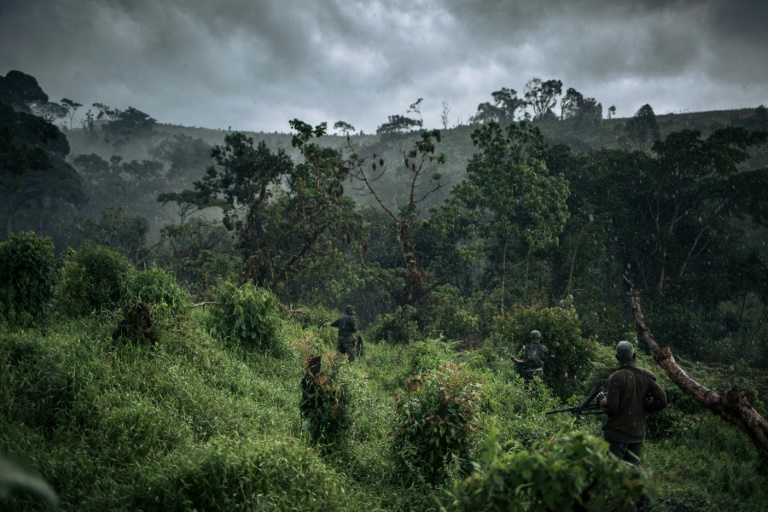
DR Congo Pygmies attacked in wildlife park: rights group

Troops and rangers in the Kahuzi-Biega National Park in eastern DR Congo have carried out attacks on indigenous Pygmies living in the famed wildlife haven, a rights watchdog said on Wednesday

Violence broke out in 2018 between park rangers and members of the Batwa community, who are accused of illegally settling in the reserve, cutting down trees to make charcoal and opening fire on rangers, killing and wounding a number of them.

The British watchdog Minority Rights Group (MRG), in a report on Wednesday, alleged that soldiers and Kahuzi-Biega guards carried out attacks against the Pygmies living in the park. 

“The attacks were well-planned, targeted civilian populations,” the group said.

“The research team obtained direct evidence of the deaths of at least 20 individual Batwa community members in connection with this three-year campaign of forced expulsion,” it added.

“The research team obtained direct evidence that 15 Batwa women were forcibly group-raped by park guards and soldiers during the July and November-December 2021 operations,” the watchdog said.

The 6,000-square-kilometre (2,300-square-mile mile) reserve lies close to the Rwandan border near Bukavu, in one of the most troubled areas of the vast country.

– Legal limbo –

Dominated by the extinct volcanoes of Kahuzi and Biega, the park’s tropical forests are a redoubt for one of the last populations of eastern lowland gorillas, made up of about 250 primates, according to its website.

Since the 1990s, the haven has been listed by UNESCO as a World Heritage site in danger because of the presence of armed groups and settlers, poaching and deforestation.

A number of Pygmies charge that their land was confiscated when the national park was expanded and want to recover what they say is theirs.

The MRG report, based on on-site investigation and dozens of witnesses, said the park rangers received financial and technical support at the time from the governments of Germany and the United States, as well as international conservation organizations such as the Wildlife Conservation Society.

An investigation has recently been launched by the park’s overseers, the Congolese Institute for the Conservation of Nature (ICCN), to probe alleged violations.

The panel has been in Bukavu since April 4 and will travel to the scene of the alleged crimes, Georges Muzibaziba, who heads the ICCN’s human rights section.

There is a lack of legal clarity between DR Congo’s laws that protect the national park and those guaranteeing the rights of the Pygmy populations. 

On April 7, 2021, a bill to protect and promote the rights of indigenous people was adopted by the DR Congo parliament.

It guarantees among other things recognition of the rights to land and natural resources of the indigenous Pygmy people to possess, occupy and use traditionally.

The Senate has been reviewing the bill for the last year.

Close Bitnami banner
Bitnami