AFP

Torrential rain kills 55 in Brazil tourist town

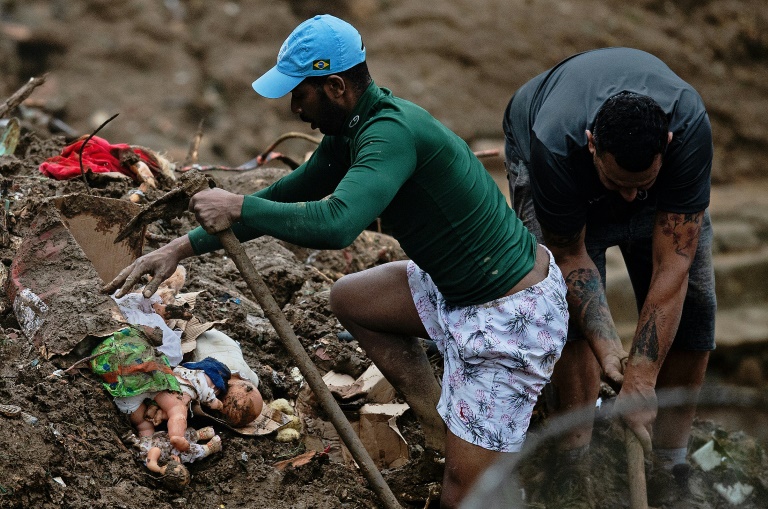
At least 55 people were killed in devastating flash floods and landslides that hit the picturesque Brazilian city of Petropolis, turning streets into torrential rivers and sweeping away houses, officials said Wednesday.

Rescue workers raced to find survivors buried in the mud and wreckage after heavy storms Tuesday dumped a month’s worth of rain in three hours on the scenic tourist town in the hills north of Rio de Janeiro.

There were fears the death toll could rise further as firefighters and volunteer rescue workers dug through the remains of houses washed away in torrents of mud, many of them in impoverished hillside slums.

At least 21 people have been so far been rescued alive in the effort, according to the state government.

Around 300 people were being housed in shelters, mostly in schools, officials said. Charities called for donations of mattresses, blankets, food, water, clothing and face masks for victims.

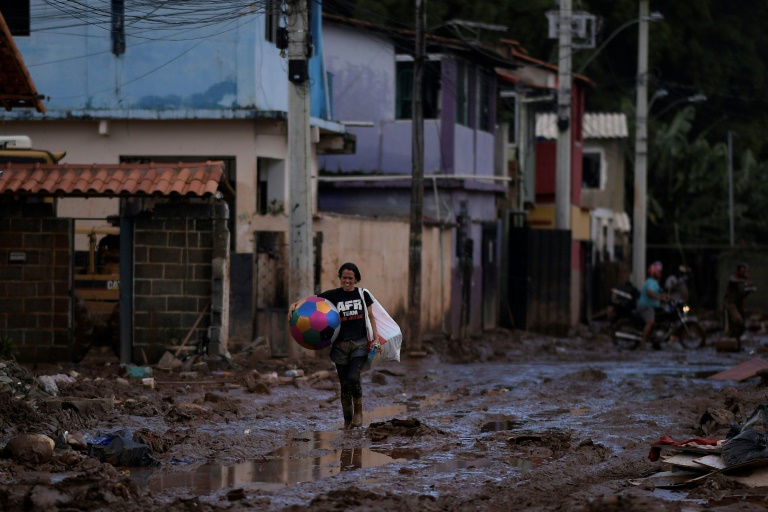
Wendel Pio Lourenco, a 24-year-old resident, was walking through the street with a television in his arms, heading to a local church in search of shelter.

He said he was trying to save a few possessions, after spending a sleepless night helping search for victims.

“I found a girl who was buried alive,” he said.

“Everyone is saying it looks like a war zone.”

Governor Claudio Castro said much the same after visiting the scene.

“It’s almost a war situation. We’ve mobilized our entire team,” he said.

Videos posted on social media from Tuesday’s rains showed streets in Petropolis, the 19th-century summer capital of the Brazilian empire, fill with gushing floods that swept away cars, trees and nearly everything else in their paths.

Many shops were completely inundated by the rising waters, which gushed down the streets of the historic city center.

Officials said more than 180 firefighters and other rescue workers were responding to the emergency, aided by 400 soldiers sent in as reinforcements.

City hall declared a “state of disaster” in the city of 300,000 people, which sits 68 kilometers (42 miles) north of Rio.

The city council declared three days of mourning for victims.

– ‘Tragedy’ –

Petropolis is a popular destination for tourists fleeing the summer heat of Rio, known for its leafy streets, stately homes, imperial palace — today a museum — and the natural beauty of the surrounding mountains.

Tuesday’s storms dumped 258 millimeters (10 inches) of rain on the city in three hours, nearly equal to all the rainfall from the previous month, the mayor’s office said.

The heaviest downpour had passed, but more moderate rain was expected to continue on and off for several days, authorities said.

President Jair Bolsonaro, on an official trip to Russia, said on Twitter he was keeping abreast of “the tragedy.”

“Thank you for your words of solidarity with the people of Petropolis,” he told President Vladimir Putin after meeting the Russian leader.

“May God comfort (the victims’) families.”

Brazil has been swept by heavy rains in the past several months that have caused a series of deadly floods and landslides.

Experts say rainy season downpours are being augmented by La Nina — the cyclical cooling of the Pacific Ocean — and by the impact of climate change.

Because a warmer atmosphere holds more water, global warming increases the risk and intensity of flooding from extreme rainfall.

Last month, torrential rain triggered floods and landslides that killed at least 28 people in southeastern Brazil, mostly in Sao Paulo state.

There have also been heavy rains in the northeastern state of Bahia, where 24 people died in December.

It is not the first time the mountains around Rio have been the scene of deadly storms.

In January 2011, more than 900 people died in the region due to heavy rains that caused flooding and landslides in a large area, including Petropolis and neighboring cities Nova Friburgo and Teresopolis.

Despair, solidarity for Brazil storm victims

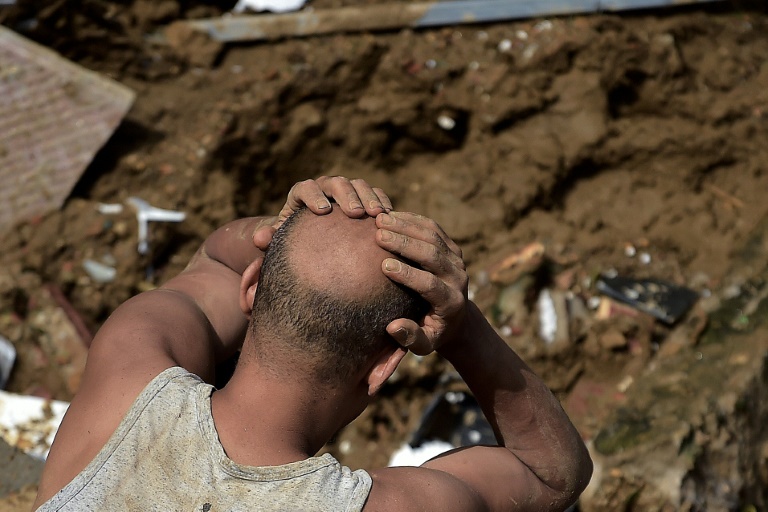
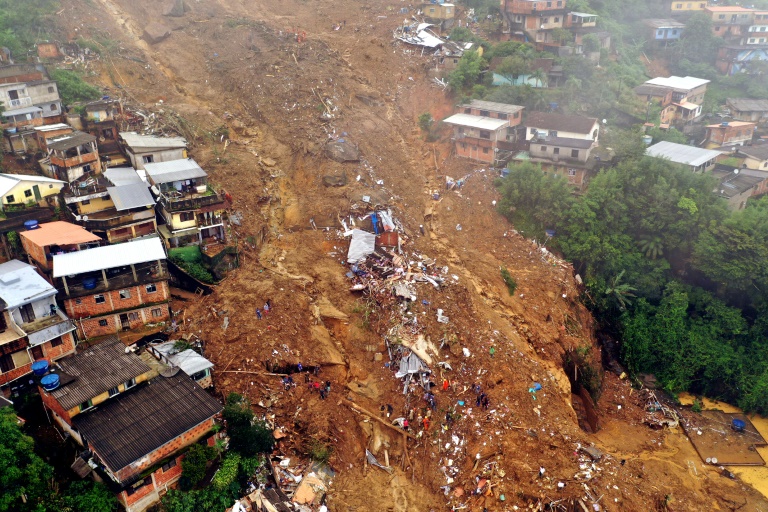
Holding the few possessions they are able to carry, families stream down the slopes of the hillside neighborhood of Alto da Serra, many in tears, fleeing the devastation left by deadly landslides in the Brazilian city of Petropolis.

Their modest neighborhood was one of the hardest hit by Tuesday’s storms, which dumped a month’s worth of rain on this scenic tourist town in a matter of hours, triggering flash floods and torrents of mud that gushed violently through the city.

“It’s devastating. We never could have imagined something like this,” says one fleeing resident, Elisabeth Lourenco, clutching two bags in which she stuffed some clothing when emergency officials ordered everyone in the neighborhood to evacuate.

“When the rain was falling hardest, a huge amount of mud came pouring down the hillside, and some tree branches fell on my house,” says the 32-year-old manicurist, on the verge of tears.

Nearby is a scene of total chaos. A giant swathe of hillside is covered in mud and strewn with the remains of shattered houses.

Authorities say the disaster killed at least 50 people across the city. There are fears the death toll could rise further as rescue workers continue digging through the mud and ruins.

Watching the rescue operation in disbelief, residents shudder with each deafening pass of the helicopters hovering overhead.

“I was eating dinner when the storm started. My brother came in and said, ‘We need to get out of here, the hillside is collapsing,'” says Jeronimo Leonardo, 47, whose home sits at the edge of the area wiped out by the landslide.

– ‘Up to our waists’ –

Residents of Alto da Serra have been evacuated to a church that sits atop another hill nearby.

From the square outside the small blue building, they can see the disaster zone through the mist.

Dozens of families swarm the church, carting their belongings in bags.

Outside, volunteers unload a truck of bottled water, as others sort through donated clothing.

“Can I have some shoes?” asks a little boy standing barefoot, his clothes stained with mud.

Inside, mattresses line the floor.

“We started taking people in as soon as the tragedy started Tuesday evening. We’re hosting around 150 to 200 people, including a lot of children,” says Father Celestino, a parish priest.

Yasmin Kennia Narciso, a 26-year-old teacher’s assistant, is sitting on a mattress nursing her nine-month-old baby.

“I didn’t sleep all night,” she says.

She tells the story of how she fled with her two daughters around 11:00 pm.

“We tried to leave earlier, but there were boulders strewn across the path and everything was flooded. We were in water up to our waists. We had no choice but to wait until it went down,” she says.

She adds that she is still waiting for news on several neighbors.

“An older lady and her three grandchildren who lived just above us were buried in the mud.”

Survivors know they likely face a long wait to learn if and when they can return home — for those who still have homes left.

How world's most precise clock could transform fundamental physics

US scientists have measured Albert Einstein’s theory of general relativity — which holds that gravity slows time down — at the smallest scale ever, demonstrating that clocks tick at different rates when separated by fractions of a millimeter.

Jun Ye, of the National Institute of Standards and Technology (NIST) and the University of Colorado Boulder, told AFP it was “by far” the most precise clock ever built — and could pave the way for new discoveries in quantum mechanics, the rulebook for the subatomic world.

Ye and colleagues published their findings in the prestigious journal Nature on Wednesday, describing the engineering advances that enabled them to build a device 50 times more precise than their previous best clock, itself a record-breaker, built in 2010.

It was more than a century ago, in 1915, that Einstein put forward his theory of general relativity, which held that the gravitational field of a massive object distorts space-time.

This causes time to move more slowly as one approaches closer to the object.

But it wasn’t until the invention of atomic clocks — which keep time by detecting the transition between two energy states inside an atom exposed to a particular frequency — that scientists could prove the theory.

Early experiments included the Gravity Probe A of 1976, which involved a spacecraft six thousand miles (10,000 kilometers) above Earth’s surface and showed that an onboard clock was faster than an equivalent on Earth by one second every 73 years.

Since then, clocks have become more and more precise, and thus better able to detect the effects of relativity.

A decade ago, Ye’s team set a record by observing time moving at different rates when their clock was moved 33 centimeters (just over a foot) higher.

– Theory of everything –

Ye’s key breakthrough was working with webs of light, known as optical lattices, to trap atoms in orderly arrangements. This is to stop the atoms from falling due to gravity or otherwise moving, resulting in a loss of accuracy.

Inside Ye’s new clock are 100,000 strontium atoms, layered on top of each other like a stack of pancakes, in total about a millimeter high.

The clock is so precise that when the scientists divided the stack into two, they could detect differences in time in the top and bottom halves.

At this level of accuracy, clocks essentially act as sensors.

“Space and time are connected,” said Ye. “And with time measurement so precise, you can actually see how space is changing in real time — Earth is a lively, living body.”

Such clocks spread out over a volcanically-active region could tell geologists the difference between solid rock and lava, helping predict eruptions. 

Or, for example, study how global warming is causing glaciers to melt and oceans to rise.

What excites Ye most, however, is how future clocks could usher in a completely new realm of physics. 

The current clock can detect time differences across 200 microns — but if that was brought down to 20 microns, it could start to probe the quantum world, helping bridge gaps in theory.

While relativity beautifully explains how large objects like planets and galaxies behave, it is famously incompatible with quantum mechanics, which deals with the very small, and holds that everything can behave like a particle and a wave.

The intersection of the two fields would bring physics a step closer to a unifying “theory of everything” that explains all physical phenomena of the cosmos.

Torrential rain kills 44 in Brazil tourist town

At least 44 people were killed in devastating flash floods and landslides that hit the picturesque Brazilian city of Petropolis, turning streets into torrential rivers and sweeping away houses, officials said Wednesday.

Rescue workers raced to find survivors buried in the mud and wreckage after heavy storms Tuesday dumped a month’s worth of rain in three hours on the scenic tourist town in the hills north of Rio de Janeiro.

There were fears the death toll could rise as firefighters and volunteer rescue workers dug through the remains of houses washed away in torrents of mud, many of them in impoverished hillside slums.

At least 21 people have been so far been rescued alive in the effort, according to the state government.

Around 300 people were being housed in shelters, mostly in schools, officials said. Charities called for donations of mattresses, blankets, food, water, clothing and face masks for victims.

Wendel Pio Lourenco, a 24-year-old resident, was walking through the streets with a television in his arms, heading to a local church in search of shelter.

He said he was trying to save a few possessions, after spending a sleepless night helping search for victims.

“I found a girl who was buried alive,” he said.

“Everyone is saying it looks like a war zone.”

Governor Claudio Castro said much the same after visiting the scene.

“It’s almost a war situation. We’ve mobilized our entire team,” he said.

Videos posted on social media from Tuesday’s rains showed streets in Petropolis, the 19th-century summer capital of the Brazilian empire, fill with gushing floods that swept away cars, trees and nearly everything else in their paths.

Many shops were completely inundated by the rising waters, which gushed down the streets of the historic city center.

Officials said more than 180 firefighters and other rescue workers were responding to the emergency, aided by 400 soldiers sent in as reinforcements.

City hall declared a “state of disaster” in the city of 300,000 people, which sits 68 kilometers (42 miles) north of Rio.

The city council declared three days of mourning for victims.

– ‘Tragedy’ –

Petropolis is a popular destination for tourists fleeing the summer heat of Rio, known for its leafy streets, stately homes, imperial palace — today a museum — and the natural beauty of the surrounding mountains.

Tuesday’s storms dumped 258 millimeters (10 inches) of rain on the city in three hours, nearly equal to all the rainfall from the previous month, the mayor’s office said.

The heaviest downpour had passed, but more moderate rain was expected to continue on and off for several days, authorities said.

President Jair Bolsonaro, on an official trip to Russia, said on Twitter he was keeping abreast of “the tragedy.”

“Thank you for your words of solidarity with the people of Petropolis,” he told President Vladimir Putin after meeting the Russian leader.

“May God comfort (the victims’) families.”

Brazil has been swept by heavy rains in the past several months that have caused a series of deadly floods and landslides.

Experts say rainy season downpours are being augmented by La Nina — the cyclical cooling of the Pacific Ocean — and by the impact of climate change.

Because a warmer atmosphere holds more water, global warming increases the risk and intensity of flooding from extreme rainfall.

Last month, torrential rain triggered floods and landslides that killed at least 28 people in southeastern Brazil, mostly in Sao Paulo state.

There have also been heavy rains in the northeastern state of Bahia, where 24 people died in December.

It is not the first time the mountains around Rio have been the scene of deadly storms.

In January 2011, more than 900 people died in the region due to heavy rains that caused flooding and landslides in a large area, including Petropolis and neighboring cities Nova Friburgo and Teresopolis.
At least 18 dead in storms near Rio de Janeiro

Landslides and flooding triggered by heavy rainfall killed at least 18 people Tuesday in a tourist town in the hills above Rio de Janeiro, Brazilian firefighters said.

“So far, 18 deaths caused by landslides and floods have been confirmed” in recent hours, the Rio de Janeiro Fire Department said in a statement.

The department did not provide figures for those injured or missing.

It said more than 180 firefighters and other rescue workers were at the scene in the picturesque hill town of Petropolis, where Brazil’s last emperor Pedro II is buried, 68 kilometers (42 miles) north of the city of Rio.

“Specialized search-and-rescue teams have been sent to reinforce the rescue operations, with the support of 4×4 vehicles and boats,” it added.

City hall declared a “state of disaster” as images spread on social media of destroyed houses and cars swept away by floodwater.

Many shops were completely inundated by the rising waters which gushed down the streets of the historic city center. 

Some parts of Petropolis received up to 260 millimeters (10 inches) of water in less than six hours, more than was expected for the whole month of February, according to the meteorological agency MetSul. 

The heaviest downpour had passed but more moderate rainfall was expected to continue for several hours, authorities said.

Global warming has increased the risk of heavy storms and flooding, as the atmosphere retains more water and rainfall patterns are disrupted.  

President Jair Bolsonaro, on an official trip to Russia, said on Twitter that he was keeping abreast of “the tragedy” and asked his ministers to provide “immediate aid to the victims.”

Earlier this month, floods and landslides caused by torrential rain killed at least 28 people in the southeast of the country, mostly in Sao Paulo state and the region north of Rio.

In January 2011, more than 900 people died in the mountainous region of Rio due to heavy rains that caused flooding and landslides in a large area including Petropolis and neighboring cities Nova Friburgo and Teresopolis.
Petropolis, the summer residence of the former imperial court, is a tourist destination that attracts a large number of visitors.

Because of its altitude, it has a cooler climate than the coast of Rio.

China govt to help run coal power plants at full capacity

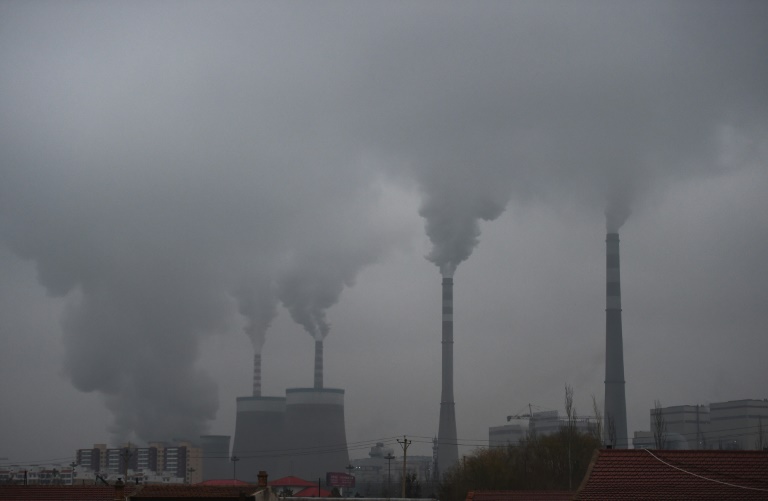
China will help its coal-fired power plants run at full capacity, the government has announced, raising further alarm about the fate of Beijing’s climate pledges.

Swathes of the world’s second-biggest economy were paralysed last year because of power shortages, partly caused by a drop in coal supply as global prices of the fossil fuel soared.

China is the world’s biggest emitter of the greenhouse gases responsible for climate change, and has pledged to peak emissions by 2030 and become carbon neutral by 2060.

But coal production has been ramped up since last year’s energy shortages, sparking uncertainty and concern about those targets.

The focus on energy security and economic growth was reiterated at a high-level meeting of China’s State Council, chaired by Premier Li Keqiang, state news agency Xinhua reported Tuesday.

It was decided in the Monday meeting that “coal supply will be increased and coal-fired power plants will be supported in running at full capacity and generating more electricity” to meet industrial and residential demand, according to Xinhua.

The move comes weeks after President Xi Jinping told top policymakers to ensure that emissions reductions do not hurt economic growth and energy security — widely seen as a signal to limit restrictions on the coal sector.

Following the energy crunch last year, China reopened dozens of coal mines and scrapped production quotas, unravelling earlier steps to curb emissions.

The country’s coal output hit a record of over four billion metric tons last year — the highest in a decade — after imports were disrupted by the pandemic.

Two-thirds of China’s economy is fuelled by coal, and it generates an estimated 29 percent of the world’s greenhouse gas emissions, double the US share and three times that of the European Union.

The Chinese government’s measures to curb emissions are considered crucial to keeping global temperature rises to under 1.5 degrees Celsius as agreed in the landmark Paris climate accord.

“We are pivoting back to the model of supporting the economy at all costs,” said Li Shuo, a campaigner for Greenpeace China. 

“China is losing time for crucial climate action.”

China govt to help run coal power plants at full capacity

China will help its coal-fired power plants run at full capacity, the government has announced, raising further alarm about the fate of Beijing’s climate pledges.

Swathes of the world’s second-biggest economy were paralysed last year because of power shortages, partly caused by a drop in coal supply as global prices of the fossil fuel soared.

China is the world’s biggest emitter of the greenhouse gases responsible for climate change, and has pledged to peak emissions by 2030 and become carbon neutral by 2060.

But coal production has been ramped up since last year’s energy shortages, sparking uncertainty and concern about those targets.

The focus on energy security and economic growth was reiterated at a high-level meeting of China’s State Council, chaired by Premier Li Keqiang, state news agency Xinhua reported Tuesday.

It was decided in the Monday meeting that “coal supply will be increased and coal-fired power plants will be supported in running at full capacity and generating more electricity” to meet industrial and residential demand, according to Xinhua.

The move comes weeks after President Xi Jinping told top policymakers to ensure that emissions reductions do not hurt economic growth and energy security — widely seen as a signal to limit restrictions on the coal sector.

Following the energy crunch last year, China reopened dozens of coal mines and scrapped production quotas, unravelling earlier steps to curb emissions.

The country’s coal output hit a record of over four billion metric tons last year — the highest in a decade — after imports were disrupted by the pandemic.

Two-thirds of China’s economy is fuelled by coal, and it generates an estimated 29 percent of the world’s greenhouse gas emissions, double the US share and three times that of the European Union.

The Chinese government’s measures to curb emissions are considered crucial to keeping global temperature rises to under 1.5 degrees Celsius as agreed in the landmark Paris climate accord.

“We are pivoting back to the model of supporting the economy at all costs,” said Li Shuo, a campaigner for Greenpeace China. 

“China is losing time for crucial climate action.”

Chainsaws, ice and a sauna in India's frozen north

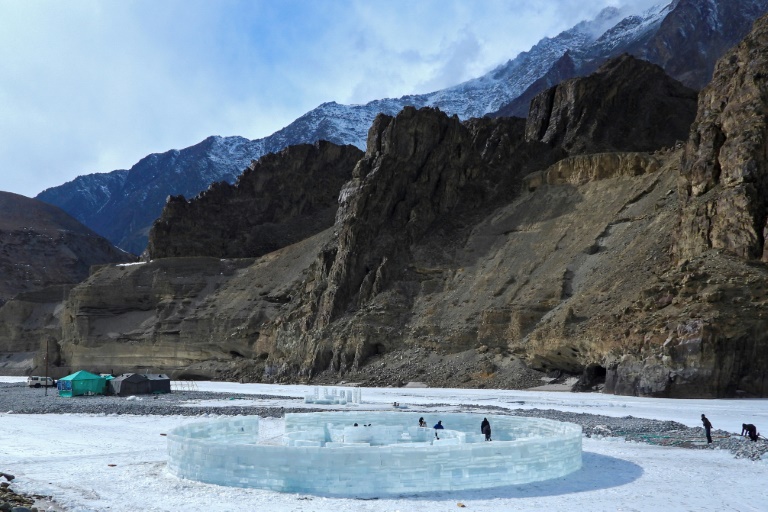
High in the barren Indian Himalayas, artists are chainsawing blocks of ice from a frozen river creating what they hope will be the beginnings of India’s answer to China’s Harbin International Ice Festival.

So far the Kangsing collective have created what they call a “mini-colosseum”, a cafeteria and a sauna near the appropriately named village of Chilling in the northern region of Ladakh.

The installation at 11,000 feet (3,350 metres) serves as the take-off point for the popular seven-day Chadar Trek along the surface of the frozen Zanskar river through breathtaking “frozen desert” scenery that has been shut for two years due to the pandemic.

“We’re thinking we might have a festival big enough, grand enough like Harbin International Festival, something where we can ask artists from all over the world to come and participate,” group member Tashi, who uses only one name, told AFP.

For now the mini-colosseum stands just a little higher than the average person.

But one day its creators hope to emulate the famous ice hotel in Jukkasjarvi, Sweden.

The spot was selected for its lack of sunshine that might melt the ice and where whistling icy winds keep temperatures at a bone-chilling minus 17-20 degrees Celsius (plus 1.5 to minus 4 Fahrenheit) throughout the day.

With some support from the local government the group, which includes a doctor, has also built a sauna at the bank of the frozen river, where they manage to raise the temperature up to 60 degrees Celsius.

A hardy handful in their underpants then plunge straight into a pit outside, dug into the frozen Zanskar, to take an ice bath lasting about a minute — if they can take it.

“Its extraordinary and rejuvenating,” said an invigorated Tundup Gyaltsan, a local policeman.

“You don’t feel the cold at all.”

18 dead in storms near Brazil's Rio de Janeiro: firefighters

Landslides and flooding triggered by heavy rainfall killed at least 18 people Tuesday in a tourist town in the hills above Rio de Janeiro, Brazilian firefighters said.

“So far, 18 deaths caused by landslides and floods have been confirmed” in recent hours, the Rio de Janeiro Fire Department said in a statement.

It said more than 180 firefighters and other rescue workers were at the scene in the picturesque hill town of Petropolis where Brazil’s last emperor Pedro II is buried, 68 kilometers (42 miles) north of the city of Rio.

City hall declared a “state of disaster” as images spread on social media of destroyed houses and cars swept away by floodwater.

Many shops were completely inundated by the rising waters which gushed down the streets of the historic city center. 

Some parts of Petropolis received up to 260 millimeters (10 inches) of water in less than six hours, more than was expected for the whole month of February, according to the meteorological agency MetSul. 

The heaviest downpour had passed but more moderate rainfall was expected to continue for several hours, authorities said.

President Jair Bolsonaro, on an official trip to Russia, said on Twitter that he was keeping abreast of “the tragedy” and asked his ministers to provide “immediate aid to the victims.”

Earlier this month, floods and landslides caused by torrential rain killed at least 28 people in the southeast of the country, mostly in Sao Paulo state and the region north of Rio.

In January 2011, more than 900 people died in the mountainous region of Rio due to heavy rains that caused flooding and landslides in a large area including Petropolis and neighboring cities Nova Friburgo and Teresopolis.
The Brazil resort town disappearing into the sea

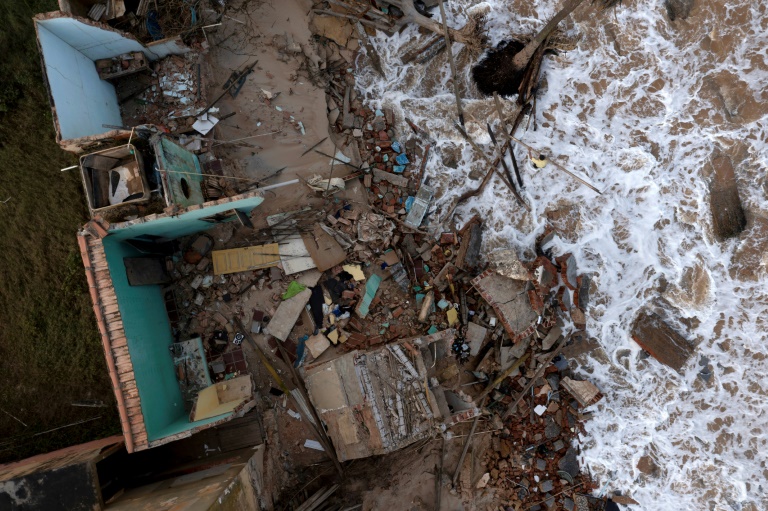
Vultures roam the sand in the Brazilian resort town of Atafona amid the ruins of the latest houses destroyed by the sea, whose relentless rise has turned the local coastline into an apocalyptic landscape.

The Atlantic Ocean advances an average of six meters (nearly 20 feet) a year in this small town north of Rio de Janeiro, which has long been prone to extreme erosion — now exacerbated by climate change.

The sea has already submerged more than 500 houses, turning the once idyllic coastline into an underwater graveyard of wrecked structures.

One of the next to lose his home will be Joao Waked Peixoto.

Walking through the jumbled rubble of what was once his neighbors’ house, he looks at what is left: a fragment of a blue-painted room strewn with tattered magazines, a bicycle and other remnants of life.

“When will we have to leave? That’s an unknown,” he says.

“The sea advanced three or four meters in 15 days. Our wall might not last until next week.”

Waked Peixoto’s grandfather built the house as a vacation home, a beachfront getaway with large rooms and a garden.

During the coronavirus pandemic, Waked Peixoto and his family moved in full-time.

But it now looks inevitable the house will be swallowed by the sea.

“It will be a shame to lose this house, because it holds so many memories of my whole family,” he says.

– Extreme erosion –

Atafona, a town of some 6,000 people, has long suffered from extreme erosion. It is part of the four percent of coastlines worldwide that lose five meters or more every year.

The problem is being exacerbated by global warming, which is causing sea levels to rise and making currents and weather patterns more extreme, says geologist Eduardo Bulhoes of Fluminense Federal University.

But Atafona has had a “chronic problem” for decades, he says.

The Paraiba do Sul river, whose mouth is in Atafona, has shrunk because of mining, agriculture and other activities that drain it upstream.

“In the last 40 years, that has drastically reduced the river’s volume, meaning it transports less sand to Atafona,” says Bulhoes.

With less sand, the town’s beaches have stopped regenerating naturally, ceding ground to the sea.

Construction on the coast has only made the problem worse, by stripping away sand dunes and vegetation, the beaches’ natural defenses.

The result has been disastrous for the tourism and fishing industries.

“Large boats can’t come through the river delta anymore… and the money disappeared along with them,” says Elialdo Bastos Meirelles, head of a local fishermen’s community of some 600 people.

“The river is dead.”

– ‘Abandoned’ –

Local authorities have studied several plans to curb the erosion, including building dikes to reduce the force of the ocean’s waves and hauling sand from the river delta to the beach.

Bulhoes, the geologist, proposed the latter, which is modeled on similar initiatives in the Netherlands, Spain and the United States.

But the projects exist only on paper so far.

The county under-secretary for the environment, Alex Ramos, told AFP no one had yet come up with a definitive solution, and that any plan would have to gain environmental regulators’ approval first.

In the meantime, the county has launched a social assistance program that pays 1,200 reais ($230) a month to more than 40 families who lost their homes to erosion.

But critics accuse the local government of a lack of political will.

“We keep hearing promises,” says Veronica Vieira, head of neighborhood association SOS Atafona.

“But this town has been abandoned. It’s an apocalypse. It makes you want to cry.”

Close Bitnami banner
Bitnami