AFP

China govt to help run coal power plants at full capacity

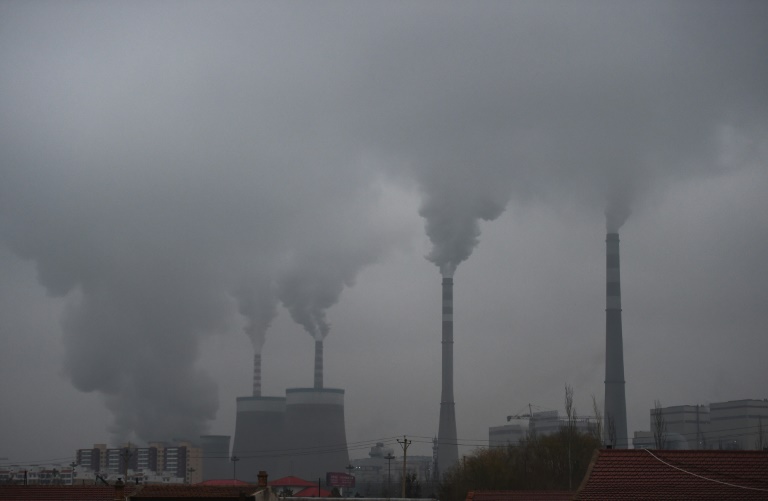
China will help its coal-fired power plants run at full capacity, the government has announced, raising further alarm about the fate of Beijing’s climate pledges.

Swathes of the world’s second-biggest economy were paralysed last year because of power shortages, partly caused by a drop in coal supply as global prices of the fossil fuel soared.

China is the world’s biggest emitter of the greenhouse gases responsible for climate change, and has pledged to peak emissions by 2030 and become carbon neutral by 2060.

But coal production has been ramped up since last year’s energy shortages, sparking uncertainty and concern about those targets.

The focus on energy security and economic growth was reiterated at a high-level meeting of China’s State Council, chaired by Premier Li Keqiang, state news agency Xinhua reported Tuesday.

It was decided in the Monday meeting that “coal supply will be increased and coal-fired power plants will be supported in running at full capacity and generating more electricity” to meet industrial and residential demand, according to Xinhua.

The move comes weeks after President Xi Jinping told top policymakers to ensure that emissions reductions do not hurt economic growth and energy security — widely seen as a signal to limit restrictions on the coal sector.

Following the energy crunch last year, China reopened dozens of coal mines and scrapped production quotas, unravelling earlier steps to curb emissions.

The country’s coal output hit a record of over four billion metric tons last year — the highest in a decade — after imports were disrupted by the pandemic.

Two-thirds of China’s economy is fuelled by coal, and it generates an estimated 29 percent of the world’s greenhouse gas emissions, double the US share and three times that of the European Union.

The Chinese government’s measures to curb emissions are considered crucial to keeping global temperature rises to under 1.5 degrees Celsius as agreed in the landmark Paris climate accord.

“We are pivoting back to the model of supporting the economy at all costs,” said Li Shuo, a campaigner for Greenpeace China. 

“China is losing time for crucial climate action.”
Chainsaws, ice and a sauna in India's frozen north

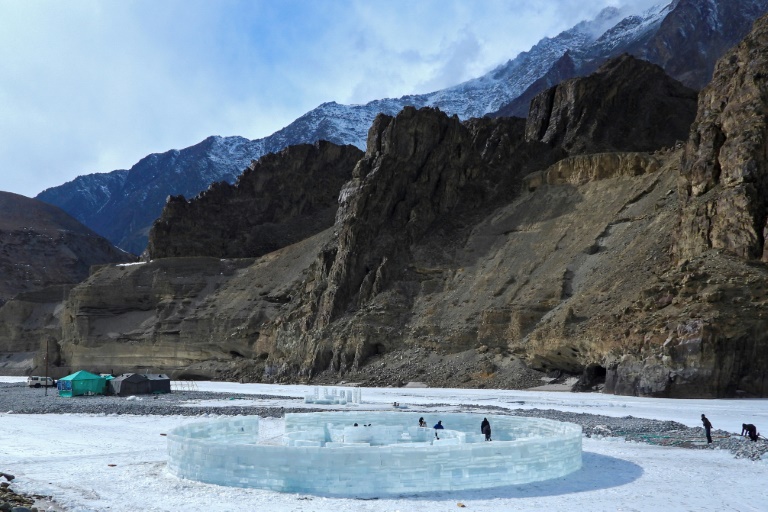
High in the barren Indian Himalayas, artists are chainsawing blocks of ice from a frozen river creating what they hope will be the beginnings of India’s answer to China’s Harbin International Ice Festival.

So far the Kangsing collective have created what they call a “mini-colosseum”, a cafeteria and a sauna near the appropriately named village of Chilling in the northern region of Ladakh.

The installation at 11,000 feet (3,350 metres) serves as the take-off point for the popular seven-day Chadar Trek along the surface of the frozen Zanskar river through breathtaking “frozen desert” scenery that has been shut for two years due to the pandemic.

“We’re thinking we might have a festival big enough, grand enough like Harbin International Festival, something where we can ask artists from all over the world to come and participate,” group member Tashi, who uses only one name, told AFP.

For now the mini-colosseum stands just a little higher than the average person.

But one day its creators hope to emulate the famous ice hotel in Jukkasjarvi, Sweden.

The spot was selected for its lack of sunshine that might melt the ice and where whistling icy winds keep temperatures at a bone-chilling minus 17-20 degrees Celsius (plus 1.5 to minus 4 Fahrenheit) throughout the day.

With some support from the local government the group, which includes a doctor, has also built a sauna at the bank of the frozen river, where they manage to raise the temperature up to 60 degrees Celsius.

A hardy handful in their underpants then plunge straight into a pit outside, dug into the frozen Zanskar, to take an ice bath lasting about a minute — if they can take it.

“Its extraordinary and rejuvenating,” said an invigorated Tundup Gyaltsan, a local policeman.

“You don’t feel the cold at all.”

18 dead in storms near Brazil's Rio de Janeiro: firefighters

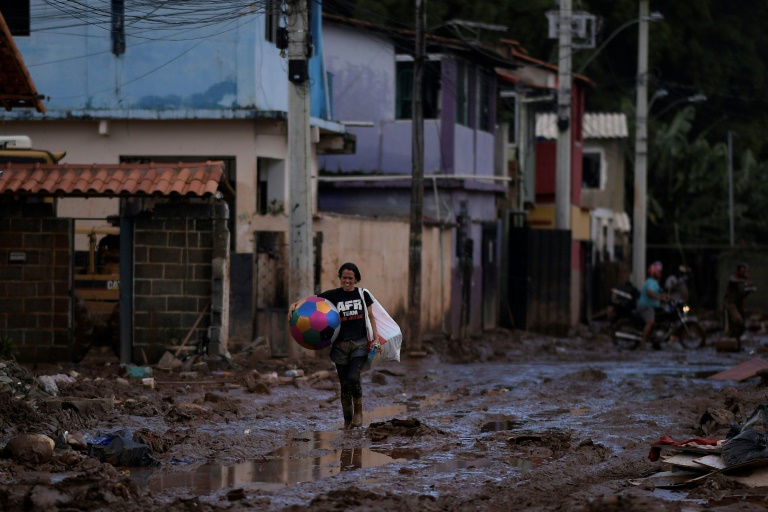
Landslides and flooding triggered by heavy rainfall killed at least 18 people Tuesday in a tourist town in the hills above Rio de Janeiro, Brazilian firefighters said.

“So far, 18 deaths caused by landslides and floods have been confirmed” in recent hours, the Rio de Janeiro Fire Department said in a statement.

It said more than 180 firefighters and other rescue workers were at the scene in the picturesque hill town of Petropolis where Brazil’s last emperor Pedro II is buried, 68 kilometers (42 miles) north of the city of Rio.

City hall declared a “state of disaster” as images spread on social media of destroyed houses and cars swept away by floodwater.

Many shops were completely inundated by the rising waters which gushed down the streets of the historic city center. 

Some parts of Petropolis received up to 260 millimeters (10 inches) of water in less than six hours, more than was expected for the whole month of February, according to the meteorological agency MetSul. 

The heaviest downpour had passed but more moderate rainfall was expected to continue for several hours, authorities said.

President Jair Bolsonaro, on an official trip to Russia, said on Twitter that he was keeping abreast of “the tragedy” and asked his ministers to provide “immediate aid to the victims.”

Earlier this month, floods and landslides caused by torrential rain killed at least 28 people in the southeast of the country, mostly in Sao Paulo state and the region north of Rio.

In January 2011, more than 900 people died in the mountainous region of Rio due to heavy rains that caused flooding and landslides in a large area including Petropolis and neighboring cities Nova Friburgo and Teresopolis.

The Brazil resort town disappearing into the sea

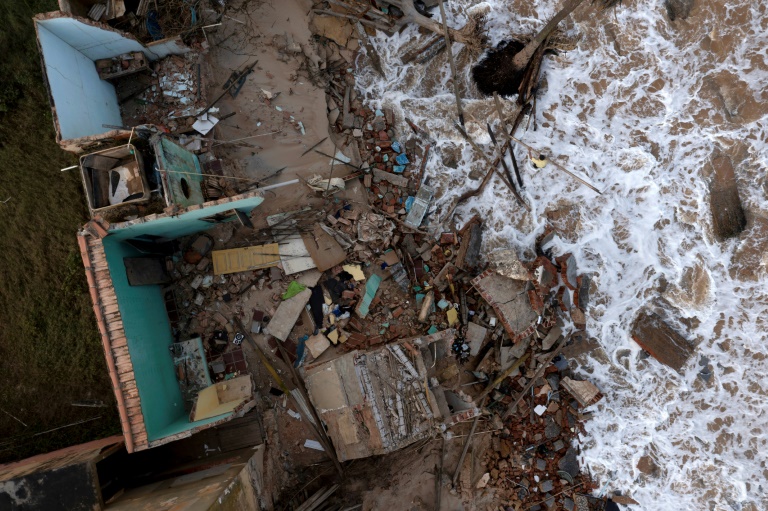
Vultures roam the sand in the Brazilian resort town of Atafona amid the ruins of the latest houses destroyed by the sea, whose relentless rise has turned the local coastline into an apocalyptic landscape.

The Atlantic Ocean advances an average of six meters (nearly 20 feet) a year in this small town north of Rio de Janeiro, which has long been prone to extreme erosion — now exacerbated by climate change.

The sea has already submerged more than 500 houses, turning the once idyllic coastline into an underwater graveyard of wrecked structures.

One of the next to lose his home will be Joao Waked Peixoto.

Walking through the jumbled rubble of what was once his neighbors’ house, he looks at what is left: a fragment of a blue-painted room strewn with tattered magazines, a bicycle and other remnants of life.

“When will we have to leave? That’s an unknown,” he says.

“The sea advanced three or four meters in 15 days. Our wall might not last until next week.”

Waked Peixoto’s grandfather built the house as a vacation home, a beachfront getaway with large rooms and a garden.

During the coronavirus pandemic, Waked Peixoto and his family moved in full-time.

But it now looks inevitable the house will be swallowed by the sea.

“It will be a shame to lose this house, because it holds so many memories of my whole family,” he says.

– Extreme erosion –

Atafona, a town of some 6,000 people, has long suffered from extreme erosion. It is part of the four percent of coastlines worldwide that lose five meters or more every year.

The problem is being exacerbated by global warming, which is causing sea levels to rise and making currents and weather patterns more extreme, says geologist Eduardo Bulhoes of Fluminense Federal University.

But Atafona has had a “chronic problem” for decades, he says.

The Paraiba do Sul river, whose mouth is in Atafona, has shrunk because of mining, agriculture and other activities that drain it upstream.

“In the last 40 years, that has drastically reduced the river’s volume, meaning it transports less sand to Atafona,” says Bulhoes.

With less sand, the town’s beaches have stopped regenerating naturally, ceding ground to the sea.

Construction on the coast has only made the problem worse, by stripping away sand dunes and vegetation, the beaches’ natural defenses.

The result has been disastrous for the tourism and fishing industries.

“Large boats can’t come through the river delta anymore… and the money disappeared along with them,” says Elialdo Bastos Meirelles, head of a local fishermen’s community of some 600 people.

“The river is dead.”

– ‘Abandoned’ –

Local authorities have studied several plans to curb the erosion, including building dikes to reduce the force of the ocean’s waves and hauling sand from the river delta to the beach.

Bulhoes, the geologist, proposed the latter, which is modeled on similar initiatives in the Netherlands, Spain and the United States.

But the projects exist only on paper so far.

The county under-secretary for the environment, Alex Ramos, told AFP no one had yet come up with a definitive solution, and that any plan would have to gain environmental regulators’ approval first.

In the meantime, the county has launched a social assistance program that pays 1,200 reais ($230) a month to more than 40 families who lost their homes to erosion.

But critics accuse the local government of a lack of political will.

“We keep hearing promises,” says Veronica Vieira, head of neighborhood association SOS Atafona.

“But this town has been abandoned. It’s an apocalypse. It makes you want to cry.”

Sea level projected to rise a foot on US coasts by 2050

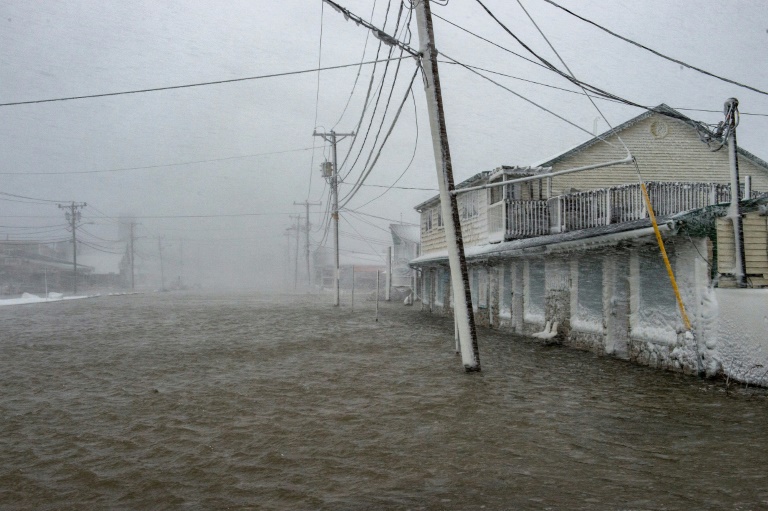
The US coastline is expected to experience up to a foot (30 centimeters) of sea-level rise by the year 2050 because of climate change, making damaging floods far more common than today, a US government study said Tuesday.

The Sea Level Rise Technical Report combined tide gauge and satellite observations with climate modeling from the latest Intergovernmental Panel on Climate Change (IPCC) to make projections for the next 100 years.

It updates a 2017 technical report, providing new information on how tide-, wind- and storm-driven water levels affect current future flood risk.

The 111-page study predicted sea levels along the coastline will rise 10-12 inches between 2020-2050 — as much rise over a 30-year period as the previous 100-year period of 1920-2020. 

Specific amounts vary regionally, mainly due to land height changes. 

“This new data on sea rise is the latest reconfirmation that our climate crisis — as the President has said — is blinking ‘code red,'” said Gina McCarthy, National Climate Advisor, in a news release.

“We must redouble our efforts to cut the greenhouse gasses that cause climate change while, at the same time, help our coastal communities become more resilient in the face of rising seas.”

The report also found that the sea level rise will drastically increase the rate of coastal flooding, even without storms or heavy rainfall.

“By 2050, moderate flooding — which is typically disruptive and damaging by today’s weather, sea level and infrastructure standards — is expected to occur more than 10 times as often as it does today,” said Nicole LeBoeuf of the National Oceanic and Atmospheric Administration, which led the report that was co-authored by half a dozen agencies.

Moderate floods that now occur every two to five years would happen multiple times in a single year.

Higher sea levels are caused by the melting ice sheets and glaciers and the expansion of seawater as it warms, and are linked to higher global temperatures.

About two feet of sea level rise is thought increasingly likely between 2020 and 2100 because of greenhouse gas emissions seen to date, the report said.

But failing to curb future emissions could cause an additional 1.5 to five feet of rise, for a total of 3.5 to seven feet by the end of the century.

Above 5.5 degrees Fahrenheit (three degrees Celsius) warming might cause much higher sea level rise because of the potential for rapid melting of ice sheets in Greenland and Antarctica, but the precise level is uncertain because of current model limitations.

Expanding monitoring through satellite tracking of sea levels and ice sheet thickness will be critical to improving models and helping inform adaptation plans, the report said. 

“For businesses along the coast, knowing what to expect and how to plan for the future is critical,” said Secretary of Commerce Gina Raimondo.

Faroe Islands begin review of controversial dolphin hunt

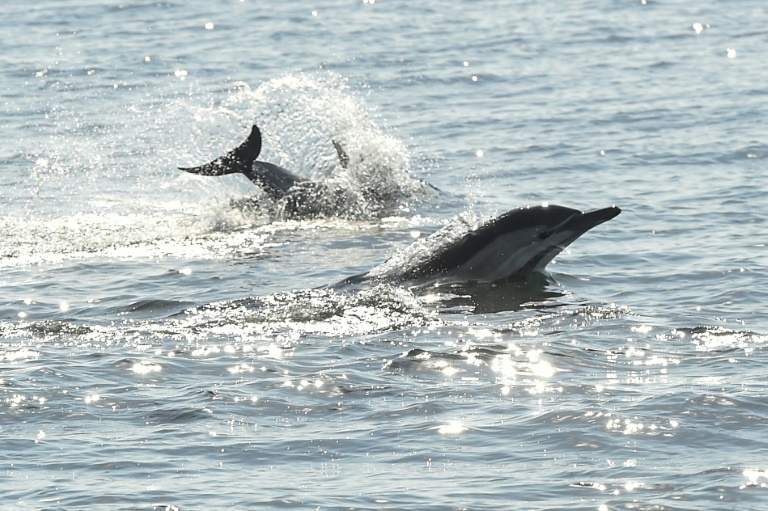
The Faroe Islands, a Danish autonomous territory, said Tuesday it had begun discussions about the future of its controversial dolphin hunt, with a decision expected in the coming weeks.

A petition with almost 1.3 million signatures calling for a ban on the traditional hunt was submitted to the Faroese government on Monday, the prime minister’s office and whale conservation groups told AFP.

At a meeting on Tuesday in Torshavn, the government discussed the conclusions of a re-evaluation that Prime Minister Bardur a Steig Nielsen had ordered in September, after the unusually large slaughter of more than 1,400 Atlantic white-sided dolphins sparked an outcry.

“It was a first meeting. No decisions were taken,” an official in the prime minister’s office told AFP.

He added that a final decision was expected “in a few weeks”, and “several options” were on the table.

In the Faroese tradition known as “grindadrap”, or “grind” for short, hunters surround dolphins or pilot whales with a wide semi-circle of fishing boats and drive them into a shallow bay where they are beached.

Fishermen on shore slaughter them with knives.

Every summer, images of the bloody hunt make headlines around the world and spark outrage among animal rights defenders who consider the practice barbaric.

But the hunt still enjoys broad support in the Faroes, where supporters point out that the animals have fed the local population for centuries.

Normally, around 600 pilot whales are hunted every year in this way.

But the dolphin hunt on September 12, 2021 in the Skala fjord was much bigger, triggering an international outcry and pushing the government to reconsider the practice.

Only the dolphin hunt is currently being reviewed, not the entire “grind” tradition.

In the petition, handed over by the Whale and Dolphin Conservation organisation, signatories called for the end of the “cruel” practice.

Virgin Galactic re-opens ticket sales for $450,000

Virgin Galactic, which last year flew its flamboyant founder Richard Branson to space, will re-open ticket sales to the general public starting Wednesday, for the sum of $450,000.

Previously, only people who had paid a deposit to be on a waiting list could buy new tickets — but now sales are once more open to everyone.

“We plan to have our first 1,000 customers on board at the start of commercial service later this year, providing an incredibly strong foundation as we begin regular operations and scale our fleet,” said CEO Michael Colglazier in a statement.

Established in 2004, Virgin Galactic is looking to build on the success of a high profile test mission last July, which saw Branson beat Blue Origin founder Jeff Bezos in their billionaire space race by a few days. 

But Virgin has not flown since then. In October it announced it was entering an “enhancement period” to make safety upgrades to its fleet, and pushed back a planned test flight with the Italian Air Force to this year. 

Its target to fly its first paying individual customers towards the end of 2022 puts it behind its competition in the nascent space tourism sector — Blue Origin and Elon Musk’s SpaceX — which have already flown commercial passengers. 

Blue Origin’s suborbital rockets have now carried out three crewed flights with customers and guests, though the price is thought to be significantly higher.

Privately-held Blue Origin and SpaceX have not revealed their exact ticket costs, unlike publicly-traded Virgin Galactic, which is required to be more transparent.

Virgin’s spaceflights launch from Spaceport America in New Mexico. 

A massive carrier aircraft takes off horizontally, gains high altitude, and drops a rocket-powered spaceplane that soars into space at Mach-3, before gliding back to Earth.

The total journey time is 90 minutes, with passengers experiencing a few minutes of weightlessness in the spaceplane’s cabin, from where they can also observe the Earth’s curvature through 17 windows.

As of last November, the company said it had sold 700 tickets. The current fare, which includes a $150,000 deposit, is well above the $200,000-$250,000 paid by some waiting 600 customers from 2005 to 2014.

Plastic, chemical pollution beyond planet's safe limit: study

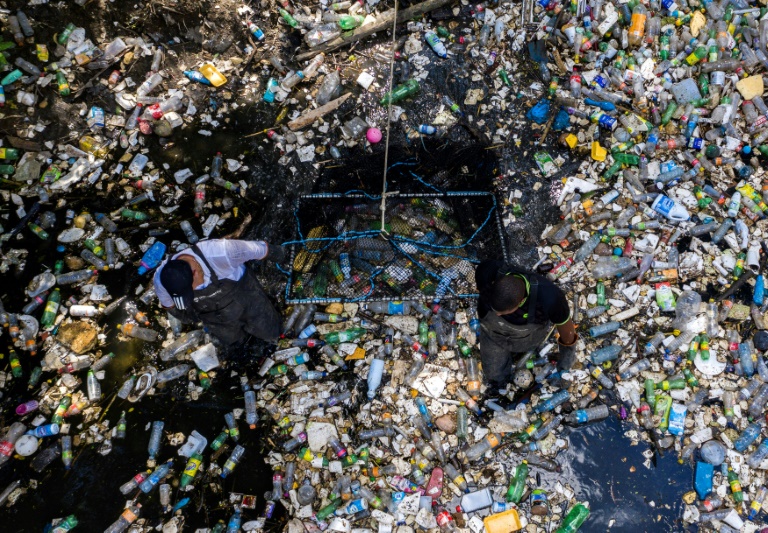
The torrent of man-made chemical and plastic waste worldwide has massively exceeded limits safe for humanity or the planet, and production caps are urgently needed, scientists have concluded for the first time.

There are an estimated 350,000 different manufactured chemicals on the market and large volumes of them end up in the environment.

“The impacts that we’re starting to see today are large enough to be impacting crucial functions of planet Earth and its systems”, Bethanie Carney Almroth, co-author of a new study told AFP in an interview.

The study, by the Stockholm Resilience Centre, comes ahead of a UN meeting in Nairobi at the end of the month on tackling plastic pollution “from source to sea”, UN Environment Programme head Inger Andersen said on Monday.

Chemicals and plastics are affecting biodiversity, piling additional stress on already stressed ecosystems.

Pesticides kill living organisms indiscriminately and plastics are ingested by living things.

“Some chemicals are interfering with hormone systems, disrupting growth, metabolism and reproduction in wildlife,” Carney Almroth said.

While greater efforts are needed to prevent these substances being released into the environment, scientists are now pushing for more drastic solutions, such as production caps.

– ‘Enough is enough’ –

Recycling has so far yielded only mediocre results.

Less than 10 percent of the world’s plastic is currently recycled, even as production has doubled to 367 million tonnes since 2000. 

Today, the total weight of plastic on Earth is now four times the biomass of all living animals, according to recent studies.

“What we’re trying to say is that maybe we have to say, ‘Enough is enough’. Maybe we can’t tolerate more,” the Sweden-based researcher said.

“Maybe we have to put a cap on production. Maybe we need to say, ‘We can’t produce more than this’.”

For several years, the Stockholm Resilience Centre has been conducting studies on “planetary boundaries” in nine areas that influence Earth’s stability, such as greenhouse gas emissions, freshwater usage and the ozone layer.

The aim is to determine if mankind is in a “safe operating space” or if the limits are being exceeded and threaten the future of the planet.

The impact of so-called “novel entities” — or man-made chemical products such as plastics, antibiotics, pesticides, and non-natural metals — has until now been a big question.

And the answer is complex.

“We are only beginning to understand the large-scale, long-term effects of these exposures,” Carney Almroth said.

Not only are there thousands of these products but the data on the risks they pose is often non-existent or classified as corporate secrets.

Additionally, the chemicals are relatively recent, most of them developed in the past 70 years.

“And we’re talking about 350,000 different substances,’ Carney Almroth said.

“We don’t have knowledge on the vast majority of those, in terms of how much are produced or their stability. Or their fate in the environment or their toxicity.”

“We know what some of them are. For most of them, we have no clue.”

Even the most comprehensive databases, such as the European Union’s REACH inventory, only cover 150,000 products, and only a third of those have been the subject of detailed toxicity studies.

– ‘No silver bullet’ –

As a result, the team of researchers focused on what is known, and this partial information was enough to draw an alarming conclusion.

“Looking at changes over time and trends in production volumes lost in the environment … and connecting that to the little bit we do know about impacts, we could say that every arrow is pointing in the wrong direction”, Carney Almroth said.

There is still “time to revert this situation” but it will take “urgent and ambitious actions … at an international level”, she added.

Furthermore, “there’s no silver bullet”.

“No one answer is going to solve all of this, because a lot of these chemicals and materials are things that we use and that are necessary for our lives as of right now,” she said.

Regardless of how much effort is made during the production or waste management phase, production volumes need to come down, she stressed.

“This seems very obvious to say but it’s only recently accepted as truth: The more you produce, the more you release”.

Mongolia reopens borders for vaccinated travellers

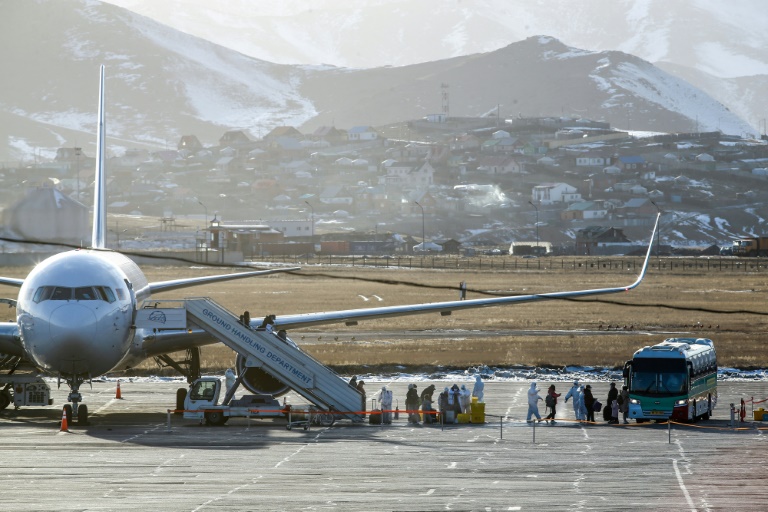
Mongolia has reopened its borders to fully vaccinated international travellers, state media reported, rolling back coronavirus curbs that had kept the country isolated for two years.

The nation has implemented some of the world’s toughest anti-Covid measures since the start of the pandemic, largely sealing off its borders and imposing several lockdowns.

The curbs have battered its economy as businesses closed, exports plunged and hundreds of thousands faced precarious employment.

Mongolia’s cabinet approved a resolution downgrading the pandemic “state of readiness” from orange to yellow, effectively lifting all restrictions on business operations, state news agency Montsame reported Monday.

The move means the country of three million “fully opens its borders to international travel”, Prime Minister Luvsannamsrai Oyun-Erdene said, according to Montsame.

Declaring Mongolia open to fully jabbed tourists and investors, he reportedly said the government would “put efforts into creating the necessary conditions to ensure safety… for all those arriving in the country for business and tourism purposes”.

Oyun-Erdene’s predecessor resigned last year during protests and public anger over the treatment of a coronavirus-positive woman and her newborn baby.

She had been transferred to a disease control centre in hospital pyjamas and plastic slippers despite temperatures of minus 25 degrees Celsius.

An aggressive Covid vaccination campaign has since helped turn the tide, with 92 percent of Mongolian adults now fully inoculated and more than half in targeted groups having received a booster, according to Montsame.

Mongolia has recorded 885,000 coronavirus cases and more than 2,000 deaths during the pandemic, according to World Health Organisation data.

The border reopening follows the easing of restrictions last month under the orange and yellow readiness levels.

Official advisories on wearing face masks, social distancing and hand sanitising remain in place.

Young labels make sustainable fashion headway at NY Fashion Week

Two years after losing her job in fashion due to the pandemic, Emma Gage founded her own brand, Melke, that debuted at this season’s New York Fashion Week with an emphasis on sustainability.

The 26-year-old from Minnesota is not the first to bet on this trend, at a moment when the fashion industry has faced criticism for its environmental impact.

Another designer, 23-year-old Olivia Cheng, told AFP that “everybody now wants to be part of this conversation.”

Her brand, Dauphinette — known for its jewelry and outfits crafted from real flowers — was featured on New York fashion week’s official calendar for the first time, showing over the weekend at a Chinatown restaurant.

Gage cited the use of hemp, organic cotton and recycled fabrics as materials that are less environmentally harmful, and also voiced her mission to purchase materials from companies committed to respecting human rights.

“I would never want to come out and say like, yeah, everything’s 100%, sustainable, everything’s perfect,” Gage said. “Because that’s a lie.”

Speaking from her studio in Brooklyn’s Bushwick neighborhood, a trendy area for New York creatives, Gage said she’s “focusing on making pieces that will last.”

– Zero plastic? Still elusive –

She said “zero plastic” remains an elusive goal at the moment, because synthetic materials often slip into recycled fabrics.

Thus the focus on durability, and making use of every piece of fabric on hand: Gage creates “scrap bags” made out of small bits of material, for example.

Far from voluminous or elegant evening gowns, one of Gage’s favorite items is the humble sweater, which she makes a play on every collection with embroidered motifs — flowers, fish and now sheep have graced her pieces.

But keeping it simple doesn’t translate to less creativity. The designer’s second collection — inspired by the Anne Carson book “Autobiography of Red” — emphasizes this strong color, often incorporating dark tones and using fringe reminiscent of lava flows.

For her fall/winter 2022 collection, set for presentation Tuesday, Gage wanted to evoke memories of a trip to an Irish medieval castle and her discovery of falconry: “The symbiotic relationship of two predators working together — you have human and a bird trying to work together for the same common goal.”

– Gingko nuts and beetle wings –

Cheng’s presentation Sunday bet on old clothes and floral materials, preserved thanks to a resin she said is non-toxic.

She also ventured into experimentation, offering one outfit made of gingko nuts and a dress studded with beetle wings — which she specified died of natural causes and not for her project.

Both designers said they favor local suppliers but aren’t against sourcing from elsewhere.

Gage said that only sourcing stateside “completely eliminates all of the beautiful craftsmanship that exists around the world.”

She does face a dilemma of keeping her brand — which makes pieces to order — affordable.

“I can’t be the only one making things more affordable, if they’re sustainable,” she said. “I need other people to also be buying what I’m buying so that the price can go down.”

But that kind of popularity could create its own problem of overproduction and waste. Gage has tried to approach the problem by creating a product line with varying price points, the least expensive being a t-shirt for $75.

Cheng — the daughter of Chinese immigrants who has two dresses on show in the Metropolitan Museum’s current fashion exhibition — is able to keep prices lower for her fruit and flower jewelry, with some pieces going for less than $50.

“It’s most central to me to remember why we started our mission and how we can kind of further that story,” she said. “And to not get caught up in kind of the illusions of grandeur.”

Close Bitnami banner
Bitnami