AFP

Rocket set to hit Moon was built by China, not SpaceX, say astronomers

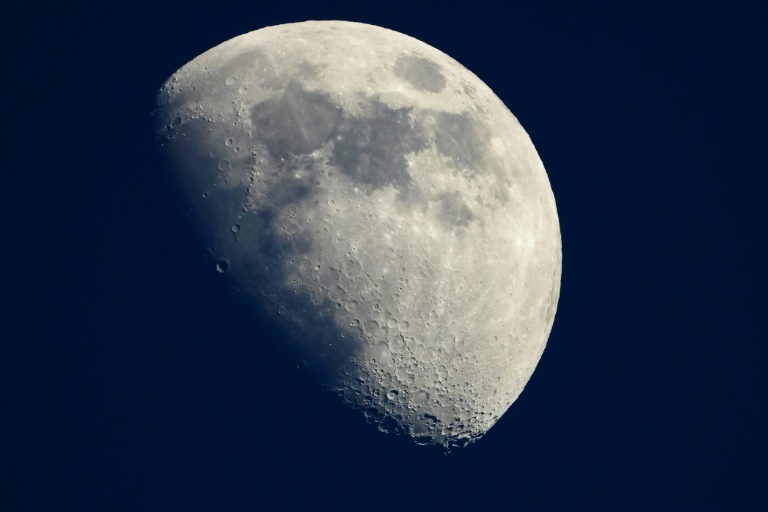
Astronomy experts say they originally misread the secrets of the night sky last month: it turns out that a rocket expected to crash into the Moon in early March was built by China, not SpaceX.

A rocket will indeed strike the lunar surface on March 4, but contrary to what had been announced, it was built not by Elon Musk’s company, but by Beijing, experts now say.

The rocket is now said to be 2014-065B, the booster for the Chang’e 5-T1, launched in 2014 as part of the Chinese space agency’s lunar exploration program.

The surprise announcement was made by astronomer Bill Gray, who first identified the future impact, and admitted his mistake last weekend.

“This (honest mistake) just emphasizes the problem with lack of proper tracking of these deep space objects,” tweeted astronomer Jonathan McDowell, who advocates for greater regulation of space waste.

“The object had about the brightness we would expect, and had showed up at the expected time and moving in a reasonable orbit,” he wrote in post.

But “in hindsight, I should have noticed some odd things” about its orbit, he added.

NASA said in late January that it would attempt to observe the crater that will be formed by the explosion of this object, thanks to its probe that orbits around the Moon, the Lunar Reconnaissance Orbiter (LRO).

The agency called the event an “exciting research opportunity.” 

Climate-boosted drought in western US worst in 1,200 years

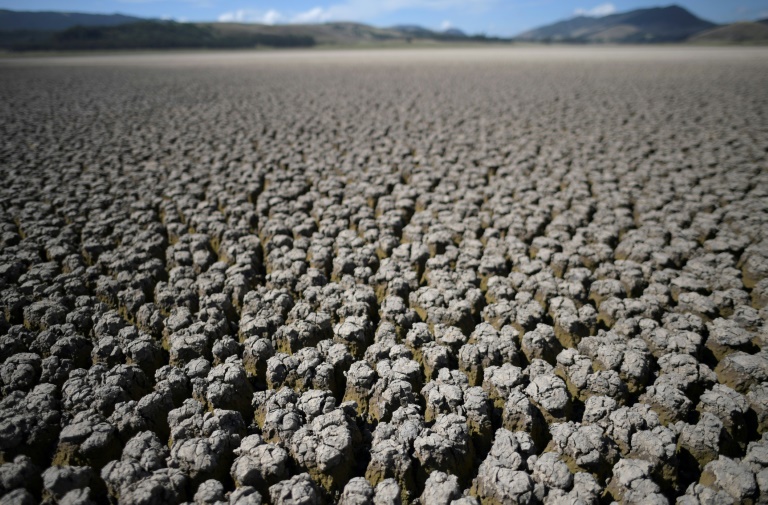
The megadrought that has parched southwestern United States and parts of Mexico over the last two decades is the worst to hit the region in at least 1,200 years, researchers said Monday.

Human-caused global heating accounts for more than 40 percent of the dry spell’s intensity, they reported in the journal Nature Climate Change.

“The turn-of-the-21st-century drought would not be on a megadrought trajectory without anthropogenic climate change,” lead author Park Williams, an associate professor at the University of California in Los Angeles, and colleagues wrote.

Over the last decade, California and other western states have experienced severe water shortages, triggering periodic restrictions on water usage and forcing some communities to import bottled water for drinking.

Occasional heavy snow or rainfall have not been enough to compensate. 

2021 was especially dry. As of February 10, 95 percent of western US had drought conditions, according to the US government’s Drought Monitor.

Last summer, two of North America’s largest reservoirs — Lake Mead and Lake Powell — reached their lowest recorded level in more than a century. 

The odds are high that the current dry spell will continue for at least a couple of years, probably longer, according to the findings.

Running simulations based on soil moisture records stretching back 1,200 years, the researchers calculated a 94 percent chance that the drought would extend through 2022.

There’s a three-in-four chance it will run until the end of decade.

Tree-ring analysis shows that the area west of the Rocky Mountains from southern Montana to northern Mexico was hit repeatedly by so-called megadroughts — lasting at least 19 years — between the years 800 and 1600. 

– Chronic water scarcity –

Earlier research had established that the period 2000-2018 was likely the second worst drought since the year 800, topped by one in the late 1500s. 

Data from 2019-2021, backed by new climate models released last year, have revealed the current drought to be worse than any from the Middle Ages.

But without climate change it “wouldn’t hold a candle to the megadroughts of the 1500s, 1200s or 1100s,” Williams said in a statement.

Western North America is not the only region hit by increasingly severe dry periods.

Climate change worsened the El Nino-driven droughts of 2015-2016, leading to widespread crop failures, loss of livestock, Rift Valley fever outbreaks, and increased rates of malnutrition. 

Globally, 800 million to three billion people are projected to experience chronic water scarcity due to drought caused by two degrees Celsius warming above preindustrial levels, according to a draft 4,000-page Intergovernmental Panel on Climate Change (IPCC) report on climate impacts seen by AFP. 

In a 4C world, that figure is up to four billion people.

Earth’s surface has already warmed 1.1C on average, and is almost certain to breach the 1.5C cap called for in the Paris Agreement within two decades. 

Other natural extreme weather events enhanced by global warming include deadly heatwaves, flood-causing rainfall and superstorms.

US billionaire announces three more ambitious SpaceX flights

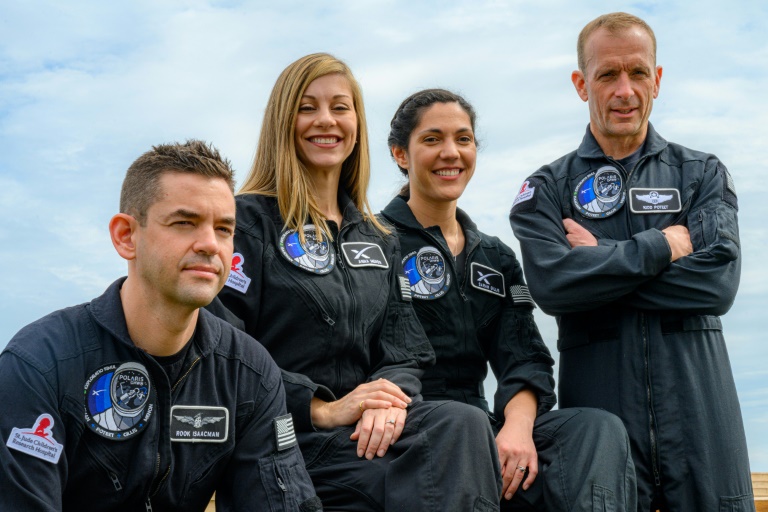
US billionaire Jared Isaacman, who chartered the first all-civilian orbital spaceflight, announced Monday three more private missions with SpaceX — which will include spacewalking and culminate in the first crewed flight of the next-generation Starship rocket.

The first, named Polaris Dawn, will take place no sooner than the fourth quarter of this year, and will be commanded by Isaacman, the founder of payment processing company Shift4.

The program represents a new step for the commercial space sector, as Elon Musk’s SpaceX seeks to carry out more ambitious missions that were until now the domain of national space agencies.

In a press call, Isaacman revealed that the Polaris Program, named after the North Star, will be co-funded by himself and SpaceX. He declined to give further details such as total cost, or the percentage each side would contribute. 

It is however widely expected to run into the hundreds of millions of dollars.

“This program has been purposefully designed to advance long duration spaceflight capabilities… guiding us towards the ultimate goal of facilitating Mars exploration,” Isaacman told reporters.

He is an experienced pilot who last year led the Inspiration4 mission, which saw four civilian crew complete a three-day orbital mission aboard a SpaceX Dragon, raising $240 million for St. Jude Children’s Research Hospital. 

For Polaris Dawn, the crew will journey deeper into space than any Dragon has previously flown — with Isaacman indicating the altitude would be similar to NASA’s Project Gemini, the agency’s second crewed spaceflight program in the 1960s. 

Gemini 11 flew around 850 miles (1370 kilometers) high, which is far deeper into space than more recent missions to the International Space Station, 250 miles high. 

But it is still well short of the journey to the Moon during the Apollo-era, which is roughly 239,000 miles — or 30 Earths back-to-back — away.

The Polaris Dawn crew will also attempt the first commercial spacewalk, which will require new extravehicular space suits that have yet to be developed.

Since Dragon has no airlock, the whole spacecraft will be exposed to the vacuum of space when the hatch is opened. 

The crew will “make sure that everything is secured very well before we open that hatch,” mission specialist and medical officer Anna Menon said.

Launching from the Kennedy Space Center in Florida on a Falcon 9 rocket, the spacecraft will spend up to five days in orbit.

The crew’s intended altitude will see them enter the inner Van Allen belt, a region of dangerous radiation that protects the Earth from solar wind.

Dragon’s hull and the new spacesuits will help protect the crew, who will be measuring radiation exposure throughout, added Menon, a former NASA employee whose husband Anil Menon was selected in the latest cohort of NASA astronaut candidates.

“We had just told our four-year-old son that daddy was going to be an astronaut and our son’s first response was, ‘Mama, when are you going to be an astronaut?'” she said — with her invitation to join Isaacman’s mission coming just weeks later.

– Starship mission –

The crew includes former US Air Force Colonel Scott Poteet — an executive at Isaacman’s companies Shift4 and private aerospace contractor Draken International — as its pilot. 

Rounding out the quartet is Sarah Gillis, SpaceX’s lead space operations engineer, who will assume the role of mission specialist.

During the mission, they will also test laser-based communication in space using SpaceX’s Starlink satellite network, and conduct medical research such as studying decompression sickness, the impacts of space radiation and the effects of spaceflight on eye health.

The last of the three missions will involve a SpaceX Starship rocket, which when complete will be the biggest and most powerful spacecraft ever built. 

Musk sees the vessel as key to fulfilling his vision of colonizing Mars, while a version has been contracted by NASA as a lunar lander for the Artemis program, which is set to return humans to the Moon around the middle of this decade.

Brazil launches plan to expand mining in Amazon

Brazilian President Jair Bolsonaro launched a plan Monday to expand gold mining in the Amazon rainforest, drawing criticism from environmentalists for bolstering an industry accused of rampant deforestation, pollution and attacks on indigenous peoples.

Bolsonaro signed a decree creating a program to support the development of artisanal mining, a controversial activity known as “garimpo” that occupies something of a legal gray area in Brazil.

The decree says the aim is to “propose public policies and stimulate the development of artisanal and small-scale mining, fostering sustainable development for the region and the nation.”

It also creates an inter-ministerial commission on artisanal mining, whose “priority region” will be the nine states that make up Brazil’s 60-percent share of the Amazon.

Artisanal miners, or “garimpeiros,” are divisive in Brazil.

Bolsonaro, whose father was once a “garimpeiro,” defends wildcat miners as hardscrabble frontiersmen.

Critics paint a different picture.

Mining destroyed a record 125 square kilometers (nearly 50 square miles) of the Brazilian Amazon last year — more than twice the size of Manhattan.

Much of the destruction was on protected indigenous reservations.

The use of mercury to separate gold dust from soil has also left toxic pollution in rivers.

Prosecutors say illegal gold miners have links to organized crime, and there have been deadly clashes between armed miners and indigenous groups opposed to them.

Artisanal mining is legal in Brazil, provided miners have environmental licenses and work on authorized land.

But many don’t.

The government estimates there are 4,000 illegal miners operating on indigenous territory in the Amazon. Activists say the figure is much higher.

“What (the government) should be doing is proposing and supporting environmental licensing of this activity and monitoring its implementation,” said Suely Araujo of the Climate Observatory, a coalition of environmental groups.

“Instead… the Bolsonaro administration looks set to defend the sector’s ‘historical values,’ which is to say, environmental destruction,” she said in a statement.

Bolsonaro, who has pushed to expand agribusiness and mining in the Amazon, has faced international outcry over the destruction of the world’s biggest rainforest.

Deforestation in the Brazilian Amazon has surged since the far-right leader took office in 2019, to a 15-year high of 13,235 square kilometers from August 2020 to July 2021.

Ancient mummies of children, likely sacrificed, unearthed in Peru

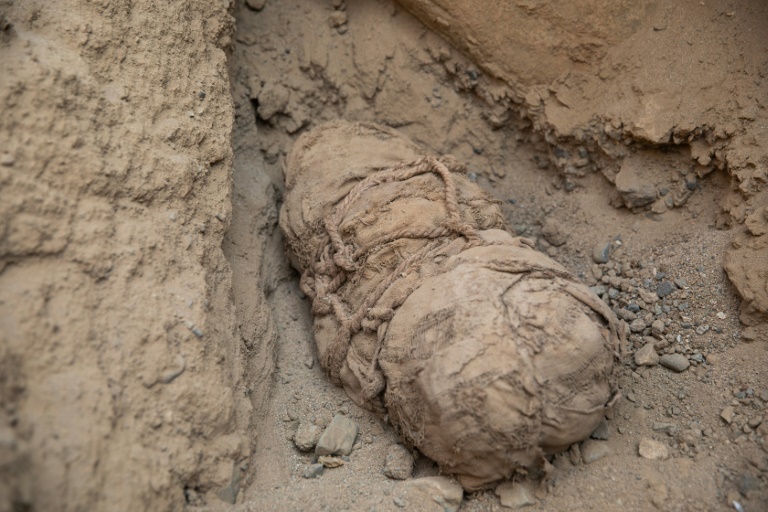
Six mummified children thought to have been sacrificed hundreds of years ago, apparently to accompany a dead nobleman to the afterlife, have been unearthed in a tomb near Lima, archaeologists reported.

The tiny skeletons, wrapped tightly in cloth, were found in the grave of an important man, possibly a political figure, discovered last November at the dig site of Cajamarquilla about 24 kilometers (15 miles) east of Lima. 

“The children could be close relatives and were placed… in different parts of the entrance of the tomb of the (nobleman’s) mummy, one on top of the other,” archaeologist Pieter Van Dalen, in charge of the dig, told AFP. 

“The children, according to our working hypothesis, would have been sacrificed to accompany the mummy to the underworld,” says Van Dalen. 

Cajamarquilla was a city built out of mud in about 200 BC, in the pre-Inca period, and occupied until about 1500. It could have been home to 10,000-20,000 people.

Van Dalen said the mummies were about 1,000 to 1,200 years old.

Nearby, the team also found the bones of seven adults who had not been mummified, as well as the remains of llama-like animals, and earthenware.

The remains of the supposed nobleman were found last year in a tomb some three meters (9.8 feet) long and 1.4 meters deep in Cajamarquilla, one of the largest archaeological complexes near Lima.

He had been about 20 when he died and was entombed with his hands covering his face, and tied up with rope.

Stakes 'never been higher' in climate fight: IPCC head

The stakes in the fight against global warming are higher than ever, the UN’s climate science chief said Monday as nearly 200 nations met to finalise what is sure to be a harrowing report on climate impacts.

“The need for the Working Group 2 report has never been greater because the stakes have never been higher,” Intergovernmental Panel on Climate Change (IPCC) Chair Hoesung Lee said in a live videocast.

Species extinction, ecosystem collapse, mosquito-borne disease, deadly heat, water shortages and reduced crop yields are already measurably worse due to rising temperatures.

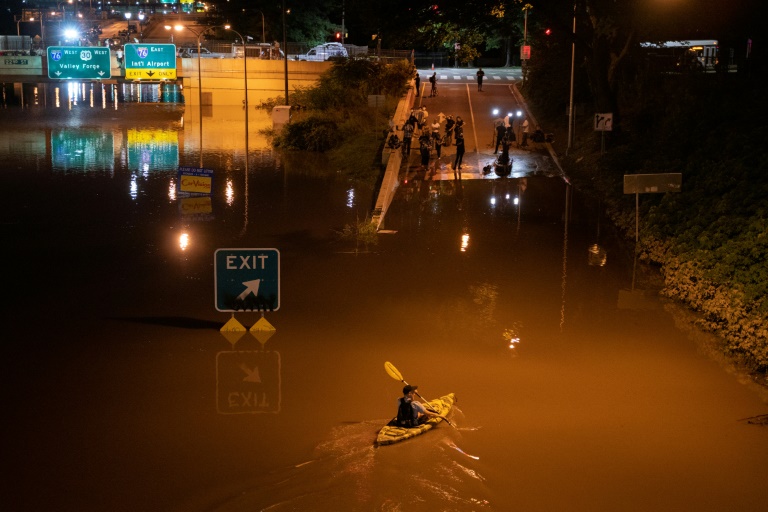
Just in the last year, the world has seen a cascade of unprecedented floods, heatwaves and wildfires across four continents.

All these impacts will accelerate in the coming decades even if the carbon pollution driving climate change is rapidly brought to heel, the IPCC report is likely to warn.

A crucial, 40-page Summary for Policymakers — distilling underlying chapters totalling thousands of pages, and reviewed line-by-line — is to be made public on February 28.

“This is a real moment of reckoning,” said Rachel Cleetus, climate and energy policy director at the Union of Concerned Scientists.

“This not just more scientific projections about the future,” she told AFP ahead the two-week plenary. This is about extreme events and slow-onset disasters that people are experiencing right now.”

The report will also underscore the urgent need for “adaptation” — climate-speak which means preparing for devastating consequences that can no longer be avoided, according to an early draft seen by AFP in 2021.

In some cases this means that adapting to intolerably hot days, flash flooding and storm surges has become a matter of life and death.

– ‘Doping the atmosphere’ –

“The growth in climate impacts is far outpacing our efforts to adapt to them,” said Inger Andersen, head of the UN Environment Programme, noting that climate change threatens to become a major driver of species loss.

IPCC assessments — this will be the sixth since 1990 — are divided into three sections, each with its own volunteer “working group” of hundreds of scientists.

In August 2021, the first instalment on physical science found that global heating is virtually certain to pass 1.5 degrees Celsius (2.7 degrees Fahrenheit), probably within a decade.

Earth’s surface has warmed 1.1C since the 19th century.

“We have been doping the atmosphere with fossil fuels,” World Meteorological Organization chief Petteri Taalas said Monday, comparing the result to the “enhanced performance” of Olympic athletes who used banned substances.

The 2015 Paris deal calls for capping global warming at “well below” 2C, and ideally 1.5C.

This report is sure to reinforce this more ambitious goal. 

It will likewise underscore that vulnerability to extreme weather events — even when they are made worse by global warming — can be reduced by better planning and preparation, according to the draft seen by AFP.

This is not only true in the developing world, noted Imperial College professor Friederike Otto, pointing to massive flooding in Germany last year that killed scores and caused billions in damage. 

– Tipping points –

“Even without global warming there would have been a huge rainfall event in a densely populated geography where the rivers flood very easily,” said Otto, a pioneer in the science of quantifying the extent to which climate change makes extreme weather events more likely or intense.

The report will zero in on how climate change is widening already yawning gaps in inequality, both between regions and within nations. 

The simple fact is that the people least responsible for climate change are the ones suffering the most from its impacts.

The report is also likely to highlight dangerous “tipping points”, invisible temperature trip wires in the climate system for irreversible and potentially catastrophic change.

Some of them — such as the melting of permafrost housing twice as much carbon as in the atmosphere — could fuel global warming all on their own.

“There is a finite set of choices we can make that would move us productively into the future,” said Clark University professor Edward Carr, a lead author of one of the report’s chapters. 

“Every day we wait and delay, some of those choices get harder or go away.”

The Brazil resort town disappearing into the sea

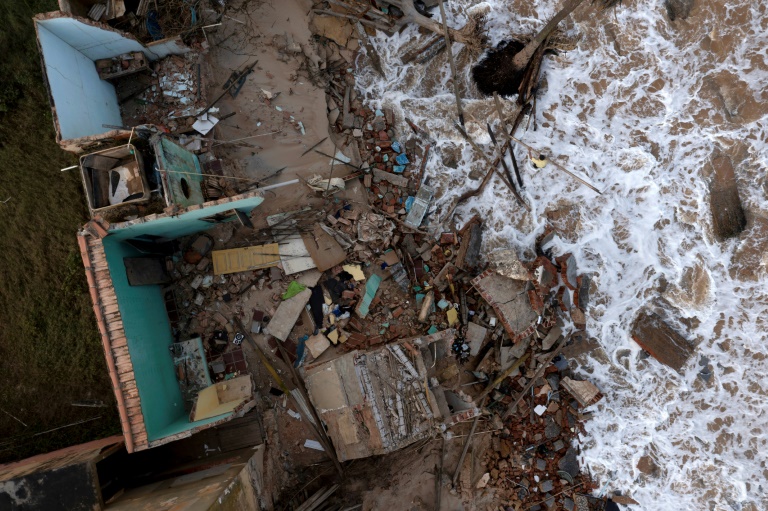
Vultures roam the sand in the Brazilian resort town of Atafona amid the ruins of the latest houses destroyed by the sea, whose relentless rise has turned the local coastline into an apocalyptic landscape.

The Atlantic Ocean advances an average of six meters (nearly 20 feet) a year in this small town north of Rio de Janeiro, which has long been prone to extreme erosion — now exacerbated by climate change.

The sea has already submerged more than 500 houses, turning the once idyllic coastline into an underwater graveyard of wrecked structures.

One of the next to lose his home will be Joao Waked Peixoto.

Walking through the jumbled rubble of what was once his neighbors’ house, he looks at what is left: a fragment of a blue-painted room strewn with tattered magazines, a bicycle and other remnants of life.

“When will we have to leave? That’s an unknown,” he says.

“The sea advanced three or four meters in 15 days. Our wall might not last until next week.”

Waked Peixoto’s grandfather built the house as a vacation home, a beachfront getaway with large rooms and a garden.

During the coronavirus pandemic, Waked Peixoto and his family moved in full-time.

But it now looks inevitable the house will be swallowed by the sea.

“It will be a shame to lose this house, because it holds so many memories of my whole family,” he says.

– Extreme erosion –

Atafona, a town of some 6,000 people, has long suffered from extreme erosion. It is part of the four percent of coastlines worldwide that lose five meters or more every year.

The problem is being exacerbated by global warming, which is causing sea levels to rise and making currents and weather patterns more extreme, says geologist Eduardo Bulhoes of Fluminense Federal University.

But Atafona has had a “chronic problem” for decades, he says.

The Paraiba do Sul river, whose mouth is in Atafona, has shrunk because of mining, agriculture and other activities that drain it upstream.

“In the last 40 years, that has drastically reduced the river’s volume, meaning it transports less sand to Atafona,” says Bulhoes.

With less sand, the town’s beaches have stopped regenerating naturally, ceding ground to the sea.

Construction on the coast has only made the problem worse, by stripping away sand dunes and vegetation, the beaches’ natural defenses.

The result has been disastrous for the tourism and fishing industries.

“Large boats can’t come through the river delta anymore… and the money disappeared along with them,” says Elialdo Bastos Meirelles, head of a local fishermen’s community of some 600 people.

“The river is dead.”

– ‘Abandoned’ –

Local authorities have studied several plans to curb the erosion, including building dikes to reduce the force of the ocean’s waves and hauling sand from the river delta to the beach.

Bulhoes, the geologist, proposed the latter, which is modeled on similar initiatives in the Netherlands, Spain and the United States.

But the projects exist only on paper so far.

The county under-secretary for the environment, Alex Ramos, told AFP no one had yet come up with a definitive solution, and that any plan would have to gain environmental regulators’ approval first.

In the meantime, the county has launched a social assistance program that pays 1,200 reais ($230) a month to more than 40 families who lost their homes to erosion.

But critics accuse the local government of a lack of political will.

“We keep hearing promises,” says Veronica Vieira, head of neighborhood association SOS Atafona.

“But this town has been abandoned. It’s an apocalypse. It makes you want to cry.”

IAEA begins mission to review Fukushima water release

An International Atomic Energy Agency taskforce began a mission Monday in Japan to review the controversial planned release of treated water from the Fukushima nuclear plant into the ocean.

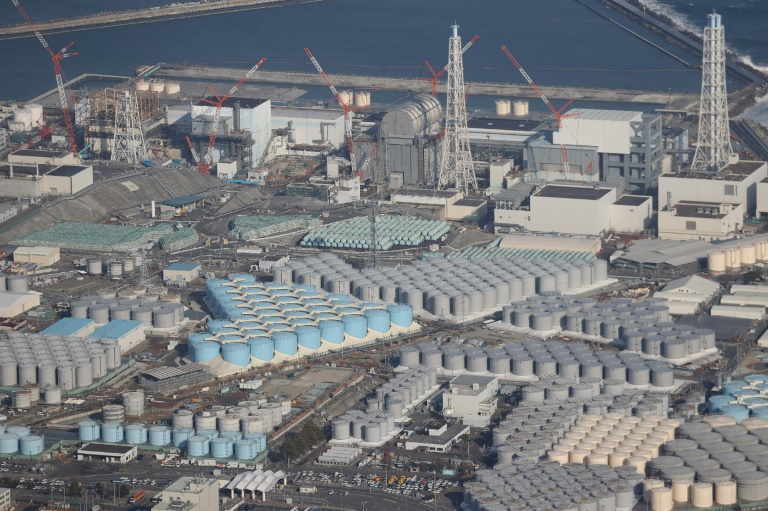
More than a million tonnes of processed water has accumulated in tanks at the crippled plant since it went into meltdown following a tsunami in 2011 and storage space is running out.

An extensive pumping and filtration system removes most radioactive elements, and Japan says the plan to dilute and release the water over several decades is safe.

The IAEA has endorsed the release, which it says is similar to the disposal of wastewater at nuclear plants elsewhere.

But the plan adopted by the government last April, which is expected to begin as soon as March 2023, sparked ire from neighbouring countries over environmental and safety concerns.

It also generated fierce opposition from local fishing communities, who fear it will undermine years of work to restore confidence in their seafood.

Plant operator TEPCO and the Japanese government are hopeful that IAEA monitoring of the process will boost confidence.

“This week we will conduct a mission to review the action, plans, data, and relevant documents, to assess their compliance against the provisions included in international safety standards,” said Gustavo Caruso, director and coordinator of the IAEA’s nuclear safety and security department.

He said the taskforce would be scrutinising elements including the “radiological characterisation of the water to be discharged” and as well the impact on people and the environment.

TEPCO’s chief officer for the treated water management, Junichi Matsumoto, said the firm was already studying infrastructure design and operations for the discharge plan “with the priority on safety and also to contain the impact on the region’s reputation.”

“We hope to further improve the objectivity and transparency of this process through this review,” he added, at a meeting with IAEA and Japanese government officials.

Debate over how to handle the water has dragged on for years, as space to store it at the site runs out, though some critics have suggested there could be ways to store more water until a new plan is devised.

The liquid includes water used to cool damaged reactors, as well as rain and groundwater that seeps into the area.

The filtration process removes most radioactive elements from the water, but some remain, including tritium.

Experts say the element is only harmful to humans in large doses and with dilution the treated water poses no scientifically detectable risk.

The IAEA team will be in Japan February 14-18 and will visit the plant site and give a press conference at the end of their trip.

Nations to review harrowing catalogue of climate impacts

Nearly 200 nations kick off a virtual UN meeting Monday to finalise what is sure to be a harrowing catalogue of climate change impacts — past, present and future.

Species extinction, ecosystem collapse, mosquito-borne disease, deadly heat, water shortages, and reduced crop yields are already measurably worse due to global heating.

Just in the last year, the world has seen a cascade of unprecedented floods, heatwaves and wildfires across four continents.

All these impacts will accelerate in the coming decades even if the carbon pollution driving climate change is rapidly brought to heel, the Intergovernmental Panel on Climate Change (IPCC) report is likely to warn.

A crucial, 40-page Summary for Policymakers — distilling underlying chapters totalling thousands of pages, and reviewed line-by-line — is to be made public on February 28.

“This is a real moment of reckoning,” said Rachel Cleetus, Climate and energy policy director at the Union of Concerned Scientists.

“This not just more scientific projections about the future,” she told AFP. “This is about extreme events and slow-onset disasters that people are experiencing right now.”

The report will also underscore the urgent need for “adaptation” — climate-speak which means preparing for devastating consequences that can no longer be avoided, according to an early draft seen by AFP in 2021.

In some cases this means that adapting to intolerably hot days, flash flooding and storm surges has become a matter of life and death.

– Billions in damages –

“Even if we find solutions for reducing carbon emissions, we will still need solutions to help us adapt,” said Alexandre Magnan, a researcher at the Institute for Sustainable Development and International Relations in Paris and a co-author of the report, without commenting on its findings. 

IPCC assessments — this will be the sixth since 1990 — are divided into three sections, each with its own volunteer “working group” of hundreds of scientists.

In August 2021, the first instalment on physical science found that global heating is virtually certain to pass 1.5 degrees Celsius (2.7 degrees Fahrenheit), probably within a decade.

Earth’s surface has warmed 1.1 degrees Celsius since the 19th century.

The 2015 Paris deal calls for capping global warming at “well below” 2C, and ideally 1.5C.

This report is sure to reinforce this more ambitious goal. 

It will likewise underscore that vulnerability to extreme weather events — even when they are made worse by global warming — can be reduced by better planning and preparation, according to the draft seen by AFP.

This is not only true in the developing world, noted Imperial College professor Friederike Otto, pointing to massive flooding in Germany last year that killed scores and caused billions in damage. 

– Finite set of choices –

“Even without global warming there would have been a huge rainfall event in a densely populated geography where the rivers flood very easily,” said Otto, a pioneer in the science of quantifying the extent to which climate change makes extreme weather events more likely or intense.

The report will zero in on how climate change is widening already yawning gaps in inequality, both between regions and within nations. 

The simple fact is that the people least responsible for climate change are the ones suffering the most from its impacts.

Not only is this unjust, experts and advocates say, it is a barrier to tackling the problem.

“I do not think there are pathways to sustainable development that do not substantively address equity issues,” said Clark University professor Edward Carr, a lead author of one of the report’s chapters.

The report is also likely to highlight dangerous “tipping points”, invisible temperature trip wires in the climate system for irreversible and potentially catastrophic change.

Some of them — such as the melting of permafrost housing twice as much carbon as in the atmosphere — could fuel global warming all on their own.

“There is a finite set of choices we can make that would move us productively into the future,” said Carr. “Every day we wait and delay, some of those choices get harder or go away.”

The third and final instalment of the IPCC assessment currently unfolding, due out in early April, examines options for curbing carbon emissions and removing carbon from the atmosphere.

Covid-pass protest convoy heads for banned Brussels rally

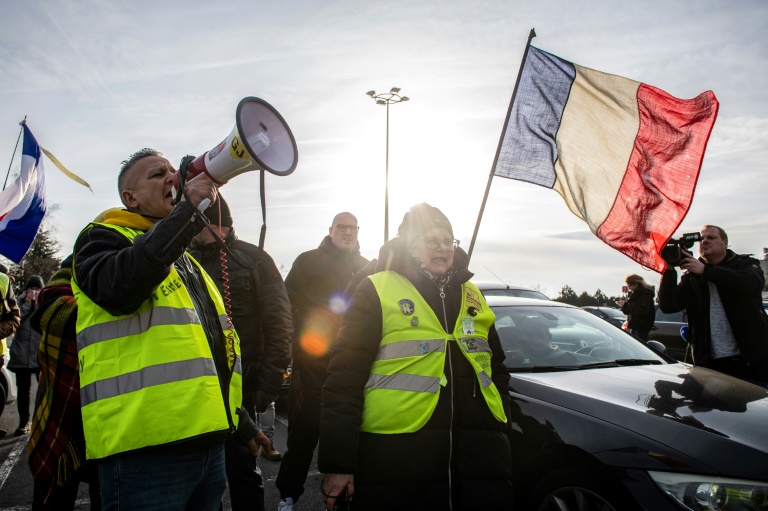
Hundreds of cars, campervans and trucks taking part in a Canada-style protest convoy against Covid regulations were preparing to enter Brussels Monday where Belgian officials have already banned a demonstration following a weekend attempt in Paris.

Around 1,300 vehicles from across France had arrived near the French border town of Lille by late Sunday, according to police.

The protest is one of several worldwide inspired by the truckers’ standoff with authorities in Canada.

Camped at a parking lot near Lille, protesters brandished French flags and chanted “We won’t give up” and “Freedom, freedom.”

“We’ll go to Brussels to try to block it, to fight against this policy of permanent control,” said Jean-Pierre Schmit, an unemployed 58-year-old who came from Toulouse.

For Sandrine, 45, who came from Lyon, the government’s response to the Covid crisis had revealed that “we’re losing our freedoms bit by bit, in an insidious way.”

The latest self-proclaimed “freedom convoy” comes after 97 people were arrested at the weekend in Paris where thousands of demonstrators defied a ban on attempting to blockade the French capital.

In France, the demonstrators took aim at the “vaccine pass” required to enter restaurants, cafes and many other public venues implemented as part of President Emmanuel Macron’s inoculation drive.

– Border checks –

Belgian authorities have banned all demonstrations in the capital with “motorised vehicles” and said they had taken measures to prevent the blocking of the Brussels region.

Brussels police have posted on social media warning that vehicle protests are banned and advising against travelling to the capital by car, channelling convoys to a parking lot on the outskirts of the city as the only place where a static protest will be tolerated.

Some participants in a similar demonstration organised in The Hague have also announced their intention to go to Belgium.

Belgian Prime Minister Alexander De Croo had however advised the demonstrators to abandon their plans to come to Brussels.

“I say to those who come from abroad: look at the rules in Belgium. We never had rules that were too hard and we don’t have so many anymore. So complain at home,” he said Friday.

Checks are planned at the border and vehicles coming to the capital despite the ban will be diverted, Belgian authorities warned.

Brussels airport also advised travellers to take precautions on Monday and come by train for fear of blocking access routes.

The self-proclaimed “freedom convoy” is one of several worldwide inspired by a truckers’ standoff with authorities in Canada over vaccine mandates.

While French police counted 3,000 vehicles outside Paris on Friday evening, only around a hundred made it to the Champs-Elysees avenue in the heart of the capital on Saturday before being forced out after officers deployed tear gas to disperse the protesters.

In Canada, police on Sunday cleared demonstrators who had occupied a key US border bridge for a week but thousands of protesters remained in the capital Ottawa, where they have paralysed the city centre.

The French protest movement brings together those opposed to the Covid vaccine pass required to access many public venues but also some angry at rising energy and food prices, issues which ignited the “yellow vest” protests that shook France in late 2018 and early 2019.

The French government has said it plans to relax face mask mandates by February 28, and is hoping to end the vaccine pass requirement by late March or early April.

burs-ob/roc/mtp/jfx

Close Bitnami banner
Bitnami