AFP

Russia oil embargo, price cap disrupts tankers

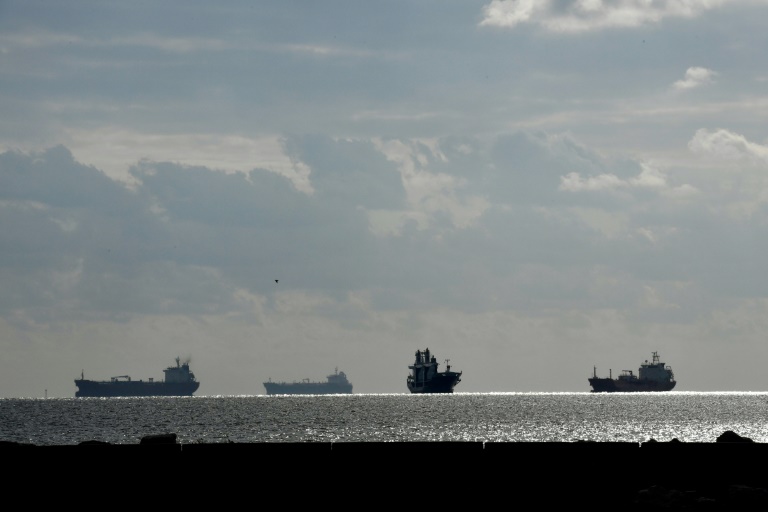
The European Union embargo on Russia’s oil and an international cap on the price of the country’s crude is disrupting the maritime transport sector.

The EU on Monday enforced an embargo on Russian crude shipments, the bloc’s latest sanction in retaliation for Moscow’s invasion of Ukraine.

This week also saw the start of a $60 cap on a barrel of Russian crude, agreed by Western nations.

– Tanker traffic jam –

Aimed at depriving Russia of key income, the measures have also slowed transportation of its oil by sea.

This is because Turkey has started to request proof of insurance from tankers loaded with Russian crude, slowing their passage through the Bosphorus and Dardanelles straits and onto international markets.

The Financial Times has reported that Russia has assembled a “shadow fleet” of more than 100 vessels seeking to circumnavigate the Western sanctions regime.

These ships are reportedly using non-Western insurers and selling oil at higher prices to countries that have not subscribed to the new sanctions.

A 1936 treaty guarantees the freedom of navigation to merchant vessels passing through Turkey’s two straits.

But it also gives Turkey the right to regulate security — a provision it is now using to make sure the oil ships are insured against spillage and other accidents.

The London P&I Club, a leading provider of maritime protection and indemnity insurance, claims “the Turkish government’s requirements go well beyond the general information that is contained in a confirmation of entry letter. 

“It requires… (confirmation) that cover will not be prejudiced under any circumstances, including where there is a sanctions breach on the part of the assured.”

Marcus Baker, global head of Marine & Cargo at insurance broker Marsh, said the price cap “adds another layer of complexity to an already pretty complex situation”.

He also told AFP: “The slowdown that might happen because of this added administrative burden may have the desired effect that the G7 wanted anyway.” 

The price ceiling was agreed by the Group of Seven rich countries, which includes Britain, Japan and the United States, as well as the EU and Australia.

Meanwhile as much as 95 percent of the P&I insurance market is run by insurers in the EU and Britain, who suddenly can no longer insure cargoes of Russia oil sold for more than $60 per barrel.

The market price of a barrel of Russian Urals crude is around $65, suggesting the cap may have only a limited impact in the short term.

President Vladimir Putin on Friday warned that Russia could reduce crude production in response to the price limit.

– Avoiding ban –

“Moscow is already working on circumventing the ban on insurance by providing its own insurance to potential clients through its state-controlled Russian National Reinsurance Company,” noted Edoardo Campanella, analyst at UniCredit Bank.

An executive at an oil shipping company, who wished to remain anonymous, said “it will take a week or two, I think at a minimum, to see how the market will function in light of the price cap”. 

They added: “There’s a general view that there is enough shipping capacity in what can be called a ‘Dark Fleet’ or a sanctions-indifferent fleet so that Russia can sell its oil without regard to the price cap. 

“This means to China, to India, potentially some to Brazil or other parts of the world. So it doesn’t have to comply with the price cap. So there’s enough capacity,” the executive told AFP.

burs-tu-emb/bcp/rl
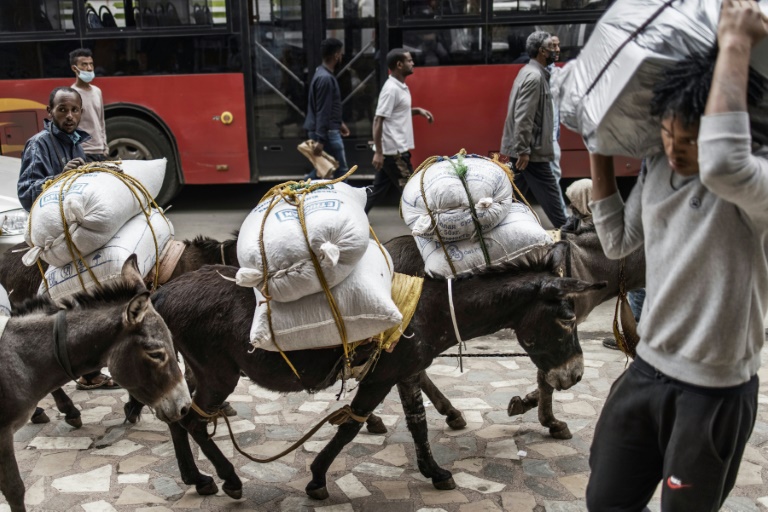
'Everything increasing except wages': inflation batters Ethiopia

“Everything is increasing except our wages,” Ethiopian porter Zerihun told AFP, summing up the financial crisis facing the Horn of Africa nation as it reels from skyrocketing inflation and an economic slowdown.

After a decade of dynamic growth during the 2010s, Africa’s second most populous country has suffered multiple shocks, including the Covid-19 pandemic, a record drought, a two-year war in its northernmost region of Tigray and the global impact of the invasion of Ukraine.

Annual average inflation is expected to hit 30 percent in 2022 (compared to 26 percent last year), driven by an increase in food costs.

“Groceries, food, rent, all prices have gone up,” said Zerihun, a 30-year-old father of two working at the sprawling Merkato market in the capital Addis Ababa.

“Because of the cost of living, life is very difficult… life has become expensive,” said his colleague Sintayeh Tadelle, who has two sons aged 12 and six and “no savings”. 

Were it not for handouts from the Addis Ababa municipal government including uniforms, books and school meals, his family would struggle to survive, the 29-year-old porter told AFP.

The porters at Merkato, considered Africa’s largest open-air market, earn five birr (nine US cents) for loading or unloading a crate.

On average, a good day brings in than five dollars in wages. 

“The economy is slow, so there’s less work and my pay is less,” said Zerihun.

– ‘Very difficult’ – 

Packed with thousands of stalls stocking everything from clothing to industrial machinery, the busy lanes of Merkato teem with buyers, sellers, touts and day labourers.

But regulars say business has taken a sharp hit this year as inflation dampens customer appetite for spending.

“Business is very cold, not only here but in all sectors,” said Hamat Redi, manager of a shop selling televisions and washing machines.

A few doors down, shopkeeper Sisai Desalegn complained about a nationwide shortage of foreign currency, making it difficult for him to import the sound equipment and solar panels sold in his store.

“Because of the shortage, we are not getting enough foreign exchange from the bank to import goods,” he told AFP.

“We estimate that our business has lost 40 percent in two years,” Desalegn said, adding that the downturn has forced him to sell everything at the purchase price, putting profits out of reach.

As a result, he has reduced his daily expenses.

“It’s very difficult to make do with what you have,” he said, underlining that the war in Tigray meant his former customers — traders and farmers from the north — were no longer coming to the market.

The slowdown in trade with the north has also seen fewer trucks turning up at Merkato, meaning less work for porters like Zerihun and Sintayeh.

– Multiple causes – 

The conflict put pressure on government finances and hit key sectors such as agriculture and industry. 

It also scared away investors and foreign partners, contributing to a shortage of foreign currency in an importing nation.

A peace deal signed last month between the federal government and Tigrayan rebels has raised hopes of an economic recovery.

“I hope the peace agreement will make the situation better in the future,” said Zerihun.

But Ethiopia’s economy hit roadblocks before the war began in November 2020, with the Covid-19 pandemic triggering a sharp slowdown.

Growth, which averaged 9.7 percent between 2010 and 2018, fell to 6.1 percent in 2020 and is forecast to drop below four percent this year, according to the International Monetary Fund. 

The drought ravaging the Horn of Africa has weighed on agriculture — a key employer in the largely rural nation — and contributed to the explosion in food prices, with the conflict in Ukraine also affecting the cost of living.

The causes behind the crisis may be manifold and complex, but the impact is easy to see, according to Zerihun.

“Eventually, all this affects low-income people like us,” he said.

NASA Moon capsule Orion due to splash down after record-setting voyage

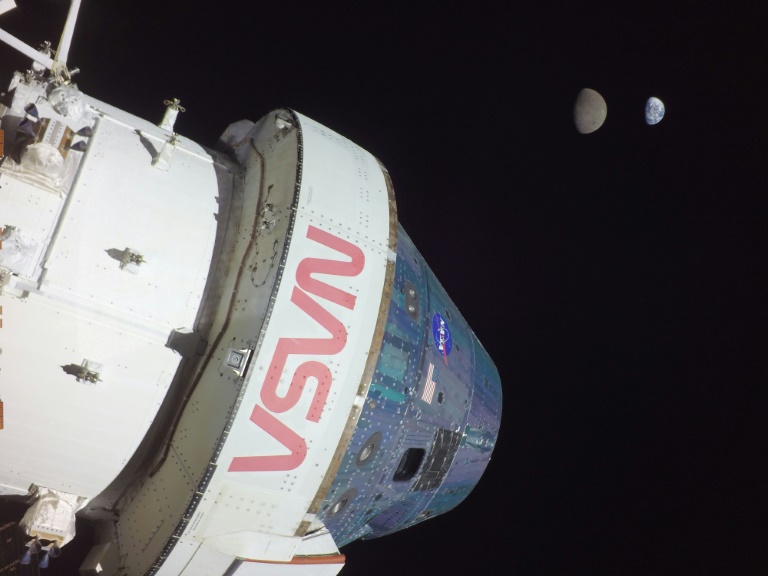
After making a close pass at the Moon and venturing further into space than any previous habitable spacecraft, NASA’s Orion capsule is due to splash down Sunday in the final test of a high-stakes mission called Artemis.

As it hurtles into Earth’s atmosphere at a speed of 25,000 miles (40,000 kilometers) per hour, the gumdrop-shaped traveler will have to withstand a temperature of 2,800 degrees Centigrade (5,000 Fahrenheit) — about half that of the surface of the sun.

Splashdown in the Pacific off the Mexican island of Guadalupe is scheduled for 1739 GMT (9:39 am local time).

Achieving success in this mission of just over 25 days is key for NASA, which has invested tens of billions of dollars in the Artemis program due to take people back to the Moon and prepare for an onward trip, someday, to Mars.

So far the first test of this uncrewed spacecraft has gone very well.

But it is only in the final minutes of this voyage that the true challenge comes: seeing if Orion’s heat shield, the biggest ever built, actually holds up.

“It is a safety-critical piece of equipment. It is designed to protect the spacecraft and the passengers, the astronauts on board. So the heat shield needs to work,” said Artemis mission manager Mike Sarafin. 

A first test of the capsule was carried out in 2014 but that time the capsule stayed in Earth’s orbit, so it came back into the atmosphere at a slower speed of around 20,000 miles per hour.

– Choppers, divers and boats – 

A US Navy ship, the USS Portland, has been positioned in the Pacific to recover the Orion capsule in an exercise that NASA has been rehearsing for years. Helicopters and inflatable boats will also be deployed for this task.  

The falling spacecraft will be slowed first by the Earth’s atmosphere and then a web of 11 parachutes until it eases to a speed of 20 miles (30 kilometers) per hour when it finally hits the blue waters of the Pacific.

Once it is there, NASA will let Orion float for two hours — a lot longer than if astronauts were inside — so as to collect data.

“We’ll see how the heat soaks back into the crew module and how that affects the temperature inside,” said Jim Geffre, NASA’s Orion vehicle integration manager.

Divers will then attach cables to Orion to hoist it onto the USS Portland, which is an amphibious transport dock vessel, the rear of which will be partly submerged. This water will be pumped out slowly so the spacecraft can rest on a platform designed to hold it.

This should all take about four to six hours from the time the vessel first splashes down.

The Navy ship will then head for San Diego, California where the spacecraft will be unloaded a few days later.

When it returns to Earth, the spacecraft will have traveled 1.4 million miles since it took off November 16 with the help of a monstrous rocket called SLS.

At its nearest point to the Moon it flew less than 80 miles (130 kilometers) from the surface. And it broke the distance record for a habitable capsule, venturing 268,000 miles (432,000 kilometers) from our planet.

– Artemis 2 and 3 –

Recovering the spacecraft will allow NASA to gather data that is crucial for future missions.

This includes information on the condition of the vessel after its flight, data from monitors that measure acceleration and vibration, and the performance of a special vest put on a mannequin in the capsule to test how to protect people from radiation while flying through space.

Some components of the capsule should be good for reuse in the Artemis 2 mission, which is already in advanced stages of planning.

This next mission planned for 2024 will take a crew toward the Moon but still without landing on it. NASA is expected to name the astronauts selected for this trip soon.

Artemis 3, scheduled for 2025, will see a spacecraft land for the first time on the south pole of the Moon, which features water in the form of ice.

Only 12 people — all of them white men — have set foot on the Moon. They did this during the Apollo missions, the last of which was in 1972.

Artemis is scheduled to send a woman and a person of color to the Moon for the first time.

NASA’s goal is to establish a lasting human presence on the Moon, through a base on its surface and a space station circling around it. Having people learn to live on the Moon should help engineers develop technologies for a years-long trip to Mars, maybe in the late 2030s.

US Fed poised for smaller rate hike with eye on wage growth

The US Federal Reserve is poised to slow its interest rate hikes next week, economists say, as central bankers’ most forceful moves in decades to fight inflation ripple through the economy.

But the half-point jump analysts expect to see in the Fed’s benchmark lending rate will still be a steep rise, as it struggles to cool demand in the United States to bring consumer costs down.

Households in the world’s biggest economy have been contending with red-hot prices, with conditions worsened by surging food and energy costs after Russia’s invasion of Ukraine.

To make borrowing more expensive, the Fed has raised interest rates six times this year, including four bumper 0.75-point increases, bringing the rate to between 3.75 percent and four percent.

“We think the stage is set for a (half-point) hike this month,” said Oren Klachkin of Oxford Economics, as sectors sensitive to interest rates like housing reel and inflation shows signs of easing.

The decision will be announced after a two-day meeting of the policy-setting Federal Open Market Committee (FOMC) starting Tuesday.

Policy makers are keeping a close eye on wage growth, given concerns that higher salaries will add to inflation pressures.

“The primary concern for the Fed here is really wage growth,” said Martin Wurm of Moody’s Analytics, adding that the Fed is unlikely to ease policy until there is consistent development on this front.

“That doesn’t necessarily mean it’s going to keep hiking forever, but it does mean that the rate will increase for a little bit and… stay elevated throughout the next year,” Wurm told AFP.

With a higher benchmark rate, it becomes more expensive to borrow funds for big-ticket purchases such as cars and property, or to expand businesses.

– ‘Signs of stress’ –

Despite the Fed’s forceful moves, consumer inflation stood at 7.7 percent in October while job gains remained robust, sending jitters through markets on worries that the central bank would prolong its aggressive campaign.

“The strong jobs market, rising wages and the strong household balance sheet… are key areas of support” for demand, said economist James Knightley of ING.

Household wealth has increased by $30 trillion since the start of the pandemic, he noted, allowing consumers to dip into their savings as the cost of living spiked.

“However, we are also seeing greater use of consumer credit and credit cards to fund spending, which could hint at some signs of stress and that household efforts to maintain their standard of living are starting to be exhausted,” Knightley told AFP.

– Smaller recession –

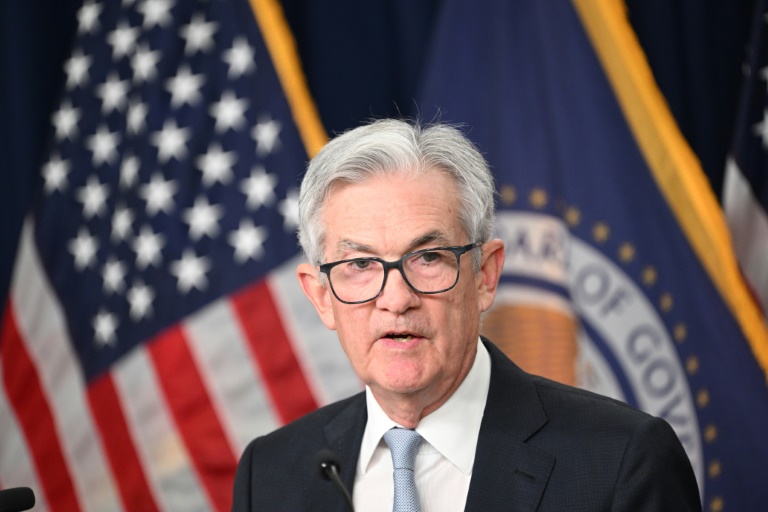
Fed Chair Jerome Powell has warned that monetary policy will likely have to remain tight “for some time,” even if the time to ease the pace of rate hikes may come as soon as in December.

The timing of this moderation is less significant than questions of how much more officials need to raise rates, and how long they should keep policy restrictive, he added in a speech.

While many economists believe there is about a 50-50 chance of recession, Wurm said, this will likely mean a small contraction in GDP.

“What we wouldn’t expect necessarily is a big financial crisis like 2008… the big sectors of the economy are still in pretty good shape,” he said.

The US economy rebounded strongly after Covid-19, boosting incomes, while the lockdown period raked in profits for American businesses as well — accounting for resilience seen despite the Fed’s sharp tightening.

Knightly of ING said policymakers maintain a mentality that the risk of doing too little outweighs that of doing too much.

“They will tolerate a recession to make sure inflation is defeated,” he added.

US Fed poised for smaller rate hike with eye on wage growth

The US Federal Reserve is poised to slow its interest rate hikes next week, economists say, as central bankers’ most forceful moves in decades to fight inflation ripple through the economy.

But the half-point jump analysts expect to see in the Fed’s benchmark lending rate will still be a steep rise, as it struggles to cool demand in the United States to bring consumer costs down.

Households in the world’s biggest economy have been contending with red-hot prices, with conditions worsened by surging food and energy costs after Russia’s invasion of Ukraine.

To make borrowing more expensive, the Fed has raised interest rates six times this year, including four bumper 0.75-point increases, bringing the rate to between 3.75 percent and four percent.

“We think the stage is set for a (half-point) hike this month,” said Oren Klachkin of Oxford Economics, as sectors sensitive to interest rates like housing reel and inflation shows signs of easing.

The decision will be announced after a two-day meeting of the policy-setting Federal Open Market Committee (FOMC) starting Tuesday.

Policy makers are keeping a close eye on wage growth, given concerns that higher salaries will add to inflation pressures.

“The primary concern for the Fed here is really wage growth,” said Martin Wurm of Moody’s Analytics, adding that the Fed is unlikely to ease policy until there is consistent development on this front.

“That doesn’t necessarily mean it’s going to keep hiking forever, but it does mean that the rate will increase for a little bit and… stay elevated throughout the next year,” Wurm told AFP.

With a higher benchmark rate, it becomes more expensive to borrow funds for big-ticket purchases such as cars and property, or to expand businesses.

– ‘Signs of stress’ –

Despite the Fed’s forceful moves, consumer inflation stood at 7.7 percent in October while job gains remained robust, sending jitters through markets on worries that the central bank would prolong its aggressive campaign.

“The strong jobs market, rising wages and the strong household balance sheet… are key areas of support” for demand, said economist James Knightley of ING.

Household wealth has increased by $30 trillion since the start of the pandemic, he noted, allowing consumers to dip into their savings as the cost of living spiked.

“However, we are also seeing greater use of consumer credit and credit cards to fund spending, which could hint at some signs of stress and that household efforts to maintain their standard of living are starting to be exhausted,” Knightley told AFP.

– Smaller recession –

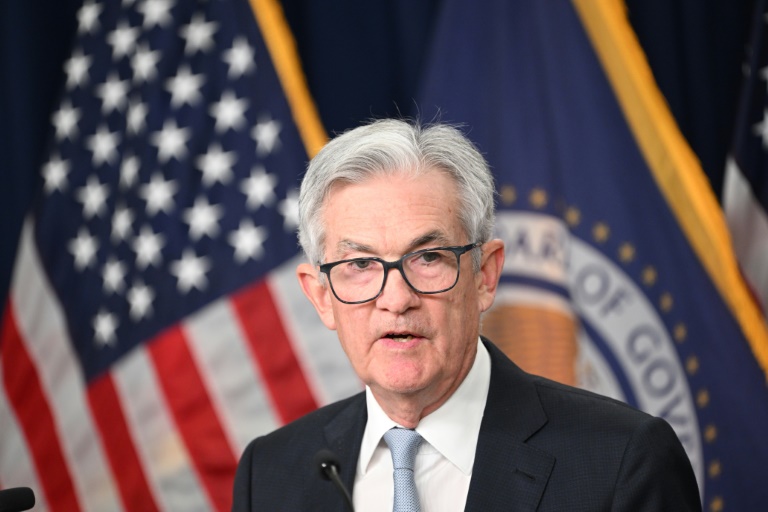
Fed Chair Jerome Powell has warned that monetary policy will likely have to remain tight “for some time,” even if the time to ease the pace of rate hikes may come as soon as in December.

The timing of this moderation is less significant than questions of how much more officials need to raise rates, and how long they should keep policy restrictive, he added in a speech.

While many economists believe there is about a 50-50 chance of recession, Wurm said, this will likely mean a small contraction in GDP.

“What we wouldn’t expect necessarily is a big financial crisis like 2008… the big sectors of the economy are still in pretty good shape,” he said.

The US economy rebounded strongly after Covid-19, boosting incomes, while the lockdown period raked in profits for American businesses as well — accounting for resilience seen despite the Fed’s sharp tightening.

Knightly of ING said policymakers maintain a mentality that the risk of doing too little outweighs that of doing too much.

“They will tolerate a recession to make sure inflation is defeated,” he added.

Biden tries to reboot US brand in Africa amid China, Russia inroads

When Barack Obama welcomed African leaders to Washington in 2014, many viewed the summit as historic, not just due to the US president’s background but for the pledges to make the partnership deeper and such events routine.

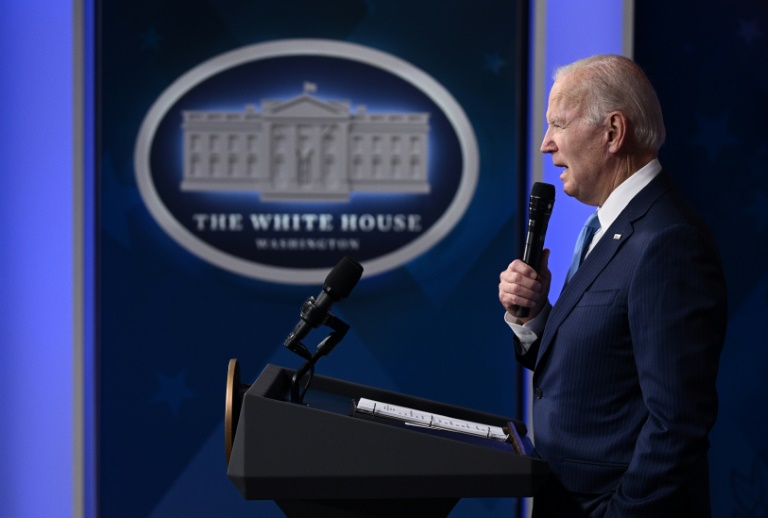
The sequel took eight years — the equivalent of two presidential terms — but on Tuesday, Joe Biden will host a second US-Africa summit.

Since 2014, China — viewed by Washington as its main long-term challenger — has consistently outpaced the United States as the largest investor in Africa and Russia has increasingly flexed its muscle, sending mercenaries to hotspots and trying to rally opinion to blunt Western pressure over Ukraine.

Biden’s three-day summit will feature announcements of new US investment and highlight food security — worsened by the invasion of Ukraine — but, unlike China, also focus on values such as democracy and good governance, as well as fighting climate change.

But the biggest message from Biden, a lover of backslapping face-to-face diplomacy, will be that the United States cares.

Since defeating Donald Trump, who made no secret of his lack of interest in Africa, Biden has thrown his support behind an African seat on the Security Council and at the Washington summit will call for the African Union to formally join the Group of 20 major economies, an aide said.

“We believe that this is a decisive decade. The way in which the world will be ordered will be determined in the coming years,” said Biden’s top Africa advisor, Judd Devermont.

Biden and Secretary of State Antony Blinken “believe strongly that African voices are going to be critical in this conversation,” he said.

African leaders have already been holding summits every three years with China and also have regular meetings with several US allies — France, Britain, Japan and the European Union.

– All, almost, welcome –

After a row over invitations distracted attention from his Western Hemisphere summit in Los Angeles in June, Biden has been open with the guest list from Africa.

The United States is inviting all African Union members in good standing — meaning not Burkina Faso, Guinea, Mali or Sudan — and with which Washington has full relations, which excludes authoritarian Eritrea.

One of the most closely watched leaders expected in Washington will be Ethiopian Prime Minister Abiy Ahmed, a onetime US ally whom the Biden administration has accused of backing widespread abuses in the Tigray conflict, which has subsided with a breakthrough November 2 agreement signed in South Africa.

Also in Washington will be the presidents of Rwanda and the Democratic Republic of Congo as Blinken leads international pressure on Rwanda over alleged support to rebels advancing in its giant neighbor.

Other presidents due at the summit include Egypt’s Abdel Fattah al-Sisi and Tunisia’s Kais Saied, who have both faced criticism on democratic rights, and Equatorial Guinea’s Teodoro Obiang Nguema Mbasogo, days after the United States called his latest election a sham. The foreign minister of Zimbabwe, which is under US sanctions, is also expected to attend.

“We’ve taken some criticism, I think it’s fair to say, from some who wonder why we invited this government or that government about which there are some concerns,” said Molly Phee, the top State Department official for Africa.

“But that reflects the commitment of President Biden and Secretary Blinken to having respectful conversations even where there are areas of difference.”

– ‘Robust’ debate on trade –

One key topic will be the fate of the African Growth and Opportunity Act, the 2000 deal that granted duty-free access to the US market for most products from sub-Saharan nations that meet standards on rights and democracy.

The pact expires in 2025, leading African leaders to seek clarity at a time that the United States has soured on trade deals.

“We regret that AGOA trade preferences have not been utilized to the maximum,” Phee said.

She expected a “robust discussion” and said the United States may look after 2025 to engage instead with a nascent continental free trade area.

Mvemba Phezo Dizolele, director of the Africa program at the Center for Strategic and International Studies, said the United States was entering the summit with a “trust deficit” from Africans due to the long wait since 2014.

“The summit presents great opportunities but it also poses some risks,” he said.

“This is an opportunity to show Africa that the US really wants to listen to them,” he added.

“But now that we have high expectations, the question will be, what will be different now?”

Activists warn a toothless UN nature pact will fail

The world’s next global pact for nature is doomed without clear mechanisms for implementing targets, conservation groups said Saturday on the sidelines of UN talks, as hundreds of protesters took to the streets of Montreal demanding greater action.

Similar factors were widely blamed for the failure of the last 10-year biodiversity deal, adopted in 2010 in Aichi, Japan, which was unable to achieve nearly any of its objectives. 

“Strong text that commits countries to review progress against global targets and ratchet up action over time is essential to hold governments accountable,” said Guido Broekhoven of the World Wide Fund for Nature (WWF), adding he was “very worried” about the current state of negotiations on this point.

Implementation mechanisms are at the heart of the Paris agreement on the fight against global warming, in the form of “nationally determined contributions.”

However, the current text on biodiversity only “urges” countries to take into account the conclusions of a global review in four years’ time — without committing them to enhance action if the review finds targets aren’t on track.

“So what we have on the table is barely an encouragement to maybe do better,” Aleksandar Rankovic, of the US nonprofit Avaaz, told AFP. 

“And there is no compliance mechanism being discussed that could help organize this necessary conversation between governments, on how they could cooperate better.”

The UN meeting, called COP15, running from December 7 – 19, bringing together nearly 5,000 delegates from 193 countries to try to finalize “a pact of peace with nature,” with key goals to preserve Earth’s forests, oceans and species.

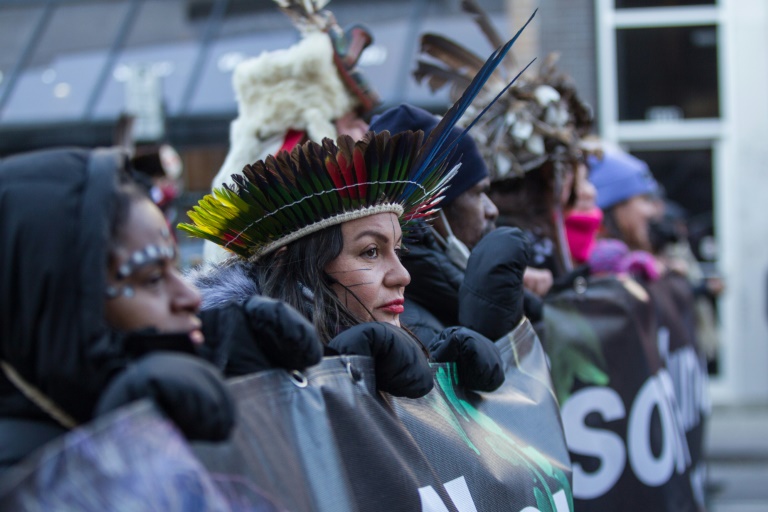
On a freezing Saturday, people young and old, including a large contingent of Indigenous Canadians, braved the biting cold to make their voices heard in Canada’s second city.

Some wore costumes, dressed as birds, trees, and even caribou — an emblem of Canada’s boreal forests that are now threatened.

“The people are trying to speak, trying to say you can’t just talk, you have got to act,” said Sheila Laursen, part of the group Raging Grannies. 

“Let’s not forget that… to protect biodiversity we need to protect Indigenous people first, Indigenous people are protecting biodiversity,” Helena Gualinga, who belongs to a tribe in the Ecuadoran Amazon. 

– ‘Missing critical elements’ –

Saturday was supposed to be the last day for delegates to work on the implementation text, before their environment ministers arrive on December 15 for the home stretch of the negotiations. Under pressure, an additional meeting day next week was approved.

“If biodiversity targets are the compass, implementation is the actual vessel to take us there,” Li Shuo of Greenpeace told AFP.

“The implementation negotiations are missing critical elements that will ensure countries to ramp up their action over time: this is like a bicycle without gears.”

“There has been some progress,” Juliette Landry, a researcher at French think tank IDDRI added, pointing out that the countries have for the first time adopted common planning and reporting templates, making cross-comparison possible.

On-again, off-again Twitter subscription service to be relaunched

After several false starts, Twitter announced on Saturday it would relaunch its subscription service next week, including a system for authenticating accounts on the platform.

“We’re relaunching @TwitterBlue on Monday — subscribe on web for $8/month or on (Apple’s) iOS for $11/month to get access to subscriber-only features, including the blue checkmark,” the company tweeted.

A blue checkmark on an account, which indicates it has been verified by Twitter, was previously free but reserved for organizations and public figures in an attempt to avoid impersonation and misinformation.

After buying Twitter in October, billionaire entrepreneur Elon Musk announced his intention to diversify the company’s revenue stream beyond advertising, turning to new paying formulas for premium features.

A first version was launched 10 days after Musk took control in early November, but it caused an uproar when many fake accounts popped up pretending to be celebrities or companies. The version was quickly suspended.

Under the new offer, accounts seeking blue checkmarks will again be reviewed by Twitter, the company said.

The checkmark will become gold for businesses and, later in the week, gray for government organizations, it added.

Subscribers will also be able to access functions such as one to edit tweets after they are published and another to download higher quality videos.

“Thanks for your patience as we’ve worked to make Blue better,” the company tweet said.

Musk had promised the return of Twitter Blue by the end of November before indicating a few days later that the project had been postponed indefinitely, as experts sought to develop a system to prevent impersonation. 

Lascar volcano in Chile stirs, sending plume skyward

A volcano in the Andes in Chile’s north rumbled to life early Saturday, triggering minor earth tremors and sending a plume of smoke and ash 6,000 meters (nearly 20,000 feet) into a clear sky.

Chile’s National Geology and Mining Service reported that at 12:36 am (15:36 GMT) the Lascar volcano stirred.

The volcano sent “an eruptive column” comprising volcanic ash and hot gases 6,000 meters above its crater, the service said.

Authorities raised an alert level to “yellow,” indicating elevated volcanic activity, and established a no-entry perimeter five kilometers (three miles) around the crater.

They also alerted aircraft to the drifting plume.

Authorities stayed in close contact with officials in Talabre, a town 30 kilometers from the volcano, in case evacuations were required. But no property damage was reported.

Lascar, with an elevation of 5,592 meters above sea level, is 70 kilometers from San Pedro de Atacama, a popular tourist center that draws visitors for trekking, amateur astronomy and visits to the Atacama Desert, the driest place on Earth.

Lascar erupted in 1993 but also had lesser volcanic activity in 2006 and 2015.

Farther to the south, yellow alerts remain in effect for regions around the Nevados de Chillan volcanic complex and the Villarrica volcano.

Bad news piles up for candidate Trump

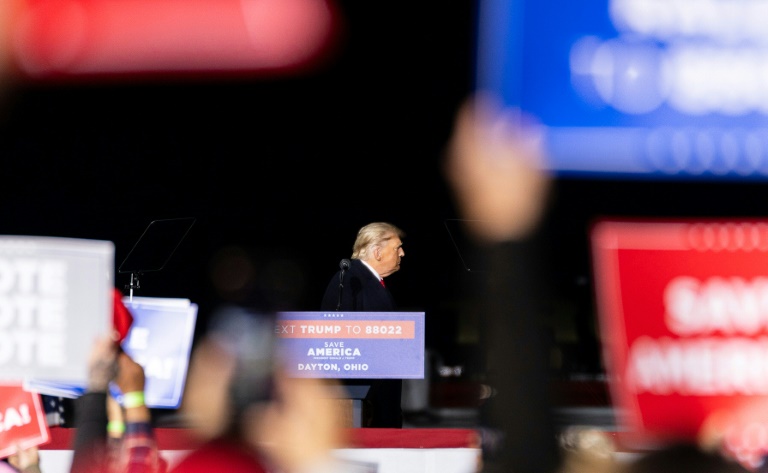
Having launched a new bid for the White House, Donald Trump has not been met with the energy he had been hoping for.

Quite the opposite, in fact.

“In all, it has been a truly terrible launch of a presidential campaign,” said Lara Brown, political science professor at George Washington University, noting that the one-term former US president has stumbled through “one scandal after another.”

Having hoped to ride a Republican “red wave” in the midterm elections last month, Trump instead found himself high and dry after most of the noteworthy candidates he backed were defeated.

Spurned by conservative heavyweights, the former president once again found himself the target of intense criticism last month after dining with rapper Kanye West, who has been accused of anti-Semitism, and a white supremacist. 

Many Republicans who had long been fearful of incurring their leader’s wrath now piled their scorn on the real estate mogul, calling the dinner “ridiculous,” “disgusting” and “scandalous.” 

Their efforts to distance themselves from the former president accelerated further when Trump — who falsely claims he won the 2020 election — issued calls to abandon the US Constitution. 

And the point was driven home yet again Tuesday, when one of Trump’s most famous protege candidates, former American football player Herschel Walker, lost a bid for a Senate seat in the state of Georgia. 

“Trump has also had a number of high-profile donors publicly state that they are not interested in supporting his 2024 campaign,” Brown told AFP. 

The billionaire, known for his inflammatory speeches to rallies of red-hatted supporters, has not held any campaign event outside his residence at the Mar-a-Lago golf club in Florida since declaring his candidacy in November. 

And while the 76-year-old has always thrived on political controversy, he is now the subject of myriad criminal and civil investigations, from his handling of classified documents to his financial affairs in New York.

– Assault on the Capitol –

Trump’s real troubles are likely only just beginning. 

For more than a year, the contentious Republican has been under investigation over allegations of exerting pressure on Georgia state officials during the 2020 presidential election, which could lead to an indictment. 

And a Congressional committee investigating his responsibility for the attack by his supporters at the US Capitol on January 6, 2021, is set to release a voluminous report in the coming weeks.

The panel has already indicated that it would recommend indictments, without specifying who could be targeted. 

The decision of whether or not to charge the former president will ultimately rest with Attorney General Merrick Garland, who in mid-November appointed a special prosecutor to independently investigate Trump. 

The courts have already found his family business guilty of tax evasion, a blow for the ex-businessman, although he himself has not been tried. 

– Hard core –

But with the 2024 presidential election nearly two whole years away, Trump still has plenty of time to stage a comeback.

When he was abandoned by some in the conservative movement after the Capitol riot, the former leader managed within a few months to regain almost total control of the party. 

Trump’s political demise has been predicted over and over again, but so far he has survived. The more scandals he accumulates, the less effect any individual incident seems to have on his power. 

After taking office in November 2016 in an unprecedented political upheaval that almost no one predicted, Trump may also be tempted to play the position of rebel candidate if the defections in his ranks continue. 

Polls show he is still a big favorite in a hypothetical Republican primary, a fact he likes to tout at every opportunity.

He can also still count on a steadfast base, which swears unfailing support to the former president and continues to flock to his rallies. 

But even those loyalists could eventually lose patience, predicted Brown. 

“While some in his base may rally to support him when he in the coming months claims to be a victim of a political witch hunt, for many, I imagine that act is getting old,” she said.

Close Bitnami banner
Bitnami