AFP

A greener ride: West Africans switch on to electric motorbikes

Beninese hairdresser Edwige Govi makes a point these days of using electric motorbike taxis to get around Cotonou, saying she enjoys a ride that is quiet and clean.

Motorcycle taxis are a popular and cheap form of transportation in West Africa. 

But in Benin and Togo, electric models are gaining the ascendancy over petrol-powered rivals.

Customers are plumping for environmentally-friendlier travel and taxi drivers are switching to machines that, above all, are less expensive to buy and operate. 

“They are very quiet and do not give off smoke,” says Govi, 26, who had just completed a half-hour run across Benin’s economic hub.

In African cities, road pollution is becoming a major health and environment issue, although for taxi drivers, the big attraction of electric motorcycles is the cost.

“I manage to get by,” said Govi’s driver, Octave, wearing the green and yellow vest used by Benin’s zemidjan taxis — a word meaning “take me quickly” in the local Fon language. 

“I make more money than with my fuel motorcycle.”

Local environmentalist Murielle Hozanhekpon said the electric motorbikes do have some disadvantages “but not on an environmental level”.

Alain Tossounon, a journalist specialising in environmental issues, said electric bikes were prized by taxi drivers as they were less expensive to maintain or run.

The cost factor has become more and more important in the face of an explosion of fuel prices this year triggered by Russia’s invasion of Ukraine.

– Credit carrot –

In Benin, an electric motorcycle costs between 490,000 CFA (750 euros) and 884,000 CFA (1,345 euros) depending on the model. 

But this price difference is only one factor which explains the trend towards “silent motorcycles,” said Tossounon. 

To allow these motorcycles to be competitive with gasoline motorcycles, Beninese authorities have decided to exempt electric vehicles and hybrids from VAT and customs duties. 

For a few months in Cotonou, at least two companies have been offering electric models. They say they are overwhelmed with requests and each shows strong sales in their own company figures. 

The manufacturer Mauto launched in mid-2022 in Benin and Togo, where it said it has already put 2,900 motorcycles into circulation.

Many taxi drivers are also lured by flexible credit deals — instead of making a hefty one-off purchase, many are able to get loans that they pay off monthly, weekly or even daily. 

“The queue here is from morning to evening. Every hour, at least two roll out of the shop,” said Anicet Takalodjou, a vendor from Mauto’s competitor Zed-Motors. 

Oloufounmi Koucoi, 38, director of the company delivering the models to Cotonou, said they had put thousands of e-motorcycles in circulation.

“The number is growing every day.” 

By assembling the motorcycles locally in Benin, his electric models are cheaper than if they had been imported. 

To attract customers, his company, Zed-Motors, offers solar panels to facilitate recharging for those who do not have electricity at home. 

For decades, Benin and its economy have struggled with power cuts. The situation has improved, but outages remain common.

In rural areas, especially, electricity remains largely inaccessible.

 – Battery change – 

In Lome, capital of neighbouring Togo, Octave de Souza parades proudly through the streets on his brand-new green electric motorcycle made by Mauto. 

One point in particular makes him and his wallet happy: no more fuelling up.

“All you need to do is change the battery,” he smiled. “There are sales outlets, you go there and it’s exchanged for you.” 

A recharge costs 1,000 CFA ($1.50 / euros) and can provide three days’ mobility. For the same price, Octave said, he would only be able to ride for one day using petrol, which is subsidised by the government.

Local authorities also are encouraging the switch to electric in a bid to replace old, highly polluting motorcycles. 

But some drivers remain wary of electric models, citing range anxiety — the worry of coming to a halt with a flat battery.

Taxi driver Koffi Abotsi said he struggled with the “stress” of having to quickly find a charging station so as not to break down. 

“This sometimes leads us to swap (the battery) even with 10 percent or 15 percent charge remaining so as not to have any unpleasant surprises along the way.”


UK union announces ambulance strike as stoppages widen

Britain’s government on Wednesday rejected union pay demands after ambulance workers joined nurses in voting to go on strike.

“Our economic circumstances mean unions’ demands are not affordable,” Health Secretary Steve Barclay said, after the Unison union confirmed the ambulance service faced its biggest strike in 30 years.

Paramedics, ambulance technicians and emergency call handlers will walk out for 24 hours before Christmas, Unison announced late Tuesday after its members held a strike ballot.

The strike will affect London and four other regions of England as the ambulance service joins nurses across most of Britain in striking over government pay offers, which fall well short of double-digit inflation.

The Royal College of Nursing is holding the first strike in its 106-year history on December 15 and 20.

Unison general secretary Christina McAnea said it was a “tough call” for the ambulance workers to also strike.

“But thousands of ambulance staff and their NHS (National Health Service) colleagues know delays won’t lessen, nor waiting times reduce, until the government acts on wages,” she said.

The nurses’ strike will be sandwiched between the first of a series of two-day walkouts by national railway workers, while postal service employees will stage fresh stoppages in the run-up to Christmas.

Numerous other public and private-sector staff, from lawyers to airport ground personnel, have also held strikes this year as Britain contends with its worst cost-of-living crisis in generations.

Markets rise as traders weigh China moves, await Fed's Powell

Markets rose Wednesday on hopes that China will further ease its strict Covid containment measures following widespread protests, though gains were tempered by leaders’ warnings of a crackdown on dissent.

Traders were also nervously awaiting a key policy speech by Federal Reserve chief Jerome Powell later in the day that could outline the bank’s strategy for tackling inflation in light of a recent slowdown in price gains.

A spectacular rally in Hong Kong on Tuesday led gains across Asia as investors looked past weekend demonstrations in China after officials announced moves aimed at softening the zero-Covid strategy.

The government said it would step up a drive to vaccinate the elderly, while the National Health Commission appeared to blame local governments for instituting extreme measures such as tight lockdowns, one of the main reasons for the unrest.

However, in a sign that the leadership was determined to maintain its authority, the country’s top security body called for a “crackdown” against “hostile forces”.

The warning came after security services were sent out to prevent further demonstrations, the likes of which had not been seen in decades.

The developments saw Hong Kong stocks extend Tuesday’s more than five percent surge, while Shanghai built on its own healthy gains.

Data showing China’s factory activity shrank further in November underscored the impact the zero-Covid approach has had on the country’s economy. 

“Due to a more reflective approach to the recent zero-Covid measures, Chinese stocks have taken substantial leaps and bounds this week,” said SPI Asset Management’s Stephen Innes.

“Still, the global investment community is keeping close tabs on China… Any antagonistic escalation risks a walk back of current positive momentum, especially with folks playing the trade-off thinking that a calming in protests might hasten a shift away from zero-Covid policies.”

There were also gains in most other Asian markets, with Sydney, Seoul, Mumbai, Singapore, Bangkok, Wellington, Taipei and Jakarta in the green, though Tokyo dipped.

London, Paris and Frankfurt all opened higher.

Focus is also on Fed boss Powell’s speech later Wednesday on the labour market, with many expecting him to outline the bank’s plans for future interest rate hikes.

After lifting borrowing costs 75 basis points for the past four meetings, officials are widely expected to take their foot off the gas when they gather next month following a recent batch of weak data, including a below-forecast inflation print for October.

But a string of policymakers has lined up in recent weeks to ram home their intention to keep lifting until they are satisfied inflation has been slayed, with warnings there will not likely be any cuts until 2024.

The sharp lift in rates this year has fanned bets that the world’s top economy will tip into recession.

“The Fed has hiked enough — and quickly enough — to make recession a base-case scenario in our book,” said Lauren Goodwin, at New York Life Investments.

“Volatility and risk premia are likely to remain elevated as long as the Fed is fighting inflation in a growth slowdown.”

The remarks by Powell come just before the Friday release of US jobs data for November, which will provide the latest snapshot of the economy.

– Key figures around 0820 GMT –

Tokyo – Nikkei 225: DOWN 0.2 percent at 27,968.99 (close)

Hong Kong – Hang Seng Index: UP 2.2 percent at 18,597.23 (close)

Shanghai – Composite: UP 0.1 percent at 3,151.34 (close)

London – FTSE 100: UP 0.5 percent at 7,548.18

Euro/dollar: UP at $1.0353 from $1.0332 on Tuesday

Dollar/yen: DOWN at 138.63 yen from 138.67 yen

Pound/dollar: UP at $1.1973 from $1.1952

Euro/pound: UP at 86.47 pence from 86.42 pence

West Texas Intermediate: UP 0.9 percent at $78.90 per barrel

Brent North Sea crude: UP 1.3 percent at $84.13 per barrel

New York – Dow: FLAT at 33,852.53 (close)

Markets rise as traders weigh China moves, await Fed's Powell

Markets rose Wednesday on hopes that China will further ease its strict Covid containment measures following widespread protests, though gains were tempered by leaders’ warnings of a crackdown on dissent.

Traders were also nervously awaiting a key policy speech by Federal Reserve chief Jerome Powell later in the day that could outline the bank’s strategy for tackling inflation in light of a recent slowdown in price gains.

A spectacular rally in Hong Kong on Tuesday led gains across Asia as investors looked past weekend demonstrations in China after officials announced moves aimed at softening the zero-Covid strategy.

The government said it would step up a drive to vaccinate the elderly, while the National Health Commission appeared to blame local governments for instituting extreme measures such as tight lockdowns, one of the main reasons for the unrest.

However, in a sign that the leadership was determined to maintain its authority, the country’s top security body called for a “crackdown” against “hostile forces”.

The warning came after security services were sent out to prevent further demonstrations, the likes of which had not been seen in decades.

The developments saw Hong Kong stocks extend Tuesday’s more than five percent surge, while Shanghai built on its own healthy gains.

Data showing China’s factory activity shrank further in November underscored the impact the zero-Covid approach has had on the country’s economy. 

“Due to a more reflective approach to the recent zero-Covid measures, Chinese stocks have taken substantial leaps and bounds this week,” said SPI Asset Management’s Stephen Innes.

“Still, the global investment community is keeping close tabs on China… Any antagonistic escalation risks a walk back of current positive momentum, especially with folks playing the trade-off thinking that a calming in protests might hasten a shift away from zero-Covid policies.”

There were also gains in most other Asian markets, with Sydney, Seoul, Mumbai, Singapore, Bangkok, Wellington, Taipei and Jakarta in the green, though Tokyo dipped.

London, Paris and Frankfurt all opened higher.

Focus is also on Fed boss Powell’s speech later Wednesday on the labour market, with many expecting him to outline the bank’s plans for future interest rate hikes.

After lifting borrowing costs 75 basis points for the past four meetings, officials are widely expected to take their foot off the gas when they gather next month following a recent batch of weak data, including a below-forecast inflation print for October.

But a string of policymakers has lined up in recent weeks to ram home their intention to keep lifting until they are satisfied inflation has been slayed, with warnings there will not likely be any cuts until 2024.

The sharp lift in rates this year has fanned bets that the world’s top economy will tip into recession.

“The Fed has hiked enough — and quickly enough — to make recession a base-case scenario in our book,” said Lauren Goodwin, at New York Life Investments.

“Volatility and risk premia are likely to remain elevated as long as the Fed is fighting inflation in a growth slowdown.”

The remarks by Powell come just before the Friday release of US jobs data for November, which will provide the latest snapshot of the economy.

– Key figures around 0820 GMT –

Tokyo – Nikkei 225: DOWN 0.2 percent at 27,968.99 (close)

Hong Kong – Hang Seng Index: UP 2.2 percent at 18,597.23 (close)

Shanghai – Composite: UP 0.1 percent at 3,151.34 (close)

London – FTSE 100: UP 0.5 percent at 7,548.18

Euro/dollar: UP at $1.0353 from $1.0332 on Tuesday

Dollar/yen: DOWN at 138.63 yen from 138.67 yen

Pound/dollar: UP at $1.1973 from $1.1952

Euro/pound: UP at 86.47 pence from 86.42 pence

West Texas Intermediate: UP 0.9 percent at $78.90 per barrel

Brent North Sea crude: UP 1.3 percent at $84.13 per barrel

New York – Dow: FLAT at 33,852.53 (close)

Alzheimer's drug data shows results but also risks

Experts hailed full data Wednesday showing a new drug can slow cognitive decline in Alzheimer’s patients, but warned improvements were comparatively small and the treatment can have serious side effects.

Preliminary data from a trial of lecanemab was released in September and found it slowed cognitive decline by 27 percent across an 18-month period.

The complete trial data, published in the New England Journal of Medicine, fleshes out those findings but also raises concern about the incidence of “adverse effects” including brain bleeds and swelling.

The results showed 17.3 percent of patients administered the drug experienced brain bleeds, compared with nine percent of those receiving a placebo.

And 12.6 percent of those taking the drug experienced brain swelling, compared with just 1.7 percent of those in the placebo group.

Deaths were reported at approximately the same rate in both arms of the trial of the drug, which was developed by firms Biogen and Eisai.

The results were broadly welcomed by researchers and campaigners for patients with the disease, including Bart De Strooper, director of the UK Dementia Research Institute.

“This is the first drug that provides a real treatment option for people with Alzheimer’s,” he said.

“While the clinical benefits appear somewhat limited, it can be expected that they will become more apparent if the drug is administered over a longer time period.”

– Longer trials needed –

In Alzheimer’s disease, two key proteins, tau and amyloid beta, build up into tangles and plaques, known together as aggregates, which cause brain cells to die and lead to brain shrinkage.

Lecanemab works by targeting amyloid, and De Strooper said the drug proved effective at clearing it but also had “beneficial effects on other hallmarks of Alzheimer’s, including tau”.

The phase 3 trial involved nearly 1,800 people, divided between those given the drug and given a placebo, and ran over 18 months.

They were assessed on a clinical scale for Alzheimer’s patients that measures cognition and function, as well as for changes in amyloid levels and other indicators.

But Tara Spires-Jones, programme lead at the UK Dementia Research Institute, noted that “there is not an accepted definition of clinically meaningful effects in the cognitive test they used”.

“It is not clear yet whether the modest reduction in decline will make a big difference to people living with dementia. Longer trials will be needed to be sure that the benefits of this treatment outweigh the risks,” she added.

The drug also only targets those in the early stages of the disease with a certain level of amyloid build-up, limiting the number of people who could potentially use the treatment.

And as Alzheimer’s is not always caught quickly, some experts said an overhaul in early diagnosis would be needed to ensure more people could benefit.

“This isn’t the end of the journey for lecanemab –- it’s being explored in further trials to see how well it works over a longer period of time,” said Richard Oakley, associate director of research at the Alzheimer’s Society.

“The safety of drugs is crucial and lecanemab did have side effects, but they will be closely looked at when decisions are made about whether or not to approve lecanemab, to see if the benefits outweigh the risks,” he said.

Biogen and Eisai previously brought the Alzheimer’s drug Aduhelm to market, but there was significant controversy over the evidence that it worked, and its approval led to three high-level resignations in the US Food and Drug Administration.

Climate's toll on trees threatens the sound of music

Stroking a tiny spruce sapling, Swiss forest ranger Francois Villard fears the tree will not withstand global warming and live to a ripe old age like its ancestors.

The Risoud Forest, covering the border between France and Switzerland some 1,200 metres (3,900 feet) up in the Jura mountains, is filled with spruce trees which are hundreds of years old.

Their wood is perfect for crafting acoustic guitars, violins and other string instruments, making it sought after by luthiers around the world.

But climate change has brought drier, warmer weather, threatening the special tonal qualities of the wood.

“I have never seen so many dry trees,” says Villard, who is now approaching retirement.

He is saddened by the sight of so many spruces turning red, losing their needles and drying up, and by spending his days marking trees for felling.

“When I arrived here 30 years ago, there was an average annual temperature of five to six degrees Celsius (40-43 degrees Fahrenheit). Now we are well above that,” he tells AFP. 

Recent winters have been nowhere near as cold as before.

– Risoud resonance –

Spruces are the most common tree in Switzerland, and the hitherto stable climate in the Jura made the species perfect for producing tonewood for acoustic string instruments.

Stiff yet light softwoods like spruce are used to make soundboards — the top of the instrument — which amplifies the vibrations of the strings.

The soundboard must resonate easily with good tonal qualities, while resisting the strain of the strings on the bridge — characteristics that spruce possesses better than other woods.

The trees that meet the criteria perfectly are exceptionally rare — one in 1,000 or even 10,000, some say.

The tree must be 200 to 400 years old, and the bottom of the trunk must have a diameter of at least 50 centimetres (20 inches). It must be without knots or flowing resin.

The tree must have grown straight, slowly and, above all, with regular annual growth so that the tree rings are uniform and tight.

– Wood stock –

In the workshop of Swiss Resonance Wood, in the village of Le Brassus close to the French border, Quentin Durey sketches the outline of a guitar on a thin sheet of wood. Thousands more sheets are piled up to dry out over the years.

“There are about 2,000 guitar tops — classical, romantic and folk guitars,” explains company boss Theo Magnin.

The company sells to Europe, Japan and Mexico amongst other destinations.

But Magnin is worried.

“I don’t know where people who make musical instruments are going to get their supplies in 10 or 20 years,” he says.

“If there is no more wood, there will be no more instruments.” 

Philippe Ramel, a luthier whose workshop overlooks Vevey and Lake Geneva, makes two to four guitars a year, using spruce from Swiss Resonance Wood.

“We have to stock up, on the assumption that one day these trees will no longer be there” or will lose their special qualities, he tells AFP, noting that cedar wood from Lebanon, though not as good, could end up being the replacement.

Spruce tonewood should therefore be used wisely, he said, questioning whether factories should be churning out a thousand guitars a month.

“The guitar is a popular instrument. It may become a luxury instrument,” he says.

– Music of the future –

Dry conditions weaken the spruce trees, which then attract forest-ravaging bark beetles.

And extreme weather conditions can affect their growth, altering the regularity of the tree rings.

“If it continues like this, the stress on these trees will be greater and greater and it’s not clear that they will be able to get through it,” Villard says.

Normally the trees bear fruit every two to three years. But they are now doing so more frequently, driven by the need to reproduce and thereby ensure they continue to exist, Villard explains.

All is not lost. Letting hardwoods, particularly beech trees, grow in the spruce forests helps to retain moisture in the soil, as their broader span and foliage helps keep the sun’s rays off the ground.

Others note the millions of spruces already growing in the mountains.

“In the places which are sheltered from climate extremes, particularly north-facing ones, there really will be spruces for a very long time,” forest engineer Philippe Domont tells AFP.

“With the altitude, they can take advantage of a slight increase in temperatures — if the precipitation does not decrease too much,” he insists.

But Magnin, thinking further down the line, says: “We will have to find another wood to replace spruce.”

“That’s the music of the future.”

Climate's toll on trees threatens the sound of music

Stroking a tiny spruce sapling, Swiss forest ranger Francois Villard fears the tree will not withstand global warming and live to a ripe old age like its ancestors.

The Risoud Forest, covering the border between France and Switzerland some 1,200 metres (3,900 feet) up in the Jura mountains, is filled with spruce trees which are hundreds of years old.

Their wood is perfect for crafting acoustic guitars, violins and other string instruments, making it sought after by luthiers around the world.

But climate change has brought drier, warmer weather, threatening the special tonal qualities of the wood.

“I have never seen so many dry trees,” says Villard, who is now approaching retirement.

He is saddened by the sight of so many spruces turning red, losing their needles and drying up, and by spending his days marking trees for felling.

“When I arrived here 30 years ago, there was an average annual temperature of five to six degrees Celsius (40-43 degrees Fahrenheit). Now we are well above that,” he tells AFP. 

Recent winters have been nowhere near as cold as before.

– Risoud resonance –

Spruces are the most common tree in Switzerland, and the hitherto stable climate in the Jura made the species perfect for producing tonewood for acoustic string instruments.

Stiff yet light softwoods like spruce are used to make soundboards — the top of the instrument — which amplifies the vibrations of the strings.

The soundboard must resonate easily with good tonal qualities, while resisting the strain of the strings on the bridge — characteristics that spruce possesses better than other woods.

The trees that meet the criteria perfectly are exceptionally rare — one in 1,000 or even 10,000, some say.

The tree must be 200 to 400 years old, and the bottom of the trunk must have a diameter of at least 50 centimetres (20 inches). It must be without knots or flowing resin.

The tree must have grown straight, slowly and, above all, with regular annual growth so that the tree rings are uniform and tight.

– Wood stock –

In the workshop of Swiss Resonance Wood, in the village of Le Brassus close to the French border, Quentin Durey sketches the outline of a guitar on a thin sheet of wood. Thousands more sheets are piled up to dry out over the years.

“There are about 2,000 guitar tops — classical, romantic and folk guitars,” explains company boss Theo Magnin.

The company sells to Europe, Japan and Mexico amongst other destinations.

But Magnin is worried.

“I don’t know where people who make musical instruments are going to get their supplies in 10 or 20 years,” he says.

“If there is no more wood, there will be no more instruments.” 

Philippe Ramel, a luthier whose workshop overlooks Vevey and Lake Geneva, makes two to four guitars a year, using spruce from Swiss Resonance Wood.

“We have to stock up, on the assumption that one day these trees will no longer be there” or will lose their special qualities, he tells AFP, noting that cedar wood from Lebanon, though not as good, could end up being the replacement.

Spruce tonewood should therefore be used wisely, he said, questioning whether factories should be churning out a thousand guitars a month.

“The guitar is a popular instrument. It may become a luxury instrument,” he says.

– Music of the future –

Dry conditions weaken the spruce trees, which then attract forest-ravaging bark beetles.

And extreme weather conditions can affect their growth, altering the regularity of the tree rings.

“If it continues like this, the stress on these trees will be greater and greater and it’s not clear that they will be able to get through it,” Villard says.

Normally the trees bear fruit every two to three years. But they are now doing so more frequently, driven by the need to reproduce and thereby ensure they continue to exist, Villard explains.

All is not lost. Letting hardwoods, particularly beech trees, grow in the spruce forests helps to retain moisture in the soil, as their broader span and foliage helps keep the sun’s rays off the ground.

Others note the millions of spruces already growing in the mountains.

“In the places which are sheltered from climate extremes, particularly north-facing ones, there really will be spruces for a very long time,” forest engineer Philippe Domont tells AFP.

“With the altitude, they can take advantage of a slight increase in temperatures — if the precipitation does not decrease too much,” he insists.

But Magnin, thinking further down the line, says: “We will have to find another wood to replace spruce.”

“That’s the music of the future.”

Self-driving lorries hit the road in Sweden

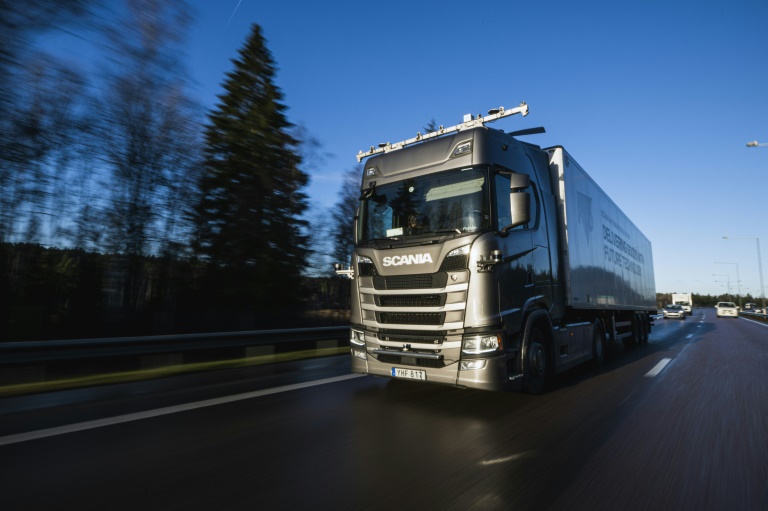
Barrelling down a motorway south of Stockholm in a 40-tonne lorry and trailer, the driver keeps a careful eye on the road but, jarringly, no hands on the wheel.

Instead, the truck drives itself, and veteran driver Roger Nordqvist is at the ready only in case of unexpected problems.

Swedish truck maker Scania is not the only auto manufacturer developing autonomous vehicles, but it recently became the first in Europe to pilot them while delivering commercial goods.

“We take their goods from point A, drive them to point B, fully autonomously,” Peter Hafmar, head of autonomous solutions at Scania, tells AFP outside the company’s transport lab in Sodertalje, south of Stockholm.

In the pilot project, the self-driving truck is manoeuvring a stretch of some 300 kilometres (186 miles) between Sodertalje and Jonkoping in Sweden’s south, delivering fast-food goods.

From the outside, the vehicle looks almost like any other lorry, save for a rail on the roof packed with cameras and two sensors resembling bug antennae on the sides.

Inside the cab, the wheel and seats are where you’d expect to find them, but small devices and screens dot the dashboard and a nest of wires run to the computer rack housed behind the passenger seat. 

– ‘Drives better by itself’ –

Engineer Goran Fjallid sits next to the safety driver in the passenger’s seat, eyes glued to his laptop as it receives video from the truck’s cameras and flickering text with information about what the vehicle is seeing.

A second screen shows a 3D-visualisation of the truck on the road and all nearby vehicles.

The lorry combines all the input from the various sensors with a GPS system, with the different technologies acting as back-ups for each other.

“If the road markings disappear for a while, then it will use the GPS and it stays perfectly in its lane,” Fjallid explains.

“It drives better by itself than when you drive it manually,” he adds.

But he acknowledges that a lot of trial and error has gone into getting the truck to that point.

They’ve had to tweak things like how the truck handles merging onto the motorway, and what to do when another car cuts in front of it.

Every time the truck does something unexpected, such as braking or slowing down for no apparent reason, Fjallid makes a note of the exact timing so the logs and data can be examined.

The lorry’s sensors are also calibrated daily before hitting the road.

Hafmar says there are still some hurdles to clear before driverless trucks — without safety drivers — become a common sight on roads, both in terms of technology and legislation.

They expect to have this ready by the end of the 2020s or the beginning of 2030s, Hafmar says.

– No more truck drivers? –

The advent of self-driving trucks can be seen as a threat to the jobs of truck drivers — one of the world’s most common professions.

But Hafmar insists autonomous vehicles are needed to address a global driver shortage.

And, he says, it will be a long time before artificial intelligence will be able to handle all aspects of logistics.

Initially, self-driving lorries will likely be used for long-haul trips, but the last-mile distribution to shops and customers “will happen with human drivers”, Hafmar adds.

According to a report from the International Road Transport Union (IRU) in June, there were some 2.6 million unfilled positions for truck drivers around the world in 2021.

Hafmar also points out other potential benefits: since computers don’t need to sleep or rest, the vehicles can be scheduled for trips at times when there is less traffic, or drive slower — but for longer — to save on fuel.

A host of other companies are also in the race to launch self-driving trucks.

Start-ups Aurora, Waymo, Embark, Kodiak and Torc (together with Daimler) are running tests in the United States, while China’s Baidu announced a self-driving truck in late 2021.

In Europe, IVECO is working with Californian start-up Plus, supported by Amazon, and recently announced the end of their first phase of circuit testing. They will also launch road tests.

Swedish company Einride also plans to launch road tests in Germany soon.

Self-driving lorries hit the road in Sweden

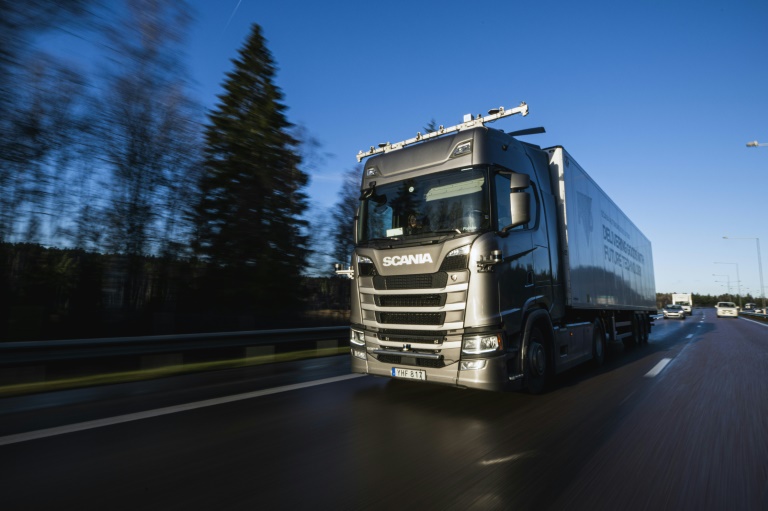
Barrelling down a motorway south of Stockholm in a 40-tonne lorry and trailer, the driver keeps a careful eye on the road but, jarringly, no hands on the wheel.

Instead, the truck drives itself, and veteran driver Roger Nordqvist is at the ready only in case of unexpected problems.

Swedish truck maker Scania is not the only auto manufacturer developing autonomous vehicles, but it recently became the first in Europe to pilot them while delivering commercial goods.

“We take their goods from point A, drive them to point B, fully autonomously,” Peter Hafmar, head of autonomous solutions at Scania, tells AFP outside the company’s transport lab in Sodertalje, south of Stockholm.

In the pilot project, the self-driving truck is manoeuvring a stretch of some 300 kilometres (186 miles) between Sodertalje and Jonkoping in Sweden’s south, delivering fast-food goods.

From the outside, the vehicle looks almost like any other lorry, save for a rail on the roof packed with cameras and two sensors resembling bug antennae on the sides.

Inside the cab, the wheel and seats are where you’d expect to find them, but small devices and screens dot the dashboard and a nest of wires run to the computer rack housed behind the passenger seat. 

– ‘Drives better by itself’ –

Engineer Goran Fjallid sits next to the safety driver in the passenger’s seat, eyes glued to his laptop as it receives video from the truck’s cameras and flickering text with information about what the vehicle is seeing.

A second screen shows a 3D-visualisation of the truck on the road and all nearby vehicles.

The lorry combines all the input from the various sensors with a GPS system, with the different technologies acting as back-ups for each other.

“If the road markings disappear for a while, then it will use the GPS and it stays perfectly in its lane,” Fjallid explains.

“It drives better by itself than when you drive it manually,” he adds.

But he acknowledges that a lot of trial and error has gone into getting the truck to that point.

They’ve had to tweak things like how the truck handles merging onto the motorway, and what to do when another car cuts in front of it.

Every time the truck does something unexpected, such as braking or slowing down for no apparent reason, Fjallid makes a note of the exact timing so the logs and data can be examined.

The lorry’s sensors are also calibrated daily before hitting the road.

Hafmar says there are still some hurdles to clear before driverless trucks — without safety drivers — become a common sight on roads, both in terms of technology and legislation.

They expect to have this ready by the end of the 2020s or the beginning of 2030s, Hafmar says.

– No more truck drivers? –

The advent of self-driving trucks can be seen as a threat to the jobs of truck drivers — one of the world’s most common professions.

But Hafmar insists autonomous vehicles are needed to address a global driver shortage.

And, he says, it will be a long time before artificial intelligence will be able to handle all aspects of logistics.

Initially, self-driving lorries will likely be used for long-haul trips, but the last-mile distribution to shops and customers “will happen with human drivers”, Hafmar adds.

According to a report from the International Road Transport Union (IRU) in June, there were some 2.6 million unfilled positions for truck drivers around the world in 2021.

Hafmar also points out other potential benefits: since computers don’t need to sleep or rest, the vehicles can be scheduled for trips at times when there is less traffic, or drive slower — but for longer — to save on fuel.

A host of other companies are also in the race to launch self-driving trucks.

Start-ups Aurora, Waymo, Embark, Kodiak and Torc (together with Daimler) are running tests in the United States, while China’s Baidu announced a self-driving truck in late 2021.

In Europe, IVECO is working with Californian start-up Plus, supported by Amazon, and recently announced the end of their first phase of circuit testing. They will also launch road tests.

Swedish company Einride also plans to launch road tests in Germany soon.

Cracking the covert app that exposed Europe's drug gangs

From torture and murder in the Netherlands and Serbia to an unprecedented web of corruption in Belgium, the Sky ECC investigation has shone a light into some of Europe’s darkest corners.

Sky ECC was a secure messaging app once prized by underworld drug barons. But, after it was cracked by investigators in 2021, it has brought some to their downfall.

Police from Belgium, France and the Netherlands are now sifting through a vast trove of messages sent within the secretive drug smuggling gangs, and they have begun to make arrests.

“It was as if we were sitting at the table with the criminals,” said Catherine De Bolle, executive director of Europol, the EU police coordination agency.

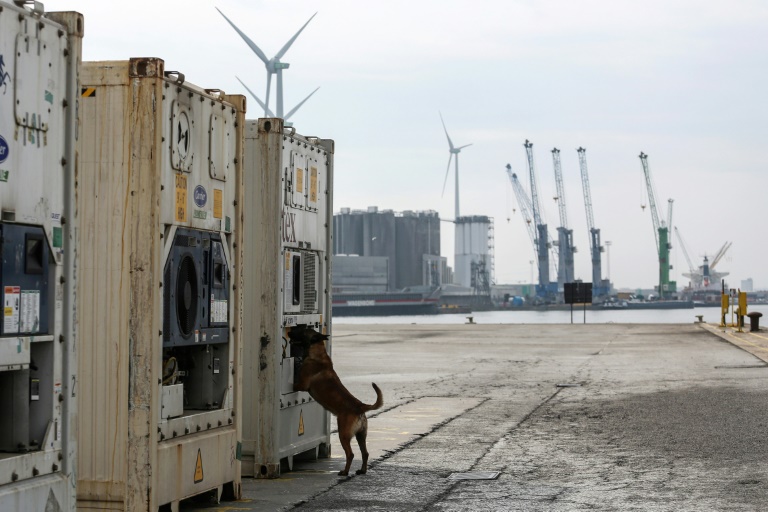
Last year, Belgian police tracking what was already reckoned to be a huge drug smuggling operation in the North Sea port of Antwerp noticed concentrated activity on the covert network.

More than 48 people were arrested in a series of raids on March 9, 2021 and 200 premises were searched, thanks in part to evidence in messages culled from the Sky ECC records.

Antwerp is reputed to be the principal port of entry to Europe for cocaine from Latin America — 90 tonnes were seized last year alone.        

In parallel, French investigators were examining an “undeclared” communications network hosted on servers in France, culling more criminal data.  

More than a year and a half later, detectives on both sides of the border agree that the Sky ECC probe marked a turning point in the war against the drug gangs.

– ‘House of horrors’ –


Eric Snoeck, director general of Belgium’s Federal Judicial Police, told AFP that authorities have their hands on more than one billion Sky ECC messages.

“We’ve made use of a relatively small proportion of the available evidence,” he said. “It’s work that is ongoing and will take years to complete.”   

Since the breakthrough, more than 1,200 people have been detained for questioning in Belgium and 510 criminal case files opened and informed by Sky ECC data.

This week, messages discovered on the covert network allowed police to launch a cross-border operation to dismantle a “super-cartel” thought to control a third of Europe’s cocaine trade.

Officers in five countries arrested 49 suspects, including six alleged drug barons based in Dubai. 

Antwerp police alone have opened 257 case files based on the new evidence.

The investigations are making progress tracking down drug dealers, but they have also shown how deeply gangs have penetrated Belgium’s society and economy.

In September, Belgian Prime Minister Alexander De Croo announced reinforcements for the police investigative service and warned that organised crime’s reach extends far beyond the country’s ports.      

And if the scale of the networks is vertiginous, their violence is disturbing.

“They have imported into Europe behaviour that we thought contained in Latin America,” said Remy Heitz, general prosecutor at the Paris court of appeals.

“Terror, murders, people being executed on live video and shared with laughing viewers. That is how they manage these businesses.”

Snoeck describes “a previously completely unheard-of level of violence” and cites the discovery of shipping containers equipped as torture chambers in the Netherlands.

“For a few thousand euros, for a contract that wasn’t fulfilled, they murder without hesitation — sometimes after hours of agony — people they were working with a few hours earlier,” Snoeck said.

Text messages exchanged on the encrypted network allowed investigators to find a “house of horrors” in Serbia near the capital Belgrade where victims were dismembered and fed into a meat grinder.

– Spreading violence –

While most senior figures arrested so far were living in Dubai, the Western Balkans has also proved a hotspot for the gangs.

After English, the most common language used on Sky ECC was Albanian, investigators found.

Data from Sky ECC, which was marketed by now-defunct Canadian firm Sky Global, has been shared with authorities in 22 countries, including Colombia and Brazil.

Investigators who were already confronted by the Moroccan-Dutch “Mocro-Maffia” and southern Italy’s ‘Ndrangheta Mafia now know that Latin American cartels are implanted on European soil.

“I’m very worried,” a French magistrate told AFP, speaking on condition of anonymity. 

“We’re underestimating the danger of these networks in terms of destabilising the state and spreading violence to all corners of society.”  

Close Bitnami banner
Bitnami