AFP

Kim Kardashian 're-evaluating' Balenciaga ties after controversial ads

Reality show star and social media titan Kim Kardashian said she is “re-evaluating” her involvement with luxury fashion house Balenciaga, after it apologized for ads featuring children holding teddy bears wearing what critics called bondage gear.

The French brand, part of the luxury Kering group, last week withdrew the photos from the Spring/Summer 2023 advertising campaign. Two of them showed young children holding handbags in the shape of teddy bears, which were wearing black leather straps with silver studs.

Internet commentators noticed another photo from a Balenciaga-Adidas ad collaboration showed printed documents from a US Supreme Court ruling on child pornography.

After that revelation, Balenciaga filed a $25 million lawsuit against the company that produced the advertisements, according to reports. 

“As a mother of four, I have been shaken by the disturbing images,” Kardashian, a celebrity ambassador for the brand, wrote on Instagram Sunday night, adding that she had spent the last few days talking with the Balenciaga team “to understand for myself how this could have happened.”

“The safety of children must be held with the highest regard and any attempts to normalize child abuse of any kind should have no place in our society — period,” she wrote.

“As for my future with Balenciaga, I am currently re-evaluating my relationship with the brand,” the star posted to her account, which has 74 million followers.

Last week, Balenciaga posted an apology on its own Instagram account. 

“Our plush bear bags should not have been featured with children in this campaign. We have immediately removed the campaign from all platforms,” the post said. 

They then posted another apology, this time addressing the ad that featured the court documents referencing child pornography laws.  

“We apologize for displaying unsettling documents in our campaign. We take this matter very seriously and are taking legal action against the parties responsible for creating the set and including unapproved items for our Spring 23 campaign photoshoot,” the post said.

The New York Post reported that Balenciaga had filed a $25 million lawsuit against production company North Six and set designer Nicholas Des Jardins.

Amelia Brankov, a lawyer for Des Jardins, said there “certainly was no malevolent scheme going on.”

“As Balenciaga is aware, numerous boxes of documents simply were sourced from a prop house as rental items,” she told AFP.

“Moreover, representatives from Balenciaga were present at the shoot, overseeing it and handling papers and props, and Des Jardins as a set designer was not responsible for image selection from the shoot,” the lawyer added.

For Balenciaga, who apologized again on Monday following Kardashian’s comments, the controversy comes at a bad time.

It had ended its partnership with Kardashian’s ex-husband, rapper and designer Kanye West, last month after West, also known as Ye, posted an anti-Semitic tweet and appeared at a Paris fashion show wearing a shirt with the slogan “White Lives Matter,” a rebuke to the Black Lives Matter racial equality movement.
Global equities slide on China unrest

Global stocks fell Monday as protests across China in opposition to the government’s hardline zero-Covid policy fueled uncertainty about the world’s number-two economy.

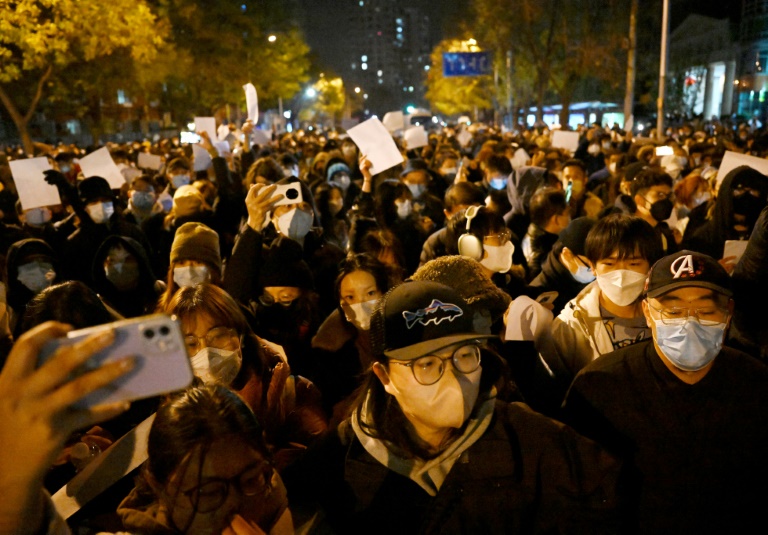
Hundreds of people took to the streets in China at the weekend, in a wave of demonstrations not seen since pro-democracy rallies in 1989 were crushed.

China-linked stocks took the brunt of selling in Asia, with Hong Kong’s Hang Seng Index closing down more than one percent and Shanghai off 0.8 percent. 

Paris, London and Frankfurt all ended in the red Monday while Wall Street also began a heavy week of economic data releases deeply in negative territory.

After last week’s advance, all three major US indices lost at least 1.5 percent.

“Sentiment has turned sour as unrest across China grows,” said SPI Asset Management’s Stephen Innes.

“Risk of the situation escalating from here and short-term volatility remains high.”

A deadly fire in the Xinjiang region Thursday served as the catalyst for the public anger in China, with many blaming virus lockdowns for hampering rescue efforts.

People have taken to the streets in Beijing, Shanghai, Guangzhou and Chengdu, with many calling for an end to lockdowns after an easing of some measures had fueled hopes of a lighter pandemic approach.

Some demonstrators were even demanding the resignation of President Xi Jinping, who recently secured an unprecedented third term as the country’s leader.

The tightened containment measures were introduced as China battled record-high Covid infections.

Beijing’s zero-Covid policy means the threat of more growth-choking lockdowns, City Index analyst Fawad Razaqzada said in a note.

“This is going to hold back the yuan and Chinese stocks, and potentially risk assets outside of China,” added Razaqzada.

The prospect of a hit to demand in the world’s biggest crude importer also hammered oil prices early in the day. But the commodity later rebounded following a rumor that oil exporters could trim production.

– Eyes on Fed boss –

The weakness “isn’t just about China. The reports out of China have also become a good excuse to take some money off the table following a big run by the market,” Briefing.com analyst Patrick O’Hare said in a note.

The selling has taken a bit out of recent gains across markets, sparked by hopes of a slowdown in the Federal Reserve’s interest rate hikes, with US inflation finally showing signs of softening.

However, some observers said the protests might provide long-term benefits as they could force President Xi to shift away from his strict, economically damaging measures sooner.

Investors are also looking ahead to the release of US jobs data at the end of the week, which could provide clues about the Fed’s next moves, while watching for speeches by central bank boss Jerome Powell and other key policymakers.

– Key figures around 2130 GMT –

New York – Dow: DOWN 1.5 percent at 33,849.46 (close)

New York – S&P 500: DOW 1.5 percent at  3,963.94 (close)

New York – Nasdaq: DOWN 1.6 percent at 11,049.50 (close)

London – FTSE 100: DOWN 0.2 percent at 7,474.02 (close)

Frankfurt – DAX: DOWN 1.1 percent at 14,383.36 (close)

Paris – CAC 40: DOWN 0.7 percent at 6,665.20 (close)

EURO STOXX 50: DOWN 0.7 percent at 3,935.51 (close)

Tokyo – Nikkei 225: DOWN 0.4 percent at 28,162.83 (close)

Hong Kong – Hang Seng Index: DOWN 1.6 percent at 17,297.94 (close)

Shanghai – Composite: DOWN 0.8 percent at 3,078.55 (close)

Euro/dollar: DOWN at $1.0347 from $1.0395 on Friday

Dollar/yen: DOWN at 138.87 yen from 139.19 yen

Pound/dollar: DOWN at $1.1952 from $1.2092

Euro/pound: UP at 86.50 pence from 85.96 pence

West Texas Intermediate: UP 1.3 percent at $77.24 per barrel

Brent North Sea crude: DOWN 0.5 percent at $83.19 per barrel

Global equities slide on China unrest

Global stocks fell Monday as protests across China in opposition to the government’s hardline zero-Covid policy fueled uncertainty about the world’s number-two economy.

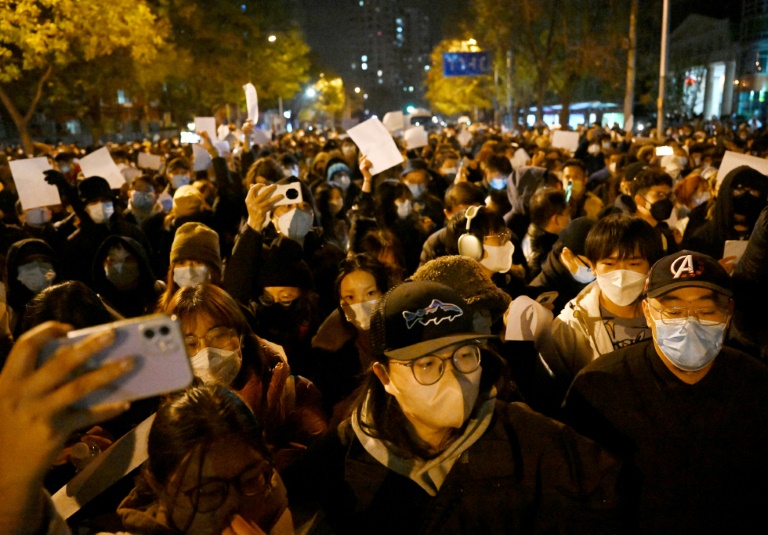
Hundreds of people took to the streets in China at the weekend, in a wave of demonstrations not seen since pro-democracy rallies in 1989 were crushed.

China-linked stocks took the brunt of selling in Asia, with Hong Kong’s Hang Seng Index closing down more than one percent and Shanghai off 0.8 percent. 

Paris, London and Frankfurt all ended in the red Monday while Wall Street also began a heavy week of economic data releases deeply in negative territory.

After last week’s advance, all three major US indices lost at least 1.5 percent.

“Sentiment has turned sour as unrest across China grows,” said SPI Asset Management’s Stephen Innes.

“Risk of the situation escalating from here and short-term volatility remains high.”

A deadly fire in the Xinjiang region Thursday served as the catalyst for the public anger in China, with many blaming virus lockdowns for hampering rescue efforts.

People have taken to the streets in Beijing, Shanghai, Guangzhou and Chengdu, with many calling for an end to lockdowns after an easing of some measures had fueled hopes of a lighter pandemic approach.

Some demonstrators were even demanding the resignation of President Xi Jinping, who recently secured an unprecedented third term as the country’s leader.

The tightened containment measures were introduced as China battled record-high Covid infections.

Beijing’s zero-Covid policy means the threat of more growth-choking lockdowns, City Index analyst Fawad Razaqzada said in a note.

“This is going to hold back the yuan and Chinese stocks, and potentially risk assets outside of China,” added Razaqzada.

The prospect of a hit to demand in the world’s biggest crude importer also hammered oil prices early in the day. But the commodity later rebounded following a rumor that oil exporters could trim production.

– Eyes on Fed boss –

The weakness “isn’t just about China. The reports out of China have also become a good excuse to take some money off the table following a big run by the market,” Briefing.com analyst Patrick O’Hare said in a note.

The selling has taken a bit out of recent gains across markets, sparked by hopes of a slowdown in the Federal Reserve’s interest rate hikes, with US inflation finally showing signs of softening.

However, some observers said the protests might provide long-term benefits as they could force President Xi to shift away from his strict, economically damaging measures sooner.

Investors are also looking ahead to the release of US jobs data at the end of the week, which could provide clues about the Fed’s next moves, while watching for speeches by central bank boss Jerome Powell and other key policymakers.

– Key figures around 2130 GMT –

New York – Dow: DOWN 1.5 percent at 33,849.46 (close)

New York – S&P 500: DOW 1.5 percent at  3,963.94 (close)

New York – Nasdaq: DOWN 1.6 percent at 11,049.50 (close)

London – FTSE 100: DOWN 0.2 percent at 7,474.02 (close)

Frankfurt – DAX: DOWN 1.1 percent at 14,383.36 (close)

Paris – CAC 40: DOWN 0.7 percent at 6,665.20 (close)

EURO STOXX 50: DOWN 0.7 percent at 3,935.51 (close)

Tokyo – Nikkei 225: DOWN 0.4 percent at 28,162.83 (close)

Hong Kong – Hang Seng Index: DOWN 1.6 percent at 17,297.94 (close)

Shanghai – Composite: DOWN 0.8 percent at 3,078.55 (close)

Euro/dollar: DOWN at $1.0347 from $1.0395 on Friday

Dollar/yen: DOWN at 138.87 yen from 139.19 yen

Pound/dollar: DOWN at $1.1952 from $1.2092

Euro/pound: UP at 86.50 pence from 85.96 pence

West Texas Intermediate: UP 1.3 percent at $77.24 per barrel

Brent North Sea crude: DOWN 0.5 percent at $83.19 per barrel

US teen pleads guilty to racist massacre at supermarket

A self-declared white supremacist pleaded guilty Monday to killing 10 Black people during a live-streamed shooting rampage at a supermarket in the US state of New York earlier this year.

Payton Gendron, 19, will spend the rest of his life in prison after admitting one state charge of domestic terrorism motivated by hate over the massacre in Buffalo in May.

Erie County District Attorney John Flynn said Gendron had pleaded guilty to all the charges against him, including 10 counts of murder in the first degree, three attempted murder charges and one count of criminal possession of a weapon.

Reporters in the courtroom said Gendron said the word “guilty” 15 times during Monday’s hearing.

“While justice has been accomplished, nothing will ever bring back the 10 beautiful people who lost their lives on that day,” Flynn told reporters.

“Hopefully the legal closure will provide the families and the victims some measure of relief,” he added.

Gendron had planned the attack for months, targeting Tops Friendly Market in Buffalo because of the large American population in the surrounding neighborhood.

On May 14, the then 18-year-old drove from his hometown of Conklin, more than 200 miles (322 kilometers) away, with the intention of killing as many Black people as possible, prosecutors said.

Wearing heavy body armor and wielding an AR-15 assault rifle, Gendron shot four people in the store’s parking lot, three of them fatally, before entering the supermarket.

Among those killed inside was a retired police officer working as a security guard. He fired several shots at the assailant before being shot and killed himself, police said.

Gendron wore a helmet with a video camera attached and live-streamed the two-minute attack on the platform Twitch.

The victims ranged in age from 32 to 86. Eleven of the 13 people shot were Black and two were white. 

At one point, Gendron said “sorry” to a white man that he had injured and chose not to kill, “further demonstrating it was a racially motivated attack,” Flynn said.

Police arrested Gendron within hours of the attack and investigators found a 180-page document on his computer that laid out his racist motivations for the massacre.

“It is clear this was an act of premeditated, pure evil,” Buffalo Mayor Byron Brown said Monday.

Gendron is the first person in New York to be convicted of the state’s domestic terrorism charge, which was introduced in 2020.

He is due to be formally sentenced on February 15 next year but the offense carries a mandatory penalty of life without parole.

Defense attorney Brian Parker told reporters that Gendron will not appeal the guilty pleas.

He still faces federal hate crime charges that could see him receive the death penalty.

Gendron had initially pleaded not guilty to a single count of first-degree murder before state authorities later added the other charges.

UK start-up behind algae-based packaging bids for Earthshot glory

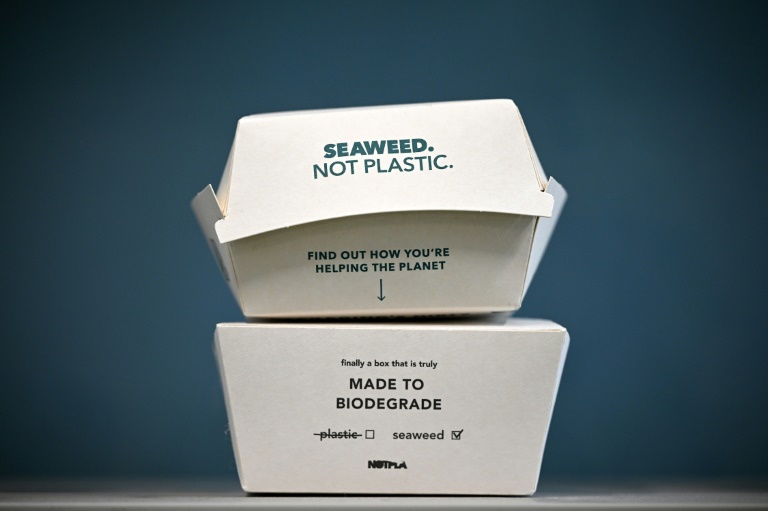
A British start-up founded by two ex-students from France and Spain, crafting biodegradable packaging from marine plants, is aiming to seal royal approval this week when Prince William unveils his latest Earthshot prizes.

Notpla — whose mantra is “we make packaging disappear” — is competing with 14 other firms for five prestigious awards, to be dished out by the prince and a star-studded cast at a ceremony in US city Boston on Friday.

In its second year, the initiative to reward innovative efforts to combat climate change will then be broadcast on UK and US television on Sunday and Monday, respectively, as well as online.

The five winners will each receive a £1 million ($1.2 million) grant. 

The co-creator of Notpla, which rather than using environmentally damaging plastics makes various naturally degrading — and even edible — packaging from seaweed and other marine plants, says they have already felt the competition’s benefits.

“Just being there is a massive boost to our visibility,” French co-founder Pierre Paslier, 35, told AFP.

“So that’s already a huge asset to be part of the finalists and I think that if we win, it’s just going to be that on a much larger scale.”

Together with fellow former Royal College of Art student and co-founder Rodrigo Garcia Gonzalez, 38, the duo began their eco-business adventure in a small London kitchen. 

They were intent on finding natural alternatives to petrochemicals-based packaging, sampling a variety of materials from tapioca seeds to other starches. 

– Seaweed ‘family’ –

“Eventually, we found seaweed,” explained Paslier, a former packaging engineer at French cosmetics giant L’Oreal who created Notpla with Gonzalez in 2014. 

“Now we have a flexible film, we make seaweed paper, we have rigid materials. So it’s really the beginning of a family of seaweed-based technologies that hopefully can help us stop using so much plastic.”

He said their early kitchen exploits had eventually led to the secretly-formulated “Ooho” creation.

An edible bubble membrane made from seaweed — holding water, sports drinks or other flavoured liquids including cocktails and sauces — it is marketed as a replacement for single-use plastic cups, bottles and sachets. 

Tasting like a gelatinous candy, it can be consumed whole — like a cherry tomato — or from a larger sachet, making it ideal at sporting events and festivals.

It has been widely used at marathons across the UK, including the 2019 London run.

Viral online interest has helped attract the attention of investors, with Notpla expanding rapidly to boast more than 60 employees and finding itself on the verge of manufacturing its products on an industrial scale.

Production of “Ooho” takes place at the firm’s offices in a large warehouse, a stone’s throw from the Queen Elizabeth Olympic Park in east London. 

Notpla’s growing young team also has laboratories there as it continues to develop new algae-based products.

– ‘Very renewable’ –

Among the more recent results: a naturally biodegradable coating protecting takeaway food boxes from grease and liquids. 

The company now supplies industry giant Just Eat in Britain and five other European countries. 

It also provided the packaging for all the food sold during the final of the women’s European football championships at London’s Wembley Stadium in July. 

Another of its new innovations is a transparent package for dry goods, such as pasta. 

Paslier noted that although his products may currently cost more than plastic alternatives, the latter’s sales price fails to account for “the impact on societal ecosystems, health for humans or for marine life”.

“This is basically going to be paid for [by] the next generations and that doesn’t come into the price of plastic that you buy on the market today,” he added.

“So what we want is to be the most affordable, sustainable packaging solution that takes into account its whole lifetime costs.”

Paslier believes seaweed can become the most affordable packaging option, in large part due to its fast growth rate which can top one metre (3.3 feet) a day in the lab.

“It’s a very, very renewable resource,” he added, noting it doesn’t require any fresh water or fertilisers.

Its emergence is undoubtedly timely.

A recent OECD report found, at the current rate, worldwide plastic waste will triple by 2060 to one billion tonnes per year, much of which will pollute the oceans and threaten many species. 

Italy landslide death toll rises to 8, warnings 'ignored'

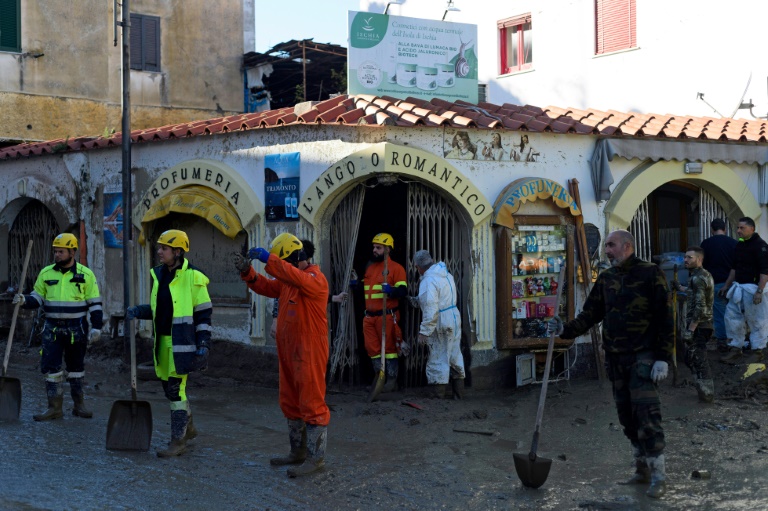
Search parties on Monday recovered the body of an eighth victim of a landslide on the small Italian island of Ischia, as a former mayor said his calls for an evacuation had been ignored.

A wave of earth and debris crashed through the small town of Casamicciola Terme amid heavy rains on Saturday, destroying houses and sweeping cars down to the sea.

The latest body to be recovered was a 15-year-old boy, killed along with his younger brother and sister. Four people are still missing, authorities said.

As the island mourned its dead, including a 21-day-old baby, it emerged Monday that former mayor Giuseppe Conte had called four days earlier for at-risk areas to be evacuated.

He sent 23 emails to authorities, but “nobody answered me,” he told the Corriere della Sera.

Geologist Aniello Di Iorio told the Corriere della Sera daily there were “high risks” of further landslides on parts of Ischia, a lush island near Capri that is thronged with tourists in summer.

Experts said the disaster was caused by a fatal mix of deforestation, overdevelopment, and a lack of mitigation strategies.

National Council of Architects head Francesco Miceli said it was “a tragedy foretold”.

“This is not an isolated case, the risk areas are numerous and affect many regions of our country,” he said.

Italy needs to “quickly define more incisive territorial control strategies (and) concrete intervention programmes, and disburse adequate resources”, he said.

The devastation in Ischia comes just weeks after 11 people died in heavy rain and flooding in the central Italian region of Marche.

Talks kick off on global plastic trash treaty

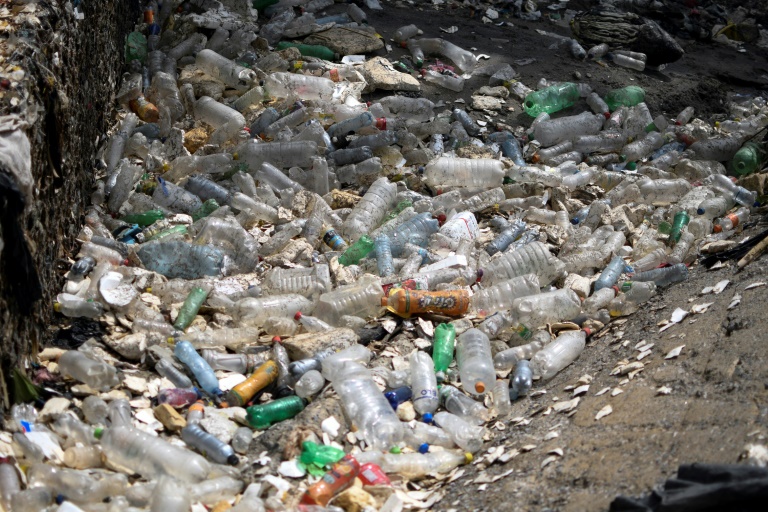
Despite decades of effort, plastic pollution is only getting worse — a gloomy fact that representatives of almost 200 nations meeting in Uruguay Monday are determined to change.

Delegates in the seaside city of Punta Del Este began charting a path to the first global treaty to combat plastic pollution.

“We know that the world has a significant addiction to plastic,” said Inger Andersen, Executive Director of the Nairobi-based United Nations Environment Programme, at the start of the talks.

“A plastic crisis is also a climate crisis. Plastic has a heavy carbon footprint and a heavy chemical footprint,” she said.

The Uruguay meeting comes after the parties at the UN Environment Assembly in Nairobi in March agreed to create an intergovernmental committee to negotiate and finalize a legally binding plastics treaty by 2024.

The decision was seen as the biggest environmental advance since the Paris Agreement to curb global warming was signed in 2015.

By some estimates, a garbage truck’s worth of plastic is dumped into the sea every minute. The amount of plastic entering the oceans is forecast to triple by 2040.

At the same time, microplastics have been found in human blood, lung, spleen, and kidney tissue, and even in fetal tissue.

Experts believe it is only an international, legally binding agreement that could truly begin to halt one of the worst environmental scourges on the planet — if there is enough political will.

The meeting in Uruguay will last for five days, and is only a first step in the negotiations process. Another four global meetings are planned to carry the process forward.

Technical matters, such as how to structure the two years of talks, or even what should be included in the treaty, are up for discussion.

“It is ambitious to end plastic pollution, but it is entirely doable,” said Andersen.

She said the delegates would work together to “transform the entire life cycle of plastic,” from the production of polymers, to the way brands and retailers use plastic, to the waste that emerges.

“That means working with the private sector, that means working with environmentalists, that means working with communities, that means strong political leadership,” said Andersen.

According to the World Wide Fund for Nature (WWF) the total plastic in the ocean has increased 50 percent in the past five years. This is despite a 60 percent increase in policies to fight plastic pollution on the country level.

“The unique potential of a global treaty is to hold all signatories to a high common standard of action,” the WWF said in a report on the treaty published this month.

US Supreme Court to hear immigration policy case

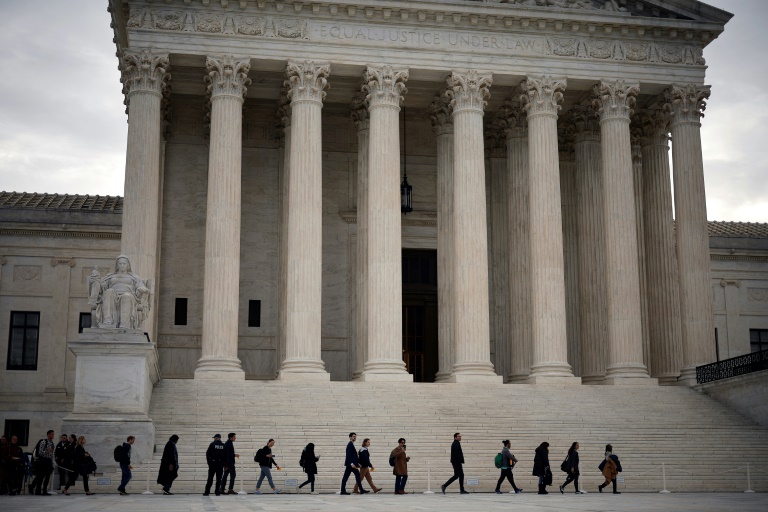
The US Supreme Court wades into the immigration debate on Tuesday as it examines the Biden administration’s expulsion policies for undocumented migrants.

The Homeland Security Department, in a September 2021 memo, instructed US Immigration and Customs Enforcement (ICE) to concentrate expulsion efforts on persons who “pose a threat to national security, public safety, and border security.”

“It is estimated that there are more than 11 million undocumented or otherwise removable noncitizens in the United States,” Homeland Security Secretary Alejandro Mayorkas said in the memo.

“We do not have the resources to apprehend and seek the removal of every one of these noncitizens,” Mayorkas said. “Therefore, we need to exercise our discretion and determine whom to prioritize for immigration enforcement action.”

The policy represented a shift from that of the administration of former Republican president Donald Trump which called for the expulsion of “all removable aliens.”

The Biden policy was immediately challenged by several Republican-led states as being too narrow and was blocked by a court in Texas.

The states argued that it imposes a heavy cost burden on the taxpayers because of the public services that would be needed to be provided to noncitizens.

The Biden administration challenged the Texas court’s ruling and the conservative majority Supreme Court will hear oral arguments in the case, United States vs Texas, on Tuesday.

The administration is arguing that a decision in Texas’s favor could have wide-ranging repercussions beyond immigration policy.

“Federal policies routinely have incidental effects on states’ expenditures, revenues, and other activities,” the government said in its brief.

“Yet such effects have never been viewed as judicially cognizable injuries,” it said. 

“As the recent explosion in state suits vividly illustrates, respondents’ contrary view would allow any state to sue the federal government about virtually any policy.”

The court is expected to issue its ruling by the end of June.

Britain U-turns over energy-saving publicity drive

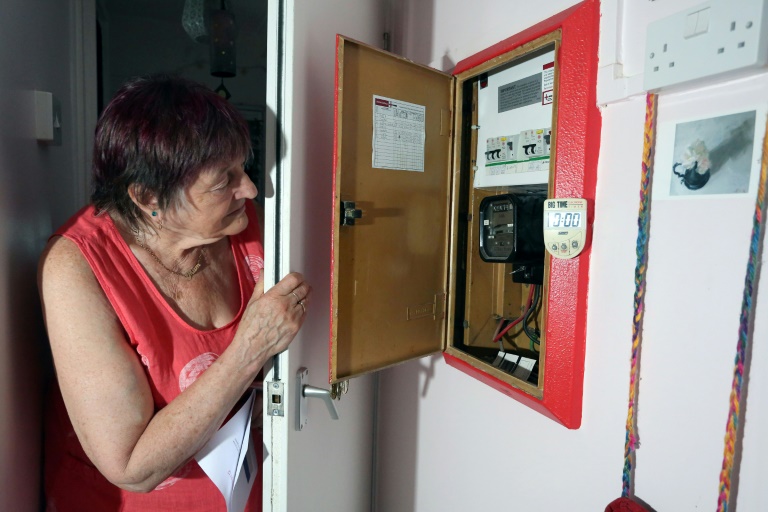
Britain on Monday unveiled an energy-saving campaign to encourage lower consumption this winter — a policy U-turn — and increased financial help for home insulation.

Prime Minister Rishi Sunak’s Conservative government announced the publicity blitz just two months after his short-lived predecessor, Liz Truss, ruled out such a move and ran into immediate criticism from opposition politicians and the green lobby.

The government is already partially subsidising rocketing electricity and gas bills after prices soared following the invasion of Ukraine by key fossil fuel producer Russia.

The publicity drive, costing £18 million ($22 million), will “demonstrate how consumers can make significant savings”, the Department for Business, Energy and Industrial Strategy said.

Advice will include measures such as lowering the temperature on boiler water heating systems, turning down radiators in unoccupied rooms and installing draught proofing on windows and doors.

“Our new public information campaign will also give people the tools they need to reduce their energy use while keeping warm this winter,” added Business and Energy Secretary Grant Shapps.

The government pledged another £1.0 billion in funds to help with home insulation. That will be on top of its existing £6.6-billion insulation help scheme.

The main opposition Labour party however criticised Monday’s news as a “reheated announcement with no new resources” that was “far too little, too late”.

Greenpeace UK energy campaigner Georgia Whitaker also warned the funding was not nearly enough.

“This is a drop in the ocean compared to what people actually need to stay warm and well this winter and in the winters to come,” Whitaker said.

Seven million households in Britain are currently in fuel poverty and unable to adequately heat their homes, according to the green pressure group.

Greenpeace also estimates that 19 million homes in England and Wales are poorly insulated.

Truss’s administration had insisted it would not give instructions on saving energy because she wanted to avoid accusations of running a “nanny state”.

Energy regulator Ofgem, however, has urged consumers to curb their energy usage as the colder northern hemisphere winter approaches, amid lingering fears of possible blackouts.

Austrian trains grind to halt as rail workers strike

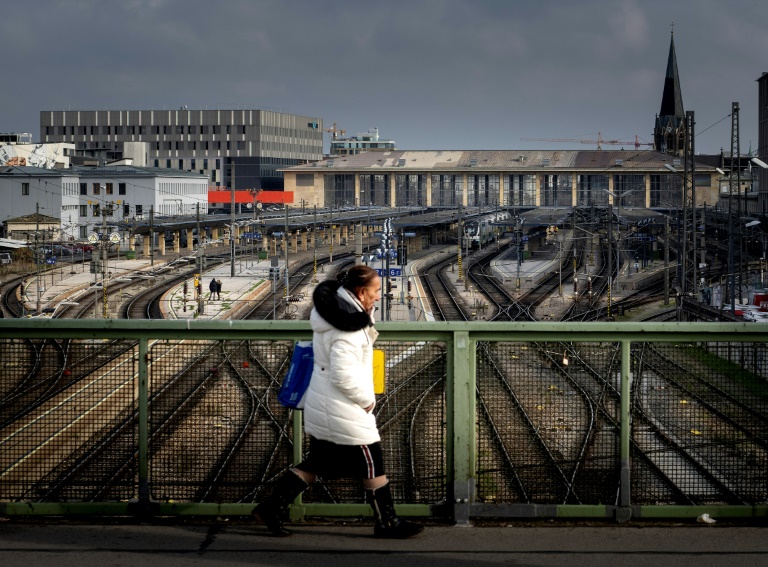
Trains across Austria ground to a halt Monday as rail workers went on a 24-hour strike to demand higher pay.

Usually bustling train stations were left deserted with about a million travellers left stranded. 

“The railway union vida is on strike today from 00:00 to 24:00. For this reason, no trains can run all day throughout Austria and across borders,” rail operator OeBB wrote on its website.

Vida said that negotiations to increase the salary of 50,000 railway workers had failed, accusing employers of “mocking” employees with a “bogus offer”.

Vida wants salaries to increase by 400 euros ($415) — instead of the 208 euros offered — to cushion the effects of surging inflation, which stood at 11 percent year on year in October.

Night train workers earn from 1,356 euros net per month, according to the union.

Strikes are rare in Austria. 

Wage increases are usually set by collective bargaining between the Austrian Economic Chambers and unions representing different branches.

In rail transport, the last strike lasting several days dates back to 2003.

Close Bitnami banner
Bitnami