AFP

Most Fed officials say slower rate hike pace appropriate 'soon'

A majority of US Federal Reserve policymakers found that a slower pace of interest rate hikes would “likely soon be appropriate,” the central bank said Wednesday.

The Fed has embarked on an aggressive path to cool demand and bring down prices as inflation in the world’s biggest economy surged to the highest level in decades, raising the benchmark borrowing rate six times this year.

With inflation hovering around 7.7 percent, the latest policy meeting in early November produced a fourth consecutive three-quarter point interest rate hike, a major rise.

This brings the rate to a range between 3.75 and four percent, the highest since January 2008.

But “a substantial majority of participants judged that a slowing in the pace of increase would likely soon be appropriate,” according to minutes of the November meeting released Wednesday.

“A slower pace in these circumstances would better allow the committee to assess progress toward its goals of maximum employment and price stability,” the minutes said.

Participants of the meeting noted that it would take time for the full effects of policy to be realized, and a few found that easing the pace of interest rate hikes could lower risks of instability in the financial system.

In a sign of diverging opinions, some cautioned the impact of rate hikes could “exceed what was required” to bring down inflation.

– Few signs of abating –

But policymakers agreed at the meeting earlier this month that inflation was “unacceptably high” and well above the longer-run goal of two percent.

Annual consumer inflation came in at 7.7 percent in October, down from a blistering high 9.1 percent in June but still underscoring a heightened cost of living.

With surging consumer prices showing “little sign thus far of abating,” some officials found that policy might have to be tightened more than anticipated.

They maintained that a period of slower growth would help reduce inflationary pressures.

Despite signs of slowing activity as the Fed’s rate hikes trickled through the economy, officials saw that the labor market remained tight, with elevated wage growth.

New home sales posted a surprise increase last month as well, while demand for big-ticket American-made goods picked up more than expected, data released on Wednesday showed.

“Policy makers appear set to slow the pace of rate hikes,” said economist Ryan Sweet of Oxford Economics.

But he noted that the Fed’s path toward a soft landing is increasingly narrow, adding that the Fed’s staff economists see “the odds of a US recession in the next year as basically a coin flip.”

A growing number of voices, including some Fed officials, have advocated for smaller steps in the coming months.

Last week, Federal Reserve Governor Christopher Waller said signs of easing inflation pressures and a slowing US economy could allow the central bank to dial back its pace of rate hikes.

Fed Vice Chair Lael Brainard also said last week that it would likely be “appropriate soon” for the Fed to slow the pace of rate increases, adding that it would take time for tightening so far to flow through to the economy.
Justice Dept seeks to question Pence in Capitol attack probe

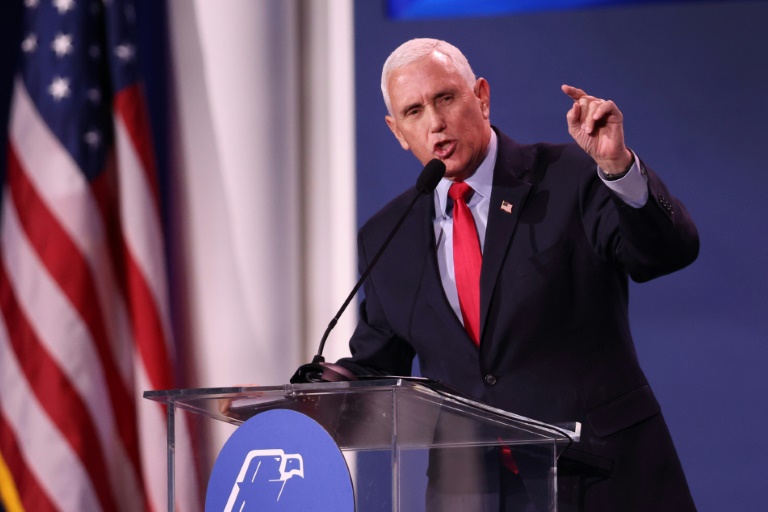
The US Justice Department is seeking to question former vice president Mike Pence about Donald Trump’s efforts to overturn the results of the 2020 presidential election, media reports said Wednesday.

The New York Times and other outlets said that Pence was considering the request to appear as a witness in the department’s criminal investigation into the actions of the former president.

US Attorney General Merrick Garland named a special counsel last week to oversee the two federal criminal probes into Trump, who has announced a new White House run in 2024.

One investigation is focused on the former president’s efforts to overturn the results of the 2020 election and the attack on the US Capitol by his supporters.

The other is a probe into a cache of classified government documents seized in an FBI raid on Trump’s Mar-a-Lago residence in Florida in August.

The special counsel will determine whether the former president should face any charges, though the attorney general will have the ultimate say on whether charges should be filed.

The Times said the request for Pence’s testimony was made before the appointment of the special counsel, Jack Smith.

Pence’s testimony could help shed light on Trump’s bid to block the January 6, 2021 certification by Congress of Democrat Joe Biden’s election victory.

Trump publicly pressured Pence, who presided over the session of Congress, not to certify the election results, but the vice president resisted his demands.

Pence has denounced Trump’s actions on January 6 as “reckless” but has declined to answer questions from a congressional committee investigating the Capitol attack.

But the Times said the former vice president was open to considering the Justice Department’s request for his testimony because it is a criminal investigation. He has not been formally subpoenaed.

Trump could try to block Pence’s testimony by citing executive privilege, as he has tried to do with other former officials who have been summoned for questioning in the probe.

Pence is believed to be considering a run for the Republican presidential nomination in 2024 but has not yet announced his candidacy.

Gucci parts ways with star designer Michele

Italian designer Alessandro Michele on Wednesday left Gucci, where he has overseen a surge in sales at the fashion powerhouse since 2015 but seen his star fade in recent seasons.

“Gucci today announces that Alessandro Michele is stepping down as creative director of Gucci,” said French conglomerate Kering, which owns the Italian house.

It said he had played “a fundamental part in making the brand what it is today through his groundbreaking creativity”.

Michele, in the same joint statement, said: “There are times when paths part ways because of the different perspectives each one of us may have.”

Kering said Gucci’s design office would “continue to carry the direction of the house forward until a new creative organisation” was announced.

Industry bible Women’s Wear Daily earlier on Wednesday said Michele was quitting after being asked to orchestrate a creative revamp to restore the brand’s lustre.

With his bookish chic looks and vintage mashups that harkened back to the 1970s and 80s, Michele helped turn the once-flagging house into a white-hot success, drawing in a new generation of fans with his anti-establishment veneer.

Michele also joined a handful of other designers by announcing in 2021 that the number of annual shows would be slashed from five to just two, saying that “clothes should have a longer life” and that his future collections would be “seasonless”.

Sales also got a boost from 2021’s Ridley Scott-directed “House of Gucci” film with Lady Gaga and a host of Hollywood A-listers.

But enthusiasm had begun to wane among industry insiders, according to WWD, with Kering CEO Francois-Henri Pinault eager for a quick change at the helm.

Pinault wished the designer a “great next chapter in his creative journey”.

“The road that Gucci and Alessandro walked together over the past years is unique and will remain as an outstanding moment in the history of the house,” he said.

Financial analysts at the brokerage firm Bernstein said earlier in a research note to clients: “Gucci is suffering from brand fatigue and Alessandro Michele has been doing the same thing for the past seven years.”

“Institutional investors appear to agree that a new approach is needed to relaunch the brand,” added analysts at Royal Bank of Canada.

Grinding inflation clouds 'Black Friday' shopping bonanza

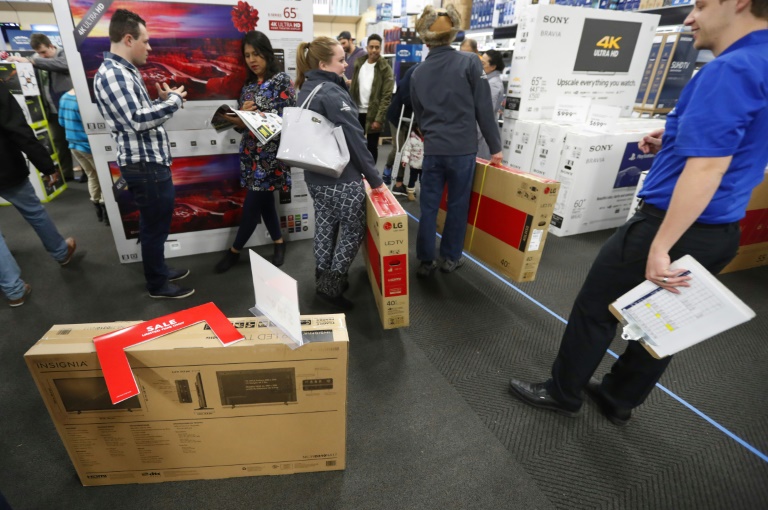
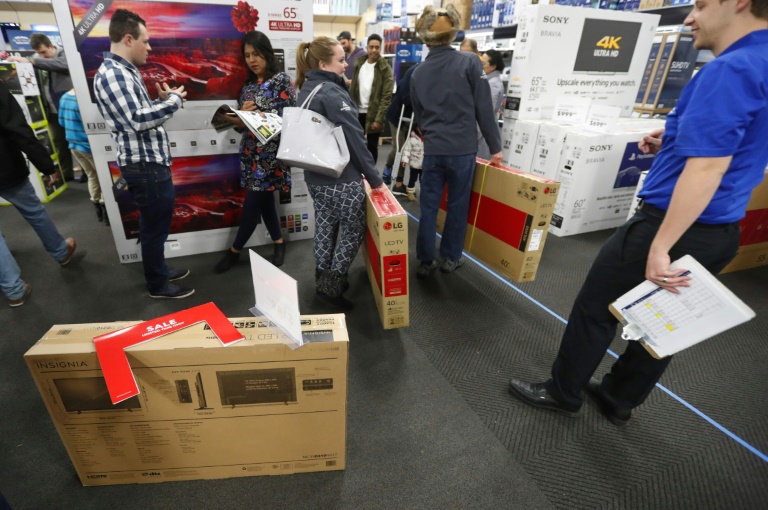
The Black Friday kickoff of the holiday shopping season is expected to bring especially deep discounts in 2022, but one challenge will be finding consumers confident enough to spend.

Grinding inflation in the world’s biggest economy in recent months has cast uncertainty over this year’s festive season, which kicks off the day after Thursday’s Thanksgiving holiday.

A year ago, retailers faced product shortfalls in the wake of shipping backlogs and Covid-19-related factory closures. To avert a repeat, the industry front-loaded its holiday imports this year, leaving it vulnerable to oversupply at a time when consumers are cutting back.

“Supply shortages was yesterday’s problem,” said Neil Saunders, managing director for GlobalData Retail, a consultancy. “Today’s problem is having too much stuff.”

Saunders said retailers have made progress in recent months in reducing excess inventories but that oversupply created banner conditions for bargain-hunters in many categories, including electronics, home improvement and apparel.

Juameelah Henderson always checks for sales, “but more so now,” she said while exiting an Old Navy store in New York with four bags of items.

The clothing chain’s prices were “pretty good,” she said. “If it’s not on sale, I really don’t need it.”

Higher costs for gasoline and household staples like meat and cereal are an economy-wide issue, but do not burden everyone equally.

“The lower incomes are definitely hit worst by the higher inflation,” said Claire Li, a senior analyst at Moody’s. “People have to spend on the essential items.” 

– Diminishing savings –

Leading forecasts from Deloitte and the National Retail Federation project a single-digit percentage increase, but it likely won’t exceed the inflation rate.

The consumer price index has been up about eight percent on an annual basis, which means that a similar size increase in holiday sales would equate with lower volumes.

US shoppers have remained resilient throughout the myriad stages of the Covid-19 pandemic, often spending more than expected, even when consumer sentiment surveys suggest they are in a gloomy mood.

Part of the reason has been the unusually robust state of savings, with many households banking government pandemic aid payments at a time of reduced consumption due to Covid-19 restrictions.

But that cushion is starting to whittle away. After hitting $2.5 trillion in excess savings in mid-2021, the benchmark fell to $1.7 trillion in the second quarter, according to Moody’s.

Consumers with incomes below $35,000 were affected the most, with their excess savings falling nearly 39 percent between the fourth quarter of 2021 and mid-2022, according to Moody’s.

Accompanying this drop has been a rise in credit card debt visible in Federal Reserve data and anecdotally described by chains that also report more purchases made with food stamps.

“We’re seeing continued pressure,” said Michael Witynski, chief executive of Dollar Tree, a discount retailer that has seen “shifts” in shoppers, “where they’re very consumable and needs-based focused to try and make that budget work and stretch it over the month.”

– Mixed picture –

Earnings reports from retailers in recent days have painted a mixed picture on consumer health.

Target stood on the downcast side of the ledger, pointing to a sharp decline in shopping activity in late October, potentially portending a weak holiday season.

The big-box chain expects a “very promotional” holiday season, said Chief Executive Brian Cornell.

“We’ve had a consumer who has been dealing with very stubborn inflation for quarter after quarter now,” Cornell said on a conference call with analysts. 

“They’re shopping very carefully on a budget, and I think they’re looking at discretionary categories and saying, ‘All right, if I’m going to buy, I’m looking for a great deal and a great value.'”

But Lowe’s, another big US chain specializing in home-improvement, offered a very different view, describing the same late-October period as “strong” and seeing no evidence of consumer deterioration.

“We are not seeing anything that feels or looks like a trade down or consumer pullback,” said Lowe’s Chief Executive Marvin Ellison.

Consumers like Charmaine Taylor, who checks airline websites frequently, are staying vigilant

Taylor thus far has been thwarted in her travel aspirations due to  exorbitant plane ticket prices. Taylor, who works in child care, isn’t sure how much she’ll be able to spend on family this year

“I’m trying to give them some little gifts,” Taylor said at a park in Harlem earlier this week. “I don’t know if I’ll be able to. Inflation is hitting pretty hard.”

jmb/tjj

Grinding inflation clouds 'Black Friday' shopping bonanza

The Black Friday kickoff of the holiday shopping season is expected to bring especially deep discounts in 2022, but one challenge will be finding consumers confident enough to spend.

Grinding inflation in the world’s biggest economy in recent months has cast uncertainty over this year’s festive season, which kicks off the day after Thursday’s Thanksgiving holiday.

A year ago, retailers faced product shortfalls in the wake of shipping backlogs and Covid-19-related factory closures. To avert a repeat, the industry front-loaded its holiday imports this year, leaving it vulnerable to oversupply at a time when consumers are cutting back.

“Supply shortages was yesterday’s problem,” said Neil Saunders, managing director for GlobalData Retail, a consultancy. “Today’s problem is having too much stuff.”

Saunders said retailers have made progress in recent months in reducing excess inventories but that oversupply created banner conditions for bargain-hunters in many categories, including electronics, home improvement and apparel.

Juameelah Henderson always checks for sales, “but more so now,” she said while exiting an Old Navy store in New York with four bags of items.

The clothing chain’s prices were “pretty good,” she said. “If it’s not on sale, I really don’t need it.”

Higher costs for gasoline and household staples like meat and cereal are an economy-wide issue, but do not burden everyone equally.

“The lower incomes are definitely hit worst by the higher inflation,” said Claire Li, a senior analyst at Moody’s. “People have to spend on the essential items.” 

– Diminishing savings –

Leading forecasts from Deloitte and the National Retail Federation project a single-digit percentage increase, but it likely won’t exceed the inflation rate.

The consumer price index has been up about eight percent on an annual basis, which means that a similar size increase in holiday sales would equate with lower volumes.

US shoppers have remained resilient throughout the myriad stages of the Covid-19 pandemic, often spending more than expected, even when consumer sentiment surveys suggest they are in a gloomy mood.

Part of the reason has been the unusually robust state of savings, with many households banking government pandemic aid payments at a time of reduced consumption due to Covid-19 restrictions.

But that cushion is starting to whittle away. After hitting $2.5 trillion in excess savings in mid-2021, the benchmark fell to $1.7 trillion in the second quarter, according to Moody’s.

Consumers with incomes below $35,000 were affected the most, with their excess savings falling nearly 39 percent between the fourth quarter of 2021 and mid-2022, according to Moody’s.

Accompanying this drop has been a rise in credit card debt visible in Federal Reserve data and anecdotally described by chains that also report more purchases made with food stamps.

“We’re seeing continued pressure,” said Michael Witynski, chief executive of Dollar Tree, a discount retailer that has seen “shifts” in shoppers, “where they’re very consumable and needs-based focused to try and make that budget work and stretch it over the month.”

– Mixed picture –

Earnings reports from retailers in recent days have painted a mixed picture on consumer health.

Target stood on the downcast side of the ledger, pointing to a sharp decline in shopping activity in late October, potentially portending a weak holiday season.

The big-box chain expects a “very promotional” holiday season, said Chief Executive Brian Cornell.

“We’ve had a consumer who has been dealing with very stubborn inflation for quarter after quarter now,” Cornell said on a conference call with analysts. 

“They’re shopping very carefully on a budget, and I think they’re looking at discretionary categories and saying, ‘All right, if I’m going to buy, I’m looking for a great deal and a great value.'”

But Lowe’s, another big US chain specializing in home-improvement, offered a very different view, describing the same late-October period as “strong” and seeing no evidence of consumer deterioration.

“We are not seeing anything that feels or looks like a trade down or consumer pullback,” said Lowe’s Chief Executive Marvin Ellison.

Consumers like Charmaine Taylor, who checks airline websites frequently, are staying vigilant

Taylor thus far has been thwarted in her travel aspirations due to  exorbitant plane ticket prices. Taylor, who works in child care, isn’t sure how much she’ll be able to spend on family this year

“I’m trying to give them some little gifts,” Taylor said at a park in Harlem earlier this week. “I don’t know if I’ll be able to. Inflation is hitting pretty hard.”

jmb/tjj

European Space Agency names new astronauts, agrees record budget

The European Space Agency announced five new career astronauts as well as history’s first astronaut recruit with a disability on Wednesday after adopting a record budget to fund its projects.

The two female and three male career astronauts “will start working immediately,” ESA director-general Josef Aschbacher told a ministerial council meeting in Paris.

From more than 22,500 applicants, the agency chose France’s Sophie Adenot, Spain’s Pablo Alvarez Fernandez, Britain’s Rosemary Coogan, Belgium’s Raphael Liegeois and Switzerland’s Marco Sieber.

“I’m European but from the UK,” Coogan told the ceremony. Though Britain has left the European Union, it remains in the ESA.

The new recruits start training next year and are not expected to blast off into space on a mission until 2026.

They will join the astronauts from the ESA’s previous 2009 astronaut class, which include Britain’s Timothy Peake and France’s Thomas Pesquet. It is from that previous class that an astronaut will be selected to go to the Moon as part of NASA’s Artemis mission.

“No one is retiring today,” Pesquet said, advising the new recruits to “hang on tight”.

The ESA also announced the first astronaut recruit with a physical disability, British doctor and Paralympian John McFall, who will join a separate “parastronaut feasibility programme”.

The 41-year-old’s right leg was amputated after a motorcycle accident at the age of 18. He became a sprinter, winning bronze at the 2008 Paralympics.

“It had been quite a whirlwind experience, given that as an amputee I’d never thought being an astronaut was a possibility,” he said.

The ESA also established an astronaut reserve of six women and five men who passed the selection process and can be called up in future if needed.

– New budget –

The new astronauts were named after two days of tough talks by ministers from the ESA’s 22 member states meeting in Paris to decide on the agency’s future funding. 

They settled on a budget of 16.9 billion euros ($17.5 billion) for the next three years, a 17-percent increase from the 14.5 billion euros agreed at the last ministerial council meeting in 2019. 

But it was well short of the 18.5 billion requested by Aschbacher.

“With inflation being so high, I have to say that I’m very impressed by this figure,” Aschbacher told the meeting. 

Aschbacher said the increased funds were necessary for Europe not to “miss the train” in the face of competition in space from the United States and China.

French Economy Minister Bruno Le Maire hailed a “great success” that was “beyond expectations”.

Negotiations about each country’s contribution continued until the last moment before the announcement.

The biggest contributors were Germany with 3.5 billion euros, France on 3.25 billion euros and Italy at 3.1 billion euros.

However the total committed remains far below NASA’s budget of $24 billion for 2022 alone.

Earth observation programmes, which monitor climate change back on Earth, had a six percent funding increase to almost 2.7 billion euros.

Robotic and human exploration’s budget jumped 36 percent to 2.7 billion, while telecommunications rose 19 percent to 1.9 billion euros.

– Rocket boost –

The budget for rocket launcher systems was increased by a third to 2.8 billion euros. 

Launchers, which were a subject of delicate negotiations, are crucial for Europe to be able send missions into space without outside help.

The ESA has struggled to get off the ground since Russia withdrew its Soyuz rockets earlier this year in response to European sanctions over Moscow’s invasion of Ukraine.

The job has been made more difficult by delays to its flagship Ariane 6 rocket, which was supposed to have its maiden flight in 2020 but will now blast off at the end of next year.

The ESA has even had to resort to using the Falcon 9 rockets of its rival SpaceX to launch two upcoming scientific missions.

The negotiations were given a boost on Tuesday when France, Germany and Italy announced their support for Ariane 6, the smaller Vega-C launcher and European-made micro and mini launch systems.

The ExoMars mission, which has been left without a ride after Russia withdrew its rockets, will go ahead with US help, Aschbacher said.

UK retailer Boohoo denies 'slave' labour claims

British online fashion retailer Boohoo on Wednesday denied allegations that staff in a UK warehouse worked in harrowing and health-threatening conditions and regarded themselves as “slaves”.

The Times newspaper, in an undercover investigation, reported that workers at Boohoo’s facility in Burnley, northwest England, complained of racism, sexual harassment, poor safety equipment, inadequate training and “gruelling” targets.

However, a Boohoo spokesperson said that it “does not believe the picture painted is reflective of the working environment at our Burnley warehouse”.

Boohoo “is taking every claim very seriously”, the spokesperson said, adding that making sure workers are safe and comfortable is the company’s “highest priority”.

The Times, whose undercover reporter worked at the warehouse for one month, said each staff member walked the equivalent of a half-marathon (13 miles, 21 kilometres) per shift.

Night-time summer temperatures reached up to 32 degrees Celsius (89.6 degrees Fahrenheit) and frequently collapsed, it alleged.

The daily added that Burnley employees are paid £11 ($13.25) per hour in shifts that are up to 12 hours long. 

Each staffer must fetch 130 items every hour, it said.

The online retail group has annual sales of almost £2.0 billion per year, and its chief executive was paid a £1.3 million bonus this year.

Boohoo had already been rocked last year by allegations that one of its suppliers in Leicester, central England, paid workers much less than the national minimum wage.

The group’s suppliers were meanwhile accused also of underpaying staff in Pakistan.

Boohoo benefited from an online sales boom during the pandemic, during which it expanded aggressively to snap up brands belonging to collapsed UK retail giants. 

It bought fashion labels Burton, Wallis and Dorothy Perkins from Arcadia, as well as assets of failed UK department store Debenhams.

The company employs about 5,000 people worldwide, according to its website.

UK defends Brexit deal despite economic woes

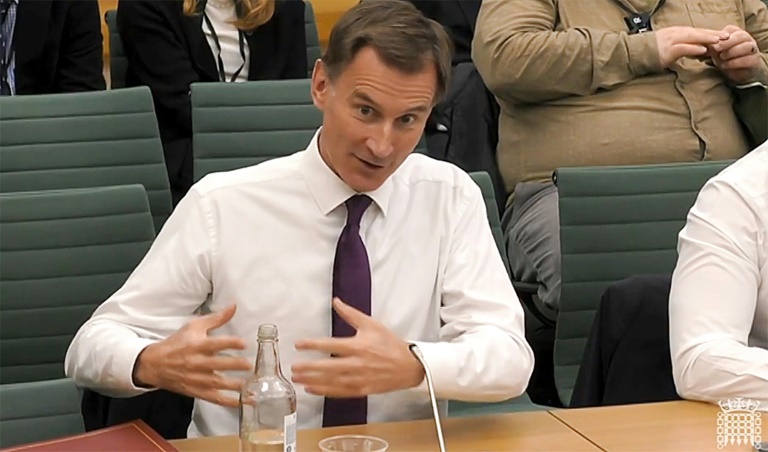
Finance minister Jeremy Hunt on Wednesday defended the UK’s post-Brexit trade deal with the EU, despite growing criticism about its economic impact, and rejected claims he was pushing for closer European ties.

Hunt, who voted to remain in the European Union at the 2016 referendum, was rumoured to be the source of a report last weekend that the government was eyeing a “Swiss-style” deal with Brussels.

But he scotched talk he was the “senior government figure” quoted in the article, which has threatened to reopen deep divisions in the ruling Conservatives over the form Brexit should take.

The government supports the trade and cooperation agreement (TCA) struck with the EU, he told the influential cross-party Treasury Committee in parliament.

“We think it is an excellent agreement,” he added.

“We do not support, we would not contemplate, I do not support, I have never contemplated, any agreement which means moving away from the TCA.

“That means we are not negotiating or deciding the regulations that we want as sovereign equals, paying unnecessary money to the EU or indeed compromising on freedom of movement.

“That has always been my position as Chancellor (of the Exchequer).”

He added: “With respect to the story in the Sunday Times, if you’re saying was the Treasury, was I, the source for any suggestion we should seek to renegotiate the TCA to move it towards an agreement more like the agreement with Switzerland, the answer is no.”

– Tough going –

Former UK prime minister Theresa May proposed a similar deal, which was roundly rejected by lawmakers, and which contributed to her downfall in 2019.

May’s successor, Boris Johnson, railroaded his own “harder” Brexit deal through parliament on the back of a landslide 2019 general election win fought on a campaign to “get Brexit done”.

But despite promises of greater freedoms to set policy and chart its own course in the world, the UK has found post-Brexit life tough going, even without the shock of the Covid pandemic.

The Bank of England and the government’s independent spending watchdog have both said Brexit has hurt the UK economy and plunged it to the brink of recession.

On Tuesday, the Organisation for Economic Co-operation and Development forecast the UK economy would contract more than any of the world’s seven most advanced nations next year.

Many critics have partly blamed the fallout from Brexit, which saw the UK withdraw from the European single market and customs union, and end free movement between member states.

Switzerland has far closer ties with the bloc through bilateral agreements allowing access to the single market, a high degree of free movement and by paying into EU coffers.

But on Monday, British Prime Minister Rishi Sunak ruled out pursuing “any relationship with Europe that relies on alignment with EU laws” as eurosceptic Tories warned of backsliding.

The European Commission says no Swiss-style deal is on the table.

Hunt last week hiked taxes and slashed spending, to try to reverse unfunded tax cuts by his predecessor Kwasi Kwarteng, under short-lived premier Liz Truss, that sparked markets chaos and worsened a cost-of-living crisis of high energy bills and inflation.

Hunt also suggested on Wednesday that support for householders would not be extended beyond early 2024, even if energy bills remain elevated.

Embattled Credit Suisse expects Q4 pre-tax loss

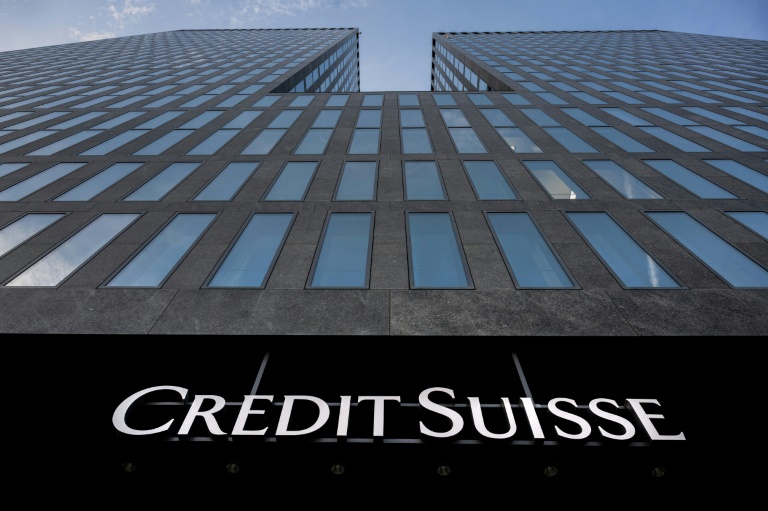
Credit Suisse predicted a surprise fourth-quarter pre-tax loss of up to $1.6 billion as the beleaguered bank undertakes a radical overhaul, sending stocks tumbling again on Wednesday.

Shaken by repeated scandals, Switzerland’s second-biggest bank unveiled a rejig in late October but accepted its accounts would take a hit of up to 1.5 billion Swiss francs ($1.6 billion) in the final three months of the year.

At the close, the group’s shares were down 6.1 percent at 3.62 Swiss francs, while the Swiss stock exchange’s main SMI index was up 0.2 percent.

At an extraordinary general meeting, shareholders approved capital increases worth around four billion Swiss francs in order to fund the restructuring plan.

Chairman Axel Lehmann called it an “important step in our journey to build the new Credit Suisse”.

“This vote confirms confidence in the strategy, as we presented it in October, and we are fully focused on delivering our strategic priorities to lay the foundation for future profitable growth,” he said.

The increase in share capital is expected to boost Credit Suisse’s CET1 ratio, which compares a bank’s capital to its risk-weighted assets.

The bank suffered a net loss of 273 million Swiss francs in the first quarter, then nearly 1.6 million in the second quarter and four billion in the third.

The scale of fourth-quarter losses “will depend on a number of factors including the investment bank’s performance for the remainder of the quarter, the continued exit of non-core positions, any goodwill impairments, and the outcome of certain other actions, including potential real-estate sales”, the Zurich-based bank said in a statement.

Credit Suisse said in October that it expected to incur restructuring charges and software and property impairments of around 250 million Swiss francs in the fourth quarter as part of its overhaul.

– Question of trust –

The bank’s reorganisation is aimed at dramatically reducing the scale of its investment bank, in a bid to repair the damage following a series of scandals.

In addition to revamping its investment banking unit, the bank announced measures including slashing 9,000 jobs and a capital injection from the Saudi National Bank.

However, the restructuring takes place in an unfavourable context for the banking sector.

Its investment bank suffered the backlash of the “substantial industry-wide slowdown” in capital markets and reduced activity in the sales and trading markets, it said.

“The bank expects these market conditions to continue in the coming months.”

Andreas Venditti, an analyst at Swiss investment managers Vontobel, said the “massive net outflows” in wealth management — the bank’s core business alongside its Swiss domestic banking — “are deeply concerning — even more so as they have not yet reversed.

“Credit Suisse needs to restore trust as fast as possible — but that is easier said than done.”

Flora Bocahut, an analyst at the US investment bank Jefferies, added: “Today’s update confirms our concerns that the Credit Suisse ship is yet to stabilise, and it’ll get worse before it potentially gets better.”

– Archegos, Greensill shocks –

Credit Suisse’s capital-guzzling investment banking arm has been the source of heavy losses which plunged its accounts into the red — eclipsing its more stable activities such as wealth management or its Swiss domestic banking services.

Credit Suisse’s investment bank suffered a loss of 3.7 billion Swiss francs in 2021 and backed that up with a 992 million Swiss franc loss in the first half of 2022.

It was hit by the implosion of US fund Archegos, which cost Credit Suisse more than $5 billion.

Meanwhile its asset management branch was rocked by the bankruptcy of British financial firm Greensill, in which some $10 billion had been committed through four funds.

Credit Suisse is one of 30 banks globally deemed too big to fail, forcing it to set aside more cash to weather a crisis.

While many industry experts think a bankruptcy highly improbable, these rumours helped drag its share price down to a low of 3.158 Swiss francs on October 3.

European, US stocks held back by economic gloom

European and US stocks made modest gains on Wednesday on news that major economies contracted in November and as traders looked ahead to Federal Reserve committee minutes.

Paris and London closed in positive territory and Wall Street gained around 0.2 percent in early deals, while Frankfurt ended flat.

The eurozone’s composite purchasing managers index (PMI), a key economic indicator, improved from 47.3 in October to 47.8 in November, S&P Global said.

But activity languished under 50 — signifying the fifth consecutive month of economic contraction as inflation spikes and dampening the outlook for the fourth quarter.

The United States’ composite PMI hit a three-month low of 46.3 in November, down from the October figure of 48.2, with services business activity and manufacturing output data also falling.

Traders were expecting the results of a meeting of the influential Federal Open Market Committee in the United States.

“It’s been a fairly lacklustre session as investors weigh up the release of tonight’s FOMC minutes against a backdrop of a weakening economic outlook,” noted Michael Hewson, chief market analyst at CMC Market UK.

“Stock markets have remained supported as optimism over a less hawkish Fed is outweighing growth concerns. But I can’t imagine investors will continue to take excessive risk heading into a potential recession,” said City Index analyst Fawad Razaqzada.

– ‘Recession is inevitable’ –

Britain’s composite PMI was fractionally higher, from 48.2 to 48.3 in November, but that marked the fourth straight contraction.

The news comes after the UK government recently confirmed that the nation’s economy was in recession, with inflation sitting at a 41-year high.

“Both data suggest that recession is inevitable in both eurozone and UK economies, with the UK likely to be designated officially before the eurozone due to the weaker Q3 data,” Monex Europe analyst Maria Marcos told AFP.

Oil prices slid on disappointing US data and fears of more painful Covid lockdowns in China that could ravage the Asian giant’s energy demand.

The main American oil contract, West Texas Intermediate, briefly sank by more than five percent on Wednesday on China concerns and the underwhelming US data.

Reports that the European Union is considering a price cap on Russian crude and pessimistic global growth forecasts by the OECD are also holding back prices, according to analysts.

“With China also grappling with record numbers of Covid cases the macro-outlook has continued to deteriorate for oil this week, with prices on course to decline for the third week in a row,” said Hewson.

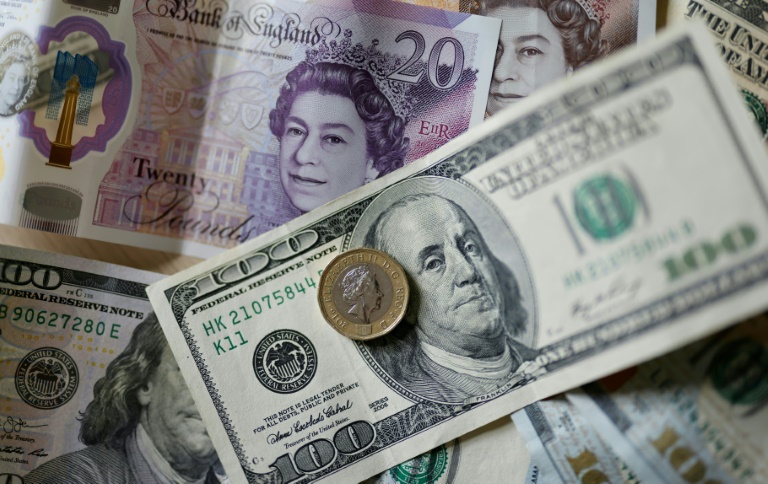
The dollar sank more than one percent against the British pound and weakened against other rival currencies as investors mulled mixed earnings and economic data.

“The US dollar fell sharply again today as concerns intensified that the economy is heading for a recession after a poor set of PMI numbers came out from the services and manufacturing sectors,” said Razaqzada.

“An economic slowdown is expected to weigh on inflation, reducing the need for the Fed to maintain an aggressive tightening stance.”

– Key figures around 1630 GMT –

London – FTSE 100: UP 0.2 percent at 7,465.24 points (close)

Paris – CAC 40: UP 0.3 percent at 6,679.09 (close)

Frankfurt – DAX: FLAT at 14,427.59 (close)

EURO STOXX 50: UP 0.4 percent at 3,946.44

New York – Dow: UP 0.2 percent at 34,175.97

Hong Kong – Hang Seng Index: UP 0.6 percent at 17,523.81 (close)

Shanghai – Composite: UP 0.3 percent at 3,096.91 (close)

Tokyo – Nikkei 225: closed for a holiday

Euro/dollar: UP at $1.0367 from $1.0304 on Tuesday

Dollar/yen: DOWN at 139.69 yen from 141.23 yen

Pound/dollar: UP at $1.2071 from $1.1886

Euro/pound: DOWN at 85.89 pence from 86.69 pence

West Texas Intermediate: DOWN 4.5 percent at $77.30 per barrel

Brent North Sea crude: DOWN 3.8 percent at $84.34 per barrel

Close Bitnami banner
Bitnami