AFP

Credit Suisse expects Q4 pre-tax loss of $1.6 bn

Credit Suisse predicted a surprise fourth-quarter pre-tax loss of up to $1.6 billion as the beleaguered bank undertakes a radical overhaul, sending stocks tumbling again on Wednesday.

Shaken by repeated scandals, Switzerland’s second-biggest bank unveiled a rejig in late October but accepted its accounts would take a hit of up to 1.5 billion Swiss francs ($1.6 billion) in the final three months of the year.

At an extraordinary general meeting, shareholders approved capital increases worth around four billion Swiss francs in order to fund the restructuring plan.

Chairman Axel Lehmann called it an “important step in our journey to build the new Credit Suisse”.

“This vote confirms confidence in the strategy, as we presented it in October, and we are fully focused on delivering our strategic priorities to lay the foundation for future profitable growth,” he said.

The increase in share capital is expected to boost Credit Suisse’s CET1 ratio, which compares a bank’s capital to its risk-weighted assets.

At 1200 GMT, the group’s shares were down 4.8 percent at 3.67 Swiss francs, while the Swiss stock exchange’s main SMI index was up 0.2 percent.

The bank suffered a net loss of 273 million Swiss francs in the first quarter, then nearly 1.6 million in the second quarter and four billion in the third.

The scale of fourth-quarter losses “will depend on a number of factors including the investment bank’s performance for the remainder of the quarter, the continued exit of non-core positions, any goodwill impairments, and the outcome of certain other actions, including potential real-estate sales”, the Zurich-based bank said in a statement.

Credit Suisse said in October that it expected to incur restructuring charges and software and property impairments of around 250 million Swiss francs in the fourth quarter as part of its overhaul.

– Question of trust –

The bank’s reorganisation is aimed at dramatically reducing the scale of its investment bank, in a bid to repair the damage following a series of scandals.

In addition to revamping its investment banking unit, the announced measures include slashing 9,000 jobs and a capital injection from the Saudi National Bank.

However, the restructuring takes place in an unfavourable context for the banking sector.

Its investment bank suffered the backlash of the “substantial industry-wide slowdown” in capital markets and reduced activity in the sales and trading markets, it said.

“The bank expects these market conditions to continue in the coming months.”

Andreas Venditti, an analyst at Swiss investment managers Vontobel, said the “massive net outflows” in wealth management — the bank’s core business alongside its Swiss domestic banking — “are deeply concerning — even more so as they have not yet reversed.

“Credit Suisse needs to restore trust as fast as possible — but that is easier said than done.”

Flora Bocahut, an analyst at the US investment bank Jefferies, added: “Today’s update confirms our concerns that the Credit Suisse ship is yet to stabilise, and it’ll get worse before it potentially gets better.”

– Archegos, Greensill shocks –

Credit Suisse’s capital-guzzling investment banking arm has been the source of heavy losses which plunged its accounts into the red — eclipsing its more stable activities such as wealth management or its Swiss domestic banking services.

Credit Suisse’s investment bank suffered a loss of 3.7 billion Swiss francs in 2021 and backed that up with a 992 million Swiss franc loss in the first half of 2022.

It was hit by the implosion of US fund Archegos, which cost Credit Suisse more than $5 billion.

Meanwhile its asset management branch was rocked by the bankruptcy of British financial firm Greensill, in which some $10 billion had been committed through four funds.

Credit Suisse is one of 30 banks globally deemed too big to fail, forcing it to set aside more cash to weather a crisis.

While many industry experts think a bankruptcy highly improbable, these rumours helped drag its share price down to a low of 3.158 Swiss francs on October 3.

At least six killed in US Walmart shooting

A gunman killed at least six people at a Walmart store Tuesday just ahead of the Thanksgiving holiday in the second mass shooting in the United States in four days.

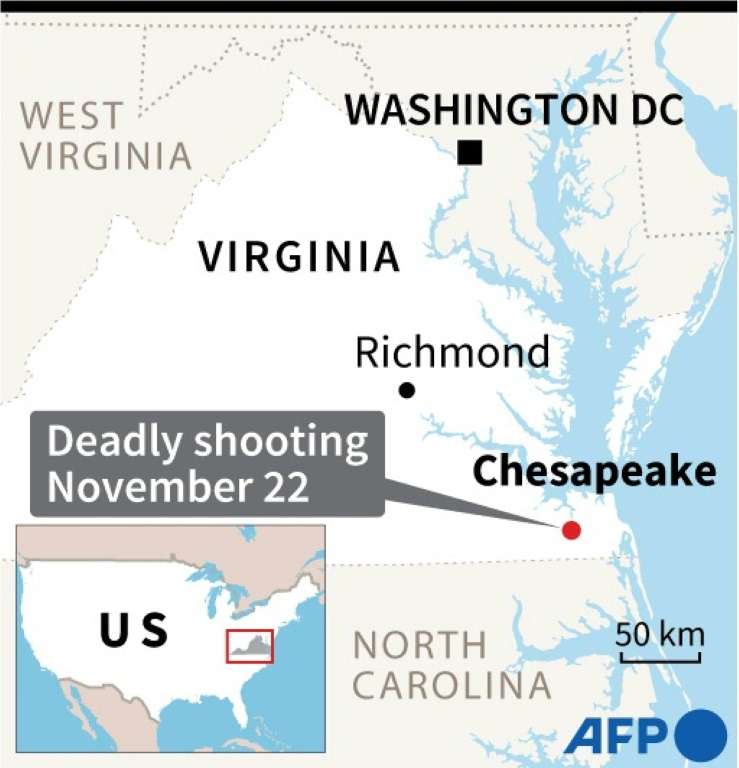
Police said the shooter was also dead after the late-night assault in Chesapeake in the state of Virginia that followed a weekend gun attack at an LGBTQ club in Colorado that killed five people.

“Chesapeake Police confirm 7 fatalities, including the shooter, from last night’s shooting at Walmart on Sam’s Circle,” the city confirmed on its Twitter account.

Chesapeake Police Department officer Leo Kosinski earlier told reporters that there had been multiple fatalities at the megastore, which local media reported was busy with holiday shoppers.

CNN quoted a law enforcement source as saying the attacker was believed to be an employee or former employee of the store who started shooting other workers in a room used for staff breaks.

At some point the shooter turned the gun on himself, CNN quoted the source as saying.

Emergency calls were first made just after 10:00 pm Tuesday (0300 GMT Wednesday) while the store was still open, with rapid response officers and tactical teams entering immediately after arriving on the scene, Kosinski said.

US media reported that witnesses said the shooting began at the back of the store and that at least five wounded had been rushed to the hospital. 

“We believe it is a single shooter and that single shooter is deceased at this time,” Kosinski said, adding he did not believe any shots had been fired by police.

In the hours afterwards, news footage showed a major police presence around the Walmart, which is located about 150 miles (240 kilometers) southeast of the US capital Washington.

– ‘Senseless violence’ –

Kosinski said officers and investigators were carefully sweeping the store and securing the area.

Walmart, the largest retailer in the United States, issued a statement early Wednesday saying: “We are shocked at this tragic event.” 

The company added that it was “praying for those impacted, the community and our associates. We’re working closely with law enforcement, and we are focused on supporting our associates.”

Virginia state Senator Louise Lucas, who represents the Chesapeake region, said she was “heartbroken that America’s latest mass shooting took place… in my district.”

“I will not rest until we find the solutions to end this gun violence epidemic in our country that has taken so many lives,” she wrote on Twitter.

The shooting occurred at a major retailer less than 48 hours before Americans nationwide celebrate Thanksgiving.

“Tragically, our community is suffering from yet another incident of senseless gun violence just as families are gathering for Thanksgiving,” tweeted Congressman Bobby Scott of Virginia.

The incident occurred three nights after a gunman opened fire inside an LGBTQ nightclub in Colorado Springs, killing five people and injuring at least 18, in what is being investigated as a possible hate crime.

Authorities said that suspect, identified as 22-year-old Anderson Lee Aldrich, had used a long rifle at the club, where partygoers were marking the Transgender Day of Remembrance, which pays tribute to trans people targeted in violent attacks.

Gun violence occurs at an alarming rate in the United States, where more than 600 mass shootings have occurred so far in 2022, according to the Gun Violence Archive website.

European equities waver on economic gloom

European stock markets wavered on Wednesday on news that the eurozone and UK economies shrank in November, but by less than the prior month.

In midday deals, Frankfurt equities fell 0.2 percent and Paris flatlined, while London won 0.3 percent.

Oil prices slid on fears of more painful Covid lockdowns in China that could ravage the Asian giant’s energy demand. 

The euro steadied against the dollar and yen.

– ‘Grim picture’ –

The eurozone’s composite purchasing managers index (PMI), a key economic indicator, improved from 47.3 in October to 47.8 in November, S&P Global said.

However, activity languished under 50 — signifying the fifth consecutive month of economic contraction as inflation spikes.

“The latest macroeconomic data from Europe continues to paint a grim picture,” said City Index analyst Fawad Razaqzada.

“Flash manufacturing and services PMIs for France and Germany, and eurozone as a whole, remain in contraction territory.

“Although the PMI data still managed to beat expectations, that’s only because we are seeing improvement from a very low base.”

Britain’s composite PMI was also fractionally higher, from 48.2 to 48.3 in November, but that marked the fourth straight contraction.

The news comes after the UK government recently confirmed that the nation’s economy was in recession, with inflation sitting at a 41-year high.

The reading is “consistent with our view that the (British) economy is probably already in recession”, noted Capital Economics analyst Ashley Webb.

Elsewhere, Asian stocks rose on hopes that the Federal Reserve will carry out smaller US rate hikes at its next few meetings after inflation cooled in the world’s biggest economy.

But there is growing concern that a surge in China’s Covid-19 cases will see officials impose more economically-damaging restrictions.

Wall Street on Tuesday enjoyed a timely rally thanks to healthy retailer earnings amid signs US consumers — the economy’s key driver — remain resilient to higher borrowing costs and inflation.

Minutes from the Fed’s policy meeting this month will be pored over when they are released Wednesday, with traders hoping for some insight into the bank’s thinking on rates.

However, US trading volumes are likely to be muted ahead of Thanksgiving on Thursday.

Traders were also keeping tabs on protests at the world’s largest iPhone factory as Foxconn workers grow increasingly angry at long-running Covid curbs.

– Key figures around 1200 GMT –

London – FTSE 100: UP 0.3 percent at 7,473.95 points

Paris – CAC 40: FLAT at 6,659.70

Frankfurt – DAX: DOWN 0.2 percent at 14,401.20

EURO STOXX 50: UP 0.1 percent at 3,935.38

Hong Kong – Hang Seng Index: UP 0.6 percent at 17,523.81 (close)

Shanghai – Composite: UP 0.3 percent at 3,096.91 (close)

Tokyo – Nikkei 225: Closed for a holiday

New York – Dow: UP 1.2 percent at 34,098.10 (close)

Euro/dollar: UP at $1.0315 from $1.0304 on Tuesday

Dollar/yen: UP at 141.45 yen from 141.23 yen

Pound/dollar: UP at $1.1938 from $1.1886

Euro/pound: DOWN at 86.39 pence from 86.69 pence

West Texas Intermediate: DOWN 2.1 percent at $79.22 per barrel

Brent North Sea crude: DOWN 2.3 percent at $86.32 per barrel

burs-rfj/bcp/kjm

European equities waver on economic gloom

European stock markets wavered on Wednesday on news that the eurozone and UK economies shrank in November, but by less than the prior month.

In midday deals, Frankfurt equities fell 0.2 percent and Paris flatlined, while London won 0.3 percent.

Oil prices slid on fears of more painful Covid lockdowns in China that could ravage the Asian giant’s energy demand. 

The euro steadied against the dollar and yen.

– ‘Grim picture’ –

The eurozone’s composite purchasing managers index (PMI), a key economic indicator, improved from 47.3 in October to 47.8 in November, S&P Global said.

However, activity languished under 50 — signifying the fifth consecutive month of economic contraction as inflation spikes.

“The latest macroeconomic data from Europe continues to paint a grim picture,” said City Index analyst Fawad Razaqzada.

“Flash manufacturing and services PMIs for France and Germany, and eurozone as a whole, remain in contraction territory.

“Although the PMI data still managed to beat expectations, that’s only because we are seeing improvement from a very low base.”

Britain’s composite PMI was also fractionally higher, from 48.2 to 48.3 in November, but that marked the fourth straight contraction.

The news comes after the UK government recently confirmed that the nation’s economy was in recession, with inflation sitting at a 41-year high.

The reading is “consistent with our view that the (British) economy is probably already in recession”, noted Capital Economics analyst Ashley Webb.

Elsewhere, Asian stocks rose on hopes that the Federal Reserve will carry out smaller US rate hikes at its next few meetings after inflation cooled in the world’s biggest economy.

But there is growing concern that a surge in China’s Covid-19 cases will see officials impose more economically-damaging restrictions.

Wall Street on Tuesday enjoyed a timely rally thanks to healthy retailer earnings amid signs US consumers — the economy’s key driver — remain resilient to higher borrowing costs and inflation.

Minutes from the Fed’s policy meeting this month will be pored over when they are released Wednesday, with traders hoping for some insight into the bank’s thinking on rates.

However, US trading volumes are likely to be muted ahead of Thanksgiving on Thursday.

Traders were also keeping tabs on protests at the world’s largest iPhone factory as Foxconn workers grow increasingly angry at long-running Covid curbs.

– Key figures around 1200 GMT –

London – FTSE 100: UP 0.3 percent at 7,473.95 points

Paris – CAC 40: FLAT at 6,659.70

Frankfurt – DAX: DOWN 0.2 percent at 14,401.20

EURO STOXX 50: UP 0.1 percent at 3,935.38

Hong Kong – Hang Seng Index: UP 0.6 percent at 17,523.81 (close)

Shanghai – Composite: UP 0.3 percent at 3,096.91 (close)

Tokyo – Nikkei 225: Closed for a holiday

New York – Dow: UP 1.2 percent at 34,098.10 (close)

Euro/dollar: UP at $1.0315 from $1.0304 on Tuesday

Dollar/yen: UP at 141.45 yen from 141.23 yen

Pound/dollar: UP at $1.1938 from $1.1886

Euro/pound: DOWN at 86.39 pence from 86.69 pence

West Texas Intermediate: DOWN 2.1 percent at $79.22 per barrel

Brent North Sea crude: DOWN 2.3 percent at $86.32 per barrel

burs-rfj/bcp/kjm

Indonesia quake survivors appeal for supplies as rain hampers rescue

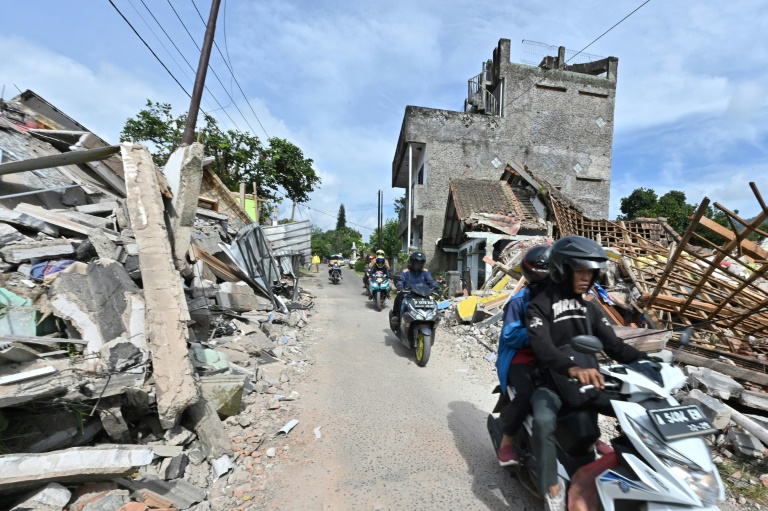
Survivors of an Indonesian earthquake that killed at least 271 people, many of them children, appealed for food and water Wednesday as heavy rain and aftershocks hampered rescue efforts among the rubble of devastated villages.

The calls for help came as authorities warned that debris from landslides caused by the strong quake near the town of Cianjur in West Java needed to be cleared as rains forecast for the coming weeks threatened a second disaster.

Two days after the quake flattened their homes, residents were still trying to retrieve priceless belongings including family photos, religious books and marriage certificates.

“Although some supplies have arrived, it is not enough. We got rice, instant noodles, mineral water but it’s not enough,” Mustafa, a 23-year-old resident of Gasol village, told AFP. 

Mustafa had just dug through the rubble of an elderly neighbour’s house at her request, appearing from the destroyed facade carrying a pile of clothes before returning to collect rice, a gas stove, canisters and frying pans.

In Talaga village, some residents put signs on the windows of damaged houses and the front of tents that read “We need help!” 

In the streets, at least three people held up cardboard boxes, asking for donations. Evacuees crammed under flimsy tents, unable to move inside from the rain in case buildings collapse from an aftershock.

A shallow 3.9-magnitude aftershock sent panicked evacuees running from shelters on Wednesday, according to an AFP reporter at the scene. Authorities had recorded 171 aftershocks as of Wednesday evening.

More than 61,000 people have been displaced by the quake, around 2,000 are injured and 40 missing, the national disaster mitigation agency (BNPB) said Wednesday. 

Around a third of those found dead so far are believed to be children, BNPB chief Suharyanto, who like many Indonesians goes by one name, told a press conference, without providing an exact figure.

The government has dispatched tents and other supplies to Cianjur for the displaced, and the military deployed 12,000 personnel on Wednesday, officials said.

Heavy rain was hampering those efforts in about a dozen villages where more than 22,000 houses had been destroyed.

“For the refugees… their basic life necessities must be guaranteed — water, food, that’s non-negotiable,” Suharyanto said.

– Hamlet buried –

Two villages remain isolated, said Henri Alfiandi, head of Indonesia’s search and rescue authority Basarnas, in a video posted to social media. 

He said he had received reports of villagers trapped without food and water, and some forced to sleep alongside dead bodies.

“The people there can’t even ask for help,” he said, adding that three helicopters were being sent to drop aid.

Another hamlet in Cugenang district, the worst-hit by the quake, was buried by a landslide, Muhammad Wachyudin, an official from the Cianjur disaster mitigation agency, told AFP.

Rescuers believed some bodies were buried in Kampung Pos but they have not been able to reach them.

Indonesia is vulnerable to landslides and flash floods in the rainy season, which has already begun and peaks in December in West Java. 

The country’s meteorology agency warned that Cianjur is prone to another catastrophe.

“We have to be vigilant over a potential second disaster, such as a landslide,” Dwikorita Karnawati, head of the meteorology, climatology and geophysics agency told a press conference Tuesday.

Karnawati said rivers could be blocked by landslides or rubble and spark a flash flood in Cianjur.

“We urgently need to clear materials and rubble that block river flows in the upper hills,” she said.

– ‘Praise God!’ –

On Tuesday, Cianjur’s residents began mourning loved ones, laying them to rest in accordance with their Islamic faith after authorities released them from morgues.

Some searched the wreckage for belongings. For one couple, there was a glimmer of hope.

Mimin, 52, and her husband Rosyid, 67, scrabbled through their destroyed home looking for one item only — a treasured two-gram gold ring. 

They pulled clothes from the concrete, patting and shaking them, until the gleaming piece of jewellery that represented their savings popped out.

“Praise God! I found the ring!” Mimin yelled.

Indonesia experiences frequent seismic and volcanic activity due to its position on the Pacific “Ring of Fire”, where tectonic plates collide.

Monday’s tremor was the deadliest in the archipelago nation since a 2018 quake and resulting tsunami killed more than 4,000 people on the island of Sulawesi.

A greener ride: West Africans switch on to electric motorbikes

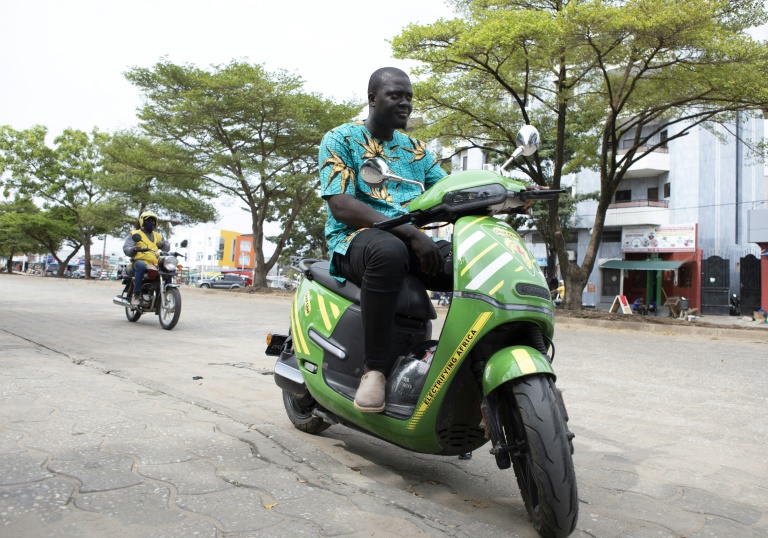
Beninese hairdresser Edwige Govi makes a point these days of using electric motorbike taxis to get around Cotonou, saying she enjoys a ride that is quiet and clean.

Motorcycle taxis are a popular and cheap form of transportation in West Africa. 

But in Benin and Togo, electric models are gaining the ascendancy over petrol-powered rivals.

Customers are plumping for environmentally-friendlier travel and taxi drivers are switching to machines that, above all, are less expensive to buy and operate. 

“They are very quiet and do not give off smoke,” says Govi, 26, who had just completed a half-hour run across Benin’s economic hub.

In African cities, road pollution is becoming a major health and environment issue, although for taxi drivers, the big attraction of electric motorcycles is the cost.

“I manage to get by,” said Govi’s driver, Octave, wearing the green and yellow vest used by Benin’s zemidjan taxis — a word meaning “take me quickly” in the local Fon language. 

“I make more money than with my fuel motorcycle.”

Local environmentalist Murielle Hozanhekpon said the electric motorbikes do have some disadvantages “but not on an environmental level”.

Alain Tossounon, a journalist specialising in environmental issues, said electric bikes were prized by taxi drivers as they were less expensive to maintain or run.

The cost factor has become more and more important in the face of an explosion of fuel prices this year triggered by Russia’s invasion of Ukraine.

– Credit carrot –

In Benin, an electric motorcycle costs 480,000 CFA ($737 / euros) against 490,050 CFA ($752 / euros) for a petrol-driven equivalent.

But this significant price difference is only one factor which explains the trend towards “silent motorcycles,” said Tossounon. 

Many taxi drivers are also lured by flexible credit deals — instead of making a hefty one-off purchase, many are able to get loans that they pay off monthly, weekly or even daily. 

Two companies in Cotonou have been offering electric models and say they are overwhelmed by demand. 

“The queue here is from morning to evening. Every hour, at least two roll out of the shop,” said vendor Anicet Takalodjou. 

Oloufounmi Koucoi, 38, director of another company delivering the models to Cotonou, said they had put thousands of e-motorcycles in circulation.

“The number is growing every day.” 

By assembling the motorcycles locally in Benin, his electric models are cheaper than if they had been imported. 

To attract customers, his company, Zed-Motors, offers solar panels to facilitate recharging for those who do not have electricity at home. 

For decades, Benin and its economy have struggled with power cuts. The situation has improved, but outages remain common.

In rural areas, especially, electricity remains largely inaccessible.

 – Battery change – 

In Lome, capital of neighbouring Togo, Octave de Souza parades proudly through the streets on his brand-new green electric motorcycle. 

One point in particular makes him and his wallet happy: no more fuelling up.

“All you need to do is change the battery,” he smiled. “There are sales outlets, you go there and it’s exchanged for you.” 

A recharge costs 1,000 CFA ($1.50 / euros) and can provide three days’ mobility. For the same price, Octave said, he would only be able to ride for one day using petrol, which is subsidised by the government.

Local authorities also are encouraging the switch to electric in a bid to replace old, highly polluting motorcycles. 

But some drivers remain wary of electric models, citing range anxiety — the worry of coming to a halt with a flat battery.

Taxi driver Koffi Abotsi said he struggled with the “stress” of having to quickly find a charging station so as not to break down. 

“This sometimes leads us to swap (the battery) even with 10 percent or 15 percent charge remaining so as not to have any unpleasant surprises along the way.”

European Space Agency to vote on record budget, name new astronauts

The European Space Agency will vote on Wednesday on whether to spend billions more euros to keep up with rising competition in space, as well as unveiling its much-anticipated new crop of astronauts.

The ESA’s 22 member states, whose ministers charged with space duties have been meeting in Paris since Tuesday, will decide on meeting the agency’s request for a record 18.7 billion euros for new programmes over the next three years.

The figure is more than 25 percent higher than the 14.5 billion euros agreed at the ESA’s last ministerial council in 2019.

ESA director-general Josef Aschbacher told AFP that Europe risks “falling out of the race” in space if it does not expand the budget. 

Europe faces an increasingly crowded market in space, with competition coming not just from the long-dominant United States but also from rising powers such as China and private companies like billionaire Elon Musk’s SpaceX.

However the request for countries to open their purse strings comes as Europe struggles against high inflation and an energy crisis.

France called for a united Europe in space on Tuesday.

“At the end of these discussions, there must be a single Europe, a single European space policy and unfailing unity in the face of Chinese ambitions and American ambitions,” France’s economy minister Bruno Le Maire said at the meeting.

“If we want to be independent, we have to put money on the table.”

At the opening of the council, Aschbacher stressed that nations would reap a huge economic benefit from their investments.

Each country can choose how much it contributes to the budget, which includes three billion euros for monitoring climate change, 3.3 billion to the Ariane 6 rocket launcher system and three billion to robotic exploration missions, among others projects.

– Rocket launcher boost –

Some of the most difficult negotiations have been about rocket launchers, which are crucial for Europe to be able launch missions into space without outside help.

The ESA has struggled to get off the ground since Russia withdrew its Soyuz rockets earlier this year in response to European sanctions over Moscow’s invasion of Ukraine.

The job has been made more difficult by delays to the next-generation Ariane 6, which was supposed to have its maiden flight in 2020 but will now blast off at the end of next year.

The ESA has even had to resort to using the Falcon 9 rockets of its rival SpaceX to launch two upcoming scientific missions.

The subject of launchers is regularly a source of “friction” between European countries, said Philippe Baptiste, head of France’s National Centre for Space Studies.

But the talks were given a boost on Tuesday when the ESA’s biggest contributors France, Germany and Italy announced their support for Ariane 6 as well as the small Vega-C launcher.

The agreement indicated that the countries recognised their “interdependence” in space and paved the way for the launchers to be paid for, said ESA’s director of space transportation Daniel Neuenschwander.

Expected to be less controversial are projects that help monitor the impact of climate change back on Earth.

A poll released by the ESA last week showed that nine of 10 European citizens “want to see space used even more to monitor and mitigate climate change,” Aschbacher said.

But trickier could be the ESA’s 750-million-euro contribution to the European Union’s satellite constellation project Iris, which is planned to provide secure communication throughout the bloc from 2027.

The project is mostly funded by the EU, which has different member states than the ESA — most notably the UK. 

– New astronauts –

Once the budget is adopted, the ESA plans to unveil its latest crop of astronauts — the agency’s first new recruits since 2009. 

Between four and six people have been chosen out of more than 22,500 applicants after a long selection process.

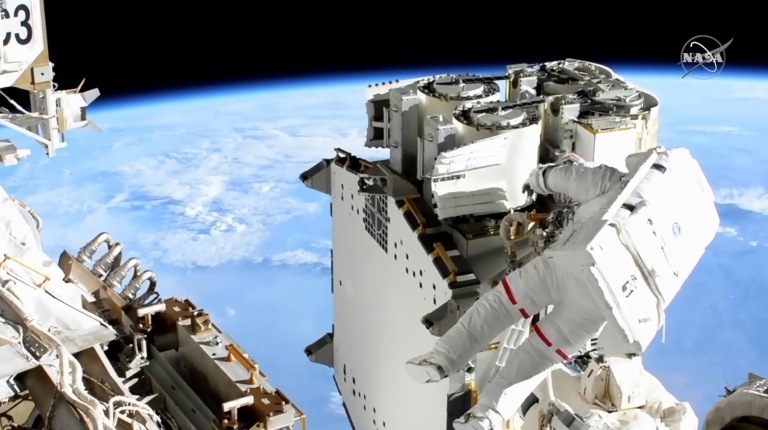
One of the new recruits could eventually head to the International Space Station.

Training for the new recruits will begin in April 2023 at the European Astronaut Centre in Cologne, Germany, the facility’s head Frank De Winne said.

Additionally, the ESA is also expected to announce one or more astronauts with a physical disability — a first in the history of space travel. 

More than 250 people applied for the role after the ESA conducted a “parastronaut feasibility study”.

Grief-stricken goodbye for Indonesia father killed in quake

When Husein’s body arrived to be lowered into the ground, his grief-stricken relatives broke down, some in wails so loud they echoed through the undulating hills of West Java’s Cianjur.

The 48-year-old construction worker and father of four, who like many Indonesians goes by one name, was building a house with three others when a strong earthquake shook the town’s foundations on Monday.

It caused buildings to collapse on residents, landslides to bury locals and forced families to reckon with the trauma of losing those closest to them. One of Husein’s co-workers also died.

“This is a disaster,” said Husein’s 30-year-old niece Yunisa Yuliani at his funeral in the village of Gasol near Cianjur, one of the hardest hit by the quake that has killed 268 people.

“It’s so hard to even look at his children, they are so young. They keep asking about their father. How do I explain it to them?”

Staring at his body, which had been carried for the duration of a five-minute walk from the construction site, his sister who lived next door to him became inconsolable. 

Several of his nieces hugged each other tightly. A tearful man was so heartbroken he had to be held up by two of his friends.

“I just lost a brother 10 days ago. He died of appendicitis and now I lost another brother,” said Husein’s 43-year-old sister Siti Rohmah.

– ‘Uncle! Uncle!’ –

Husein left behind a three-year-old daughter who does not fully understand that she has lost her father.

His eldest son, in his 20s, watched the digging of his grave quietly as his seven-year-old son cried in a relative’s arms and neighbours began a cleaning ritual for his body.

His wife could not be at the funeral as she was working in Saudi Arabia.

It was a scene replicated across the Cianjur area as families retrieved their loved ones from morgues to bury them in hastily arranged ceremonies in accordance with their Islamic beliefs.

“I still held on to hope that he was the last person who was still missing. I pray God will accept his good deeds and give him an easy journey,” said Rohmah.

His body was laid on a tarpaulin spread out on a dirt road, wrapped in a white cloth and covered by a traditional orange Indonesian batik shawl. A dozen men stood and prayed over him.

As Husein was lowered into a makeshift grave, men chanted a prayer while others looked at the ground solemnly.

His body was covered with a stack of bamboo and large banana leaves before bystanders covered the grave with soil.

Neighbours then began to recite Islamic verses for the departed.

“I just hope my uncle died in peace,” said Yuliani.

Before Husein’s body was collected for burial, it was placed in a red and white tent where it could be cleaned, and where the family could get one last look at his face.

His family’s wails broke an eery silence that had descended on the town in the quake’s aftermath.

“Uncle! Uncle!” is all that could be heard from the enclosed marquee.

Report lays bare Australia's 'sobering' climate challenge

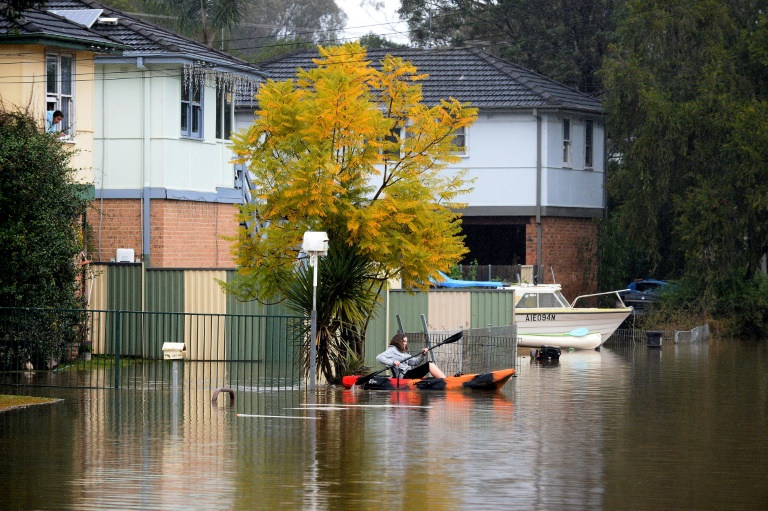
Rising temperatures are fuelling widespread environmental degradation across Australia and supercharging natural disasters, according to a government report released Wednesday in the wake of flash floods on the country’s east coast.

The State of the Climate report found global warming was also slowly melting Australia’s fragile alpine regions while contributing to ocean acidification and rising sea levels. 

Climate researcher Ian Lowe said the report was a “frightening” wake-up call for Australia, which relies heavily on coal and gas exports for economic growth.  

“The scale of changes demonstrates that cleaning up our energy use is an urgent priority,” Lowe said. 

“We also need to reduce our exports of coal and gas.” 

The report, a joint effort between the government’s weather bureau and national science agency, found Australia’s climate had warmed by an average of 1.47 degrees Celsius since records began in 1910. 

Environment Minister Tanya Plibersek said it was “sobering” reading. 

“For our environment, for our communities, this report reinforces the urgent need for climate action,” she said. 

– ‘Record-breaking extremes’ –

Australia has in recent years experienced a series of extreme weather events linked to rising global temperatures. 

Flash floods swept through parts of inland New South Wales earlier this month, tearing entire homes from their foundations in some country towns.

Tens of thousands of Sydney residents were ordered to evacuate in July when floods swamped the city’s fringe.

An east coast flooding disaster in March — caused by heavy storms in Queensland and New South Wales — claimed more than 20 lives.

Catastrophic bushfires swept through huge chunks of New South Wales in the “Black Summer” of 2019 and 2020, while the Great Barrier Reef has suffered four separate mass coral bleaching events since 2016. 

“These changes are happening at an increased pace,” the State of the Climate report found. 

“The past decade has seen record-breaking extremes leading to natural disasters that are exacerbated by anthropogenic (human-caused) climate change.”

Prime Minister Anthony Albanese last week unveiled a bid to host the 2026 COP summit, seeking to repair Australia’s international reputation as a climate change laggard. 

Albanese’s centre-left government introduced a 2050 net zero emissions target following its election earlier this year but has faced calls domestically to do more. 

University of Melbourne climate scientist Andrew King said Australia needed to rapidly cut its carbon emissions. 

“The consequences of our continued use of fossil fuels are clear in Australia like elsewhere,” he said. 

“We must act quickly to decarbonise our economy to limit further damages from worsening extreme events.” 

Ailie Gallant from the Australia Centre of Excellence for Climate Extremes said the deterioration in the country’s climate would “continue without deep and aggressive cuts to carbon emissions”.

In US, inflation sparks tough Thanksgiving meal sacrifices

Sandra White normally has turkey for Thanksgiving dinner. But on Thursday, due to soaring inflation, she’s going to have fried chicken instead.

“It’s too expensive, too expensive,” the 70-year-old White, a resident of East Harlem, says of the traditional holiday bird. 

She asked her guests to bring other parts of the meal.

It’s the same story for fellow shopper Yeisha Swan, but she got lucky: one of her loved ones bought the family fowl, and she was able to cut costs on the side dishes, which for many are just as important as the main course.

“This is way less than what I would buy. I couldn’t get my ham…. I’m using canned collard greens. It’s different,” Swan, 42, tells AFP outside a New York supermarket.

Inflation is red-hot in the United States, reaching the highest levels in decades this year. And while some prices have eased in recent months, consumers say they are straining to handle their grocery bills — a tough blow at the holidays.

Compounding that problem is a bird flu outbreak that forced the culling of about 50 million poultry, including eight million turkeys, according to calculations based on US Department of Agriculture data.

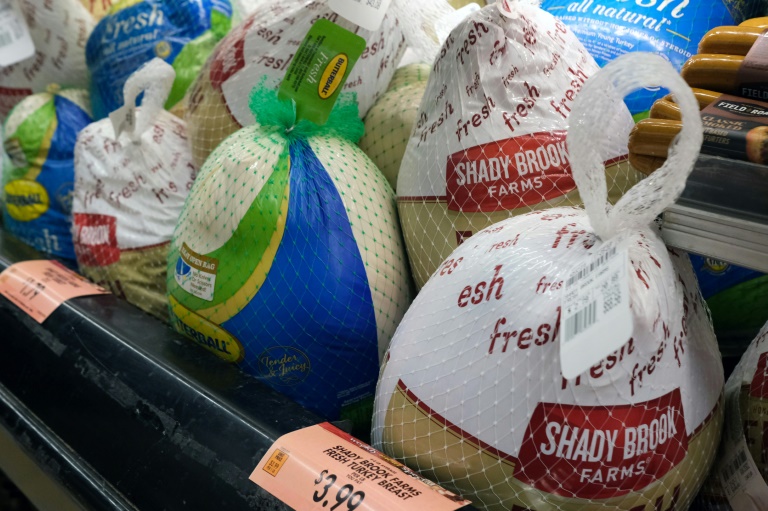
Turkey costs 21 percent more in the United States than it did last year, according to the American Farm Bureau.

– ‘Had to really cut back’ –

The turkey is not the only component of a classic Thanksgiving meal that is more pricey. A Farm Bureau survey showed that cubed stuffing mix was 69 percent more expensive as compared with last year.

The only must-have with a price drop? Cranberries.

An average meal for 10 this year — including turkey, stuffing, peas, sweet potatoes, cranberries, carrots, rolls and pumpkin pie — will cost $64.05, or 20 percent more than in 2021, the Farm Bureau said.

“I just had to really cut back…. We used to have a party and we couldn’t do that for Thanksgiving,” says chef Jose Rodriguez. Instead of an open house for all of his loved ones, he will eat with his wife and their two dogs.

Although turkey prices have jumped, demand has not completely collapsed.

At Wendel’s Poultry Farm near Buffalo, New York — which emerged unscathed from the bird flu crisis — all 1,100 Thanksgiving turkeys were sold out. Customers can already place an order for a Christmas bird.

In order to make up for increasing costs of raw materials, Wendel’s hiked its prices by 22 percent, explains manager Cami Wendel.

Retail giant Walmart went in the opposite direction, offering its Thanksgiving basket, including a turkey, for the same price as last year. Its low prices have allowed it to make inroads in the grocery market since inflation took off.

Close Bitnami banner
Bitnami